


























25.5 C
Bangkok
Saturday, June 20, 2026
Home Blog Page 3142

Southern Unrest: 'Drunk' Private Kills 3 Soldiers

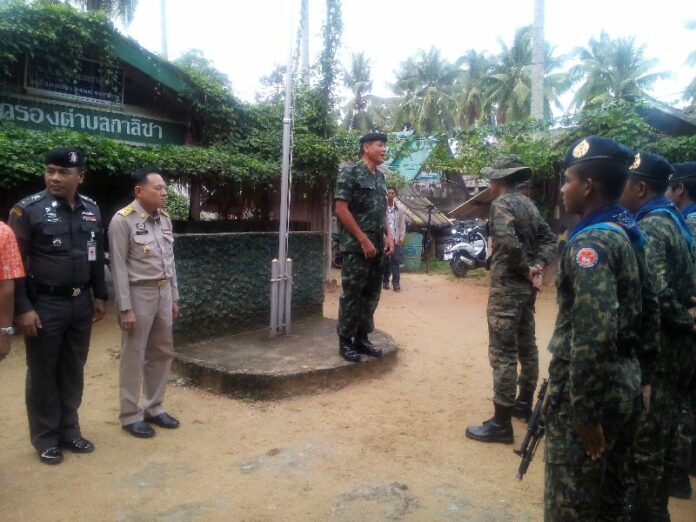
Soldiers guard a school in Narathiwat province on 6 Nov 2014.

PATTANI — Three soldiers were killed and two others seriously injured in the tumultuous southern province of Pattani after a private opened fire during a heated argument this morning, officials said.

Prior to the shootings, the soldiers were drinking alcohol in a boy scout camp in Bo Thong district, which also serves as a barrack for troops stationed in the province, police officers at Nong Chik Police Station told reporters.

The soldiers were members of a task force stationed in Pattani to combat Islamist separatist groups that have been mounting attacks against security forces in the region. 

After an argument between the men escalated, the private fetched his automatic rifle and opened fire on the group, killing three, police say.

The private, who has not been identified by name, reportedly tried to commit suicide afterwards but survived. He has been sent to a hospital along with the two other soldiers who were wounded in the shooting. 

Police say they are investigating whether the private has had any history of stress caused by operations in the region. 

The incident came several days after the Internal Security Operation Command (ISOC) announced a plan to establish a new "marine" unit to combat Islamic insurgents in Pattani and its two neighbouring provinces, Yala and Narathiwat. 

Tens of thousands of troops, policemen, and armed volunteers are already deployed in the three border provinces, known as the 'Deep South,' where more than 6,000 people have been killed since separatist violence broke out in 2004. 

Human rights activists have documented many cases of brutality and abuse of power by security forces in the region, which has alienated much of the Muslim-dominated populace from Thai authorities. 

In August, a volunteer ranger admitted to killing a local 14-year-old boy and planting a firearm on his body to falsely implicate him as an insurgent. 

A month later, the court threw out a lawsuit by a man who alleged that security officers in Narathiwat province tortured his brother during his military custody. According to the court, the lawsuit's claim that Thai citizens are protected from human rights abuses under the 2007 Constitution was invalid because the charter was dissolved following the military coup in May 2014. 


Read more:
Military To Send More Guns, Volunteers To Restive South
Rights Group Urges Prosecution of Troops For Killing Teenager in Deep South
Southern Schools Re-Open Amid Assassination Sprees


For comments, or corrections to this article please contact: [email protected]

You can also find Khaosod English on Twitter and Facebook
http://twitter.com/KhaosodEnglish
http://www.facebook.com/KhaosodEnglish
 

Advertisement

230,000 Baht Water Bill Declared Error

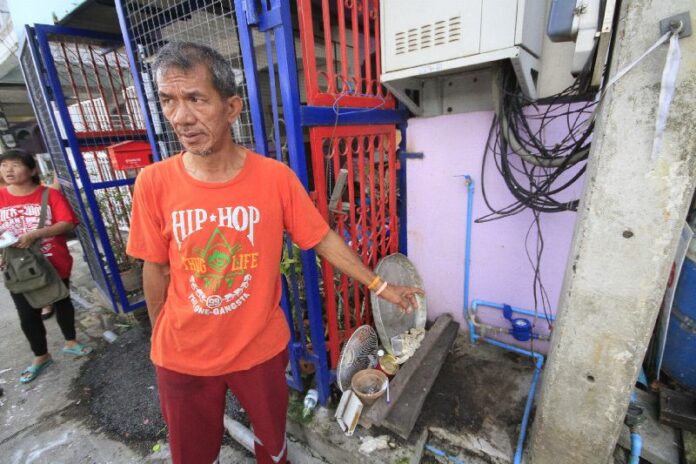
Wiriya Saenmai, 53, received a bill that claimed he owed the state 233,647 baht for using more than 9 million litres of water in a single month.

AYUTTHAYA — Thailand’s Provincial Waterworks Authority has admitted to mistakenly billing a man from Ayutthaya province more than 233,000 baht for a monthly water bill.

Wiriya Saenmai, 53, said he was shocked to receive a bill that claimed he owed the state 233,647 baht for using more than 9 million litres of water in a single month. 

"I couldn't sleep at all. My blood pressure went up," said Wiriya, who works as a local rescue volunteer. "I kept asking my wife how we are going to pay the bill. I was very stressed."

The water bill was particularly surprising for Wiriya because his family mostly uses groundwater reserves and only resorts to state water on some days, he said.

 "Usually I only pay 80-100 baht in water bill."

Officials at the Provincial Waterworks Authority later clarified that the mistake was the result of a new meter installed in Wiriya’s house.

The bill has now been voided, officials said.

After hearing the explanation, Wiriya told reporters that he wishes the Waterworks Authority would have been more careful. He added that the agency should not repeat the mistake, especially with elderly people who have heart conditions.

"They may have a heart attack and die," Wiriya warned. 

 
For comments, or corrections to this article please contact: [email protected]

You can also find Khaosod English on Twitter and Facebook
http://twitter.com/KhaosodEnglish
http://www.facebook.com/KhaosodEnglish
Advertisement

Laotian Women Rescued From Thai 'Karaoke' Brothels

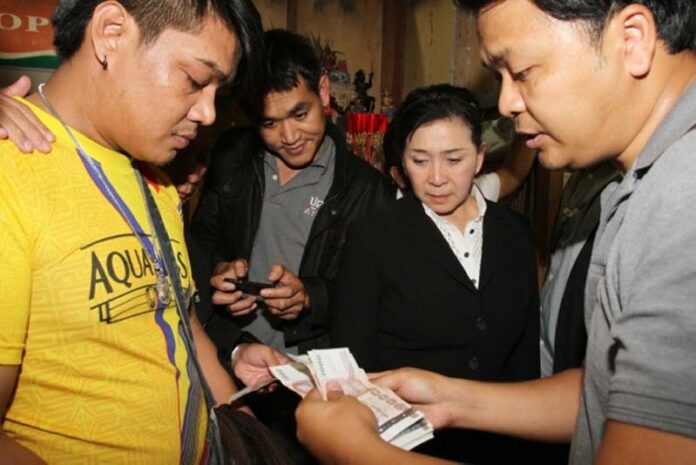
Police officers count money seized from the brothel in Nakhon Pathom province, 5 November 2014.

NAKHON PATHOM — Police say they have rescued 23 young Thai and Laotian women who were allegedly being held captive in a karaoke shop in central Nakhon Pathom where they were forced into prostitution.

Anti-human trafficking police organized the raid following a tip off from an NGO worker who received a text message from one of the women seeking help. Sixteen of the victims are under the age of 18, police say.

One of the victims told police she came to Nakhon Pathom several months ago after a Thai dealer offered her a job at Nong Fuse karaoke bar, where she was told she would earn more money than she did in Laos.

However, the woman said that she has been forced to sleep with customers and is only earning around 200 baht of the 1,000 baht each client is charged.

According to police, no arrests have been made yet as the karaoke bar’s owners appear to have fled the premises before the raid.

The victims are now staying at a state-run shelter home for mental and physical recovery, a police officer said.

On the same day, police also raided a brothel in Udon Thani and rescued four Laotian women, thanks to a tip off from another NGO organisation. A woman has been arrested on suspicion of human trafficking and running a prostitution ring. 

Thailand is a major source, transit, and destination for sex trafficking. The majority of sex workers in Thailand are foreigners from neighboring countries and more than two thirds of them are under the age of 18.


For comments, or corrections to this article please contact: [email protected]

You can also find Khaosod English on Twitter and Facebook
http://twitter.com/KhaosodEnglish
http://www.facebook.com/KhaosodEnglish
Advertisement

Junta Leader Chides Newspapers' Use of Dramatic Headlines

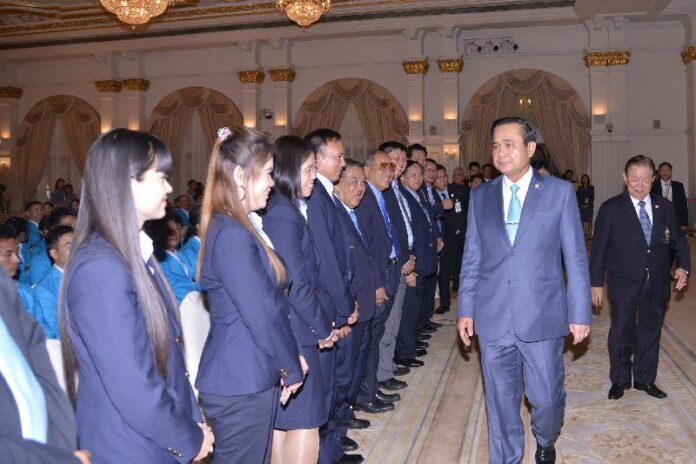
Prime Minister and chairman of Thailand’s military junta Prayuth Chan-ocha with athletes preparing for the 2014 Asia Beach Games at the Government House, 5 Nov 2014.

BANGKOK — The Prime Minister and chairman of Thailand’s military junta has asked newspapers not to describe him with dramatic or "negative" language, a government spokesperson says.

Gen. Prayuth Chan-ocha is concerned that the media’s use of colourful language will affect his credibility as a strong, serious leader, said Maj.Gen. Sansern Kaewkamnert, deputy spokesperson of the Office of Prime Minister.

"The Prime Minister believes that some words have a negative tone," Maj.Gen. Sansern said. "We are not sure how these words were invented." 

He cited Thai words like wo (to claim), foong (to suggest some incredible plan), pad (to deny), tee peep (to advertise one's achievement), and huem (to be angry), which are routinely used by Thai-language newspapers in headlines and leads about Gen. Prayuth. 

"These words are negative and un-constructive. When the public hear these words, they feel that the official described in the news is not credible," Maj.Gen. Sansern told reporters in a press conference yesterday. 

He added that Gen. Prayuth is still concerned by "some newspapers" that continue to "present news that contradicts with reality."

"The Prime Minister has already explained that some information presented by the media is not accurate, and has shown what is correct," Maj.Gen. Sansern said. "[The official information] is backed by evidence, reasons, document, and existing operation. However, certain media agencies still present the same pieces of information without regards to what the officials have tried to explain."

Gen. Prayuth, who came to power by staging a coup against the elected government on 22 May, is increasingly seen as an authoritarian leader with a growing cult of personality. As the chairman of the military junta, which has retained absolute power over his semi-civilian government, Gen. Prayuth has banned all public protests against his regime and urged the media to refrain from criticising his missions.

Gen. Prayuth has also antagonised a number of reporters by scolding at them at press conferences for asking questions about the country's administration. 

In late September, Gen. Prayuth went as far as threatening to throw the podium at a reporter who asked if the general would run as Prime Minister in the next election. 

 
For comments, or corrections to this article please contact: [email protected]

You can also find Khaosod English on Twitter and Facebook
http://twitter.com/KhaosodEnglish
http://www.facebook.com/KhaosodEnglish
Advertisement

Thai Govt Promises 'Colour-Blind Constitution'

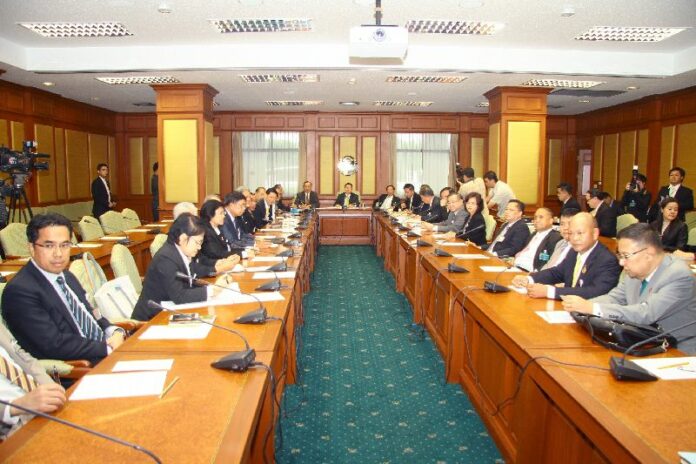
Thailand's newly-appointed Constitution Drafting Committee, 5 Nov 2014.

BANGKOK – Thailand’s military government has promised that the new charter will not support any of the country’s political factions, despite the conservative leaning of the 36 people appointed to the drafting committee this week.

"This Constitution will not be any colour. It's a colour-blind charter," Deputy Prime Minister Wisanu Krue-ngam said yesterday in reference to Thailand’s colour-coded politics. For much of the past decade, Thailand has been polarised by a political battle between the mostly-poor and rural Redshirts and the urban and elite-backedYellowshirts.

The Deputy Prime Minister's statement came after Redshirt supporters criticised the conservative makeup of the newly formed 36-seat Constitution Drafting Committee (CDC), which is headed by a staunch Yellowshirt academic, Bowornsak Uwanno.

The committee has been tasked with drafting a charter to replace the constitution dissovled by Thailand's military leaders after they staged a coup on 22 May. 

Six other members of the CDC also have a history of supporting the Yellowshirt movement, which has staged prolonged street protests to successfully pave the way for the ousting of five Prime Ministers backed by Redshirts.

Three other CDC members are military officers, and the rest are long-time bureaucrats and academics. None of the CDC members have any known ties to Redshirt organisations. 

The charter drafters were selected by the military junta, formally known as the National Council for Peace and Order (NCPO), the Cabinet, the National Legislative Assembly, and the National Reform Council. The latter three groups were also appointed by the junta. 

Speaking to reporters yesterday, Wisanu said the 11 CDC members allotted to the NCPO and Cabinet were handpicked by Prime Minister and junta leader Prayuth Chan-ocha himself. 

"We have inquired about the background of each individual. We found that none of them are involved in any conflicts," Wisanu said.

He also dismissed media speculation that the CDC, like the reform council, is dominated by the so-called "Chulalongkorn Connection," a clique of conservative academics from Chulalongkorn University. CDC chairman Bowornsak is considered a member of the clique.

"If we look at the list, you will see that there are many colours, like green, yellow, red, pink [the official colour of Chulalongkorn University]," Wisanu explained, "I insist that when we appointed these people, we didn't have any colour or connection in mind. Everyone has one anyway. But connections are fine, as long as they aren’t a conspiracy."

According to the 2014 interim charter, which was partly drafted by Wisanu, the reform council will advise the CDC and a final version of the charter draft will be approved by the NLA, the Cabinet, and the military junta.

The new constitution will further seal Thailand's record as the country with the most number of charters in the world; the nation has seen 18 constitutions since constitutional democracy was installed in June 1932.

It is also the second time Bowornsak, a well-known conservative law academic, is involved in the drafting of a charter. He also sat in the committee that drafted the 1997 Constitution, which was nicknamed "The People's Constitution" for its role in steering Thailand toward a more democratic governance. 

However, Bowornsak later said in an interview with Manager newspaper that the 2007 constitution, which followed the 2006 military coup, was an "improved version" of the People's Constitution. That constitution was seen as major step back for Thai democracy, as it did away with a fully-elected  Senate and gave more power to “independent,” unelected bodies.

"The new constitution that is being drafted right now is, in fact, an improved version of the 1997 Constitution," said Bowornsak, who was serving as a lawmaker in the post-coup government at the time. "I think it deserves some praise."

Gen. Prayuth says he led the 22 May coup – the twelfth in modern Thai history – to prevent mounting protests from spiraling out of control. Prior to the military takeover, anti-government Yellowshirt protesters demanded that unspecified “national reforms” be held before the next election, while Redshirt activists rallied in support of holding elections first.  

Many critics of the coup view the junta's reform effort as evidence of the military’s tacit alliance with Thailand's Yellowshirt faction. The reforms are widely expected to curb the influence of the Redshirt-supported political parties, backed by former Prime Minister Thaksin Shinawatra, that have won every national election since 2001. 

 
For comments, or corrections to this article please contact: [email protected]

You can also find Khaosod English on Twitter and Facebook
http://twitter.com/KhaosodEnglish

Advertisement

Thai Govt Promises 'Colour-Blind Constitution'

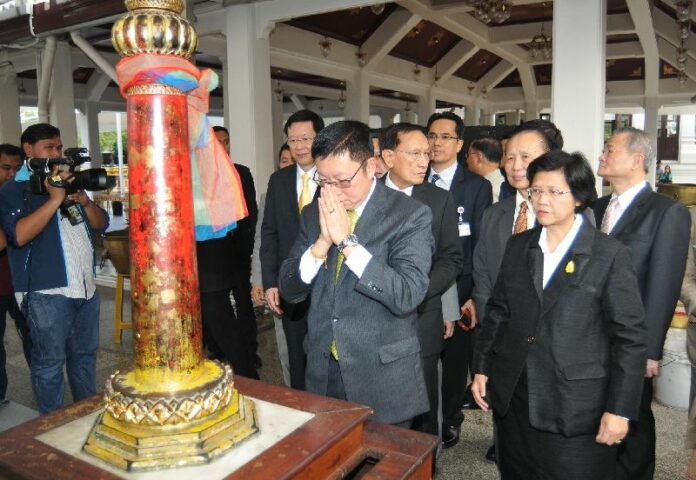
Constitution Drafting Committee chairman Bowornsak Uwanno praying at Bangkok's city shrine, 5 November 2014.

BANGKOK – Thailand’s military government has promised that the new charter will not support any of the country’s political factions, despite the conservative leaning of the 36 people appointed to the drafting committee this week.

"This Constitution will not be any colour. It's a colour-blind charter," Deputy Prime Minister Wisanu Krue-ngam said yesterday in reference to Thailand’s colour-coded politics. For much of the past decade, Thailand has been polarised by a political battle between the mostly-poor and rural Redshirts and the urban and elite-backed Yellowshirts.

The Deputy Prime Minister's statement came after Redshirt supporters criticised the conservative makeup of the newly formed 36-seat Constitution Drafting Committee (CDC), which is headed by a staunch Yellowshirt academic, Bowornsak Uwanno.

The committee has been tasked with drafting a charter to replace the constitution dissovled by Thailand's military leaders after they staged a coup on 22 May. 

Six other members of the CDC also have a history of supporting the Yellowshirt movement, which has staged prolonged street protests to successfully pave the way for the ousting of five Prime Ministers backed by Redshirts.

Three other CDC members are military officers, and the rest are long-time bureaucrats and academics. None of the CDC members have any known ties to Redshirt organisations. 

The charter drafters were selected by the military junta, formally known as the National Council for Peace and Order (NCPO), the Cabinet, the National Legislative Assembly, and the National Reform Council. The latter three groups were also appointed by the junta. 

Speaking to reporters yesterday, Wisanu said the 11 CDC members allotted to the NCPO and Cabinet were handpicked by Prime Minister and junta leader Prayuth Chan-ocha himself. 

"We have inquired about the background of each individual. We found that none of them are involved in any conflicts," Wisanu said.

He also dismissed media speculation that the CDC, like the reform council, is dominated by the so-called "Chulalongkorn Connection," a clique of conservative academics from Chulalongkorn University. CDC chairman Bowornsak is considered a member of the clique.

"If we look at the list, you will see that there are many colours, like green, yellow, red, pink [the official colour of Chulalongkorn University]," Wisanu explained, "I insist that when we appointed these people, we didn't have any colour or connection in mind. Everyone has one anyway. But connections are fine, as long as they aren’t a conspiracy."

According to the 2014 interim charter, which was partly drafted by Wisanu, the reform council will advise the CDC and a final version of the charter draft will be approved by the NLA, the Cabinet, and the military junta.

The new constitution will further seal Thailand's record as the country with the most number of charters in the world; the nation has seen 18 constitutions since constitutional democracy was installed in June 1932.

It is also the second time Bowornsak, a well-known conservative law academic, is involved in the drafting of a charter. He also sat in the committee that drafted the 1997 Constitution, which was nicknamed "The People's Constitution" for its role in steering Thailand toward a more democratic governance. 

However, Bowornsak later said in an interview with Manager newspaper that the 2007 constitution, which followed the 2006 military coup, was an "improved version" of the People's Constitution. That constitution was seen as major step back for Thai democracy, as it did away with a fully-elected  Senate and gave more power to “independent,” unelected bodies.

"The new constitution that is being drafted right now is, in fact, an improved version of the 1997 Constitution," said Bowornsak, who was serving as a lawmaker in the post-coup government at the time. "I think it deserves some praise."

Gen. Prayuth says he led the 22 May coup – the twelfth in modern Thai history – to prevent mounting protests from spiraling out of control. Prior to the military takeover, anti-government Yellowshirt protesters demanded that unspecified “national reforms” be held before the next election, while Redshirt activists rallied in support of holding elections first.  

Many critics of the coup view the junta's reform effort as evidence of the military’s tacit alliance with Thailand's Yellowshirt faction. The reforms are widely expected to curb the influence of the Redshirt-supported political parties, backed by former Prime Minister Thaksin Shinawatra, that have won every national election since 2001. 

 
For comments, or corrections to this article please contact: [email protected]

You can also find Khaosod English on Twitter and Facebook
http://twitter.com/KhaosodEnglish
http://www.facebook.com/KhaosodEnglish
Advertisement

Military To Send More Guns, Volunteers To Restive South

BANGKOK — Thailand's military is seeking to increase the number of guns and armed volunteers in the southern border provinces, where Islamic insurgents have been waging a bloody separatist campaign for the past decade.

The Internal Security Operations Command (ISOC) has approved a plan to dispatch 2,700 submachine guns to the armed "ranger" volunteer units in the Muslim-dominated provinces of Narathiwat, Yala, and Pattani, a spokesperson said yesterday.

ISOC will also ask the government to recruit 2,000 more policemen for the restive region, Col. Banpot Poonpian said. He said he hoped the posts would be filled by 1,000 volunteers from the fourteen southern provinces and 1,000 from the rest of the country.

"We want the process to be concluded by 1 June 2015," he said.

Col. Banpot added that the military is planning to establish a new "Navy Marine Ranger" unit to combat the insurgency by 2016, with a budget of more than 1.7 billion baht. He did not elaborate what role the new unit will take in the region. 

Tens of thousands of soldiers, policemen, marines, and armed volunteers are already stationed in the three southern border provinces, known as the "Deep South," to stem the tide of separatist violence that has claimed nearly 6,000 lives since 2004. 

Human rights activists have criticised the military's occasionally heavy-handed approach to stamping out violence in the region, as well as their reliance on rangers, many of whom are volunteers armed by the authorities. 

Last month, an army ranger in Narathiwat province confessed to  killing a 14-year-old Muslim boy and then planting a gun in his hand to frame the teenager as an insurgent. 

The government toppled in the 22 May coup attempted to start peace talks with one of the militant groups in 2013, but the effort was stalled after anti-government protests in Bangkok debilitated former Prime Minister Yingluck Shinawatra's administration and paved the way for the coup.

On Monday, Thailand’s new military government vowed to bring about peace in the region within a year.

Narathiwat, Yala, and Pattani are pre-dominantly Muslim, a stark to the rest of the country that is dominated by Buddhists. The Islamic insurgents are believed to be aiming to revive the independent Sultanate that existed for hundreds of years before it was incorporated into modern-day Thailand in early 20th century.

Read more:
Rights Group Urges Prosecution of Troops For Killing Teenager in Deep South
Southern Schools Re-Open Amid Assassination Sprees


For comments, or corrections to this article please contact: [email protected]

You can also find Khaosod English on Twitter and Facebook
http://twitter.com/KhaosodEnglish
http://www.facebook.com/KhaosodEnglish
Advertisement

Robbery and Attempted Rape of Tourist Near Khaosan Road

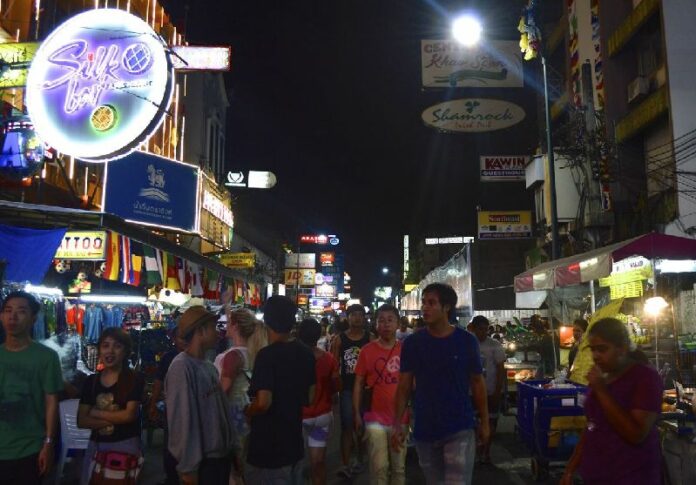
Khaosan Road in Bangkok.

BANGKOK — A 19-year-old Thai man has been arrested for allegedly robbing and attempting to rape a French tourist in Bangkok’s backpacker district early this morning.

The crime reportedly took place in Soi Samsen 3, several hundred metres away from Bangkok's famous Khaosan Road, at around 2.30 am today.

Police say Surasak Wanprapao, 19, hit the Frenchwoman in the head with a brick stone on Samsen Road before dragging her into a nearby alley, where he proceeded to steal her iPhone and cash.

According to police, Surasak also attempted to sexually assault the tourist, but she fought back and successfully escaped to the main road where she sought help from police. 

Police say they arrested Surasak and Chuen Wamakhan, an accomplice who was allegedly serving as a lookout, shortly after the tourist filed a complaint.

The victim is being treated for injuries at a hospital in Bangkok, police at Chanasongkram Police Station said. 


For comments, or corrections to this article please contact: [email protected]

You can also find Khaosod English on Twitter and Facebook
http://twitter.com/KhaosodEnglish
http://www.facebook.com/KhaosodEnglish
Advertisement

Student Sentenced To Jail For Insulting Monarchy on Facebook

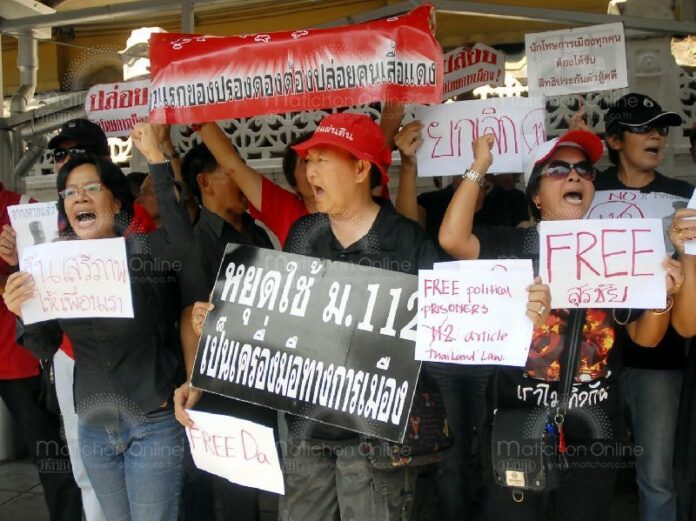
A demonstration against Thailand's lese majeste law in front of the Government House on 15 May 2012.

BANGKOK — A 24-year-old student has been sentenced to two and a half years in prison for insulting the Thai monarchy on social media.

Thailand’s criminal court found Akradet Eiamsuwan guilty of violating Section 112 of the Criminal Code, which prohibits defaming Thailand's royal family, for comments he posted on Facebook in March. 

Akradet was also convicted of violating the Computer Crime Act, which penalises dissemination of "false information" and libelous remarks through a computer system.

The court initially sentenced Akradet to five years in prison, but reduced his sentence to two and a half years after he confessed to the allegation. 

However, the judge refused to suspend his jail sentence, claiming that his offence was  "a grave threat that does not warrant a suspended punishment."

It is not immediately clear whether Akradet will appeal the verdict. 

Insulting the monarchy, known as lese majeste, carries a maximum penalty of 15 years in prison. Defendants in lese majeste cases are often denied bail while awaiting trial, as was the case with Akradet, who was refused bail five times.

Two theatre activists also in their twenties have been held in Bangkok prisons for more than 70 days over recent charges of lese majeste for staging a play about a fictional monarch.  

Lese majeste accusations and charges in Thailand have been on the rise since Gen. Prayuth Chan-ocha, a hardline royalist, seized power on 22 May. Gen. Prayuth has also given martial courts jurisdiction over lese majeste cases on the grounds that insulting the monarchy constitutes a threat to national security. 


For comments, or corrections to this article please contact: [email protected]

You can also find Khaosod English on Twitter and Facebook
http://twitter.com/KhaosodEnglish
http://www.facebook.com/KhaosodEnglish
Advertisement

Prayuth Deflects Questions About 600 Million Baht Land Sale

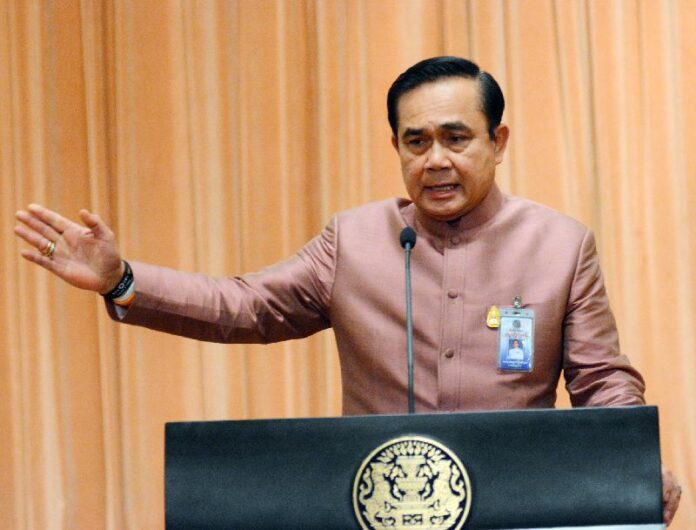
Prime Minister Prayuth Chan-ocha speaking at the Government House on 3 Nov 2014.

BANGKOK — Thailand’s military leader and Prime Minister Prayuth Chan-ocha has refused to elaborate on the 600 million baht land sale he made to a private company last year.

According to documents from Gen. Prayuth’s asset declaration published in a report by Isra News, the Prime Minister sold nine plots of land in a Bangkok suburb to a company called 69 Property for 600 million baht in May 2013. 

Gen. Prayuth was serving as commander-in-chief of the Royal Thai Army at the time of the sale. He retired from the post last month after leading a military coup on 22 May.

When a reporter asked Gen. Prayuth about the land sale today, the Prime Minister shot back that the media has no business questioning him on the matter. 

"The land has belonged to me since I was a kid, it belonged to my father. So what's the problem?" Gen. Prayuth said. "Please stop criticising me already."

He explained that the company bought the land for "investment" purposes.

"The company wouldn't have bought the land out of foolishness, don't you think? If they can't invest in the land, why would they buy it?"

Thailand’s national anti-graft agency published the financial assets of Gen. Prayuth and his Cabinet ministers last Friday, revealing that one third of the ministers are worth more than 100 million baht.

In the report, Gen. Prayuth declared 128 million baht in net assets – nearly 4 million in US dollars – and 645,754 baht in debts. Gen. Prayuth, who is still serving as the chairman of the junta's National Council for Peace and Order (NCPO), was similarly dismissive when asked about his investments last week.

"I don't know. I don't remember," Gen. Prayuth said on 1 November. "I am not a businessman. Please don't ask me about this."

When it emerged that Gen. Prayuth's brother, who is serving as a member of the National Legislative Assembly (NLA), “accidentally” included official army bank accounts in his personal assets last month, Gen. Prayuth warned that the media may face possible repercussions if Lt.Gen. Preecha is proven to be innocent.

"Don't make such a big deal out of this," the junta leader told reporters on 28 October. "If you can investigate this, then investigate. If he's guilty, say so. But if he is not guilty, you'd better prepare yourselves."


For comments, or corrections to this article please contact[email protected]

You can also find Khaosod English on Twitter and Facebook
http://twitter.com/KhaosodEnglish
http://www.facebook.com/KhaosodEnglish

Advertisement

Hot News

LATEST NEWS

Bangkok
overcast clouds
25.5 ° C
25.5 °
25.5 °
93 %
3.2kmh
100 %
Fri
25 °
Sat
32 °
Sun
35 °
Mon
37 °
Tue
37 °