























31.7 C
Bangkok
Thursday, July 23, 2026
Home Blog Page 3194

Post-Coup Election May Be Delayed To 2016

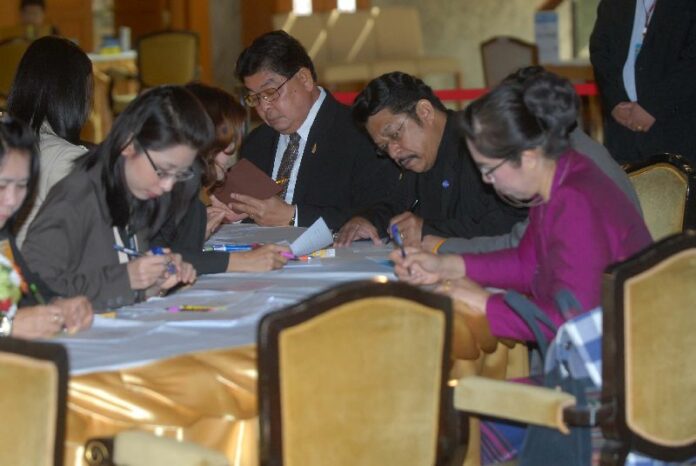
National Reform Council members reporting for duty on 12 Oct 2014.

BANGKOK — The chairman of Thailand’s military junta and his deputy have suggested that the date of the next national election may be postponed from October 2015 to early 2016.

After staging a coup on 22 May, Thailand's junta – known as the National Council for Peace and Order (NCPO) – said it would cede power to an elected government in October 2015 after pursuing a wide range of national reforms.

But NCPO chairman Prayuth Chan-ocha, who is also now Prime Minister of the interim government, said today that the military’s “roadmap to democracy” may need to be extended. 

"It depends on when the new constitution and reforms will be finished," Gen. Prayuth told reporters before boarding a plane to an international summit in Italy this morning. "It takes time to prepare for an election. It's not like we can organise an election tomorrow just because we have scheduled the poll. Elections take time."

Gen. Prayuth's comments came after his deputy, Visanu Krue-ngam, said yesterday that the public should not be "surprised" if the next election is organized several months after the promised date. 

"It wouldn’t be surprising if the [election] took place in 2016," Visanu said. "Because the new permanent constitution will only be ready by September 2015. There will be many laws about the election that need to be passed, too. It may take two months for parliament to approve each law."

According to Visanu, at least three laws will have to be in place before a new election can be held: the Election Act, the Political Parties Act, and the Election Commission Act.

"After these laws are passed, we will have to allow time for political parties to form and canvass for votes. We have to add this time too, and I don't know how long it will take," Visanu said.

He quickly added, "But we are not deliberately delaying [the election]."

At the press conference this morning, Gen. Prayuth also asked the media focus on the reform process and stop asking about the date of the election.

"Stop pressuring me about this, I have already spoken. It's over. Everything has to depend on the roadmap," Gen. Prayuth told reporters. "The question is, can they do what the roadmap describes? I am not the only one involved in the roadmap. I am not the head of the NRC [National Reform Council] or the head of the Constitution Drafting Committee.”

The National Reform Council (NRC) was appointed by the NCPO earlier this month and has been tasked with proposing reforms across a wide range of sectors. The NCPO and interim government will also form another committee early next month that will draft a new constitution to replace the charter dissolved by the coupmakers shortly after they seized power.


For comments, or corrections to this article please contact: [email protected]

You can also find Khaosod English on Twitter and Facebook
http://twitter.com/KhaosodEnglish
http://www.facebook.com/KhaosodEnglish


Advertisement

Farmer Self-Immolates Over Debt At Govt Complaint Centre

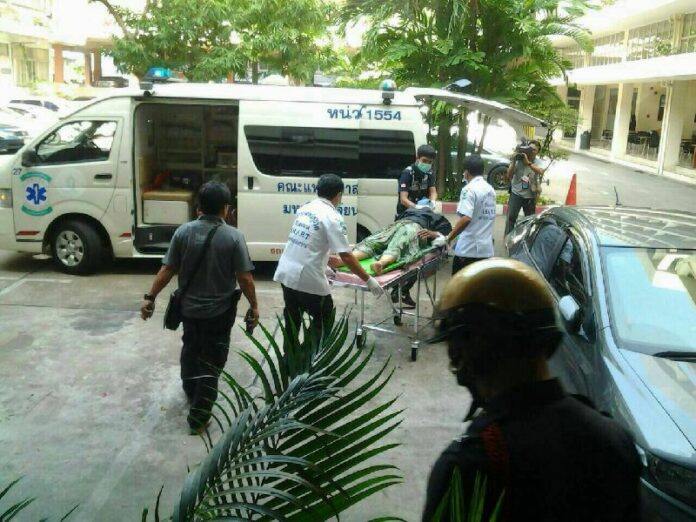
Rescue workers bring Sangwian Raksapetch, 52, to the hospital after she set herself on fire in side the government complaint centre in Bangkok, 15 Oct 2014.

BANGKOK — A severely indebted Thai rice farmer set herself on fire among a crowd of other petitioners inside the government complaint centre in Bangkok today.

Sangwian Raksapetch, a 52-year-old woman from Lopburi province, was seeking help from officials about the massive debt she owes to a moneylender. Officials say Sangwian’s original debt of 400,000 baht skyrocketed to 1.5 million baht because of a high interest rate.

Suksawat Suwannapong, the official who received Sangwian's complaint, said he was on the phone with another official in Lopburi's Kok Samrong district to seek more information about the debt when Sangwian suddenly shouted "So you can't help me?," doused herself with a bottle of petrol, and set herself on fire.

Bureaucrats at the centre scrambled to help the woman and called ambulance. She has been taken to Vajira Hospital. Rescue workers describe her condition as "critical."

Police said they also found a knife in Sangwian's bag and are investigating the incident.

The complaint centre, which is housed in the Office of The Civil Service Commission (OCSC) headquarters just opposite the Government House in Bangkok, was set up by the junta's National Council for Peace and Order (NCPO) after it seized power on 22 May to receive opinions and grievances from the public. 

Despite the country's reputation as a major exporter of rice, many Thai farmers live in poverty and are stuck in annual cycles of debt. 


For comments, or corrections to this article please contact: [email protected]

You can also find Khaosod English on Twitter and Facebook
http://twitter.com/KhaosodEnglish
http://www.facebook.com/KhaosodEnglish

Advertisement

Police Thwart Redshirts' Democracy Monument 'Picnic'

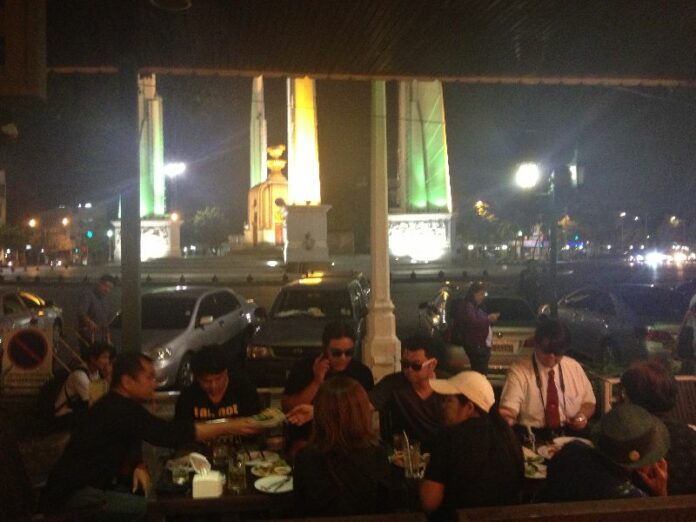
A group of Redshirt activists dined near Democracy monument to commemorate the 1973 student uprising on 14 October.

BANGKOK — Dozens of police officers surrounded Democracy Monument last night to prevent a group of Redshirt supporters from picnicking on the monument's steps.

The Redshirts originally planned to hold a laab (northeastern-style pork salad) picnic at the historic site on Ratchadamnoen Avenue to commemorate the 41st anniversary of the student uprising against military rule in 1973.

But the group decided to change their plans and dine at a restaurant opposite the monument after dozens of police officers arrived at the scene.

"We are here today to have dinner and reminisce about the old days," said Arnon Nampha, a lawyer who organised the dinner and has represented many Redshirts and lese majeste suspects in trial.

"Forty-one years ago, the student movement fought for democracy and asked for a constitution," he said. "Today, we are back to that past. There's no permanent constitution, no election, and we don't know when those things will return."

Arnon said he organised the dinner party to insist on people's right to enjoy their lives normally under the current "stressful situation." He said his group had no intention of engaging in any political activities or protests. 

"We just invited people to join us for dinner," Arnon said. "We have no demand or message for the NCPO [an acronym for the junta's National Council for Peace and Order]. We have no agenda." 

However, a handful of police cars remained stationed around Democracy Monument with their siren lights on throughout the dinner party, and dozens of police officers – some in plain clothing –  watched the group as they ate.

Thai authorities did not however interfere with other activities marking the anniversary of the student uprising, despite the junta's ban on public protests or political seminars. In contrast to several efforts to block recent political academic forums, authorities allowed student activists at Thammasat University, the site of the 1973 uprising, to hold a public seminar yesterday comparing recent student movements in Hong Kong to the 1973 uprising. 

Read more:
Military Blocks Academic Panel On Foreign Dictatorships


For comments, or corrections to this article please contact: [email protected]

You can also find Khaosod English on Twitter and Facebook
http://twitter.com/KhaosodEnglish
http://www.facebook.com/KhaosodEnglish

Advertisement

Police Thwart Redshirts' Democracy Monument 'Picnic'

Police cars and plain-clothed officers stationed near the Redshirt dinner party by Democracy Monument on 14 Oct 2014.

BANGKOK — Dozens of police officers surrounded Democracy Monument last night to prevent a group of Redshirt supporters from picnicking on the monument's steps.

The Redshirts originally planned to hold a laab (northeastern-style pork salad) picnic at the historic site on Ratchadamnoen Avenue to commemorate the 41st anniversary of the student uprising against military rule in 1973.

But the group decided to change their plans and dine at a restaurant opposite the monument after dozens of police officers arrived at the scene.

"We are here today to have dinner and reminisce about the old days," said Arnon Nampha, a lawyer who organised the dinner and has represented many Redshirts and lese majeste suspects in trial.

"Forty-one years ago, the student movement fought for democracy and asked for a constitution," he said. "Today, we are back to that past. There's no permanent constitution, no election, and we don't know when those things will return."

Arnon said he organised the dinner party to insist on people's right to enjoy their lives normally under the current "stressful situation." He said his group had no intention of engaging in any political activities or protests. 

"We just invited people to join us for dinner," Arnon said. "We have no demand or message for the NCPO [an acronym for the junta's National Council for Peace and Order]. We have no agenda." 

However, a handful of police cars remained stationed around Democracy Monument with their siren lights on throughout the dinner party, and dozens of police officers – some in plain clothing –  watched the group as they ate.

Thai authorities did not however interfere with other activities marking the anniversary of the student uprising, despite the junta's ban on public protests or political seminars. In contrast to several efforts to block recent political academic forums, authorities allowed student activists at Thammasat University, the site of the 1973 uprising, to hold a public seminar yesterday comparing recent student movements in Hong Kong to the 1973 uprising. 

Read more:
Military Blocks Academic Panel On Foreign Dictatorships


For comments, or corrections to this article please contact: [email protected]

You can also find Khaosod English on Twitter and Facebook
http://twitter.com/KhaosodEnglish
http://www.facebook.com/KhaosodEnglish

Advertisement

Blackshirt Suspects 'Tortured Into Confessing,' Lawyer Says

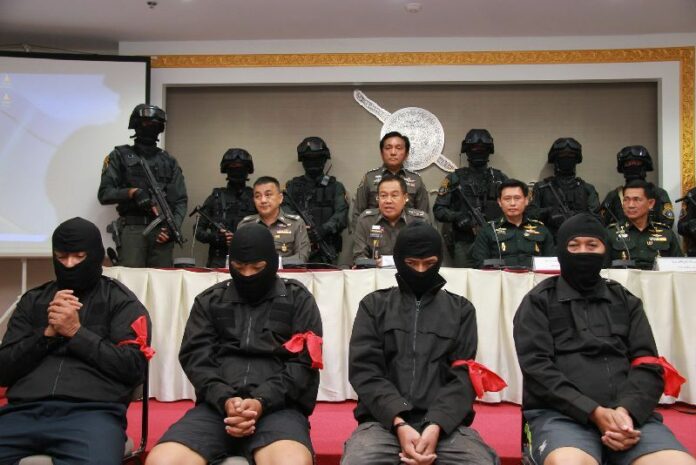
Five suspected "Blackshirt" militants were paraded in front of the media on 11 Sept 2014.

BANGKOK — The five suspects accused by Thai police of acting as armed militants in the 2010 Redshirt protests have recanted their confessions, their lawyer says.

All five suspects said they were tortured by police into confessing, their lawyer Winyat Chartmontri told reporters today. 

"They could not endure any more abuse, so they confessed," Winyat said. 

Kittisak Soomsri, Preecha Yooyen, Ranarit Suricha, Chamnarn Phakeechai, and Punika Chusri were accused by Thai police of belonging to the shadowy 'Blackshirtmilitant cell that fought with security forces during the crackdown on Redshirt demonstrators in Bangkok on 10 April 2010. 

Twenty civilians and five soldiers were killed in the clashes, including Col. Romklao Thuvatham, a high-ranking military officer who led the operation. 

It is unclear when the five suspects were arrested, but chief of Thai police Pol.Gen. Somyot Pumphanmuang paraded them in front of the media in a press conference in September. The five suspects were ordered to "re-enact" their alleged crime on Ratchadamnoen Avenue. According to Pol.Gen. Somyot, all of the suspects confessed.

Winyat, the lawyer representing the five suspects, insisted that he did not intend to discredit Pol.Gen. Somyot or any other official in his petition to the Attorney-General. "I just want to present the facts to the Attorney," Winyat said.

Winyat and representatives from the Lawyers for Human Rights organisation also petitioned the Office of Attorney-General, urging the court to "give fairness" to the four men and one woman who are currently awaiting trial in prison.

The development is bound to be viewed as another blow to the credibility of the Thai police force, which has a history of extracting confessions through physical abuse and intimidation. 

The investigation into the five alleged Blackshirt militants has already raised many questions, with police failing to explain exactly how the suspects were arrested, especially after it emerged that one of the suspects, Kittisak, was held incommunicado by the military for a week prior to the press conference.

The Thai police are also currently embroiled in a separate controversy over the arrest of two Burmese migrant workers accused of murdering two British backpackers in southern Thailand on 15 September. 

Human rights groups have alleged that the two Burmese men were "scapegoats," tortured into confessing to the crime without proper access to an interpreter or lawyer. Pol.Gen. Somyot repeatedly denied the allegation and insisted that the two men voluntarily confessed to their charges.

Yesterday, BBC News reported that the Thai charge d'affaires in London was summoned to the United Kingdom's Foreign Office over concerns about the inquiry into the murders of two British tourists. The FCO reportedly told the Thai diplomat that there was a real concern in the UK about how the investigation has been handled by Thai authorities.


For comments, or corrections to this article please contact:[email protected]

You can also find Khaosod English on Twitter and Facebook
http://twitter.com/KhaosodEnglish
http://www.facebook.com/KhaosodEnglish
Advertisement

Blackshirt Suspects 'Tortured Into Confessing,' Lawyer Says

The suspects re-enact their crime for police on Ratchadamnoen Avenue in September 2014.

BANGKOK — The five suspects accused by Thai police of acting as armed militants in the 2010 Redshirt protests have recanted their confessions, their lawyer says.

All five suspects said they were tortured by police into confessing, their lawyer Winyat Chartmontri told reporters today. 

"They could not endure any more abuse, so they confessed," Winyat said. 

Kittisak Soomsri, Preecha Yooyen, Ranarit Suricha, Chamnarn Phakeechai, and Punika Chusri were accused by Thai police of belonging to the shadowy 'Blackshirt' militant cell that fought with security forces during the crackdown on Redshirt demonstrators in Bangkok on 10 April 2010. 

Twenty civilians and five soldiers were killed in the clashes, including Col. Romklao Thuvatham, a high-ranking military officer who led the operation. 

It is unclear when the five suspects were arrested, but chief of Thai police Pol.Gen. Somyot Pumphanmuang paraded them in front of the media in a press conference in September. The five suspects were ordered to "re-enact" their alleged crime on Ratchadamnoen Avenue. According to Pol.Gen. Somyot, all of the suspects confessed.

Winyat, the lawyer representing the five suspects, insisted that he did not intend to discredit Pol.Gen. Somyot or any other official in his petition to the Attorney-General. "I just want to present the facts to the Attorney," Winyat said.

Winyat and representatives from the Lawyers for Human Rights organisation also petitioned the Office of Attorney-General, urging the court to "give fairness" to the four men and one woman who are currently awaiting trial in prison.

The development is bound to be viewed as another blow to the credibility of the Thai police force, which has a history of extracting confessions through physical abuse and intimidation. 

The investigation into the five alleged Blackshirt militants has already raised many questions, with police failing to explain exactly how the suspects were arrested, especially after it emerged that one of the suspects, Kittisak, was held incommunicado by the military for a week prior to the press conference.

The Thai police are also currently embroiled in a separate controversy over the arrest of two Burmese migrant workers accused of murdering two British backpackers in southern Thailand on 15 September. 

Human rights groups have alleged that the two Burmese men were "scapegoats," tortured into confessing to the crime without proper access to an interpreter or lawyer. Pol.Gen. Somyot repeatedly denied the allegation and insisted that the two men voluntarily confessed to their charges.

Yesterday, BBC News reported that the Thai charge d'affaires in London was summoned to the United Kingdom's Foreign Office over concerns about the inquiry into the murders of two British tourists. The FCO reportedly told the Thai diplomat that there was a real concern in the UK about how the investigation has been handled by Thai authorities.


For comments, or corrections to this article please contact: [email protected]

You can also find Khaosod English on Twitter and Facebook
http://twitter.com/KhaosodEnglish
http://www.facebook.com/KhaosodEnglish

Advertisement

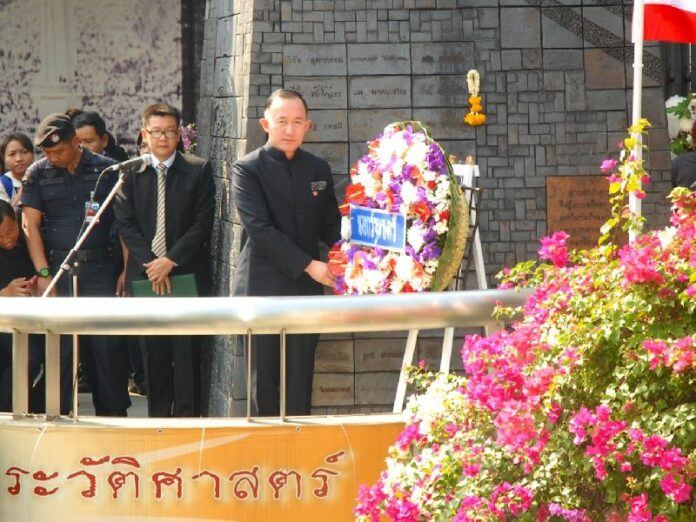
Junta Sends Representative To Mark 1973 Student Uprising

Panadda Diskul, head of the Prime Minister's Office, laying wreath in commemoration of the 1973 student uprising on 14 Oct, 2014.

BANGKOK — Junta chairman and Prime Minister Prayuth Chan-ocha sent a close aide to represent him at this morning's commemoration of the 41st anniversary of the student uprising against Thailand's military government in 1973.

Panadda Diskul, head of the Prime Minister's Office, attended the ceremony held by a memorial for the October 14th uprising on Ratchadamnoen Avenue this morning.

A handful of other high-ranking officials also participated in the service, including Surachai Liangboonlertchai, deputy speaker of the National Legislative Assembly, and Amara Pongpapitchaya, chairwoman of the National Human Rights Commission.

The event, organised annually by the "October 14 Foundation," involved making merit to monks on behalf of the 70+ people who died in the uprising, and reading eulogies praising their "sacrifice" for Thai democracy. 

The October 1973 uprising was sparked by the arrest of 20 activists who were calling to replace the military junta at the time with a permanent constitution and elected government. In response, student activists organised a rally at Thammasat University to demand their release, quickly drawing crowds of students from other universities and schools in Bangkok.

On 13 October, hundreds of thousands of demonstrators flooded Ratchadamnoen Avenue in a show of support. The military attempted to disperse the protesters on the following day, leading to riots and clashes in the capital city that killed at least 70 people.

The leaders of the military junta, including Field Marshal Thanom Kittikachorn, fled the country a day later, ending more than a decade of military rule in Thailand. 

Lamiad Boonmak, whose husband Jira Boonmak was the first person to die in the uprising, said at the remembrance ceremony this morning that she has never been adequately compensated.

"I have been pressing the authorities to push for a financial compensation for the families of the martyrs who died or were injured in the October 14 incident, for 7,000 baht for month," Lamiad said. "The petition is still being considered by the Ministry of Social Development and Human Security."

Lamiad also said she was surprised by the military coup on 22 May, as she did not expect to see another resurrection of military rule in Thailand, but added that she understood the military's intention to solve "political conflicts" and prevent bloodshed.

"The military takeover contradicts the ideals of the 14 October martyrs, but since it already happened, I have to accept it. I and other families of the martyrs are hereby calling on Gen. Prayuth to quickly return power to the people, create a new constitution, and hold an election."

She also called for amnesty for political prisoners from both the Redshirt and Yellowshirt factions to promote "reconciliation" for the country. 

Several student activist groups in Bangkok are also planning to hold events commemorating the uprising later today, in defiance of the current military junta's ban on all political gatherings, protests, and academic seminars. 

 
For comments, or corrections to this article please contact: [email protected]

You can also find Khaosod English on Twitter and Facebook
http://twitter.com/KhaosodEnglish
http://www.facebook.com/KhaosodEnglish
Advertisement

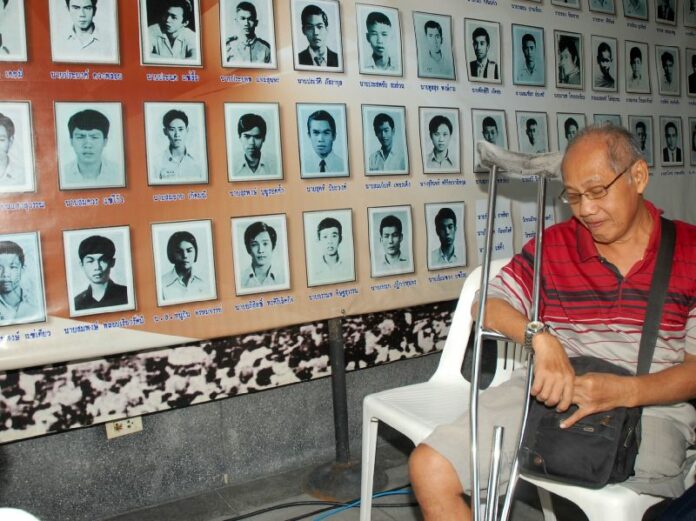
Junta Sends Representative To Mark 1973 Student Uprising

A demonstrator in the 1973 student uprising who attended the 2014 anniversary on 14 Oct in Bangkok.

BANGKOK — Junta chairman and Prime Minister Prayuth Chan-ocha sent a close aide to represent him at this morning's commemoration of the 41st anniversary of the student uprising against Thailand's military government in 1973.

Panadda Diskul, head of the Prime Minister's Office, attended the ceremony held by a memorial for the October 14th uprising on Ratchadamnoen Avenue this morning.

A handful of other high-ranking officials also participated in the service, including Surachai Liangboonlertchai, deputy speaker of the National Legislative Assembly, and Amara Pongpapitchaya, chairwoman of the National Human Rights Commission.

The event, organised annually by the "October 14 Foundation," involved making merit to monks on behalf of the 70+ people who died in the uprising, and reading eulogies praising their "sacrifice" for Thai democracy. 

The October 1973 uprising was sparked by the arrest of 20 activists who were calling to replace the military junta at the time with a permanent constitution and elected government. In response, student activists organised a rally at Thammasat University to demand their release, quickly drawing crowds of students from other universities and schools in Bangkok.

On 13 October, hundreds of thousands of demonstrators flooded Ratchadamnoen Avenue in a show of support. The military attempted to disperse the protesters on the following day, leading to riots and clashes in the capital city that killed at least 70 people.

The leaders of the military junta, including Field Marshal Thanom Kittikachorn, fled the country a day later, ending more than a decade of military rule in Thailand. 

Lamiad Boonmak, whose husband Jira Boonmak was the first person to die in the uprising, said at the remembrance ceremony this morning that she has never been adequately compensated.

"I have been pressing the authorities to push for a financial compensation for the families of the martyrs who died or were injured in the October 14 incident, for 7,000 baht for month," Lamiad said. "The petition is still being considered by the Ministry of Social Development and Human Security."

Lamiad also said she was surprised by the military coup on 22 May, as she did not expect to see another resurrection of military rule in Thailand, but added that she understood the military's intention to solve "political conflicts" and prevent bloodshed.

"The military takeover contradicts the ideals of the 14 October martyrs, but since it already happened, I have to accept it. I and other families of the martyrs are hereby calling on Gen. Prayuth to quickly return power to the people, create a new constitution, and hold an election."

She also called for amnesty for political prisoners from both the Redshirt and Yellowshirt factions to promote "reconciliation" for the country. 

Several student activist groups in Bangkok are also planning to hold events commemorating the uprising later today, in defiance of the current military junta's ban on all political gatherings, protests, and academic seminars. 

 
For comments, or corrections to this article please contact: [email protected]

You can also find Khaosod English on Twitter and Facebook
http://twitter.com/KhaosodEnglish
http://www.facebook.com/KhaosodEnglish
Advertisement

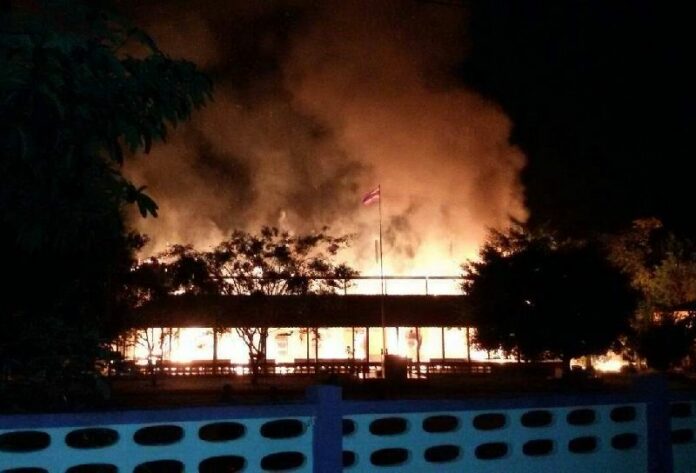
Southern Insurgency: Six Public Schools Torched Overnight

Six public schools were severely damaged in a coordinated arson attack in the restive Southern province of Pattani, 12 Oct 2014.

PATTANI — Six public schools in were severely damaged in a coordinated arson attack in the restive Southern province of Pattani last night, though no one was killed or injured in the incident.

The torching took place at around 2:30 am early Sunday morning. Locals and volunteer security units were forced to extinguish the flames on their own as firefighters struggled to contain the fire at all six locations.

Thai authorities have blamed the incident on the Islamic separatists who have been staging attacks on security forces and civilians in the region since 2004. Over the past decade, there have been hundreds of suspected insurgent attacks on public schools and teachers. 

Pol.Lt. Kamlart Tuetisorn, a police officer at Ma Yor Police Station, said 10 insurgents were spotted entering one of the schools, Baan Ka Soe Elementary School, and dousing the place with benzine before setting it on fire and fleeing the scene. 

Police have yet to identify which insurgent group was behind the attack, but the perpetrators appeared to be intent on destroying the schools rather than harming officials, said Pol Lt. Somphot Suwanrat, deputy governor of Pattani.

"Before they staged the [attacks], they rounded up the guards and tied their hands and feet," Pol. Lt. Somphot said. 

The deputy governor said he believes members of the separatist groups burned the schools in response to the recent killing of a high-profile militant insurgent by security officers in Pattani. 

Government officials, including spokesperson of the military junta, Col. Winthai Suwaree, said the armed forces will quickly investigate the incident.

The Ministry of Education has dispatched urgent aid to students and teachers who were affected by the torching, said Kamol Rodklai, sec-gen of the Office of Basic Education Commission. Officials will provide temporary tents and school materials while repairs are being done, which he estimated would take "5-7 months."

Pattani is a hotbed of separatist violence that has claimed the lives of more than 5,000 peoples over the past decade. Known as the "Deep South," Pattani and the two other southern provinces of Yala and Narathiwat are home to many Muslims, a stark contrast to the Buddhist population that dominates the rest of the country.

A variety of shadowy Islamist groups are believed to be responsible for the violent campaign, which is aimed at establishing an independent state comprised of Pattani, Yala and Narathiwat, provinces that were incorporated into modern-day Thailand in 1902. 

To combat the tide of separatist attacks, Thai authorities have deployed tens of thousands of security officers in the three provinces. The state's security forces have been occasionally accused of employing excessive force and abuse in their peacekeeping operations, causing a sense of distrust between authorities and local residents.

Yesterday a volunteer ranger opened fire with an AK-47 rifle at his own squad during a mission inside Wat Santikararm Temple, Pattani, killing two fellow rangers and seriously injuring another. 

Police say the ranger, Thopsak Srira of the Ranger's 2212 Company, committed the crime "out of stress" resulting from his deployment. 


For comments, or corrections to this article please contact: [email protected]

You can also find Khaosod English on Twitter and Facebook
http://twitter.com/KhaosodEnglish
http://www.facebook.com/KhaosodEnglish
Advertisement

Thai Reformer Calls For Shrinking Parliament To Combat Corruption

Yingluck Shinawatra canvassed for votes during the 2011 election, which she eventually won in a landslide, in Bangkok on 30 June 2011. She was assisted by the three children of her brother, the influential former Prime Minister Thaksin Shinawatra.

BANGKOK — A prominent member of the junta’s National Reform Council (NRC) has called for downsizing Thailand’s parliament to one fifth of its current size in an effort to limit the influence of political parties.

Chai-anand Samutvanich, a former Chulalongkorn University political science lecturer recently appointed to the NRC, proposed slashing the number of MPs in Thailand's House of Representatives from 500 to 77.

"If there are many MPs, there's more chance of corruption," Chai-anand said. "With the [MP election process] focused on a local level, people in the region can easily discover if corruption is taking place."

The reform would allocate one MP to each province, vastly increasing the number of voters the politicians represent. Under the previous constitution, 375 MPs were chosen in first-past-the-post elections to represent single constituencies drawn up based on population.

The proposal would also abolish the party-list system that allowed political parties to run candidates who did not represent any specific constituency. The now-defunct 2007 constitution allocated 125 parliamentary seats to candidates elected through the proportional party-list system.

According to Chai-anand, who was an active campaigner against the former government, the reform would promote "de-centralisation," reduce corruption, and decrease the influence of political parties.  

He also suggested that taking away MP’s power to elect a Prime Minister could help reduce "conflict of interests" among political actors.

"A Prime Minister does not have to be voted by the MPs," Chai-anad said, without elaborating who would have the authority to name a Prime Minister. 

A staunch critic of former Prime Minister Thaksin Shinawatra and the successive pro-Thaksin governments, Chai-anand has long expressed scepticism of electoral politics and argued that politicians like Thaksin abused the voting system by establishing a "dictatorship of the majority" in Parliament. 

Votes from Thaksin's fiercely loyal support base in Thailand's rural North and Northeast have swept his parties into power in every national election since 2001.

"The correct democratic governance needs to have quality people,” said Chai-anad. “Therefore, the solution is to create quality people who are not easily fooled, who value rights more than money, who do not easily believe in rumours or blindly follow their leaders."

Chai-anad is considered a prominent thinker in Thailand’s Yellowshirt faction, which consists mostly of urban conservatives who view rural pro-Thaksin voters as "uneducated" country folk whose votes have been purchased by politicians. 

Under the junta's 2014 interim charter, the NRC is tasked with proposing reforms to the National Legislative Assembly (NLA), whose members were also handpicked by the junta's National Council for Peace and Order (NCPO).

The NRC is widely expected to enact reforms that make Thailand’s political system less democratic, as was the case in the reform process that followed the most recent coup. In the 2006 coup, the military appointed a committee to draft a constitution that replaced Thailand’s fully-elected Senate with a half-elected, half-appointed body. 

The current junta, which seized power on 22 May, says it is committed to implementing "national reconciliation" and "reforms" in Thailand.

However, critics of the coup view the reform procedure as a sham aimed at dismantling Thailand's democratic system and eliminating the influence of Thaksin and his allies from politics. 

Their suspicion appears to have been somewhat confirmed by the formation of the NRC, which is stacked with anti-Thaksin hardliners like Chai-anand, Charas Suwanmala, Jermsak Pinthong, and Rosana Tositrakul. 


For comments, or corrections to this article please contact: [email protected]

You can also find Khaosod English on Twitter and Facebook
http://twitter.com/KhaosodEnglish
http://www.facebook.com/KhaosodEnglish
Advertisement

Hot News

LATEST NEWS

Bangkok
overcast clouds
31.7 ° C
32.2 °
29.4 °
67 %
0.5kmh
99 %
Thu
34 °
Fri
35 °
Sat
34 °
Sun
32 °
Mon
33 °