29.7 C
Bangkok
Wednesday, July 22, 2026
Home Blog Page 3199

Thailand Intensifies Sanctions On North Korea

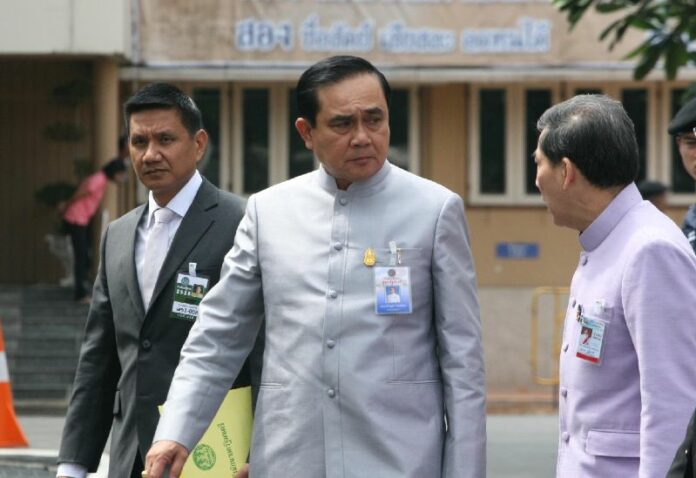
Prime Minister Gen. Prayuth arriving for a meeting at the Government House in Bangkok, 1 October 2014.

BANGKOK — Thailand's military government has approved tougher sanctions on North Korea in accordance with a United Nations resolution.

Yesterday the Cabinet adopted the United Nations Security Council's Resolution 2141, which called for an extension of existing sanctions against the Democratic People's Republic of Korea until April 2015. 

The measure was a response to North Korea's continued effort to develop nuclear capabilities, which the UN has called a threat to global security. 

The Thai Cabinet also instructed various agencies, including the Ministry of Defence, Ministry of Industry, Ministry of Commerce, and the Anti-Money Laundering Organisation (AMLO), to toughen financial sanctions on the pariah state. 

Diplomatic relations between Thailand and North Korea were formally established in 1975. The Thailand-DPRK Friendship Association in Bangkok occasionally organises trips to the Communist nation and other diplomatic activities. 


For comments, or corrections to this article please contact: [email protected]

You can also find Khaosod English on Twitter and Facebook
http://twitter.com/KhaosodEnglish
http://www.facebook.com/KhaosodEnglish

Advertisement

Thai Students Rally At Chinese Embassy In Support of HK Protests

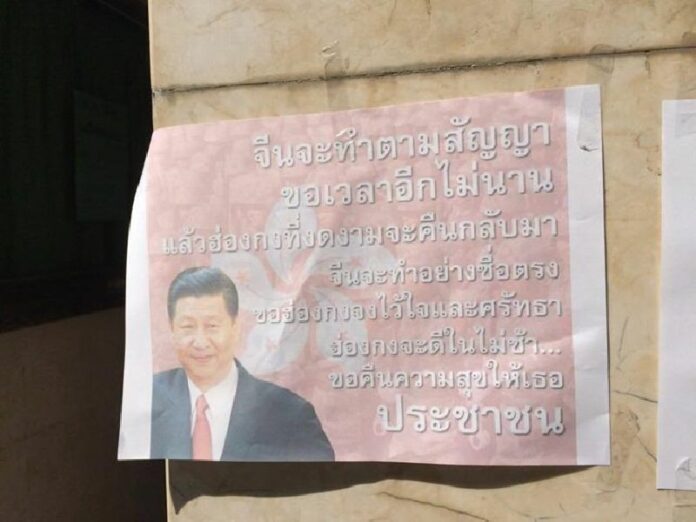
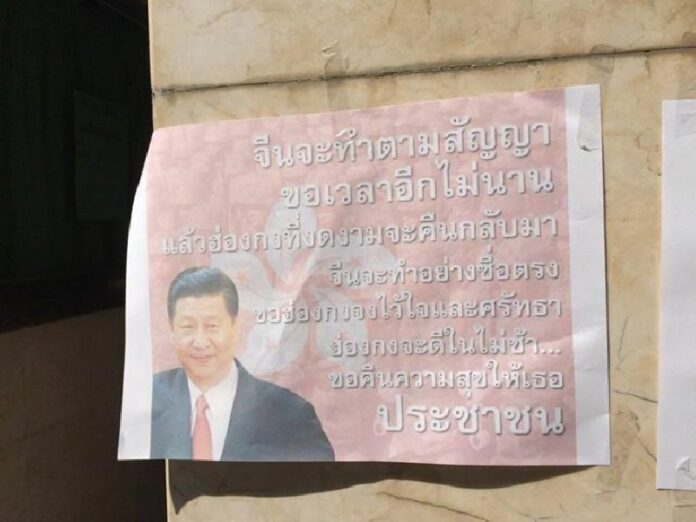
A sign posted on the Chinese Embassy mocking a patriotic Thai song allegedly penned by coup-leader Gen. Prayuth Chan-ocha.

BANGKOK — A group of Thai student activists gathered in front of the Chinese Embassy in Bangkok to show their solidarity with the ongoing pro-democracy protests in Hong Kong.

BANGKOK — A group of Thai student activists gathered in front of the Chinese Embassy in Bangkok to show their solidarity with the ongoing pro-democracy protests in Hong Kong. 

A dozen students from Thai Student Centre for Democracy (TSCD) held signs and posted placards on the entrance of the Chinese Embassy on Ratchadapisek Road this morning in support of the tens of thousands of demonstrators who have camped out in the streets of Hong Kong's financial district for four days. 

One sign held by the Thai students read, “Hong Kong Is Not Prison” in reference to a Thai pun, as "Hong Kong" sounds similar to the words for "holding cells" (hong krong) in Thai.

The students also took a swipe at Thailand's military junta, who has banned all public demonstrations and political gatherings. One sign depicted Chinese president Xi Jinping next to the caption "China will do as promised. We are asking for a little more time, and the beautiful Hong Kong will return," mocking a line from the patriotic ballad allegedly penned by Thai junta leader Prayuth Chan-ocha.

The group peacefully dispersed after 15 minutes. No police officers were visible throughout the rally, while several security guards from the Chinese embassy observed the protest from a distance. 

Speaking to Khaosod English after the rally, Piyarath Chongthep, a core activist in the Thai Student Centre for Democracy (TSCD), said he and his friends wanted to lend moral support to the protesters in Hong Kong, many of whom are student activists. 

"Over there, the activists are backed by many students who share the same ideals, whereas in Thailand students have very, very different ideas about politics or the coup," Piyarath said.

"It's very hard for Thai students to unite or organise like what happened in October 14," he added, referring to the October 1973 student uprising in Thailand against the then-military junta. "Back then many students shared the same view.”

Piyarath also said his group will be in touch with leaders of Hong Kong's Occupy Central movement to share experiences and tips about staging protests.

Prior to the rally in front of the Chinese Embassy, Piyarath's group met with police in Pathumwan district to acknowledge their punishment for commemorating the 19 September 2006 coup with pro-democracy banners

The students were fined 2,000 baht for “violating the public cleanliness act” for the banner they hung in front of Chulalongkorn University, Piyarath said. He added that anonymous donors have sent the group more than 8,000 baht to cover the fines and other legal costs in the future. 

The student activists have not been charged with violating the junta’s ban on public demonstrations, which was imposed shortly after the National Council For Peace and Order staged a coup on 22 May. 

The Hong Kong protesters' demands for an open and fair election by 2017 have resonated with many pro-democracy activists in Thailand. 

Anti-coup critics have been sharing photos of the Hong Kong protests on social media, adding mocking references to the situation in Thailand, where demonstrators took to the streets earlier this year to demand the suspension of democracy in Thailand. The anti-election protests paved the way for the coup on 22 May. 

"Hong Kong = struggle to become democracy. Thailand = struggle to become dictatorship," one Thai activist posted on social media.

The Organization of Free Thais for Human Rights and Democracy (OFHD), an anti-coup group formed in exile, also voiced support and admiration for the Hong Kong protests in a statement released today.

“OFHD would like to call for every democratic government and Human Rights organization to stand in solidarity with the Hong Kong people,” the statement reads. “This demonstration is not only a demonstration for the Hong Kong people but also a demonstration for all humankind.”


For comments, or corrections to this article please contact: [email protected]

You can also find Khaosod English on Twitter and Facebook
http://twitter.com/KhaosodEnglish
http://www.facebook.com/KhaosodEnglish


Advertisement

Thai Students Rally At Chinese Embassy In Support of HK Protests

A sign posted on the Chinese Embassy mocking a patriotic Thai song allegedly penned by coup-leader Gen. Prayuth Chan-ocha.

BANGKOK — A group of Thai student activists gathered in front of the Chinese Embassy in Bangkok to show their solidarity with the ongoing pro-democracy protests in Hong Kong.

A dozen students from Thai Student Centre for Democracy (TSCD) held signs and posted placards on the entrance of the Chinese Embassy on Ratchadapisek Road this morning in support of the tens of thousands of demonstrators who have camped out in the streets of Hong Kong's financial district for four days. 

One sign held by the Thai students read, “Hong Kong Is Not Prison” in reference to a Thai pun, as "Hong Kong" sounds similar to the words for "holding cells" (hong krong) in Thai.

The students also took a swipe at Thailand's military junta, who has banned all public demonstrations and political gatherings. One sign depicted Chinese president Xi Jinping next to the caption "China will do as promised. We are asking for a little more time, and the beautiful Hong Kong will return," mocking a line from the patriotic ballad allegedly penned by Thai junta leader Prayuth Chan-ocha.

The group peacefully dispersed after 15 minutes. No police officers were visible throughout the rally, while several security guards from the Chinese embassy observed the protest from a distance. 

Speaking to Khaosod English after the rally, Piyarath Chongthep, a core activist in the Thai Student Centre for Democracy (TSCD), said he and his friends wanted to lend moral support to the protesters in Hong Kong, many of whom are student activists. 

"Over there, the activists are backed by many students who share the same ideals, whereas in Thailand students have very, very different ideas about politics or the coup," Piyarath said.

"It's very hard for Thai students to unite or organise like what happened in October 14," he added, referring to the October 1973 student uprising against the then-military junta. "Back then many students shared the same view.”

Piyarath also said his group will be in touch with leaders of Hong Kong's Occupy Central movement to share experiences and tips about staging protests.

Prior to the rally in front of the Chinese Embassy, Piyarath's group met with police in Pathumwan district to acknowledge their punishment for commemorating the 19 September 2006 coup with pro-democracy banners

The students were fined 2,000 baht for “violating the public cleanliness act” for the banner they hung in front of Chulalongkorn University, Piyarath said. He added that anonymous donors have sent the group more than 8,000 baht to cover the fines and other legal costs in the future. 

The student activists have not been charged with violating the junta’s ban on public demonstrations, which was imposed shortly after the National Council For Peace and Order staged a coup on 22 May. 

The Hong Kong protesters' demands for an open and fair election by 2017 have resonated with many pro-democracy activists in Thailand. 

Anti-coup critics have been sharing photos of the Hong Kong protests on social media, adding mocking references to the situation in Thailand, where demonstrators took to the streets earlier this year to demand the suspension of democracy in Thailand. The anti-election protests paved the way for the coup on 22 May. 

"Hong Kong = struggle to become democracy. Thailand = struggle to become dictatorship," one Thai activist posted on social media.

The Organization of Free Thais for Human Rights and Democracy (OFHD), an anti-coup group formed in exile, also voiced support and admiration for the Hong Kong protests in a statement released today.

“OFHD would like to call for every democratic government and Human Rights organization to stand in solidarity with the Hong Kong people,” the statement reads. “This demonstration is not only a demonstration for the Hong Kong people but also a demonstration for all humankind.”


For comments, or corrections to this article please contact: [email protected]

You can also find Khaosod English on Twitter and Facebook
http://twitter.com/KhaosodEnglish
http://www.facebook.com/KhaosodEnglish

Advertisement

2010 Unrest: Japan Again Demands Answer Over Reporter's Death

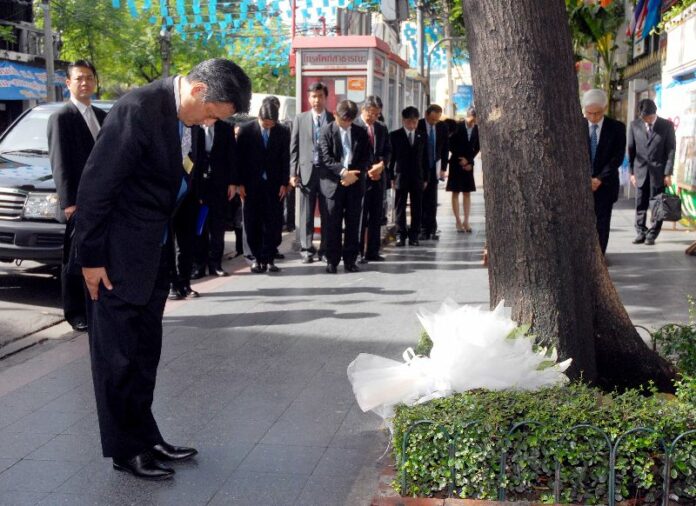
Japanese Minister of Foreign Affairs Katsuya Okada visited the site where Muramoto was slain on 23 August 2010.

BANGKOK — The Embassy of Japan in Thailand is still seeking answers from Thai authorities over the killing of a Japanese reporter during the 2010 political unrest in Bangkok.

Hiroyuki Muramoto, a camera who was working for Reuters, was shot dead while he was filming the clashes between Redshirt demonstrators and soldiers near Democracy Monument on the night of 10 April 2010. 

Taishi Akimoto, first secretary of the Japanese embassy in Bangkok, met with Thai police yesterday and discussed the development of the inquiry into the reporter's death. The discussion took place at Crime Suppression Division HQ and lasted about 30 minutes. 

According to Pol.Col. Prasopchoke Prommool, deputy commander of CSD, the Japanese diplomat wanted to know whether the recent arrest of five suspected “Blackshirt” militants has yielded any helpful information about Muramoto's death. The so-called “Blackshirts” are a group of gunmen allied to the Redshirt movement who were seen exchanging gunfire with security forces during the 2010 unrest.

"I have told the First Secretary that based on the investigation into the Blackshirt suspects, there is no evidence that they are involved in Muramoto's death," Pol.Col. Prasopchoke said. 

The police officer also informed Akimoto that the CSD is only responsible for the criminal investigation into the alleged possession of military-grade weapons by the arrested Blackshirt suspects, while the Division of Special Investigation (DSI) is launching a separate inquiry into the death of the Japanese reporter and other casualties during the crackdown.

"Right now we don't know who is responsible for the death of Mr. Muramoto," Pol.Col. Prasopchoke said. "So even though the First Secretary is very keen to know about the development in the case, we have to find the culprit first. The legal procedure is ongoing."

In the past four years, Japanese officials have made several requests to the Thai authorities for information about Muramoto's death. The gestures included a visit by Japanese Minister of Foreign Affairs Katsuya Okada to the site where Muramoto was slain in August 2010. 

More than 90 people, mostly civilians, were killed during the Redshirt protests in Bangkok between April – May 2010, which ultimately ended in a military crackdown. A handful of soldiers were also reportedly killed by the Blackshirt militants.

Five suspected Blackshirt militants were arrested last month and are awaiting trials in prison. 

Muramoto is one of the two foreign journalists killed in the 2010 military crackdown. The other was Italian photographer Fabio Polenghi, who was shot dead while he was covering the final day of the protests on 19 May 2010. A court inquest ruled that the gunfire that killed Polenghi came from the direction of security forces.


For comments, or corrections to this article please contact: [email protected]

You can also find Khaosod English on Twitter and Facebook
http://twitter.com/KhaosodEnglish
http://www.facebook.com/KhaosodEnglish


Advertisement

Govt Turning Junta Leader's Teachings Into Ballad

The Ministry of Education is currently in contact with Thai celebrities Nadech Kugimiya and Urassaya "Yaya" Sperbund to have them lend their voices to the ballad. [Photo from SBT Magazine]

BANGKOK — The Ministry of Education is producing a ballad for schoolchildren based on the "Twelve Values" bestowed by junta leader and Prime Minister Prayuth Chan-ocha.

"We are producing a song for schools," said Kamol Rodklai, sec-gen of the Office of Basic Education Commission (OBEC). "But if it becomes popular, members of the public can adopt it, too."

Kamol also suggested that the song about Gen. Prayuth's Twelve Values could be used during "aerobic exercise" classes and theatre performances. 

The Ministry of Education is currently in contact with Thai celebrities Nadech Kugimiya and Urassaya "Yaya" Sperbund to have them lend their voices to the ballad, Kamol added.

The Twelve Values, given by Gen. Prayuth to Thai children in July, are the following: 

1. Loyalty to the Nation, the Religion, and the Monarchy
2. Honesty, sacrifice, endurance, and noble ideology for the greater good
3. Gratitude for parents, guardians, and teachers
4. Diligence in acquiring knowledge, via school studies and other methods
5. Preserving the Thai customs and tradition
6. Morality and good will for others
7. Correct understanding of democracy with the King as Head of State
8. Discipline, respect for law, and obedience to the older citizens
9. Constant consciousness to practice good deeds all the time, as taught by His Majesty the King
10. Practice of Self-Sufficient Economy in accordance with the teaching of His Majesty the King
11. Physical and mental strength. Refusal to surrender to religious sins.
12. Uphold the interest of the nation over oneself.

The Ministry of Education has previously ordered all public schools to teach students about the Twelve Values and hang banners bearing the list. A poetic rendition of the values was also unveiled last month.

According to Kamol, the OBEC secretary-general, the Ministry is planning many other activities to promote Gen. Prayuth's wisdom, such as organising essay and calligraphy competitions based on the Twelve Values, and modifying school lessons to reflect the principles. 

Gen. Prayuth, who is wielding a near-absolute power as Prime Minister and chairman of the military junta, is increasingly seen by critics and international media as an authoritarian ruler with a growing cult of personality. 

A patriotic ballad Gen. Prayuth allegedly wrote "in one hour" has been played nonstop on state-owned media for months. The General also gives weekly televised lectures about morality to the public and has banned protests or any display of dissent against his rule.


For comments, or corrections to this article please contact: [email protected]

You can also find Khaosod English on Twitter and Facebook
http://twitter.com/KhaosodEnglish
http://www.facebook.com/KhaosodEnglish

Advertisement

Amulets 101: An Interview with Amulet Master Taan Tha Prachan

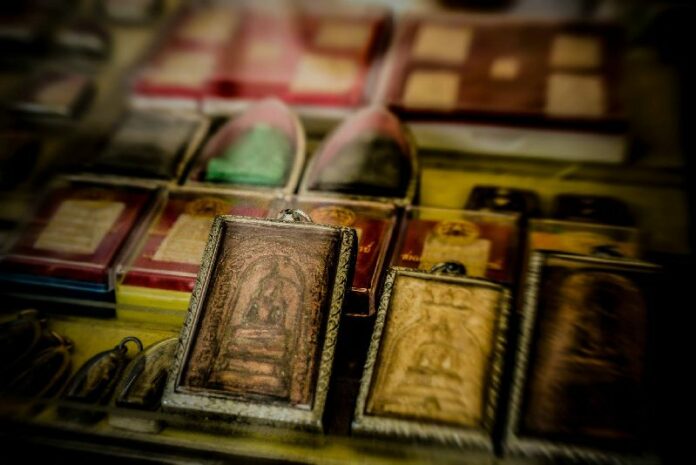
Wat Rakhang's Somdeth To, named after Thailand's patron saint, is one of the most popular amulets in Thailand associated with protective powers [Photo: Gerrit Phil Baumann]

By Gerrit Phil Baumann

Taan Tha Prachan has been an amulet master (เซียนพระ) for more than 20 years and regularly writes columns for Khaosod newspaper's amulet section. Gerrit Phil Baumann sat down with him the other day to learn more about the different types of amulets, how to spot a fake one, and the purpose of these holy artifacts from a Buddhist perspective. 

You can see a slideshow of Baumann's tour through Bangkok's amulet markets here.

Gerrit Phil Baumann: When did you first become interested in amulets?

Taan Tha Prachan: I have been interested in amulets since I was a child, when I used to follow my father to the amulet markets. I also noticed that almost every household in Thailand had them, so I wanted to know more. Then I started collecting amulets and studying them myself. 

In the beginning, I relied on the kindness of elder amulet masters who knew about the art, history, and origin of each amulet. They also showed me some of the "authentic" old amulets. I asked a lot of questions and learned more about amulets from them.

I am specifically interested in the hundred-year-old amulets stored in the pagodas of ancient temples. I also like to collect the amulets that were commissioned by monks who impressed me with their good sermons.  

\
Wat Rakhang's Somdeth To, named after Thailand's patron saint, is one of the most popular amulets in Thailand associated with protective powers.

G: What meaning do amulets hold for you? And what is appropriate way of handling them?

T: Amulets can be divided into many categories. Some are images of Lord Buddha. Others are images of the Arhat (monks who attained the highest rank in Buddhism), and of famous monks who preached in the past, like Luang Por Ngoen, for example. We revere these individuals. They are long gone, and their disciples made images of them so that we can worship them and remind ourselves of their teachings.

For me, amulets are the [physical representatives] of these holy men. Therefore, we should keep them in high places, such as in Buddha shrines, or in a cabinet. We should not place the amulets in low places because we may step over them by accident. It's like portrait of His Majesty the King. We wouldn't place the portraits of the king on the floor. It's not because we believe in the miracle of these objects, it is because we love the people these objects represent. 

Apart from that, there are not many customs associated with amulets. If you have time, you can pray to the amulets. It can be a long or a short prayer. You can also simply wai to them or just think about these holy men in your heart. That's enough worship. 

There is no need for the grand worship of amulets. Monks and amulets are just representatives of religion. When we think of them, we think of their religious teachings, and we feel conscious of our actions and refrain from doing bad things.

That is why older people encourage young men to wear amulets. It's a way to help youngsters think about religious teachings. It makes them think: Am I doing good things? Am I going to bad places? Every time the amulets touch our chests as we walk, we are reminded to think about these things. Not of all of us can be good all the time. Some of us need the amulets to remind ourselves to be good, but some don't. Yet some people misunderstand the amulets; they think amulets are miraculous things.

\
Jatukam Ramathep is one of the the most famous "Commercial Buddhism" amulets, as it is believed to carry supernatural powers. At the peak of its popularity in 2007, a rare
Jatukam Ramathep amulet could be worth one million baht. 

G: Is it correct to wear Buddhist amulets with Hindu or other charms? Many Thai people do that.

T: Older people will separate Buddhist amulets from other types of charms in a different necklace. They won't wear them together in one necklace. But in my opinion it's not wrong, because all religions teach people to be good. Buddhism does not forbid you from listening to other religions. Buddhism teaches you to use your wisdom and judge those teachings for yourself. 

T: Are there different types of amulet markets? 

G: Certainly. There are bad amulet markets like the one at Saphan Kwai. There, they just lay the amulets on the footpath, which is very inappropriate. The vendors don't have any knowledge about amulets or the religion. They are also sort of con men, because they sell copies of amulets that purport to be real, antique things. That's a scam. They may say they are Buddhists, but I don't think they are really Buddhist at heart.

Another bad amulet market is at Wat Ratchanadda Temple. They manufacture loads of amulets and sell them to amulet vendors. They are a factory of commercial amulets. It’s different than the one near the Giant Swing, which only makes amulets for temples and religious reasons. 

\
Amulets produced in bulk at the Wat Ratchanadda Temple market. 

Meanwhile, the famous amulet market in Tha Prachan is divided into two sections. The outer part is similar to the markets in Saphan Kwai and Wat Ratchanadda, but the inner section is home to shops run by amulet masters. They sell the authentic amulets to people who want to collect them.

G: We saw enchanted jackets being sold in Tha Prachan, too. What is the significance of those jackets?

T: Enchanted jackets are a kind of charm. In the past, like in Ayutthaya era, the jackets were produced to raise morale among soldiers, because wars were frequent in those times and soldiers needed moral support. The authorities usually asked temples to make these jackets and distribute them to soldiers. 

In fact, most of the jackets did not bear enchantments or charms. The text on the jackets was actually Buddhist teachings, but very few people could read them because they were written in Khmer alphabet or Pali script. It's like the Arabic Koran. Not every Muslim can read Arabic. Not every Buddhist can read Pali or Khmer, only the learned can and realise that it's just teachings written on the jackets. 

But in the present time, some temples insert incantations into the jackets and tout them as charms. That is wrong. Buddhist prayers and chants are not charms. They are teachings meant for listeners to take to heart and do good. 

\
A yantra shirt that supposedly increases the wearers "horse powers" for intimate situations at Tha Prachan market.

G: What is the value of the amulet trade in Thailand? And what determines the high prices of some amulets?

T: I cannot come up with any figure at all, because much of the amulet trade is not officially accounted for. For example, some people have their own private factories for the production of amulets.

Amulets have different origins. First, there are the ancient amulets that were stored in temple pagodas hundreds of years ago. They were made in the hope that in the far future when Buddhist religion fades away, people will find the amulets and know that once in history there existed a Buddhist faith. These amulets are highly sought after because they are like antiques. 

Then there are amulets that were commissioned by prominent monarchs in the past. Since we adore these kings, we try to find the amulets that were made under their reign. So there's low supply, but high demand. Only several hundreds of these amulets were made, but thousands of people want to have them. And the price keeps getting higher as they change hands.

Thirdly, there are amulets that were made by famous monks, like Somdet To in Rama IV reign. These monks have many followers who are impressed by their teaching, so they try to find the amulets. 

However, in the recent times, the world has nothing to hold on to, in terms of spirituality. So people make up claims that certain amulets can make you rich, or make you invincible. How can it be possible? Even the monks that made these amulets died! 

This is the sign of a lack of spiritual guidance. These people don't practice Buddhism in its essential teaching. They are like shipwreck survivors in the sea. They will grab anything in their path, even straws.

G: How were amulets used differently in the past compared to the present?

T: In the past, amulets were like a "thank you" gift from temples to temple-goers, because construction projects organised by temples relied on the workforce of the local community, and the abbots had no money to reward locals for their efforts. So they made amulets or medals to commemorate the project. One example is the "Pool Digging Amulet" from King Kaew Temple [Samut Prakan province]. The temple is built on a flood plain, and there's a flood every year. So the abbot, Luang Pu Puek, mobilised the local community to dig pools for a reservoir and move the main buildings to higher ground. Then he made amulets to thank the locals. 

But in the present era, many temples make amulets to sell, not to compensate the local Buddhists for their works. It's a phenomenon that some called "Commercial Buddhism" (พุทธพาณิชย์). This trend started in 1980s.

\
Dozens of amulet magazines and catologues cover the latest developments in the amulet market. 

G: So how many types of amulets are there?

T: There are many, many types of amulets. No one can remember all of them. That's why we divide them in different categories. We have the pagoda amulets, famous monk amulets, "modern" amulets. They can also be separated by materials, like earth, metal, dust, etc. Lastly there's the "new monks amulets," or what you can call Commercial Buddhism. These amulets were made by famous monks who claim to have spiritual powers. 

I want to stress that there are new types and new batches of amulets being made each day. We cannot estimate how many amulets there are, or their value. Imagine this: even natives of a certain provinces can't memorise how many temples there are in their province. The same goes with amulets.

G: How do you spot fake amulets now that there is technology to replicate them in precise detail?

T: Amulet forgery has been around for a long time, but in the present day, the forgery is really advanced. Sometimes they can be 98% or 99% close to the real antiques, especially with the help of printing and scanning technology. All the defects can be scanned and reproduced. Even a cat hair left on an amulet can be scanned. 

However, there is no current technology that can forge amulets with 100% accuracy. This is because the material of amulets and the way they are manufactured gives them unique traits. 

\
Collecters inspect amulets at Tha Prachan market.

Let me use the example of medallion amulets. Since they are made of metal, there is a trace left on the side of the medallions when they were pressed by the pressing machine. We have to memorise the nature of the pressing of each medallion type, and the era these objects were made, because pressing technologies differ across the eras. For 2440-2485 BE, the mold is shallow and there is a block-like shape at the presser, while the pressers used in 2485-2500 BE would leave a small curve on the side of the medallions. 

Also, you can tell which amulets are genuine by the number of pressings the objects went through. These details are very small and subtle, and no one can forge them.

Another way is to test the percentage of copper used in the medallion. Since copper is expensive these days, the forgers may use less copper in the production. 

Lastly, you can determine if certain amulets are genuinely old by looking at how the material has aged. Different material shows different signs of decay. It's like splitting nails into three groups. You keep the first in a drawer, bury the second under the earth, and place the last in the sun. They will show different decay. You can study the history of certain amulets and find out if the decay marks found on the materials correspond to their history. 

There are many other ways to spot a fake. To sum it up, to be an amulet enthusiast, you have to have knowledge in many fields, like history, art, culture, and even some chemistry, too. 


For comments, or corrections to this article please contact: [email protected]

You can also find Khaosod English on Twitter and Facebook
http://twitter.com/KhaosodEnglish
http://www.facebook.com/KhaosodEnglish

Advertisement

Photo Essay: A Journey Through Bangkok's Amulet Markets

[Photo: Gerrit Phil Baumann]

By Gerrit Phil Baumann

The Thai amulet market its a multi-billion baht industry that connects several million traders, collectors, producers, and ordinary wearers across the country. Many Thais sport amulets for their alleged supernatural powers,  while others collect the objects for their value as antiques.  The  price of amulets can range from five baht to five million baht a piece, but to avoid tainting the sacred talismans with a commercial connotation, the official act of buying an amulet is referred to as châo prá:  'renting a Buddha image' in Thai.

Khaosod English photographer Gerrit Phil Baumann recently brought his camera to three major amulet markets in Bangkok to capture the scene. To learn more about the different types of amulets and their meaning from a Buddhist perspective, read Baumann's interview with amulet master Taan Tha Prachan.

\
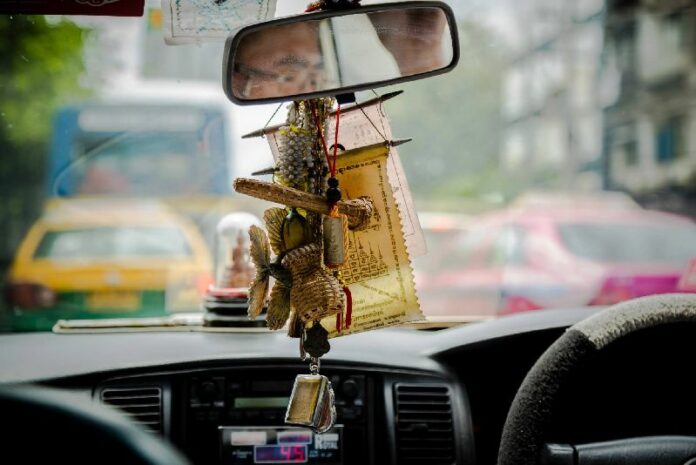
On our way to Tha Phrachan market, the center of the believer's universe, our driver explained that the fish traps dangling below his rearview-mirror help his business attract money, while the Buddhist amulets stop ghosts from entering his taxi while he is working night shifts.

\
Wat Rakhang's Somdeth To, named after Thailand's patron saint, is one of the most popular amulets in Thailand associated with protective powers.

\
Trusting the protective power of the items surrounding him, a vendor takes a quick nap. No thief would dare to put up with the karmic consequences of stealing a sacred item.

\
Where there is an orginial, there quickly emerges a fake. Distiguishing original pressings from fakes has become a science in itself. A specialized branch of Thai publications are printed to help investors verify the authenticity of their purchase. 

\
One of the oddest items we found at Tha Phrachan Amulet Market was a replica of a two-headed foetus. Kuman Thong is a child spirit that brings luck and fortune to the owner of this talisman. Its effigy traditionally relied on gruesome ingredients like roasting dead-born foetuses in a graveyard over night and then covering them with gold leaf. Today the practice strictly banned by Thai law.

\
Monk coins (phra rian) at Tha Phrachan street market. Many of them were made to commemorate a communual effort undertaken by supporters of the monastery, or the passing away of a famous Buddhist teacher.

\
Collectors in the know are aware of the irregularities that mark orginal pressings. Tiny bubbles in the alloy called khai pla (fish eggs) may help verify a certain original batch of monk coins.

\
Vests made from yantra, a sacred cloth printed with spells and protective chants. They come in all shapes and sizes to be worn on the body or carried in wallets.

.\
Even though most of what is sold on the sidewalks in places like the Saphan Kwai are relatively low value 'fakes' or imitations, professional collectors regularly comb the tables for bargain deals, hoping to outsmart sellers who might not be aware of a treasure camping out on their table.

\
From a collectors perspective, most amulets are seen as an investment. Their value can increase manyfold if the items become popular.

\
 A charm that assists making a perceived soul mate fall in love with the wearer at Wat Rachanadda Amulet Market.

 
For comments, or corrections to this article please contact: [email protected]

You can also find Khaosod English on Twitter and Facebook
http://twitter.com/KhaosodEnglish
http://www.facebook.com/KhaosodEnglish

Advertisement

No More Coups, Says Coupmaker's Heir

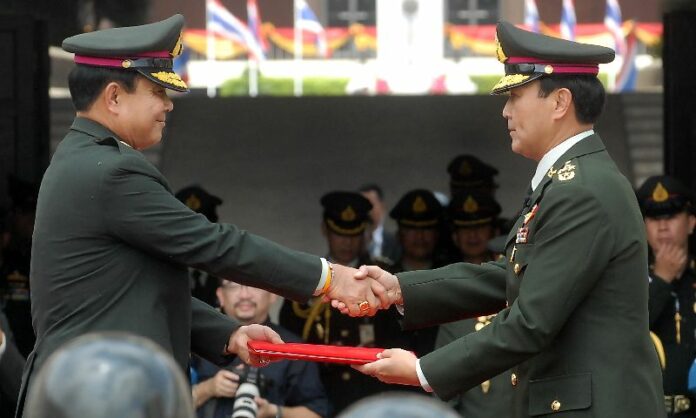
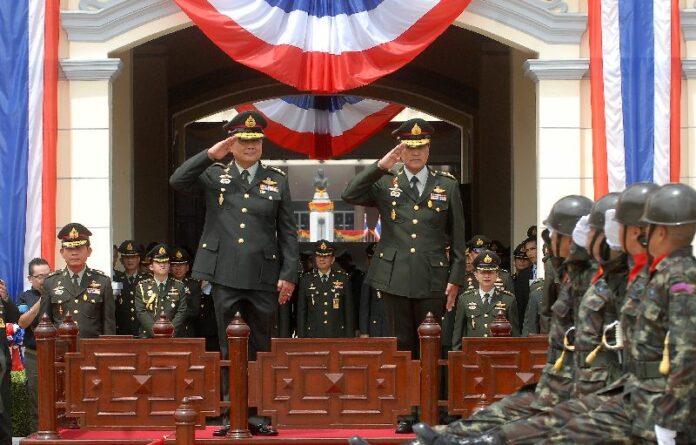
Gen. Prayuth Chan-ocha (L) and Gen. Udomdet Sitabutr (R) at a parade on 30 Sept 2014.

BANGKOK — There will not be another coup in Thailand, promised the new Thai army chief to replace Gen. Prayuth Chan-ocha, the leader of the 22 May coup d’etat.

"There won't be one. No," Gen. Udomdet Sitabutr said yesterday when a reporter asked whether he believes there would be another military coup. "The commanders have reached understanding with everyone. Everyone is now walking in the same direction."

In Thailand’s 82 years as a constitutional monarchy, there have been twelve successful coups d’etats and a handful of failed attempts. The most recent coup prior to the military takeover this May was in 2006. 

"There won't be [another coup] for sure," Gen. Udomdet stressed.

The 59-year-old general replaced Gen. Prayuth, who led the 22 May coup and is now the Prime Minister of the Thailand’s interim government.  Gen. Prayuth retired from his post as commander-in-chief of the Royal Thai Army yesterday.

Gen. Udomdet, who is also the Deputy Minister of Defense in Gen. Prayuth’s cabinet, said the army will serve as the foundation for peace in Thailand and support the interim government "until everything is settled under the framework laid down by the Prime Minister."

He added that a top priority of the army under his command will be to "defend, preserve, and uphold the monarchy with our lives. We will not allow anyone to violate it."

Although Gen. Prayuth will no longer hold the powerful position of army chief, he is expected to retain significant influence over the armed forces in his role as chairman of the junta's National Council for Peace and Order (NCPO). 

At 4 pm yesterday Gen. Prayuth paid a visit to Gen. Prem Tinsulanonda to formally bid the Head of the Privy Council and former Prime Minister farewell. Gen. Prem, who turned 94 in August, is the top adviser to His Majesty the King and an influential figure in the Thai armed forces. 

The two men talked in private for about 20 minutes before Gen. Prayuth left Gen. Prem’s residence. Speaking to reporters after the meeting, the retired army chief said Gen. Prem blessed him and wished him the best of luck in his endeavor as Prime Minister.

 
For comments, or corrections to this article please contact: [email protected]

You can also find Khaosod English on Twitter and Facebook
http://twitter.com/KhaosodEnglish
http://www.facebook.com/KhaosodEnglish

Advertisement

No More Coups, Says Coupmaker's Heir

Gen. Prayuth Chan-ocha (L) and Gen. Udomdet Sitabutr (R) at a parade on 30 Sept 2014.

BANGKOK — There will not be another coup in Thailand, promised the new Thai army chief to replace Gen. Prayuth Chan-ocha, the leader of the 22 May coup d’etat.

"There won't be one. No," Gen. Udomdet Sitabutr said yesterday when a reporter asked whether he believes there would be another military coup. "The commanders have reached understanding with everyone. Everyone is now walking in the same direction."

In Thailand’s 82 years as a constitutional monarchy, there have been twelve successful coups d’etats and a handful of failed attempts. The most recent coup prior to the military takeover this May was in 2006. 

"There won't be [another coup] for sure," Gen. Udomdet stressed.

The 59-year-old general replaced Gen. Prayuth, who led the 22 May coup and is now the Prime Minister of the Thailand’s interim government.  Gen. Prayuth retired from his post as commander-in-chief of the Royal Thai Army yesterday.

Gen. Udomdet, who is also the Deputy Minister of Defense in Gen. Prayuth’s cabinet, said the army will serve as the foundation for peace in Thailand and support the interim government "until everything is settled under the framework laid down by the Prime Minister."

He added that a top priority of the army under his command will be to "defend, preserve, and uphold the monarchy with our lives. We will not allow anyone to violate it."

Although Gen. Prayuth will no longer hold the powerful position of army chief, he is expected to retain significant influence over the armed forces in his role as chairman of the junta's National Council for Peace and Order (NCPO). 

At 4 pm yesterday Gen. Prayuth paid a visit to Gen. Prem Tinsulanonda to formally bid the Head of the Privy Council and former Prime Minister farewell. Gen. Prem, who turned 94 in August, is the top adviser to His Majesty the King and an influential figure in the Thai armed forces. 

The two men talked in private for about 20 minutes before Gen. Prayuth left Gen. Prem’s residence. Speaking to reporters after the meeting, the retired army chief said Gen. Prem blessed him and wished him the best of luck in his endeavor as Prime Minister.

 
For comments, or corrections to this article please contact: [email protected]

You can also find Khaosod English on Twitter and Facebook
http://twitter.com/KhaosodEnglish
http://www.facebook.com/KhaosodEnglish


Advertisement

Son of Koh Tao Island Chief Denies Role In Britons' Murder

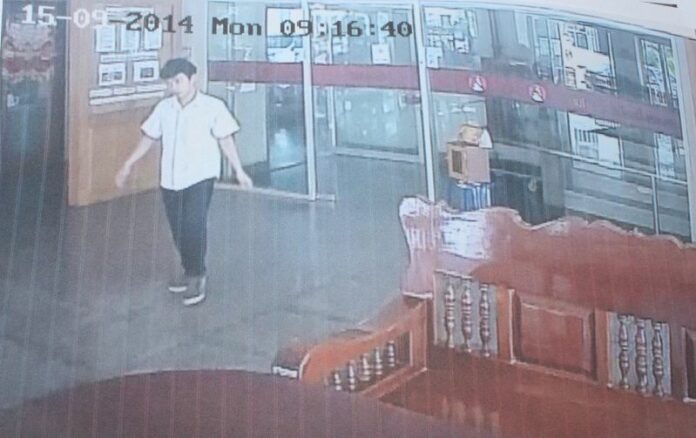
CCTV footage that reportedly shows Mr. Warot in Bangkok when the Koh Tao murder took place.

BANGKOK — The son of a powerful local administrator on Koh Tao island initially sought by police has denied any involvement in the murder of two British tourists there two weeks ago.
Warot Tuvichian, 22, said at a press conference today that he was nowhere near Koh Tao island when David Miller, 24, and Hannah Witheridge, 23, were killed on 15 September.
Warot's lawyer, Attakorn Onart, presented reporters with a still photograph from CCTV footage that showed Warot at his university and residence in Bangkok on 13-15 September.

Warot also attended classes during that period of time, Attakorn said. 

"There are university documents that confirmed his class attendance and examination," the lawyer told reporters.

Last week police identified Warot as a primary suspect, claiming that he fled the island shortly after the bodies of Miller and Witheridge were found. 

The police later retracted their statement and said Warot was no longer a suspect because he was in Bangkok when the murder took place.

Warot's father, Woraphan Tuvichian, who is a village headman on Koh Tao island, was also considered a person of interest by the police. After questioning, the police cleared Woraphan of a connection to the murder.

Woraphan previously threatened to press libel charges against media agencies that attempted to link him or any of his family members to the killing of the two Britons. 

At the press conference today, Warot's lawyer said news reports have "greatly damaged" his client. 

"He wasn't unable to attend classes because people kept asking him if he was involved in the murder," Attakorn said. "So I want to ask for fairness for Warot."

Attakorn said his client never went into hiding and that police never questioned Warot about the murder. He added that Warot is willing to cooperate with police if he is ever summoned for questioning.  

Warot then told reporters that he has become a target of hateful comments from people on social media who are convinced he was behind the murder.

"I want justice. Right now I am very fearful, and only my close friends understand me," Warot said.

Two weeks after the murder of Miller and Witheridge, Thai police have yet to arrest any suspect in the case. Police say that DNA samples collected from more than 100 potential suspects on the island did not match the DNA traces found on Witheridge's body.

Police have given conflicting statements about whether DNA samples of Warot and his father have been tested. 


For comments, or corrections to this article please contact: [email protected]

You can also find Khaosod English on Twitter and Facebook
http://twitter.com/KhaosodEnglish
http://www.facebook.com/KhaosodEnglish

Advertisement

Hot News

LATEST NEWS

Bangkok
overcast clouds
29.7 ° C
30.5 °
26.1 °
72 %
0.5kmh
100 %
Tue
30 °
Wed
35 °
Thu
33 °
Fri
32 °
Sat
35 °