33.7 C
Bangkok
Friday, July 17, 2026
Home Blog Page 3225

HM King's Condition 'Normal' For Elderly, Doctor Says

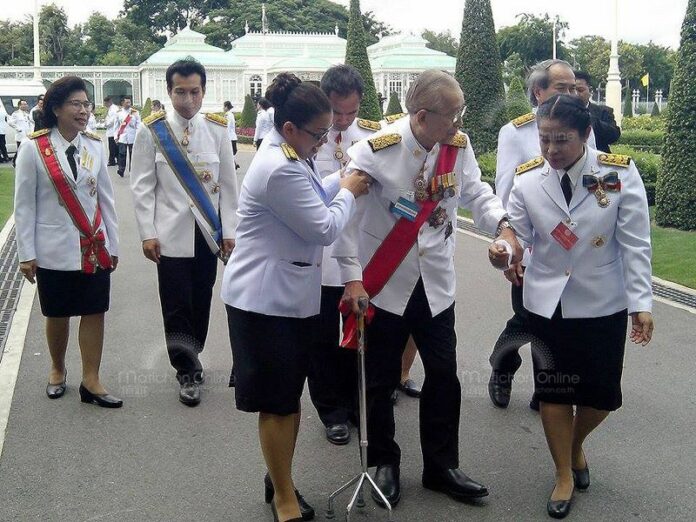
His Majesty the King en route to Siriraj Hospital for an annual medical checkup on 6 August 2014.

BANGKOK — A top doctor at Bangkok's Siriraj Hospital has told the public not to worry about His Majesty the King’s difficulty eating, insisting it is normal for a person of his advanced age.

The Royal Household Bureau said in a statement on 11 August that doctors have begun providing the 86-year-old monarch with nutrients through his blood stream after he experienced difficulty digesting food. 

The statement raised concerns about the health of King Bhumibol, who has been residing at Bangkok's Siriraj Hospital since 6 August, reportedly for an annual medical examination.

But Udom Kachinthorn, the director of Siriraj Hospital’s Faculty of Medicine, said yesterday that it is common for the elderly to experience difficulty eating.

"I don't want people to be worried. Some people are alarmed by the latest statement. They wonder why we have to give [His Majesty the King] nutrients via his blood vessels," Dr. Udom told reporters yesterday.

He continued, "It is because His Majesty the King is already old. His eating habits are in accordance with the nature of an elderly person. To use commoners' language: he doesn't eat much. Because he doesn't eat much, his health worsens, just like ordinary elderly people."

Dr. Udom said the medical team decided to provide His Majesty the King with nutrients intravenously to quickly improve his health, "so that the people will see His Majesty in good health, and will not have to worry anymore."

Apart from difficulty eating, His Majesty the King has no other health issues at the moment, Dr. Udom said. He also stressed that King Bhumibol only visited the hospital for his annual medical check-up, which requires special equipment.

"His Majesty had no condition that requires hospitalisation," Dr. Udom told reporters.

He also hinted that the king will make a public appearance "within one or two weeks." However, the doctor said it would be up to His Majesty to decide whether he returns to his summer retreat, Klai Kang Won Palace, or continues his stay at the hospital.

King Bhumibol previously spent several years at Siriraj Hospital to undergo surgery and other medical operations, before being discharged on 1 August 2013. For the past year, he has been recovering at Klai Kang Won Palace, an approximately two-hour drive south of Bangkok. 

His Majesty the King's health is a cause of anxiety for many Thais. The monarch has been on the throne for more than 60 years and is widely credited with bringing stability to the kingdom. 

Her Majesty the Queen, who turned 82 yesterday, is also said to be in frail health and has not made any public appearances in the past year. 

However, Her Majesty was seen accompanying the king in the royal motorcade to Siriraj Hospital last week.

According to Dr. Udom, Queen Sirikit is not receiving any medical treatment at the hospital and is only there to provide "moral support" to her husband. 

"At this moment, Her Majesty has a good health. She can walk normally," Dr. Udom said, "She just does not wish to make public appearances. This is Her Majesty's wish. The people should not be worried."


For comments, or corrections to this article please contact: [email protected]

You can also find Khaosod English on Twitter and Facebook
http://twitter.com/KhaosodEnglish
http://www.facebook.com/KhaosodEnglish

Advertisement

Chinese Tourist Busted For Airport Phone Theft

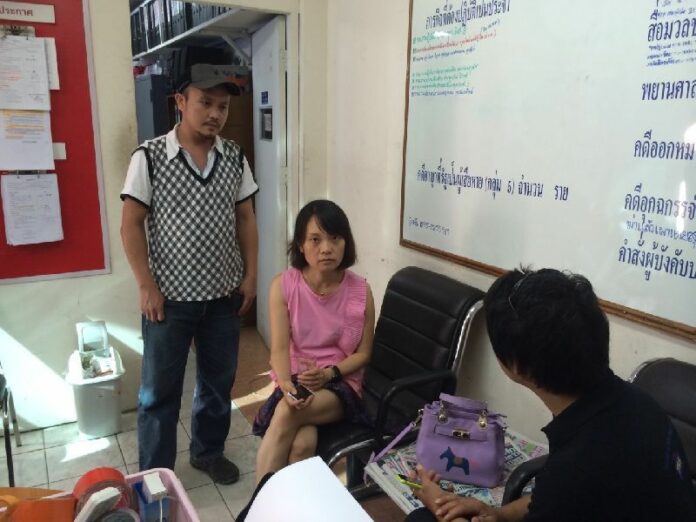
Chiew Ming (name transcribed from Thai text), a 32-year-old tourist from Szechuan, China, allegedly stole a cellphone from a Spanish tourist at Chiang Mai International Airport.

CHIANG MAI – Police have arrested a Chinese tourist who allegedly stole a cellphone from another traveler at Chiang Mai International Airport.

According to Pol.Col. Poonsap Ruamsuk, an officer at Phu Ping Police Station, a 39-year-old Spanish tourist alerted police after he lost his iPhone at the airport's x-ray security checkpoint.

Police studied CCTV footage and spotted a woman taking the Spanish tourist's phone. Pol.Col. Poonsap said police later tracked down and arrested the suspect as she returned to pick up her bag from storage in the airport.

The suspect was identified as Chiew Ming (name transcribed from Thai text), a 32-year-old tourist from Szechuan, China. 

Ms. Ming confessed that she saw the Spanish man leave his phone behind and decided to steal it out of a "spontaneous urge", Pol.Col. Poonsap said.

She has been charged with theft. 


For comments, or corrections to this article please contact: [email protected]

You can also find Khaosod English on Twitter and Facebook
http://twitter.com/KhaosodEnglish
http://www.facebook.com/KhaosodEnglish

Advertisement

HM King Diagnosed With Mild Gastritis

BANGKOK — The King of Thailand has a mild inflammation in his stomach, the Royal Household Bureau said in a statement today.

When doctors at Siriraj Hospital performed a colonoscopy on King Bhumibol during an annual medical check-up, "a mild inflammation was found in His Majesty's stomach," the statement says.

The condition is being treated, the statement said, adding that other medical checkups, such as his blood pressure, body temperature and heart beat rate, indicate that the king is in normal health. 

However, the statement noted that because the 86-year-old monarch is experiencing difficulty in eating "due to his age," medical staff are providing His Majesty with additional nutrients via his blood vessels to improve his health. 

"The doctors will perform other special medical examinations," the statement said.

His Majesty the King has been residing in Siriraj Hospital since 6 August. The Royal Household Bureau said the visit was for his annual medical check-up, which requires special equipment at the Bangkok hospital.

Starting in 2011, His Majesty the King spent many months at Siriraj Hospital to undergo surgeries and other medical operations. He was discharged from the hospital on 1 August 2013 and has since been recovering at his summer retreat, Klai Kang Won Palace, an approximately two-hour drive south of Bangkok.

The king has rarely appeared in public during his stay at Klai Kang Won Palace, although he made a brief appearance on 22 July when he endorsed the 2014 interim charter. 

The Royal Household Bureau has not said when His Majesty the King will leave hospital. 


For comments, or corrections to this article please contact[email protected]

You can also find Khaosod English on Twitter and Facebook
http://twitter.com/KhaosodEnglish
http://www.facebook.com/KhaosodEnglish

Advertisement

Yingluck Back To Face Corruption Charges

Former Prime Minister Yingluck Shinawatra appeared at a supermarket in Ram Intra district, accompanied by several aides, picking fruits and taking photos with other shoppers, 11 August 2014.

BANGKOK — Former Prime Minister Yingluck Shinawatra has returned to Thailand to face charges of corruption in criminal court.

Ms. Yingluck landed at Bangkok's Don Mueang Airport at around 10.15 pm on Sunday night. A convoy of six cars whisked her away from the airport, without giving any interviews to the press. Today, she was seen at a supermarket in Ram Intra district picking fruits and taking photos with other shoppers.

Her return to Thailand has been a matter of intense speculation, as the National Anti-Corruption Commission (NACC) found her guilty of negligence shortly before she left the country for Europe last month.

According to the NACC, Ms. Yingluck turned a blind eye to rampant corruption in her administration's rice pledging policy, reportedly costing the state more than 500 billion baht in damages. 

The NACC has sent the case to Thailand's Criminal Court. If found guilty, Ms. Yingluck could face up to 10 years in jail.

The NACC's decision to send Ms. Yingluck's case to court coincided with the former Prime Minister's announcement that she was traveling to France, presumably to attend a birthday party of her brother, former Prime Minister Thaksin Shinawatra, who was ousted in the 2006 military coup.

There was widespread speculation that Ms. Yingluck would use the opportunity to evade her trial and possible prison term.

For many Thais, Ms. Yingluck’s situation was reminiscent of that which Mr. Thaksin once faced. Mr. Thaksin was charged with corruption after the 2006 coup. He fled the country shortly before a court found him guilty in 2008 and has been living in self-imposed exile ever since.

Last week, a report from Thai Rath newspaper quoted a source inside the Pheu Thai Party as saying that Ms. Yingluck may extend her stay abroad to 31 August.

However, Ms.Yingluck's return has put an end to the speculation. Her court date has not been set, as the Office of Attorney-General has not yet officially taken up the case against her.


For comments, or corrections to this article please contact: [email protected]

You can also find Khaosod English on Twitter and Facebook
http://twitter.com/KhaosodEnglish
http://www.facebook.com/KhaosodEnglish
Advertisement

Yingluck Back To Face Corruption Charges

BANGKOK — Former Prime Minister Yingluck Shinawatra has returned to Thailand to face charges of corruption in criminal court.

Ms. Yingluck landed at Bangkok's Don Mueang Airport at around 10.15 pm on Sunday night. A convoy of six cars whisked her away from the airport, without giving any interviews to the press. Today, she was seen at a supermarket in Ram Intra district picking fruits and taking photos with other shoppers.

Her return to Thailand has been a matter of intense speculation, as the National Anti-Corruption Commission (NACC) found her guilty of negligence shortly before she left the country for Europe last month.

According to the NACC, Ms. Yingluck turned a blind eye to rampant corruption in her administration's rice pledging policy, reportedly costing the state more than 500 billion baht in damages. 

The NACC has sent the case to Thailand's Criminal Court. If found guilty, Ms. Yingluck could face up to 10 years in jail.

The NACC's decision to send Ms. Yingluck's case to court coincided with the former Prime Minister's announcement that she was traveling to France, presumably to attend a birthday party of her brother, former Prime Minister Thaksin Shinawatra, who was ousted in the 2006 military coup.

There was widespread speculation that Ms. Yingluck would use the opportunity to evade her trial and possible prison term.

For many Thais, Ms. Yingluck’s situation was reminiscent of that which Mr. Thaksin once faced. Mr. Thaksin was charged with corruption after the 2006 coup. He fled the country shortly before a court found him guilty in 2008 and has been living in self-imposed exile ever since.

Last week, a report from Thai Rath newspaper quoted a source inside the Pheu Thai Party as saying that Ms. Yingluck may extend her stay abroad to 31 August.

However, Ms.Yingluck's return has put an end to the speculation. Her court date has not been set, as the Office of Attorney-General has not yet officially taken up the case against her.


For comments, or corrections to this article please contact: [email protected]

You can also find Khaosod English on Twitter and Facebook
http://twitter.com/KhaosodEnglish
http://www.facebook.com/KhaosodEnglish

Advertisement

HM King Diagnosed With Mild Gastritis

His Majesty the King en route to Bangkok’s Siriraj Hospital, 6 August 2014.

BANGKOK — The King of Thailand has a mild inflammation in his stomach, the Royal Household Bureau said in a statement today.

When doctors at Siriraj Hospital performed a colonoscopy on King Bhumibol during an annual medical check-up, "a mild inflammation was found in His Majesty's stomach," the statement says.

The condition is being treated, the statement said, adding that other medical checkups, such as his blood pressure, body temperature and heart beat rate, indicate that the king is in normal health. 

However, the statement noted that because the 86-year-old monarch is experiencing difficulty in eating "due to his age," medical staff are providing His Majesty with additional nutrients via his blood vessels to improve his health. 

"The doctors will perform other special medical examinations," the statement said.

His Majesty the King has been residing in Siriraj Hospital since 6 August. The Royal Household Bureau said the visit was for his annual medical check-up, which requires special equipment at the Bangkok hospital.

Starting in 2011, His Majesty the King spent many months at Siriraj Hospital to undergo surgeries and other medical operations. He was discharged from the hospital on 1 August 2013 and has since been recovering at his summer retreat, Klai Kang Won Palace, an approximately two-hour drive south of Bangkok.

The king has rarely appeared in public during his stay at Klai Kang Won Palace, although he made a brief appearance on 22 July when he endorsed the 2014 interim charter. 

The Royal Household Bureau has not said when His Majesty the King will leave hospital. 


For comments, or corrections to this article please contact: [email protected]

You can also find Khaosod English on Twitter and Facebook
http://twitter.com/KhaosodEnglish
http://www.facebook.com/KhaosodEnglish
Advertisement

Actress Petitions Junta To Execute Rapists

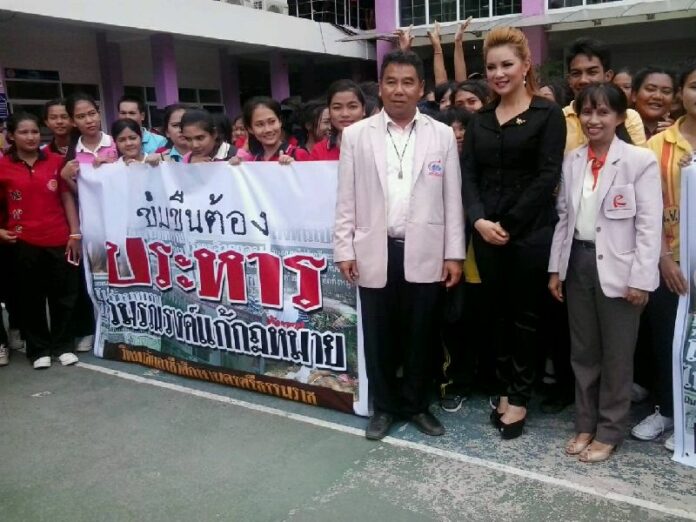
Thai actress Panadda Wongphudee campaigns for using the death penalty against rapists in 2014 at a school in Nakhon Si Thammarat province.

BANGKOK — The famous Thai actress Panadda Wongphudee has submitted a petition to the military junta calling for punishing convicted rapists with the death penalty.

Ms. Panadda said that more than 110,000 people signed the petition, which was addressed to Gen. Prayuth Chan-ocha, chairman of the junta's National Council for Peace and Order (NCPO). 

The actress presented the petition to Maj.Gen. Pollaphatara Wannapak, secretary of the Royal Thai Army, on Friday.

In addition to raising the maximum penalty for convicted rapists to execution, the petition urges a harsher punishment for those guilty of committing rapes on public transportation. Convicted rapists should also be denied a chance to submit for a Royal Pardon, the petition says.

Calls for punishing rapists with the death penalty rose after 13-year-old girl was brutally raped and murdered aboard an overnight train in July. An employee of the State Railway of Thailand (SRT) was arrested several days after the incident and reportedly confessed to sexually assaulting the girl and throwing her body out of the moving train. 

Although the suspect, Wanchai Saengkhao, will likely face death penalty due to his murder charge, pro-execution activists led by Ms. Panadda argue that punishing rape alone with the death penalty is needed to deter sexual assailants in Thailand.

Critics of the idea argue that the death penalty has not been proven to lower the number of crimes in many countries.

Speaking at the Royal Thai Army headquarters on Friday, Ms. Panadda said she was campaigning in favour of the death penalty to help express the "people's will."

"I did not do this because I want to follow a trend," Ms. Panadda said. 

Ms. Panadda, who was crowned Miss Thailand World in 2000, also urged the NCPO to comply with the petition as a means to "return happiness and confidence in safety to the people."

The NCPO has not publicly responded to the petition.


For comments, or corrections to this article please contact: [email protected]

You can also find Khaosod English on Twitter and Facebook
http://twitter.com/KhaosodEnglish
http://www.facebook.com/KhaosodEnglish
Advertisement

Pheu Thai Wants NLA Members To Reveal Their Assets

Members of the National Legislative Assembly (NLA) arrived at Ananta Samakhom Throne Hall in Bangkok for a royal inauguration of the assembly on 7 August 2014.

BANGKOK — A leading member of the Pheu Thai Party has urged members of the newly-formed National Legislative Assembly to reveal their financial assets.

"Article 6 of the interim charter says the NLA [members] function as MPs and Senators, so they have to reveal their assets and debt," said Ruengkrai Leekijwattana, a legal adviser to Pheu Thai, the ruling party of the government overthrown in the 22 May military coup.

Mr. Ruengkrai said the National Anti-Corruption Commission (NACC) is also bound by a 2011 law to scrutinise and publicise the financial data of each NLA member, as it does with Cabinet members and MPs in elected governments. 

"The NACC law requires all MPs and Senators to reveal their assets. The 200 people who are now acting as the legislative branch must also reveal theirs, too. Same goes with Gen. Prayuth Chan-ocha, as the leader of the NCPO, and the Cabinet that will be formed very soon," Mr. Ruengkrai said, referring to the junta's National Council for Peace and Order.

He continued, "I don't think the NACC needs a long time to consider that, because the law is still there. Why is it so afraid to let the people see the financial statements of these people? There's no reason to be afraid. They are all moral people."

The NLA is part of an interim government set up by the NCPO to administer the country until national elections are held at the end of 2015. The members of the newly-formed NLA were handpicked by the military junta and a majority of the seats, 115, belong to military and police officers, including a brother of Gen. Prayuth. The other seats are occupied by bureaucrats, business owners, academics, and former politicians. 

The NACC previously said it would not require members of the NCPO to reveal their assets, claiming that there was no legislation to support the action. It has not indicated whether the same approach will be applied to the NLA and other bodies in the interim government.

When Mr. Ruengkrai was asked about the possibility of Gen. Prayuth assuming the post of Prime Minister, he replied that Gen. Prayuth should take the job, whether he personally wants to or not.

"I think Gen. Prayuth should be Prime Minister himself, because the administration of the country in an abnormal situation has to rely on an urgent chain of command," Mr. Ruengkrai said.


For comments, or corrections to this article please contact[email protected]

You can also find Khaosod English on Twitter and Facebook
http://twitter.com/KhaosodEnglish
http://www.facebook.com/KhaosodEnglish

Advertisement

NCPO ‘Reforestation Campaign’ Threatens Livelihood of Forest Communities

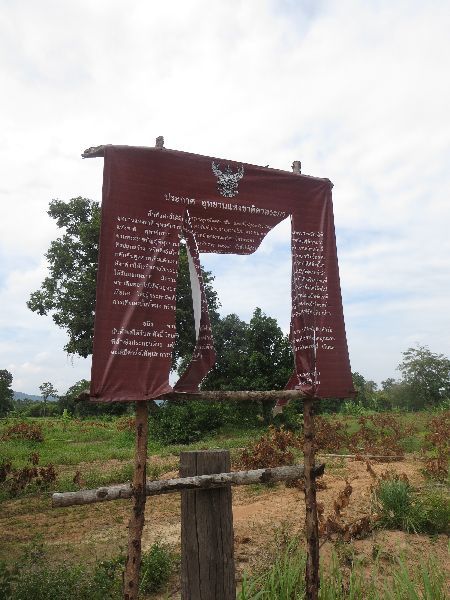
A sign warning villagers from Nong Pak Van in San Kaeo province to clear their rubber tree plantation from inside Da Pra Ya National Park within 15 days.  

By Evan Gershkovich

NONG PAK VAN — Several weeks ago, villagers from Nong Pak Van in San Kaeo province woke up to find their rubber tree plantation decimated. The several hundred rubber trees, which were only one year away from harvest, had been cut down by a task force of park officials, soldiers, and police officers. Forest officials told the villagers the land was being taken back for reforestation.

After finding their trees cut down, villagers from Nong Pak Van sought an explanation from the provincial office of Thailand’s military government, the National Council for Peace and Order (NCPO). They were told that because of the current political situation, the NCPO had to take back the land.

On 14 June, the NCPO issued an order calling upon authorities to put an end to deforestation and forest encroachment across the country. Since then, combined task forces of park officials, soldiers, and police have entered forest reserves across the country to evict local villagers and commercial operations from the protected areas.

Last week, NCPO chairman Gen. Prayuth Chan-ocha approved a plan to increase the country’s forested land from 31.5 percent to 40 percent over the next ten years.

A history of murky laws

When the Thai government began its drive to end deforestation in the 1960s, many villagers were kicked off land that became protected areas under the National Park Act of 1961 and the National Forest Reserve Act of 1964. But with nowhere else to go, many villagers fought for compromises to remain on the property as long as they did not sell any land or produce crops other than for their own consumption.

According to Nong Pak Van villagers, when they first planted the rubber trees four years ago, local forestry officials warned them that they were breaching part of a compromise agreed to in 1996. That agreement allowed villagers to live off land inside Da Pra Ya National Park, but with some restrictions.

“When the officials came after we first planted the trees, we told them we would cut down the trees if they wanted,” said Sap Chaihavong, a villager from Nong Pak Van. “But they said it was okay as long as we did not plant anymore.”

Two years later, the Nong Pak Van villagers received a court summons from local police regarding the trees. But when villagers showed police the 1996 agreement documents, the authorities decided to pardon them.

“We told the police that we didn’t think the agreement said anything about rubber trees,” said Mr. Chaihavong. “When they read the agreement they weren’t so sure, but they agreed with us. So we continued investing in the plantation.”

But the director of Da Pra Ya National Park, Boonchert Jaroensuk, says the 1996 agreement only permits the villagers to grow crops for consumption.

“The compromise only allows planting of living crops such as rice, sugarcane, and potatoes. Rubber plants are economic crops,” said Mr. Boonchert. “The fact is, I asked them a long time ago to remove the rubber plants because they violated the compromise we had in 1996.”

Mr. Boonchert also says the plot of land cultivated by Nong Pak Wan villagers has grown considerably over the years.

“When the government made this compromise, they surveyed the land in great detail,” said Mr. Boonchert. “We know how many crops they had, we know how much land they had. They have been illegally encroaching on the land.”

The villagers from Nong Pak Van, who have been living of the land for generations, say they have a difficult time understanding what they are permitted to do under the law. The complex legal documents that outline these boundaries often leave local officials stumped as well. 

Mr. Chaihavong, whose rubber trees were cut down last month, says he wishes officials had made their stance on the plantation clear three years ago.  

“We are not educated people, so we cannot understand the legal language of the compromise agreement,” Mr. Chaihavong said. “If we could have known that this would happen, we would have not planted the trees. We are now in big trouble because we took out big loans to plant these trees.”

Most villagers in Nong Pak Van grow rice and potatoes for consumption and trade any surpluses with people from nearby villages for other resources. They do not have any other income and will now struggle to pay off their loans.

Park director Mr. Boonchert says the villagers will not be receiving any compensation. 

“In fact, we are also going to ask the civil court to order the villagers to pay for the operation as well,” he said.

Mr. Boonchert added that park officials also have plans to cut down a much larger plantation of rubber trees inside the forest that is suspected to belong to a local politician.

“We have already posted a notice and we will begin the operation by late September,” Mr. Boonchert said.

Forest communities brace for new policies

Since staging a coup on 22 May, the NCPO has sought to halt deforestation and drive out land encroachers across the country. The Royal Forest Department recently ordered a major reshuffle of 30 park directors in charge of disputed areas.

On 28 June, park officials and military soldiers ordered villagers in Buriram province in Northeastern Thailand to leave their homes by 8 July, or else face a forceful eviction. Park officials and representatives from Buriram’s provincial government later agreed to give the villagers new housing and land, though they did not give details about where, how, and when the new housing and land will be provided.

Last week, villagers in Kok Idoi, another village in Da Pra Ya National Park, held a ceremony to honor to the evicted villagers in Buriram. Local forest officials and members of the Assembly of the Poor, a Thai NGO, attended the annual tree-planting ceremony as well.

Although Kok Idoi villagers have not heard from officials about their land-tenure security, news about the Buriram evictions, their neighbors in Nong Pak Van, and reports of other crackdowns across the country have led them to fear for their future.

Like in Nong Pak Van, the Kok Idoi villagers have a compromise agreement with the government that allows them live on the protected land. Because they do not grow trees to sell, local forest officials have allowed the villagers to plant trees every year, though this is technically a breach of their compromise. This year, the forest officials helped villagers plant the trees during their annual ceremony.

Baramee Chairat, a leader of the Assembly of the Poor, has been helping forest-dependent communities like Kok Idoi protect their land and reach compromises with the government since 1994. 

“We are trying our best to protect [the villagers],” said Mr. Baramee. “They invited the forestry officials to this event because they want to show them that they’re saving the forest: they plant trees regularly.”

Community forestry as a solution

With deforestation contributing to 11% of global greenhouse gas emissions, any effective climate change policy must include a plan to combat forest degradation. But despite many country’s efforts to curb the trend, deforestation has continued at a rapid rate. 

“A major reason is that those who know the forest best – the communities that have lived with them and used them for centuries – are not empowered to protect them,” wrote Andrew Steer, President and CEO of World Resources Institute (WRI), in a recent blog post. “Some of the strongest advocates for the world’s forests are the communities that depend on them for food, livelihoods and culture.”

On 24 July, WRI released a report providing evidence that deforestation has decreased considerably in places where local peoples’ rights are given strong legal recognition. According to Mr. Steer, “in the Bolivian Amazon, deforestation was six times lower; in the Brazilian Amazon, 11 times lower; and in the Guatemala Maya Biosphere, 20 times lower.”

Although the enforcement of land laws is essential to combating deforestation, involving local people in the process could both strengthen the reforestation effort and help secure the livelihoods of local communities.

“People from the outside think we are destroying the forest – they think we are encroachers,” said Uthai Saadchop, a villager from Kok Idoi. “But this is our only livelihood. We do not have any income, so we need to make the forest grow. We have been doing this since the time of our ancestors. If we could cooperate with the government officials to take care of the forest we would be so happy.”


For comments, or corrections to this article please contact[email protected]

You can also find Khaosod English on Twitter and Facebook
http://twitter.com/KhaosodEnglish
http://www.facebook.com/KhaosodEnglish

Advertisement

NCPO ‘Reforestation Campaign’ Threatens Livelihood of Forest Communities

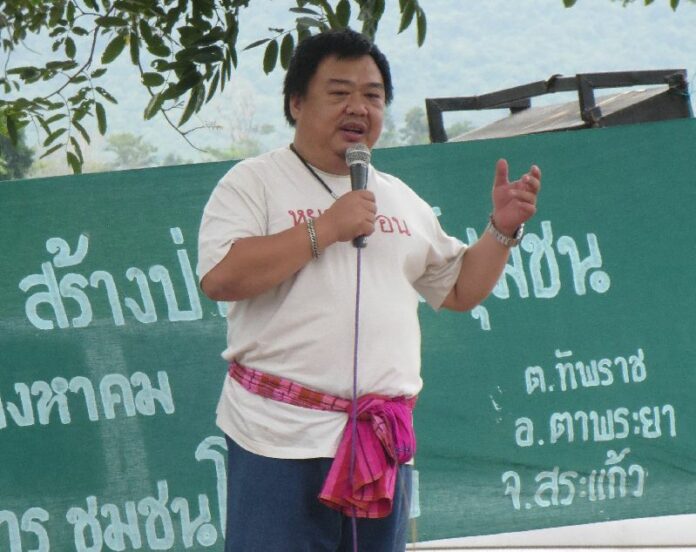
Baramee Chairat, a leader of the Assembly of the Poor, speaking at Kok Idoi villagers' annual tree-planting ceremony, 3 August 2014.

By Evan Gershkovich

NONG PAK VAN — Several weeks ago, villagers from Nong Pak Van in San Kaeo province woke up to find their rubber tree plantation decimated. The several hundred rubber trees, which were only one year away from harvest, had been cut down by a task force of park officials, soldiers, and police officers. Forest officials told the villagers the land was being taken back for reforestation.

On 14 June, the NCPO issued an order calling upon authorities to put an end to deforestation and forest encroachment across the country. Since then, combined task forces of park officials, soldiers, and police have entered forest reserves across the country to evict local villagers and commercial operations from the protected areas.

Last week, NCPO chairman Gen. Prayuth Chan-ocha approved a plan to increase the country’s forested land from 31.5 percent to 40 percent over the next ten years.

A history of murky laws

When the Thai government began its drive to end deforestation in the 1960s, many villagers were kicked off land that became protected areas under the National Park Act of 1961 and the National Forest Reserve Act of 1964. But with nowhere else to go, many villagers fought for compromises to remain on the property as long as they did not sell any land or produce crops other than for their own consumption.

According to Nong Pak Van villagers, when they first planted the rubber trees four years ago, local forestry officials warned them that they were breaching part of a compromise agreed to in 1996. That agreement allowed villagers to live off land inside Da Pra Ya National Park, but with some restrictions.

“When the officials came after we first planted the trees, we told them we would cut down the trees if they wanted,” said Sap Chaihavong, a villager from Nong Pak Van. “But they said it was okay as long as we did not plant anymore.”

Two years later, the Nong Pak Van villagers received a court summons from local police regarding the trees. But when villagers showed police the 1996 agreement documents, the authorities decided to pardon them.

“We told the police that we didn’t think the agreement said anything about rubber trees,” said Mr. Chaihavong. “When they read the agreement they weren’t so sure, but they agreed with us. So we continued investing in the plantation.”

But the director of Da Pra Ya National Park, Boonchert Jaroensuk, says the 1996 agreement only permits the villagers to grow crops for consumption.

“The compromise only allows planting of living crops such as rice, sugarcane, and potatoes. Rubber plants are economic crops,” said Mr. Boonchert. “The fact is, I asked them a long time ago to remove the rubber plants because they violated the compromise we had in 1996.”

Mr. Boonchert also says the plot of land cultivated by Nong Pak Wan villagers has grown considerably over the years.

“When the government made this compromise, they surveyed the land in great detail,” said Mr. Boonchert. “We know how many crops they had, we know how much land they had. They have been illegally encroaching on the land.”

The villagers from Nong Pak Van, who have been living of the land for generations, say they have a difficult time understanding what they are permitted to do under the law. The complex legal documents that outline these boundaries often leave local officials stumped as well. 

Mr. Chaihavong, whose rubber trees were cut down last month, says he wishes officials had made their stance on the plantation clear three years ago.  

“We are not educated people, so we cannot understand the legal language of the compromise agreement,” Mr. Chaihavong said. “If we could have known that this would happen, we would have not planted the trees. We are now in big trouble because we took out big loans to plant these trees.”

Most villagers in Nong Pak Van grow rice and potatoes for consumption and trade any surpluses with people from nearby villages for other resources. They do not have any other income and will now struggle to pay off their loans.

Park director Mr. Boonchert says the villagers will not be receiving any compensation. 

“In fact, we are also going to ask the civil court to order the villagers to pay for the operation as well,” he said.

Mr. Boonchert added that park officials also have plans to cut down a much larger plantation of rubber trees inside the forest that is suspected to belong to a local politician.

“We have already posted a notice and we will begin the operation by late September,” Mr. Boonchert said.

Forest communities brace for new policies

Since staging a coup on 22 May, the NCPO has sought to halt deforestation and drive out land encroachers across the country. The Royal Forest Department recently ordered a major reshuffle of 30 park directors in charge of disputed areas.

On 28 June, park officials and military soldiers ordered villagers in Buriram province in Northeastern Thailand to leave their homes by 8 July, or else face a forceful eviction. Park officials and representatives from Buriram’s provincial government later agreed to give the villagers new housing and land, though they did not give details about where, how, and when the new housing and land will be provided.

Last week, villagers in Kok Idoi, another village in Da Pra Ya National Park, held a ceremony to honor to the evicted villagers in Buriram. Local forest officials and members of the Assembly of the Poor, a Thai NGO, attended the annual tree-planting ceremony as well.

Although Kok Idoi villagers have not heard from officials about their land-tenure security, news about the Buriram evictions, their neighbors in Nong Pak Van, and reports of other crackdowns across the country have led them to fear for their future.

Like in Nong Pak Van, the Kok Idoi villagers have a compromise agreement with the government that allows them live on the protected land. Because they do not grow trees to sell, local forest officials have allowed the villagers to plant trees every year, though this is technically a breach of their compromise. This year, the forest officials helped villagers plant the trees during their annual ceremony.

Baramee Chairat, a leader of the Assembly of the Poor, has been helping forest-dependent communities like Kok Idoi protect their land and reach compromises with the government since 1994. 

“We are trying our best to protect [the villagers],” said Mr. Baramee. “They invited the forestry officials to this event because they want to show them that they’re saving the forest: they plant trees regularly.”

Community forestry as a solution

With deforestation contributing to 11% of global greenhouse gas emissions, any effective climate change policy must include a plan to combat forest degradation. But despite many country’s efforts to curb the trend, deforestation has continued at a rapid rate. 

“A major reason is that those who know the forest best – the communities that have lived with them and used them for centuries – are not empowered to protect them,” wrote Andrew Steer, President and CEO of World Resources Institute (WRI), in a recent blog post. “Some of the strongest advocates for the world’s forests are the communities that depend on them for food, livelihoods and culture.”

On 24 July, WRI released a report providing evidence that deforestation has decreased considerably in places where local peoples’ rights are given strong legal recognition. According to Mr. Steer, “in the Bolivian Amazon, deforestation was six times lower; in the Brazilian Amazon, 11 times lower; and in the Guatemala Maya Biosphere, 20 times lower.”

Although the enforcement of land laws is essential to combating deforestation, involving local people in the process could both strengthen the reforestation effort and help secure the livelihoods of local communities.

“People from the outside think we are destroying the forest – they think we are encroachers,” said Uthai Saadchop, a villager from Kok Idoi. “But this is our only livelihood. We do not have any income, so we need to make the forest grow. We have been doing this since the time of our ancestors. If we could cooperate with the government officials to take care of the forest we would be so happy.”


For comments, or corrections to this article please contact[email protected]

You can also find Khaosod English on Twitter and Facebook
http://twitter.com/KhaosodEnglish
http://www.facebook.com/KhaosodEnglish
Advertisement

Hot News

LATEST NEWS

Bangkok
overcast clouds
33.7 ° C
35.5 °
32.2 °
66 %
4.5kmh

100 %
Fri
33 °
Sat
37 °
Sun
37 °
Mon
35 °
Tue
33 °