32.7 C
Bangkok
Sunday, July 5, 2026
Home Blog Page 3293

Reuters, Reporters To Be Charged Over Pulitzer-Winning Paragraph

PHUKET — Reuters news agency and two Reuters reporters could face arrest for their Pulitzer prize-winning report on Rohingya refugees, police say.

The order to appear before Phuket police has come almost five months after two Phuketwan journalists were similarly summoned for publishing an excerpt from the Reuters report in question.

The two Phuketwan journalists have since been charged with criminal defamation for publshing the Reuters paragraph, which alleged the Royal Thai Navy's invovlement in the trafficking of Myanmar's persecutued Rohingya. 

Read the rest of the story here: http://phuketwan.com/tourism/reuters-reporters-charged-pulitzer-rohingya-paragraph-phuket-police-20244/


Advertisement

India's BJP Tipped to Form New Govt After Record Turnout

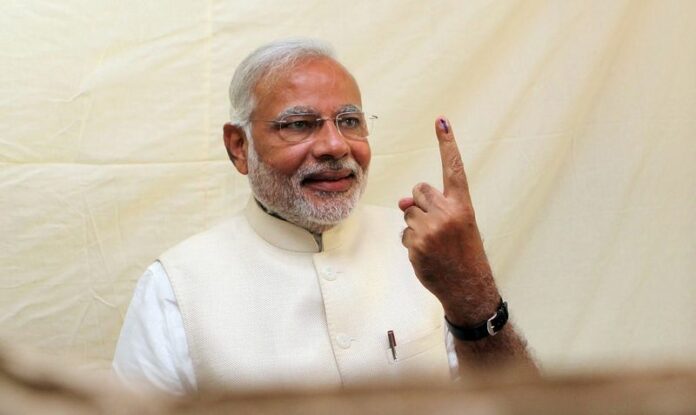
Narendra Modi, the prime ministerial candidate for India's main opposition Bharatiya Janata Party, shows his inked finger after casting his vote in Ahmadabad. Exit polls are tipping him to be in a position to form the next government (DPA).

By Siddhartha Kumar (DPA)

NEW DELHI — India's five-week long parliamentary election came to a close Monday, with exit polls tipping the opposition Hindu nationalist Bharatiya Janata Party (BJP) to be in a position to form the next government.

The parliamentary polls, the world's biggest with an electorate of 815 million, began on April 7 and were held over 10 phases. Results are due on Friday.

With 541 million eligible Indians having cast their ballots, turnout was estimated at a record 66.4 per cent. The country's previous best turnout, during the 1984 elections, was 63.6 per cent.

"The high turnout is chiefly due to enthusiasm among people, most of whom are expecting to change their government," said Sanjay Kumar, director of the Delhi-based Centre for the Study of Developing Societies.

Exit polls suggested that the Indian National Congress, led by Rahul Gandhi, the scion of the country's most famous political dynasty, was likely to be dislodged by a resurgent BJP after 10 years in power.

According to broadcaster Times Now, the National Democratic Alliance (NDA), which is led by the BJP, has secured between 249 and 265 seats in the country's 543-strong parliament.

The polls found that the Congress-led United Progressive Alliance would secure 148 seats, while smaller parties would get a combined total of 146 seats.

Another broadcaster, NDTV, which averaged polls broadcast on three news channels, said the NDA was set to gain around 280 seats.

Political analysts, however, have warned that India's exit polls have a reputation for being misleading and have gone wrong in the past.

Depending on the final results of the election, smaller regional parties could play a crucial role in enabling the NDA to form the next government.

Millions braved soaring summer temperatures to elect 41 more lawmakers to the 543-member parliament in Monday's final stage.

The spotlight of Monday's electoral round was between Narendra Modi, the prime ministerial candidate from the BJP, and Arvind Kejriwal of the fledgling anti-corruption Aam Aadmi party in the Hindu holy city of Varanasi.

Congress has faced public anger due to widespread corruption, high inflation and a sharp economic slowdown.

Modi, a pro-business reformer who has promised development and jobs to revive the economy, is a popular but divisive leader. His tenure as chief minister in the western state of Gujarat saw some of India's bloodiest Hindu-Muslim riots.

There were no major disruptions during this year's elections. But Maoist insurgents, who had called for a boycott of the polls, carried out a series of attacks, killing dozens of police officers and polling officials.

Indian markets have been hitting record highs since Friday on the back of expectations that the BJP will form the next government and bring measures to revive the economy.

The 30-share Sensex of the Bombay Stock Exchange surged over 1,000 points, or over 5 per cent, since Friday to touch an all-time high of 23,551 points.

Advertisement

Missing MH370 ‘Behind Visa Run Crackdown’

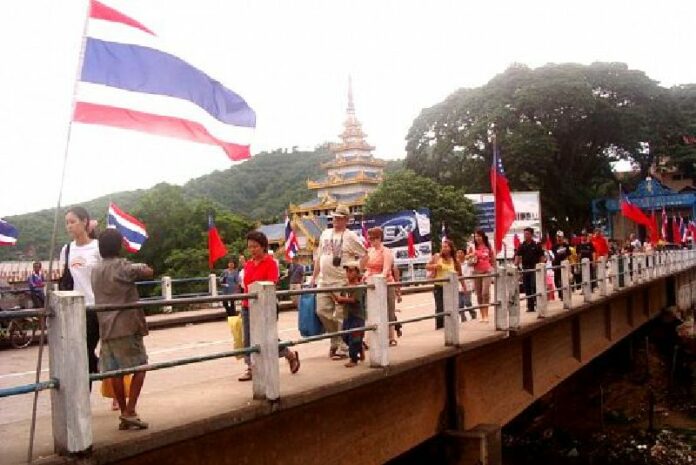
Foreigners return from Myanmar after a visa run through the Mae Sai crossing. That's all stopped now. Photo Robert Biuk-Aghai (The Phuket News).

(The Phuket News)

PHUKET — A senior Immigration officer has given a clue as to why the government is cracking down on tourists doing “out-in visa hops” across Thailand’s borders: MH370.

Pol Lt Col Tauthong Thitchai of Surin Immigration, in whose territory is the busy Chong Jom crossing into Cambodia, told The Phuket News, “The main reason is the lost Malaysian Airlines flight MH370.” Two people on that flight were carrying passports reported lost or stolen in Phuket.

Read the rest of the story here: http://www.thephuketnews.com/missing-mh370-%E2%80%98behind-visa-run-crackdown%E2%80%99-fingerprints-next-46232.php


Note: Khaosod English is not responsible for content on other websites.


Advertisement

DPA: Senators Debate Appointed PM as Protesters Move Base

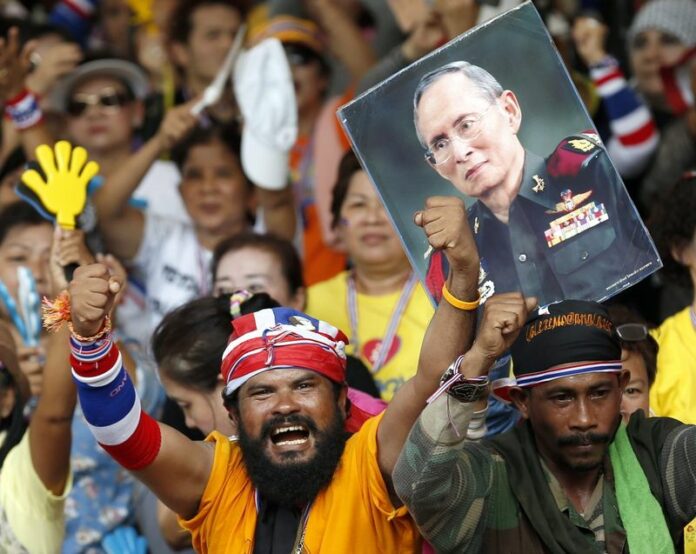
Thai anti-government protesters shout slogans next to a poster of King Bhumibol Adulyadej during a rally surrounding the Government House in Bangkok, Thailand, 09 May 2014 (DPA).

By Cod Satrusayang (DPA)

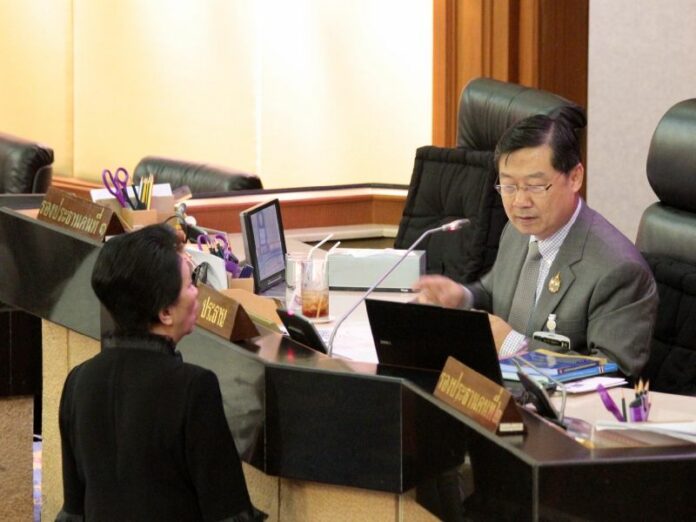
BANGKOK — Thai senators debated the merits of appointing a government to try and end the country's political conflict during an informal session Monday, as anti-government protesters moved their base closer to parliament.

Senator Kamnoon Sitthisamarn asked newly appointed speaker Surachai Liangboonlertchai to hasten the appointment of a new prime minister in an attempt to "unlock" the current political crisis.

Kamnoon, an appointed senator in Thailand's upper house – where only a fraction of the members are elected – conceded however that such an appointment could be "wrong under the constitution."

Earlier Monday protesters in central Bangkok began moving their main rally site to the area surrounding parliament, hoping to pressure the Senate to appoint an interim government to institute reforms before any new elections.

Thailand's acting prime minister insisted that new elections were the only way to resolve the protracted political crisis.

Niwatthamrong Boonsongphaisan said the caretaker government was willing to work with all sides to end the impasse, but stressed that it must be done "within the framework of the constitution." 

"Any attempt by the courts (to launch a judicial coup) is done so at their own risk," he said. "We have legal mandate."

Pro-government supporters rallying on the outskirts of Bangkok also insisted on new elections.

Jatuporn Promphan, a leader of the pro-government movement, warned that support for an appointed government "will only lead to destruction."

"If you subvert democracy, you will be starting a civil war. We will continue our fight and we will escalate it until democracy is restored," Jatuporn said at a rally over the weekend.

Key Thai institutions are reportedly resisting demands to install an appointed government to make political reforms.

Analysts said the Senate, the Electoral Commission and various courts were unlikely to implement such a plan because it would put them at risk of breaking the law, the Bangkok Post reported.

There is no constitutional precedence for the proposal being pushed by anti-government protesters, an unnamed senior judge was quoted as saying by the newspaper.  

Advertisement

Govt to Put Cheap Food Stalls Inside Supermarkets

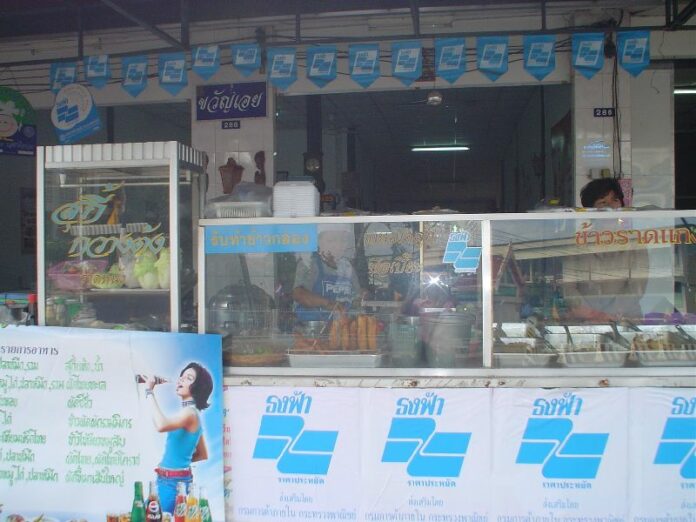
The Government will be installing "Blue Flag" food stalls selling cheap goods inside major supermarkets starting this June (Department of Internal Trade).

BANGKOK — The Department of Internal Trade has announced a plan to install food stalls selling inexpensive items inside major supermarkets across the country.

"The Blue Flag" stalls will open in branches of Big C and Lotus supermarket chains by early June, said Santichai Sarntawalpaet, deputy director of the Department of Internal Trade.

According to Mr. Santichai, the price of food sold by these "Blue Flag" stalls will be 20% cheaper than goods in the unsubsidized market.

Mr. Santichai said the program is meant to ease financial burdens during the economic slow-down, and to assist parents who are bound to face additional expenditures when school semesters start this June.

Mr. Santichai said the Department of Internal Trade will ask producers of commodity goods to freeze their prices in the next six months, while vendors who sell extraordinarily expensive goods will be punished. Citizens are urged to report any violators to the Department's hotline at 1569.

Despite the economic fallout caused by the ongoing political crisis, Thailand will not face a shortage of commodity goods, Mr. Santichai insisted.

"There is no need for consumers to stockpile any goods," he said.  


For comments, or corrections to this article please contact: [email protected]

You can also find Khaosod English on Twitter and Facebook
http://twitter.com/KhaosodEnglish
http://www.facebook.com/KhaosodEnglish

Advertisement

Editorial: Stop Invoking Article 7 — And Get Rid Of It Too

Newly elected Senate Speaker Surachai Liengboonlertchai, who Mr. Suthep is calling upon to appoint a new PM.

Article 7 of Thailand’s Constitution must be revised to prevent political actors from using it to justify circumventing other articles in the Constitution.

Article 7 of Thailand’s 2007 Constitution reads, “Whenever no provision under this Constitution is applicable to any case, it shall be decided in accordance with the constitutional tradition in the democratic regime of government with the King as Head of State.”

The provision is a favourite among the anti-government protesters that have been campaigning on the streets of Bangkok for more than six months. Their aim is to topple Thailand’s current government and create just the type of political vacuum that, they say, would warrant invocation of Article 7.

Since last November, the anti-government People's Committee for Absolute Democracy with the King as Head of State (PCAD) has successfully pushed Thailand closer and closer to the political abyss its leaders are aiming for: street protests forced then-PM Yingluck Shinawatra to dissolve Parliament in December;  PCAD’s interferences with the 2 Feb snap poll resulted in the election’s invalidation a week later; and last Wednesday, the Constitutional court ousted Ms. Yingluck and nine of her cabinet ministers in a verdict that many are calling extremely biased.

According to the PCAD’s firebrand leader, Suthep Thaugsuban, the political vacuum has arrived.

Needless to the say, the 25 Cabinet members that survived the Court’s sword last week disagree with this diagnosis, and have already appointed a senior member from their ranks to take the premiership’s seat. But Mr. Suthep has dismissed what's left of the caretaker government and is now demanding the Senate select a new candidate for Prime Minister and submit the name to His Majesty the King for royal approval.

According to Mr. Suthep, all of this is legal under Article 7.  

Article 7 is intended to provide the country with somewhere to turn when a situation not explicitly spelled out in the Constitution arises. It says that in such a case, Thailand must rely on its “constitutional tradition.” 

But what exactly does acting in "accordance with the constitutional tradition” mean? 

Does it mean the country should mimic how similar predicaments were resolved in the past?

Or, does it mean that conflicts should be resolved in a manner that accords with the spirit of the Constitution? The latter would emphasize finding a solution that best reflects the basic principles of the Constitution, while not violating any of its other provisions.

Today’s anti-government activists have clearly adopted the first interpretation of Article 7, citing past examples of when HM King has stepped in to resolve previous political crises as justification for a royal intervention today. 

In 1973, HM King did appoint Thammasat University rector Sanya Thammasak to be Prime Minister after a massive popular uprising against Gen. Thanorm's military dictatorship. However, the incident is virtually a one-time occurrence in the history of Thai democracy, which hardly constitutes the “tradition" that supporters of the Article 7 plan like to claim.

Furthermore, one could easily cite the numerous instances of when HM King has refused to arbitrate political conflicts as evidence for why the monarchy’s nonintervention is actually closer to a “constitutional tradition.” 

In fact, when protesters attempting to oust former PM Thaksin Shinawatra in 2006 tried to request a royally-appointed PM via Article 7, HM King responded in a televised address stating that the article did not give him such power.

“Article 7 does not say that the King has that authority. It does not. Look at Article 7. The article does not say that a constitutional monarchy means the King has the authority to make an order," His Majesty the King said on 16 April, 2006.

So what exactly does Article 7 say? Or does it say anything at all?

Thailand’s “constitutional tradition” could mean any number of contradicting things. In regards to the current crisis, it might mean that Ms. Yingluck’s vacated seat should be temporarily filled by her deputy, or because he too was ousted in the court verdict, another senior member from her cabinet. It is common practice in Thailand for a deputy to take charge when a permanent secretary is not in office.

Yet, acting in accordance with Thailand’s “constitutional tradition” could also mean having the Senate, the next closest thing to the House of Representatives (which is currently nonexistent), select a new temporary leader from among its ranks.

It’s impossible to say which of these solutions is more in line with Thailand’s “constitutional tradition” because it’s not at all clear what those two words mean. The fundamental problem with Article 7 is that it can be twisted to justify almost any political action.  As a result, its only real function is to grant political actors the ability to invoke it and rewrite the rules as they see fit.

In order to avoid this abuse, Article 7 must be replaced with a carefully-worded provision that elucidates the meaning of “constitutional tradition.” In our opinion, it should be amended to clarify that acting in “accordance with the constitutional tradition” involves resolving conflicts in a manner that best reflects the Constitutions’ core principles – not necessarily the country’s historical precedents.

It can’t possibly be a good idea for a country that has experienced 9 coups and 17 constitutions since 1932 to rely on tradition for solving its present and future crises.

In the present impasse, acting in accordance with the spirit of the law would involve organising new elections as soon as possible. It's clear that the most constitutional way to select the new Prime Minister would be through the ballot box— that is, after all, the process outlined in the Constitution.

The conflict in Thailand, which is already fragile, is alarmingly close to escalating into a full-blown civil war. Pro-government Redshirts have repeatedly warned that they will stage a widespread uprising against any unelected PM. We don't condone violence of any sort, but their resistance to the idea of an unelected Prime Minister is valid.

Mr. Suthep's plan to install an unelected PM will steer Thailand further away from being goverened by basic constitutional practices and guidelines. In our view, this will only deepen the country’s crisis.

Thailand must return to a system of government that can be adequately guided by the Constitution, thereby eliminating the need to invoke the flawed Article 7. 

That means returning power to a parliament and Prime Minister that has been elected by the people.


For comments, or corrections to this article please contact: [email protected]

You can also find Khaosod English on Twitter and Facebook
http://twitter.com/KhaosodEnglish
http://www.facebook.com/KhaosodEnglish
Advertisement

Uproar Over 'Doctored' Photo of Princess' Van At Red Rally

A photo of a 'real' van from  the Miracle of Life Foundation, offered as evidence to prove that a photo circulating on social media was doctored.

BANGKOK — A foundation run by His Majesty the King's eldest daughter is denying claims that they sent support to the Redshirt rally in Western Bangkok.

The claims stem from an undated photo that shows a white Toyota van operated by the Miracle of Life Foundation, which is founded and chaired by Princess Ubolratana Rajakanya, parked amid Redshirt demonstrators on Aksa Avenue. 

The caption accompanying the photo claims that "903" – a codeword commonly understood to mean Princess Ubolratana – is throwing her support behind the pro-government movement and has dispatched supplies to the demonstrators in their rally site.

After the photo was widely circulated on social media, Manas Nonuch, an executive committee member of the Miracle of Life Foundation, met with Thammasala Police in Nakhon Pathom province today and urged them to pursue legal action against the original author of the post.

According to Mr. Manas, the photo was doctored to mislead the public. The Foundation has only one white Toyota van in its fleet, and that vehicle has never been dispatched to a Redshirt rally, Mr. Manas said.  

"Let me stress that the Foundation is not related to this matter in any way," said Mr. Manas. "The forgery is utterly inappropriate and offensive toward [Princess Ubolratana]."

He added that attempts to tie the Foundation to any political faction is condemnable because the Foundation is dedicated to impartially assisting those who suffer from poverty or natural disasters, regardless of political affiliation.  

Police say they have accepted Mr. Manas' complaint and initiated an effort to identify the original author of the post.

Although Princess Ubolratana relinquished her official royal title to marry an American in 1972, the Thai public nevertheless regards and addresses her as a member of the Royal Family. 


For comments, or corrections to this article please contact: [email protected]

You can also find Khaosod English on Twitter and Facebook
http://twitter.com/KhaosodEnglish
http://www.facebook.com/KhaosodEnglish
Advertisement

20 killed After Heavy Rainfall Across China Causes Accidents

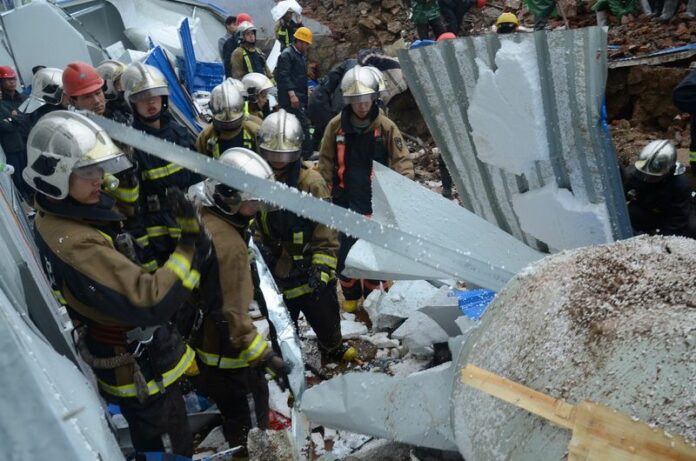
Rescuers work at the site where a rainstorm-triggered wall collapse buried makeshift dorms in rural Qingdao city, eastern China's Shandong province, 11 May 2014 (DPA).

BEIJING (DPA) — Eighteen people were killed and three injured Sunday when a factory wall collapsed as a result of heavy rainfall in the eastern Chinese city of Qingdao, state media reported.

The wall collapsed on to temporary housing where 40 workers had gathered, the Shandong province government said. Three people were taken to a nearby hospital for medical treatment.

Local authorities have launched an investigation into the collapse, which occured after the wall became waterlogged due to a heavy rainstorm.

The eastern coastal region has been drenched by heavy rainfall in recent days.

One person was killed in Hunan province after the weather conditions triggered a landslide in the Jinwutan township, while another person was found dead in the southern Guangxi Zhuang region.

The rainfall has also disrupted traffic, rail services, power and telecommunications. Some 54,000 people in Guangdong and Hunan province have been evacuated from their homes.

Advertisement

Stray Rocket Obliterates Yasothon House

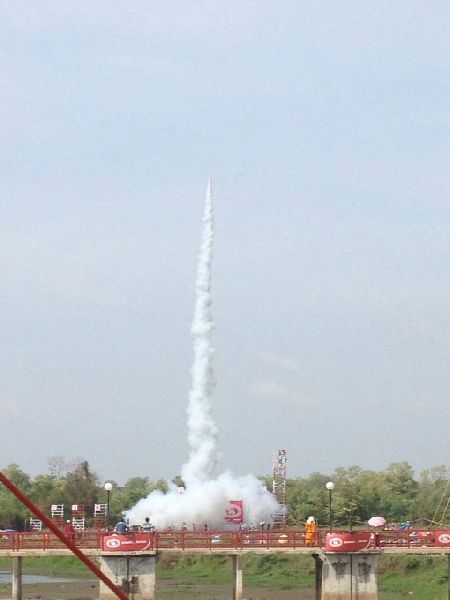
Bang Fai rocket takes off in a traditional rain-seeking ceremony.

YASOTHON — A residence in Yasothon province has been severely damaged by a stray rocket that was launched during a nearby traditional rain-seeking ceremony.

More than 10 missiles, called Bang Fai, were launched in the ceremony in accordance with the folk belief that rockets must be fired into the sky to request rain from the Gods for each year’s rainy season.

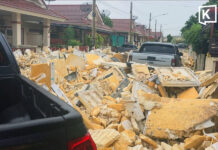
One of the four metre long rocks landed on a residence in Moo 1 of Ban Kwang village, approximately three kilometres away from its launch site at Phaya Thaan Park in Meang district.

The missile slammed into the side of the house, creating a 50-centimetre long hole in the concrete wall and damaging a number of furniture pieces inside.

The owner of the house, Somboon Proptrai, 54, said no one was at home at the time of the incident. She said she was visiting a neighbor when the missile struck, and ran back to her residence as soon as she heard the news. No one was injured by the missile, she added.

"Fortunately no fire was started inside my house," Ms. Somboon said.

The ceremony was halted when Ms. Somboon informed its organisers about the crash. A total of 30 traditional rockets were supposed to be launched today. 

Officials at Yasothon District Office, which organised the ceremony, said an insurance company will compensate Ms. Somboon for the damages. The incident is under investigation, officials said.

The launching of Bang Fai rockets have led to several injuries and fatalities in the past


CORRECTION: The original article reported that the rocket created a 50-metre long hole in the house's wall. It should have said 50-centimetre. 

For comments, or corrections to this article please contact: [email protected]

You can also find Khaosod English on Twitter and Facebook
http://twitter.com/KhaosodEnglish
http://www.facebook.com/KhaosodEnglish
Advertisement

DPA: Plan For Appointed PM Lacks Support

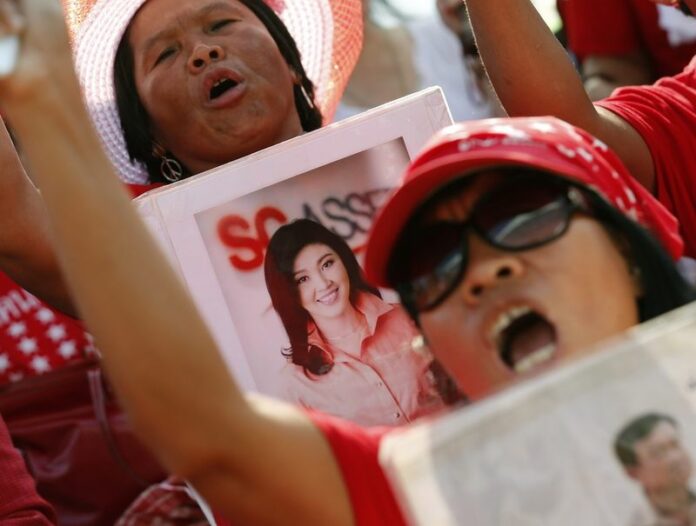
Thai pro-government Red Shirt protesters shout slogans as she holds a picture of ex Prime Minister Yingluck Shinawatra (C) during a rally on the outskirts of Bangkok, Thailand, 10 May 2014 (DPA).

By Cod Satrusayang (DPA)

BANGKOK — Key Thai institutions are resisting opposition demands to install an appointed government to make political reforms, reports said Monday.

There is no constitutional precedence for the proposal being pushed by anti-government protesters, an unnamed senior judge was quoted as saying by the Bangkok Post.

Analysts also said the Senate, the Electoral Commission and various courts were unlikely to implement such a plan because it would put them at risk of breaking the law and exacerbating the conflict. 

Protesters began moving their rally site in central Bangkok to the area surrounding parliament, hoping to pressure the Senate to appoint an interim government to institute reforms before new elections.

The protracted political crisis deepened last week when a Constitutional Court ruling sacked premier Yingluck Shinawatra and several cabinet members for abuse of power.

Protest leaders have vowed to do what was "necessary" to usher in a "people's government" if the upper house of parliament fails to act.

Several charges of assault were filed against the demonstrators' security guards over the weekend including the stabbing of a ice delivery man.

Supporters of Yingluck and her ruling party rallied in western Bangkok at the weekend and vowed to defend the electoral process, by force if necessary. 

Advertisement

Hot News

LATEST NEWS

Bangkok
overcast clouds
32.7 ° C
33.3 °
32.2 °
67 %
4.4kmh
100 %
Sun
35 °
Mon
32 °
Tue
27 °
Wed
27 °
Thu
29 °