29.4 C
Bangkok
Friday, June 5, 2026
Home Blog Page 3431

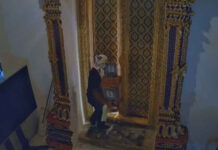
Pictured: Margaret Thatcher's Trip To Thailand In 1988

Margaret Thatcher, the "Iron Lady" who transformed Britain and inspired conservatives around the world by radically rolling back the state during her 11 years in power, died on Monday following a stroke. She was 87.

She died peacefully on Monday morning at the Ritz hotel after a stroke. She had been in poor health for months and had declined into dementia in her final years.

The AFP published the picture of Margaret Thatcher visited Thailand in 1988 as British Prime Minister. She enjoyed a welcome song sung by Cambodian refugee children at Site B refugee camp near the Thai-Cambodian border in the Surin province, August 1988.

Derek Tonkin, British Ambassador to Vietnam (1980-82) and to Thailand and Laos (1986-89) wrote a letter to the editor of the Phnom Penh Post in 2000 to explain why British and Western involvement on the Thai / Cambodian border.

He noted that Mrs Thatcher came to Thailand in August, 1988 on her way back to London from a visit to Hong Kong particularly to look at the Cambodian situation, of which she had no first-hand experience, but which she realized was of importance to the future stability and prosperity of the region. To that extent she was well ahead of one of her illustrious predecessors in the Conservative Party, Sir Winston Churchill, who in his 79th year was heard to remark: "I have lived 78 years without hearing of bloody places like Cambodia".

"I was British Ambassador in Bangkok at the time of Mrs Thatcher′s visit in August, 1988, which occurred at the time of the transition of the premiership from General Prem Tinsulanonda to General Chatichai Choonhavan, whose mutual desire to play host to Mrs Thatcher was happily resolved by an invitation issuing from both Thai Prime Ministers." Tonkin wrote.

Britain′s only woman prime minister, the unyielding, outspoken Thatcher led the Conservatives to three election victories, governing from 1979 to 1990, the longest continuous period in office by a British premier since the early 19th century.

A grocer′s daughter with a steely resolve, she was loved and loathed in equal measure as she crushed the unions, privatized vast swathes of British industry, clashed with the European Union and fought a war to recover the Falkland Islands from Argentine invaders.

She struck up a close relationship with U.S. President Ronald Reagan in the Cold War, backed the first President George Bush during the 1991 Gulf War, and declared that Soviet leader Mikhail Gorbachev was a man she could do business with.

"Very few leaders get to change not only the political landscape of their country but of the world. Margaret was such a leader. Her global impact was vast," said Tony Blair, Labour prime minister from 1997-2007.

"Some of the changes she made in Britain were, in certain respects at least, retained by the 1997 Labour Government, and came to be implemented by governments around the world," said Blair.

Prime Minister David Cameron cut short a visit to Europe to return to Britain after the death was announced and British flags on government buildings and royal palaces across London were lowered to half mast.

U.S. President Barack Obama said: "America has lost a true friend."

Mourners began to lay roses, tulips and lilies on the doorstep of her house in Belgravia, one of London′s most exclusive areas. One note said: "The greatest British leader" while another said to "the iron lady".

Advertisement

True Pai in My Eyes

By Naorn Augkamol


 “Rubbish” is one of the shameless definitions that many people called “Pai” (Thai : ปาย), a former well-known place among young tourists in Mae Hong Son province, northern Thailand. But since its retro style has attracted an enormous amount of tourist in 2008-2009, which linked to an infamous case of gasoline shortage and later raised these insulting comments whether “Pai was terrible” or “Pai is absolutely rubbish now”.

 It seems like the future of Pai appears to be going downward than we were expected as Pai′s bad reputation continue to spread all over the media and of course by word of mouth, the only way to prove if those rumors were actually real – I decided to give Pai a chance.


 So, I packed my stuffs and flew to Chiang Mai Airport with Tourism Authority of Thailand (TAT) team before joining a hopeful conservative trip “Tieaw Plook Pun SanFun…Pai Si Keaw” a Greenheart travelling project to help Pai turnaround from rubbish and become one of the best ecotourism places in Thailand.

 That′s why TAT has been working hard alongside the village′s tourism industry to develop a long-term and sustainable business to keep the area green and clean for future generations.


 Anyway…when you talk about Pai, it wasn?t easy to cope with it′s entitled to the name of “Thousand Curves Route”.

 It was definitely a challenge to ride along 762 hairpin curves (there?re 2 seperate routes to Pai, the first one from Mae Hong Son with 1,864 curves and Chiang Mai via Huai Nam Dang Nationa Park to Pai with 762 curves), the distant is just 135 kilometres but because of the winding mountain road the journey can take up to 4 hours.


 Even I have no prone to travel sickness but 4 hours in a small van wasn?t an ideal way of fun.

 Surprisingly, while I sat at the back seat and ready to take a long nap – suddently I felt like losing control, my eyes went wide open with excitment of beautiful scenery along the road.

 The sunlight shone brightly through foliage of trees and green grass contrast with blue sky while golden ripe rice in paddy field lightened up my feeling toward Pai, maybe it′s not so bad afterall.


 And here we were… the first stop at “World War 2 Memorial Bridge” located around 9 kilometres south of Pai, is a major tourist attraction built by the Japanese army as a transportation route between Chiang Mai and Burma (Myanmar) in 1942.


 But time has passed for decades and the bridge was no longer usable. So, local government decided to build a new concrete bridge next to the original bridge, which later was reconstructed and preserved as a memorial to World War 2.


 Further along the same highway is “Pai Canyon” or “Kong Lan”, it was an amazing mother nature′s creation of hight eroding cliff that offers a spectacular 360 degree view, I know it′s not “The Grand Canyon” but it′s worth every sweat after walked a 200 metres slope paved stairway for 15 minutes. Best to visit early morning or before sunset, as temperature in the afternoon can get seriously hot.


 After explored the area, the combination of hot weather and long hours of trekking – our feet were swollen. We decided to take a break with a little help of “The Pai Hot Springs” one of the focal points of Huai Nam Dang National Park. The springs offer a number of bathtubs for visitors to bathe or soak their feet in the water that strongly believed to have therapeutic value.

 As the old saying: happiness is short lived, we spent time at Pai Hot Springs till the closing time.

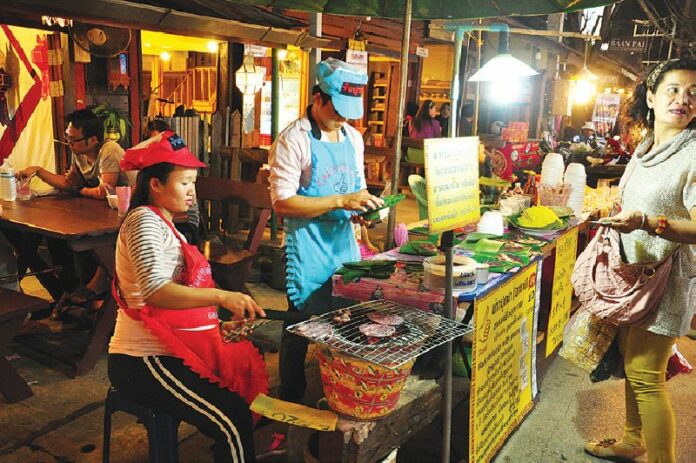
 But before called it off and went straight to the hotel, we walked through the main street of the town which becomes pedestrian street that filled with tourists, market stalls, and food carts. This so called “Pai Walking Street” has so many shops with retro style where you can find anything from souvenir, handicraft, handmade T-Shirt and postcard. Well-blended among pub, bar and restaurant with friendly atmosphere. 

 A long night walked and a few delicious local foods, we finally called it a night.

 The next day morning, we went to Pai′s City Hall and joined the rest of the group to began our ecotourism trip by cycling around the town. It was such a great experience to felt the wind blew softly through your face with pricesless view that hardly find in the city – people gatherd around at morning fresh market while some of them offered foods to a group of monks.

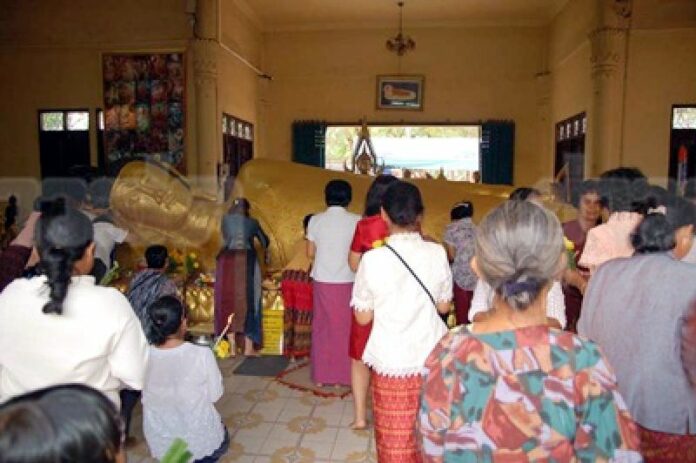
 As the sun had risen, we stopped at “Wat Klang” near the bus station. In the precincts of this temple which was built in 1792, a main Chedi of Thai-Yai (Shan) style stands in the center along with Mon Chedis. It is one of the significant temples in Pai with Prah Buddha Tarma Naluenatra, the attitude of Nirvana posture of the Buddha, was craved from a Padauk and inside the Vihear next to side park of the temple.

 And around 5 minutes cycling away from Wat Klang, we were then at “Wat Pa Kham” where beautitul Lanna Chedis surrounded by Weekday Buddha Statue and Prah Naleumitra Pichitmar Pratan Chiya Mongkol, the attitude of persuading the relatives not to quarrel, was hand craved from a hundred year-old Burma Padauk in 2009.  

 Next stop at “Wat Luang” the most famous temple in Pai, where important Thai ceremonies are frequently held. The big Shan Pagoda stands in the middle of the temple area with Mon Pagodas surrounded. On the top of the main pagoda is docorated with the beautiful pavilion and was built in 1803. The temple also contained Luang Po Tunjai Sri Muang Pai, a large Wooden Buddha Statue.


 After got tired from cycling over an hour, we continued further up on the mountain not far from Pai where “Santichon” a Chinese Village is located, the village was settled in the middle of the 20th century by Yunnanese tribes. The area surrounded by beautiful Chinese landscape with an old style Chinese mud and straw model house, offers tea tasting sessions, Yunnan Cuisine, horse riding, shooting crossbow and riding wooden ferris wheel.


 Then, visited “Hai Aui Takam Home Stay” a well-known place to learn that life is way better when everything is back to basic, with life worth lessons on how to homegrown rice, coffee, vegetable and how to handle your own life in a simple and sustainable way.


 Last but not least, we had succeeded in “Planting Vetiver Grass Project” for protecting the soil against erosion through its non-invasive nature and deep roots to retains water in the soil.


 Since I had travelled all around Pai, I would definitely recommend it as one of my top list must visit places – but you have to let go of thoes absurd comments about Pai, open your heart to see Pai in your own satisfaction.

 Don?t come here just to brag the others that you?ve been to places where romantic drama films were shot – becuse it′s olny a skin deep of Pai, not the amazing city that I have been lucky enough to see what truly Muang Pai is. 

Advertisement

Sombat – Somchai : Unforgettable Missing Life in ASEAN

Vithune Permpongsajaroen

by Wipawee Julamanee

Expecting integration of ASEAN, people always spot on various issue concerned their daily life such as an investment, goods exchange and wealth when ASEAN becoming AEC (ASEAN Economics Community) in 2015.

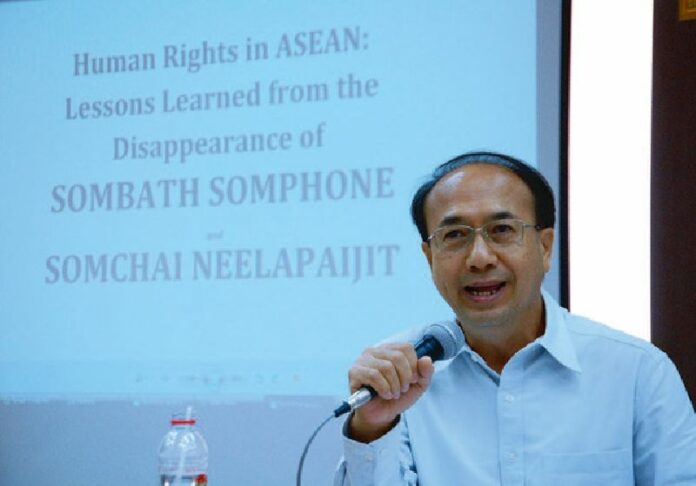
Recently, Somchai Neelapaijittr Fund coordinated with Justice for Peace Fund , The Thai People′s Network for Mekong (TERRA) and Amnesty International held the seminar on the topic "Human Rights in ASEAN Community : The Disappearance of Sombat Somphone and Somchai Neelapaijittr" at Faculty of Laws, Thammasart University.

This seminar presented the issue of human rights violation and background of ASEAN values in term of human rights. ASEAN citizen feel that they have no power to reach their rights while they have been intimidated by their state officers.

"Sombat Somphone", a 60 years old Ramon Magsaysay Award winning social activist graduated from faculty of Agriculture, Hawaii University. His family settled in the United State but he decided to returns to Laos with intention to develop the well-being base of Lao people.

He was abducted after police called on Thadueir Road, Vientiane in August 2012.

Ung Chui Mheng, Sombat′s wife sent her statement to join this seminar. It noted that :

"Disappearance of Sombat has made me understand that the mechanic of human rights in region is not available. The Human Rights declaration which noted about rules of laws and respect of civil rights has no efficiency and invalidity at all.

She added at present people think that it is not strange if someone is politically missing. Frequently, the government has threatened their citizen not to have any question.

Sombat′s colleague "Vithune Permpongsajaroen" an environment activist suggested that Sombat′s disappearance might come from parallel civil seminar along with the ASEM that Laos became the host of this conference at that time.

This civil society seminar was created in order to criticize the government. He believes that Laos authority had not expected that the Sombat case would become a big issue internationally.

Lastly, he said that we should not ignore to this violation. There is no way to stop this fear if we do not fight together to prevent anyone to be a victim anymore.

Another case, "Somchai Neelapaijittr", an advocacy who helped people in 3 provinces in southern of Thailand, was kidnapped after he complained about the police had tortured alleged offender in 2004.

"Angkana Neelapaijittra", Somchai′s wife said she did not know what she had to do after disappearance of her husband. Moreover, she never expected that she had to face with the vast international problem like this.
Now Angkana and her cooperators are rise up to call for justice and break the fear to create the system that can be protected base of human rights for everyone.

She reveals that last year there was a report from Working Group on Enforced or Involuntary Disappearances of United Nations (UN WGEID) cited that Thailand, Laos, Burma and Indonesia have reported about missing person while Malaysia, Combodia and Brunei have no report. In addition, UN WGEID states their aim to find out the actual situation in thailand but they were rejected by Thai government.

Now, although there is ASEAN Human Rights declaration, in reality, it doesn?t match up with Internationl Human Rights declaration. For example, in the part indicated that "Every person has the rights to an effective and enforceble remedy, to be determined by a court or other competent authorities, for acts violating the rights granted to that person by the constitution or by laws".

But this part of declaration doesn?t include the harmful actions from goverment. So, this declaration is criticized whether it have real capability to protect the fundamental human rights of people in ASEAN or not.

The culture of ASEAN has various difference in social construct, race also religion. It is obvious that many small-sized countries can live together without the strongly conflict because the Treaty of Amity and Cooperation in Southeast Asia (TAC) indicated that they must not interfere to each other.

This condition has pressed the individual problem behind and finally been ignored. It is including the large gap in social class, we can find that many governments in ASEAN claimed the rights in abuse of power in order to maintain the security and stability of state.

If people cannot access their rights, how the 3 pillars of ASEAN community can be completed?

Advertisement

Hundreds of ‘Ladyboys’ Exempted From Draft

Hordes of queers, transsexuals, and ‘katoeys’ showed up nationwide for mandatory military service but were turned away by officials.
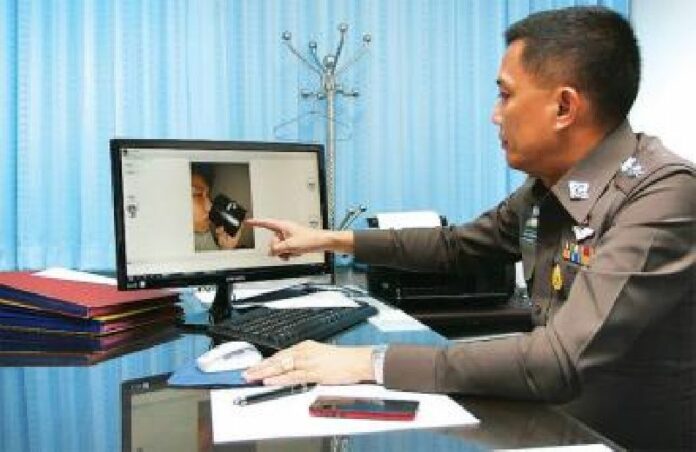
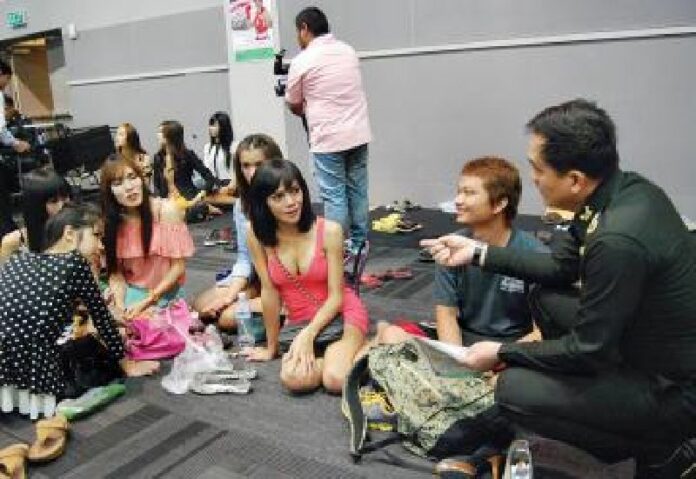
 It′s the season millions of Thai males dread – the registration for 2-year service in the the country′s armed forces. However, many potential draftees were entertained at the colorful sights of ‘katoeys’ (known in English as ladyboys) who arrived at their registration booths in sexy, revealing dresses, our provincial correspondents reported. 


 However, the military has strict rules barring ‘katoeys’ from joining the ranks. Col. Attasit Sittitaworn, who oversaw the drafting session in Pitsanuloke Province, said those who “behaved very womanly” or went through relevant surgeries are disqualified on the grounds of “gender conflicting with reported sex” and “mentally impaired” – a term that has raised eyebrows of many LGBT advocates in Thailand before.


 According to Thai laws, all males with Thai nationality are required to report for the draft in April every year, but they could also choose to participate in 3-year weekly military training during high school years in order to exempt themselves from the service. Those with health problems and undesirable height or weight are also usually exempted upon inspection at the registration sites. 

Advertisement

‘Heartbroken’ Student Leaps To His Death

A college student was found dead in an apparent suicide by jumping off his apartment building while his roommates told police he killed himself to protest his girlfriend’s affection for another student.

 The incident took place at Baan Suan Thon Condominium
in Thoong Kru Area of Bangkok. The deceased was later identified by the police as Mr. Chawanon
Yamoon, 21. He was a second year student at King Monkut Technology University Thonburi, the police
added. After inspecting the scene, the police inspected the man′s room, located on the 6th floor of
the building.
 Mr. Chawanon′s 3 roommates said they were not aware of
his death until the police informed them, as they were sleeping in their separate bedrooms. Mr.
Chawanon′s laptop was investigated by the police, and officers told the reporter Mr. Chawanon was
chatting with a woman via Line application, presumably his
girlfriend.
 Mr. Chawanon was reportedly expressing his anger at her
for not loving him back. He also sent a photo of himself drinking toilet cleaning chemical to his
girlfriend, apparently threatening that he would commit suicide out of his sadness. A cup containing
traces of the chemical was also found near the computer.
 Mr.
Chawanon, his roommates said, had been complaining that his girlfriend became too close to another
student lately. His girlfriend, whose name was not identified, later told the police she and Mr.
Chawanon had been dating “casually” for 5 months. On the night of his death, Mr. Chawanon reportedly
accused her of distancing herself from him, and sent her the photo of himself drinking the chemical,
but she dismissed it as “a joke”. She said Mr. Chawanon also sent her a song called “Changing Winds”
by a Thai pop-rock band “Bigass”, saying he intended the song to be last message for her. That was
the last she heard from him until police informed her of his death, she
said.
 A senior police officer told the reporter they were not
treating Mr. Chawanon′s death as suspicious.
Advertisement

Survey: Majority of Monks Thinks Lotto is Sinful

A survey claims 92% of monks think lottery is a sin, while a sizable proportion of interviewed monks admit they occasionally assist templegoers in choosing lucky lotto number.

Ms. Thaniccha Limpanich, the director of Family Foundation, unveiled the survey result in a panel discussion under the topic of “Gambling and Degeneration in Buddhism”, which was co-hosted by the Foundation and an anti-gambling network at Suan Moke, Bangkok. The survey was conducted by Assumption College (ABAC Poll), covering 909 20-39 year old monks from the provinces of Chiangmai, Konkaen, Chonburi, and Songkhla.

50.9% of the respondents say there are aware of problems caused by gambling in their communities, citing debt, fights, thefts, and disputes amongst family members as examples. Asked why locals buy lottery, 59.8% of the monks interviewed said the locals “wanted to try their lucks” and 50.6% answered the locals were looking for a “shortcut to being rich”.

According to the survey, 92% of respondents believed that lottery is against Buddhism, did not want to see lottery buying or any gambling take place in temple compounds, and would oppose the plan to install government-sanctioned automatic lottery dispensing machines. 45% of monks surveyed also believed the authorities should seriously crackdown on illegal types of lottery whereas 23% wanted every type of lottery banned.

Upon being asked whether the respondents were involved in lottery business, 60.6% of the respondents said they did not buy lottery or encourage lottery buying in any way. However, 23.5% said they were involved in the trade via actions such as suggesting lucky lotto numbers for templegoers. Furthermore, 24.3% admitted having been encouraged by the templegoers into buying lottery themselves.

Advertisement

Thai Lady aged 102 loves Thai dance

Nakhon Ratchasima – If you want to know how to live a long life, a lady aged 102 years could give an answer.

 Her name is Am Shin-jor-hor, residing at 20 Moo 4, Ban Pho, Muang, Nakhon Ratchasima. Her identification does not specify a date of birth, but notes that she was born in the year of 1911. She looks healthy, despite the difficulties misty eyes and ears. 

Granny "Am" has 9 children but already died 3. Her husband died in 1997 with the age of 92. She reveals that she loves Thai dancing that maybe make her healthy.

"I dances because dance make physical strength and feel fresh. In addition, I prays every night before bed." Granny Am said.

"How about the food?" a reporter asked.

 Granny said she like vegetable with Thai chilly sauce (Namprik) and also KhaoPong, a local snack of dried rice in Northeast of Thailand.

Advertisement

Hot News

LATEST NEWS

Bangkok
overcast clouds
29.4 ° C
29.4 °
29.4 °
76 %
4.7kmh
100 %
Fri
35 °
Sat
37 °
Sun
35 °
Mon
35 °
Tue
35 °