




































Thailand is rightly proud of its achievements. As one of Asia’s most dynamic economies, it recognizes that effective transport is more than steel on sleepers; it is a force for prosperity, growth, and connectivity. Today, the State Railway of Thailand (SRT) manages more than 4,400 kilometers of track spreading north to Chiang Mai, east to Cambodia, south to Malaysia and northeast to Nong Khai, Ubon Ratchahani and Lao People’s Democratic Republic, all vital arteries for people and goods alike.
Today’s passengers and freight customers expect more – shorter waits, higher capacity, real-time information and punctual services that match modern life. For SRT, this is not just about keeping trains running; it is about executing a long-term strategy to become a regional logistics hub.
The Case for a Communication Revolution
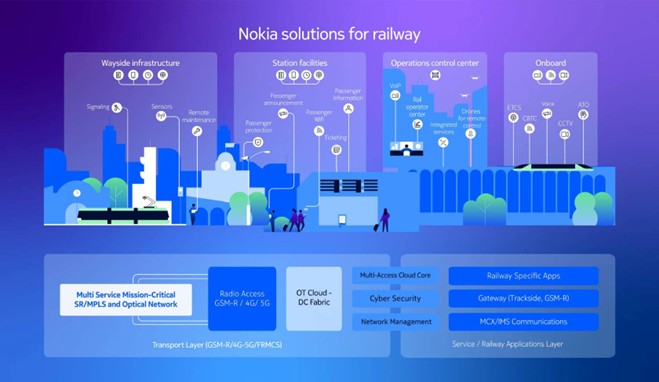
Around the world, railways are moving to Future Railway Mobile Communication System (FRMCS) — a new global standard built on 5G technology that replaces legacy systems. FRMCS is the successor to the existing GSM-Railway (GSM-R) system – a second-generation (2G) technology originally designed for voice calls and basic data between drivers and control centers. But that system is nearing the end of its useful life and simply cannot scale to meet the communication, data, and automation needs of the 21st century.
By contrast, 5G-enabled FRMCS provides the speed and capacity to support everything from advanced signaling and automation to real-time passenger updates and predictive maintenance.
How modern communications transform operations
Today’s rail communications are not designed for a digital world. GSM-R delivered decades of dependable service, but it was never designed to handle rich data streams, machine-to-machine communication or the high-bandwidth demands of modern rail networks. With 5G at its core, FRMCS introduces several transformative capabilities:
- Reduced latency and higher capacity for control and safety-critical data.
- Seamless coexistence with legacy systems, enabling a smooth phased migration rather than disruption.
- Support for broadband mission-critical services, including push-to-talk (MC-PTT), data (MC-Data), and video (MC-Video), enabling real-time monitoring, automatic train operations, and high-definition video surveillance.
These capabilities enable safer operations, better asset management and potentially, more enriching passenger experiences over time. For example, high‑speed trains running from Bangkok onward to the China–Laos Railway will depend on consistent, interoperable communications to manage speed, signaling and safety as they move between national networks.
Call to action for Thailand’s rail leaders
Thailand stands at a pivotal moment. With ongoing investments in high-speed links linked to international networks and plans to expand capacity nationwide and plans to expand capacity nationwide, the time to think digitally is now. Today’s decision isn’t just about technology; it’s about how Thailand’s railways will serve people’s lives, livelihoods and the nation’s future.
Replacing legacy communication systems with 5G-enabled FRMCS will unlock safer operations, higher efficiency and new passenger-centric services. Coupled with AI-driven insights, this transformation can make the SRT more competitive regionally and deliver experiences that travelers increasingly expect.
(ends)