


































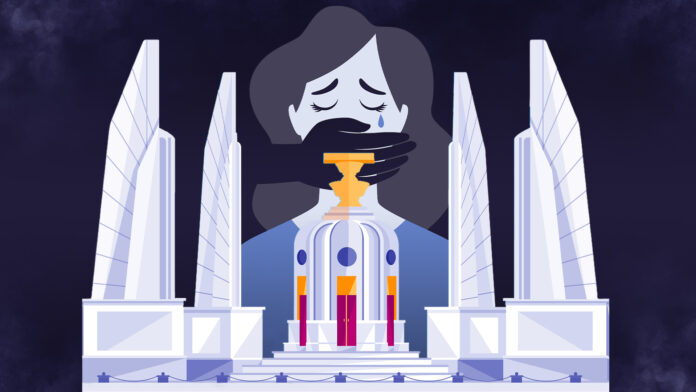
After years, if not decades, of silence and gossip behind people’s backs, the #MeToo moment among Thailand’s so-called progressive and liberal circles arrived last Friday when an online media outlet published an interview with a woman under the pseudonym Ms A.
Ms A alleged in a very long and detailed interview on the Socialgaze Facebook page that a few years ago she was manipulated and raped by a prominent labour and political activist. While she did not directly identify the person, her description appeared to point to former lèse-majesté detainee Somyot Prueksakasemsuk, now 64.
Last Friday night, I read the lengthy account by Ms A as others began to speculate that the person referred to might have been Somyot.
Nearly nine years ago, Khaosod English published a report for which I interviewed Somyot about allegations of sexual harassment. The interview took place at Bangkok Remand Prison in September 2017, before he was released in April 2018. We spoke in Thai and I translated his responses for publication.
Sexual Violence Stalks Thailand’s Activist Community
Here is the section, originally published on Khaosod English, in which I asked Somyot specifically about the allegations of repeated sexual harassment in cases alleged to have occured years before Ms A’s account.
“What does harassment mean? I don’t know what sexual harassment means. At what level and who has been sexually harassed?” he said from behind a glass partition at the Bangkok Remand Prison.
Asked if he believes the alleged victims and witnesses had lied, Somyot, who has been in prison for six years and will be released in April, said: “Who are the victims? If there’s no one [coming out publicly], how can I respond?”
He added, “It’s not possible to say I am above it or I am like a temple abbot. No. And I can’t say I haven’t done it. It’s not clear what constitutes sexual harassment. I am glad it’s being talked about. Let’s hope many discussions will follow so people will understand about sexual harassment. I may have harassed someone or may have not. Talking about it is good, however.”
The original article was co-written by Teeranai Charuvastra and me, and edited by Todd Ruiz. Last Saturday, I translated it into Thai and I posted it on my Facebook and X accounts.
The following day, Saturday, 22 August, Somyot wrote a short message on his Facebook page acknowledging that he was the man to whom Ms A was referring to, but asserting that his account differed significantly from hers in relation to the alleged rape, physical assault, and psychological manipulation.
Somyot wrote:
“I apologise to A for misunderstanding and thinking on my own that A had given consent, but that was not the case, as A later told me. After the incidents, A moved in to live with me, thinking that our relationship could go smoothly in terms of love. A was 25 years old and I was 64 years old. There was an age difference as described.
“After living together for two years, the first year we were still able to maintain the relationship together. In the second year, the relationship became estranged. While we were living together, A wanted the relationship and the fact that we were living together to be kept secret, and I also participated in keeping it secret.
“We lived together and had arguments and increasingly serious verbal conflicts until we had to separate.
“I apologise to A once again. I apologise to everyone who has been upset by this mistaken action. Therefore, I ask to accept all punishment and consequences.”
Ms A’s response:
Following the post, Ms A responded hours later on the Socialgaze Facebook page, calling it a false apology.
“The victim was never in a relationship with the person concerned, nor did they ever agree to be in a relationship as claimed.
“The victim never asked for the relationship to be kept secret. It was the perpetrator who told the victim to keep what he had done secret because he was afraid that people would find out.
“This was not “tricking someone into having sex” or any kind of romantic relationship. This was rape — an abuse of power.
“Stop distorting the narrative from rape into consensual sex.
“Stop blaming the victim for something that the perpetrator himself did.
“After the story was made public, several more people contacted us to share their experiences, saying they had been approached using the same pattern. Many others have also come forward to confirm that this was repeated behaviour over a period of several years. There was not just one victim. This is the behaviour of a sexual predator.
“Society needs to start learning about and understanding consent, as well as unequal power dynamics between genders, the power imbalance between older and younger people, and unequal structures within activist movements that leave victims with no real choice. The word “no” means “no.” Trying to distort this into a relationship between two people that never existed in the first place is unacceptable.
“For a movement to grow and become stronger, it must be willing to acknowledge its mistakes, learn from them, and address the problems that arise. We must work together to create a safe space for everyone — not question the victim who has less power while allowing those who use their power to oppress, threaten, and harm people with less power to escape accountability.
“Protecting those with power while questioning those who have been harmed simply reproduces the same power structures that you claim to be fighting against.”
More allegations emerged
Veteran labour activist Sriprai Nonsri, who refused to answer my questions for the Khaosod English article nearly nine years ago, posted on Facebook over the weekend saying those in the labour movement knew about Somyot’s behaviour all along over the years but kept quiet, and that she had been chastised by colleagues for trying to warn some young women.
By late Saturday, another major allegation emerged, this time involving an incident that took place 20 years ago. Pornnapa Iamsamarng posted on social media accusing a prominent social and political activist, later identified as Sombat Boonngamanong, of manipulation and rape when Pornnapa was in her early twenties. Two days later, Sombat publicly acknowledged that he was the person accused, but insisted that their “relationship” back then was consensual.
The similarities and differences between the Somyot and Sombat cases can be summarised as follows:
Somyot’s case: Somyot apologised, but the apology was criticised by Ms A and others as inauthentic and victim-blaming.
Sombat’s case: He has not apologised to his accuser. He insists that he is not a rapist.
Somyot’s case: He communicated publicly, but Ms A and others criticised both the substance and manner of his statement as victim-blaming.
Sombat’s case: He has maintained that it was consensual, while adding that he is not perfect and that he unilaterally ended what he describes as their relationship.
The bottom line
Somyot’s case differs because he has faced repeated allegations from multiple women over the past 20–30 years, according to several prominent figures.
Based on these accounts, some have concluded that Somyot may fit the description of a serial sexual predator, and that his credibility in the wider public sphere has seriously diminished, if not collapsed.
As veteran labour activist Sriprai Nonsri wrote on Facebook over the weekend:
“I have spoken about [Somyot’s] bad behaviour towards women all along. People in the movement knew about his behaviour and were warned to be careful. But I was seen as being excessively malicious towards him. After meetings, when I invited him to go home, I was accused of being a third wheel. Now I see attempts to whitewash him.”
Sombat’s case differs in that there have not previously been any public allegations against him—at least none that have become public in the same way. Moreover, Sombat and his accuser appear to have completely different recollections of what happened.
That so many women are now speaking publicly is significant. The more troubling question is how long warnings, rumours, and accounts of alleged misconduct were left to circulate in private, and why those who tried to raise concerns felt ignored, criticised, or isolated. Sriprai’s account suggests that these concerns were not new. How many other woman have suffered and said nothing? Worse, how many spoke and were ignored or silenced? And also, the vast majority of the Thai press ignore the issue until it exploded last weekend.
Criminal courts determine criminal guilt. But political and activist movements also have their own responsibility: to ask whether their culture allows vulnerable people to say no, report harm, and be taken seriously when they do.
We must see people as human beings, rather than as idols, prophets, or gods. When we elevate people to that status, we create space for their followers to be exploited and manipulated, and we make society psychologically dependent on particular individuals.
It is also time to educate the general public about what constitutes sexual consent versus sexual violation.