BANGKOK — Bangkokians can now try a different kind of tropical at a Carribean eatery delivering to most parts of the city.
Doughy pies with beef filling and bouncy roti with chicken jerk are just some of the stepping stones to the region’s cuisine on offer at Jamaican Eatz.
“It’s Caribbean fusion, not strictly Jamaican. There’s a mixture of American soul food with Cuban, Puerto Rican, Bahamian, and Trinidadian influences,” co-owner Phillip Akers said.
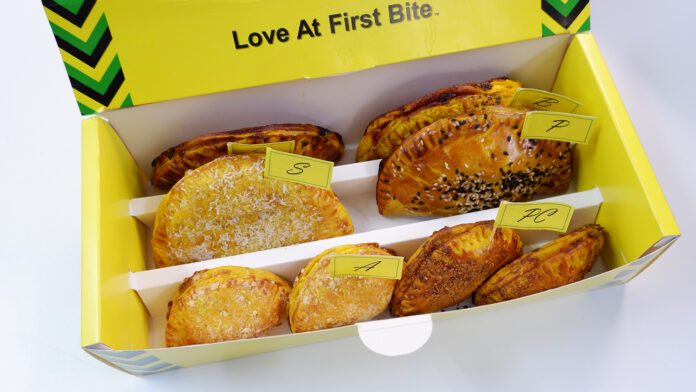
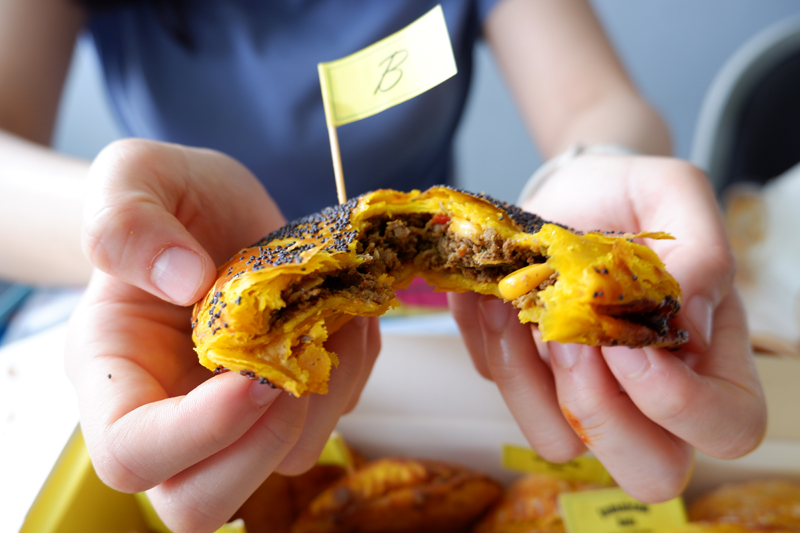
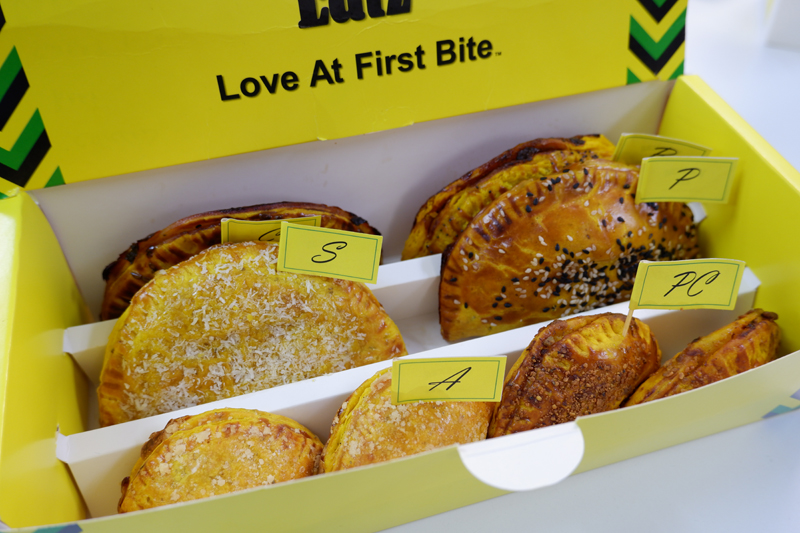
Undoubtedly the pies (or patties) headline at Jamaican Eatz, filled with various sweet and savory fillings. We tried three savory pies: pork, chicken, and beef. They’re all flavored with Akers’ secret 17 herbs-and-spices blend, but we felt the beef brought out the spice rub best.
Although we were warned the pies would be spicy even to the Thai tongue, we only felt warmth in our tummies post-meal rather than the hot-tongue spice we’re accustomed to.
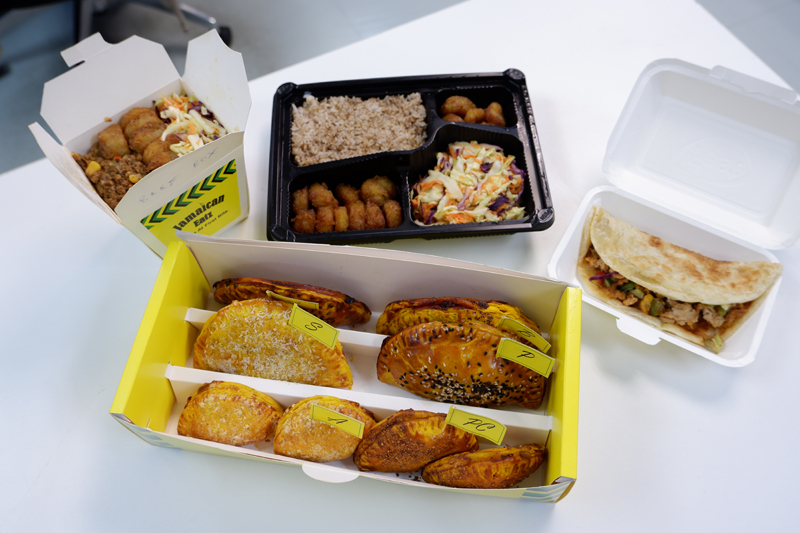
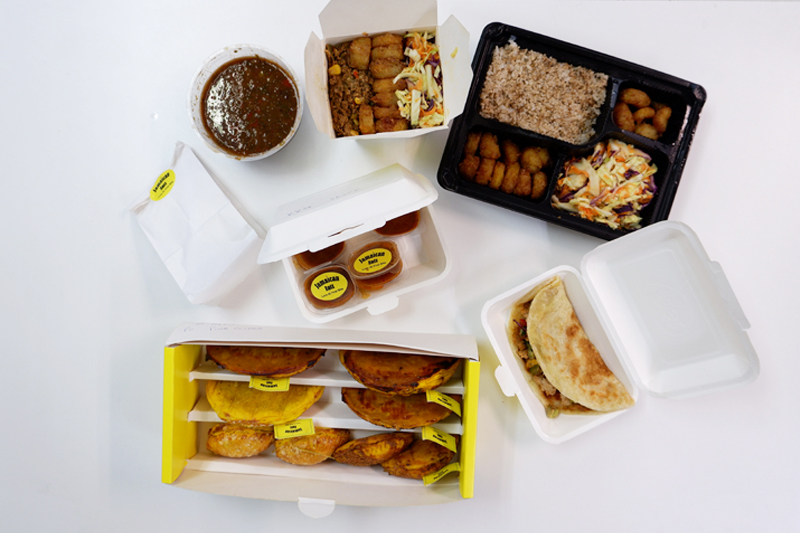
From left, clockwise: the Caribbean Box (160 baht), Super Combo Plate (320 baht) including the jerk chicken roti (120 baht), and box of pies.
Large pies are 100 baht each (or 6 for 500), while three mini pies go for 100 baht (12 for 400 baht). The apple pie was our favorite, filled with apples, cinnamon, and raisins. The pina colada is filled is coconut flakes and pineapple. Sweet pies – including Akers’ favorite, the very filling sweet potato pie – are served with ice cream if eating in at their W District branch.
We were impressed by the pie pastry. Forget the flaky, dry crumbs of supermarket pies. The pastry at Jamaican Eatz is thick and doughy, and carries filling without becoming soggy. But, beware: a pie or two is enough to fill you up. Try a trio of three different minis before committing to a big serving.
A large beef pie (100 baht).
Akers explained that Jamaican food has been influenced by European colonists as well as Africans who migrated to the region. Hench the pies (or patties) – British-style, but with minced, flavored meat.
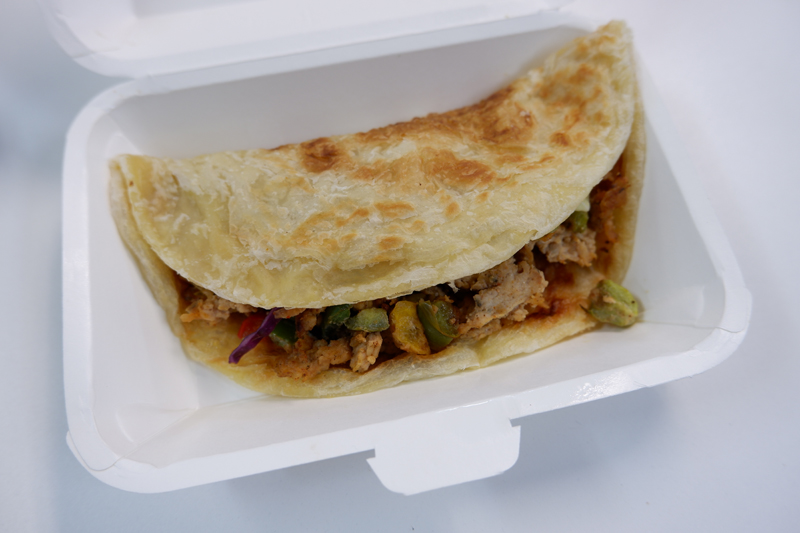
To Thais, the cuisine may bear similarities to Indian food, especially when it comes to the spices and the roti. We tried the jerk chicken roti (120 baht) – think a soft taco, but with a roti shell and what tasted like chicken-and-sweet-bell-pepper filling (emphasis on the sweet). The Super Combo Plate (320 baht) includes the jerk roti, a pie, coconut and garlic rice, beans and cabbage coleslaw. But to the Thai tongue, the most curious part of the Combo Plate will be the pan-fried plantains, a member of the banana family.
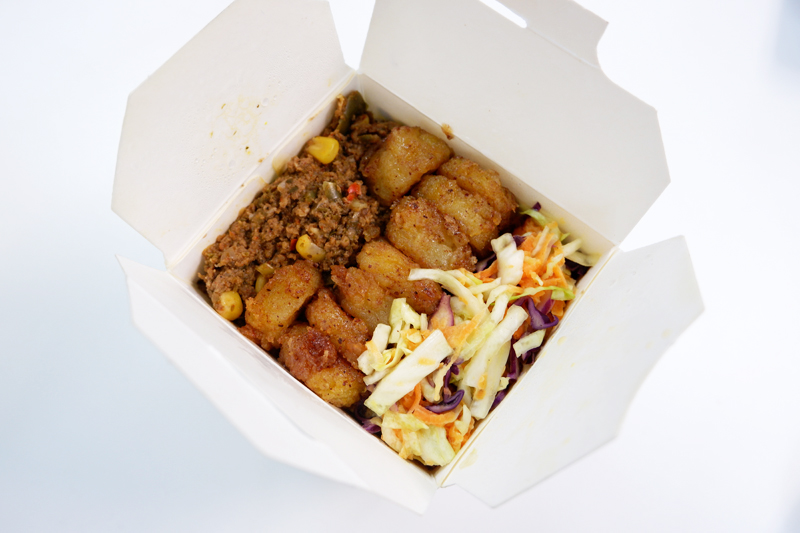
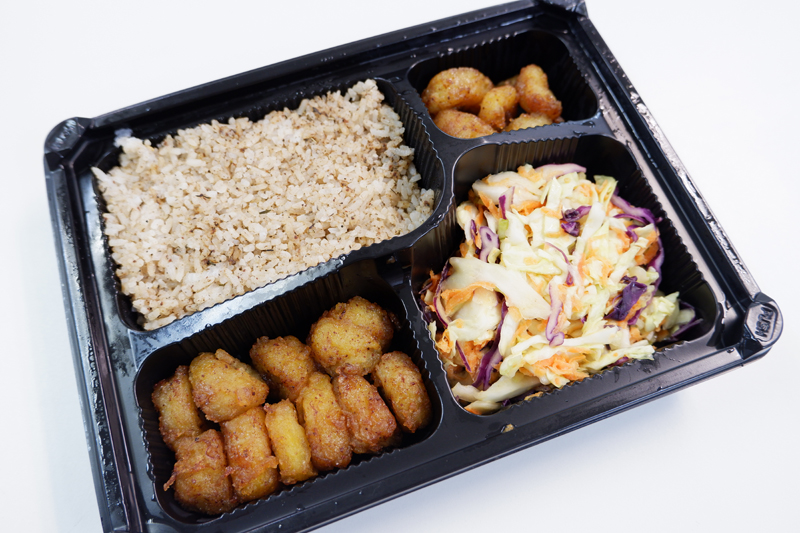
Caribbean Box (160 baht).
“It’s savory, eaten to break up the spices,” Akers said.
Plantains also line the Caribbean Box (160 baht), a vertical takeout box stacked with coconut rice, and topped with coleslaw and spiced beef. Try it if you want to boggle the mind with the taste combo of beef and bananas.
Akers has been bowled over by the reception from expats familiar with the cuisine, from Jamaicans, Brits, to Americans. The biggest compliment, he said, has been repeat visits from a Jamaican New Yorker.
Jamaican Eatz is at W District, near BTS Phra Khanong, and is open from 4pm to midnight every day. Delivery is available from 11am to midnight via Food Panda, Grab, Line Man, and their website.
A mini apple pie (3 for 100 baht).
Coconut garlic rice, coleslaw, and bananas, part of the Super Combo Plate (320 baht).Jerk chicken roti.
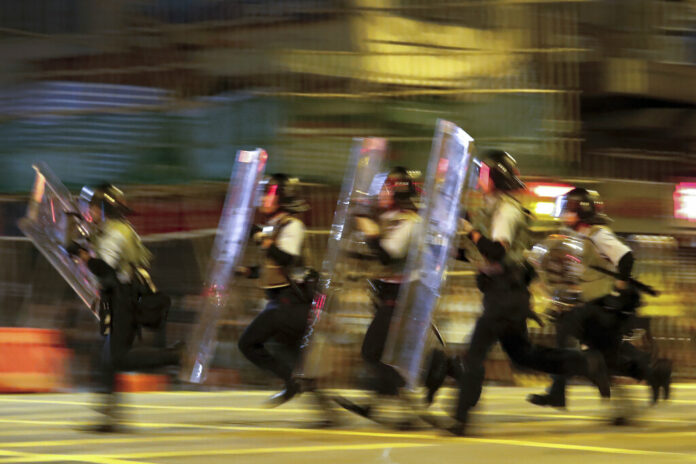
Policemen in riot gears move to disperse the residents and protesters at Sham Shui Po district in Hong Kong, Wednesday, Aug. 7, 2019. Protesters surrounded a Hong Kong police station to demand the release of a university student arrested for apparently buying laser pointers, sparking the latest confrontation in the Chinese city. Photo: Vincent Thian / AP
HONG KONG — Hong Kong sought Friday to reassure visitors to the city after several countries issued travel safety warnings related to ongoing prod-democracy protests, potentially devastating its crucial travel industry.
An email attributed to an unidentified government spokesman conceded recent road blockages and confrontations between police and protesters had caused inconveniences, but said they were confined to limited areas. The statement said the government and the travel industry were working to minimize disruptions and “all stand ready to welcome and assist visitors to Hong Kong any time.”
The government on Thursday said tourist arrivals dropped 26% at the end of last month compared to last year and were continuing to fall in August. The travel industry accounts for 4.5% of the financial hub’s economy and employs about 2500,000 people, or about 7% of the total working population.
The impact could be as bad or worse than occurred during the 2003 outbreak of severe acute respiratory syndrome, Travel Industry Council chairman Jason Wong Chun-tat was quoted as saying by the South China Morning Post. Wong said cancellations could see hotel revenues in August drop by 40% against the same period last year.
Commerce Secretary Edward Yau Tang-wah said 22 countries and regions, including the U.S., have issued travel warnings for Hong Kong.
Although the previous two days have been relatively quiet, protests that have involved increasing levels of violence between police and demonstrators were not abating. More are planned for this weekend, including at the city’s international airport, one of the world’s busiest, where scores of flights were canceled Monday when air traffic controllers stayed away as part of a city-wide general strike.
Sparked two months ago by proposed extradition legislation that could have seen suspects sent to mainland China — where protesters say they could face torture and unfair politicized trials — the protests have since morphed into calls for broader democratic reforms in the former British colony, along with the resignation of Chief Executive Carrie Lam and investigations into alleged police abuse of force.
Hong Kong police say 592 people have been arrested in the protests since June 9, ranging in age from 13 to 76. They face charges including rioting, which allows for prison terms of up to 10 years. Police have fired tear gas, rubber bullets and other projectiles at protesters, with demonstrators responding with metal sticks, bricks, gasoline bombs and carts full of burning debris.
On several occasions, protesters have been attacked by unknown people believed to be linked to organized crime groups, while police took little action to stop them.
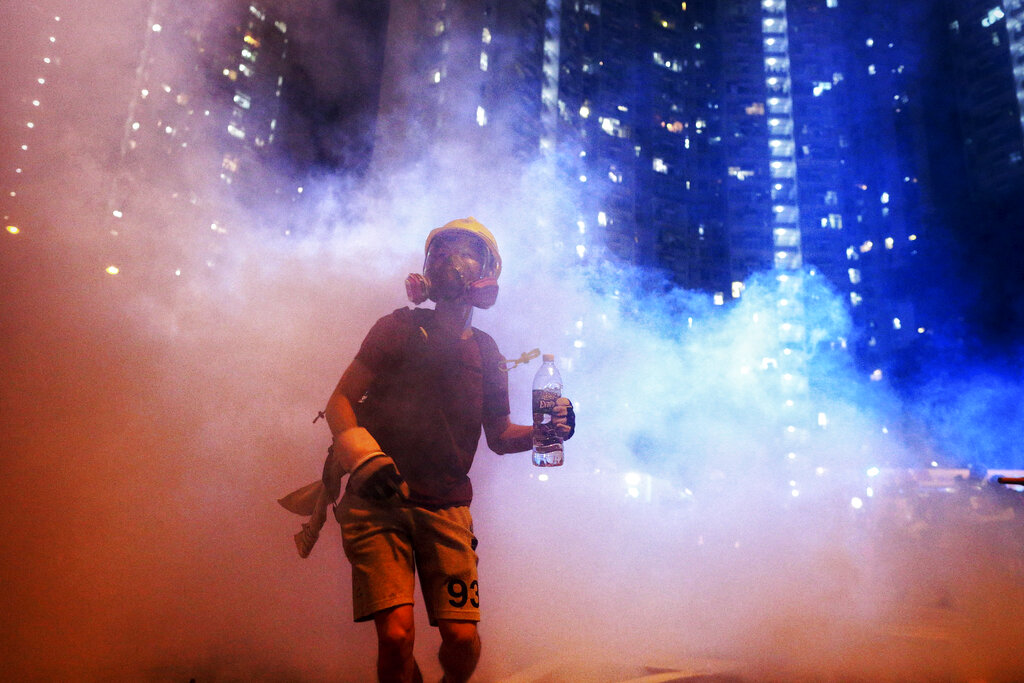
A protester stands in the midst of tear gas during confrontation with police in Hong Kong during the early hours of Sunday, Aug. 4, 2019. Hong Kong protesters ignored police warnings and streamed past the designated endpoint for a rally Saturday in the latest of a series of demonstrations targeting the government of the semi-autonomous Chinese territory. Photo: Elson Li / HK01 via AP
The Communist Party leadership in Beijing has so far has not visibly intervened in the situation, though in their editorials and public remarks they have condemned demonstrators and protest organizers as criminals, clowns and “violent radicals” and alleged that they have been inflamed by politicians from the U.S., Taiwan and elsewhere.
On Thursday, the Chinese foreign ministry’s office in Hong Kong issued a formal protest over a reported meeting between U.S. consular officials in the city and opposition figures, including prominent activist Joshua Wong.
The statement demanded the U.S. explain the purpose of the meeting and “immediately cease interfering in Hong Kong affairs.”
Wong was released in June after serving a two-month sentence for contempt related to his involvement in 2014 protests advocating a more democratic electoral process known as the Umbrella Movement.
The State Department defended the diplomat’s actions and accused the Chinese government of “thuggish” behavior” for allegedly leaking her photograph and personal family information.
“I don’t think that leaking an American diplomat’s private information — pictures, names of their children — I don’t think that’s a formal protest,” spokeswoman Morgan Ortagus told reporters.
She added: “That’s not how a responsible nation would behave. Releasing any of that personal information of an American diplomat is completely unacceptable. That’s not a protest. That’s what a thuggish regime does.”
She said the political officer in question was doing “what American diplomats do every single day around the world.”
“American diplomats meet with formal government officials, meet with opposition protesters, not just in Hong Kong but in China. Our diplomat was doing her job,” Orgtagus said.
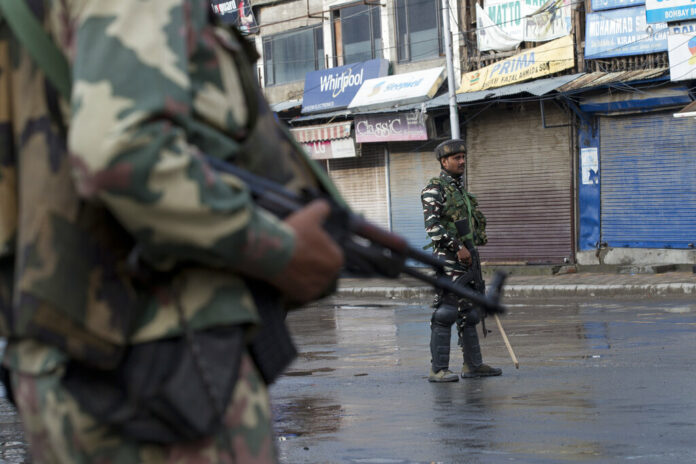
Indian Paramilitary soldiers stand guard on a deserted street during curfew in Srinagar, Indian controlled Kashmir, Thursday, Aug. 8, 2019. The lives of millions in India's only Muslim-majority region have been upended since the latest, and most serious, crackdown followed a decision by New Delhi to revoke the special status of Jammu and Kashmir and downgrade the Himalayan region from statehood to a territory. Kashmir is claimed in full by both India and Pakistan, and rebels have been fighting Indian rule in the portion it administers for decades. Photo: Dar Yasin / AP
NEW DELHI — Indian Prime Minister Narendra Modi told the nation Thursday night that he stripped the Indian-controlled portion of Kashmir of its statehood and special constitutional status to free the disputed region of “terrorism and separatism.”
Kashmir is claimed in full by both India and its archrival Pakistan, although each controls only a part of it and rebels have been fighting Indian rule in the portion it administers for decades. This week, India downgraded the Himalayan region from statehood to a territory, limited its decision-making power and eliminated its right to its own constitution.
In his first nationally broadcast speech on the decision, Modi described the changes for Jammu and Kashmir, as the region is formally known, as historic. He assured its residents that the situation will soon “return to normal gradually,” although he gave no specifics.
Modi said the “mainstreaming” of the Kashmiri people with the rest of the nation would expedite development and create new jobs with investment from public and private companies.
He accused neighboring Pakistan of using the past arrangement “as a weapon to incite people of the region against India.”
“I have complete faith under this new system we all will be able to free Jammu and Kashmir of terrorism and separatism,” Modi said, referring to ending the region’s special status granted under Articles 370 and 35A of India’s Constitution.
Those provisions “gave Jammu and Kashmir nothing but terrorism, separatism, dynasticism and large-scale spread of corruption,” and they were “used as a weapon by Pakistan to incite anti-national feelings against some people in our country,” he said.
Modi added: “This heaven on earth, our Jammu and Kashmir, will once again reach new heights of development and attract the whole world toward it. Ease of living will increase for our citizens. Citizens will receive all the benefits they deserve without any obstacles or challenges.”
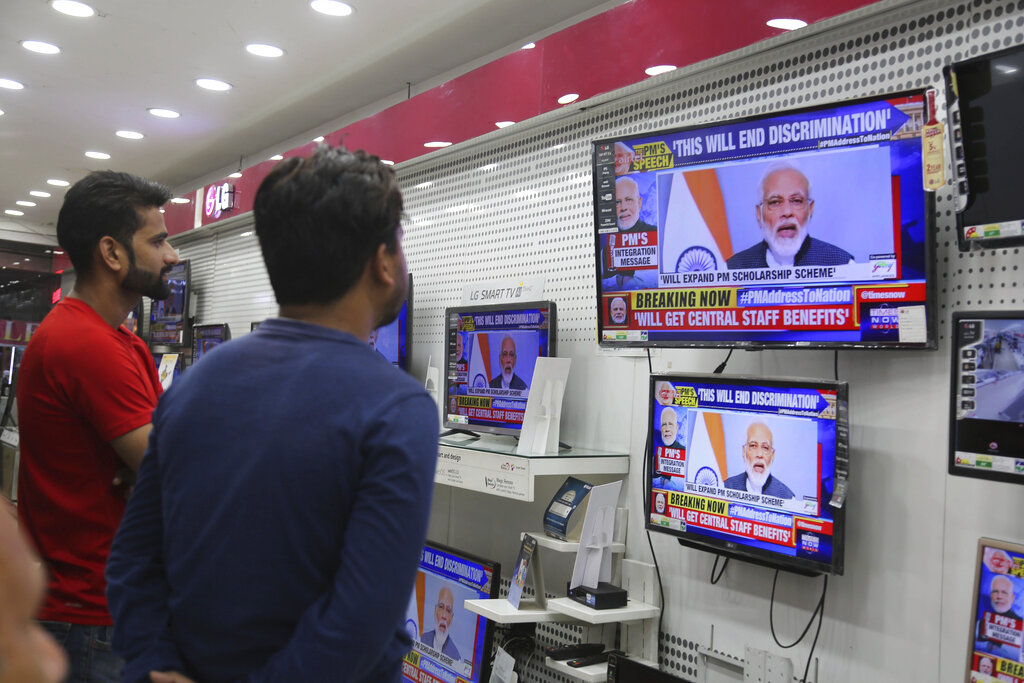
Indians watch Prime Minister Narendra Modi address the nation in a televised speech, in an electronics store in Jammu, India, Thursday, Aug. 8, 2019. Modi says a federally-ruled Indian portion of Kashmir will help end decades-old separatism incited by archrival Pakistan. Describing changes in Kashmir as historic, Modi assures Kashmiri people that the situation in the region will soon become normal. Photo: Channi Anand / AP
Pakistan said it would downgrade diplomatic ties with New Delhi, expel the Indian ambassador and suspend trade and a key train service with India. Prime Minister Imran Khan told his National Security Committee that his government will use all diplomatic channels “to expose the brutal Indian racist regime” and human rights violations in Kashmir, a government’s statement said.
Pakistani Foreign Minister Shah Mahmood Qureshi said Islamabad is not considering any military action, looking instead at its political and legal options.
U.N. Secretary-General Antonio Guterres urged India and Pakistan to refrain from taking any steps that would affect the status of Kashmir. U.N. spokesman Stephane Dujarric said Guterres “is also concerned over reports of restrictions on the Indian-side of Kashmir, which could exacerbate the human rights situation in the region,” and reiterates his call for “maximum restraint.”
State-run All India Radio, which reported on the arrests without details, also said that cross-border firing by Indian and Pakistani troops hit the Rajouri sector of the Indian-controlled Kashmir late Wednesday. Many people there remain holed up in their homes.
Activist Ali Mohammed told broadcaster New Delhi Television that he organized ambulances to carry sick poor people to hospitals in Srinagar, the main city in India’s portion of Kashmir, since they can’t even use phones to seek medical help.
“It’s hell,” a patient told the broadcaster.
Modi’s national security adviser Ajit Doval visited the region Wednesday to assess the law and order situation in the country’s only Muslim-majority state where most people oppose Indian rule. The insurgency that began in 1989 and India’s ensuing crackdown have killed more than 70,000 people.
A petition challenging the lockdown was filed in India’s top court. Opposition Congress party activist Tehseen Poonawalla said he expected the Supreme Court to hear his petition seeking the immediate lifting of the curfew and other restrictions in Kashmir, including blocking of phone lines, internet and news channels.
He also sought the immediate release of Kashmiri leaders who have been detained, including Omar Abdullah and Mehbooba Mufti.
India said it regretted Pakistan’s steps and said in a statement that “the intention behind these measures is obviously to present an alarming picture to the world of our bilateral ties.”
The External Affairs Ministry said it was not surprised by Pakistan because Islamabad “has used such sentiments to justify its cross-border terrorism.”
Describing India’s latest steps in Kashmir as an internal matter, the statement urged Pakistan to review its decision so that normal diplomatic channels are preserved.
Pakistan’s Foreign Ministry spokesman Mohammad Faisal said authorities were considering a proposal to approach the International Court of Justice over India’s action. He condemned the imposition of communications blackout and security clampdown, saying “Kashmir has been converted into the world’s biggest jail” by India by forcing people to stay home.
“They are taking such actions in a panic,” he said. “They have touched something they don’t know how to get out of.”
Faisal said even the Indian opposition and media were against the moves in Kashmir.
He said Pakistan had never shut doors for talks with India in the past but India never positively responded to such offers from Islamabad. “Only they can say what they want now,” he said.
The government in Islamabad also said it would give diplomatic, political and moral support to people living in Kashmir and their “right of self-determination.” It also said it would ask the U.N. to pressure India to reverse its decision.
An uneasy calm prevailed along the Line of Control in Pakistan’s part of Kashmir, where people in border villages were awaiting government instructions to move to safer places, although some residents had already gone to nearby towns.
FILE - In this Tuesday, Aug. 1, 2017 file photo, Thailand's former Prime Minister Yingluck Shinawatra waves to supporters as she arrives at the Supreme Court in Bangkok, Thailand. Serbian media say fugitive former Thai Prime Minister Yingluck Shinawatra has received Serbian citizenship. State news agency Tanjug said Thursday, Aug. 8, 2019 that the Serbian government granted her the citizenship “because it could be in the interest of Serbia.” Photo: Sakchai Lalit / AP File
BELGRADE — Fugitive former Thai Prime Minister Yingluck Shinawatra, who was sentenced in Thailand to five years in prison on graft-related charges, has received Serbian citizenship.
State news agency Tanjug reported Thursday that the Serbian government granted her the citizenship “because it could be in the interest of Serbia.” Serbian officials did not comment on the reason behind the decision.
A government decree confirming she was granted citizenship was published in June in Serbia’s official gazette.
With the Serbian passport, Shinawatra can travel without a visa to over 100 countries, including most of members of the European Union.
She fled Thailand in 2017 days before she was convicted of running a rice subsidy scheme that cost Thailand billions of dollars. She and her supporters say the case was politically motivated.
She skipped bail and reportedly went to London via Dubai, where her billionaire brother, former Prime Minister Thaksin Shinawatra, resides in self-imposed exile after fleeing Thailand also facing corruption charges.
Her current whereabouts are unknown.
They were both elected premier, but were toppled in military coups — Thaksin in 2006 and Yingluck in 2014. Although they live in exile, the two retain significant support in rural and poorer parts of Thailand.
Thaksin has citizenship of another Balkan country, Montenegro, which he received in 2009.
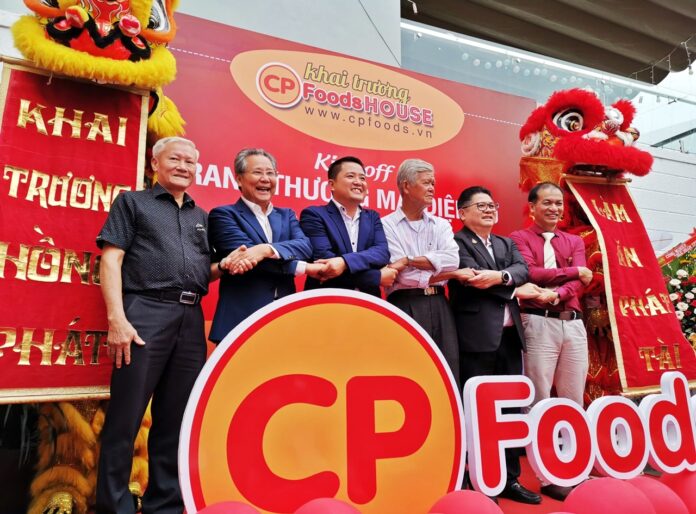
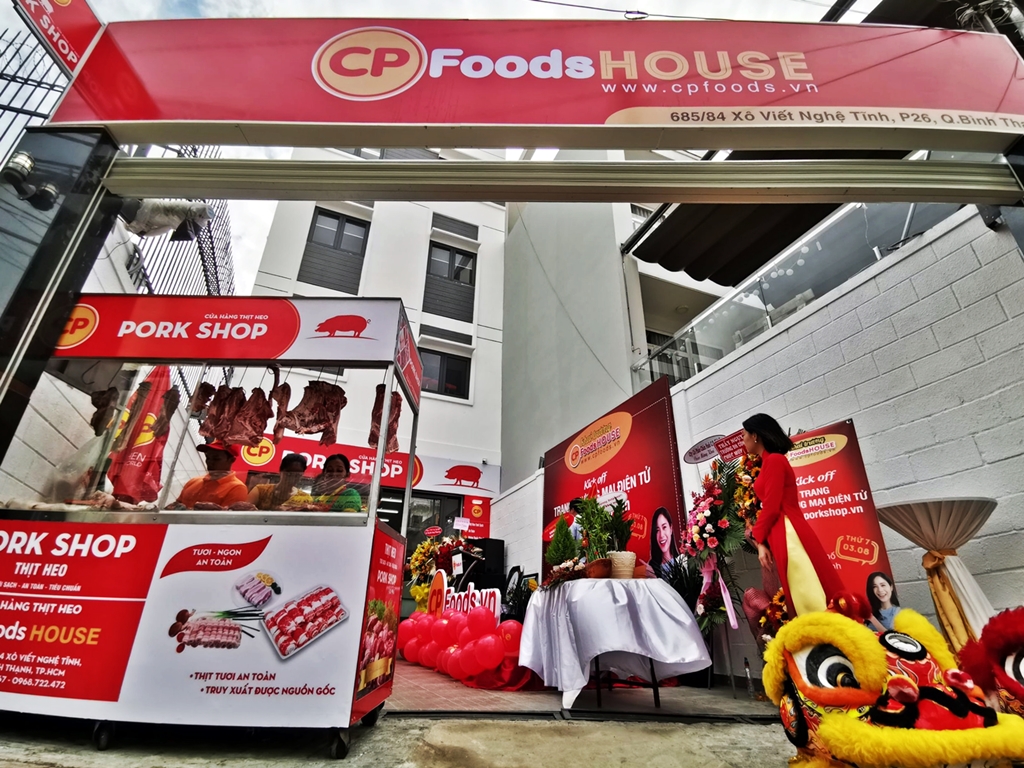
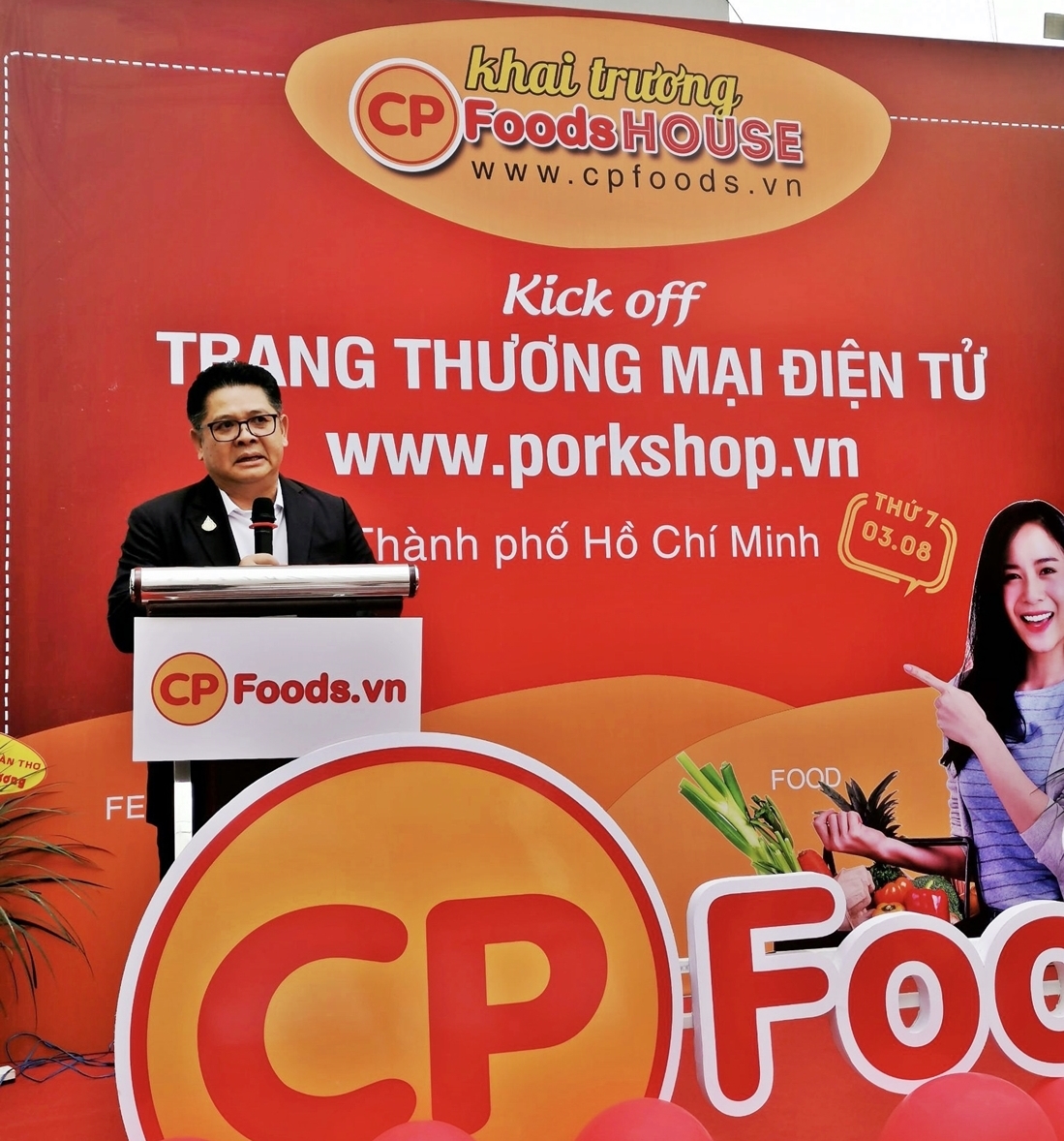
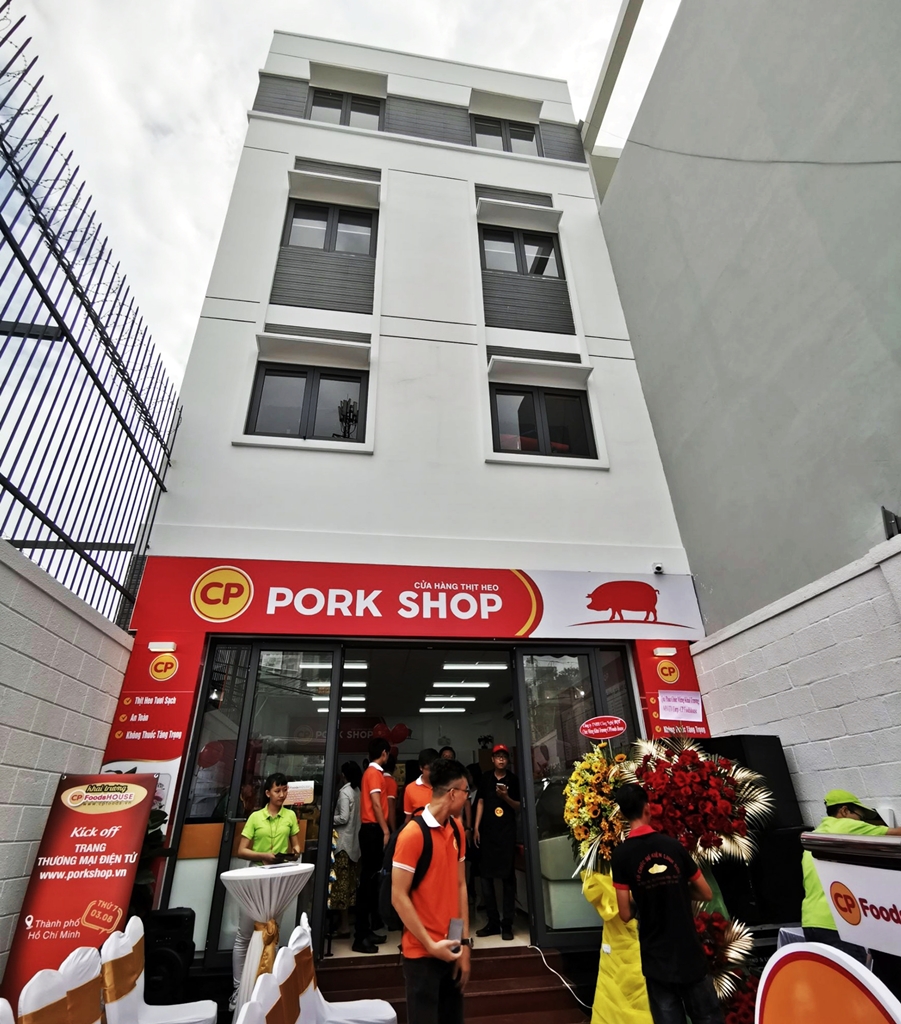
Mr. Montri Suwanphosri, President of CP Vietnam, together with executives and staffs joined the opening ceremony of CP Foods HOUSE and CP PORK SHOP owned by Mr. Nguyen Tuan Khoi, Managing Director of VTVCorp and DSF Vietnam. The shop opening ceremony was received congratulation from Mr. Tran Quoc Hun, Vice President of Vietnam Red Cross and Dr. Nguyen Toan, Professor of HUTECH University.
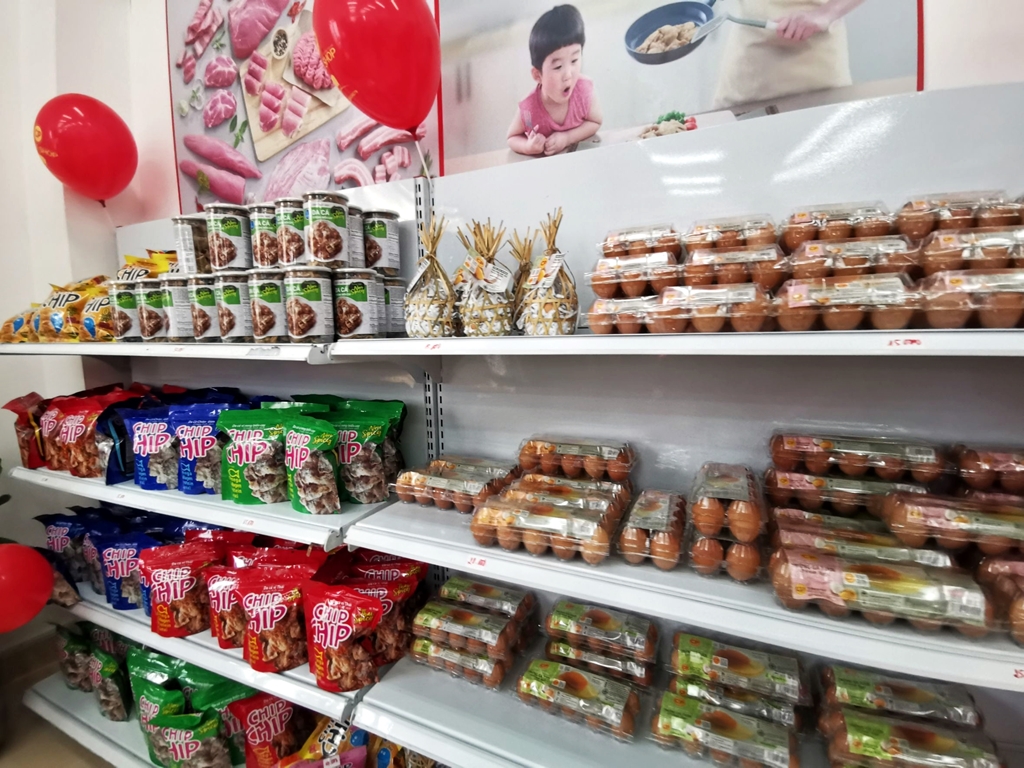
Both shops are selling “CP” brand products and distributed via online at www.porkshop.vn. With the international standard for the whole production processes, these shops allow more channels for Vietnamese accessing to high quality and safe foods.
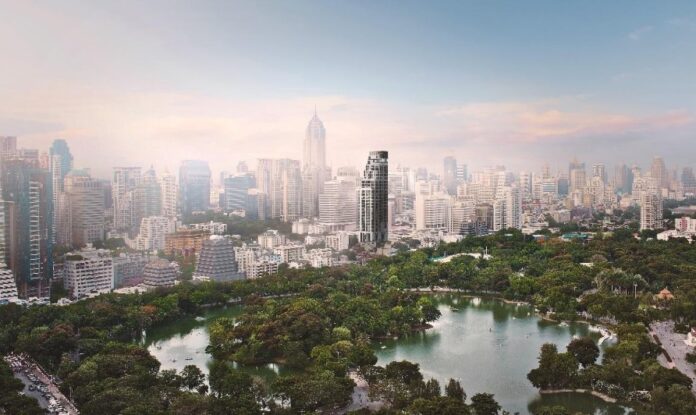
MUNIQ Langsuan becomes the latest addition to the success list of Major Development, Thailand’s leading real estate developer that creates sensation in the country’s industry, as the project makes record sales of 90% on the first day of reservation. MUNIQ Langsuan’s construction, overseen by Koranit ConstructionCo.,Ltd is reportedly underway.
Major Development PCL, developer of high end real estate projects in prime locations, recently unveils its latest mega-project, MUNIQ Langsuan, freehold high-rise luxury condominium that can be passed on to the next generations, located on mid-town premium location on Langsuan, which is regarded as the “Beverly Hills” of Thailand. The project was first launched in February 2018
Dr. Suriya Poolvoralaks, Managing Director of Major Development PCL, states that MUNIQ Langsuan’s construction is currently underway by Koranit Construction to be completed by the first quarter of 2022. MUNIQ Langsuan, a freehold property worth of 4,085 million baht, is designed with classic aesthetics with New York flair under the concept “Live Your Everlasting Romance”. Blending delicate art and meticulous design, MUNIQ Langsuan offers ample and functional utility space where ultimate living can be achieved on Bangkok’s largest piece of green land with Lumpini Park, which is located only 100 meters away any and convenient access to Sarasin, Ton Son and Wittayu Roads.
Experience the ultimate mid-town living at MUNIQ Langsuan with prices starting from 25.4 million baht (2-bedrooms). For more information, please visit MJD.TH/MUNIQ or call 1266.
About Koranit Construction
Koranit Construction is widely respected in local and international real estate industry. Previous projects include The Room Sukhumvit 64, The Bangkok Sathorn – Taksin, Life@ Sathorn, Oka Haus to name a few.
About MUNIQ Langsuan
Completion: First quarter of 2022
MUNIQ Langsuan in Soi Ton Son is a high-rise condominium of 28 floors with 166 units, 111% Parking (185 cars) and full facilities.
Size 1-1-65 rai
One-Bedroom (50 – 76sqm), Two-Bedrooms (78 – 101sqm), Three-Bedrooms (121 – 179.5sqm) and The Collection (80.5 – 280sqm)
2 Bedroom units’ prices start from 25.4 million baht.
Siam Daikin Sales and Siam Country Club, affiliates of Siam Motors Group, continues to lend support to “Bangkok Bank CycleFest 2019” to promote good health among Thais and offer the experience of the year’s biggest cycling events between on November 23-24 at Siam Country Clun in Chonburi.
Siam Daikin Sales and Siam Country Club, affiliates of Siam Motors Group, join hands to support Bangkok Bank CycleFest 2019 once again and open the field for professional and amateur cyclists from all ages to partake in health-enhancing experiences throughout the two-day event on safe, picturesque routes with international standard.
Mr. Somporn Jangreenapawong, Assistant Managing Director of Siam Daikin Sales Co., Ltd. said that, “So far Siam Daikin Sales and other affiliates of Siam Motors Group have been avid support of sports event, as it is the organization’s key policy to promote sports and healthy lifestyle. This time around, it is our honor to support one of Thailand’s biggest cycling events, Bangkok Bank CycleFest 2019, that many cyclists have been waiting for. For the past 2-3 years, cycling has become a more popular sport activities among Thais of every age group. Some take cycling as a form of exercise. Some take it as mode of transportation in daily life, while some use cycling in sightseeing. We would like to treat cyclists with memorable cycling experiences on safe and picturesque routes throughout the competition. We are delighted to see cyclists partake in various activities as part of their exercise routine.”
Bangkok Bank CycleFest 2019 is held under the concept “Ride for All” and caters to all lifestyle. Offering various classifications and choices of cycling styles through the two-day event, Bangkok Bank CycleFest 2019 includes 30-60 kilometers routes and team 90-minute timed competition for 15.5 kilometers which will be joined by celebrity cyclists such as Nat Thephassadin Na Ayutthaya, Yossawadee “Yo” Hassadeevikit and Surampa “Golf” Yokchotsakul who will share thrilling cycling experiences with fans. Cyclists and families will also get to enjoy series of fun activities at the Festive Village that include shops, entertainment and exercise zone for table tennis and badminton.
Bangkok Bank CycleFest 2019 creates cycling programs for cyclists of all levels and ages on 15.5-kilometer open route that circles Siam Country Club in Pattaya, surrounded by picturesque scenery and, abundant nature. The event is under the care and management of IMG, the expert in sport event organization and the leader in international media and fashion business, that promises the new dimension of international cycling experiences that cater towards experiences-building and fun rather than competitiveness.
Key points: Thailand and other countries in the Mekong Region have been suffering more and more severe droughts for the past five decades. Not only do they need a long-term plan to cope with the ongoing crisis, but also require regional cooperation as well.
By Dr. Liu Hui, China Institute of Water Resources and Hydropower Research
Drought, follows flood and storm, is among the most influential natural disasters in the world. According to 2018 publication on the International Disaster Database website, 16% of people affected by disasters in 2018 were affected by droughts.
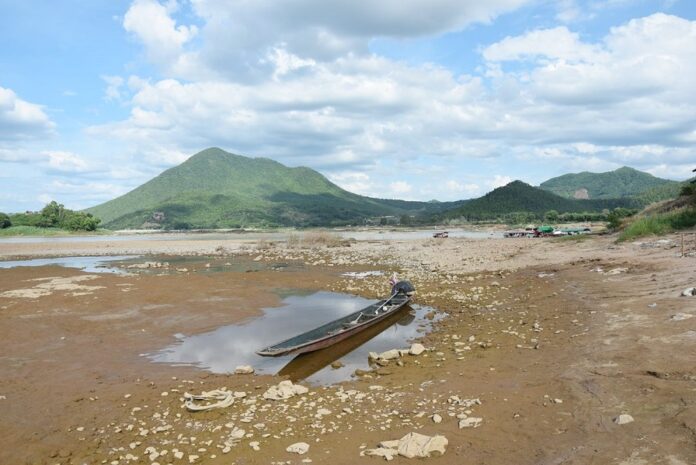
Over the past few decades, countries along the Lancang-Mekong River have experienced different degrees of drought events, causing tremendous impacts on agriculture, fisheries, production and life.
The Lancang-Mekong region is facing raising temperature like the other places in the world. According to surface temperature of January to March, 2019 is the 3rd warmest of 170 years. As news released by WMO, the Earth just had the warmest June on record.
The temperature departure from historical average is around 1 Degree Celsius in the Lancang-Mekong region in 2019.
When high temperature is accompanied with strong El Niño or weakened Southwest monsoon, long-lasting severe drought will take place in this region, like the whole-basin exceptional drought in 2016 and the long-lasting extensively affected drought this year.
A Warmer Era
According to meteorological data, the rainfall in Lancang River basin was 42 percent less than average during January to mid July 2019.
Low rainfall in early Wet Season this year was also reported by Mekong River Commission Secretariat (MRCS) in its weekly flood situation reports since June.
According to the drought index (SPEI) of January to June 2019, drought occurred in the whole Lancang-Mekong region.
For the Lancang basin, the drought severity got heavier since March, and reached severe level in May; For the middle Mekong basin (Thailand, part of Lao PDR and Cambodia), the severity of drought stayed moderate to severe level since the beginning of the year; For the Mekong delta region, the drought happened in February and April, and ended in May.
The reservoirs on Lancang mainstream stored part of the water during the wet season of 2018, and released supplementary water to the Mekong River during January to June 2019, and the water level of reservoirs gradually dropped to the dead storage level in early July.
Considering running out of the “supplementary” capacity, the Jinghong reservoir decided to implement the routine overhaul from 5th to 19th July, during which reasonable outflow was maintained.
A notification of the operation information during the overhaul was sent from the Ministry of Water Resources, China to mekong countries and MRCS in advance on 3rd July. And MRCS timely published the information on its website on 3rd July, titled Water flow from China’s Jinghong station to fluctuate, but no major impact is expected.
Recently, news coverage about drought this year has been increasing and drawn more and more attentions from farmers to senior administration officials.
According to the Cambodia Daily on July 20, 2019, an extended drought in Cambodia has caused the tributaries of Tonle Sap lake to dry up, spelling ruin for farmers and fishermen in Battambang province. Villagers in this district have been unable to fish since April because of the drought. They are now running out of food and have pleaded with the government to give them emergency relief.
The drought situation in Thailand is so severe that the government has asked China, Laos and Myanmar to release more water into rivers to help relieve the drought conditions in Thailand said Prime Minister Prayut Chan-o-cha on 24 July 2019.
Based on long time observation and research on the drought study in the Lancang-Mekong region, I would like to take this opportunity to share my findings and suggestions with riparian stakeholders and decision makers, with the aim to improve our drought relief ability jointly to make a more secure Lancang-Mekong region.
Findings
(1) The results of meteorological drought analysis show that the drought severity in northeastern Thailand, most of Cambodia and Myanmar has increased over the past half century, especially in some parts of northeastern Thailand.
In most parts of the basin, the frequency of meteorological drought is close to 25% due to low rainfall, especially in northeastern Thailand and Cambodia; and Cambodia and Vietnam Delta in the lower reaches are more liable to severe and exceptional droughts.
By analyzing the causes of typical drought events, it is found that the main reason for the drought in the Mekong River Basin is the extraordinary less rainfall (compared with that in the same period in history) caused by El Nino and anomalies of atmosphere-ocean circulation system.
(2) Because of the differences between the national economic supporting capacity and development of water conservancy projects, the drought resistance ability of different countries is different.
Among them, the distribution of irrigated areas is uneven in Cambodia and the ability of drought resistance in different regions is different. The number of irrigation projects and irrigation area in Lao PDR is relatively small and drought resistance ability is slightly inadequate.
Vietnam and Thailand have built relatively high-density, large-scale irrigation projects and irrigation network, which is expected to provide a better engineering guarantee for the development of drought resistance.
Suggestions
(1) Exploit potentialities and enhance the ability of countries to cope with natural disasters.
The Mekong River Basin countries have established organization system for disaster prevention and reduction to deal with drought disasters.
Although there is a significant correlation between the national drought relief capacity and economic and social development level, the consensus of the whole basin on improving the drought relief structural measures is also very important.
Based on the viewpoint of engineering, though countries like Thailand and Vietnam have taken adequate measures to combat drought, it seems still necessary to enhance the drought relief engineering construction to cope with severe drought.
(2) Make overall plans and coordinate to enhance the disaster mitigation ability from the whole-basin perspective.
Though the reservoirs on Lancang mainstream have played a “supplementary” role by using the storage and regulation capacity and released about 140 percent more water than that of natural flow this year to the Mekong River during January to June 2019, the low water level status of hydrological stations on lower reaches of the Mekong mainstream still occurred.
It is due to the fact that the flow contribution of Lancang River to the whole Lancang-Mekong basin is only around 20% and 11% in dry season and wet season respectively. When whole-basin drought happens, more measures should be considered from the whole-basin perspective.
It is suggested that the tributaries along the mekong river should play more important role in regulating and storing water. Besides, The reservoirs built in the Mekong River Basin have a capacity of more than 20 billion m3.
It is suggested that the possible positive role of these reservoirs in drought relief in all countries and the whole basin should be studied in depth, and the impacts of drought relief projects on the water disasters in the downstream regions or countries should be deeply analyzed while they alleviate the local disasters to lay a foundation for the overall coordination of the basin.
(3) Make full use of the regional cooperation mechanisms to promote the whole-basin cooperation level.
Among the several cooperation mechanisms in the Lancang-Mekong region (MRC, GMS, Golden Quadrangle Program etc.), the Lancang-Mekong Cooperation (LMC) mechanism was established by all six riparian countries of Lancang-Mekong River in 2016, which provides a new platform for dialogue and cooperation from the whole basin perspective.
Water resources is one of the five priority areas under the LMC mechanism. Joint Working Groups on water resources under the LMC mechanism consisting of line agencies of the six LMC countries and the Lancang-Mekong Water Resources Cooperation Center established in Beijing, which mark the establishment of Lancang-Mekong Water Resources mechanism in 2017.
The following cooperation topics are recommended to be carried out under the Lancang-Mekong Water Resources mechanism.
They include enhancing information sharing and countermeasure consultation through Joint Working Groups on water resources of LMC, research on climate change impacts and adaptation measures in the Lancang-Mekong basin and research on joint operation of the reservoirs in the whole basin, so as to make full use of the regulation capacity to cope with natural disasters.
Note: Dr. Liu Hui was the project leader of “Joint Assessment on Flood Prevention and Drought Relief in Mekong River Basin (Phase I)”, which was carried out by experts from six member countries under the Lancang-Mekong Cooperation mechanism in 2018.
She is also among the core experts of the joint research “Hydrological Impacts of the Lancang Hydropower Cascade on Downstream Extreme Events” in cooperation with MRC and IWMI.
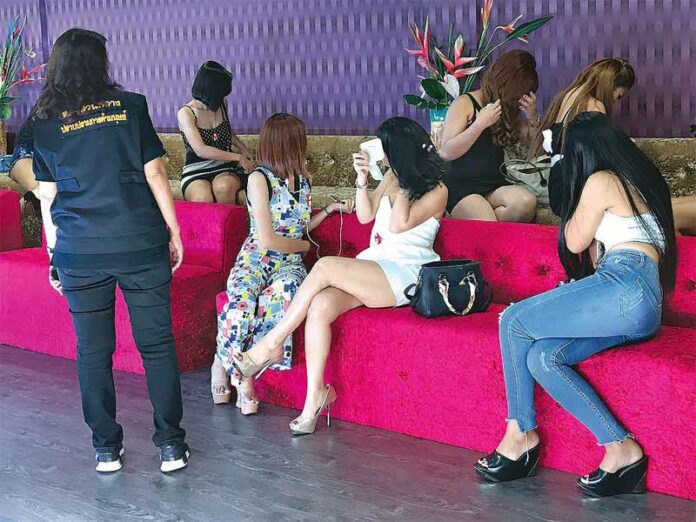
Suspected sex workers are paraded in front of the media in Bangkok on June 21, 2017.
BANGKOK — Sex workers and NGOs said Thursday the police have taken the right step by agreeing to adopt a more “humane” approach when arresting suspects on prostitution charges.
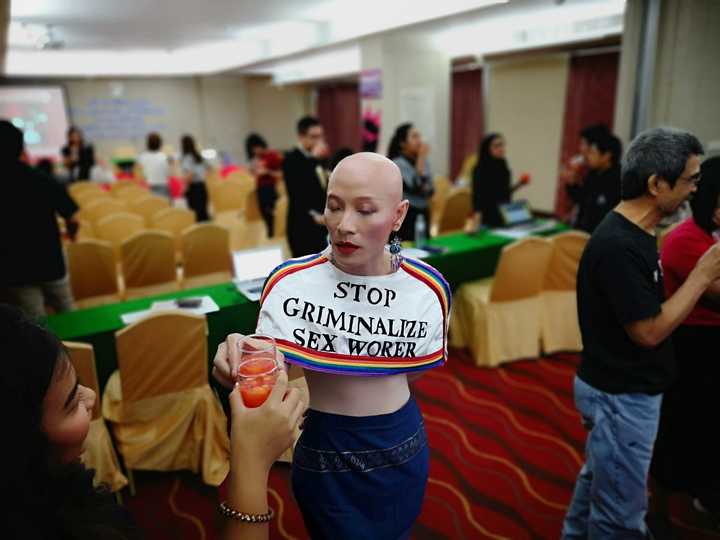
In what they called a “round one” victory, sex work advocates toasted (non-alcoholic) punch to celebrate new protocols which ban sexual intercourse during sting operations, parading sex workers in front of the press, and allowing media inside raided venues.
Passports of foreign sex workers will also no longer be stamped with a message saying they were arrested for prostitution, according to a police memo unveiled today at a panel discussion held in Bangkok.
“Stamping passports of foreign sex workers is against their freedom to travel,” activist Mai Chanta said.
Activists give a toast to celebrate the police’s new policies.
Under the previous system, anybody caught in an anti-prostitution raid could no longer re-enter Thailand or travel to countries where prostitution is a crime.
Mai also hopes the new measures will put an end to the media’s habit of publishing photos of sex workers when they are arrested. Some moral vigilante Facebook pages even release names, frontal pictures, and IDs of sex workers in an attempt to shame them, she said.
“Many media organizations take photos without asking for permission and without caring for their feelings,” the activist said.
Although prostitution is widely practiced in Thailand, it is illegal under a 1996 law which carries a one-month jail term. There are about 200,000 to 300,000 sex workers in the Kingdom, according to activist groups.
The law is rarely enforced, but raids on brothels continue from time to time, often with media in tow. Mai said the police and media cause further emotional harm when reporters are allowed to ask sex workers inappropriate questions after raids.
Leading the call for the decent treatment of sex workers is the advocacy group Empower Foundation. The network has been working with the National Human Rights Commission for years to pressure police into respecting the basic rights of sex workers during arrests.
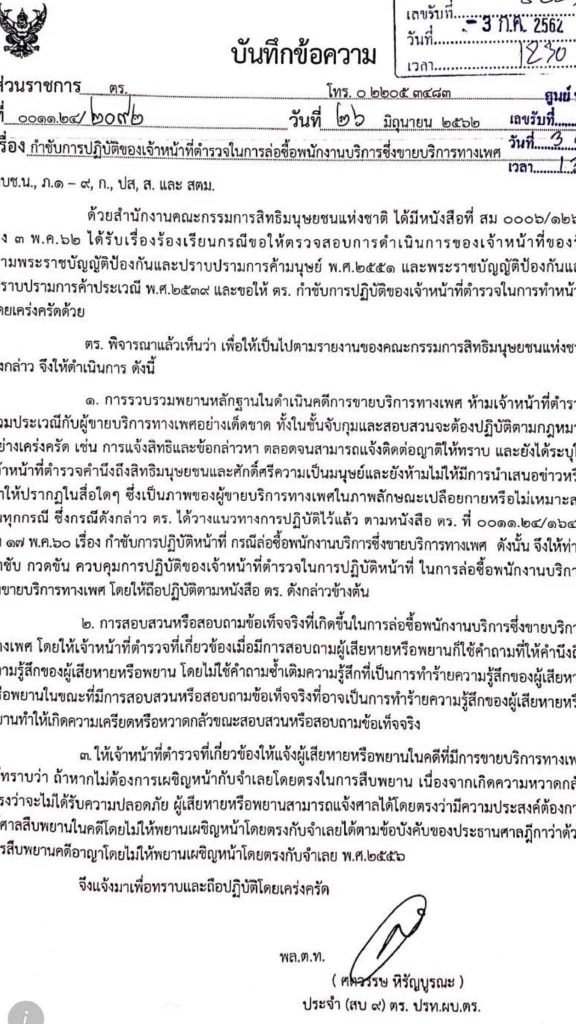
The police memo shown at the event.
Commissioner Angkhana Neelapaijit said she made recommendations back in February, but the breakthrough came in June when the national police issued new protocols to its forces.
At today’s event, Angkhana also showed a police memo dated June 26 which bans officers from having sex with suspects in sting operations. The practice has been repeatedly condemned by various NGOs as a breach of civil rights.
The letter also stated that police must strictly “inform [sex workers] of their rights” and allow them to contact their relatives and a lawyer.
“Interrogation or questioning… must not be conducted using questions that add emotional injury or hurt the person’s feelings,” the letter stated.
Anyone kept as a witness should also be housed in accommodation appropriate to a witness and not in a detention center.
But it is unclear whether the memo will be actually implemented. Previous orders by the police and government to stop parading suspects in news conferences and “crime reenactments” have often gone unheeded.
Three female police officers were in the audience at today’s discussion. One of them said arrests will have to continue as long as prostitution remains outlawed.
But Empower Foundation on Thursday vowed to push for the eventual decriminalization of sex work.
“We must forge an understanding in society. We don’t sell ourselves, we sell a service!” foundation activist and sex worker Sirisak Chaithet said at the event. “Once it’s done, we say bye. It’s not like they are buying our hands or mouths or will cut them.”
He continued, “Our dignity as a human being is still intact.”
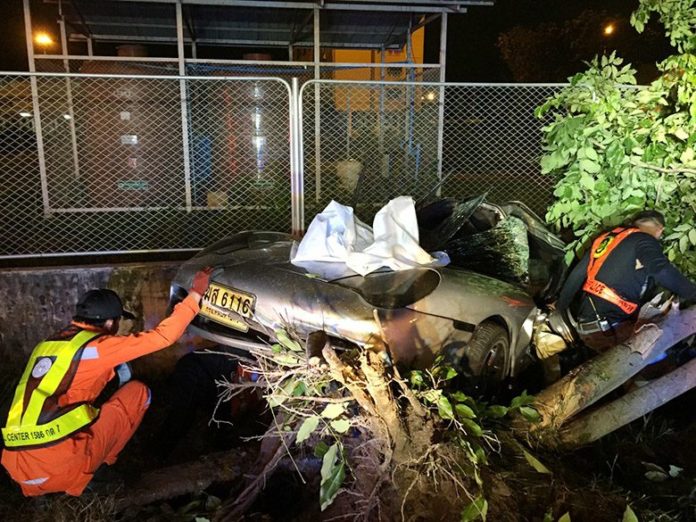
Wrecked Porsche at the scene on Ratchadapisek Road on August 8.
BANGKOK — Another car was sacrificed to the so-called “Hundred-Death Curve” on Thursday night, but luckily no one was hurt.
Police reported that a Porsche 718 Cayman, driving on the inbound side of Ratchadaphisek Road, lost control on the slippery surface before hitting a tree shortly before 5am.
The driver, Kanapol Kowatana, and the accompanying passenger walked away from the wreckage without injuries. But the sports car sustained major damage to its front, with a busted bumper and grille.
Kanapol refused to talk to the press after meeting with police.
Locals have dubbed the two-kilometre curve stretching in front of the Criminal Court on Ratchadapisek Road as the “Hundred-Death Curve” due to the many accidents and fatalities that befall it.
Thanapong Jinwong, the manager of the road-safety advocacy group Academic Centre for Road Safety, said the stretch of road has been designed to road safety standards. He posits that drivers may simply be reckless, driving at high speed at night when they see no traffic on the road.
Over the past few years, the city has installed signs, guard rails, and even removed road-side offerings to ghosts (such as zebra dolls and red soda bottles) in an effort to mitigate accidents.
This week has not been generous to Porsche owners, with several reported incidents involving the German luxury cars. On Monday, a yellow Porsche stopped smack in the middle of the bustling Khlong Tan intersection. The driver was drunk and evaluated that rush hour was a good time to rest the vehicle.
Then on Sunday, a silver Porsche skidded off the road after trying to cut in front of another car on Motorway No. 7. Both drivers emerged safe.
Another crashed Porsche on Motorway No. 7 on August 4.