































35 C
Bangkok
Monday, June 8, 2026
Home Blog Page 1549

Thai Parents Divided on Physically Punishing Children

A woman shows wounds on the body of her 7-year-old son allegedly inflicted "as a punishment" by his stepfather in Prachinburi province on March 21, 2018. Police later charged the stepfather with physical assaults. Image: Channel 3.

BANGKOK — Smacking a kid’s palm is the most popular form of corporal punishment for disciplining children, according to a survey of almost a thousand Thai parents.

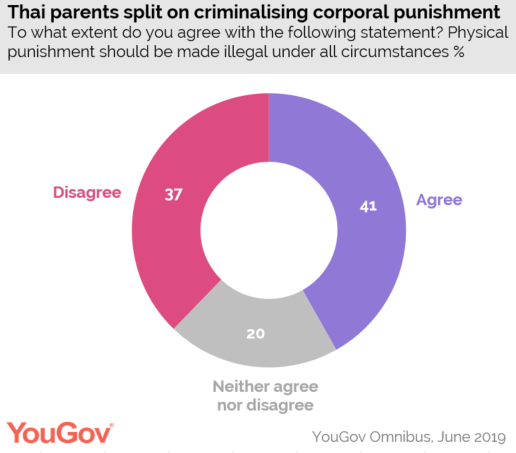
In a survey of 999 Thai parents by YouGov, 29 percent of Thai parents used palm-smacking to discipline their children. Overall, some 80 percent of Thai parents use physical punishment.

Two in five believe that physical punishment should be illegal, although about the same amount believe that physical punishment is normal. The remaining one in five are undecided.

“I just smack my children on the hand. There’s no need to use canes or tools to punish. They’re just children,” said Siriporn Suthiprapa, a 43-year-old secretary with a 14-year-old daughter and 11-year-old son. “If you make them bleed, that’s definitely wrong.”

The second most popular physical disciplinary method was caning (23 percent), then pinching (13 percent). Only 5 percent preferred slapping, while the least popular method was making the child eat unpleasant substances such as soap or chili (4 percent).
TH corporal punishment 1

In contrast to her acceptance of palm-smacking, Siriporn supports outlawing more violent methods such as caning.

“Some parents aren’t teaching with their heart, but just releasing their rage. They grab whatever they have on hand to hit the kid,” Siriporn said.

The most recent case of sensational domestic abuse to make headlines involved a 23-year-old Samut Prakan mother who, along with her new 26-year-old husband, hit her 5-year-old daughter to the point of hospitalization. Both were arrested and charged with domestic assault.

Mothers are slightly more likely than fathers to discipline their children using physical methods, the survey also found (82 percent vs. 76 percent).

The survey was conducted by UK-based market research company YouGov, which from June 26 to July 3 randomly selected parents from a pool of 165,000 Thais who signed up to participate in return for compensation. YouGov states the study has a margin of error of 3 percent.

TH corporal punishment 2

“While it appears most Thai parents are comfortable with physically disciplining their children at home, they are split over whether the law should come into play,” Jake Gammon from YouGov commented.

Seven out of ten (71 percent) of parents answered that physical punishment is “sometimes necessary.” The top three activities that surveyed parents viewed as warranting physical punishment were stealing, violence, and bullying.

The study found no correlating factors between support for physical discipline and socio-economic status. Nor was there a correlation between support for physical discipline and the age of parents.

The survey did not include questions on corporal punishment outside of the home, such as in schools. However, headlines regularly feature stories about teachers, often at public schools, hitting students. On July 5, a sixth-grade girl in Nakhon Nayok alleged that she had to get three stitches after her teacher hit her with a stick on the head for copying their friend’s homework.

According to a Time article in 2014 by psychologist Jared Pingleton, spanking can be an “appropriate form of child discipline,” but only for cases of “willful disobedience or defiance of authority—never for mere childish irresponsibility.” Parents with difficulty controlling their tempers should refrain from corporal punishment, Pingleton said, since “it should never be administered harshly, impulsively, or with the potential to cause physical harm.” Pingleton recommended stopping the practise of spanking by adolescence.

A more recent publication in November by the American Academy of Pediatrics, however, found that spanking may not decrease negative behaviors and might instead increase aggression. The study instead recommended non-physical disciplinary methods such as time-outs, ignoring bad behavior, and positive reinforcement.

Advertisement

Review: ‘Lion King’ Returns but It’s Harder to Feel the Love

This image released by Disney shows Nala, voiced by Beyoncé Knowles-Carter, left, and Simba, voiced by Donald Glover in a scene from
This image released by Disney shows Nala, voiced by Beyoncé Knowles-Carter, left, and Simba, voiced by Donald Glover in a scene from "The Lion King." Image: Disney via AP

Life moves in a circle, “The Lion King” tells us, and, increasingly, so does studio moviemaking.

Close on the heels of “live-action” remakes of “Aladdin” and “Dumbo” and on the precipice of a reborn “The Little Mermaid,” ”The Lion King” is back, too. Round and round we go. Cue Savannah sunrise. Cue “Naaaants ingonyama bagithi baba!”

The remakes have themselves been a mixed bag offering some combination of modern visual effects, fresh casting and narrative tweaks to catch up more dated material to the times. Don’t count on a new “Song of the South,” but much of the Disney library will soon have been outfitted with digital clothes for the Internet era.

It’s easy to greet these remakes both cynically and a little eagerly. In the case of “The Lion King,” the songs are still good, the Shakespearean story still solid. And, well, Beyonce’s in it.

And yet Jon Favreau’s “The Lion King,” so abundant with realistic simulations of the natural world, is curiously lifeless. The most significant overhaul to an otherwise slavishly similar retread is the digital animation rendering of everything, turning the film’s African grasslands and its animal inhabitants into a photo-realistic menagerie. The Disney worlds of cartoon and nature documentary have finally merged.

It’s an impressive leap in visual effects, which included Favreau, cinematographer Caleb Descehanel and VFX chief Rob Legato making use of virtual-reality environments. Some of the computer-generated makeovers are beautiful. Mufasa, the lion king voiced again by James Earl Jones, is wondrously regal, and his mane might be the most majestic blonde locks since Robert Redford. And the grass stalks of the pride lands shimmer in the African sunlight.

But it’s a hollow victory. By turning the elastic, dynamic hand-drawn creations of Roger Allers and Rob Minkoff’s 1994 original into realistic-looking animals, “The Lion King” has greatly narrowed its spectrum of available expressions. Largely lost are the kinds of characterization that can flow from voice actor to animation. (Think of how closely fused Tom Hanks is with Woody in the “Toy Story” movies.) Here, most of the starry voice actors (including Donald Glover as the grown-up lion prince Simba, Beyonce as the older lioness Nala and Chiwetel Ejiofor as the villainous Scar) feel remote from their characters. And, in many cases, so do we.

It’s worth asking: Just how real do we need our talking animals? Do we need the feathered majordomo Zazu (voiced by John Oliver) to look enough like a red-billed hornbill to win the approval of avid birders? “The Lion King” may well be a pivotal stepping stone toward CGI splendors to come, but for now, it feels like realism has been substituted for enchantment.

That doesn’t stop an army of top craft professionals and an enviable voice cast from doing their best to inject some vitality into “The Lion King.” The familiar songs by Elton John and Tim Rice are back, along with a new tune by Rice and Beyonce, though this time, the score by Hans Zimmer, with Lebo M., feels more airy and buoyant.

Yet the degree to which this “Lion King” mimics the first is disappointing. (Jeff Nathanson gets a solo writing credit but scene-to-scene the film hues extremely close to the original.) There’s a sound case to be made that the tale, which has been running on Broadway for more than 20 years, needs little revision.

But the few deviations taken by the filmmakers make you want more. The role of Nala has rightfully been elevated and toughened. The most rope for riffing has been extended to the new Timon and Pumba: Billy Eichner and Seth Rogen. Taking over for Nathan Lane’s meerkat and Ernie Sabella’s warthog, Eichner and Rogen make their own shtick together and they, more than anyone else, give “The Lion King” a breath of fresh air, even as they make plenty of fart jokes.

Yet that’s hardly enough to warrant a bland, unimaginative rehash like this, let alone merit Beyonce’s imperial presence. Instead, “The Lion King” is missing something. A purpose, maybe, and a heart. The life expectancy of Disney classics has begun to feel more like a hamster wheel than a circle of life, and it’s getting harder and harder to feel the love.

“The Lion King,” a Walt Disney Co. release, is rated PG by the Motion Picture Association of America for sequences of violence and peril, and some thematic elements. Running time: 118 minutes. Two stars out of four.

Story: Jake Coyle

Advertisement

Wissanu: Gov’t to Retain ‘Attitude Adjustment,’ But Won’t Detain People

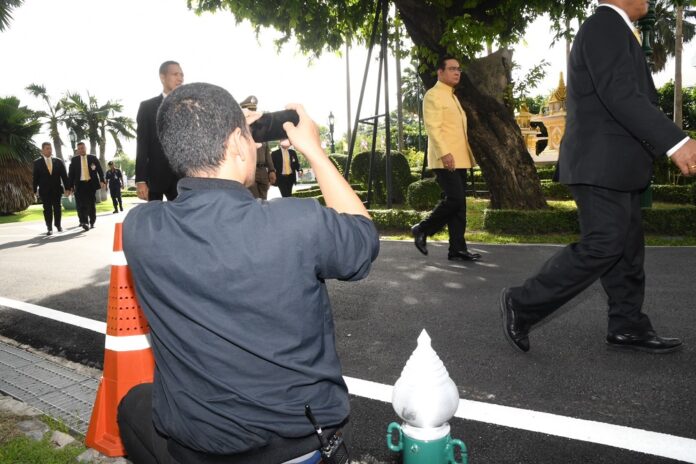
A reporter takes photos of junta chairman Prayuth Chan-ocha at Government House on July 15, 2019.

BANGKOK — The practice of “attitude adjustment” will continue even after the junta is formally dissolved tomorrow, deputy prime minister Wissanu Krea-ngam said Monday.

Wissanu told reporters the power to detain people without warrants will continue to rest with the counter-insurgency agency operating under the Prime Minister’s Office, but won’t be invoked. Instead, Wissanu said, those who pose threats to national security or the monarchy will merely be questioned and warned.

“No [detention]. No. We’ll continue to invite people to be have [their attitude] adjusted. Well, we’ll make requests and say please don’t [do such actions]. But we can’t detain them,” Wissanu said on Monday afternoon. “It’s okay to retain such power, however, because it’s to oversee peace and order.”

He also offered a silver lining, “It’s better than declaring martial law.”

Read: Some Junta Laws to Remain Effective Under New Cabinet

Wissanu’s remarks came after at least two political activists in Bangkok were visited and questioned by police on Monday, raising concerns among government critics that the authorities will continue to intimidate political opponents even after the regime ceases to formally exist tomorrow.

Although the junta will become defunct the moment the new cabinet takes its oath of office to His Majesty the King – scheduled to take place at 5pm on Tuesday – some of the regime’s controversial special orders will be retained under the succeeding government.

They include Orders 3/2014, 13/2015, and 5/2017 which allow designated military officers with rankings of no less than second lieutenant to detain people who are perceived as threats to national security, the monarchy, or who are “influential persons” without charge.

The forced detention, termed in junta euphemisms as “attitude adjustment,” can last as long as seven days in an undisclosed location with no visitation allowed. The measure has been routinely enforced since the 2014 coup to dissuade activists, politicians and even journalists from publicly challenging the junta’s rule.

Decisions to summon individuals for attitude adjustment after the junta is dissolved tomorrow will be made by the Internal Security Operations Command (ISOC), Wissanu said.

But adding to the confusion, a spokesman for ISOC insisted on Tuesday that the anti-insurgency agency has neither the authority nor mandate to summon people for attitude adjustment, because the junta never conferred such powers to the body.

“The NCPO has ceased to exist, but no powers were transferred to ISOC,” said Maj. Gen. Thanathip Sawangthep, using the NCPO’s acronym.

Thanathip added that Article 13/1 of the Security Act technically allows for provincial-level security committees under ISOC to invite people to provide information to security authorities. But calling such a measure “attitude adjustment” would be inaccurate, said Thanathip, since those invited would be neither interrogated nor detained.

“It’s the duty of the NCPO to clarify the whole thing,” Thanathip had said on Tuesday.

Yingcheep Atchanont, a coordinator at law reform advocacy group iLaw, said the authorities must clarify who will be responsible for authorizing attitude adjustment.

“Our preliminary demand is clarity,” said Yingcheep, who has organized a campaign to repeal the special laws enacted by the junta during its five years in power.

Despite support from opposition politicians for his campaign, Yingcheep has acknowledged that the repeals will be difficult to achieve because legislation of such scale would have to be approved by junta-appointed Senate.

According to iLaw’s database, at least 929 civilians have been summoned for attitude adjustment since the May 2014 coup, including those detained without charge for up to seven days.

In a farewell speech as the head of the soon-to-be-defunct junta, Gen. Prayuth Chan-ocha thanked the country for showing support to the regime over the past five years.

Gen. Prayuth also said in the televised speech that Thailand had moved toward a “fully democratic” transition under his watch. The broadcast made no mention of attitude adjustment and other special junta orders.

Additional reporting Teeranai Charuvastra

Update: This article has been updated with statements from the ISOC spokesman.

Related stories:

Man Complains of Election Fraud, Gets Attitude Adjustment

Yingluck’s Lawyer Summoned By Military For Attitude Adjustment

Advertisement

‘Flume’ to ‘Say It’ in Bangkok Concert This August

Photo: Flume / Facebook

BANGKOK Chill out to the spacey, deep bass of Australian Grammy-award winner Flume at first live gig in Asia this August.

Known for international hits like “Never Be Like You” and “Say It,” the Australian DJ and producer is performing in Bangkok on August 21 at Centerpoint Studio Lasalle.

Early-bird tickets are on sale now for 1,800 baht via The Concert.

Local “Queen of Electronic” Prya, who was the first Thai artist to ever perform at Burning Man in Nevada, will be the supporting act.

Flume, or Harley Edward Streten, debuted his first album “Flume” in 2012. His second album “Skin”, released in 2016, earned him international attention and ultimately Best Dance/Electronic Album at the 2017 Grammy Awards.

Advertisement

Cave Rescue Chief Uncommitted to Bangkok Governor Race

Narongsak Osatanakorn at the command center of Tham Luang rescue operation in Chiang Rai on June 29, 2018.

BANGKOK — The official who oversaw the daring operation that saved 13 young footballers and their coach from a cave a year ago has rejected rumors that he will enter the capital’s gubernatorial race.

Phayao governor Narongsak Osatanakorn – whose role in the rescue propelled him to nationwide fame – told the media on Sunday he has yet to make any decision on the matter, despite a pro-junta party official saying Phalang Pracharath Party is ready to nominate Narongsak as its candidate in the upcoming race.

Narongsak declined to comment on Bangkok’s governor election, which will likely take place in late 2019. The incumbent Bangkok governor is set to retire in September due to his age.

Read: Cave Boys Mark Year Since Ordeal With Buddhist Rites

The news first surfaced when Phalang Pracharath official Udorn Sornsan said last week his party will send Narongsak as its contender against Pheu Thai’s candidate, widely believed to be popular former transport minister Chadchart Sitthipunt.

The alleged nomination generated considerable excitement on social media. Both Narongsak and Chadchart have massive followings online – Narongsak due to his role in the world-renowned rescue effort at Luang Cave in July 2018, while Chadchart has been praised for proposals during previous cabinet tenures to modernize Thailand’s infrastructure.

But speaking in a media interview yesterday, Phalang Pracharath deputy chairman Natthapol Teepsuwan said the news is just speculation on Udorn’s part, with the party leadership still undecided on the issue.

In the interview with Spring News, Natthapol said he believes Narongsak is a “talented person,” but added that the current Phayao governor is not a member of any political party.

A junta-appointed governor has been overseeing Bangkok since the city’s last elected governor was removed in a special order by the junta in 2016 citing corruption allegations.

Narongsak served as the governor of Chiang Rai until his abrupt transfer to the less prominent province of Phayao in April 2018. Although transparency critics suspect Narongsak was transferred because he refused to sign off questionable government projects, the authorities maintained his move was routine.

Despite his transfer, the government allowed Narongsak to head the operation in Chiang Rai to free 13 young footballers and their coach from a cave there in June that year, until the mission was completed two weeks later.

Advertisement

Foreign Business Act: New Policy Friendly to Global Construction Companies

Junta chairman Prayuth Chan-ocha urges representatives of German businesses to invest more in Thailand during his November 2018 visit to Berlin.

Beginning in 2017, foreign construction companies, with pleasant surprises, have found it convenient to launch their contracting business in Thailand with or without applications for foreign business licenses under the Foreign Business Act of 1999 or the FBA, typically known as the prohibitive regulatory hurdles to entry into the local market by any foreign service provider.

Such hurdle exists no more.

List 3(10): Construction is Somewhat Restricted

Along with service business in general, construction is considered by the legislation as a business in which Thai nationals are not ready to compete with foreigners.

wirot.3

Foreigners who wish to carry on the restricted construction business will need to apply for a foreign business license from the Department of Business Development (DBD), the Ministry of Commerce (MOC) under the recommendation of the Foreign Business Committee.

List 3(10)(a) attached to the FBA does provide for an exception: construction business related to infrastructure projects in the fields of public utilities and transport using tools, machinery, technology or special skills with investment from 500 million baht or more (USD 16 million). This large infrastructure construction investment is exempt from the FBA and a multinational company is free to set up a 100%-foreign owned company to undertake megaprojects.

Because of the minimum capital requirement, this exception is not very popular.

A Flexible Exception

Realizing that construction is key to the development of the country, the legislators were smart in including List 3(10)(b) as another flexible exception: any construction business stipulated in a ministerial regulation. 

The exception implies that years down the road if any administration envisions they should relax any particular type of construction business or any rules or regulations concerning foreign construction, they could instruct the Ministry of Commerce to simply issue a regulation to exempt such construction service from the application of the FBA, without having to go back to the Parliament and take the trouble through the constitutional process of enacting a new amendment legislation.

The Favorable List 3(21)

List 3(21) attached to the FBA: other services, is also another flexibility for the DBD to grant a foreign business license to any overseas construction company by classifying it as other services not particularly designated as a construction business in List 3(10). The leeway helps avoiding any need for the government to risk issuing even a secondary regulation in favor of foreigners and upsetting fellow Thai citizens in the construction industry.

In fact, most foreign business licenses for construction are quietly granted in this category.

Liberating Ministerial Regulations

One great benefit of category (21) of List 3 is it opens up the possibility for the MOC to prescribe a ministerial regulation to remove any service business from List 3 altogether when it deems that Thai nationals are ready to compete with foreigners in those areas.

The MOC has issued a few of such regulations, including the one in 2017, which liberates construction companies who enter into construction contracts with government agencies and state enterprises.

Government agencies are any government entities defined in the Budget Procedure Act, such as the Ministry of Transport, the Ministry of Energy, the Eastern Economic Corridor Office, and the Bangkok Metropolitan Administration.

 State enterprises are also any government-owned business units covered by the Budget Procedure Act, namely the State Railway of Thailand, the Mass Rapid Transit Authority of Thailand, the Airports of Thailand Plc, PTT Plc., and the Industrial Estate of Thailand.

These foreign construction companies, either incorporated abroad or established in Thailand as a wholly-foreign own limited companies, are totally exempt from the FBA and do not need to apply for a foreign business license at all to undertake a government project in the country. They will just have to seek routine acknowledgement from the DBD by producing a draft contract with government agencies or state enterprises.

Foreign Construction Contracts in Private Sector

Foreign construction companies engaging with employers in the Thai private sector are no less viewed favorably by the Foreign Business Committee and the DBD, even though they remain obligated to seek a foreign business license in List 3(10) or List 3(21), as appropriate.

Although not backed up by a ministerial regulation in the fashion of a government contract, a private construction contract is practically viewed by the authorities as a business that Thai nationals are able to compete very well with global companies, thus they are more relaxed in their approach.

Many of such foreign business licenses for private construction contracts have been granted particularly to overseas construction companies from Asia which are more active in the country than their counterparts from other parts of the world due to their geographical proximity to the Thai nation.

This unprecedented positive approach, adopted by the administration to up local economic activities through government budgets and private investments, has been running smoothly for a few years now and is unlikely to change as the latest government after the general election is obviously an extension of its predecessor. It is a new friendly image of the FBA that more and more foreign service providers feel comfortable to live with.

Wirot Poonsuwan is the Senior Counsel and Head of Special Projects at Blumenthal Richter & Sumet in Bangkok and can be reached at [email protected].

Advertisement

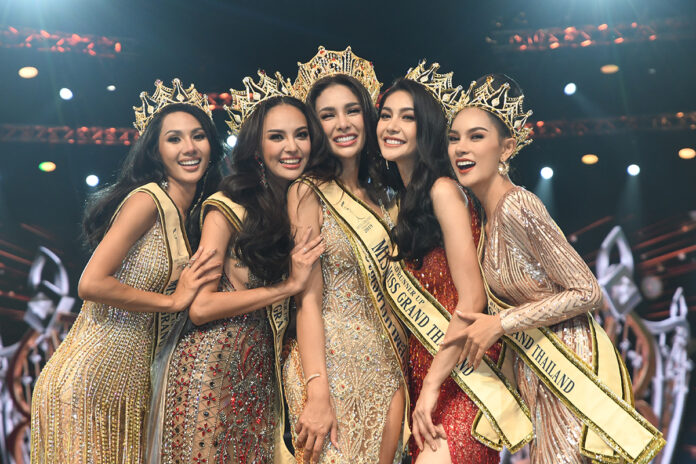
‘Wat Phra Kaew’ Wins Best Costume at Miss Grand Thailand

Miss Grand Bangkok, Nutsuda “Bambam” Termjai. Photo: Miss Grand Bangkok / Facebook

BANGKOK A dress modeled on the gilded, multi-tier roofs of the Temple of the Emerald Buddha, complete with two yak giants, won Best National Costume at this year’s Miss Grand Thailand.

Miss Grand Bangkok, Nutsuda “Bambam” Termjai, took home the 100,000 baht reward at the final round of Miss Grand Thailand on Saturday night for turning one of the capital city’s top tourist attractions into apparel.

Bambam, 20, a third-year student from Sripatum University, stood out among the 77 contestants, each representing Thailand’s provinces, when she literally wore Wat Phra Kaew during the “national costume” round of the pageant held Wednesday night. A golden crown completed her extravagant costume.

“I wanted to showcase the dress to foreign eyes, so I selected the Temple of the Emerald Buddha to represent the capital, which is already well-known to tourists,” designer Art Akarach said.

Bambam ultimately fell short of winning Miss Grand Thailand to Miss Nakhon Phanom, Arayha Suparurk, but the costume contest section of Miss Grand Thailand arguably generates as much interest as the beauty pageant itself.

Although the judges selected the winners, Bambam’s dress also won the hearts of fans, with more than 28,000 likes and 4,000 shares on Facebook. Likes and shares on the pageant’s Facebook page were used to determine ten of the 20 pageant finalists.

The Temple of the Emerald Buddha represents the importance of Buddhism as “the nation’s precious treasure” which “harmonizes each region’s customs into a single unity,” according to a description posted on the pageant’s Facebook page.

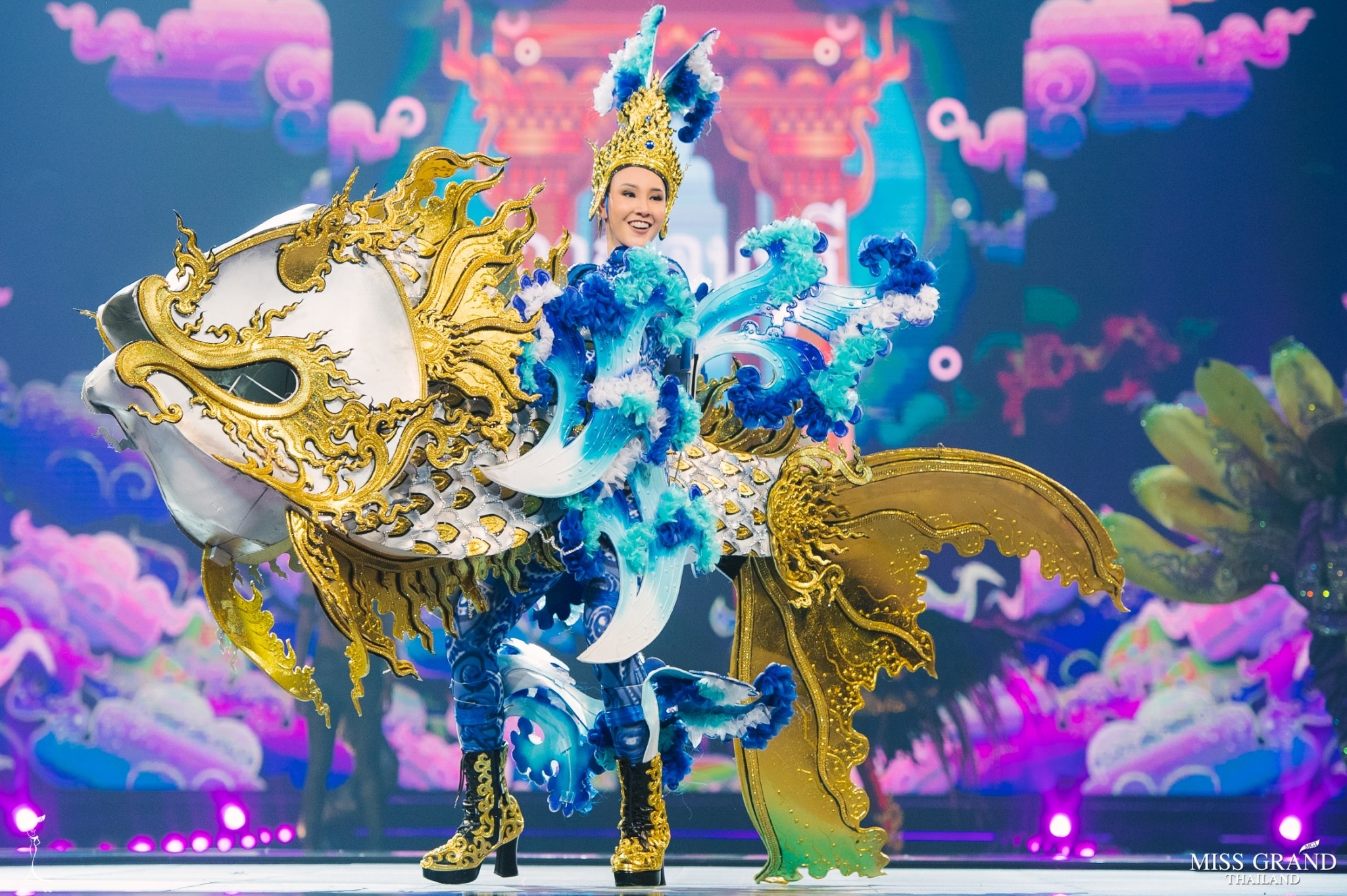
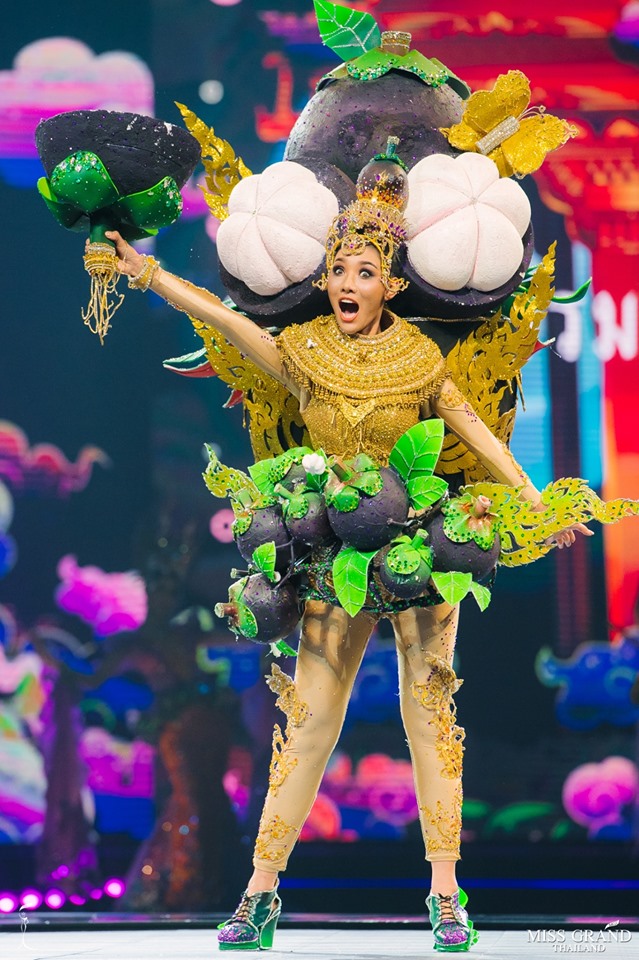
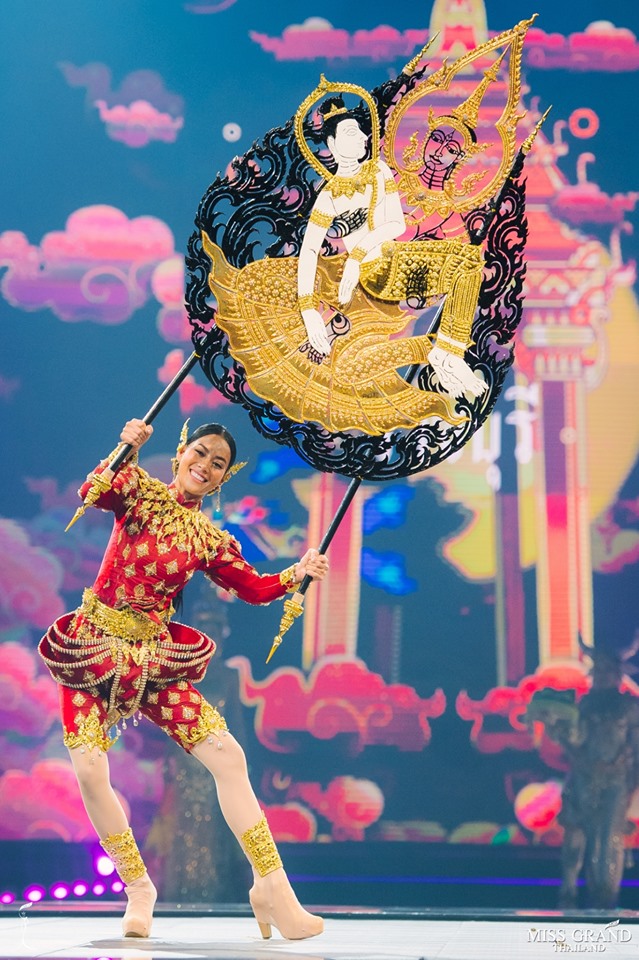
Runner-ups were Miss Grand Nakhon Ratchasima’s pad mee korat, Kanchanaburi’s carp, Nakhon Sri Thammarat’s “Mangosteen Mountain Queen”, and Ratchaburi’s nang yai shadow plays. The runner-ups were given 30,000 baht each.

Miss Grand Nakhon Ratchasima.
Miss Grand Kanchanaburi.
Miss Grand Nakhon Sri Thammarat.
Miss Grand Ratchaburi.

Related stories:

Miss Grand Thailand 2019 Ignites Netizen Rage for Calling Catriona Gray ‘Fat’

Wild Boars and Fried Noodles: This Year’s Miss Grand Thailand Costumes

Miss Grand Thailand Reaches Top 20

Phuket Wins Miss Grand Thailand 2018

Behind the Babes, Thai Pageant Fanatics Froth and Scream

‘Tom Yum’ Attire Wins Best Costume at Miss Grand Thailand Pageant

Local Pride, Outrageous Costumes Ride High at Miss Grand National (Photos)

Advertisement

Miss Grand Thailand 2019 Ignites Netizen Rage for Calling Catriona Gray ‘Fat’

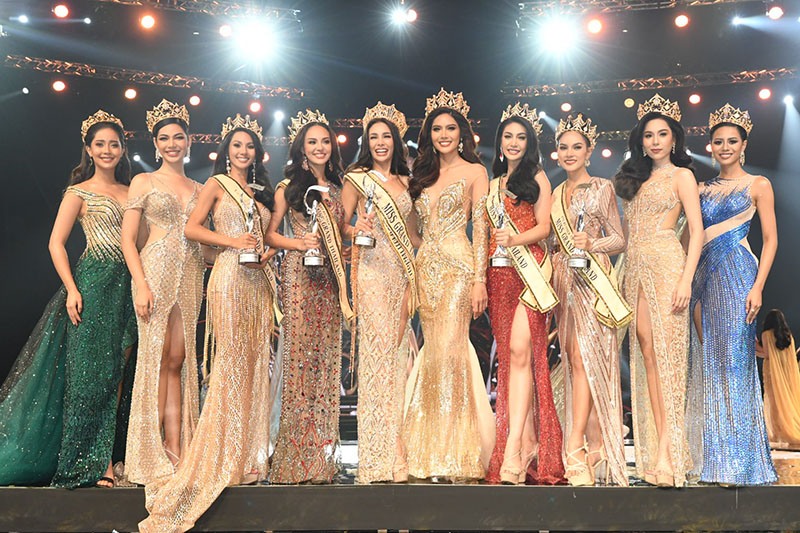
Miss Grand Thailand 2019, Arayha “Coco” Suparurk, center, wins the crown on July 13, 2019.

BANGKOK — What’s the worst thing a beauty queen can do for her popularity? Body shame a more popular beauty queen, of course.

Netizens both Thai and foreign are fuming at Miss Grand Thailand 2019 Arayha “Coco” Suparurk’s victory on Saturday night at BITEC convention center in Bang Na, due to a meme posted by Coco calling Miss Universe 2018 Catriona Gray “fat.”

“I just won the crown. Can’t you celebrate with me and be happy for me? I got the crown. Isn’t anyone happy for me at all?” Coco said to reporters who pressed her on the drama moments after she won. “If you had followed my journey since the beginning, you would see that the drama is another matter. My skills can’t be overlooked.”

Coco, representing Nakhon Phanom province, beat out 76 other contestants, each representing other Thai provinces. As soon as Coco was crowned over crowd favorite Miss Grand Nan Peerachada Khunnarak, the live feed on Facebook was overwhelmed with angry reactions and comments.66285122 1286017371601493 2427993773192511488 n

The source of wrath was a now-deleted meme showing Miss Grand 2018 Clara Sosa as “fit” compared to the “fat” Miss Universe 2018, Catriona Gray of the Philippines, which Coco shared in early July from the @MissGrandFamily Instagram.

Earlier in July, Coco defended herself from the accusations of body-shaming that had begun pouring in.

“I shared the photo of Clara because I’m jealous of her body and want it. I shared the truth and everyone hates me for it. Even when I upload a pretty picture of myself, there’s a thousand angry comments,” Coco said in a July 8 interview. “I shared the truth. I know she’s Miss Universe, but the picture just says it all.”

In a Twitter Q&A on Sunday, Gray condemned body shaming in what netizens saw as a shut down of Coco’s shade.

“Obviously I stand firmly against any form of bullying and bashing – online and off. It is never, ever okay to put someone down for the sake of ‘expressing your opinion,’” Gray wrote. “Bodyshaming is hurtful and should never be tolerated. If anyone reading this too has been bodyshamed, I know how it feels.”

But Nawat Itsaragrisil, the outspoken president of the Miss Grand organization, said that Coco’s crown was justified.

“Nan is talented, but she can’t compete with Latinas on the international stage in terms of height, curviness, and performance. That’s why Coco won,” Nawat said.

DSC 2719

During the pageant on Saturday, the final question referred to recent debates on the attire of female MPs: “As a woman in Thailand 4.0, do you think colorful dress in Parliament should be allowed, or should there be regulations?”

Read: Future Forward MPs Don Local Dress, Stir Debates

“Dressing up colorfully in Parliament is irrelevant to the meetings themselves. You just have to be appropriate. Dressing up colorfully makes others happy too,” Coco replied.

As Miss Grand Thailand 2019, Coco won 1 million baht, a crown, a car, an apartment condo, and a scholarship to Bangkok Thonburi University. Coco also won the Press Photographer’s Favorite award, as well as the Best Armpit award. In October, she will go on to compete in Miss Grand International 2019 in Caracas, Venezuela.

DSC 2819 DSC 3036 DSC 3190

Related stories:

Thai Woman Speaks Out on the Secret That Almost Killed Her

Wild Boars and Fried Noodles: This Year’s Miss Grand Thailand Costumes

Miss Grand Thailand Reaches Top 20

Phuket Wins Miss Grand Thailand 2018

Behind the Babes, Thai Pageant Fanatics Froth and Scream

‘Tom Yum’ Attire Wins Best Costume at Miss Grand Thailand Pageant

Local Pride, Outrageous Costumes Ride High at Miss Grand National (Photos)

Advertisement

New Travel Bookshop Brings the World to Bangkok’s Old Town

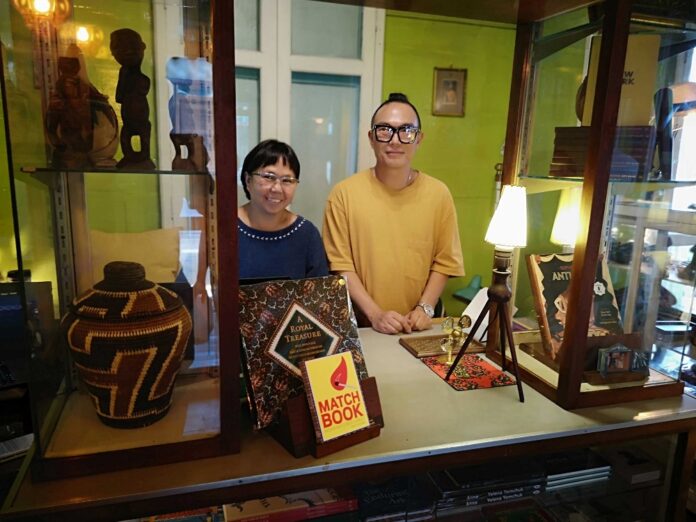
BANGKOK — The owner of a new travel bookshop in Old Town says he opened the store for himself, as much as to encourage other booklovers to explore the world.

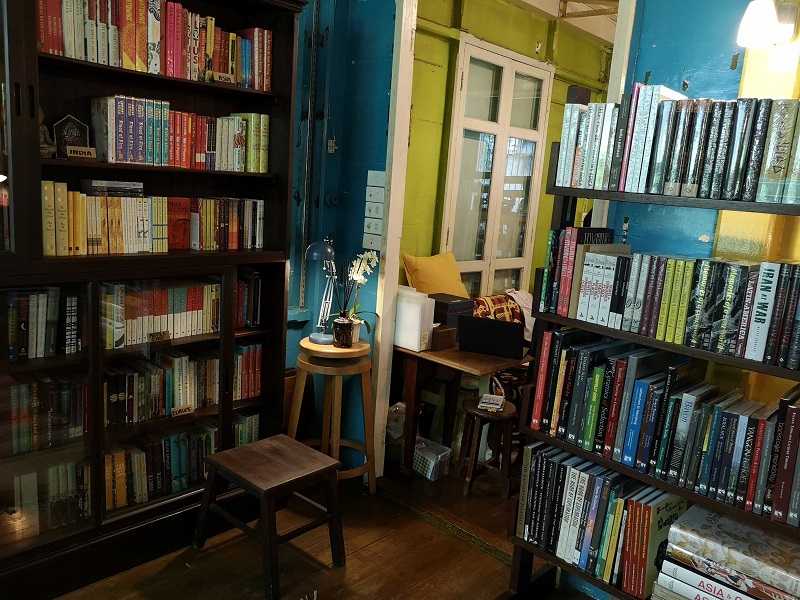
Nat Prakobsantisuk, 54, and his sister Sivika Prakobsantisuk, 57, recently opened “World At The Corner,” a English-language travel bookshop in a colorful, century-old wooden house just a five-minute walk from Democracy Monument.

“I want it to be a sanctuary when I am old,” said Nat, a bespectacled fashion-photographer and an avid traveler.

Equally, Nat hopes to tempt his customers into a thirst for traveling and discovering new things. Though it’s a small bookshop, readers can find travel books and fiction from every corner of the world.

66332992 2415462041845573 5194539881090514944 n

If you’re after non-fiction, Sivika recommends the “Atlas of Cursed Places: A Travel Guide to Dangerous and Frightful Destinations” by Olivier Le Carrer. The book paints dangerous destinations far and close to Bangkok, such as the Sunda Strait separating the islands of Java and Sumatra that is notorious for piracy.

“Staying at home doesn’t enable us to understand the world,” Nat enthused, adding that people gain respect for other cultures, people and religions while travelling.

Though English-language proficiency remains generally low in Thailand, Nat says there are already plenty of Thai-language bookstores. He hopes an English-language bookstore will encourage Thai readers to learn about the world through the eyes of people from other nations.

DSC 7380 1

“Seeing [the world] through the perspectives of people from other nationalities enables us to see a clearer picture,” said Nat, who has a habit of reading books about each country he visits. He and Sivika are considering Uzbekistan as the destination for their next trip.
Closer to home, the store sells books on Thailand from Bangkok-based River Books. There is a limited selection of English-language books for children.

As for opening a bookshop in an era where many books, newspapers and texts have migrated online, Nat says there’s still value in making time to savour books.

“The internet has its positive qualities, including speed. The drawback is it’s superficial and not detailed. Books require concentration and generate deep understanding,” said Nat.

World At The Corner Bookshop is located inside Soi Mahannop near Democracy Monument and the old City Hall. It’s open Friday to Sunday from 10am to 7pm and features a room for sitting and reading. The store can be reached at 089 699 7074.

This is the first of two stories on travel bookshops in Bangkok. Stay tuned for Passport Bookshop next week.

Related stories:

Journey’s End for Nancy Chandler’s Bangkok Maps

Advertisement

India Aborts Moon Mission Launch, Citing Technical Glitch

Indian Space Research Organization (ISRO)'s Geosynchronous Satellite launch Vehicle (GSLV) MkIII carrying Chandrayaan-2 stands at Satish Dhawan Space Center after the mission was aborted at Sriharikota in southern India, Monday, July 15, 2019. India has called off the launch of a moon mission to explore the lunar south pole. The Chandrayaan-2 mission was aborted less than an hour before takeoff on Monday. An Indian Space Research Organization spokesman says a
Indian Space Research Organization (ISRO)'s Geosynchronous Satellite launch Vehicle (GSLV) MkIII carrying Chandrayaan-2 stands at Satish Dhawan Space Center after the mission was aborted at Sriharikota in southern India, Monday, July 15, 2019. India has called off the launch of a moon mission to explore the lunar south pole. The Chandrayaan-2 mission was aborted less than an hour before takeoff on Monday. An Indian Space Research Organization spokesman says a "technical snag" was observed in the 640-ton launch-vehicle system. Photo: Manish Swarup / AP

SRIHARIKOTA — India aborted the launch on Monday of a spacecraft intended to land on the far side of the moon less than an hour before liftoff.

The Chandrayaan-2 mission was called off when a “technical snag” was observed in the 640-ton, 14-story rocket launcher, Indian Space Research Organization spokesman B.R. Guruprasad said.

The countdown abruptly stopped at T-56 minutes, 24 seconds, and Guruprasad said that the agency would announce a revised launch date soon.

Chandrayaan, the word for “moon craft” in Sanskrit, is designed for a soft landing on the lunar south pole and to send a rover to explore water deposits confirmed by a previous Indian space mission.

With nuclear-armed India poised to become the world’s fifth-largest economy, the ardently nationalist government of Prime Minister Narendra Modi is eager to show off the country’s prowess in security and technology. If India did manage the soft landing, it would be only the fourth to do so after the U.S., Russia and China.

Dr. K. Sivan, chairman of the Indian Space Research Organization, said at a news conference last week that the around $140-million Chandrayaan-2 mission was the nation’s most prestigious to date, in part because of the technical complexities of soft landing on the lunar surface — an event he described as “15 terrifying minutes.”

After countdown commenced on Sunday, Sivan visited two Hindu shrines to pray for the mission’s success.

Practically since its inception in 1962, India’s space program has been criticized as inappropriate for an overpopulated, developing nation.

But decades of space research have allowed India to develop satellite, communications and remote sensing technologies that are helping solve everyday problems at home, from forecasting fish migration to predicting storms and floods.

With the 50th anniversary of the Apollo 11 mission this month, the world’s biggest space agencies are returning their gaze to the moon, seen as ideal testing grounds for technologies required for deep space exploration, and, with the confirmed discovery of water, as a possible pit stop along the way.

“The moon is sort of our backyard for training to go to Mars,” said Adam Steltzner, NASA’s chief engineer responsible for its 2020 mission to Mars.

Because of repeated delays, India missed the chance to achieve the first soft landing near the lunar south pole. China’s Chang’e 4 mission landed a lander and rover there last January.

India’s Chandrayaan-1 mission orbited the moon in 2008 and helped confirm the presence of water. The Indian Space Research Organization wants its new mission’s rover to further probe the far side of the moon, where scientists believe a basin contains water-ice that could help humans do more than plant flags on future manned missions.

The U.S. is working to send a manned spacecraft to the moon’s south pole by 2024.

Modi has set a deadline of 2022 for India’s first manned spaceflight.

Story: Emily Schmall.

Advertisement

Hot News

LATEST NEWS

Bangkok
overcast clouds
35 ° C
35 °
32.7 °
68 %
4kmh
99 %
Mon
35 °
Tue
36 °
Wed
34 °
Thu
31 °
Fri
29 °