33.8 C
Bangkok
Saturday, July 18, 2026
Home Blog Page 1840

US Sanctions Singapore Companies Over N Korea Dealings

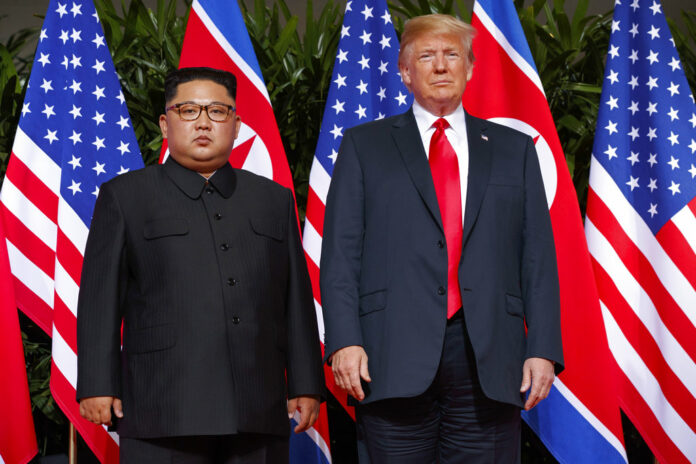
U.S. President Donald Trump meets with North Korean leader Kim Jong Un in June on Sentosa Island, in Singapore. Photo: Evan Vucci / Associated Press

WASHINGTON — The United States imposed sanctions Thursday on the Singapore-based director of a commodities company accused of laundering money for North Korea through the U.S. financial system.

The Department of Justice also unsealed criminal charges against the person, Tan Wee Beng, accusing him of “a multi-year scheme to violate and evade U.S. national security controls” against North Korea. Officials said he is also managing director of a marine fuels company involved in illicit economic activity with the North.

It’s the latest step by the U.S. to punish foreign companies and individuals said to have helped Pyongyang evade U.N.-mandated sanctions on its nuclear weapons program. The extra pressure comes even as President Donald Trump prepares for a second summit with North Korean leader Kim Jong Un to persuade him to disarm.

“Treasury will continue to enforce and implement sanctions until that time,” Treasury Secretary Steve Mnuchin said in a statement.

The blacklisting covers Tan himself and the two companies, Wee Tiong (S) Pte. Ltd., and WT Marine Pte. Ltd. The action blocks any assets they may have in the U.S. and generally prohibits Americans from dealing with them.

According to Treasury, Tan and at least one other individual in his company fulfilled millions of dollars in commodities contracts for North Korea dating back to 2011, and helped it avoid regulatory scrutiny. It says that at least once, when a wire payment was rejected, Tan orchestrated payment in cash, hand-delivered to a North Korean.

The indictment unsealed Thursday in the federal court of the Southern District of New York charges that Tan and at least two others used commodities businesses and front companies in Singapore, Thailand, Hong Kong and elsewhere to evade prohibitions on North Korea’s access to the U.S. financial system and dealings with entities already under sanctions. Tan is also charged with bank fraud, money laundering and conspiracy to defraud the United States.

At least one of Tan’s alleged accomplices, who were not named, is expected to be brought to and arrested in the South District, the indictment says. Tan remains at large.

Calls to the Singapore office of Wee Tiong (S) Pte. Ltd went unanswered late Thursday local time.

The company’s LinkedIn profile says the company was incorporated in 1993 and is a regional importer of rice, wheat flour and sugar and has built up household brands such as Golden Royal Jewel in Singapore. It says that in 2015, the company expanded into the oil and gas industry, incorporating a new marine fuels division and recently acquiring 17 oil tankers to augment its fleet.

Companies in the wealthy city state in Southeast Asia, where North Korea has an embassy, have been previously implicated in its efforts to circumvent sanctions on banking, imports of oil and petroleum products and other business dealings.

Singapore was the venue of Trump’s first, landmark meeting with Kim in June where the two leaders agreed on the vague goal of denuclearization. There’s been little progress since then. North Korea has continued its yearlong halt in weapon tests but wants the U.S. to ease sanctions in exchange for further steps on its nuclear and missile programs.

National security adviser John Bolton said this week that Trump looks forward to meeting Kim again, probably early next year.

Stephen Biegun, the U.S. special representative for North Korea, will travel to Seoul on Monday for talks with South Korean officials on the denuclearization efforts. State Department spokesman Robert Palladino told reporters that Biegun is not expected to meet North Korean officials on the trip.

Story: Matthew Pennington

Advertisement

Mass Rally to Promote Moderate Islam in Indonesia Canceled

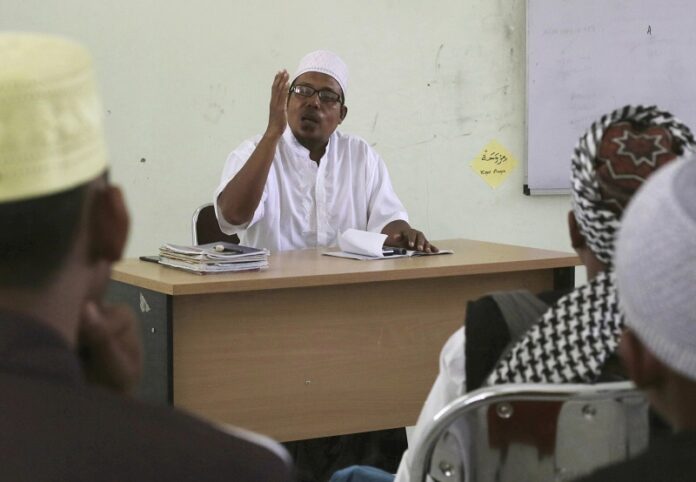
Former radical preacher Khairul Ghazali teaches at Al Hidayah Islamic Boarding School, a school set up for the sons of Islamic militants in 2017 in Sei Mencirim, North Sumatra, Indonesia. Photo: Binsar Bakkara / Associated Press

JAKARTA — Organizers of an Indonesian movement to promote a moderate brand of Islam have canceled a mass rally after its youth supporters burned the flag of an outlawed hard-line Muslim group, sparking allegations of blasphemy.

The rally in Yogyakarta, predicted to draw 100,000 people, was canceled to prevent violence, said Yahya Cholil Staquf, general secretary of Nahdlatul Ulama, Indonesia’s largest Muslim organization.

Video of members of Nahdlatul Ulama’s youth arm burning the flag of the outlawed group, Hizbut Tahrir, has stirred controversy in Indonesia because the flag is also emblazoned with the Islamic declaration of faith.

Staquf said Hizbut Tahrir “operatives” disrupted the youth wing’s celebrations and exploited religious symbols, which led to the flag burning incident. He said the campaign of “provocation and sabotage” was widely believed to be directed by political forces hoping to influence the outcome of Indonesia’s presidential election in April.

Some 70,000 members of Ansor, Nahdlatul Ulama’s youth arm, had been on their way to Yogyakarta for the rally to coincide with the launch of an inter-faith movement that aims to counter extremism globally.

“Further incidents of provocation were planned. Our members would find it difficult to control their anger in the face of such flagrant exploitation of our religious symbols,” said Staquf.

The image of Indonesia, the world’s most populous Muslim nation, as being religiously moderate was undermined last year when the minority Christian governor of the capital, Jakarta, was imprisoned for blasphemy following street protests against him that drew hundreds of thousands.

Hizbut Tahrir, which seeks a global caliphate, was banned by the Indonesian government last year.

Advertisement

Philippine Island Once Called ‘Cesspool’ Reopens to Visitors

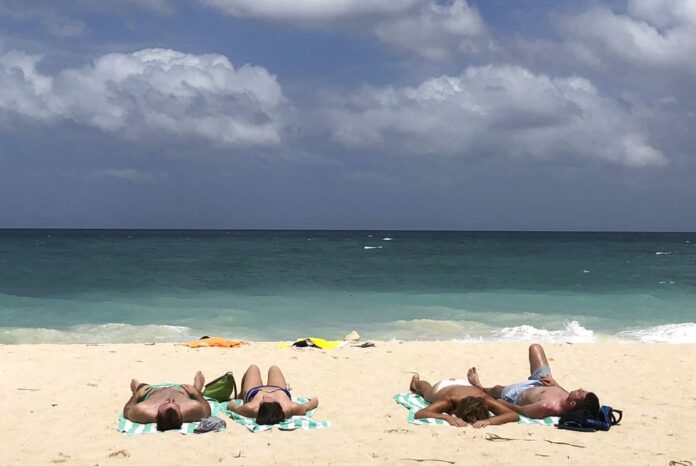
Tourists sunbathe at a beach on Boracay island in April in central Aklan province, Philippines. Photo: Aaron Favila / Associated Press

BORACAY, Philippines — Boatloads of tourists sailed to tiny Boracay island Friday on the first day Philippine officials reopened the resort to visitors after a six-month closure to clean waters the president had called a “cesspool” due to overcrowding, partying and neglect.

Officials at the island in central Aklan province have imposed new rules to regulate the influx of visitors and beach parties, decongest resorts and prevent sewage from being discharged directly into the turquoise waters. Only a portion of Boracay’s hotels and other businesses have reopened under the new rules, and a fraction of the more than 20,000 workers who lost their jobs were rehired.

“Let us treat the island as our home. Keep it clean and pristine. Don’t drink alcohol or smoke in the beach, don’t litter,” Tourism Secretary Berna Romulo-Puyat said in a message to incoming tourists.

A ceremony attended by Cabinet officials and local celebrities to mark Boracay’s return to business was planned on a white-sand beach near the wharf where ferries unloaded tourists.

Visitors will be kept to about 6,000 daily and they’ll be asked to sign an oath to follow the new rules, including proper waste disposal and a ban on bonfires.

Only 157 of Boracay’s hundreds of hotels, inns, restaurants and souvenir shops have reopened after complying with regulations, including connecting to authorized sewer pipes and maintaining a 30-meter distance from the beach waters.

Gil delos Santos, whose family owns a 10-room inn called Roy’s Rendezvous, a travel agency and passenger ferries, welcomed Boracay’s reopening. The family businesses employ five people.

“The weather is good and the water is so clear. This is the best way to welcome a better Boracay,” said delos Santos, 42. “It’s like Boracay got a reboot.”

President Rodrigo Duterte in February had ordered Boracay shut for rehabilitation and said the waste being discharged into the sea had made Boracay’s waters a “cesspool.”

During the rehabilitation, authorities discovered a hidden sewage pipe discharging waste directly to the coastal waters and two hotels built on restricted wetlands. Some resorts were demolished because they had strayed into a no-build area fronting the sea — one of many violations that have been unchecked for years in the country’s top tourist draw.

The mayor and several other officials in charge of Boracay faced complaints for neglect of duty over Boracay’s deterioration.

Six months were too short for Boracay’s complete overhaul, said Eduardo Ano, who heads the Department of the Interior and Local Government. Workers were continuing to widen concrete roads and build tourist infrastructures as the holiday island reopened, whipping up dust in the island’s inland community.

More than 2 million tourists visited Boracay last year to enjoy its powdery white-sand beaches, spectacular sunsets and festive nightlife, generating about 56 billion pesos ($1.3 billion) in revenue. But the influx and neglect have threatened to turn Boracay into a “dead island” in less than a decade, according to a government study.

Other Philippine beach resorts and tourist destinations believed to have breached environmental and safety regulations for years have also been warned of possible closures. In a similar move, Thailand closed the bay made famous by the Leonardo DiCaprio movie, “The Beach,” to allow it to recover from environmental damage caused by a deluge of tourists.

Advertisement

South Korean War on ‘Fake News’ Raises Concern of Censorship

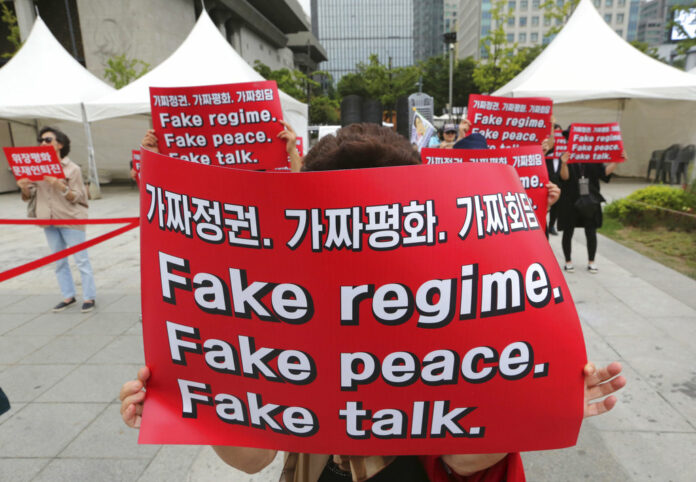
South Korean protesters hold banners during a September rally against the summit between South Korean President Moon Jae-in and North Korean leader Kim Jong Un near the U.S. embassy in Seoul, South Korea. Photo: Ahn Young-joon / Associated Press

SEOUL, South Korea — While governments around the world ponder how to deal with the explosion of “fake news,” South Korea has come out swinging, vowing to use its criminal laws to curb what officials have declared a threat to democracy.

The plans have drawn an outcry from civil liberty advocates, who see it as an attack on free expression. They question whether liberal President Moon Jae-in, who was elected last year following a popular uprising that helped bring down a corrupt government, is pivoting toward a path taken by his disgraced conservative predecessors who used their powers and a criminal charge of defamation to suppress critics.

Some experts say Moon’s government is becoming increasingly sensitive about public opinion as it struggles with economic and social policies and desperately tries to keep optimism alive for its fragile diplomacy with North Korea.

Seoul’s Unification Minister Cho Myoung-gyon met with North Korea defector groups on Wednesday as he sought to calm criticism over his decision to block a North Korea-born reporter from covering last week’s inter-Korean talks to avoid angering North Korean officials.

Presidential spokesman Kim Eui-kyeom has snapped at conservative newspapers in recent briefings for supposedly exaggerating the rift between Washington and Seoul over North Korea policies.

The controversy erupted after Justice Minister Park Sang-ki last week ordered state prosecutors to aggressively chase down people spreading “false, manipulated information.” He said prosecutors should be proactive in detecting fake stories and misinformation and, when needed, push ahead with criminal investigations even when no one files a complaint.

They can apply various laws, such as defamation that carries a penalty of up to seven years in prison. The Justice Ministry also plans to revise laws to make it easier to removing suspect online content.

The National Police Agency said it is currently looking into 16 false stories that made rounds online. They include claims that Moon is showing signs of dementia; Prime Minister Lee Nak-yon paid tribute to North Korea founder Kim Il Sung during a recent visit to Vietnam; North Korea has demanded cash payment of 200 trillion won (USD$176 billion) from the South as costs for engagement.

A frequent target is YouTube, which is overflowing with video channels run by right-wing conservatives who often make bizarre claims against a president they characterize as a North Korea sympathizer.

Park Kwang-on, a lawmaker from Moon’s Democratic Party, lashed out at Google on Tuesday after it refused the party’s demand to remove some 100 videos, including those describing rumors about Moon, from YouTube. Conservatives say the ruling party is pressuring a private company for political purposes.


Old Habits

Under Moon’s predecessor, Park Geun-hye, prosecutors indicted a Japanese journalist on charges of defaming Park by citing salacious rumors about her whereabouts on the day of a ferry sinking that killed more than 300 people in 2014. Park’s aides also in 2014 filed a defamation complaint against six reporters from Segye Ilbo after the newspaper reported on a leaked presidential document to allege Park was allowing a private confidante to influence state affairs.

Before Park, President Lee Myung-bak was accused of turning major TV networks into his mouthpieces by filling their corporate leadership with close supporters. They meddled in reporting and shut down investigative news programs critical of Lee’s policies, triggering massive strikes and layoffs as journalists protested. Lee also took steps to strengthen online monitoring and limit the anonymity of people posting comments. Prosecutors arrested an anti-government blogger in 2009 on charges of spreading online rumors that disrupted the country’s economy. The blogger was later acquitted in court.

Park and Lee are now serving lengthy prison terms over separate corruption scandals.

Moon’s government has not attempted to influence the traditional media in the ways Park and Lee did. But critics say attempts to impose more rules on internet users could create a chilling effect among people and reporters criticizing and scrutinizing the government.

“We had clearly witnessed the maneuvers by the Lee Myung-bak and Park Geun-hye governments to destroy the media,” the National Union of Media Workers said in a statement last week. “It’s not appropriate for the government to intervene and define what fake news is. This will almost certainly create suspicions that decisions will be based on the government’s taste.”

Freedom of speech and media freedoms are sensitive issues in South Korea, which from the 1960s to ’80s was ruled by military dictatorships that heavily censored news reports and persecuted and even executed journalists and dissidents.

The recurring debates on the boundaries of government regulation and free speech also reflect how deeply South Korea is divided along ideological lines. The arguments have mostly revolved around partisan political issues, while the country has yet to take any meaningful step to curb hate and discrimination speech against women and minorities overflowing online.

“Supporters of each side sincerely see themselves as defenders of the good against the evil, and are willing to do pretty much everything to ensure that the forces of the ‘light and virtue,’ that is, their side, will triumph,” said Andrei Lankov, a professor at Seoul’s Kookmin University.


Slippery Slope

Government officials say false stories and negative rumors have become a more serious problem than before because their influence is amplified by smartphones and chat apps.

The Justice Ministry said the crackdown targets only stories that cause “social distrust” and hurt “democratic discourse” by “intentionally manipulating objective facts,” and doesn’t aim against “expression of different opinions, false reports caused by mistakes, suspicions based on logic.”

Legal experts say there can be no fully objective way for a government to distinguish what’s maliciously false and what’s simply inaccurate.

It isn’t always easy to parse what’s true and untrue either.

For years, Park bristled at bizarre rumors that she was allowing relatives of a late cult leader to manipulate her government from the shadows, describing them as flat-out lies. Journalists eventually proved the suspicions as true, sparking massive protests that led to Park’s demise and new elections.

Lee Kang-hyeok from the Seoul-based Lawyers for a Democratic Society said the plans to strengthen government power to delete online content and bring internet users in line with traditional reporters in terms of accountability were particularly concerning.

Lee said the country’s free speech is already held back by the defamation law, with charges being threatened or brought against reporters and government critics. It’s also relatively easy to remove online articles, due to a law that requires websites to suspend the publishing of content deemed as false or slanderous for a month before arbitrators rule on the complaints.


Sensitivity Over North Korea

Lankov said Moon’s government could end up in a bitter fight with critics and conservative media if the public support of his North Korea diplomacy wanes.

Moon has garnered robust backing for his outreach to North Korea, which has resulted in three summits this year with North Korean leader Kim Jong Un. Moon also helped set up a meeting between Kim and President Donald Trump.

But Pyongyang has been playing hard ball since, insisting that sanctions should be lifted before any progress in nuclear talks, fueling doubts on whether Kim will every fully relinquish his arsenal. South Korea’s enthusiasm for engagement has also created discomfort with the United States, which has called for allies to maintain pressure until the North denuclearizes.

“The Moon government has good reasons to believe (that) if it fails to create and maintain an impression of progress toward denuclearization, the U.S. hawks might use force, and this will lead to a disaster,” said Lankov, who said Moon’s policy is “rational and responsible” despite being possibly “dishonest” about North Korean intent.

“They are annoyed about people who tell the sad truth, since the excessive honesty might provoke a disaster,” he said.

Story: Kim Tong-hyung

Advertisement

Life Sentences For 7 Men Who Gang-Raped Teen in Phang Nga

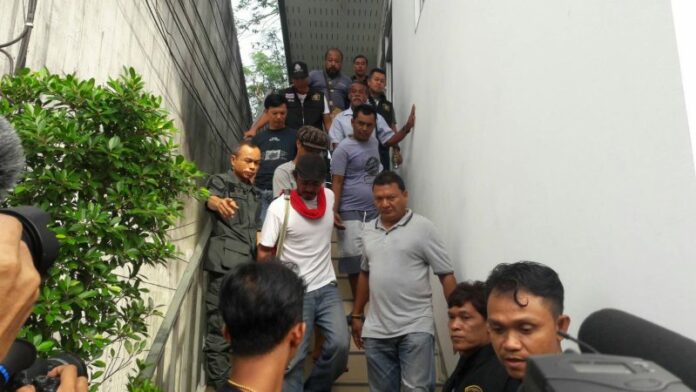
Five suspects in the rape case of a 14-year-old are led out of Khokkhoi Police Station in September 2017.

PHANG GNA — A court convicted 11 men and sentenced them to lengthy jail terms Thursday for raping a 14-year-old girl in Phang Nga province last year.

The Phang Nga provincial court said all defendants were guilty of multiple counts related to the attack on the underage girl. It said they gang-raped the victim in her home on Koh Raet 16 times between May 2016 and February 2017.

Worachit Kongbut, Chatchai Srirat, Boonpoj Nonsee, Chalerm Samin, Sucheep Sumen, Thawatchai Thaogu and Nuttawut Butnoi were sentenced to life in prison.

Worachit was accused of being the first to assault the girl before forcing her out to the beach to be raped by other men. He also filmed and took photos of the assaults to blackmail her. He and Boonpoj were accused of forcing the girl to take drugs before the men assaulted her.

Keerati Sumen was sentenced to 45 years in jail. Rangsan Chailiang got 20 years and 4 months. Sayan Sumen and Nawik Jareuk got 15 years each. All were also ordered to pay the girl and her mother 18 million baht in damages.

News about the assault broke after the mother filed charges with police last year, accusing up to 40 men in her community to have repeatedly assaulted her daughter, who was often left home alone at night while her parents went out to harvest rubber.

Community elders and relatives of the men denounced the family as liars and accused them of tainting their reputations. A protest was also held when some men were arrested.

Rochitdee Raimancha of the Muslims for Peace Foundation, which has represented the victim, said he was pleased with the ruling, and said the foundation will continue to help the girl and her mother, who have relocated to Bangkok.

An attorney for the accused, Sanphetch Thipmonthien, said they would file an appeal since he believes some of those convicted are innocent.

Related stories:

Police Arrest All 11 Suspects in Phang Nga Gang Rape Case

5 Men Held in Phang Nga Gang Rape Case

Police Seek 11 of 40 Men Accused of Raping Phang Nga Girl

Advertisement

Police Arrest Suspect of Hit-and-Run that Killed Filipino

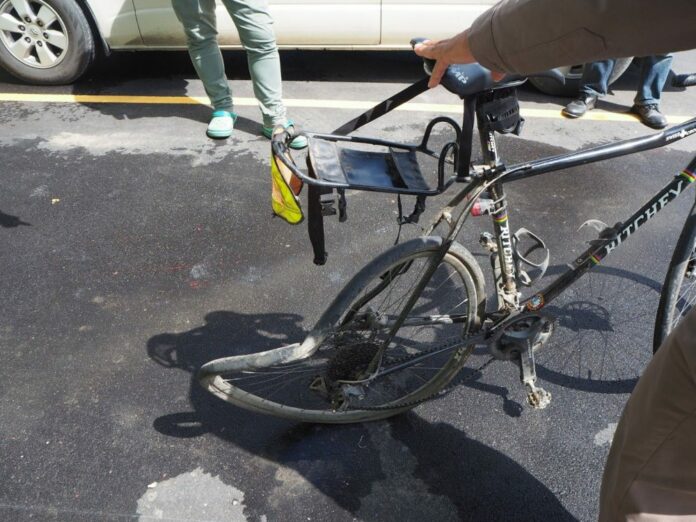
A bicycle that belonged to Filipino cyclist Russel Perez who died from hit-and-run crash in Chachoengsao.

CHACHOENGSAO — A driver accused of fatally hitting a Filipino cyclist with his van was arrested Thursday afternoon in eastern Thailand.

Police arrested Chutipan Buddawieng in Sa Kaeo province. The 29-year-old van driver allegedly ran a red light early Tuesday morning in Chacheongsao province, hitting cyclist Russel Perez before fleeing the scene.

Police were questioning Chutipan on Friday, according to Col. Nipon Klaisingh, chief of Sanphudat Police in Chachoengsao province.

The 55-year-old victim from Manila and several other cyclists were attending 1,000 BRM, a long-distance cycling rally. The event started Saturday, when cyclists left Bangkok’s Suvarnabhumi Airport bound for Trat province.

Perez died on the way to hospital.

Chutipan’s van was later found at an auto repair shop in Bangkok’s Min Buri district. He reportedly arrived at the shop at 8am on Wednesday, telling the shop owner his van had hit an ox. Police collected DNA and fingerprints from the vehicle before obtaining an arrest warrant on the same day.

Advertisement

Miss Grand Thailand Reaches Top 20

Photo: Miss Grand Thailand / Facebook

YANGON — Thailand’s representative to the Miss Grand International pageant was among 20 contestants in the contest’s final round Thursday night.

Miss Grand Thailand Nam-oi “Moss” Chanapan was one of 20 finalists from the original pool of 75 contestants vying for the title, and she left the The One Entertainment Park on Thursday night in Myanmar with Best in Evening Gown award.

“I’m surprised she didn’t make it to the top five, even though she’s totally qualified,” user Chutithep Pop Chotikachattham commented on the Miss Grand Thailand Facebook page. “But good job, Moss!”

Screen Shot 2018 10 26 at 12.14.14 PM e1540530905860

The winner was Miss Grand Paraguay, Clara Sosa, who had to be helped from the stage after fainting when the results were announced. Sosa, 25, was crowned by Miss Grand International 2017, Maria Jose Lora of Peru. Second place went to Meenakshi Chaudhary of India, who tried and failed to catch Sosa as she fell.

In July, Moss won Miss Grand Thailand while representing Phuket, although she is originally from Chaiyaphum. A crowd favorite, she was praised by fans for her humble background.

Our interview with Clara Sosa:

Our interview with Moss:

Related stories:

Phuket Wins Miss Grand Thailand 2018

Behind the Babes, Thai Pageant Fanatics Froth and Scream

‘Tom Yum’ Attire Wins Best Costume at Miss Grand Thailand Pageant

Local Pride, Outrageous Costumes Ride High at Miss Grand National (Photos)

Advertisement

Court Keeps Indonesia Woman Irked by Noisy Mosque in Prison

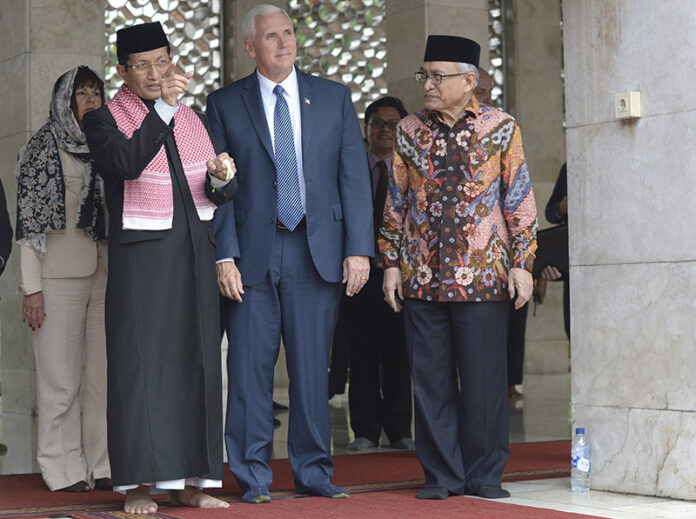
U.S. Vice President Mike Pence, center, is given a tour by the Grand Imam of Istiqlal Mosque Nasaruddin Umar, left, and the Chairman of the mosque Muhammad Muzammil Basyuni, right, during his 2017 visit to the largest mosque in Southeast Asia, in Jakarta. Photo: Adek Berry / Pool / Associated Press

MEDAN, Indonesia — A High Court on Thursday upheld an 18-month prison sentence for a woman convicted of blasphemy in Indonesia after complaining about the volume of a mosque’s loudspeakers.

The woman’s lawyer, Ranto Sibarani, told The Associated Press that the decision would be appealed to the Supreme Court.

The ethnic Chinese woman, Meiliana, was sentenced in August, more than two years after her comments sparked rioting in her hometown Tanjung Balai on the island of Sumatra.
In a conversation with the daughter of the caretaker of her neighborhood mosque, Meiliana had commented that the five-times-daily call to prayer was too loud. Rumors spread that she wanted to stop the call to prayer and days later, mobs attacked her home and burned and ransacked at least 14 Buddhist temples.

Indonesia’s largest Muslim organizations have said her complaint wasn’t blasphemy and have criticized her imprisonment but a conservative group, Islamic Community Forum, said Meilana’s sentence was too light.

The case has highlighted how Indonesia’s blasphemy law has become a tool for Islamic hard-liners to persecute followers of minority religions in the world’s most populous Muslim nation.

Meiliana, who uses a single name, wasn’t in court for Thursday’s decision.

Her supporters say she is kept in a 30-square-meter (323-square-foot) cell with more than a dozen other women. Her husband and two sons feared for their safety and moved from Tanjung Balai to Medan, the capital of North Sumatra province.
Advertisement

Police to Summon Rappers Who Criticized Military Govt

Image: Rap Against Dictatorship / YouTube

BANGKOK — A group of rappers that released a song lambasting the junta earlier this week may have broken the law, a deputy police chief said Friday.
Deputy police chief Pol. Gen Srivara Ransibrahmanakul said there’s a “50 percent chance” the song “My Country’s Got” (“Prathet Ku Mee“) by Rappers Against Dictatorship may have violated a junta order. Srivara did not elaborate on what order the song could have breached. In the 5-minute piece, the group of 10 take turns mocking and criticizing the junta’s rule.

Read: With ‘My Country’s Got,’ Thai Rap Voices Rare Dissent Against Junta

“Let me warn musicians to not do anything risky against the laws because it won’t be good for you and your family if it’s found that there was wrongdoing,” Srivara said.

He added that police would summon the rappers and that they were investigating the matter. Some junta critics have been charged with sedition since the May 2014 coup. The YouTube music video had been watched more than 840,000 times by Friday morning.

Rapper and co-producer Pratchayaa Surakamchonrot said Tuesday that he doesn’t believe the song violates the law. He said however that four of 10 rappers chose to remain anonymous for fear of facing a backlash from the junta.

Pratchayaa said Friday morning that he and his collaborators would not report to police until formally summoned.

The developments came two days after Foreign Minister Don Pramudwinai told reporters other countries are amazed that the current administration is run by “a coup government but gives [citizens] full freedom.”

Advertisement

Brain-Damaged Kid Muay Thai Fighters Prompt Call For Ban

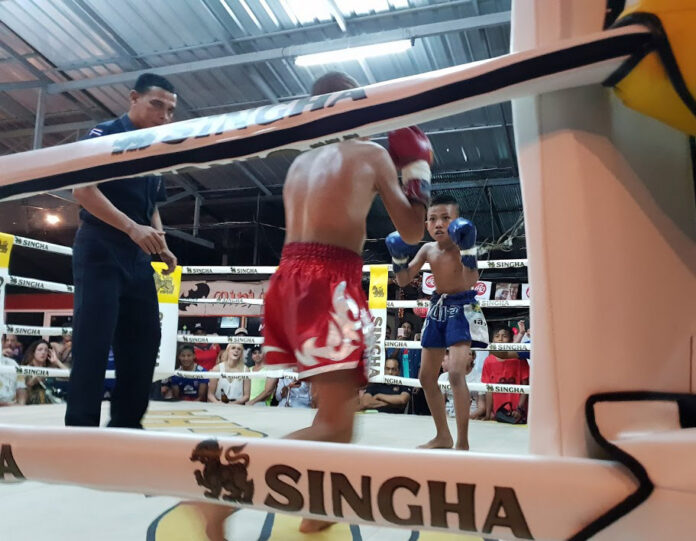
Young Muay Thai boxers fight for a crowd of tourists in April near Railay Beach in Krabi province.

BANGKOK — Muay Thai may be the pride of the kingdom, but new research says letting children fight in the ring can irreparably damage their minds.

Citing a new study by Mahidol University, medical advocates held a Thursday news conference in Bangkok to call for the boxing of minors under 15 to be regulated to prevent permanent brain damage.

A five-year neuropsychological study led by medical professor Jiraporn Laothamatas revealed that kid fighters suffer undetected brain damage which results in lower IQ results, reduced emotional self-restraint and a heightened the risk of Parkinson’s disease.

“The longer they fight, the lower their IQ and intelligence becomes. That’s their future,” Jiraporn said at the conference held at Ramathibodi Hospital. She added that children under 15 are more prone to experiencing brain damage than adults when hit in the head.

She said that while the precise number of boxers in the country under 15 is unavailable, estimates run from 100,000 to 300,000 minors – about 1 percent to 4 percent of the age group.

The group is lobbying the junta-appointed National Legislative Assembly to amend the 1999 Thai Boxing Act to regulate child boxing.

The group also called on the government to ban children under 13 from boxing. It also demanded those 12 to 15 obtain permission from provincial sports authorities before being allowed in the ring.

The five-year study compared 335 child boxers under 15 to 252 children of the same age and socio-economic backgrounds who had not boxed.

The results found that child boxers scored an average of 10 fewer points on IQ tests. Brain scans showed damage to their hippocampi and temporal lobes, iron accumulation in their brains that could affect vision and micro-hemorrhaging.

Jiraporn compared the injuries to people suffering concussions, brain inflammation and damage to the brain’s connective tissues caused by auto accidents.

“If, in the future, they become leaders, they will be less intelligent than children who don’t box,” Jiraporn said.

However, the group does not seek to outright ban child boxing, saying it wants to compromise with the traditional sport and societal expectations.

Jiraporn said boxing camps for young children are very common throughout rural Thailand and that the group has already been heavily criticized on social media.

Parliament will review the draft amendment.

A lot is riding on not just the popularity of the sport but its economic incentives, the director of the National Institute for Child and Family Development at Mahidol University said, as young boxers can win prizes worth several thousand baht.

Adisak Plitpornkarmpim added that the Labor Ministry does not consider it child labor and that schools promote boxing bouts for children. He said parents in poor families send their boys – as young as 5 or 6 – to fight for prizes.

“No age is safe for boxing, but we seek to ensure a balance between safety and the right to decide [to box]. Children under 12 should be banned from competitive bouts,” Adisak said, adding that only a few such child boxers end up as Muay Thai professionals, while the rest have to return to society with lower IQs, making their future livelihood more challenging.

Advertisement

Hot News

LATEST NEWS

Bangkok
overcast clouds
33.8 ° C
35.5 °
33.8 °
59 %
3.3kmh
97 %
Sat
34 °
Sun
37 °
Mon
36 °
Tue
32 °
Wed
35 °