Charoen Sirivadhanabhakdi in an undated file photo. Photo: Prachachat
BANGKOK — His wealth swollen to USD$17.9 billion, alcohol and real estate mogul Charoen Sirivadhanabhakdi is now the 65th wealthiest person in the world, according to Forbes’ latest ranking released Wednesday.
The ThaiBev and TCC Group founder was the top Thai to appear in the list, followed by Charoen Pokphand Group’s Dhanin Chearavanont, who came in at 95 on the list which saw its highest number of billionaires ever – 2,208.
The fortunes of both men and their families leapfrog each other from year to year: The Chearavanonts were named Thailand’s wealthiest last year with a combined wealth of $21.5 billion. Forbes’ lists Dhanin’s individual wealth this year as $14.9 billion.
Charoen’s beverage juggernaut has made acquisitions in other ASEAN nations and his TCC Group is breaking ground on the $3.5 billion “One Bangkok” project next to Lumpini Park, saw his fortune grow by $2.5 billion over last year.
The latest ranking counted 30 Thai billionaires, with 10 new faces over last year. Bangkok Airways and hospital tycoon Prasert Prasarttong-Osoth, 84, was ranked at No. 791 and is worth $3 billion. The list does not include Thailand’s royal family.
Image: Forbes
Prasert’s Bangkok Dusit Medical Services, which operates the largest chain of private hospitals, is constructing a luxury healthcare complex that includes a five-star hotel at the site of the former Swissotel Nai Lert Park.
Ousted and fugitive former premier Thaksin Shinawatra, 68, was ranked No. 1,339 in the world and 16th richest Thai with $1.8 billion, an improvement over last year by $100 million.
The wealthiest person on the planet is Jeff Bezos of Amazon.com, who is classified as the first centi-billionaire with $112 billion. His e-commerce shares rose 59 percent over the past 12 months. He’s followed by Bill Gates ($90 billion) and Warren Buffet ($84 billion).
US President Donald Trump’s fortunes fell 400 million from last year’s list. He’s ranked at No. 776 and is worth $3.1 billion.
Chinese President Xi Jinping, left, and Hong Kong's new Chief Executive Carrie Lam leave after administered the oath for a five-year term in office at the Hong Kong Convention and Exhibition Center in 2017. Photo: Kin Cheung/ AP.
BEIJING — Students at China’s prestigious Tsinghua University are celebrating International Women’s Day with banners making light of a proposed constitutional amendment to scrap term limits for the country’s president.
One banner joked that a boyfriend’s term should also have no limits, while another said, “A country cannot exist without a constitution, as we cannot exist without you!”
Photos of the banners were shared on Chinese social media Wednesday night before they were scrubbed by censors. Several online commenters also said the posters appeared to have been swiftly removed.
China’s ceremonial legislature is poised to pass a constitutional amendment that will allow President Xi Jinping to rule indefinitely during its ongoing annual session.
Despite heavy censorship, the move has been criticized by liberal intellectuals as a return to dictatorship and satirized online.
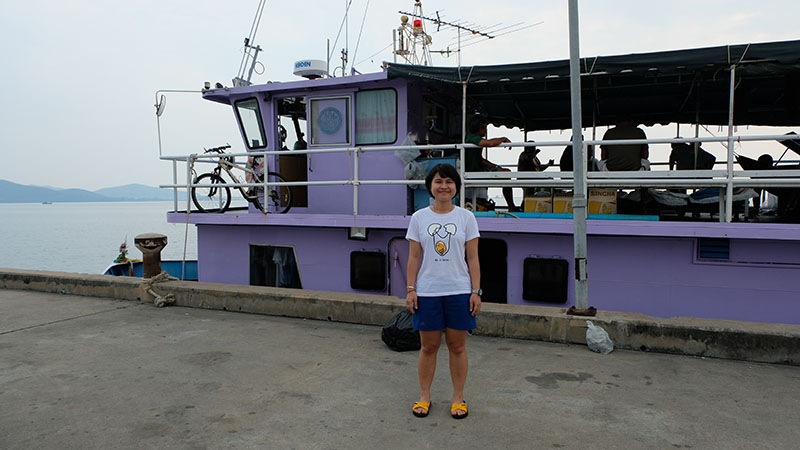
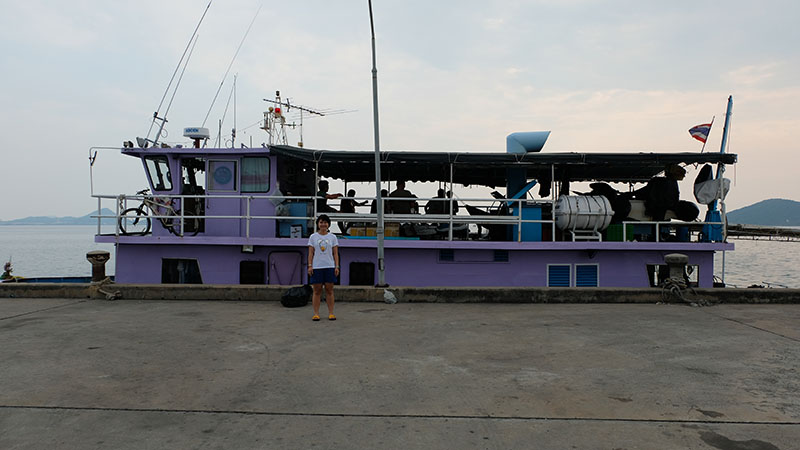
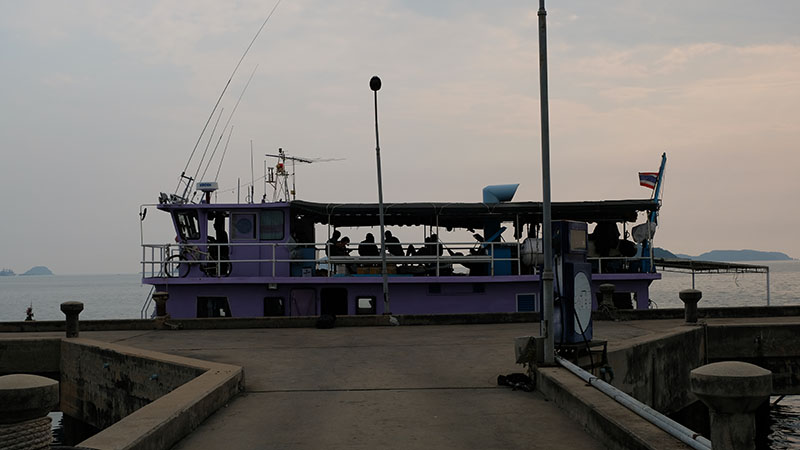
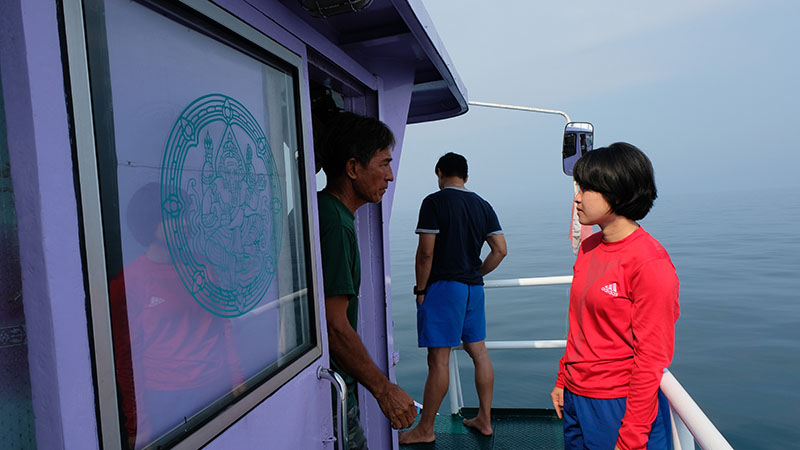
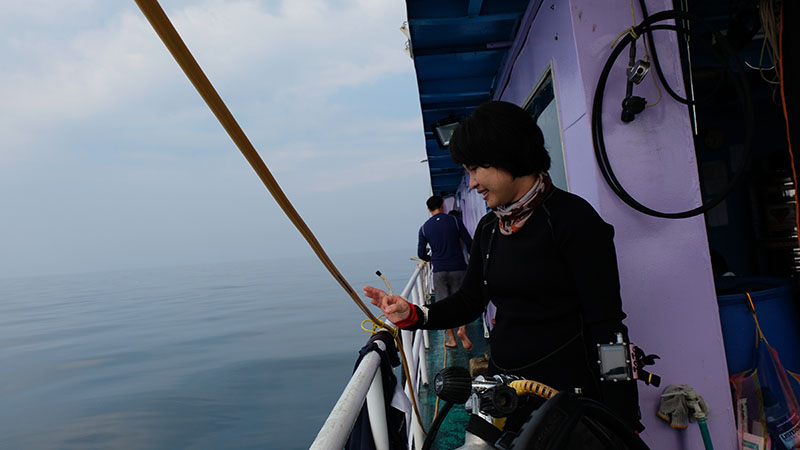
A lavender-colored boat bobs off the Chonburi coast, flat ocean all around.
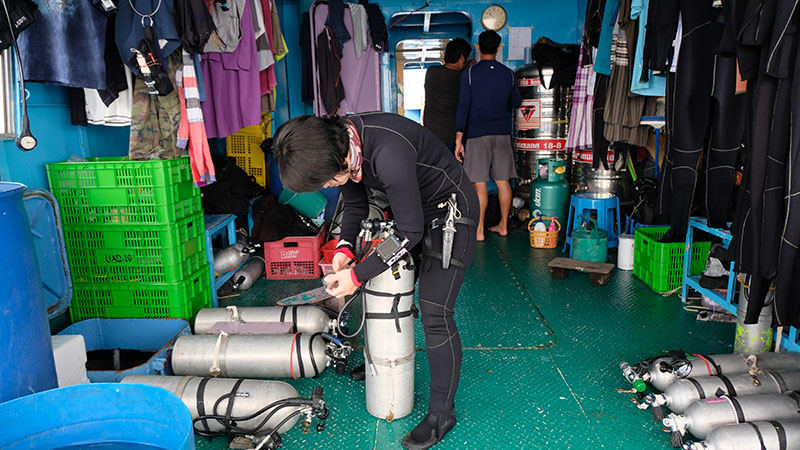
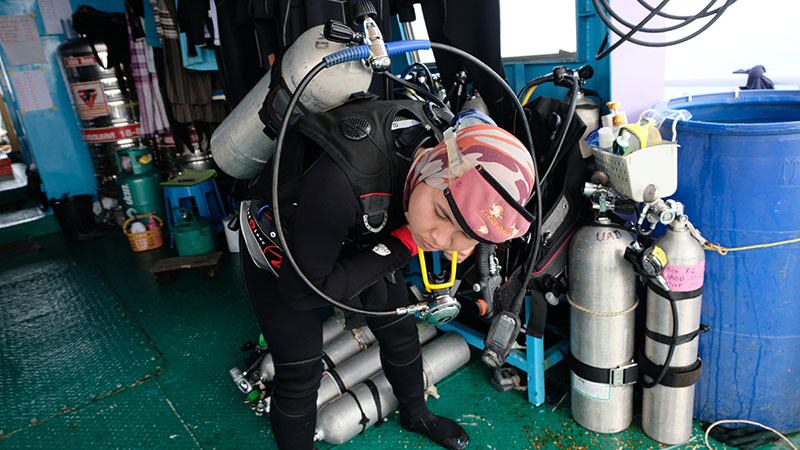
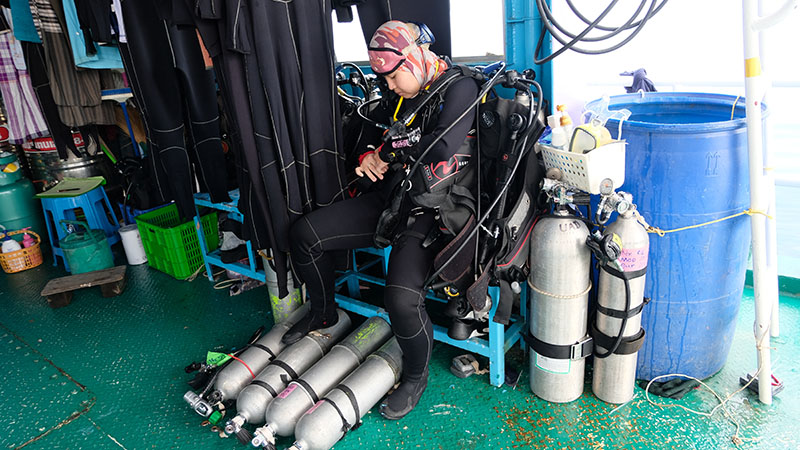
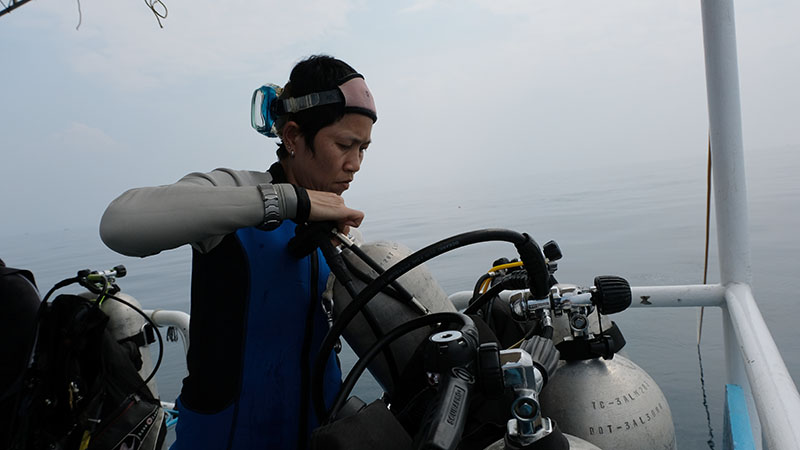
Feet steady on the dock, Jo adjusts the knobs on her oxygen tanks and reads out the numbers. She then straps a heavy tank to each hip and a third to her back with nary a grunt.
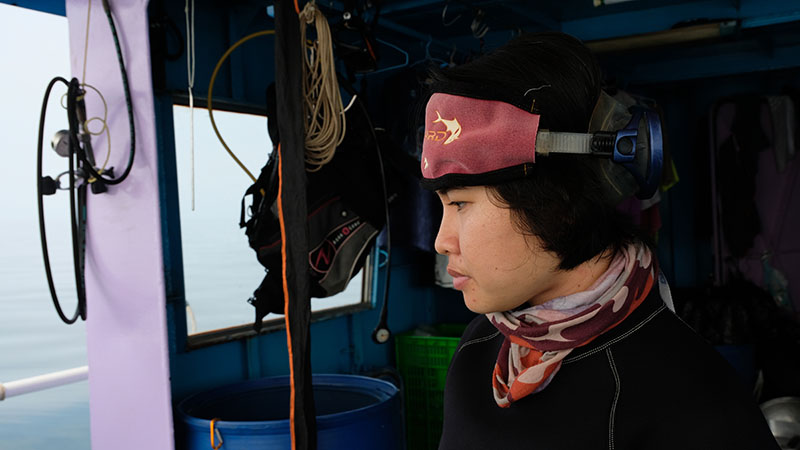
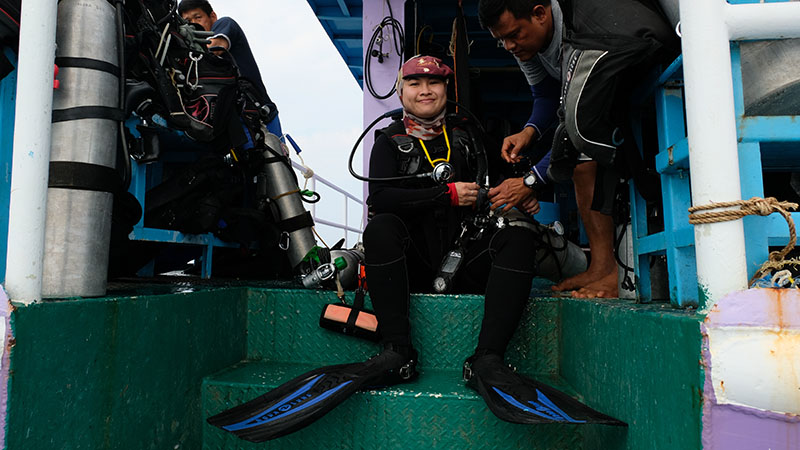
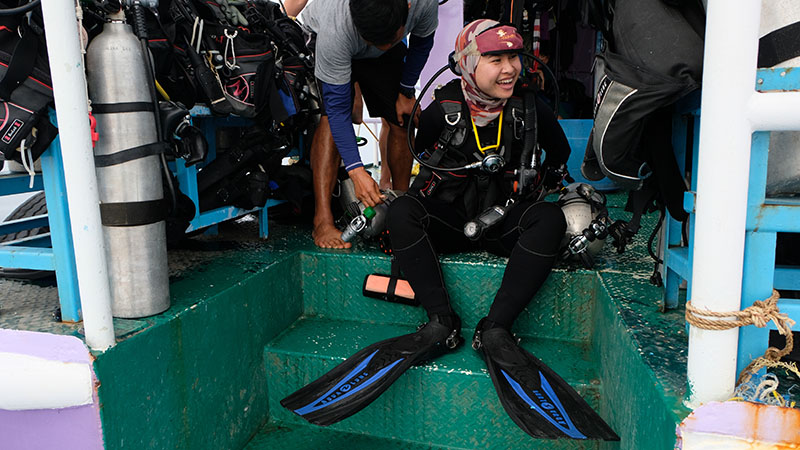
Flashing a smile from under a pink camo scarf and goggles, Jo slips her flippers on. She nods to her diving partner, then walks to the platform’s edge.
Deep beneath her at the bottom of the Gulf of Thailand, a shipwreck has rested for nearly a millennium. Jo, now 40 kilograms heavier with gear, will swim down to unearth the secrets it holds to learn the story they will tell.
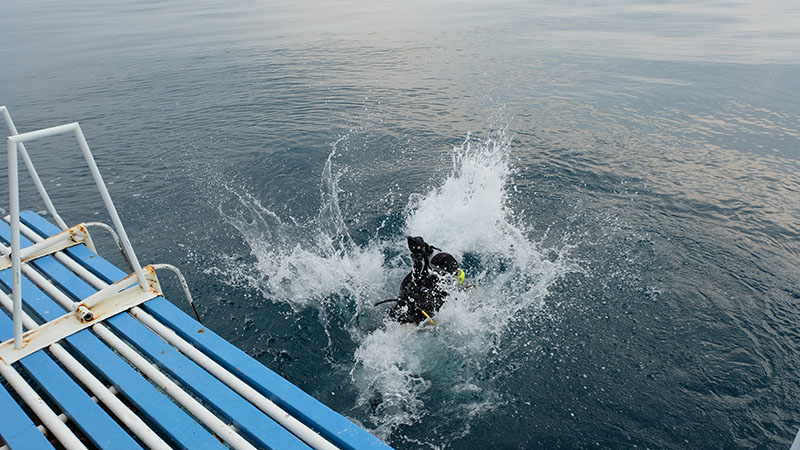
The assembled crew can all hear her loud breathing through the regulator. She takes three breaths and hops from the diving platform and, with a splash, disappears beneath the steel blue waves.
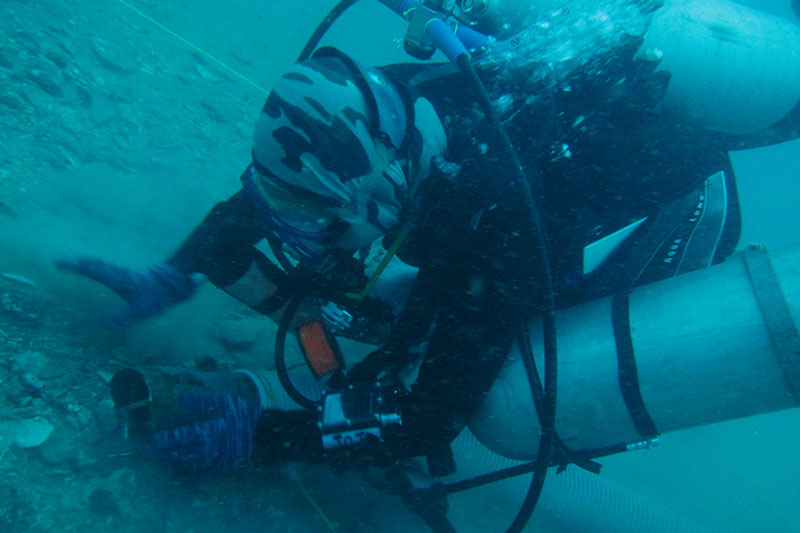
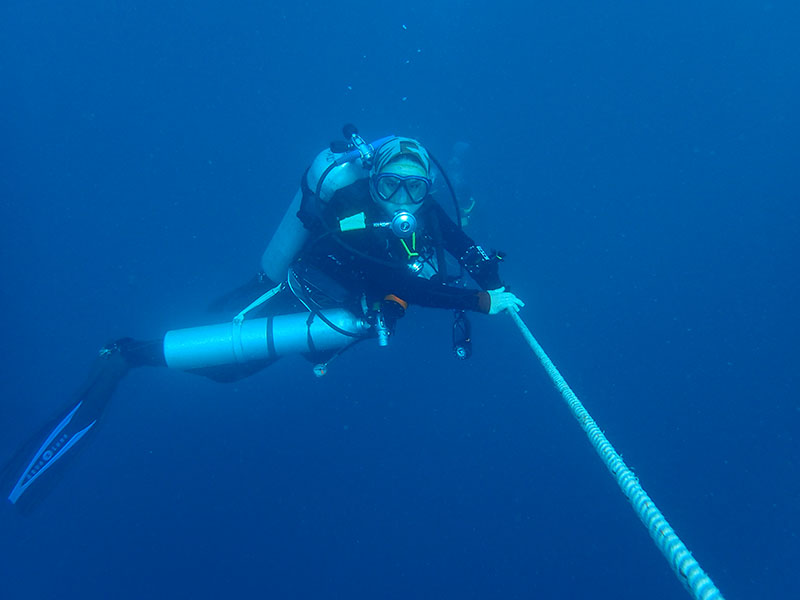
Pornnatcha “Jo” Sankhaprasit underwater on the Koh Khram Dive.
Koh Khram Dive, 8am
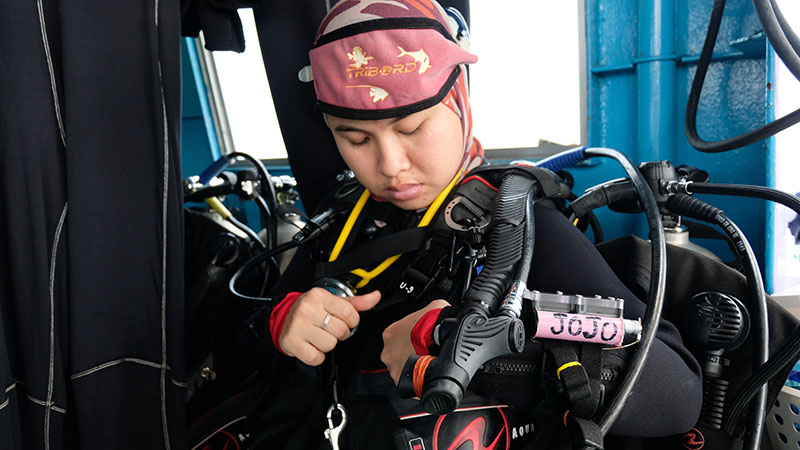
Pornnatcha “Jo” Sankhaprasit doesn’t remove her rose-shaped earrings and bracelets before diving. To identify herself down below, the dive computer on her wrist is wrapped in pink duct tape labeled “JOJO.”
Jo is, at 30, Thailand’s first female underwater archeologist.
Watching Lara Croft movies and soap operas about characters discovering hidden, magical ruins, fueled Jo’s keen interest in history and set her on the path to becoming an underwater archaeologist – and Thailand’s first woman one, at that.
“Those movies really had an effect on me. I thought I would become like the stereotypical cool Lara Croft type,” Jo said.
Her most recent mission has been to study the largest underwater archaeological site in Southeast Asia off the coast of Chonburi with her crew of fellow divers and archeologists.
Sometime between 1350 and 1450 – while the sun was setting on the Khmer Empire – Sukhothai traders, Japanese privateers and Ming Chinese treasure-seekers criss-crossed the seas to Malacca and beyond.
Stormy weather or hostile pirates sank a large junk ship beneath the waves in the Gulf of Thailand.
The team believes that buried in sediment amid broken pottery and wood, the ship’s haul of ivory tusks, jars of duck eggs and spices remain intact on the ocean floor.
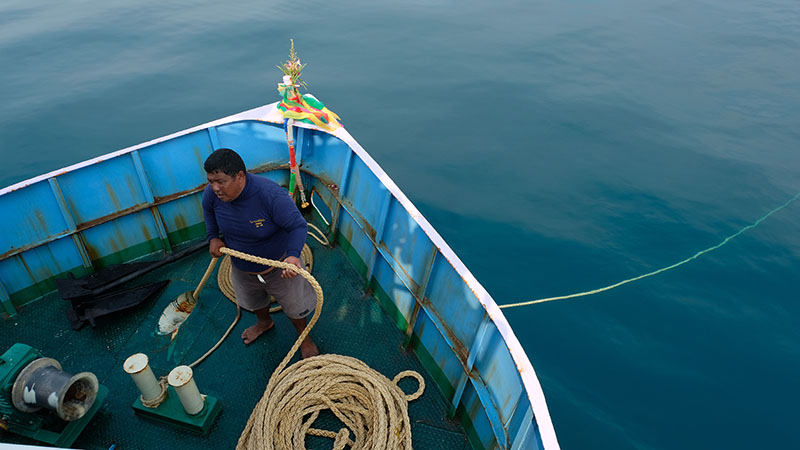
On a recent day, the Waew Mayura sputtered loudly to a spot past Koh Khram where the wreck lies. After the crew shoved off early in the morning from a marine police pier at Sattahip, the archaeologists prepped for their mission.
“This’ll be the biggest dive of my career yet,” Jo said.
Koh Khram Dive, 11am
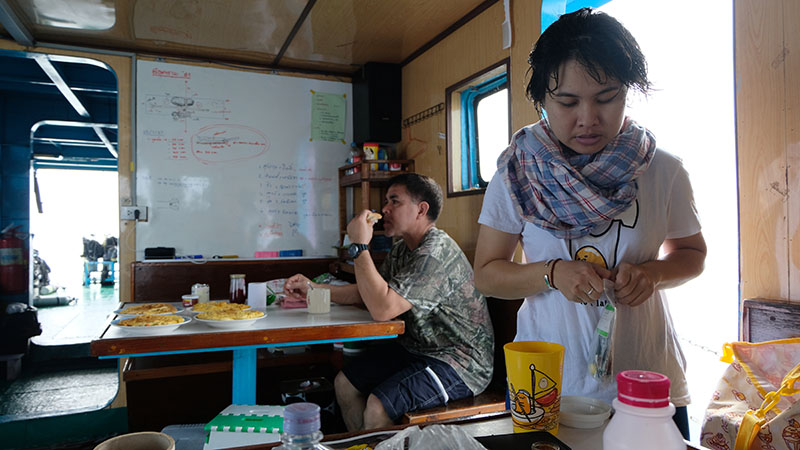
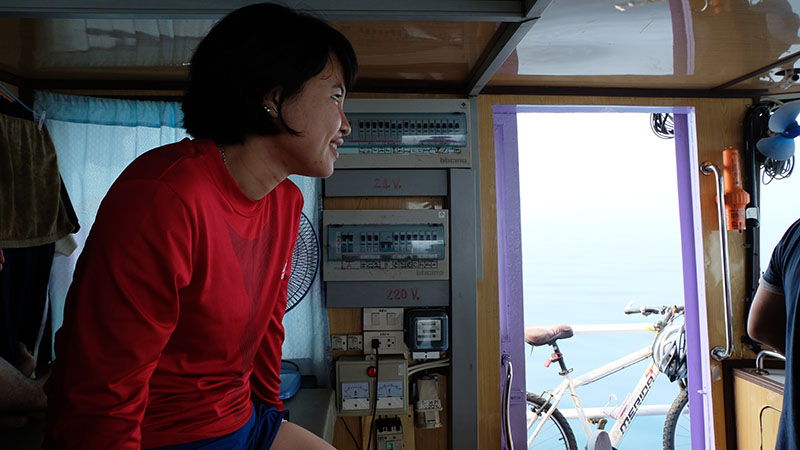
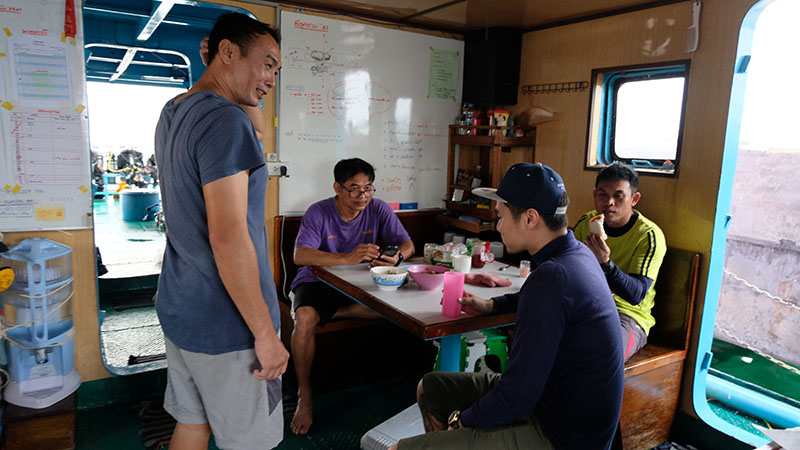
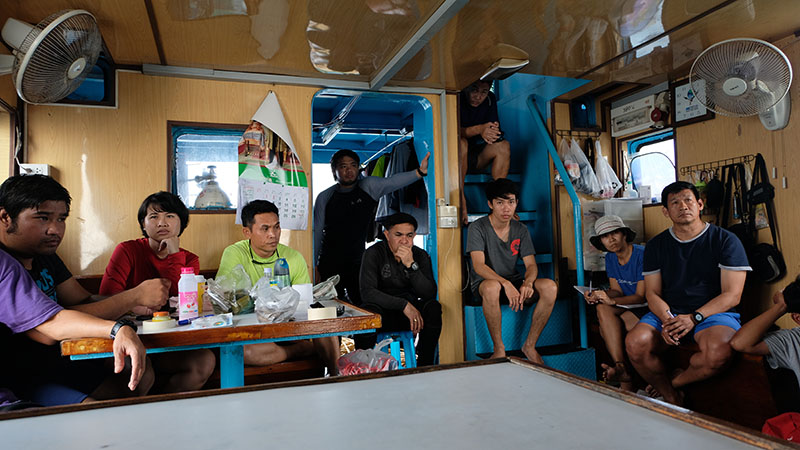
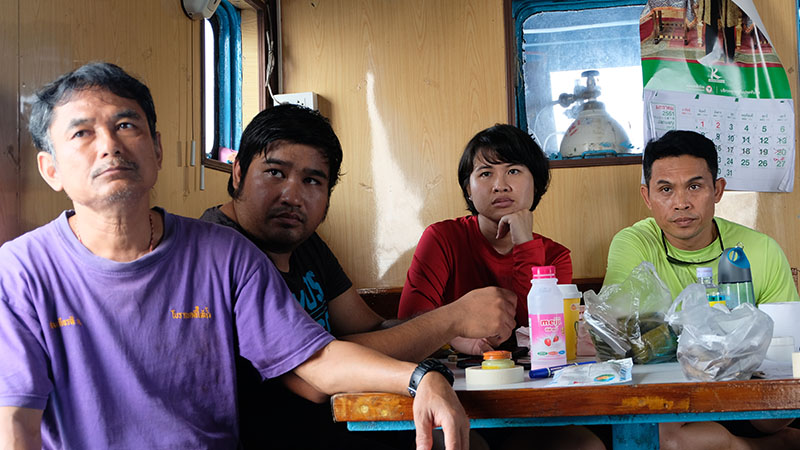
The crew of the Waew Mayura at a briefing for the Koh Khram Dive on their 28th day. Second from left, in red, is Jo. Chief Petty Officer 3rd Class Dacha Phonthai, the expedition leader, is at far right.
The entire crew gathers for a briefing with expedition leader in the ship’s cabin. Jo’s team has to decide what to bring to the surface and what to leave behind, lest precious items disintegrate upon tasting oxygen for the first time in seven centuries.
“Don’t call it digging. It’s more like dismantling. Let’s move the pottery to the side and then try to get the digging depth we need today. And be careful with the ivory, its decomposition is advanced and the layers are sloughing off. Be careful not to touch it,” says the expedition leader, Chief Petty Officer 3rd Class Dacha Phonthai.
Tight-Knit Community
Jo said she was lucky that her family supported her career choice, although they were confused about what it actually entailed.
“When my mom heard I was going to work in an arts-related field, she imagined me studying Thai dance,” Jo said.
She said she isn’t treated differently for being a woman by the other archaeologists.
“They walk around in underwear around me; they don’t care,” Jo laughed. “We’re all like siblings. They don’t treat me like a woman too much.”
An underwater archaeologist is party history buff, part athlete and part Lara Croftian adventurer.
Under the law, Thai archaeologists must have a bachelor’s degree in the field from Silpakorn University, the only such full-fledged program in the country. No other archaeology degrees are recognized.
“The industry is very narrow. We all know each other like siblings,” Jo said.
The culture ministry provides one boat for the nation’s underwater archaeologists: the violet-hulled Waew Mayura.
“Actually, sailors told us boats shouldn’t be painted purple because it’s an unlucky ‘widow’s color,’ but we don’t care,” she said, laughing.
Koh Khram Dive, Noon
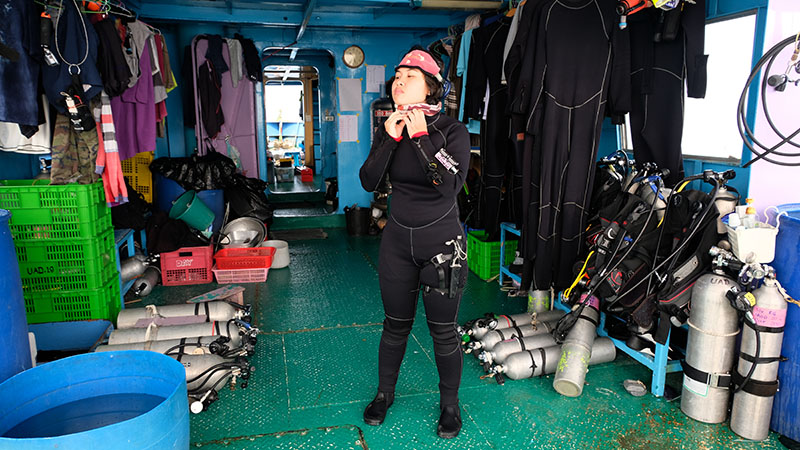
Jo prepares for her dive.
1 of 8
Soon after the briefing, the crew drops anchor at a seemingly random spot among surprisingly calm waves.
It may be a science mission, but superstition always runs high on the sea.
“Usually when a stranger is on board, the waves are really high,” Jo says. “Strange.”
Soon the divers are strapping on their wetsuits and tanks and making for the platform.
Pairs of archaeologists and divers go down in shifts of 25 minutes each. The diver holds a PVC pipe that blows air to clear sand and debris. The archaeologist brushes away floating debris to gather data and retrieve artifacts.
A closed-circuit breathing system recycles their air, allowing dives of hours instead of minutes. That’s crucial for a dive of 40 meters.
The other archaeologists on the dive are Sira “Jib” Ploymukda, 29, and Wongsakorn “Pan” Rohothan, 28. Both were underclassmen in Jo’s same faculty. Of the crew of 17, the only other woman is Kanlapangha “Aum” Kiawmas, a 46-year-old assistant archaeologist.
Kanlapangha “Aum” Kiawmas.
“Being an underwater archaeologist is all about being prepared,” Jo says as she twists the knobs on her oxygen tanks. “It’s not like on land, where you just climb out of a meter-high hole to retrieve a pencil. Here, if you go under without something, you’re dead.”
Jo and the other divers strap on a plastic slate where they can jot with a pencil what they need to do.
“Underwater, everyone is 50 percent dumber. You need to write even simple instructions like moving an artifact to another location down so you don’t forget,” Jo says.
So what’s it like down there?
“It’s not a full ship down there like the Titanic,” Jo said. “It’s in ruins, a piece of wood here and there. You have to reconstruct the ship in your head.”
Passion For the Past
Artifact looters and fishing trawlers boil Jo’s blood.
She said that eight-in-10 dive sites, like the Koh Khram shipwreck, are discovered by fishermen whose trawlers comb the ocean floor, smashing centuries-old pottery in the process. Few fishermen report such sites to the navy because it’s tempting to trade an old Sukhothai plate for some cash on the black market.
“When we find a site we have to hurry,” Jo said. “People in this country haven’t developed an awareness about valuing historical artifacts yet. And we can’t protect them all.”
Jo’s eyes come alive as she uses her hands to describe the shapes of pottery and ivory she has found.
“The ships we find can be Chinese junks, European ships and Southeast Asian junks,” she said. “So we think this dive here is one of those Southeast Asian junks: They’re mutant junks which locals modeled after Chinese junks, but are smaller and more streamlined.”
The shipwreck off Koh Khram still guards its secrets. The discovery of jewelry has whet their imaginations to the possibility it may have been more than a trading vessel.
“The Ayutthaya ships we find are mostly merchant ships, but we found gold jewelry with rubies on this dig. That means this could possibly be a royal boat!” Jo said, bursting with excitement.
And then there’s the discovery of things one wouldn’t think could survive.
People in this country haven’t developed an awareness about valuing historical artifacts yet. And we can’t protect them all.
Saltwater and ocean mud helps preserve organic matter that would have decomposed long ago from oxidation and decomposition if it was on an dig site on land.
“We found fragrant woods and an ivory tusk this wide,” she said, stretching her arms wide. “You would never, ever dig up ivory on land because it decomposes. We also found duck eggs preserved in jars and whole pepper grains too,” Jo spews, her enthusiasm flowing like a powerful current.
Koh Khram Dive, 1pm
Jo underwater on the Koh Khram Dive.
As Jo climbs back onto the boat, crewmates move in to help her unstrap her heavy tanks. Post-dive exhaustion doesn’t dull her enthusiasm: She quickly launches into her finds, saying she dug 10 centimeters to find broken pottery, a piece of the wooden hull and some Sukhothai-era tableware.
She’s no newb when it comes to diving back through time to touch history first-hand. She’s gone down to study a rice barge that sailed in the late 19th century under Rama V and foundered in the Mun River in Isaan. Another mission saw her up close with French iron-clad wrecks in Bueng Kan.
“Other people don’t get why we’re so excited about some broken old pots. But it’s funny, I don’t actually like the act of diving. I wouldn’t go diving to see coral. But when I know there’s a dig site below, I willingly dive,” Jo said.
A split-second mistake can cost an underwater archaeologist her life – and the job is risky enough no one will insure them.
“All life insurance companies refuse to take us on. We each just get a 10,000 baht hazard fee per month from the government that basically says, ‘If you die, then mai pen rai,’” Jo said.
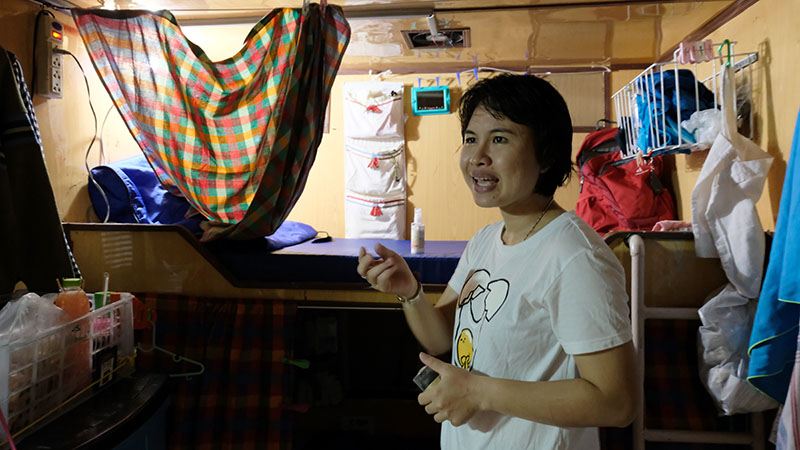
Jo next to her bunk on the Waew Mayura.
And die they have. A practice pool at the Underwater Archeology Office is named after Detchpirun Seerabutr, an archaeologist who drowned on a 70-meter dive near Koh Kut in 2013.
“That was the only death,” Jo said.
At sea, Jo said there are no hard and fast gender roles on the boat. Still, there are some tasks she notices men and women gravitate toward.
She especially likes categorizing the finds and writing up the academic dive reports.
“It’s not that the men are bad at it, but I can really systematize it,” she said. “We trade off writing the academic reports, but I volunteered to write up this dive’s.”
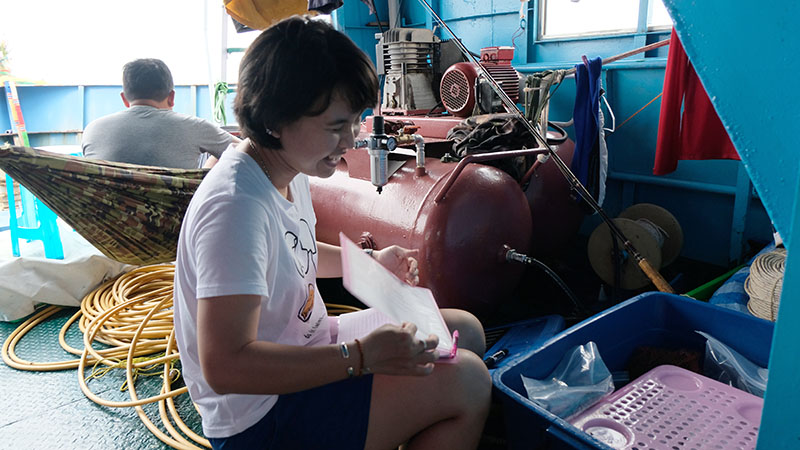
Jo holds a folder of reports about the Koh Khram Dive that she wrote.
But at sea, archaic superstitions hamper everyday tasks: Crew members tell her a women’s clothes can’t be hung higher than people’s heads.
Nevertheless, Jo finds it important to maintain her femininity. Sometimes, after removing her diving mask, she slaps on a cosmetic facial mask.
“I never think I have to become a guy. There’s a middle ground,” Jo said while dabbing on Korean face cream next to her bunk in the musty brig. “It’s important to moisturize, especially for divers. Sea [rashes] can really mess up your face.”
I never think, ‘If men can do it, so can I.’ I think, ‘I will do the best that I can.’
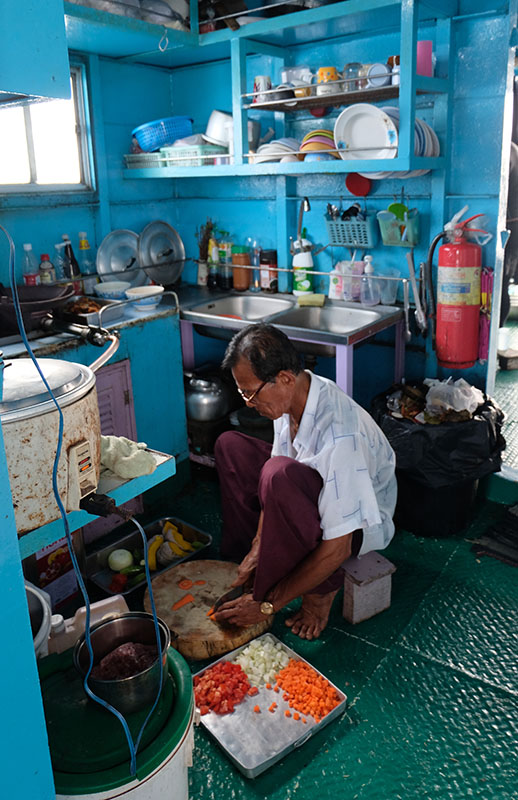
The ship’s cook on the Waew Mayura.
Koh Khram Dive, 2pm
As the divers surface, the ship’s cook fries up several omelettes chock-full of pork and cubed veggies for the hungry historians. The ship pulls anchor and leaves the dive spot before 2pm.
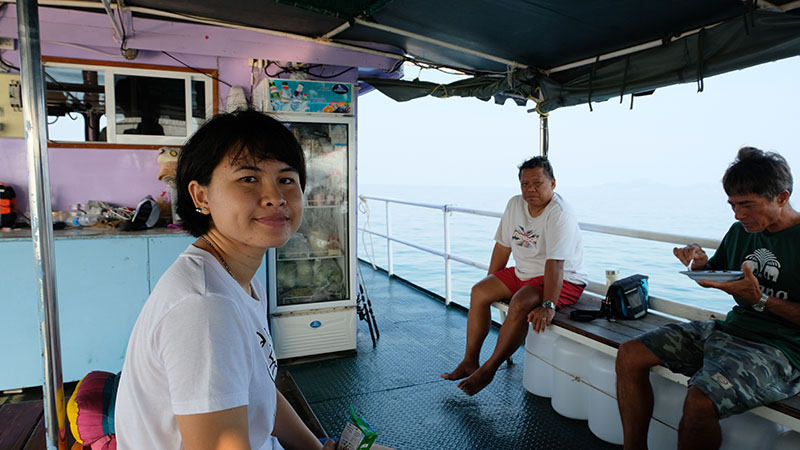
Deflated from the big dive, no one retires to the brig. Most spread out around the upper and lower decks to recuperate and enjoy some well-earned quiet time.
Sharing the small boat with 17 people, Jo marks her stuff clearly with stickers of Gudetama, the anthropomorphized egg yolk Sanrio character.
It was a long and arduous journey from her 2008 graduation to the waters of the gulf.
When Jo began training, one of her instructors strapped two 12-kilogram tanks to her and told her he would not take her as a student if she could not stand up.
Jo in a Gudetama shirt with her Gudetama cup.
“They trained us like we were in the navy. We’d run at 4 in the morning. On the job sometimes we feel like we’ve used our body to its breaking point,” Jo said. “But I accept my limitations. It’s important to know yourself and not force it too much. I never think, ‘If men can do it, so can I.’ I think, ‘I will do the best that I can.’”
Despite the physical demands the job may have, Jo wishes more Thai women would join her profession.
“I want them to join so much!” she said loudly from the upper deck of the boat. “Most women training to be archaeologists become one on land because they had a bad experience with diving – maybe their air tank exploded, or they went out on a day with bad waves.”
Jo said women also are deterred by the physical demands and fear they’ll be a burden.
“To people who say that they couldn’t survive like this, I say that you can. You just need to adjust,” Jo said. “I want more people to know what I’m doing because I hope I can inspire someone.”
The Fine Arts Department’s Underwater Archaeology activities can be followed at their Facebook, where shipwrecks and underwater sites can be reported to. Sites can also be reported to the local navy.
Women bang pots and pans as shooting slogans during a protest marking the beginning of a 24-hour women strike Thursday at the Sol square in Madrid, Spain. Photo: Francisco Seco / Associated Press
MANILA — Marches and demonstrations in Asia are kicking off rallies around the world to mark International Women’s Day.
Hundreds of women activists in pink and purple shirts protested Thursday in the Philippines against President Rodrigo Duterte, who they said is among the worst violators of women’s rights in Asia.
Protest leaders sang and danced in a boisterous rally in downtown Manila’s Plaza Miranda. They handed red and white roses to mothers, sisters and widows of several drug suspects slain under Duterte’s deadly crackdown on illegal drugs.
A rally for the rights of female workers was scheduled for later Thursday in central Seoul in South Korea, where a rapidly spreading #Metoo movement is galvanizing support for women’s issues.
Other events are planned across Asia, the Mideast, Europe and the Americas.
Women in Spain have been called for a 24-hour feminist strike in their workplaces and also to stop doing duties at home.
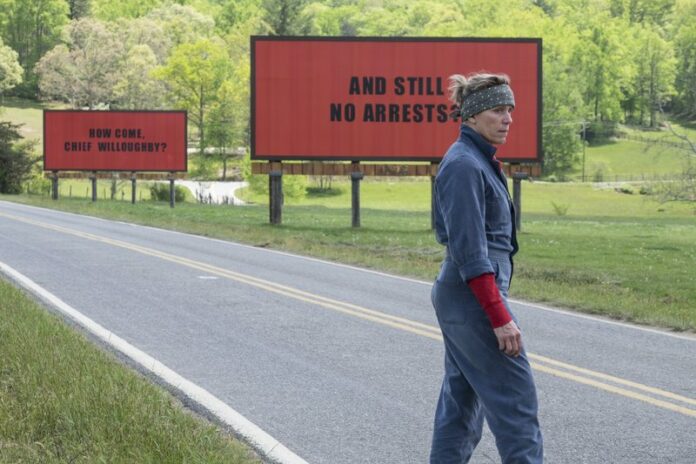
Frances McDormand’s face is one of the first things you see in “Three Billboards Outside Ebbing, Missouri,” and it’s impossible not to be struck by its pure decency.
Perhaps it’s a result of all the other roles we’ve seen this uniquely fearless actress play, on stage and screen, wrapped into one. But you look at her face and you think: This person has a moral compass. Her side is the right one. We will be safe there.
And that’s the way it seems for a while in “Three Billboards ,” until suddenly it isn’t quite so simple. It’s a credit both to writer-director Martin McDonagh and to McDormand’s revelatory performance — her best since her Oscar-winning turn in “Fargo” — that we don’t see this coming nearly soon enough to steel ourselves.
McDormand plays Mildred Hayes, a mother who’s suffered unimaginable loss: the rape, murder and incineration of her teen daughter. The film begins seven months later, as Hayes is driving down a little-used road near her home. She stops and stares at three dilapidated billboards.
She heads to the town advertising office, and hands over a wad of cash. Soon, those billboards will be painted bright red, and emblazoned with three messages: “Raped While Dying.” ″And Still No Arrests?” ″How Come, Chief Willoughby?”
A grieving mother searching for answers from a lazy police force. What could be wrong with that? Our righteous anger intensifies as a self-satisfied priest comes to her home, sips tea in her kitchen, and explains that she’s out of line in going after the chief. Mildred lectures right back at the priest, telling him that he is complicit, as a member of the church, in church sex abuse. And then she tells him to get the #$% out of her kitchen.
She’s only getting started. This, it turns out, will be Mildred’s go-to stance: Fight back, and fight harder, no matter how profane or even violent she needs to get.
So much for black and white. “Three Billboards” is a veritable study in gray. Willoughby (an excellent Woody Harrelson) comes to visit Mildred, and he’s a decent and caring guy. The billboards are plain unfair, he tells her — it’s not easy to catch a killer. She suggests they test the DNA of every man in town — heck, in the country. He finally tells her he has terminal cancer. She says she already knew. And she adds: “They won’t be as effective when you croak.”
Mildred and the chief, at least, have a grudging respect for each other. The same can’t be said for her relationship with Officer Dixon, a hapless, moronic, racist, dangerously temperamental and buffoonishly violent Mama’s boy, played with complexity and finesse by Sam Rockwell in a constantly surprising performance. (If there’s any justice, Rockwell will have an awards season as busy as McDormand’s is sure to be.) Mildred’s take-no-prisoners quest for justice will bring her into a fiery — and we do mean fiery — confrontation with Dixon. But there’s no way you’ll be able to foresee the twists and turns their relationship will take.
If one were looking for telltale signs that “Three Billboards” was written by a stage playwright, one might mention that the town of Ebbing seems populated by only a few characters — as in a play. In any case, the small cast is extraordinary. It includes Lucas Hedges as Mildred’s pensive son; this thoughtful young actor, who made such an impression in “Manchester By the Sea,” sure knows how to pick his movies. Caleb Landry Jones is a jumble of jitters as the unlucky guy who runs the billboard office, and Zeljko Ivanek does terrific work as a police deputy. Peter Dinklage and Abbie Cornish are both moving, he as the unappreciated suitor in Mildred’s life, she as the wife of the dying police chief.
Most of “Three Billboards” takes place in the present, but there is one brief flashback to Mildred’s life before the murder. It is utterly devastating, and speaks to the idea that the most inconsequential words, that we utter at the most inconsequential times, can of course have consequences so dire, we might never recover from them.
There are no clear heroes here, and no clear villains, and needless to say, one should not expect to take away any easy lessons, either.
Except perhaps this: there’s no better time than right now for a high-profile movie led by a meaty, complicated female character — and no better actress than McDormand to take it on. And you can put that on a billboard.
“Three Billboards Outside Ebbing, Missouri” is rated R by the Motion Picture Association of America “for violence, language throughout, and some sexual references.” Running time: 115 minutes. Three and a half stars out of four.
A trailblazing film director. A snowboarding champion. A pioneering mathematician for NASA. An iconic artist. Barbie is marking International Women’s Day by honoring some of the inspiring women of the present and the past.
The brand announced on Tuesday — a day before International Women’s day — that it has chosen 17 modern-day and historic role models to honor with a doll in their likeness.
The 14 new honorees of the brand’s “Shero” program are: Patty Jenkins, director of “Wonder Woman;” Chloe Kim, who won an Olympic gold medal in snowboarding last month at age 17; Bindi Irwin, the Australian conservationist; British boxing champion Nicola Adams; Turkish windsurfing champion Cagla Kubat; French Michelin-starred chef Helene Darroze; Chinese volleyball champion Hui Ruoqi; German fashion designer Leyla Piedayesh; Mexican golfer Lorena Ochoa; Polish author and journalist Martyna Wojciechowska; Italian soccer player Sara Gama; Chinese actress and philanthropist Xiaotong Guan; Chinese ballerina Yuan Yuan Tan; and Vicky Martin Berrocal, Spanish designer and entrepreneur.
The brand’s new “Inspiring Women” series is honoring pioneering aviator Amelia Earhart; celebrated artist Frida Kahlo; and Katherine Johnson, the NASA mathematician who broke race and gender barriers. Johnson, who is now 99, was featured in the recent movie “Hidden Figures.” These dolls come with educational information about the contributions each has made to society.
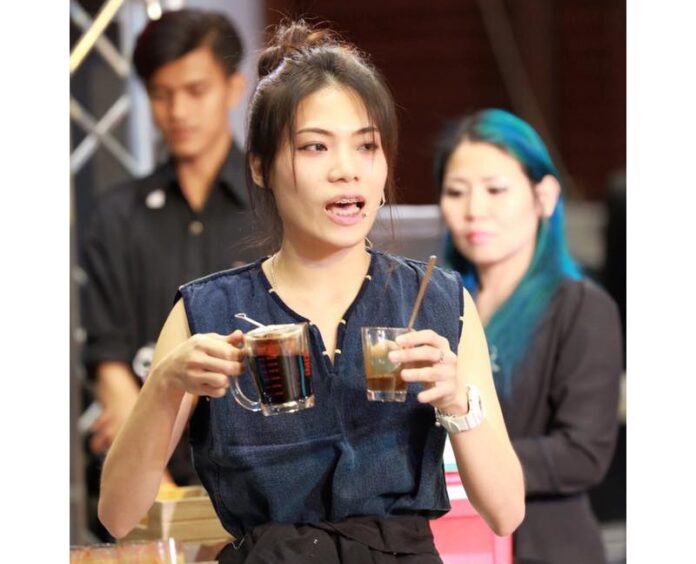
BANGKOK — Coffee from around the country will make waking up easier the next three days when more than 100 brands spill the beans at a downtown convention center.
Entering its sixth edition, Thailand Coffee Fest is bringing 120 companies from across Thailand to sample and sell their beans at an event drawing expert baristas that includes workshops, brunches, talks and more.
Join daily workshops that teach skills from brewing at home and latte art-making to basic coffee tasting and sensory skill training.
Award-winning baristas will offer a taste of their best brews once or twice daily, as they take turns to brew for an hour at a time.
Friday to Sunday, listen to six different talks on the main stage ranging from “taste designing” to creating a sustainable coffee industry in Thailand.
Finally, for those needing a bite, a 250-baht brunch served 11:30am to 1pm will offer an array of dishes and different cups of coffee every day.
Thailand Coffee Fest runs 10am to 9pm now through Sunday at the Queen Sirikit National Convention Center, which can be reached via MRT Queen Sirikit National Convention Centre.
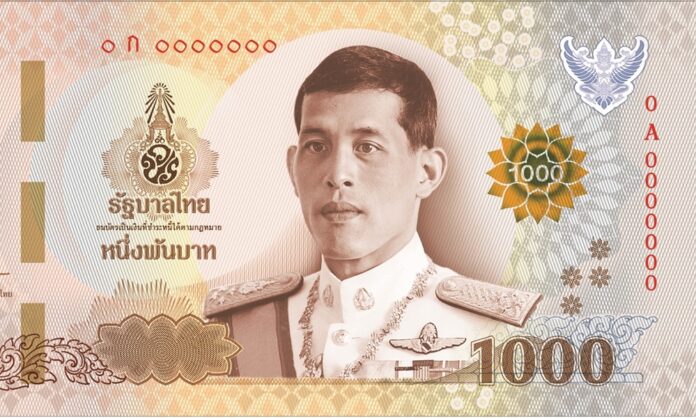
BANGKOK — The Bank of Thailand on Thursday released images of new currency bearing the portraits of King Vajiralongkorn.
The new set will enter circulation April 6 – the 236th anniversary of the founding of the Chakri dynasty – according to a statement released online by the central bank.
It replaces the current banknotes that have displayed the face of King Bhumibol for 70 years, but the former currency will still be legal tender, the bank said.
The front of the new the banknotes show a portrait of King Vajiralongkorn in his air force commander uniform. All 10 past and current kings of the Chakri dynasty grace the back of each denomination in pairs beginning with the 20 baht note. King Vajiralongkorn and his father, Rama IX, are featured on the back of the largest bill of 1,000-baht notes.
The first set of notes in 20-, 50- and 100-baht denominations will be released on April 6, or Chakri Day. The 500 baht and 1,000 baht bills will come out three months later on the king’s birthday of July 28.
The federal bank also uploaded a digital collection of all past banknotes released under King Rama IX on their website.
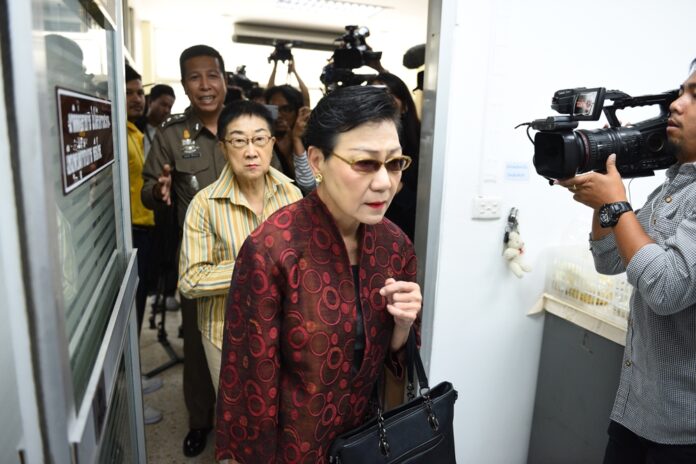
Ranee Saengyoktrakarn and Rattanachat Saengyoktrakarn meet with police Monday to hear charges related to their Feb. 19 assault on a pickup truck.
BANGKOK — A city official said Thursday his agency would respect a court order re-affirming that five illegal markets must shut down per complaints from local residents.
The order, issued by the Administrative Court yesterday, also fines Prawet district officials for failing to shutter the markets sooner as demanded by Boonsri Saengyoktrakarn and her family. District director Thanasit Metpunmuang said he will make sure the markets stay closed.
“We will respect the court order,” Thanasit said. “And we will protect the rights of the plaintiffs, the aunties. We will safeguard their property.”
The court ruled Wednesday that officials must protect the Saengyoktrakarn family from the environmental impact and pollution caused by the markets by shutting them down.
The marketplaces operated without any permit for more than 20 years before local officials, cowed by public sympathy for the Saengyoktrakarns, closed the facilities on Feb. 27.
The court also fined Prawet district 5,000 baht for ignoring the family’s request.
However, Thanasit said Wednesday’s order did not say anything about dismantling the buildings completely, and he would need a new court order authorizing him to do so.
“We have to wait for a court order on the issue,” Thanasit said. “Whatever the court says, we will do. If they say the markets can sell, then we let them sell. If they say the markets can’t sell, then we will tear them down.”
He continued, “We are civil servants. We have to respect the rights of both parties: the plaintiffs and the sellers.”
After operating in full view of law enforcement for two decades, the markets only attracted attention after one shopper illegally parked her pickup in front of a mansion owned by the Saengyoktrakarn family.
The family responded by emerging to attack the Nissan with an axe and pipe, telling the media they suffered for years from illegal parking, noise and odors.
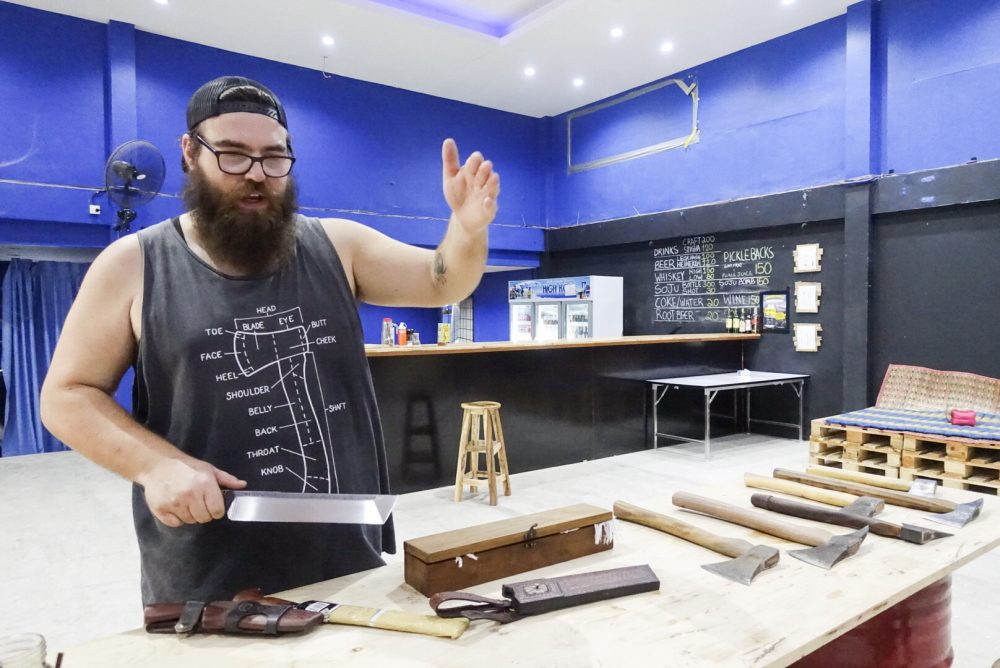
Golden Axe Throw Club co-founder and three-time Canadian axe-chucking champ Ryan Nelson poses between throws.
Top: Golden Axe Throw Club co-founder and three-time Canadian axe-chucking champ Ryan Nelson poses between throws.
BANGKOK — Got an axe to grind? Put both your mitts around the shaft and raise it behind your head, like you’re holding a back scratcher instead of a razor-sharp weapon. Take a moment to access your deepest rage and then hurl that thing.
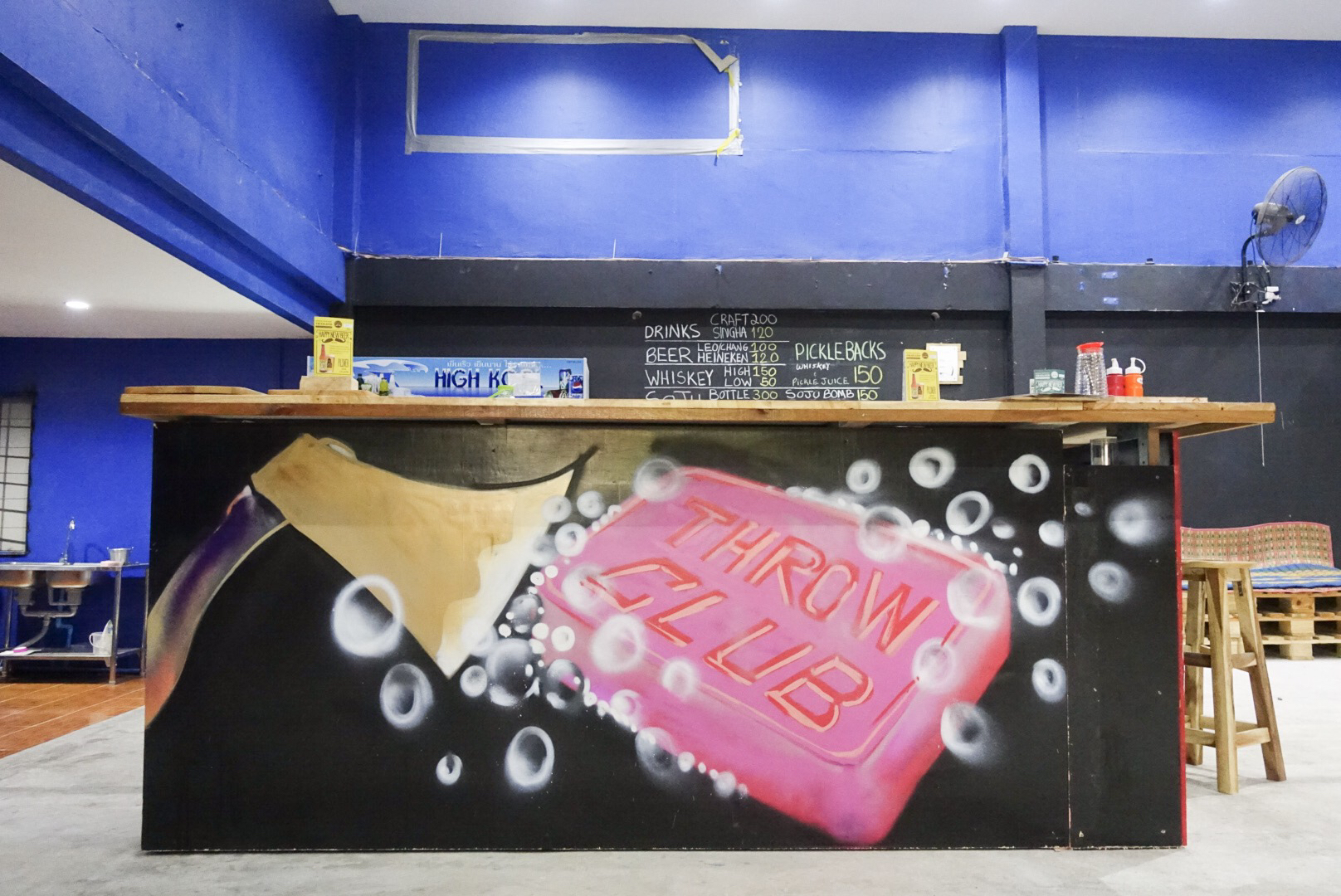
What was once a ping-pong parlor was taken over recently and converted into a place where people can unleash their inner Gimli by throwing axes. And if alcohol is needed to fuel your dwarven rage? No problem, the Golden Axe Throw Club has a bar.
When three-time Canadian axe-throwing champ Ryan Nelson moved to Bangkok, he found a city completely lacking in axe-throwing facilities. So to capitalize on his favorite hobby and share his love of throwing heavy weapons, he opened the place with Siriluk “Aom” Sathanart, his wife who, despite being quite pregnant, can throw the hell out of an axe herself.
“I kinda miss axe-throwing, living here,” 31-year-old Nelson said. “In Canada, it’s a really big sport, but in Bangkok it’s nothing, so I brought it here so I can throw axes every day,” Nelson said.
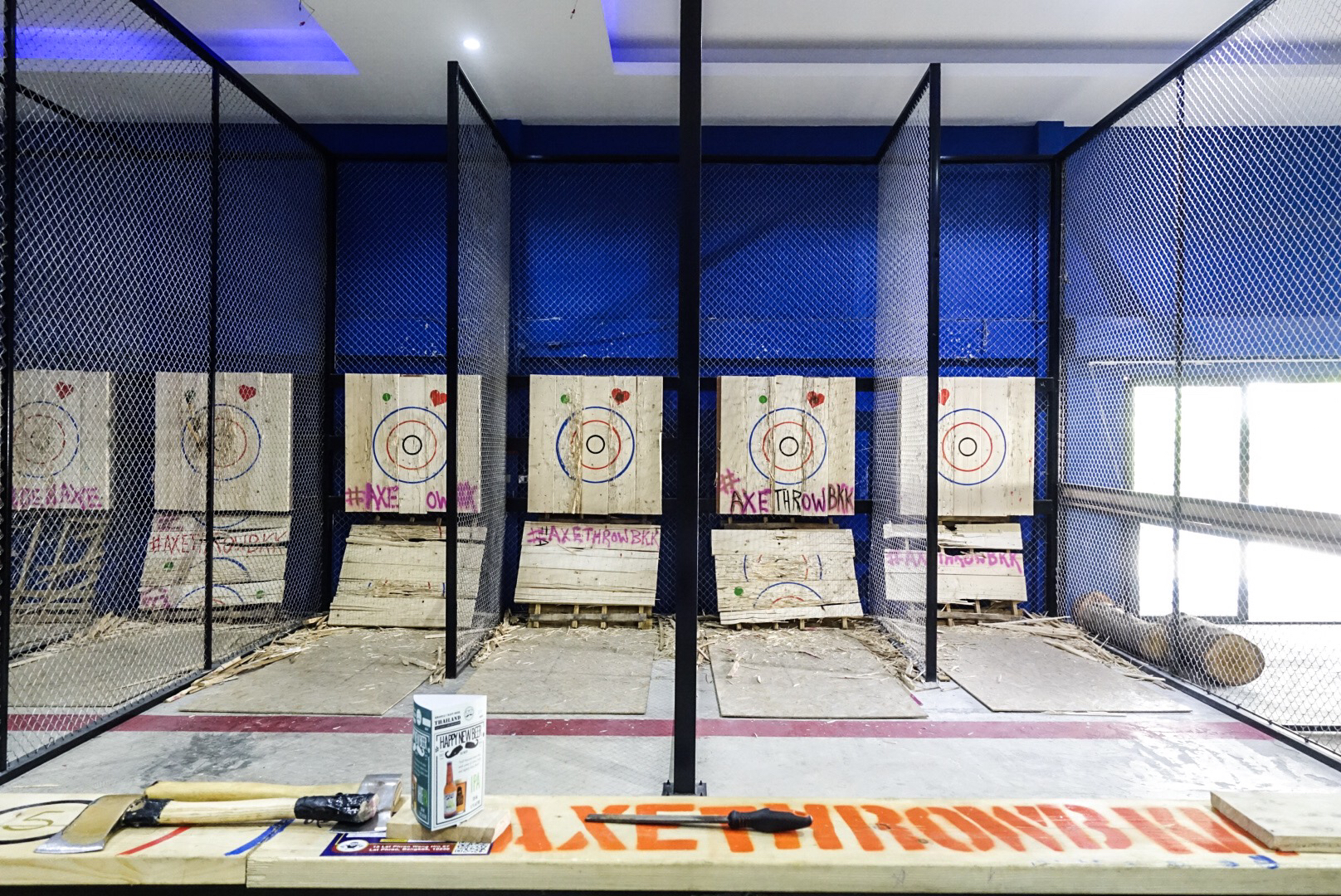
Golden Axe currently has eight throwing lines in addition to its bar.
According to Nelson, there are now 150 axe-throwing clubs around the world – mostly in Canada, the United States, Russia and Australia. He believes his is the first in all of East Asia.
Nelson is happy to see others discover the joy of axe throwing as well. He explains the basic form – it’s something first-timers can totally do, but expect to throw about 10 axes to get the hang of it.
After release of axe comes release of endorphins: axe throwing is very cathartic.
Who’s this orange-haired ruffian in need of a good axing?
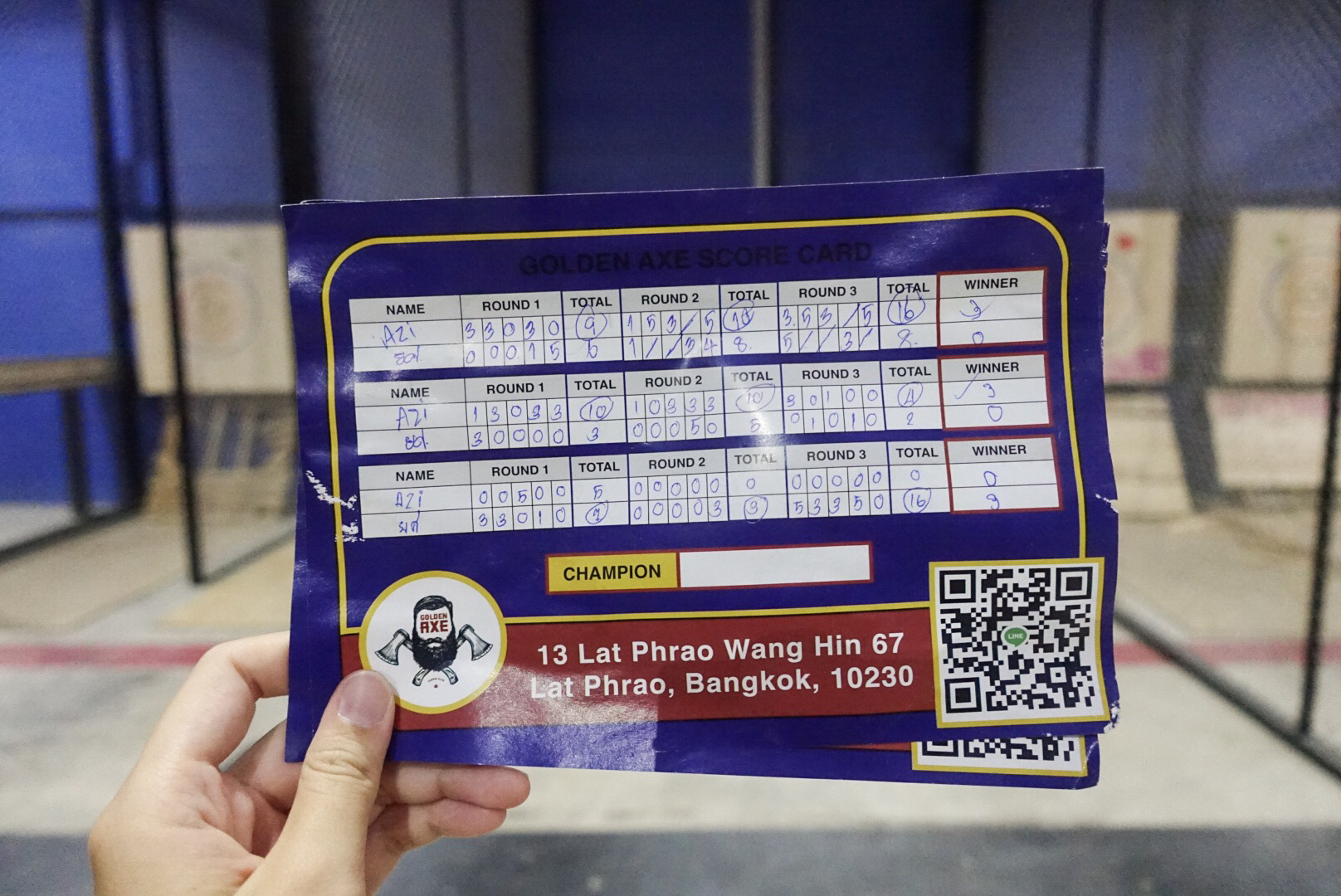
Once the basics are down and it’s time to get serious, make it a mini-challenge. Score cards are available on a wooden bar to keep track of strikes made. Hitting inside the outermost circle is one point, the inner circle scores three points, and a bullseye means five points. Up the game by aiming for green dots in the corners for a clutch throw worth up to seven points.
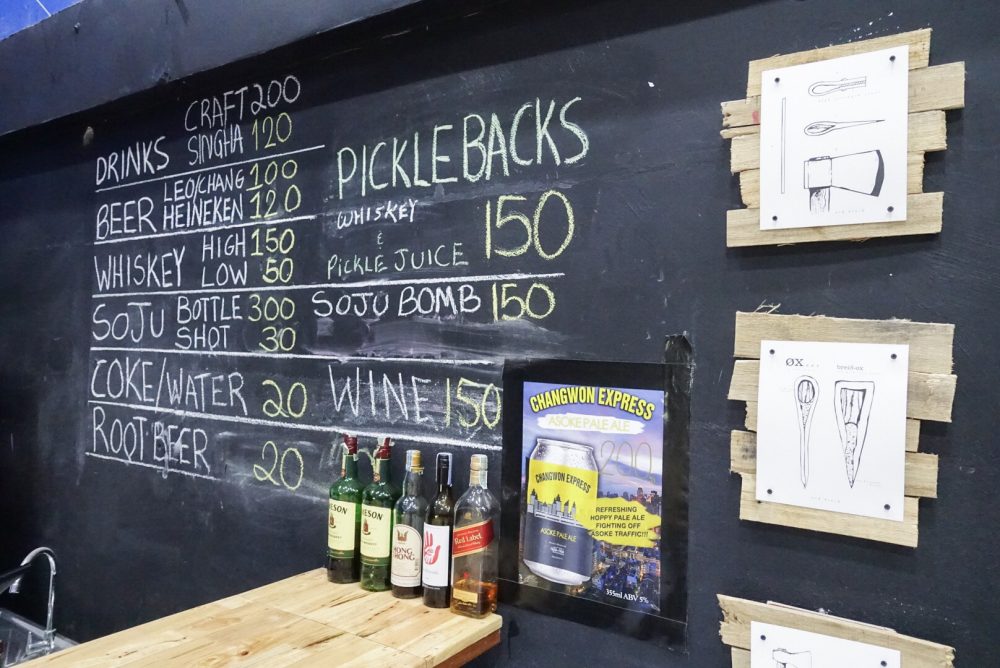
Then there’s the bar to nurse that Viking spirit with various beers or a shot of soju (30 baht). Water and Coke (20 baht) are available for those who don’t like to drink & throw, while real bastards can opt for a glass of pickle juice (150 baht).
Drink and throw at your own risk: All players must sign liability waivers to play. Nelson assures that the bartenders are trained to cut anyone off before they get drunk.
“[Axe throwing] is fun because it’s a sport you can do while you drink,” Nelson said. “You throw some axes, you work up some sweat, and you have something to drink. It’s not about getting drunk. We’re an axe-throwing range with a bar, not a bar with axes.”
What else is in store? Nelson and Aom plan to add some knife-throwing ranges.
“Axe-throwing and more!” Nelson said.
Walk-ins are allowed, butbooking in advance is recommended. It’s 500 baht per person for one hour of all-you-can-throw axe fun. Come with a group for longer to save money: Groups of at least six can pay 800 baht per person for two hours.
The Golden Axe Throw Club is located on Soi Lat Phrao-Wanghin 69 Soi Lat Phrao-Wanghin 71 (Update on Jan. 7, 2019). Get off MRT Lat Phrao and hop take a taxi or hop on a motorbike for 40 baht to the venue. It’s closed Mondays and Tuesdays.
Pregnant Siriluk “Aom” Sathanart and Ryan Nelson throw axes at Golden Axe Throw Club.Ryan Nelson shows his collection of knives and axes






































 She said she isn’t treated differently for being a woman by the other archaeologists.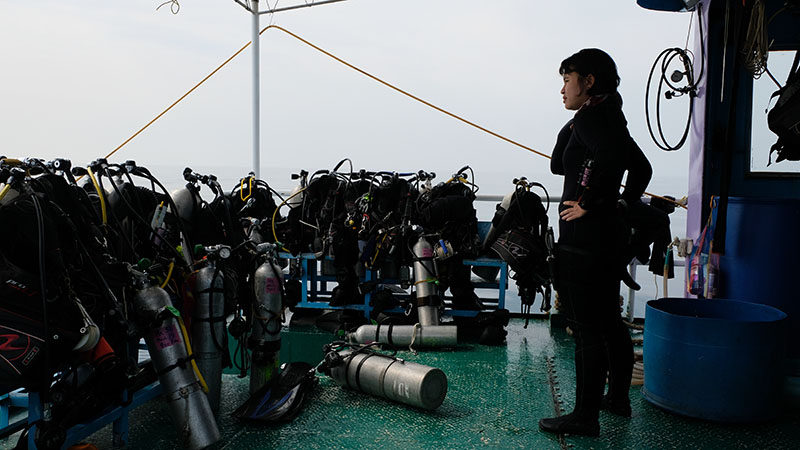
 She said that eight-in-10 dive sites, like the Koh Khram shipwreck, are discovered by fishermen whose trawlers comb the ocean floor, smashing centuries-old pottery in the process. Few fishermen report such sites to the navy because it’s tempting to trade an old Sukhothai plate for some cash on the black market.