


























30.2 C
Bangkok
Tuesday, June 9, 2026
Home Blog Page 2078

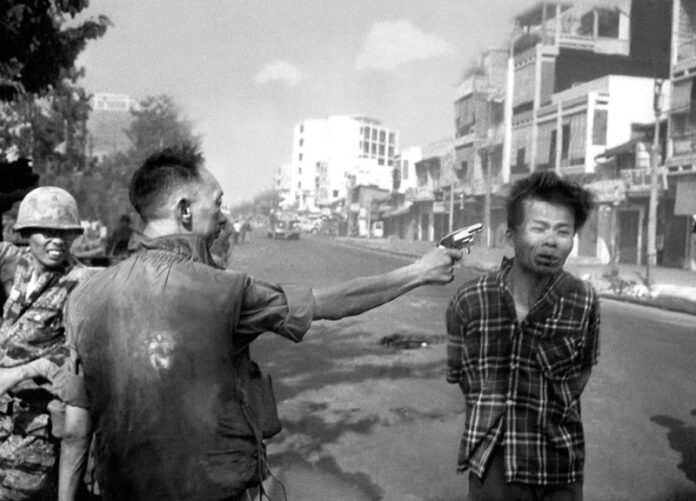
In an Instant, Vietnam Execution Photo Framed a View of War

South Vietnamese Gen. Nguyen Ngoc Loan, chief of the National Police, fires his pistol into the head of suspected Viet Cong officer Nguyen Van Lem (also known as Bay Lop) in 1968 on a Saigon street, early in the Tet Offensive. Photo: Eddie Adams / Associated Press

NEW YORK — It was a fraction of a second that jolted Americans’ view of the Vietnam War.

In a Saigon street, South Vietnam’s police chief raised a gun to the head of a handcuffed Viet Cong prisoner and abruptly pulled the trigger. A few feet away, Associated Press photographer Eddie Adams pressed his shutter.

Taken during the North’s surprise Tet Offensive, Adams’ Feb. 1, 1968, photo showed the war’s brutality in a way Americans hadn’t seen before. Protesters saw the image as graphic evidence that the U.S. was fighting on the side of an unjust South Vietnamese government. It won Adams the Pulitzer Prize. And it haunted him.

“Pictures don’t tell the whole story,” he said later. “It doesn’t tell you why.”

After 50 years, the Saigon execution remains one of the defining images of the war. Time magazine has declared it one of history’s 100 most influential photos.

“It still represents a lot of what photojournalists do, that idea of bearing witness to an important event,” says Keith Greenwood, a University of Missouri photojournalism-history professor. “There are ugly things that happen that need to be recorded and shared.”

It was the second day of the Tet Offensive. North Vietnamese forces and Viet Cong guerrillas had attacked South Vietnamese towns and cities, including the capital, Saigon, during a holiday cease-fire.

Adams, a former Marine Corps Korean War photographer who joined the AP in 1962, and NBC cameraman Vo Suu had been checking out fighting in a Saigon neighborhood when they saw South Vietnamese soldiers pulling a prisoner out of a building, toward the newsmen.

The soldiers stopped. The police chief, Lt. Col. Nguyen Ngoc Loan, walked up and lifted his pistol. Adams figured the chief planned a gunpoint interrogation.

Instead, Loan fired, and Adams’ photo froze prisoner Bay Lop’s grimace as he was shot. Suu’s footage also captured the moment, in motion.

Loan told the two: “They killed many of my men and many of your people” and walked away, Adams recalled in a 1998 interview for an AP oral history project.

At the AP’s New York headquarters, photography director Hal Buell saw the image emerging from the radio-based system used to transmit photos at the time. After some deliberation, he and other editors decided to distribute it worldwide.

“I knew when it went out that you were going to get two reactions. The doves were going to say, ‘See the kind of people we’re dealing with here (in South Vietnam)?’ And the hawks said, ‘It shouldn’t have been used – you guys gotta get on the team,'” says Buell, now retired.

But “the image had an impact, and its impact was felt by those people who were on the fences.”

The photo appeared on front pages, TV screens and protest placards. The Tet Offensive proved a military failure for the Communists, but it fueled the American public’s pessimism and weariness about the war. It ended when the North prevailed in 1975.

Adams, meanwhile, felt Loan was unfairly vilified by a public that didn’t see something outside the frame: the killings of Loan’s aide and the aide’s family hours earlier by the Viet Cong.

“I don’t say what he did was right, but he was fighting a war, and he was up against some pretty bad people,” Adams said. He rued that “two people’s lives were destroyed that day” – Lop’s and Loan’s – “and I don’t want to destroy anybody’s life. That’s not my job.”

Loan died in 1998 in Virginia, where he ran a restaurant. Lop’s widow told the AP in 2000 that she felt the picture helped turn Americans against the war.

Adams, who died in 2004, was more proud of his 1977 photos of people fleeing postwar Vietnam. Those images helped persuade the U.S. government to admit over 200,000 of the refugees (one of the pictures also is on Time’s 100-most-influential list). His legacy includes the annual Eddie Adams Workshop for emerging photojournalists, which marked its 30th year this fall.

Work and fundraising are underway to expand a 2012 short documentary about the famous photograph, “Saigon ’68,” into a full-length film.

Director Douglas Sloan says it will encourage people to understand the context of what they see in powerful images.

Story: Jennifer Peltz
Advertisement

Voranai: When Power Corrupts Absolutely

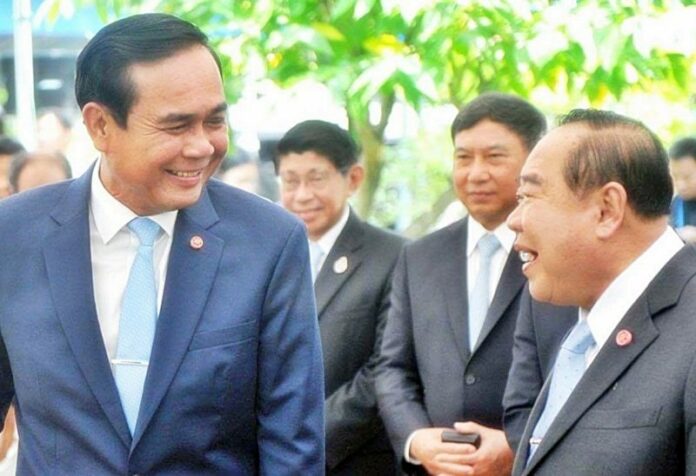
Junta chief Prayuth Chan-ocha shares a laugh with his deputy Prawit Wongsuwan in an undated file photo.

Voranai VanijakaGen. Prayuth Chan-ocha wants to have the final word on the scandal over Gen. Prawit Wongsuwan’s alleged undeclared assets, including a collection of luxury watches worth millions of baht. In true military-dictatorship fashion, he tells the media to shut up about it.

Meanwhile, the National Anti-Corruption Commission, or NACC, is backing off the case, like some powerless state agency in fear of an erratic dictator who uses his power arbitrarily and suffers from bad mood swings. Actually, we don’t need a simile here, do we?

Politics is no stranger to prominent figures embroiled in controversy “taking one for the team” by resigning. When we Thais see Japanese and South Korean leaders resign under pressure, we look at their political cultures with admiration. Although it should not excuse the misdeeds committed, we see the accountability as something for the greater good. Meanwhile in Thailand, instead of resigning and preserving whatever façade of credibility the junta government may have left, Gen. Prawit simply refuses to go away, and Thais are shaking our heads in disgust.

Even the whistle-blowers are saying, “Well, we just wanted to kick Yingluck out … we didn’t call for the coup.”

The majority of media outlets, whether they lean red or yellow, joined in the outcry as if suddenly they have suddenly become colorblind. We Thais have been so up in arms over the scandal that even the international press has picked up the story, and now Thailand has become a laughing stock because of it.

Obviously, this isn’t the first time we have become an international laughing stock, and unfortunately it won’t likely be the last.

During the Abhisit Vejjajiva government, Thai people were divided over the rubber scheme scandal. During the Yingluck Shinawatra government, we were divided over the rice pledging scandal. The key term here is divided, as we have been for over a decade of political conflicts. Who would have thought that a general flashing precious bling would have Thais singing the same tune when it comes to politics?

This doesn’t mean reconciliation is happening – far from it. However (and hopefully), what it does mean is that we Thais are coming to understand the danger of dictatorships.

Power corrupts; absolute power corrupts absolutely, as the saying goes. The junta government’s greatest weapons are its tanks, which have held the country captive for nearly four years. Its second greatest weapon is Article 44, which grants the junta leader absolute power to do whatever he likes. Add to that the attitude adjustment detention camps, and it is of no surprise that Gen. Prayuth feels he has every right tell the media to shut up. Legally speaking, he has to power to do so.

There are simply no checks and balances when it comes to the power of the junta.

There’s a small upside however, unlike dictatorships in other countries, here in Thailand the media and the public can investigate, discuss and condemn, to a certain extent. Unfortunately, it stops there, as the state agency created to combat corruption, the NACC, is unwilling or unable to pursue the matter. The people have the power to only talk about it, and if we talk too much about it, attitude adjustment detention camps await. It’s a soft dictatorship compared to, say, North Korea, but a dictatorship nonetheless.

We may hate a democratically elected government, whether it’s the Democrats or Pheu Thai. Under the democratic system, state agencies may be cowed by powerful politicians. But at the very least, we the people have the right guaranteed by the constitution to organize and protest. Public pressure may lead to a no-confidence debate, which may topple a corrupted regime. Failing that, we can vote them out in the next election. But with the junta regime, we only have a vague promise of an election that has already been pushed back from November this year to February next year, if it happens at all. As well, even with an election, we may end up with a “handpicked” prime minister.

Look at the Yingluck government. Try to fool the people with the rice-pledging scheme?

You’re not getting away with it. Try to pass a blanket amnesty at 4am in the morning, hoping no one would notice? You’re not getting away with it. But a junta general flashing his bling? He’s getting away with it. How? Because it’s a dictatorship’s privilege.

Many of us Thais have lost faith in democracy, and there’s reason for it. Corrupt ministers and gangster MPs have become the norm of the Thai democracy. But at the very least, under a democratic system, there are checks and balances. We can hold them accountable. We can kick them out. But under a dictatorship system, we are powerless to remove anybody, because absolute power is in the hands of the junta regime.

Advertisement

Amid Turmoil, Trump Seeking Reset With State of the Union

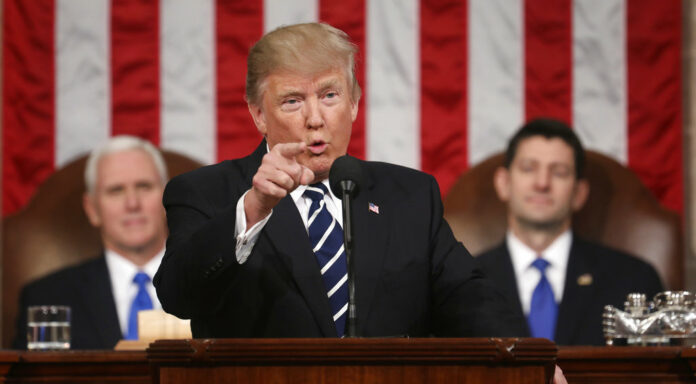
US President Donald Trump addresses a joint session of Congress in February 2017 on Capitol Hill in Washington. Photo: Jim Lo Scalzo / Associated Press

WASHINGTON — Beset by poor poll numbers and the grind of the Russia investigation, President Donald Trump will look to reset his term with his first State of the Union address, arguing that his tax cut and economic policies will benefit all Americans.

The theme of his Tuesday night address to Congress and the country is “Building a safe, strong and proud America,” and the president is looking to showcase accomplishments of his first year while setting the tone for the second. Aides say the president plans to set aside his more combative tone for one of compromise, and to make an appeal beyond his base.

Trump often engages in hyperpartisan politics, and his tax overhaul has been criticized for disproportionately favoring the wealthy. But he will try to make the case that all groups of people have benefited during his watch, according to a senior administration official who was not authorized to preview the speech for the record and spoke on the condition of anonymity.The annual address is a big set piece for any president, a prime-time window to address millions of voters. Every word is reviewed, every presidential guest carefully chosen, every sentence rehearsed. The stakes are enormous for Trump, hoping to move past a turbulent first 12 months in office.

Trump is giving the speech “with the lowest approval ratings of any president in his first year in the history of presidential polling, and can point to the least number of legislative accomplishments,” said Wendy Schiller, political science professor at Brown University. “Every month that goes by in which Trump fails to increase his support works against him because voters’ negative impressions of him will just solidify.”

She said the address “could turn that around if he strikes a bipartisan conciliatory tone and makes it more about the country than about himself.”

Five themes are expected to dominate: the economy and the tax overhaul, infrastructure, immigration, trade, and terrorism and global threats.

Selling the GOP’s tax plan is an election-year project as Republicans look to retain their majority in Congress. The tax changes are billed as essential to powering the ambitious projections of economic growth, and Trump is expected to cite the benefits to the public that proponents envision.

Trump also plans to outline a nearly USD$2 trillion (66.2 trillion baht) plan that his administration contends will trigger $1 trillion or more in public and private spending on roads, bridges and other public works projects.

On immigration, he will promote his new proposal for $25 billion for a wall along the Mexican border and for a path to citizenship for hundreds of thousands of young people brought to the United States as children and now here illegally.

Trump’s trade talk will reflect what he discussed at the World Economic Forum in Switzerland on Friday: a preference for one-on-one deals instead of multilateral agreements.

The public should get an update on the fight against terrorism and an assessment of international threats, including North Korea. The senior administration official said Trump probably would avoid the taunts of “Little Rocket Man” for Kim Jong Un and “fire and fury” that he used before.

The White House says one of Trump’s guests for the speech will be someone who has been touched by the opioid crisis.

The address comes at a critical point for the president. He wants to move past the government shutdown that coincided with the anniversary of his inauguration and prepare for a grueling election season that is shaping up as a referendum on his leadership. Trump and members of his Cabinet are expected to travel in the days after the speech to drive home its themes.

Critics wonder why the president will show the resolve to stay on message.

“The most capable White Houses use the State of the Union as an organizing moment to set agenda for the whole year, from both a messaging and legislative perspective,” said Jennifer Palmieri, former communications director for President Barack Obama. “I don’t think this White House is capable of that kind of discipline. So even if he gives a good speech, it is unlikely to have any staying power and transcend his broader problems of not being able to drive a coherent agenda or generate support for himself beyond his core supporters.”

Sometimes, the address is a high-water mark for a president.

In 2002, Republican George W. Bush used the speech to define the “axis of evil” — Iran, Iraq, and North Korea — that he believed supported terrorism and sought weapons of mass destruction.

In 1996, Democrat Bill Clinton declared that the “era of big government is over” after emerging from a shutdown fight.

In 1941, Democrat Franklin D. Roosevelt outlined the “four freedoms” that people across the globe held dear in the face of World War II’s horrors.

The White House, led by policy adviser Stephen Miller and staff secretary Rob Porter, has spent weeks on the speech, seeking input from Cabinet secretaries and agency leaders. Several drafts have circulated throughout the West Wing and the president has weighed in with handwritten notes.

A White House official said the speech-writing process has helped cut through the “hangover” of passing the tax bill just before the holidays and kept officials more focused on issues than they might otherwise have been through Trump’s trip this past week.

Trump did address a joint session of Congress in 2017, though it was not technically a State of the Union speech because it occurred barely a month into his term. It was notable for this president for how it hewed to conventional speechmaking.

Story: Jonathan Lemire, Zeke Miller

Advertisement

Thai Election Going to Be One Hell of a Party: NLA

BANGKOK — New Year’s Eve is off the chain and Songkran is wild. But what about the next elections cycle?

When the day comes they are allowed to campaign, political parties can live up to the name after the interim parliament voted to let them pay for entertainment to win voters’ hearts before they head to the polls.

Though critical issues about how and when the vote will be staged remain unresolved, the National Legislative Assembly, or NLA, settled one issue Thursday: It should be a festive affair.

Read: Prayuth Rehashes ‘Roadmap’ Vow as 2018 Election Hopes Fade

One of a slew of election laws approved, Article 64 allows political parties to use up to 20 percent of their campaign funds for entertainment. It passed by a 136-78 vote.

Supporters of the move said it would energize campaigns and draw a higher turnout. Opponents say it will disadvantage smaller parties.

Wanchai Sornsiri, who sat on the legislative vetting committee, said campaigning should be “exciting and lively,” similar to New Year’s Eve celebrations, adding that entertainment would ensure this.

“This is a new innovation and will alert [voters],” Wanchai said, adding that the Election Commission will supervise the use of the money.

NLA member Tuang Antachai took the floor to warn the move would give an unfair advantage to bigger and wealthier political parties. Tuang said small parties may be unable to afford much entertainment, let alone pay for high-wattage star power.

“This will create a discrepancy,” Tuang said.

According to Election Commissioner Somchai Sritthiyakorn, campaign entertainment has been banned since 1979 because it afforded unequal advantages to the large and well-funded parties. The latest laws regarding MP elections are also written to bar entertainment, Somchai said.

Former Election Commission Chairman Praphan Naiyakowit, now a minority member of the NLA vetting committee, said during marathon deliberations in parliament that he wasn’t convinced it was a sound idea.

He said there could be no fool-proof mechanism to prevent big parties from exploiting the law, adding that there was nothing the Election Commission could do to stop celebrities from lending their star power free of charge.

“There’s nothing the Election Commission can do about it. Will this make elections honest?” Praphan said.

He said the real problem lies with what is considered “entertainment” and the true costs incurred.

“There’s no way we can incorporate all kinds of entertainment into the definition of what constitutes entertainment, because there are so many types of entertainment in this world,” Somchai said.

Under the new law, the Election Commission will have to find a way, however.

Somchai said it’s also next to impossible to keep tabs on the real cost as some movie stars may undercharged a political BBparty in making an appearance in order to do favour to the party thus giving unfair advantage to the party. “We cannot really set a median price. It’s not possible.”

Advertisement

Monkey Business: Baboon Breakout Shuts Paris Zoo

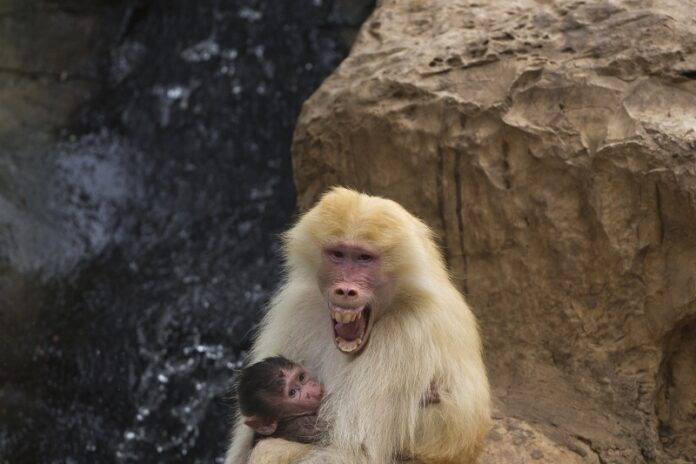
Sahara, a rare red-haired female Hamadryas Baboon holds 3 weeks old dark-furred baby in 2015 in the Ramat Gan Safari Park near Tel Aviv, Israel. Photo: Ariel Schalit / Associated Press

PARIS — Paris Zoo says visitors have been evacuated after four baboons escaped from their enclosure.

Zoo spokesman Jerome Munier said all four have been located in a closed area. Zoo employees plan to use sedative arrows to capture them and put them back with the rest of the group of 50 baboons.

Paris police intervened Friday to help secure and evacuate the zoo, which will remain temporarily closed until the end of the incident.

Guinea baboons, originated from West Africa, are classified as a “near threatened” species by the International Union for the Conservation of Nature.

Visitors can usually admire them around the zoo’s “Big Rock” that towers over the Bois de Vincennes park, in eastern Paris.

Advertisement

Death of The Nation As We Knew it

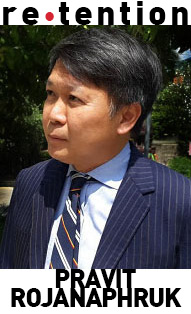
Re•tention: Pravit Rojanaphruk“Editor for Life” was what I used to think of The Nation co-founder Suthichai Yoon, a larger-than-life figure gifted in self-publicity.

At The Nation newspaper, where I worked 23 years until 2015, Suthichai was like a demigod, revered by many of his loyal staff for his abilities as a journalist.

Some years ago, I heard that top management were preparing The Nation and its sister publications and two digital TVs stations for a post-Suthichai era – a time after the passing of the 71-year-old editor and significant shareholder.

Suthichai is still alive and healthy today, but The Nation, founded four decades ago in 1971, is now without him after a hostile takeover by far-right news corp T News succeeded earlier this month.

Although I was never a big fan of Suthichai, and no one could be too surprised by a takeover three years in the making, I can’t help but feel disturbed by the latest development.

I know many would say The Nation has over the past decade morphed from a progressive newspapers into a coup-apologist cheerleader for military intervention, but there has always been a liberal acceptance for political differences among its staff. At least until I was asked to resign in September 2015, one day after being released from three days’ of junta detention without charge for “attitude adjustment” for a second time.

Long after I left, some of the minority progressives such as Supalak Ganjanakhundee continued to have space to express critical views toward the military regime.

One of the most important missions for the press in a society lacking tolerance for differing opinions is to foster tolerance and maintain a diverse stable of views.

The media can play an instrumental role in fostering a culture of tolerance by putting it into practice as a platform.

Unfortunately, what we have seen over the past decade has been the deepening of the mass media’s political polarization.

With the taking over of The Nation by right-wing, conservative media with an agenda, it can only be expected that there will be even less space for dissenting and diverse views within The Nation.

It’s feared the with-us-or-against-us mentality is growing. That the simplistic view there’s only one right view and those who think differently are not just wrong but evil continues to take root in Thai society. Much of the Thai press are partly responsible for spreading such a worldview.

Say what you may about The Nation newspaper under Suthichai and his younger brother, Thepchai Yong, who is also leaving, The Nation, at least during its heyday over a decade ago, was a bastion of committed journalism and tolerance. It even counted one of the founders of Malaysiakini.com, my ex-colleague Steven Gan, who was in charge of The Nation’s editorial page a few years prior to setting up of the famous Malaysian news website in 1999.

French political cartoonist Peray “Stephff” Stephane continues to offer his unique take on Thai politics, critical of both the military junta and Thaksin-Yingluck Shinawatra.

Change is coming to The Nation, and whatever you may think of it, the paper is unlikely to be the same. It’s unfortunate that so much of what was The Nation was based on the Suthichai personality cult – and to a lesser extent that of Thepchai – to the point that, without the two, the paper will unlikely maintain its identity, because too much of The Nation’s DNA belongs to them.

Advertisement

Grim Reminders of War in Vietnam, a Generation Later

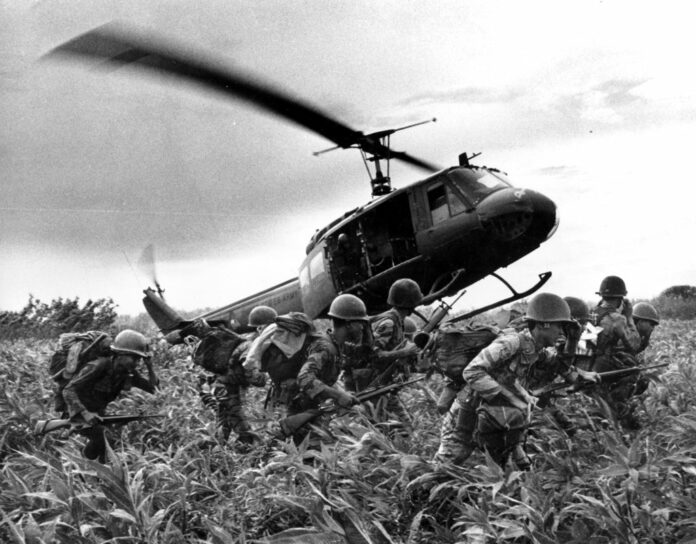
In this June 1970 file photo, taken by Associated Press photographer Huynh Cong
In this June 1970 file photo, taken by Associated Press photographer Huynh Cong "Nick" Ut, south Vietnamese Marines rush to the point where descending U.S. Army helicopter will pick them up after a sweep east of the Cambodian town of Prey-Veng during the Vietnam War. It only took a second for Associated Press Photographer Huynh Cong "Nick" Ut to snap the iconic black-and-white image of Phan Thi Kim Phuc after a napalm attack in 1972, but it communicated the horrors of the Vietnam War in a way words could never describe. Nick Ut / Associated Press

HANOI, Vietnam — It’s been over for 40-plus years, the war that Americans simply call Vietnam but the Vietnamese refer to as their Resistance War Against America.

Yet it lingers in so many ways, as was apparent this week when Defense Secretary Jim Mattis dropped in for a couple of days of defense diplomacy with a former enemy. Although he never served in Vietnam and had not previously visited the country, Mattis has said he learned from a lot of Marines who did.

In his meeting with Vietnamese government leaders, Mattis’ focus was on a peaceful future. Not the bloody past.

Still, the legacy of the conflict that divided America and ultimately unified Vietnam confronted Mattis almost immediately after his arrival on Wednesday as he visited a U.S. office that oversees the search for remains of American servicemen still missing from the war.

More than 1,200 Americans are unaccounted for in Vietnam and 350 more are missing in Laos, Cambodia and China, according to the Pentagon’s POW-MIA Accounting Agency. That accounting effort, decades in the making and dependent on cooperation from Hanoi, is likely to continue for decades.

Later, while talking to his Vietnamese counterpart, Mattis was presented with photo identification cards of two U.S. servicemen from the war. Details weren’t made public.

More than 58,000 U.S. service members were killed in the war, including more than 1,200 in Cambodia and Laos.

Estimates of the number of Vietnamese killed vary widely, from about 2 million to nearly twice that. For the Vietnamese, the war was a continuation of their fight for independence from French colonial masters. And it was quickly followed by a border war with China in 1979. The country reunified and remains communist, although it has opened up to foreign investment. Hanoi is a bustling, vibrant capital city.

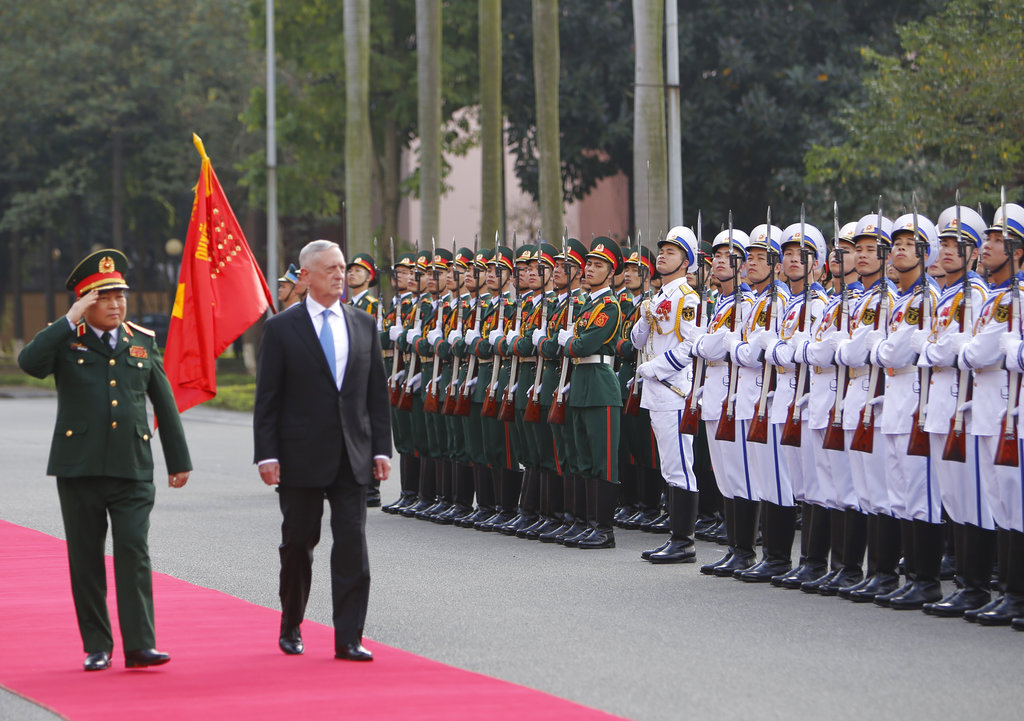
U.S. Defense Secretary Jim Mattis, at right, and his Vietnamese counterpart Ngo Xuan Lich review an honor guard before heading for talks in Hanoi on Thursday. Photo: Tran Van Minh / Associated Press

Among Vietnam’s other reminders of the war: environmental damage and unexploded mines. Vietnamese still suffer from the effects of herbicides, including Agent Orange, sprayed by U.S. forces to defoliate the countryside.

“We’re still remediating the effects of the war,” Mattis told reporters Thursday as he flew out of the country. The U.S. government has helped clean up contamination from bases American forces used before completing their withdrawal in 1975. Last year the U.S. and Vietnam finished the first phase of dioxin cleanup at Danang airport.

Remarkably, given this history, Vietnam indicated during Mattis’s visit that it may permit a U.S. Navy aircraft carrier to make a port visit in March — something that has never happened in the postwar period.

Just down the street from the hotel where Mattis stayed is Hoa Lo prison, known to the Americans who spent part of the war there as the Hanoi Hilton. Inside are dark reminders of the suffering, the sacrifice and the shackles — not just of the Americans held there but also Vietnamese imprisoned in earlier decades by the French.

One of those American prisoners was John McCain, shot down on a bombing mission over Hanoi in 1967, before the U.S. anti-war movement was in full swing. Along the lake from which a badly injured McCain was recovered by his captors stands a concrete marker depicting the captured pilot and noting that his Navy plane was one of several shot down that day.

Mattis’ motorcade drove by the McCain marker as the Pentagon boss made his way to a lakeside pagoda to show his respect for Vietnamese culture. He told the monk there that he enjoyed the serene setting.

“Beautiful. Peaceful. It makes you think more deeply,” Mattis said.

By coincidence, Mattis’ visit came just days before the Vietnamese marked the 50th anniversary of the Tet Offensive. That series of assaults by the North Vietnamese was timed to coincide with Tet, the Lunar New Year holiday, on Jan. 31, 1968. Militarily it was a failure, but the offensive marked a turning point in the war because it punctured American hopes of certain and swift victory. After Tet, the U.S. began to focus less on how to win and more on how to get out.

Even with past hostilities in mind, Mattis said his visit made clear that Americans and Vietnamese have shared interests that in some cases predate the Vietnam War.

“Neither of us liked being colonized,” he said.

Story: Robert Burns

Advertisement

Relations Between Trump, Global Elites Thaw at Davos

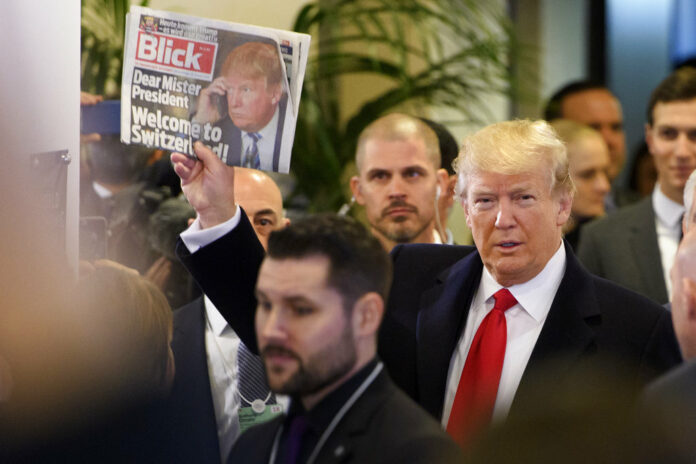
US President Donald Trump holds up Swiss newspaper 'Blick' as he arrives at the Congress Center on the last day of the annual meeting of the World Economic Forum, WEF, in Davos, Switzerland on Friday. Photo: Laurent Gillieron / Keystone

DAVOS, Switzerland — Snow was piled high outside, but inside the Davos summit, relations between President Donald Trump and the assembled global elites seemed to thaw.

Before Trump’s debut appearance at the World Economic Forum, critics speculated that the president would function as a protectionist bull in the free-trade-loving china shop. After all, this was a former reality television star who rode a wave of nationalist angst to the White House, blew up international trade deals and inflamed allies with his coarse rhetoric.

That uncertainty was clear as Trump arrived at the modern conference center Thursday for his two-day stay in the Swiss Alps. A hush fell on the crowd of people snapping photos and then someone asked the president how he would be treated.

“You tell me,” Trump shot back.

Overall, not that bad.

While there were scattered protests, some critiques and many panel discussions with Trump-wary titles — “Democracy in a Post-Truth Era” and “The Global Impact of America First” — the president’s visit also brought him praise from allies, a reception in his honor and a fawning dinner with European business executives.

“I think I have 15 new friends,” Trump enthused about his business dinner.

Before Trump’s centerpiece speech on Friday, attendees crowded around an international buffet in an open hall, dining on curry and empanadas, before filing into the brightly lit hall.

“Now is the perfect time to bring your business, your jobs and your investments to the United States,” the cheerleading president told the crowd, which seemed to regard him with a skeptical eye.

Applause was light, but the reception was generally polite.

Forum Chairman Klaus Schwab did draw some hisses in his introduction of the president when he said Trump’s presidency could be subject to “misconceptions and biased interpretations.”

And Trump himself got a mixed reaction during a brief question-and-answer session. When Schwab threatened to ask a personal question, Trump drew laughs by quipping: “I didn’t know about that.”

He also got a laugh about how he’s always been the recipient of good press coverage — but that quickly turned into boos when he made a crack about the “fake” media.

Showing up for the last two days of the summit, Trump flew over spectacular mountain scenery before landing in Davos via helicopter. Aides held Trump’s arms as he walked across the snowy landing zone to his waiting car — a wintry metaphor, perhaps, for entering the conference with caution.

It was not clear if he’d noticed a protest banner reading “Trump not welcome!” that hung on the side of a Swiss mountain.

As he moved through the conference center, political and business elites in dark suits and snow boots angled to snap his photo. Trump stopped to chat with a delegate waving a copy of “God and Donald Trump” by Stephen E. Strang. The president also waved aloft a Swiss newspaper headline declaring, “Dear Mister President Welcome to Switzerland!”

Taking time for some diplomacy along the way, Trump exuded affection in a Thursday meeting with close ally Israeli Prime Minister Benjamin Netanyahu and earlier played nice with British Prime Minister Theresa May, batting away the idea of a strained relationship. On Friday, he worked to mend relations with a key African leader following his use of a vulgar term when referring to African nations. Rwandan President Paul Kagame said they had “good discussions” on economic and trade issues.

Trump emanated confidence as he strode from room to room in the conference center, flanked by aides. “Today has been a very exciting day,” he declared to questions about how it was going.

After a reception in his honor, Trump used his dinner with business leaders to boast about the booming U.S. economy, showcasing his recent tax overhaul and deregulation efforts before soliciting comments from the group.

As he has before, Trump went around the table of CEOs, bantering with the president of Volvo about Mack Trucks, noting to a Nestle executive that he’d read candy was not their primary product and telling a Bayer executive he takes a daily aspirin.

“I should say, I only take Bayer,” Trump said. “One aspirin a day. So far, it’s been working. But it’s a great company. So are you going to be investing in the U.S.?”

Werner Baumann responded: “Yes, we are.”

Many executives praised Trump’s administration and promised, like Bayer, to do more.

Still, Trump did take a few hits.

Denmark’s finance minister, Kristian Jensen, tweeted that Trump’s address was “rather ordinary” and added that the crowd “didn’t need a sales speech” about the United States.

George Soros, the billionaire liberal philanthropist, predicted that Trump would be a “temporary phenomenon” and lose in the 2020 election if he got that far.

Of course, not that long ago in Davos, everyone predicted Trump would never win in the first place.

This week, to hear Trump tell it, not only did he come to Davos, but he also made Davos better.

Said Trump: “We have a tremendous crowd and a crowd like they’ve never had before.”

Story: Catherine Lucey
Advertisement

Federer; Injury Wake Chung Up From Aussie Open Dream

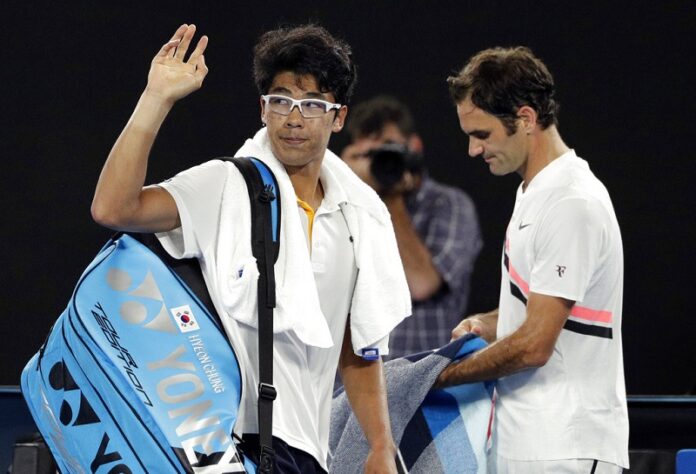
South Korea's Hyeon Chung waves as he leaves Rod Laver Arena after retiring injured from his semifinal against Switzerland's Roger Federer at the Australian Open tennis championships Friday in Melbourne, Australia. Photo: Dita Alangkara / Associated Press

MELBOURNE, Australia — Roger Federer has moved to within one win of a 20th Grand Slam singles title after reaching a record seventh Australian Open final when Hyeon Chung retired from their semifinal on Friday night.

Defending champion Federer was leading 6-1, 5-2 when Chung retired because of blisters on his left foot. Federer, who spent just over an hour on court, will play No. 6-seeded Marin Cilic in the final on Sunday night.

“I’ve played with blisters in the past a lot, and it hurts a lot. And at one point, it’s just too much and you can’t take it anymore – you can’t go on,” said Federer, who will be contesting his 30th major final. “That’s why this one feels bittersweet. I’m incredibly happy to be in the finals, but not like this.

“He’s played such a wonderful tournament, so credit to him for playing so hard again today.”

Federer beat Cilic in the final at Wimbledon last year, when the Croatian player was hampered by blisters on his feet, too.

This time, Cilic, the 2014 U.S. Open winner, has had one more day off than Federer after his semifinal win over Kyle Edmund.

The 21-year-old Chung needed a medical timeout to re-tape his left foot after going down a break in the second set and only played two more games before he quit.

Federer was utterly dominant until that point. After all, the 36-year-old Swiss star had the standing of the so-called Big Four to protect – there hasn’t been a final at Melbourne Park since 2005 that hasn’t featured Federer, Rafael Nadal, Novak Djokovic or Andy Murray.

Stan Wawrinka’s win over Nadal in 2014 was the only final since 2008 that didn’t feature two of the Big Four.

Federer set a record by reaching his seventh Australian Open final – one more than Djokovic – and has lost only one of the first six, to Nadal in 2009.

Cilic beat top-ranked Nadal in the quarterfinals and Chung stunned six-time champion Djokovic in the fourth round. And Murray, a five-time Australian Open runner-up, withdrew from the season-opening major to have surgery on his hip, leaving their collective reputation for dominance in Australia on Federer.

He didn’t let anyone down in a clinical disposal of the No. 58-ranked Chung, who won the Next Gen ATP Finals last November and had an attention-grabbing run through his first five rounds in Melbourne.

Chung was the first Korean to reach the semifinals at a major and had taken out Djokovic and No. 4-ranked Alexander Zverev on his way to the last four.

Earlier, Timea Babos of Hungary and Kristina Mladenovic of France became the first players from their respective countries to lift the Australian Open women’s doubles crown.

Babos and Mladenovic combined to beat the Russian pair of Ekaterina Makarova and Elena Vesnina 6-4, 6-3.

It’s the first Grand Slam title for Babos. Mladenovic won the 2016 French Open doubles with compatriot Caroline Garcia.

Story: Josh Pye

Advertisement

Military ‘Not Ruling Out’ Abuse of Dead Cadet

Cadet Pakapong Tanyakan poses for a photo with his parents on Aug. 16 in Nakhon Nayok province. Image: Sukanya Tanyakan / Facebook

BANGKOK — Military investigators have yet to rule out the possibility that cadet Pakapong Tanyakan might have died due to abuse by his commanding officers, a spokesman said Friday.

While an internal inquiry established that the 19-year-old cadet died of heart failure at an academy in October, armed forces spokesman Nothapol Boonngam said investigators haven’t closed the case following a Tuesday meeting between army reps and Pakapong’s family.

“We were saying for a long time that we wanted to meet them, so that we could talk and exchange views with each other,” Lt. Gen. Nothapol said. “There are many facts that we don’t know. His parents may learn those facts from other sources, which is good, because now we know we have to investigate more.”

On Tuesday the military informed Pakapong’s parents that its investigation into their child’s death confirmed what was initially announced in December: Pakapong died of sudden heart failure.

But Pakapong’s family remains convinced he might have died from abuse at the academy, Nothapol said.

“We are not ruling it out right now,” the spokesman said. “We didn’t rule it out in our investigation either. It’s just there was no [evidence] about that. So we will continue to investigate this. We have procedures to do so.”

The cadet died during training at an armed forces academy in Nakhon Nayok in October. After the news drew widespread attention and anger from the public, the armed forces announced they would investigate the chain of events that led to Pakapong’s death.

Pakapong’s family was also shocked to discover that some of the cadet’s internal organs had gone missing from his body. The military later admitted to keeping them without the family’s knowledge and returned them to his parents following social media outcry.

Monday will mark the anniversary of the founding of the academy where Pakapong studied. Key military and government officials are expected to attend, including junta chief Prayuth Chan-ocha.

Advertisement

Hot News

LATEST NEWS

Bangkok
overcast clouds
30.2 ° C
31.6 °
28.8 °
76 %
4.5kmh
100 %
Tue
34 °
Wed
34 °
Thu
35 °
Fri
31 °
Sat
31 °