
































27.7 C
Bangkok
Monday, June 22, 2026
Home Blog Page 2100

Three Years of Excuses Later, BTS Still Not Accessible

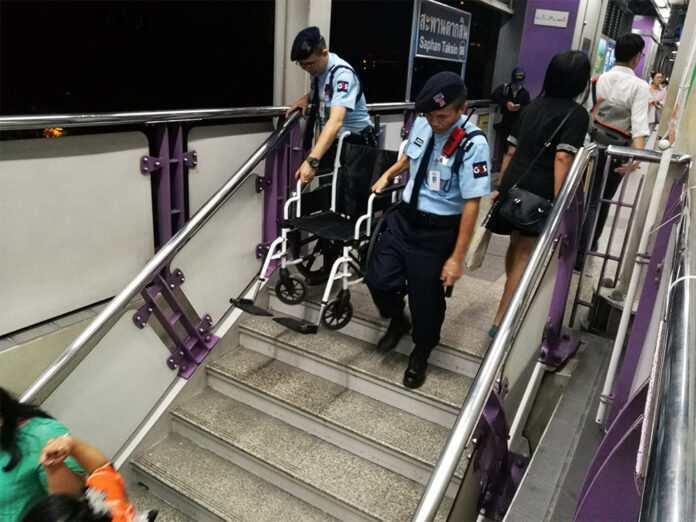
Private security carry a commuter's wheelchair down the stairs Tuesday at BTS Saphan Taksin. Three years after the highest court gave the city 12 months to make all stations wheelchair-accessible, the work remains incomplete.

Top: Private security carry a commuter’s wheelchair down the stairs Tuesday at BTS Saphan Taksin. Three years after the highest court gave the city 12 months to make all stations wheelchair-accessible, the work remains incomplete.

BANGKOK — The BTS Skytrain remains inaccessible to commuters with disabilities three years after the courts ordered City Hall to install elevators, and a class-action suit remains in administrative limbo one year after it was filed.

As of Saturday, the anniversary of both the landmark 2015 court ruling and historic 2017 lawsuit, some stations still lack functioning lifts. Most with elevators connecting to ground level are only available on one side of the street.

“Along BTS lines, new malls pop up on a daily basis,” said Manit Intharapim,  the wheelchair user who for years has fought for access to the popular rail service. “It takes them a year to build such malls. How difficult is it then to install elevators?”

Read: Activists Ask Court to Probe City Hall’s Failure to Make BTS Accessible

Manit, members of advocacy group Transportation for All and other disabled commuters traveled en masse one year ago today to the Civil Court to file a class-action lawsuit against the Bangkok Metropolitan Administration, or BMA, one of Thailand’s first such suits.

Lawyers for City Hall challenged it on administrative grounds. The case has yet to be taken up in any venue.

The BMA’s top traffic and transportation official, Thanoochai Hoonniwat, said the BMA would continue working toward fully equipping all stations with lifts.

“This is not about winning or losing. It’s our duty to enable access and comfort,” Thanoochai said, adding that at least 100 million baht is being sought in this year’s budget to install more lifts to satisfy the Supreme Administrative Court’s 2015 order.

Siding with the plaintiffs after a long legal battle, the 2015 decision gave City Hall one year to make all stations accessible. That deadline came and went without a single elevator installed. BMA officials, who have come and gone over the years, have cited difficulties in completing the work and promised new completion dates they were unable to meet.

In March, Bangkok’s junta-appointed governor, Aswin Kwanmuang, said he’d push for the work to be completed by the end of 2017.

Thanoochai, who recently took the helm of the Department of Traffic and Transportation, said he could not pin down any time frame for when it would be done.

“It would be a lie [to do so]. And this is not an excuse,” he said, citing external factors such as complicated underground electrical lines at spots such as BTS Sala Daeng, which requires major work by the utilities and has hindered progress.

Our look in 2016 at BTS accessibility

Half Measures

Of the original Skytrain stations that opened in 1999 – Mo Chit to On Nut on the Sukhumvit Line and National Stadium to Saphan Taksin on the Silom Line – elevators were later added to five: Siam, Asoke, Mo Chit, On Nut and Chong Nonsi.

In August, the activists identified 18 BTS stations as not being fully accessible. (see box for our latest updates on the status of these stations.)
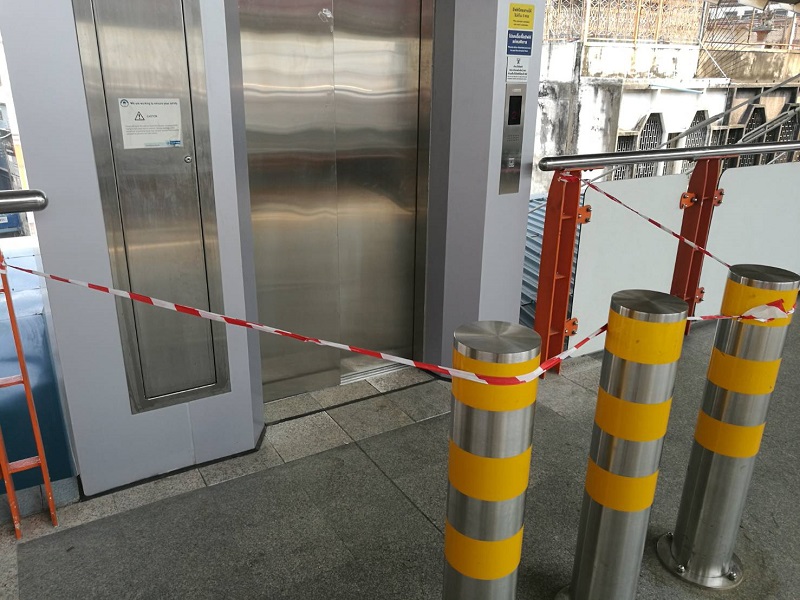
The elevator at BTS Saphan Khwai was cordoned off Tuesday.
The elevator at BTS Saphan Khwai was cordoned
off Tuesday.

Most stations now have functioning elevators from the street to the ticket-selling concourse, where separate elevators go up to both sides of the platform. But most only have one that goes down one side of the street.

Read: Broken Promises: BTS Still Off Limits to Disabled

BTS Nana has no lift to the street. BTS Chong Nonsi, a station with two elevators from the street is still problematic, according to Sonthipong Mongkonsawat, the activist group’s pro bono lawyer.

“Once you take a lift down to ground level on Chong Nongsi station, you are dead … because you will find yourself on a traffic island,” he said. “If a disabled person takes the lift, he would probably be run down by a car.”

Manit of Transportation for All is particularly outraged by the lack of access to both sides of the street. He acknowledges that the court order didn’t spell out that ground lifts must installed on both sides of the traffic, but believes it should be clear to the BMA as necessary to be considered accessible.
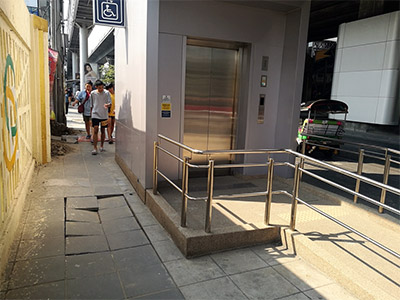
Sidewalk access to the elevator at BTS National Stadium is limited.
Sidewalk access to the elevator at BTS National
Stadium is limited.

“They told us we should take a taxi to go to the other side,” said Manit, 51, who has used a wheelchair since he was in a car accident at 24.

Manit refused to identify which BMA official told him to take a cab.

“Try tying yourself to a wheelchair and flagging a cab to go to the other side of the street and see how complicated life gets. It’s been very hard. I want to see sincerity on the part of the BMA.”

Return to the Courts

Thanoochai meanwhile said the BMA will eventually install lifts on both sides of the streets, adding that there the BMA does not disagree it should be done. He said City Hall would make its best effort to ensure that all stations lifts on both sides of the street where they are situated.

Still, a slew of unkept promises over the years is what led activists on Jan. 20, 2017, two years after the original decision, to seek another bold remedy from the courts: millions of baht in punitive compensation.

The lawsuit, filed after new legislation allowed class actions, has stalled since the city challenged which court can hear it.
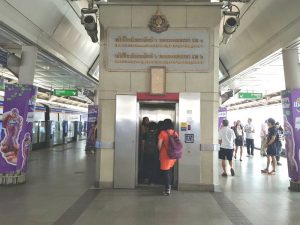
Commuters use the elevator Wednesday at BTS Siam.

“It’s like our side is trapped in a pothole and immobilized,” Manit said. “We will probably have to continue using social measures.”

Sonthipong, the lawyer helping with the class action, said he expects some clarity on their lawsuit in the next month or two, now that a judicial committee has been set up to decide which court has jurisdiction over the case.

The suit seeks 1,000 baht for each plaintiff to join the class for every day that has passed since the court-ordered completion deadline of Jan. 21, 2016. It seeks 4,000 baht for every day that has passed since the suit was filed one year ago, plus 7.5 percent annual interest.

Sonthipong said some of the excuses cited over the years by the BMA for years of delay are reasonable, such as issues coordinating with the utilities in charge of underground infrastructure.

He also agreed that some stations were not structurally built to accommodate the addition of elevators.

Then there’s opposition by shopkeepers in some areas who see an elevator shaft in front of their shophouse as a business-killer. Sonthipong argues that the BMA has the legal authority to relocate and compensate such shop owners to make way for construction, however.

Additionally, as long as there exist access to the elevated stations from only one side of the road, the BTS system does not meet international standards and cannot be considered genuinely accessible, Sonthipong said, adding that his clients are not ruling out further legal action against City Hall.

Additional reporting Lobsang Dundup Sherpa Subirana, Asaree Thaitrakulpanich and Todd Ruiz

Related stories:

Activists Ask Court to Probe City Hall’s Failure to Make BTS Accessible

City Hall Challenge Delays Decision on BTS Accessibility Suit

Elevators Unveiled at Four BTS Stations – But Do They Work?

How Long to Install BTS Elevators? City Hall Says 3 Years.

Wheelchair Rally to File Class-Action Lawsuit Over BTS Accessibility at Court

City Hall Fails to Make BTS Accessible 2 Years After Court Ruling

Broken Promises: BTS Still Off Limits to Disabled

BTS Stations Remain Inaccessible to Disabled, a Year After Landmark Ruling

Court Orders Skytrain to Accommodate Disabled Passengers

Advertisement

2017 Was Hottest Year Without an ‘El Nino’

A man walks his dog across the snow-covered beach while a cargo ship sits in the steaming fog of Lake Ontario in Toronto. According to a report released on Thursday, Jan. 18, 2018, U.S. and British scientists calculate that 2017 wasn’t the hottest year on record, but close and unusually warm for no El Nino cooking the books. Photo: Frank Gunn / The Canadian Press

WASHINGTON — Earth last year wasn’t quite as hot as 2016’s record-shattering mark, but it ranked second or third, depending on who was counting.

Either way, scientists say it showed a clear signal of man-made global warming because it was the hottest year they’ve seen without an El Nino boosting temperatures naturally.

The National Oceanic and Atmospheric Administration and the United Kingdom’s meteorological office on Thursday announced that 2017 was the third hottest year on record. At the same time, NASA and researchers from a nonprofit in Berkeley, California, called it the second.

The agencies slightly differ because of how much they count an overheating Arctic, where there are gaps in the data.

The global average temperature in 2017 was 58.51 degrees (14.7 degrees Celsius), which is 1.51 degrees (0.84 Celsius) above the 20th century average and just behind 2016 and 2015, NOAA said. Other agencies’ figures were close but not quite the same.

Earlier, European forecasters called 2017 the second hottest year, while the Japanese Meteorological Agency called it the third hottest. Two other scientific groups that use satellite, not ground, measurements split on 2017 being second or third hottest. With four teams calling it the second hottest year and four teams calling it third, the United Nations’ World Meteorological Organization termed 2017 a tie for second with 2015.

“This is human-caused climate change in action,” said Nobel Prize winning chemist Mario Molina of the University of California San Diego, who wasn’t part of any of the measuring teams. “Climate is not weather, (which) can go up and down from year to year. What counts is the longer-term change, which is clearly upwards.”

Which year is first, second or third doesn’t really matter much, said Princeton University climate scientist Gabriel Vecchi. What really matters is the clear warming trend, he said.

NOAA’s five hottest years have been from 2010 on.

During an El Nino year — when a warming of the central Pacific changes weather worldwide — the globe’s annual temperature can spike, naturally, by a tenth or two of a degree, scientists said. There was a strong El Nino during 2015 and 2016.

But 2017 finished with a La Nina, the cousin of El Nino that lowers temperatures. Had there been no man-made warming, 2017 would have been average or slightly cooler than normal, said National Center for Atmospheric Research climate scientist Ben Sanderson.

On the other hand, NASA calculated if the temperature contributions of El Nino and El Nina were removed from the global data through the years, 2017 would go down as the hottest year on record, NASA chief climate scientist Gavin Schmidt said.

Carbon pollution is like putting the Earth on an escalator of rising temperatures, with natural variation such as El Nino or the cooling effect of volcanoes like hopping up or down a step or two on that escalator, scientists said. Not every year will be warmer than the last because of natural variations, but the trend over years will be rising temperatures, they said.

The observed warming has been predicted within a few tenths of a degree in computer simulations going back to the 1970s and 1980s, several scientists said.

It has been 33 years since the last month that the globe was cooler than normal, according to NOAA.

Northern Illinois University climate scientist Victor Gensini has never lived through a month or year that wasn’t hotter than normal.

“I look at pictures of the great winters of the late ’70s from my parents and wonder if I’ll ever experience anything like that in my lifetime,” said Gensini, who’s 31.

Story: Seth Borenstein

Advertisement

Drone Saves Two Swimmers During Test Flight (Video)

CANBERRA, Australia — A flying drone has dropped a flotation device to two teens caught in a riptide in heavy seas off the Australian coast in what officials describe as a world-first rescue.

Monty Greenslade and Gabe Vidler got into trouble on Thursday at Lennox Head, 750 kilometers north of Sydney. They were about a kilometer from lifeguards, who were about to start training with one of the new drones equipped with a camera, rescue gear and six rotors.

After a friend raised the alert, lifeguard Jai Sheridan said he piloted the drone to the swimmers and dropped a rescue pod minutes faster than lifeguards could have reached the pair by conventional means.

“I was able to launch it, fly it to the location, and drop the pod all in about one to two minutes. On a normal day, that would have taken our lifeguards a few minutes longer to reach the members of the public,” Sheridan said in a statement.

Greenslade, 16, said Friday the pair were lucky that the drone had been nearby.

“We realized pretty quickly that it was a rescue drone, once we heard it,” Greenslade told Nine Network television. “It was pretty noisy, so it was kind of hard to miss it, to be honest.”

“With the heavy waves, we were sort of going under and coming up for breath and … the drone dropped the package and we both grabbed on pretty quickly. It’s kind of obvious what you’re supposed to do with it,” he added.

Vidler, 17, told Nine: “It was pretty heavy out there and we were a little bit concerned.”

“It just dropped the life raft and so we just held on to that and just swam into shore,” Vidler said.

It was the first drone rescue since the New South Wales state government last month invested 430,000 Australian dollars (11 million baht) in drone technology for rescue and shark spotting work in the state’s north.

“This is a world-first rescue,” state Deputy Premier John Barilaro said. “Never before has a drone, fitted with a flotation device been used to rescue swimmers like this.”

Story: Rod McGuirk

Advertisement

Traffic Alert: Yellow Line Work Starts Tonight

BANGKOK — Another day, another detour.

Yellow Line construction begins Friday night and will put the crunch on the ever-lousy Lat Phrao Road when the first phase of the 30-kilometer stretch – linking MRT Lat Phrao to the east and south by way of BTS Samrong – begins construction at 10pm.

Portions of Lat Phrao Road will be closed for the duration of the first phase of construction, which starts tonight and continues for about eight months. That includes several hundred meters of the outermost lanes going both ways.

Several hundred meters of the outermost, westbound lane will be closed between sois Lat Phrao 136 and 134. The same goes for the eastbound side of the road from Soi Lat Phrao 45/1 to Soi Lat Phrao 45.

Transit spokeswoman Naruemon Poomhoi broke down some traffic pro tips for wary end-of-week commuters:

“There’s extra traffic expected, so please try driving along some shortcuts such as going into Soi Lat Phrao 130, which will connect through Soi Ramkhamhaeng 81, or going into Soi Lat Phrao 80 which will go through to Soi Pracharat Bamphen 26.”

The entire, 52-billion-baht extension, including 25 new stations, is expected to take three years and three months to complete, though most major rail projects have seen years of delay.

By the time it reaches BTS Samrong, that station will no longer be the terminus of the Sukhumvit Line. Eight additional stations planned along the Sukhumvit Green Line – which will push 13 kilometers toward the Gulf of Thailand – will be operating by December, Surapong Laoha-Unya of the Bangkok Mass Transit System said last month.

An average of more than 660,000 people ride the BTS each day, a ridership expected to grow by 3 percent to 5 percent annually. BTS profits for 2017 were at 10.4 billion, according to Surapong. He said the BTS plans to purchase 46 more trains to accommodate the additional lines.

Advertisement

Activist Assaulted While Protesting Prawit’s Luxury Watches

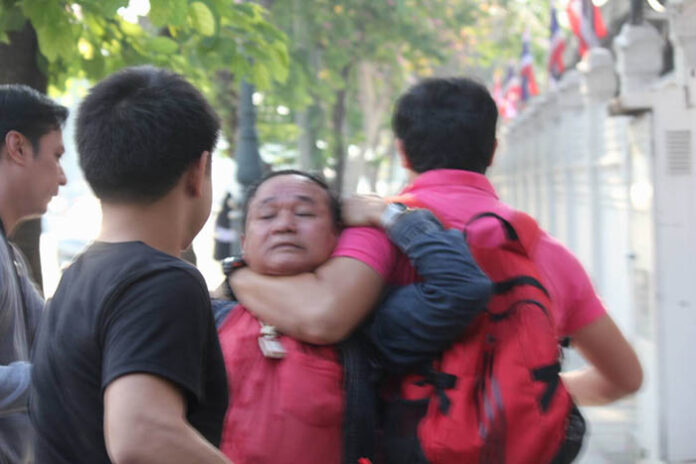
Undercover police drag Rittikrai Chaiwannasan away Friday moments after he assaulted pro-democracy activist Ekachai Hongkanwan.

BANGKOK — A man was arrested Friday after attempting to punch an activist who has been staging daily protests over a junta boss’ collection of luxury watches at the Government House.

Rittikrai Chaiwannasan, 56, was charged with physical assault and carrying a knife in public. A police official said undercover officers stopped Rittikrai just in time before he harmed activist Ekachai Hongkangwan.

“He didn’t get to punch Ekachai,” Dusit station chief Jakkrit Chosungnoen said. “I think officers did well in this case. They were able to intercept him.”

Police found a pocket knife on Rittikrai, Col. Jakkrit said, adding that he would be brought before a court today.

For the past week, Ekachai and a friend have maintained a two-man protest in front of the Government House to draw attention to the ever-growing number of undeclared luxury watches spotted on deputy junta chairman Prawit Wongsuwan’s wrist.

Ekachai said today’s protest started off as normal. He arrived at the bus stop at about 8:45am, he said, and undercover police who usually trail him in town followed as he made his way to the entrance of the building that is the prime minister’s seat of power.

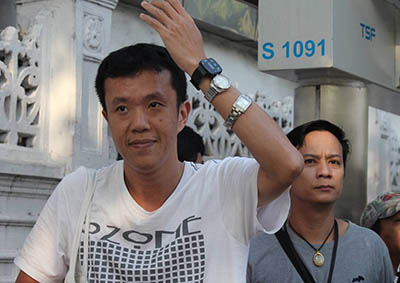
Ekachai Hongkangwan displays the watches worn on his wrist as a part of his protest today at the Government House in Bangkok.
Ekachai Hongkangwan displays the watches
worn on his wrist as a part of his protest today
at the Government House in Bangkok.

Ekachai said a man violently pulled his shoulder and threw a plastic coffee cup at him, prompting nearby officers to tackle the assailant and drag him away.

“If police didn’t get him in time, something more serious may have happened,” Ekachai said.

Col. Jakkrit said Rittikrai was being questioned about his background and motives as of publication time. However, Ekachai – a former lese majeste convict who has had numerous run-ins with law enforcement for his political stunts – said he was convinced his attacker was acting on orders from the government.

“He was definitely sent to do it,” Ekachai said. “In the past, I’ve encountered this kind of thing before, but at most they were just pointing at my face and scolding me. In this case, he closed up on me, even though there were many policemen. Someone was definitely behind it.”

Gen. Prawit has been under pressure to explain how he acquired a great number of multi-million baht watches – the latest count put them at 25 – and why he did not declare them among his mandatory asset disclosures as required by anti-graft law.

At a Tuesday news conference, Prawit said he borrowed the timepieces from unidentified friends, an explanation met with much ridicule by the public.

The 72-year-old junta strongman declined to answer reporters’ questions today about the attempted assault on Ekachai.

Advertisement

Modest Minimum Wage Hike Approved, 1st Since 2013

Photo: Matichon

BANGKOK — The national minimum wage was increased by the military government Wednesday for the first time in nearly five years.

A seven-hour special cabinet meeting ended Wednesday with labor officials announcing nationwide increases ranging from five baht to 22 baht in different regions.

“In the meeting we discussed the economic considerations, cost of living and competitive potential of each province,” said Jarin Chakkaphark, the Labor Ministry permanent secretary who headed Wednesday night’s meeting.

The new policy will go into effect April 1. Seven different rate increases were approved depending on location. Phuket, Chonburi and Rayong provinces will see the highest rate paid of 330 baht per day. The lowest paid workers will continue to be found in the southernmost provinces.

A national minimum wage of 300 baht per day was set in 2012. Since then, workers in some regions but not others have gotten increases, with the minimum wage in 2017 ranging from 300 baht to 310 baht depending on the province.

An academic Thursday called the move a populist measure to garner popularity for the ruling junta before general elections slated for later this year.

“This is actually a large increase,” said Bundit Thanachaisethavut, who researches labor issues.

Bundit said that the wage increase, the first to be done across the board since 2012, is a political strategy on the government’s part to “build a relationship with citizens.”

“You’ve seen economic policies such as the ‘Shop to Save the Nation’ tax breaks. These and this wage increase policy is a strategy to get votes. [Junta leader Gen. Prayuth Chan-ocha] even declared himself to be a politician,” Bundit said.

Bundit said that as an economics expert, he had not expected the government to pass an increase of more than 15 baht. He was surprised that Bangkok was no longer among the provinces with the highest rate.

“Phuket has only had a minimum wage higher than Bangkok once, and this is the first time for Chonburi and Rayong,” Bundit said. “The government wants to to win public approval and develop industries there based on employers’ paying power.”

Workers in Bangkok, Nakhon Pathom, Nonthaburi, Pathum Thani, Samut Prakan, Samut Sakhon and Chachoengsao provinces will see an increase to 325 baht per day.

In Ubon Ratchathani, Suphan Buri, Saraburi, Ayutthaya, Nong Khai, Lopburi, Trat, Khon Kaen, Songkhla, Surat Thani, Krabi, Chiang Mai, Nakhon Ratchasima and Phang Nga, the increase will be to 320 baht.

Workers will earn a minimum of 318 baht per day in Chanthaburi, Samut Songkram, Sakon Nakhon, Mukdahan, Nakhon Nayok, Kalasin and Prachinburi provinces.

Roi Et, Prachuap Khiri Khan, Nakhon Sawan, Sa Kaeo, Phattalung, Uttaradit, Udon Thani, Buriram, Surin, Phetchaburi, Phitsanulok, Phetchabun, Chai Nat, Loei, Yasothon, Phayao, Bueng Kan, Nan, Kanchanaburi and Ang Thong will see an increase to 315 baht.

The southernmost provinces of Narathiwat, Yala and Pattani will have the lowest minimum wage of 308 baht.

The remaining 22 provinces will see an increase to 310 baht.

Advertisement

Master of Thai Satire ‘Kai Maew’ Disappears (Updated)

Original image: Kai Maew / Facebook

Update Feb. 16, 2018: ‘Kai Maew X’ appears to have returned at a slightly different address. A new comic was posted at about 2pm showing the Thaksin Shinawatra character showering money on the illustrator-as-everyman.

BANGKOK — The internet on Friday mourned the apparent loss of a webcomic that had become ubiquitous online for its sharp satire of the ruling junta and other current events.

Kai Maew, run by the creator of the breakup meme that hit the world late last year, abruptly disappeared from Facebook on Thursday afternoon. The artist – who remains anonymous to this day – had not announced any intention to remove the page.

Tributes from netizens and other online communities soon filled social media, with many saying they would miss the almost-daily cartoons taking jabs at the military regime’s cast of colorful characters.

Read: Dangerously Funny Webcomic Satirizes Thai Politics

“You left without a word of goodbye. My heart wasn’t prepared for this,” Basement Karaoke croons for Kai Maew with lyrics from a breakup song “Farewell Party” by SoCool.

With more than 450,000 followers, Kai Maew was one of the most prominent online presences.

Speculation about the cause for its demise has included successfully convincing Facebook to remove it or the authorities tracking down the artist. The junta has previously detained and arrested people for satirical online content.

“I think it might be because many accounts were mobilized to report [Kai Maew]. It’s possible,” pro-democracy activist Ratthapol Supasopon said.

The page is best known for four-panel comics that featured characters ripped from the headlines and mercilessly mocked figures not known for tolerating the content such as junta chairman Gen. Prayuth Chan-ocha and his underlings. Users engaged with the comic in comments and each edition came with a hidden figure of junta nemesis Thaksin Shinawatra to find.

Kai Maew, a reference to a derogatory nickname for Thaksin’s followers, not only lampooned the latest scandals involving the regime, but also current affairs and celebrity news.

The same illustrator is also behind webcomic page Tod Maew, which deals less with politics and more with absurd humor. It’s also where the “Thai Political Crisis Breakup” meme was first born. The Tod Maew page did not respond to messages seeking inquiry as of Friday morning.

Advertisement

Helicopter With Zimbabwe Opposition Leader Crashes, Kills 5

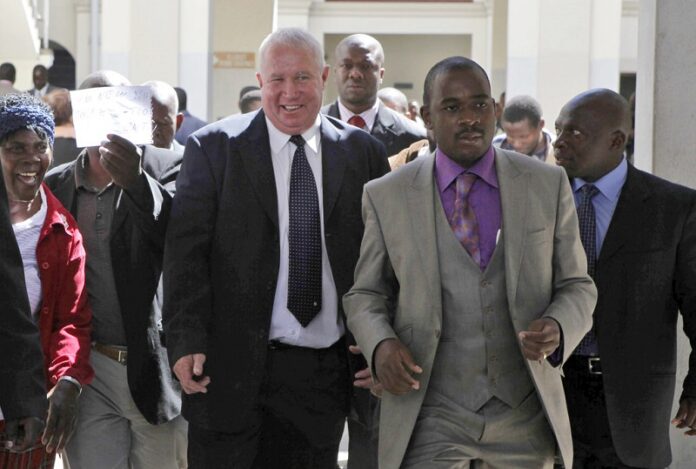
Roy Bennett, center left, leaves the High Court in 2010 in Harare, Zimbabwe, after he was acquitted of terrorism charges. Photo: Tsvangirayi Mukwazhi / Associated Press

RATON, New Mexico — A group of prominent friends, including a key Zimbabwean opposition leader and a Texas-based investor and philanthropist, was heading to a ranch in the U.S. state of New Mexico when their helicopter crashed and burned in a remote area, killing five people aboard.

Friends and family members confirmed Thursday that opposition leader Roy Bennett and his wife, Heather, had traveled to New Mexico to spend their holiday with friend and wealthy businessman Charles Burnett III at his ranch. Burnett’s friends, pilot Jamie Coleman Dodd of Colorado and co-pilot Paul Cobb of Texas, were ferrying the group aboard a Huey UH-1 when it went down after dark Wednesday.

All five died, according to New Mexico State Police.

The only survivor was Andra Cobb, the co-pilot’s daughter who was in a long-term relationship with Burnett. She was able to escape before the helicopter burst into flames.

Her voice breaking, Martha Cobb told The Associated Press that her 39-year-old daughter was hospitalized with broken bones.

“She’s just very distraught,” the mother said in a telephone interview. “I’m just glad my daughter is OK, but I hate that my husband of 41 years is gone.”

Martha Cobb and her husband had befriended the Bennetts while traveling on cruises.

Roy Bennett, 60, treasurer-general of the Morgan Tsvangirai’s Movement for Democratic Change opposition party, won a devoted following of black Zimbabweans for passionately advocating political change.

Bennett, a white man who spoke fluent Shona and drew the wrath of former President Robert Mugabe, survived a traumatic year in jail and death threats over his work. He was known as “Pachedu,” meaning “one of us” in Shona and was often called the sharpest thorn in Mugabe’s side.

Obert Gutu, spokesman for the MDC-T party, described Bennett’s death as a “huge and tragic loss.”

Burnett, born in England, inherited part of a family fortune and had been friends for some time with the two pilots, said his personal lawyer, Martyn Hill.

Both Dodd and Cobb were experienced aviators who would not have taken unnecessary risks in the helicopter, Hill said. Cobb served in Vietnam and survived being shot down, he said.

A 911 call from Andra Cobb alerted authorities to the crash, whose cause is under investigation. There was no indication of bad weather that night.

Officials launched a search but said the response was slow because of the rugged terrain and lack of access. Engulfed in flames, the wreckage of the helicopter registered to an aviation company linked to Burnett was spotted on a ranch.

The group was heading to the Emery Gap Ranch, a mountainous property on the Colorado-New Mexico border. Burnett bought it in February 2017, said Sam Middleton, a real estate broker in Lubbock, Texas, who helped with the purchase.

Middleton called Burnett a “fun loving” person who enjoyed entertaining, at times extravagantly.

In Zimbabwe, Tendai Biti, a prominent opposition leader and a former finance minister, tweeted that the Bennetts’ “tragic passing” was “a blow to our struggle.” David Coltart, an opposition figure, said the couple were “two of Zimbabwe’s greatest patriots.”

In 2004, Roy Bennett was jailed for a year for assaulting a Cabinet minister who had said Bennett’s “forefathers were thieves and murderers” during a parliamentary debate. An enraged Bennett charged the minister, who fell to the floor.

He emerged from prison rail-thin and scarred from repeated sunburns. He told of the mistreatment of fellow prisoners, some of whom he said had starved to death in their cells.

After receiving death threats, Bennett fled Zimbabwe but returned in 2009 after his party nominated him for the deputy agriculture minister in a coalition government with Mugabe’s ZANU-PF. Mugabe, who had repeatedly alleged Bennett was the opposition party’s contact with foreign funders, refused to swear him in.

Bennett later returned to South Africa but remained a vocal critic of Mugabe’s rule. He also criticized his former party for allegedly enjoying the comforts of government while ordinary Zimbabweans suffered.

Story: P. Solomon Banda, Nomaan Merchant

Advertisement

Defense Stymied as Trial Resumes in Kim Jong Nam Murder

Indonesian suspect Siti Aisyah, left, and Vietnamese suspect Doan Thi Huong, both suspects in the killing of Kim Jong Nam, North Korean leader Kim Jong Un's estranged half brother, are escorted out of court by police officers last March in Sepang, Malaysia. Photo: Daniel Chan / Associated Press

KUALA LUMPUR — Malaysia’s high-profile trial of two women accused of killing the estranged half brother of North Korea’s leader resumes Monday after a seven-week recess, with defense lawyers saying their efforts have been stymied by missing links.

Indonesia’s Siti Aisyah, 25, and Vietnam’s Doan Thi Huong, 29, are accused of smearing a nerve agent on Kim Jong Nam’s face in a crowded airport terminal in Kuala Lumpur last Feb. 13. The two are the only suspects in custody, though prosecutors have said four North Koreans who fled the country were also involved.

Prosecutors have focused on proving the women’s guilt but shied away from scrutinizing any political motive behind the killing.

Gooi Soon Seng, the lawyer for Siti Aisyah, said the defense will seek to shift the focus to the North Koreans but their case is largely crippled by the lack of crucial evidence such as the content of Kim Jong Nam’s mobile phone, which could provide clues on why he was killed. Prosecutors say the phone and most of his belongings, along with Kim’s body, were returned to North Korea in the days after his murder.

“The content of his phone is vital because it could show how he arrived at the airport, who he linked up with in Malaysia, what actually happened. Until now, there is no evidence of possible debts, love affairs or revenge that could cause someone to take his life. We are saying it’s a political assassination because of the involvement of the North Korean Embassy,” Gooi told The Associated Press.

A police witness has testified that a car used to take the North Korean suspects to the airport on the day of the murder belonged to the embassy. The court also heard that an embassy official met the suspects before they fled and facilitated their check-in at the airport.

Here’s a look at the evidence that has emerged since the trial began in October.


The Victim

Kim Jong Nam was seen on airport security video being approached by two women who appear to smear something on his face. The footage showed Kim gesturing for help before he suffered seizures. He was dead within two hours.

An autopsy showed the banned VX nerve agent was found on Kim’s face and in his eyes, blood and urine, and other tests found it on his clothing and bag. His brain, lungs, liver and spleen were damaged. Doctors concluded the cause of death was “acute VX nerve agent poisoning,” and ruled out any other contributing factors.

Police testified Kim was carrying eight currencies, including $124,000. Ironically, he also carried a known antidote for nerve agents.

Kim, the eldest son in the family that has ruled North Korea since its founding, had been living abroad for years after falling out of favor. It is thought he could have been seen as a threat to his half brother Kim Jong Un’s rule.


The Defendants

If they are convicted, the two women could face the death penalty but not if they lacked intent to kill. That is their defense.

The court has heard that traces of VX were found on the women’s clothing as well as on Huong’s fingernails. A government chemist testified that VX was a “strategic” choice of poison because it doesn’t evaporate quickly and a victim could be targeted without affecting the surroundings.

The chemist told the court that rubbing VX on a person’s eye would be the fastest way to kill because the eyes have no barrier like the skin. He said the palm is the least sensitive area and VX can be safely washed from the hand within 15 minutes of exposure, which could explain why the women weren’t affected.

Prosecutors contend the women knew they were handling poison and deliberately rushed to wash their hands after the attack. Security footage shows both holding their hands away from their bodies as they hurry to separate restrooms.

Defense lawyers argued that the women didn’t flee the country or discard their clothing, indicating they didn’t know they were handling poison. They say the women believed they were playing a prank for a hidden-camera TV show.


The North Koreans

Police have told the court that several North Korean men helped plot the attack, including a man one of the women says hired her to stage pranks. The four men left Malaysia on the day of the killing. North Korea has denied any involvement.

A police investigator identified the four as Hong Song Hac, Ri Ji Hyon, Ri Jae Nam and O Jong Gil. On Malaysia’s request, Interpol has issued wanted notices for the men, who are believed to be back in Pyongyang, but North Korea is not a member of the organization.

Airport security video played in the courtroom showed all four discarding their belongings and changing their outfits after the attack. They were then seen meeting North Korean Embassy official Hyong Kwang Song and Air Koryo official Kim Uk-Il in another part of the airport before flying out of the country.

The embassy and officials of Air Koryo, North Korea’s state airline, have told police it was their duty to assist North Korean citizens leaving the country. Those two and another North Korean whom police were seeking to question were allowed to leave the country along with Kim Jong Nam’s body in March in exchange for the release of nine Malaysians stuck in North Korea.

The court heard that Hong Song Hac orchestrated the operation on the ground.


What’s Next?

When the trial resumes, defense lawyers are to cross-examine the chief police investigator, viewed as the most important witness.

They are expected to ask him about the role of North Korean chemist Ri Jong Chol, who was detained shortly after the killing but was released due to lack of evidence and deported. Defense lawyers said Ri, who had used a North Korean Embassy car since 2015, was a key suspect and his house could have been used to make the nerve agent used in the killing.

However, Siti’s lawyer Gooi said he needed more time to analyze the content of mobile phones and laptops belonging to Ri and suggested prosecutors may instead continue with other witnesses in next week’s three-day hearing.

Prosecutor Wan Shaharuddin Wan Ladin told the AP that the defense had ample time to prepare and that prosecutors won’t call any new witnesses until the defense finishes questioning the police investigator. The judge will likely have to decide the conflict.

Malaysian officials have never officially accused North Korea of involvement in Kim’s death and have made it clear they don’t want the trial politicized.

So far, 26 witnesses have testified. Prosecutors have about a dozen more minor witnesses to call before they are expected to rest their case in March. The judge could then decide that there is no case against the women, who will be freed, or to let the case continue. If that’s his decision, the defense will be called and the trial will continue for several more months.

Advertisement

Luksika Falls to Petra Martic in 3rd Round of Aussie Open

MELBOURNE, Australia — Petra Martic celebrated her 27th birthday with a 6-3, 3-6, 7-5 win over Luksika Kumkhum to advance to the fourth round at Melbourne Park.

The Croatian player will take on Elise Mertens or Alize Cornet in the final 16. Luksika had beaten Belinda Bencic in the second round after Bencic defeated Venus Williams in the first.

On Thursday, 2016 champion Angelique Kerber celebrated her 30th birthday with a second-round win over Donna Vekic.

Advertisement

Hot News

LATEST NEWS

Bangkok
overcast clouds
27.7 ° C
27.7 °
27.7 °
80 %
1.2kmh
100 %
Sun
30 °
Mon
36 °
Tue
37 °
Wed
37 °
Thu
36 °