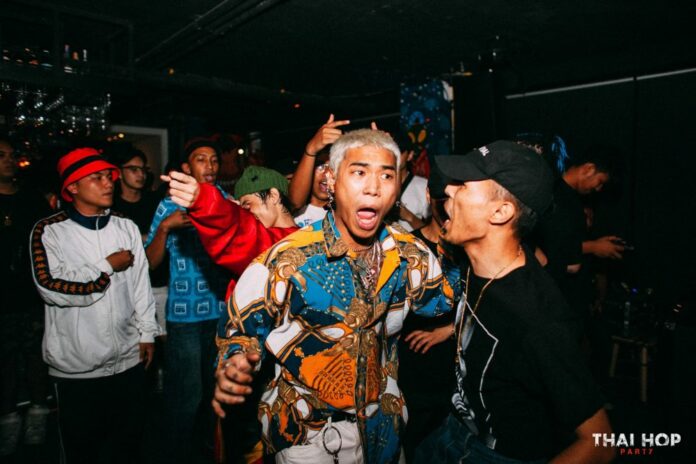
BANGKOK — More than 50 musicians from electronic and hip-hop to heavy rock will gather in an outdoor space for a 12-hour party.
Four stages will go up in the heart of the city forBangkok Block Party, an all-day event bringing together music, food, drinks, workshops, barbers and tattoo art.
The international lineup leads off with Chicago indie trio Autograf, Nashville-based electro-indie duo Cherub and rap duo The Cozy Boys.
Electropop act X0809’s NoteP and techno DJ Dan Buri will perform as well as underground punk rock group The Greed, hardcore act License to Kill and many more.
Hip-hop scene ain’t dead. Thai-Swedish rapper Thaiboy Digital and Phuket-based hip-hop act Southside will perform along with up-and-coming Fiixd and Youngohm.
The money made from the event will go to “a good cause” to help orphans and refugees in the country, said Supreda “Nick” Sotawong, co-founder of the event and owner of hip-hop nightclub Blaq Lyte.
The “block party” will take place noon through midnight on Saturday, Jan. 13, at A Square. No idea where that is? It’s located on Soi Sukhumvit 26 just off Rama IV Road and shares the same venue with Rockademy Thailand, popular Peking Duck joint An An Lao and simulated surfing center Flow House Bangkok.
Tickets purchased online are 900 baht. They’re 1,500 baht at the door.
Kiradech Aphibarnrat seen here during the French Open in 2014. Photo: Cyrille BERTIN / Wikimedia Commons
AUGUSTA, Georgia — A late surge by Kiradech Aphibarnrat makes him among nine players projected to get invitations to the Masters by finishing the year in the top 50 in the world ranking.
Kiradech ended his year with four straight top 10s, including a fifth-place finish Sunday in the Indonesian Masters. The Thai is projected to finish the year at No. 49, one spot ahead of Yusaku Miyazato of Japan, who also will get to Augusta National.
The last tournament offering ranking points this year is on the Asian Development Tour and is not expected to affect the top 50.
The other seven who get into the Masters through the world ranking are Tyrrell Hatton, Alex Noren, Matt Fitzpatrick, Branden Grace, Ross Fisher, Yuta Ikeda and Bernd Wiesberger. That puts the field of players expected to compete at 80 going into next year.
The Masters also invites players who are in the top 50 on March 25, and anyone winning a PGA Tour event that offers full FedEx Cup points.
BANGKOK — A top alcohol regulator said Monday his agency is suing the popular open-air beer gardens at CentralWorld Plaza for violating advertising laws.
The legal action won’t stop there, said Alcohol Control Board director Nipon Chinanonwait, who threatened to crack down on similar events nationwide on the grounds that they entice the public to drink. A trade guild denied Nipon’s allegation.
“Beer gardens themselves are against the law. We have to take action,” Nipon said in an interview. “This is because the form of beer gardens is event marketing. Because, let me ask you, who would open beer gardens without a purpose?”
Nipon’s comment came after he took officials and police to inspect the beer gardens Thursday night at the downtown shopping mall. They are set up annually by major brewers of brands such as Chang, Leo and Singha, and usually feature live music in a festive atmosphere.
Following the raid, Nipon pressed charges against the beer garden organizers for violating Section 32 of a 2008 law that bans attempts to “encourage” drinking. If found guilty, violators face a maximum fine of 500,000 baht.
But Thanakorn Kuptajit, president of the Thai Alcohol Beverage Business Association, said beer gardens do not fall under Section 32 because they sell drinks, but don’t advertise them.
“We believe it’s not illegal,” he said. “Do these beer gardens have a license to sell [alcohol]? As far as I know, they do. Since they have licenses, their actions are lawful.”
Nipon also said he plans to take similar action against other beer gardens.
“We already held a meeting with police. They were told that we will do the same all across the country,” the official said. “Police said we can alert any local unit if we see an infraction anywhere.”
Back in 2015, beer gardens were the targets of prosecution under Nipon’s predecessor, Samarn Futrakul, who threatened legal action against the same beer conglomerates, ThaiBev and Boonrawd. Samarn eventually backed off after junta chairman Prayuth Chan-ocha joined in the backlash, publicly chiding him for going after the multi-billion baht industry.
It is unclear whether the military regime will support or discourage Nipon’s campaign. For the time being, the charges have only been filed against the beer garden organizers instead of the two big brewers.
An Indonesian police car in 2016. Photo: Wikimedia Commons
BALI, Indonesia — Authorities have recaptured an American man who escaped from an overcrowded and understaffed prison on the Indonesian resort island of Bali, police said Sunday.
Christian Beasley, 32, is believed to have escaped during heavy rain last Monday from the Kerobokan penitentiary in Bali’s provincial capital, Denpasar, by sawing through a ceiling and then climbing over a 6-meter (20-foot) -high wall behind the prison.
The head of the prison, Tonny Nainggolan, said earlier that another American inmate, Paul Anthony Hoffman, 57, who has been serving a 20-month sentence since July for robbery, was captured while trying to escape along with Beasley.
Beasley was arrested in August at a post office in Bali’s Kuta tourist area while allegedly trying to pick up a package containing 5.7 grams of hashish. He stood trial and the verdict was due last Tuesday, a day after his escape.
Bali police detective Made Pramestia said Beasley had reached the neighboring tourist island of Lombok by boat on the day of his escape.
Pramestia said Beasley was recaptured on Saturday in an alley near a beach on Lombok after a five-day manhunt.
An investigation was underway to determine if prison guards were involved in the escape, said Surung Pasaribu of the local office of the Law and Human Rights Ministry. He also said there is a shortage of guards at the prison, which was built to accommodate about 300 people but has nearly 1,600 inmates.
It was the second escape from the prison since June, when four foreign inmates escaped through a drainage tunnel.
Two of them, Bulgarian Dimitar Nikolov Iliev and Indian Sayed Mohammed Said, were recaptured in East Timor days later and were returned to Bali. The two others, Shaun Edward Davidson of Australia and Tee Koko King bin Tee Kim Sai of Malaysia, are still at large.
Jailbreaks are common in Indonesia, where prisons are overcrowded with people convicted of drug crimes as part of the government’s anti-drug crusade.
Paramilitary policemen in an armored vehicle on duty Nov. 3 at the airport in Hotan in western China's Xinjiang region. Photo: Ng Han Guan / Associated Press
KORLA, China — Nobody knows what happened to the Uighur student after he returned to China from Egypt and was taken away by police. Not his neighbors, not his classmates, not his mother.
“Is he dead or alive?” the mother said, tears streaming down her face when Associated Press reporters visited her at home unexpectedly and showed her a photo of the student.
The student’s friends think he joined thousands — possibly tens of thousands — of people who have been spirited away without trial into new indoctrination centers. The mass disappearances, beginning the past year, are part of efforts by Chinese authorities to use detentions and data-driven surveillance to impose a police state over the region of Xinjiang and its 10 million Uighurs, a Turkic-speaking Muslim minority that China says has been influenced by Islamic extremism.
Unprecedented levels of police blanket Xinjiang’s streets in many cities. Cutting-edge surveillance systems track where Uighurs go, what they read, who they talk to and what they say.
Through rare interviews with Uighurs who recently left China, a review of government procurement contracts and unreported documents, and a trip through southern Xinjiang, the AP pieced together a picture of a campaign that’s ostensibly rooting out terror — but instead instilling fear.
Most of the more than a dozen Uighurs interviewed for this story spoke on condition of anonymity for fear that Chinese authorities would punish them or their family members. The AP is withholding the student’s name and other personal information to protect people who fear government retribution.
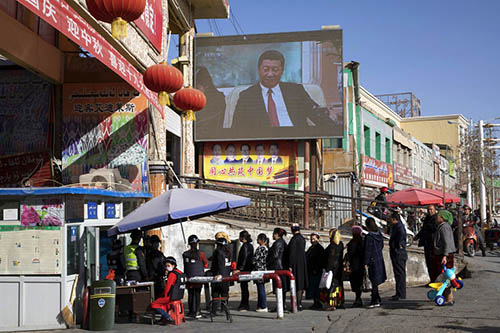
Residents walk through a security checkpoint into the Hotan Bazaar where a screen shows Chinese President Xi Jinping in Hotan in western China’s Xinjiang region. Photo: Ng Han Guan / Associated Press
The Xinjiang regional government did not respond to repeated requests for comment. But China’s government describes its Xinjiang security policy as a “strike hard” campaign that’s necessary following a series of attacks in 2013 and 2014, including a mass knifing in a train station that killed 33. A Hotan city propaganda official, Bao Changhui, told the AP: “If we don’t do this, it will be like several years ago — hundreds will die.”
China also points to decades of heavy economic investment and cultural assimilation programs and measures like preferential college admissions for Uighurs.
Authorities refer to the detention program as “vocational training,” but its main purpose appears to be indoctrination. Training sessions on “Mandarin, law, ethnic unity, de-radicalization, patriotism” are described as lasting anywhere from 3 months to 2 years.
In Korla, one center the AP visited was labeled a jail. Another was downtown on a street sealed off by rifle-toting police.
Southern Xinjiang, where Korla is located, is one of the most heavily policed places on earth.
In Hotan, police depots with flashing lights and foot patrols are set up every 500 meters. Motorcades of more than 40 armored vehicles rumble down city boulevards. Police checkpoints on every other block stop cars to check identification and smartphones for religious content.
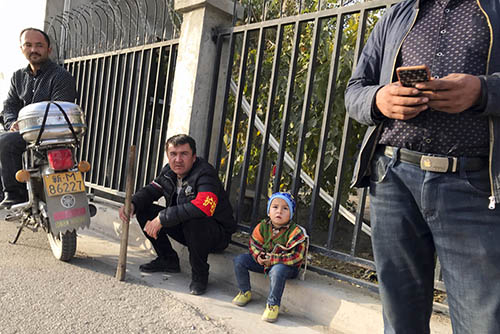
Residents act as neighborhood watch for suspicious activities in a village near Korla in western China’s Xinjiang region. Photo: Ng Han Guan / Associated Press
Xinjiang’s published budget data shows public security spending this year is on track to increase 50 percent from 2016 to roughly 45 billion yuan ($6.8 billion) after rising 40 percent a year ago. It’s quadrupled since 2009, when a Uighur riot broke out in Urumqi, killing nearly 200 people.
But much of the policing goes unseen.
Shoppers entering the Hotan bazaar must pass through metal detectors and place their national identification cards on a reader while having their faces scanned. AP reporters were stopped outside a hotel by a police officer who said the public security bureau had been remotely tracking the reporters’ movements by watching surveillance camera footage.
The government’s tracking efforts have extended to vehicles, genes and even voices. A biometric data collection program appears to have been formalized last year under “Document No. 44,” a regional public security directive to “comprehensively collect three-dimensional portraits, voiceprints, DNA and fingerprints.” The document’s full text remains secret, but the AP found at least three contracts referring to the 2016 directive in recent purchase orders for equipment such as microphones and voice analyzers.
China has also turned to a familiar low-tech surveillance tactic: recruiting the masses.
A Uighur businessman from Kashgar who fled China said his four brothers and his father were in prison because of his escape and that families tasked with spying on one another in his community had also been punished. Members from each were sent to re-education centers for three months, he told the AP.
A document obtained by U.S.-based activists and seen by the AP shows Uighur residents in the Hebei Road West neighborhood in Urumqi, the regional capital, being graded on a 100-point scale. Those of Uighur ethnicity are automatically docked 10 points. Being aged between 15 and 55, praying daily, or having a religious education, all result in 10 point deductions. A neighborhood police official in Urumqi surnamed Tao confirmed that every community committee in the city needed to conduct similar assessments.
Uighurs abroad say it’s too risky to stay in touch with their families in China.
When Salih Hudayar, an American Uighur graduate student, last called his 70-something grandfather this summer, the elderly man told him kindly not to call again. He later heard his grandfather had been sent to an indoctrination camp.
A Uighur student who moved to Washington following the crackdown this summer said that after his move, his wife, a government worker still in Urumqi, messaged to say the police would show up at her home in 20 minutes. She had to say goodbye: after that she would delete him permanently from her contacts list.
Later, he couldn’t help himself placing one last call home. His daughter picked up.
“Mom is sick but she doesn’t want me to speak to you. Goodbye,” she said.
Tourists don sweaters and knitted hats to visit Suan Phum Prueksa for its winter flowers Monday morning in Nakhon Ratchasima province.
BANGKOK — Break out a light sweater and strut down the uneven sidewalk without breaking a sweat: cool weather has arrived.
Expect temperatures as low as 21C Monday through Friday, with highs of 32C as well as strong winds throughout Bangkok, state meteorologists said Monday.
To really feel the coolness, step out into the provinces for some camping weather.
Nationwide, temperatures are expected to drop an average of 4C to 6C. In the north and northeast, temperatures are expected to fall as low as 11C this until Friday. The central provinces can reach as low as 17C while the south expects lows of 20C.
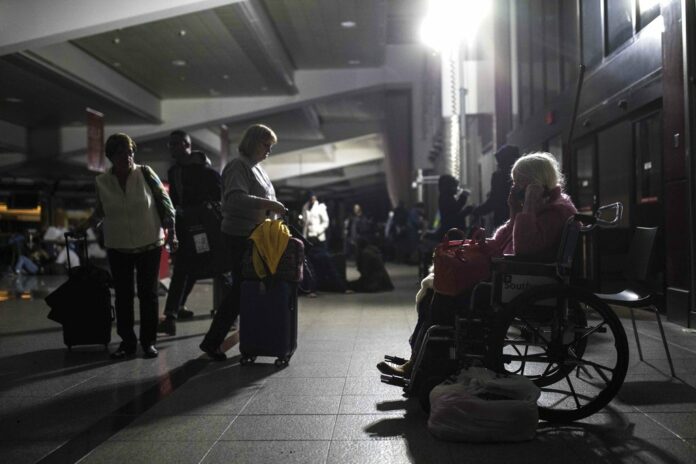
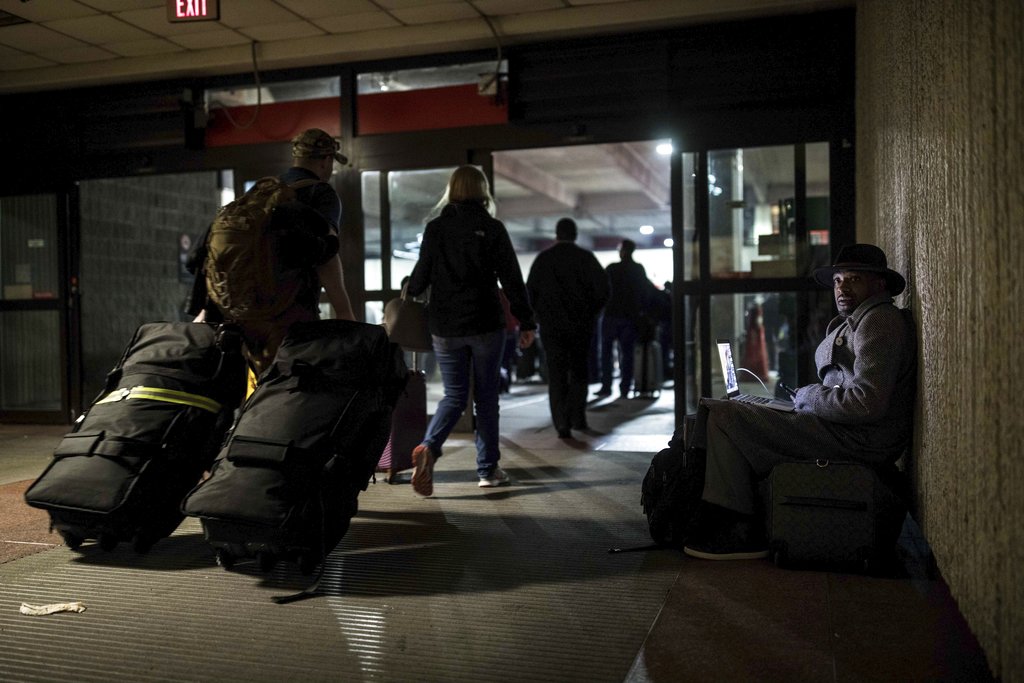
Passengers wait after the lights went out at Hartfield-Jackson Atlanta International Airport, Sunday, Dec. 17, 2017, in Atlanta. A sudden power outage at the airport on Sunday grounded scores of flights and passengers during one of the busiest travel times of the year. (AP Photo/Branden Camp)
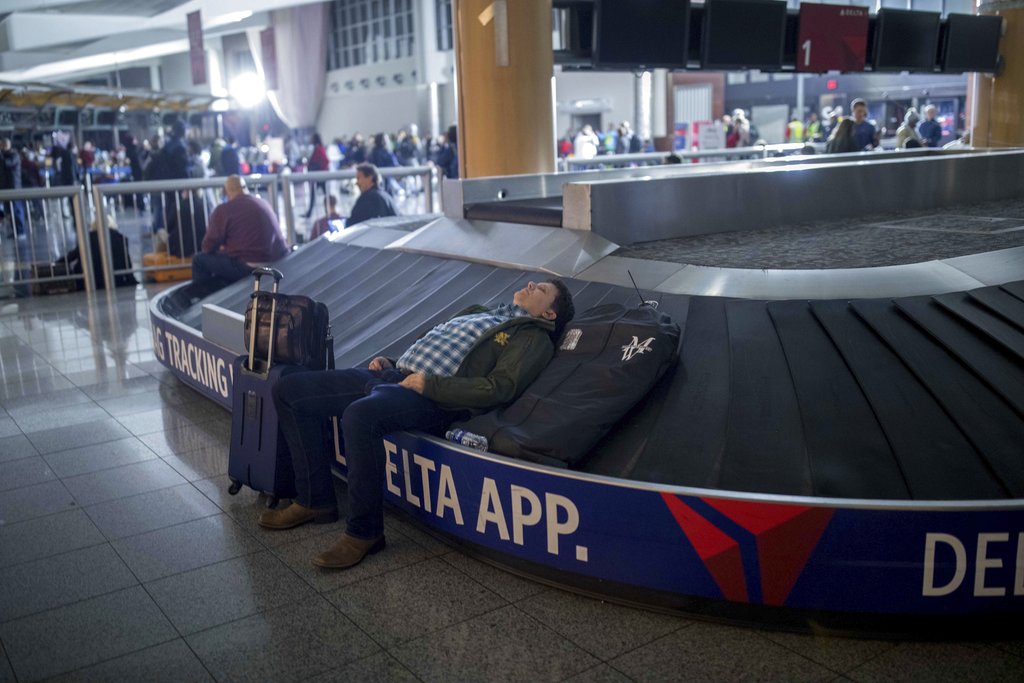
ATLANTA — A sudden power outage brought the world’s busiest airport to a standstill Sunday, grounding more than 1,000 flights in Atlanta just days before the start of the Christmas travel rush. Hours after the blackout began, authorities announced that electricity would be restored at the Hartfield-Jackson Atlanta International Airport by midnight.
Passengers at the airport were left in the dark when the lights went out at around 1 p.m. The outage halted all outgoing flights, and arriving planes were held on the ground at their point of departure. International flights were being diverted, officials said.
Delta passenger Emilia Duca, 32, was on her way to Wisconsin from Bogota, Colombia, when she got stuck in Atlanta. She said police made passengers who were in the baggage-claim area move to a higher floor. She said restaurants and shops were closed. Vending machines weren’t working.
“A lot of people are arriving, and no one is going out. No one is saying anything official. We are stuck here,” she said. “It’s a nightmare.”
Delta, with its biggest hub operation in Atlanta, will be hardest hit. By evening, Delta had already cancelled almost 800 Sunday flights and another 250 on Monday, nearly all of them in Atlanta, according to tracking service FlightAware.com.
Robert Mann, an aviation consultant and former American Airlines executive, said it likely will be Tuesday before Delta’s operations in Atlanta return to normal, and for passengers “it could be most of the week” because there aren’t many open seats on other flights in the last week before Christmas.
A traveler sleeps on a baggage carousel at Hartfield-Jackson Atlanta International Airport, Sunday, Dec. 17, 2017, in Atlanta. A sudden power outage at the airport on Sunday grounded scores of flights and passengers during one of the busiest travel times of the year. (AP Photo/Branden Camp)
“Tomorrow is going to be a long and difficult day for everybody,” Mann said.
One bit of good news, according to Mann: Delta has more spare planes and available crews in Atlanta than anywhere else, which will help it to recover.
Still, when flights at Atlanta were grounded for most of one day last spring, it took Delta five days — and about 4,000 cancelled flights — before it fully recovered.
Like Sunday’s outage, that April storm hit Delta’s largest hub at a busy travel time when there weren’t many empty seats to accommodate customers from cancelled flights. At the time, CEO Ed Bastian vowed that Delta would make “significant improvements” to its system for scheduling and tracking aircraft crews to recover more quickly from disruptions.
While Delta was hit hardest by the outage, other airlines also canceled flights for the rest of Sunday. American Airlines canceled 24 departures and an equal number of arrivals, said spokesman Ross Feinstein. The airline also diverted three planes that were headed to Atlanta when the outage struck, sending them instead to Dallas, Nashville and back to Philadelphia.
The FAA said it would staff the airport control tower throughout the night so that it can handle flights once they resume. The FAA said the tower could operate normally but flights were affected because airport equipment in the terminals was not working.
According to a Georgia Power statement, a fire in an underground electrical facility may have been responsible for the outage. The cause of the fire was not known.
“No personnel or passengers were in danger at any time,” the statement said.
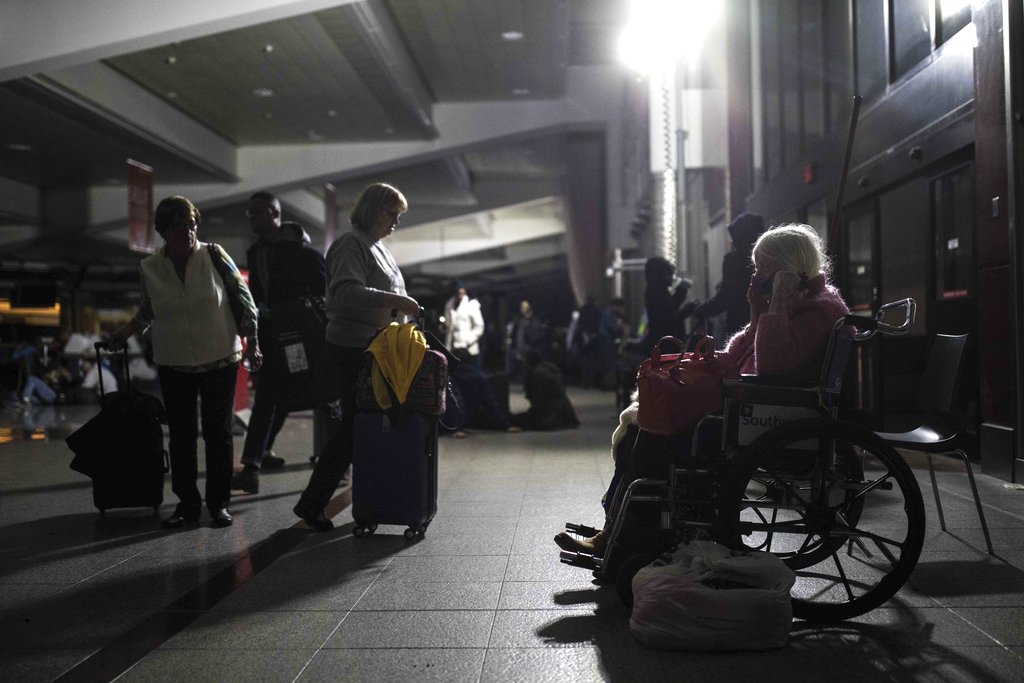
A traveler waits in dark at Hartfield-Jackson Atlanta International Airport, Sunday, Dec. 17, 2017, in Atlanta. A sudden power outage at the airport on Sunday grounded scores of flights and passengers during one of the busiest travel times of the year. (AP Photo/Branden Camp)
No areas outside of the airport were affected by the power loss. The utility said that there are “many redundant systems in place” to ensure the power supply to the airport and that such outages at the airport “are very rare.”
That wasn’t enough to comfort Jeff Smith, 46, of Pittsburgh, who ended up stuck in a plane on the tarmac for three hours after it landed.
“This is the worst experience I’ve ever had at an airport,” he said.
Sara Melillo, who was traveling to Pittsburgh from Kenya, where she lives with her husband, Greg Presto, to spend Christmas with his family were stuck on the tarmac for six hours. The couple had made stops in Nairobi and Amsterdam and landed shortly after the lights went out in Atlanta.
She said the pilot didn’t have a lot of information for the travelers but the plane had air conditioning and attendants offered water and juice a few times. She described the Delta terminal as “big chaos” with not enough customer service for the hundreds of people trying to find a flight to their next destination and a place to sleep for the night.
With her new boarding pass handwritten and her bags still stuck on a plane, Melillo was hopeful that she and her husband would be able to get a flight in the morning to Pittsburgh, she said as she waited for an Uber to take them to a hotel.
By evening, power had been restored to at least one concourse. On its Twitter page Sunday night the airport tweeted, “Power on Concourse F is back ON! We are working with great urgency w/ @GeorgiaPower to restore power throughout rest of airport.” Airport workers were distributing bottled water, and Dunkin’ Donuts was giving out doughnuts.
Officer Lisa Bender of the Atlanta Police Department said officers were at the airport to help with crowd control and managing traffic around the airport.
Passengers wait after the lights went out at Hartfield-Jackson Atlanta International Airport, Sunday, Dec. 17, 2017, in Atlanta. A sudden power outage at the airport on Sunday grounded scores of flights and passengers during one of the busiest travel times of the year. (AP Photo/Branden Camp)
Delta Air Lines, which has its hub at the airport, said about 900 mainline and connection flights were cancelled, and 48 flights were diverted. Delta temporarily embargoed unaccompanied minors from traveling Monday.
At Southwest Airlines, about 70 Atlanta departures out of 120 scheduled for Sunday were cancelled, an airline spokesman said in an email. United Airlines and JetBlue Airways were among carriers reporting delays or cancellations.
Mozell Smith, 58, of Atlanta arrived at the airport hours after the electricity went off. He was headed to Las Vegas with a sister and a friend.
“This is terrible. I wish someone would’ve given us a heads-up before we got to the airport,” he said. “I wish there would have been better communication.”
American Airlines reported only a handful of diversions and cancellations because the carrier does not use Atlanta as a hub, airline spokeswoman Alexis Aran Coello.
Hartsfield-Jackson, which serves 104 million passengers a year, is the world’s busiest airport, a distinction it has held since 1998.
The airport serves an average of 275,000 passengers daily, according to its website. Nearly 2,500 planes arrive and depart each day.
SYDNEY — A South Korean-born Sydney man was charged Sunday with acting as an economic agent for North Korea in Australia by allegedly attempting to broker sales worth tens of millions of dollars for Pyongyang that included components used in ballistic missiles.
The Australian Federal Police said 59-year-old naturalized Australian Chan Han Choi used encrypted communication to broker sales and discuss the supply of weapons of mass destruction. His actions contravened both United Nations and Australian sanctions against North Korea, police said.
Police said the man was acting to generate income for Pyongyang by arranging the sale of computer software used for guiding ballistic missiles as well as expertise from North Korea to other “international entities.” Police didn’t elaborate.
Prime Minister Malcolm Turnbull said he had been briefed by AFP Commissioner Andrew Colvin on the “very, very serious matter” and warned anyone thinking of assisting North Korea that “the AFP will find you.”
“North Korea is a dangerous, reckless, criminal regime threatening the peace of the region,” Turnbull said. “It supports itself by breaching U.N. sanctions, not simply by selling commodities like coal and other goods, but also by selling weapons, by selling drugs, by engaging in cybercrime.”
He added: “It is vitally important that all nations work relentlessly to enforce those sanctions because the more economic pressure that can be brought on North Korea, the sooner that regime will be brought to its senses.”
Despite international sanctions, cash-strapped North Korea last month test-fired its most powerful missile that may be able to target the U.S. mainland.
Choi is facing six charges related to brokering the sale of missile componentry and expertise from North Korea to other international entities, and attempting to transfer coal from North Korea to entities in Indonesia and Vietnam.
Choi didn’t appear or apply for bail in a Sydney court Sunday, and bail was formally refused.
Federal police Assistant Commissioner Neil Gaughan said the governments of Indonesia and Vietnam — or authorities in those countries — were not involved in the coal transfer attempt.
Choi is the first person charged under Australia’s Weapons of Mass Destruction Act and could face a maximum 10-year prison sentence.
Gaughan said the charges related to his alleged activity over the past year, but that allegations dated back to 2008.
Choi was arrested Saturday and charged over two transactions that were unsuccessful. “But we estimate that if these trades were successful, we’re talking tens of millions of dollars,” Gaughan told reporters.
He said investigations were continuing and that more charges could be filed against Choi.
“The AFP are saying this man was a loyal agent of North Korea, believing he was acting to serve some high patriotic purpose,” Gaughan said.
Police started investigating Choi after a tip-off from another international agency on another matter, he said.
“I know these charges sound alarming, but we are not suggesting that there are any weapons or missile componentry that came to Australian soil,” he said. “We’re alleging all of the activity occurred offshore.”
Choi’s activities also involved commodities including oil and gemstones.
“This is black market 101. It’s the same with the coal and oil and gemstones — it’s all about making money for North Korea,” he said, adding the case was “like nothing we have ever seen on Australian soil.”
“Any individual who attempts to fly in the face of sanctions cannot and will not go unnoticed in Australia,” he said.
Junta chairman and Prime Minister Gen. Prayuth Chan-ocha at the Government House in Bangkok, 14 May 2015.
The last time I was on the panel at the British Chamber of Commerce, someone asked whether I believed the military government was sincere in its bid to clean up corruption.
“Of course, they are,” I replied. “They are as sincere as any government aiming to clean up the corruption [dramatic pause] of other political factions.”
(Translation: Move aside, it’s our turn to eat the cake – allegedly, of course.)
On May 22, 2014, General Prayuth Chan-ocha sent in the tanks, overthrew the democratically elected government and became the dictator. Come May 2018, it will be four years running that Thailand has struggled under his regime. Three reasons were given for the coup d’etat. First, to protect the monarchy. Second, to put an end to street violence. Third, to clean up corruption. The first is a hyper-sensitive issue, so we shall leave it there. The second, the junta leader accomplished. The third – if we are to gauge public sentiment – seems to follow the classic Thaism of “same same but different.” Same old business dealings – different people doing the dealing.
The topic of this commentary hence is that public sentiment is key in making sure the promise of a general election next year is fulfilled. A promise that has been reneged upon at least twicealready.
Whether one is an absolute monarch, a fascist dictator or an elected leader, public sentiments are key to legitimizing one’s regime. From early on, the junta leader could claim strong support from the people, even if this group of people was in the minority.
When he took power by force, they cheered for him as if he was Miss Universe Thailand strutting across the stage to greet Steve Harvey. When officials and politicians were rounded up on corruption charges, they applauded him as if he was Toon Bodyslam running across the country, one stride at a time. The love for the junta leader was so strong that when the alleged billion baht Rajabhakti Park corruption scandal involving the army gripped the headlines, they waved dismissively.
Move along, nothing to see here – he brought peace and is cleaning up corruption.
When his brother, Gen. Preecha Chan-ocha, bestowed upon his then 25-year-old an officer’s rank of second lieutenant in the army amid cries of alleged cronyism, they shrugged. When alleged irregularities were found in General Preecha’s 79 million baht assets, as well as an undeclared mansion in Phitsanulok province, they smirked. When over 13 billion baht was approved to purchase three Chinese submarines, they grinned.
Move along, nothing to see here – he brought peace and is cleaning up corruption.
When he berated a fisherman for asking him tough questions, or when he and Deputy Prime Minister Gen. Prawit Wongsuwan glossed over the not-so-mysterious death of first-year cadet Pakapong Tanyakan. When Gen.l Prawit unwittingly showed off a huge diamond ring and Richard Mille watch reportedly worth between 4 and 10 million baht. When the junta leader told the media and the public to “take it easy” on Gen. Prawit and his fancy accessories. When the public saw leaked receipts from luxury “work trips” abroad enjoyed by the junta government. When, day after day, we see the dictator fuming and scolding anyone and everyone who disagrees with or questions him.
There are still die-hard supporters of the junta, no doubt.
But many of those who had previously cheered the tanks are wavering and shaking their heads in disappointment. Here we have a classic case of early infatuation blinding the eyes and fogging the mind. After over three years – and it shouldn’t have taken this long – many supporters of the junta government are beginning to see things for what they are, and it’s an ungainly sight. In fact, many are now fuming with expletives and exasperations.
Read the commentaries. Listen to the people. Scroll through social media to assess the mood of the Thais. The phrase, “I used to support him, but…” is more commonly expressed.
Add to that a stagnating economy in which poor and middle class are struggling while the richest families grow richer, and the overall public sentiment seems to be “General, it’s time to move on.” Public pressure: Don’t ever underestimate its power.
But presently this sentiment is still very much in the undercurrent. People aren’t exactly yelling it out loud and in unison. As such, the junta leader can still rule under the façade of a mandate, backed by convenient public relations photo ops with the much-adored Miss Universe Thailand Maria Lyn Ehren and the well-loved Toon Body Slam. It’s politically expedient to be associated with the people’s heroes.
Hence, the promise of a general election comes next year is still up in the air. Nothing is set in stone. Especially if a bomb goes off here and there to provide a scenario where democracy would again be postponed for security under a military regime. Therefore, it’s very important for the Thai people to make a stand. We can even be polite about it.
“Thank you for all you have done, General, but it’s time to move on.”
Strong public pressure goes a long way toward ensuring that, come next year, there will be a general election. But the people must voice it out loud and also must make the stance peaceably. This is because any possible threat to peace and security is a convenient excuse for the junta leader to postpone the election.
So loudly and peacefully, start the movement, make the hashtag, send the meme and slap on the bumper sticker: “General, it’s time to move on.”
FILE - This file image provided by Disney shows, from left, Chadwick Boseman as Panther, Paul Bettany as Vision, Robert Downey Jr. as Iron Man, Scarlett Johansson as Natasha Romanoff, and Don Cheadle as War Machine in a scene from "Marvel's Captain America: Civil War." Disney’s announcement Thursday, Dec. 14, 2017, that it’s buying most of movie goliath Fox for $52.4 billion in stock brings these once disparate franchises together. The combined company will account for more than a third of theatrical revenues in the U.S. and Canada. (Disney Marvel via AP, File)
MENLO PARK, California — The coming union of the Disney and Fox media empires is set to create a new nirvana for fanboys and -girls, one that reunites superheroes and sci-fi characters long separated by an energy barrier of corporate legalism.
Take, for instance, the fractured world of Marvel superheroes. For years, the X-Men (Wolverine, Storm, Professor X and the crew) and the Fantastic Four (Thing, Invisible Woman, et al) have battled bad dudes from the studios of 20th Century Fox. Meanwhile Iron Man, Black Widow and other Avengers vanquished villains in another corner of the galaxy run by Disney. Almost ne’er the twain did meet — though that could soon change.
In a related fashion, rights to the various “Star Wars” films have been scattered all over a galaxy far, far away; those will soon be unified under a powerful Galactic Emp– er, well, Magic Kingdom.
THE MOUSE THAT ATE THE FOX
Disney’s announcement Thursday that it’s buying most of movie goliath Fox for $52.4 billion in stock brings these once disparate franchises together, possibly for as-yet unplanned intergalactic dust-ups. Add the “Avatar” franchise to the blockbuster mix, and the company that launched Mickey Mouse will be an unavoidable presence at the box office and online if the deal goes through.
The combined company will account for more than a third of theatrical revenues in the U.S. and Canada, an $11 billion business last year, not to mention a huge chunk of the global theater-going pie, according to Daniel Ives, chief strategy officer at market research firm GBH Insights.
That would make the Disney juggernaut a more powerful theatrical force to be reckoned with than ever before. Online, Disney has announced plans to launch its own streaming service in 2019, after pulling titles like “Rogue One: A Star Wars Story” and Disney’s “Moana” from Netflix’s streaming platform to move onto its own. After Fox’s deal to send its movies to HBO ends reportedly in 2022, its films will also move to the Disney streaming platforms.
“Creating a direct-to-consumer relationship is vital to the future of our media businesses and it’s our highest priority,” Disney CEO Bob Iger told investors in a Thursday conference call detailing the Fox deal.
ONE BIG HAPPY DEATH STAR
Those old enough to remember the blaring 20th Century Fox opening to the original “Star Wars” (Episode IV) may no longer have to search far, far, away to find the other titles. The original was made and distributed by Fox, but it was a quirk of the series.
Episodes V, VI, I, II, and III were owned by Lucasfilm (bought by Disney in 2012) and distributed by Fox. You can only stream those first six movies endlessly if you buy them and register them through the not-terribly-popular UltraViolet system backed by several studios. (You can also rent them digitally.) “The Force Awakens” — Episode VII — is available to streaming subscribers, though only if you have Starz.
The Force may finally put these titles in one place.
Buying Fox will also give Disney a majority stake in streaming platform Hulu. The addition of Fox’s regional sports TV networks and National Geographic video programming in the deal could let the new service bundle hugely popular movie and TV franchises, local sports broadcast rights, and distribution platforms into one live online video empire.
That would recreate online what the U.S. Supreme Court broke apart in the 1940s. That’s when the court forced Hollywood studios to divest ownership of theater chains to keep content producers from controlling every step along the way to the consumer.
“This moves Disney from an afterthought in streaming to a legitimate contender,” Ives said.
SCRAPPY REBELS
At the same time, tech companies — particularly Netflix, Amazon, Facebook, Google, and Apple — are making big investments in video streaming. Hollywood-centered entertainment companies have struggled as people drop traditional TV packages, shifting the nexus of power in entertainment from the Hollywood Hills toward Silicon Valley and Seattle.
That marketplace dynamic could help pave the way for regulators to clear the deal, aimed to close within the next 12 to 18 months.
“These guys are up against Facebook and Google, not Warner Bros. and MGM,” said Mike Kelly, the former Weather Channel CEO who is now CEO of investment and advisory firm Kelly Newman Ventures. “If you look at it that way, I don’t think the government would have that big of an issue with it.”
Iger said he anticipates a “significant amount of regulatory scrutiny both in the United States and internationally” because of the deal’s size, but he said authorities should quickly approve it because it makes sense for consumers.
He said Disney’s current thinking is to split its streaming services into three different brands, such as a Disney-labeled family service that would fold in NatGeo, Marvel, Pixar and Lucasfilm; an ESPN-led sports service; and an adult-oriented service that would incorporate Hulu and some of Fox’s TV shows.
Disney also aims to expand the global audience of its cast of characters as it pulls in Fox’s London-based pay-TV broadcaster Sky, which has a pan-European audience, and Mumbai-based Star India.
OH, THAT LONELY WEB-SLINGER
But there’s one part of the comic book world that will escapes Disney’s sizable web: Spider-Man, whose rights Marvel partially farmed out to Sony.
Although Sony and Disney cut a deal to include Spidey in Avengers tales starting with “Captain America: Civil War” last year, Sony continues to develop its own alternate reality with movies like the animated “Spider-Man: Into the Spider-verse” as well as spin-offs “Venom” and “Silver & Black” starting in 2018.