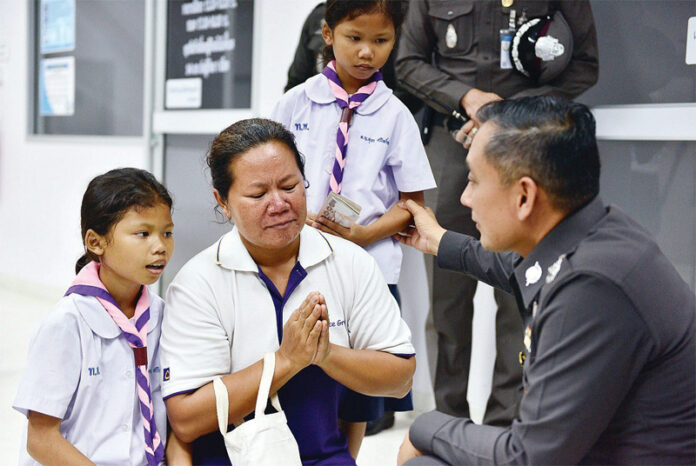
A police officer speaks with the wife and children of security guard Somchai Yarmdee on Thursday at Phra Nang Klao Hospital, where he has been recovering from his injuries.
BANGKOK — A security guard struck and run over by a health official earlier this month is now expected to recover, the doctor in charge of his care said Sunday.
Although he showed sign of mental impairment, Somchai Yarmdee emerged from the coma he had been in since earlier this month, according to Sakhon Sukprom, deputy director of Phra Nang Klao Hospital. Somchai remains in the hospital’s critical care unit, and doctors are keeping close watch on his condition, Sakhon said.
Sakhon said Somchai’s brain is functioning at “14 out of 15.” He estimated it could take the patient up to a year to make a full recovery.
The security guard was on duty at the Public Health Ministry on the night of Nov. 10 when a car driven by senior ministry official Yorn Chiranakhon hit him. A video of the incidentshows Yorn stop the car for some time before accelerating over Somchai and dragging him beneath it for the next 26 meters.
For the crash, which was captured on video, Yorn has been charged with multiple offenses including attempted murder, hit-and-run and DUI. He told police he was not aware he had struck Somchai.
It was 1974. Thailand’s civil rights movement was in full swing when Thatchai “Tong” Obtong was sold by his parents for 5,000 baht. He was 7.
He was bought by a traveling Chinese opera troupe and taken from his native province of Satun in the south. He never went to school and remains functionally illiterate to this day. But what he lacks in arts and letters, he’s made up for with the thespian talents his life has singularly been devoted to pursuing. No one can belt out the signature, soul-shaking howls of the tough-guy roles he’s been typecast for ever since.
Sai Yong Hong ngiew actors onstage.
He wasn’t the only one.
“My wife’s parents sold her because she was a girl, and they said raising her would cost too much,” Tong said.
Both are now members of the Sai Yong Hong troupe, one of about 30 still active in Thailand. They recently performed during the Vegetarian Festival for a few wizened Chinese-Thais in a hall in Bangkok’s Chinatown.
Four decades ago, tens of thousands would gather to watch Tong’s large companies as they toured the country. Today, though he still paints his face to stalk the stage as Cao Cao from “Romance of the Three Kingdoms” or Justice Bao, his audience is usually small and older than his 50 years. Sometimes, it’s an empty room.
Though the once-ubiquitous art form has been hanging on by a fraying cultural thread, it was thrust back into the limelight when a 167-year-old Chinese pier recently opened as the latest hipster hangout.
“Ngiew is beauty, dance, music, kungfu, acrobatics and literature all in one. Show all of this to someone, and they will be entertained too”
At a gala event replete with contemporary crowd-pleasers such as nacho stalls, beer taps and indie bands was the art form few under 50 today have ever even seen.
Usually relegated to small or nonexistent audiences in temples or cultural halls, Chinese opera got a shot of vitality at this month’s Lhong 1919 opening, where a generation that likely never stepped into either was exposed to the three-century-old form for the first time.
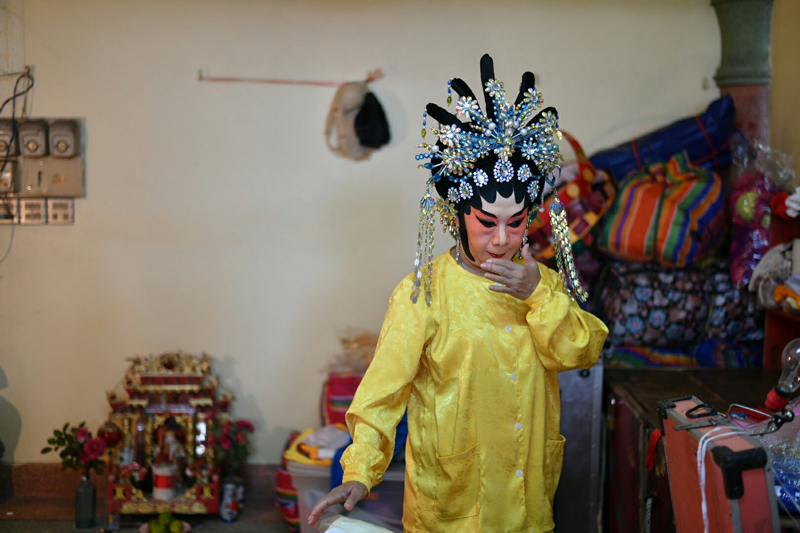
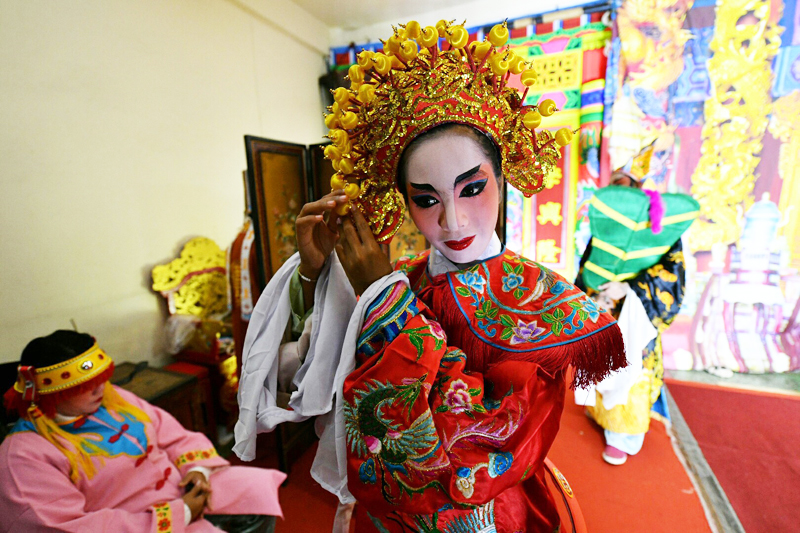
A ngiew actress from Sai Yong Hong troupe in costume at the Sai Tee Lui Im Yee Vegetarian Hall in October.
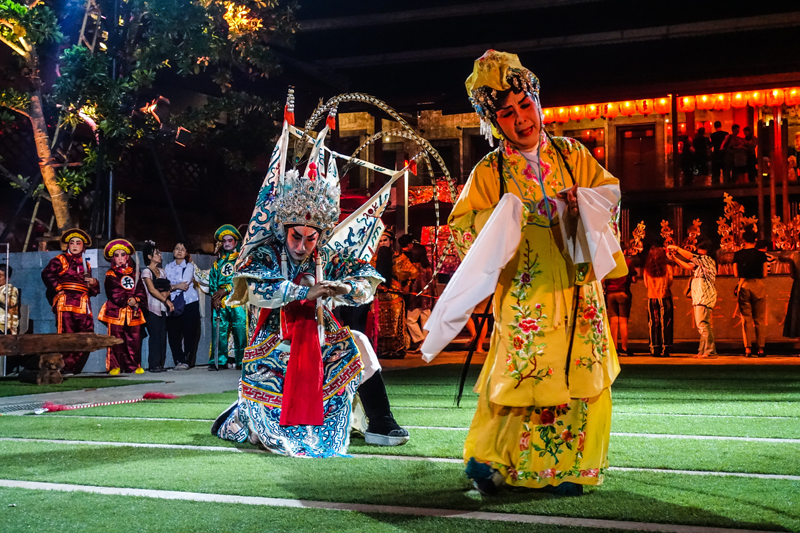
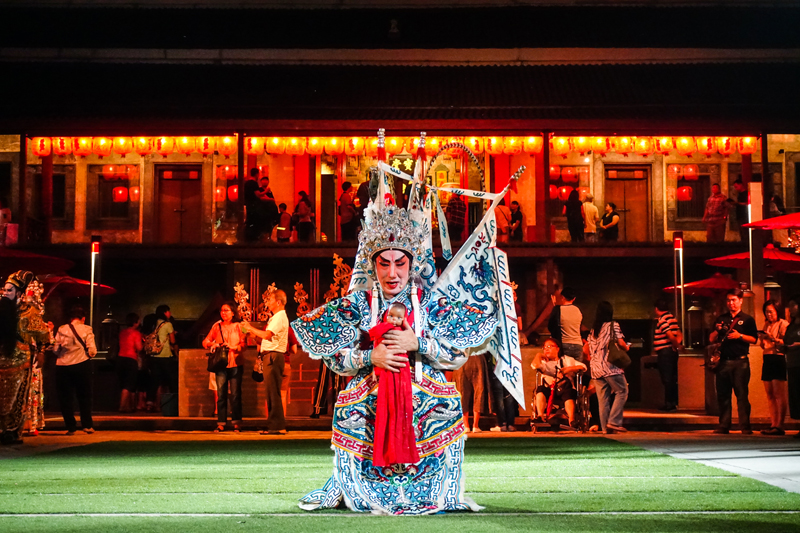
There, before an audience of hundreds, a general in bright blue sequins and a pheasant-feathered headdress offered his honorable aid to a wounded noblewoman fleeing an enemy army with a child. She hands him the baby – of royal birth – before committing suicide to not slow the general’s escape. High drama was followed by a skit depicting an old man and young woman bickering comically in a boat.
“This is the first time we’re performing in a hip place for teenagers like this. Before, young people wouldn’t have the chance to see it,” said Ampan Jarensooklab, the 74-year-old head of the Meng Por Pla troupe, a competitor to Tong’s Sai Yong Hong company.
Before there were sitcoms and soap operas, there was Chinese opera, called ngiew. Equal parts drama and entertainment, performances unfold in situational sketches over an hour or so.
“Ngiew is beauty, dance, music, kungfu, acrobatics and literature all in one. Show all of this to someone, and they will be entertained too,” Ampan said.
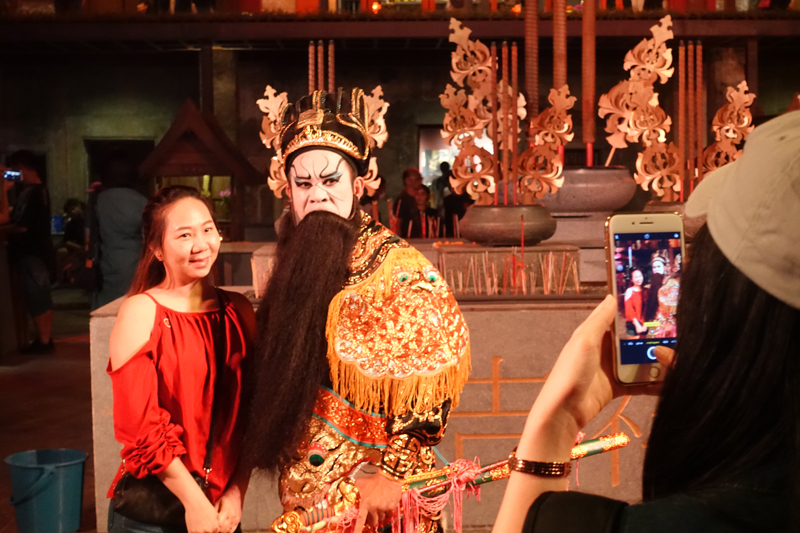
Afterward, people lined up to take photos and selfies with the performers in their mirror-covered costumes with images that would make a splash in their Instagram feeds.
It was a far cry from their usual audiences of a few elderly women or empty chairs. Ampan, who’s taught the art for 50 years, said that’s why ngiew is itinerant – it’s always had to go to the people.
The Meng Por Pla troupe performs a scene from Romance of the Three Kingdoms Nov. 4 at Lhong 1919.
“It’s Chinese opera’s responsibility to serve the people. We have to bring the performance to them; young people aren’t going to buy a ticket to see it. We put it in front of them, and they will absorb its value and beauty,” Ampan said.
Meng Por Pla is one of around 30 companies still performing in Bangkok.
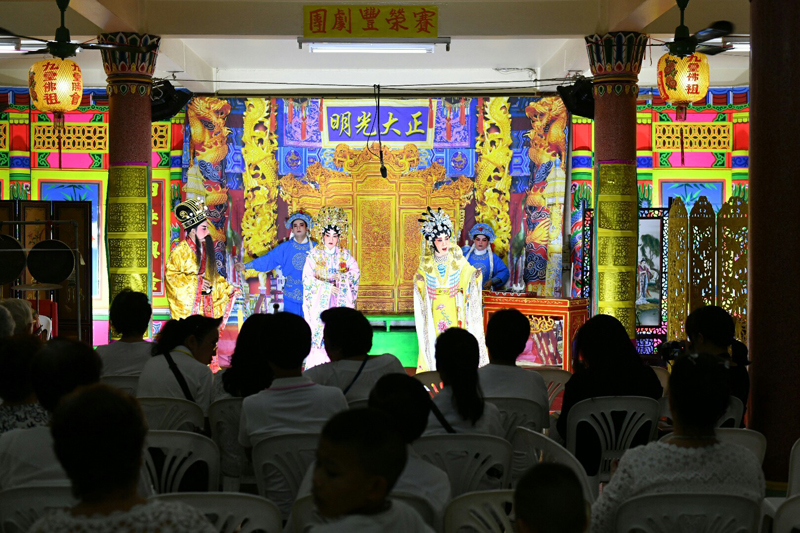
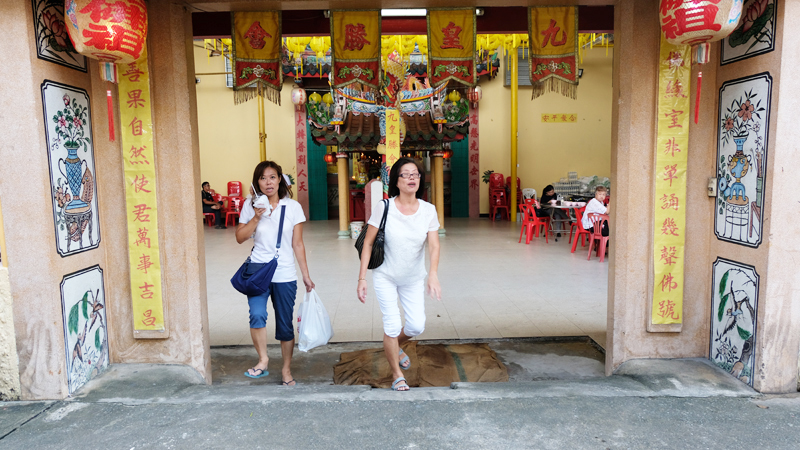
A few weeks earlier, Sai Yong Hong troupe performed in a more typical setting: the Sai Tee Lui Im Yee Vegetarian Hall in Soi Charoen Krung 79 for this year’s Vegetarian Festival.
“Hello to all the hardcore fans of the Sai Yong Hong Chinese opera troupe! Today we’ll be performing for the long haul. The leading man’s handsome; the leading lady’s beautiful. The costumes are all fresh out of the box!” announced manager-slash-performer Tong to a sparse crowd of maybe two dozen elderly ethnic Chinese.
Ngiew is Old
It would be difficult to overstate how big Chinese opera was at one time. While today’s companies are tiny crews of only a couple dozen people, large casts staging elaborate performances in the Yaowarat area once drew ethnic Chinese audiences in the thousands.
At least until radio and television and cinemas siphoned off those audiences, and the opera went the way of the world’s traveling entertainment shows such as likay, vaudeville and circuses.
One of the first records of Chinese opera in Thailand dates back to the 18th century reign of King Taksin, when it appeared alongside Thai khon in temple rites capital by way of Teochew Chinese immigrants. It then proliferated under the Chakri dynasty, and opera schools popped up in Chinese diaspora communities.
While subsequent waves of immigrants kept it going through to the mid-20th century, opera’s role diminished due to modern entertainment and the loss of Chinese identity and language. It wasn’t until the 1980s that the operas began performing in Thai, rather than teochew, like the Meng Por Pla troupe’s riverside performance at Lhong 1919.
“Chinese people who regularly watched opera thinned out and died off,” said Huyseng “O-tee” Sae-lim, president of the Teochew Ngiew Preservation Society.
Indeed, today’s Sino-Thai descendants who can still speak any teochew are likely to have little more than vague memory of the shows.
“Before we had tens of thousands of viewers. Now it’s dwindled down to about 50 for our troupe, maybe 20 for others. The audiences who spoke Chinese, the opera teachers and old actors died,” Tong said.
Opera Afterlife
“If there weren’t spirits, opera would’ve gone bankrupt a long time ago”
Pornsuda Jirachotsakul, 71, followed raptly and understood every word at the recent matinee in the Yaowarat vegetarian hall.
“I’ve been watching since I was 10,” she said. “In the past decade, I’ve been watching one almost every day. It’s fun, and the clothes are beautiful.”
Pornsuda’s daily opera dose is also a social event.
“I used to be so addicted to soap operas that I didn’t leave the house much. But here, I meet and chat with friends and have fun even if the performance that day isn’t fun,” she said. “Afterward, we go out to eat.”
Like that during the Vegetarian Festival, most work comes at the nation’s many Chinese shrines, called sarn jao. Patrons hire opera troupes to perform at least twice a year to honor the temple’s spirits.
“If there weren’t spirits, opera would’ve gone bankrupt a long time ago,” Tong said.
O-tee of the preservation society said the decision to sing in teochew or Thai depends on whether anyone is listening.
“When there’s people in the audience, actors might sing in Thai. If the people leave and there’s only spirits watching, they will switch back to teochew,” he said.
In the Past, Purely
Chinese opera is strictly limited to stories from the Chinese literary or historical tradition.
For the Vegetarian Festival matinee, it was the story of Eiang Chung Kiew Chu, a general who helps a dynasty’s heir escape in hope of one day returning to reclaim the throne.
Letters are written in blood, a royal infant is tearfully placed in a chest, and nobles stab each other. The drama is as high-pitched as the actor’s voices.
Musicians by the stage ring gongs, pound drums, tickle woodblocks and pluck a khim to accompany the show. They even make crying baby noises on cue.
Each performer, including the musicians, earn about 18,000 baht per month.
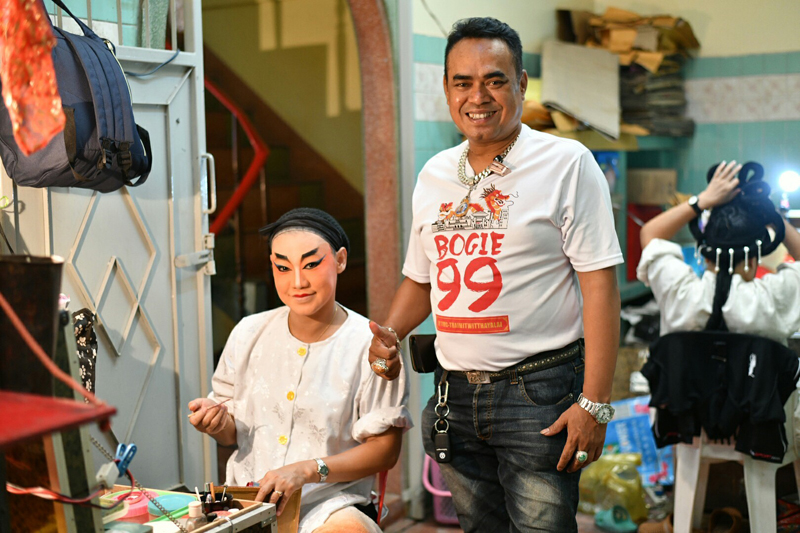
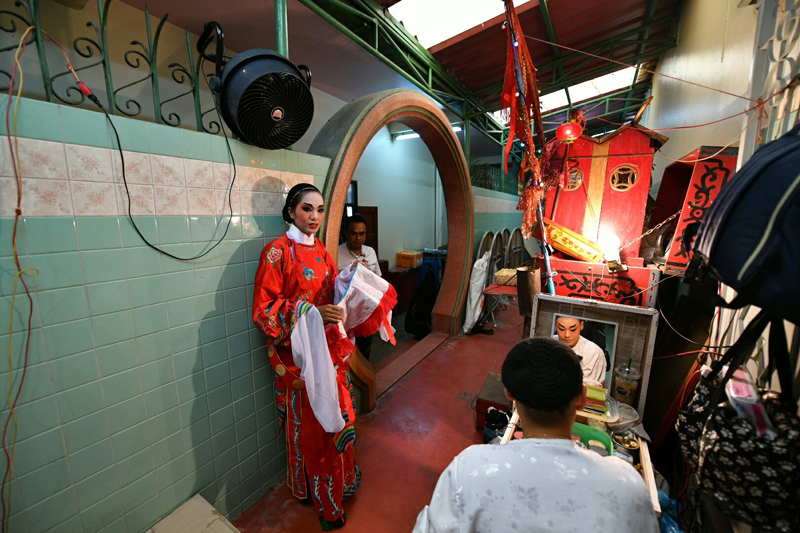
Thatchai Obtong and his wife backstage.
Although that adherence to unchanging storylines – most often episodes taken from enduring folklore figure about Song dynasty judge Justice Bao (also the subject of a 1993 Chinese TV series which aired in Thailand), 1300s novel Romance of the Three Kingdoms or Song dynasty collection of military stories Generals of the Yang Family – risks relevance to younger audiences, both O-tee of the preservation society and Tong said changing them would cause confusion.
“It all has to be old stories, set in the past. If we do new stories, people will think it’s strange or we’re see-sua,” Tong said, saying a Sino-Thai word that roughly means “messing it up.”
Ampan, leader of the Meng Por Pla company, said the restrictions are a strength.
“Although the opera is stagnant and has to compete with other forms of entertainment, it’s a fast and fun way for literally anyone, not just the high class, to learn Chinese history and culture,” he said.
The Circus Life
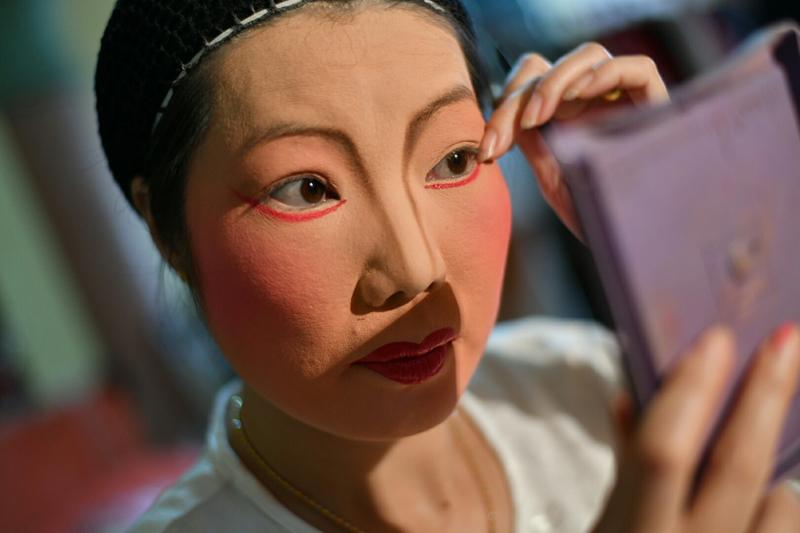
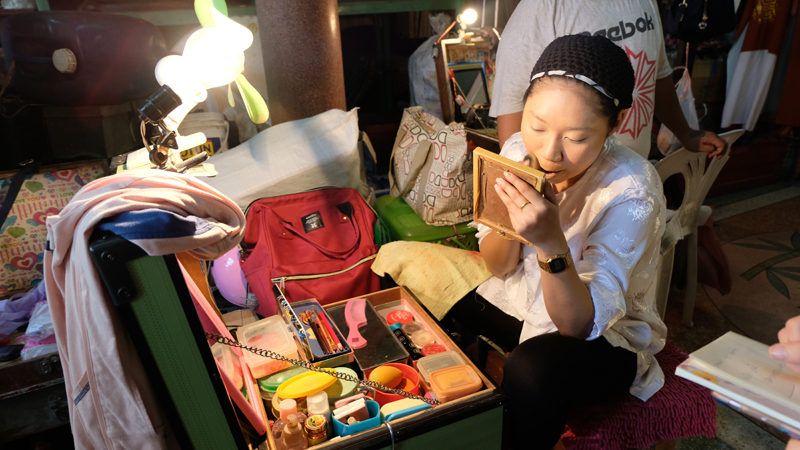
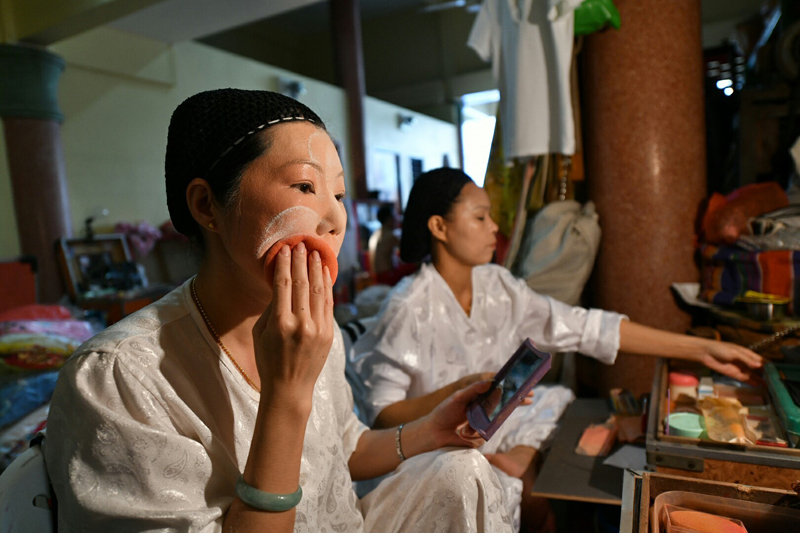
A ngiew actress from the Sai Yong Hong troupe puts on her stage makeup.
There are currently 30 Teochew and 3 Hainanese ngiew troupes roaming Thailand, from dozens-strong groups using LCD screen backdrops for international performances, to small back-alley troupes touring countryside shrines. Once there were many more troupes with regular performances at local shrines everywhere.
Sai Yong Hong is one of the largest remaining troupes, with almost 50 members.
According to O-tee, an average troupe gets paid around 25,000 baht per night, but only if they perform for at least four consecutive festival nights at a shrine. On less auspicious days, the pay is less, but if the troupe has to travel farther, they get paid more.
A leading lady, leading man, percussionist, flutist and khim player get paid around 18,000 baht per month. Teenagers in the troupe who play supporting roles get paid around 100 baht a day.
Many of the Thai actors cannot read Chinese, so they memorize lines by ear. A laozi, or Chinese teacher, checks their pronunciation of the dialect.
“If laozi says we pass, then we can make a living,” Tong said. “My wife never learned her letters, but she never misses a word.”
Vanishing Art
Today many of the performers are old, and the sale of children has fallen out of fashion.
Patchamon “Fern” Obtong puts on stage makeup backstage.
New blood is hard to find. Tong’s daughter Patamaporn “Fern” Obtong, quit school after sixth grade to perform full time. She’s now 24.
“I followed what my parents did. Don’t know what else to do at this point,” she said, applying red paint to the sides of her nose.
Asked whether people her age are interested in watching opera, Fern dipped her brush into the red paint, shrugged and said they’re more likely to watch a performance on Facebook rather than come to a show.
She prefers playing men’s roles to women’s. “I’m a brash kinda person. Women in opera always hafta be so delicate and gentle,” she said in a guttural, mischievous voice.
The rest of the troupe, Tong said, consists of actors from China and other interesting characters, such as ex-cons who haven’t been able to find a regular job, those who’ve run away from home and stagehands from Cambodia and Laos.
“We’re all like a family,” Tong said.
How to See it?
The next best chance to see an elaborate Chinese opera will be a Nov. 27 showin honor of late King Rama IX at Bangkok’s Sanam Luang. The Chae Lung Ngek Lao Choon troupe will perform in costumes dispensing with the usual auspicious red.
Most years, the largest annual show is in August, at a collaboration between Thai and Chinese troupes at the Chinese-Thai Friendship performance.
Several troupes have Facebook pages to find performances.
Otherwise, stumbling upon a ngiew performance remains a combination of serendipity, timing and luck: O-tee says look for red signs with gold letters around shrines and temples, which means there’ll be a performance soon.
A scene from the Eiang Chung Kiew Chu opera performed by a Sai Yong Hong actress.
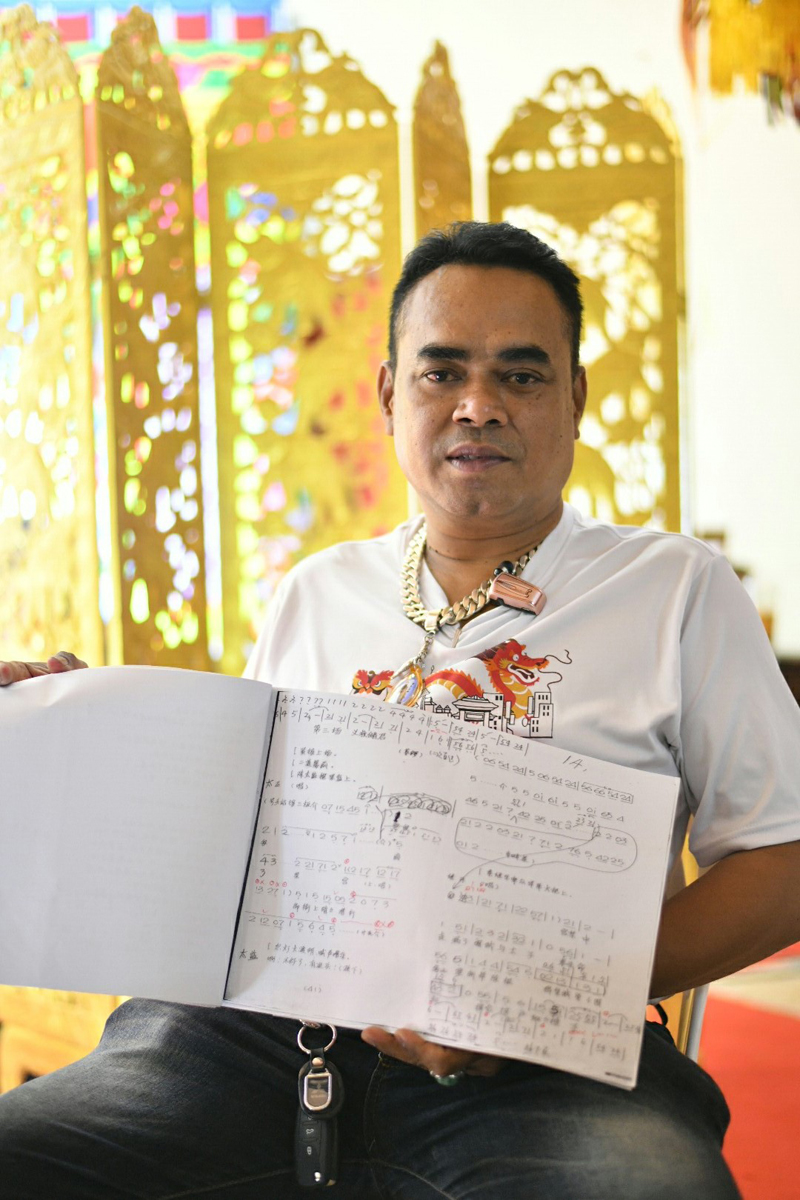
Thatchai Obtong holds up a ngiew script for “Eiang Chung Kiew Chu.”
Sai Yong Hong actresses backstage.
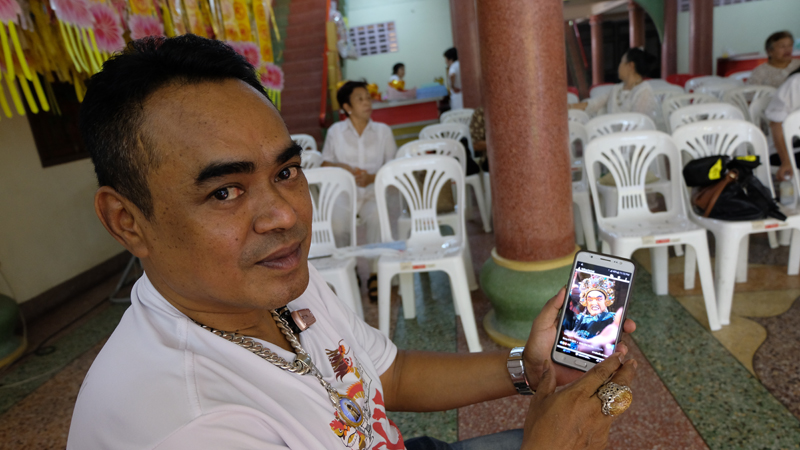
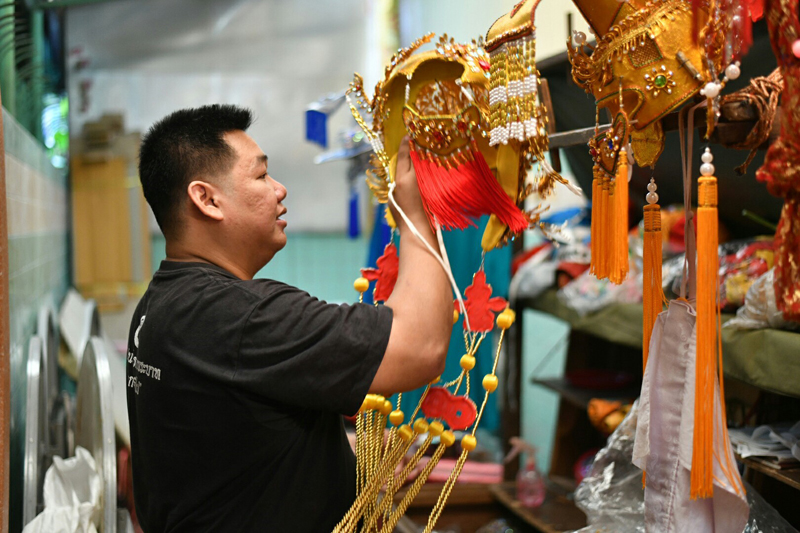
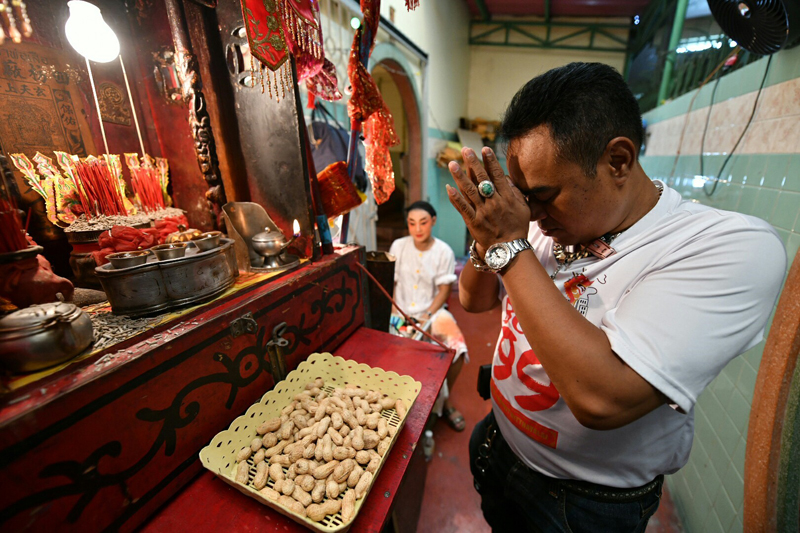
Thatchai holds a photo of himself in his Justice Bao costume.A Sai Yong Hong troupe stagehand arranges costume hats.Before the performance, Thatchai “Tong” Obtong wais to a shrine next to the stage dedicated to the troupe’s late master.
A Sai Yong Hong troupe actress adjusts her headdress before going onstage.
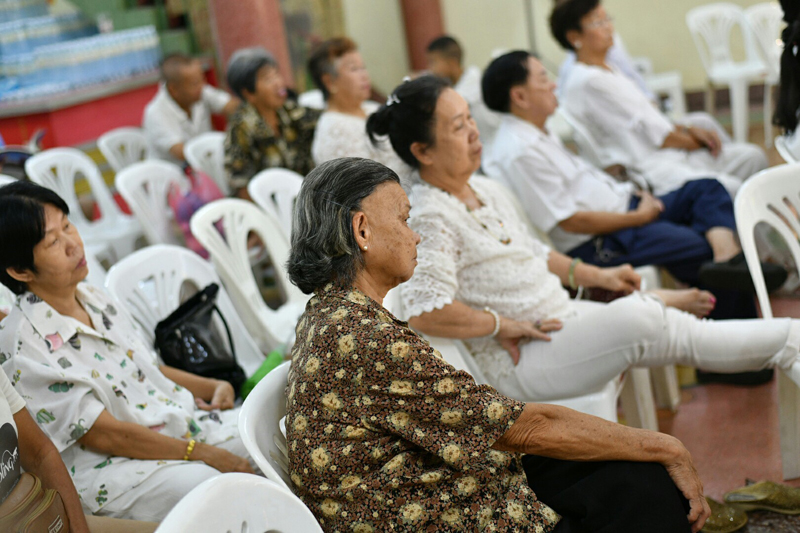
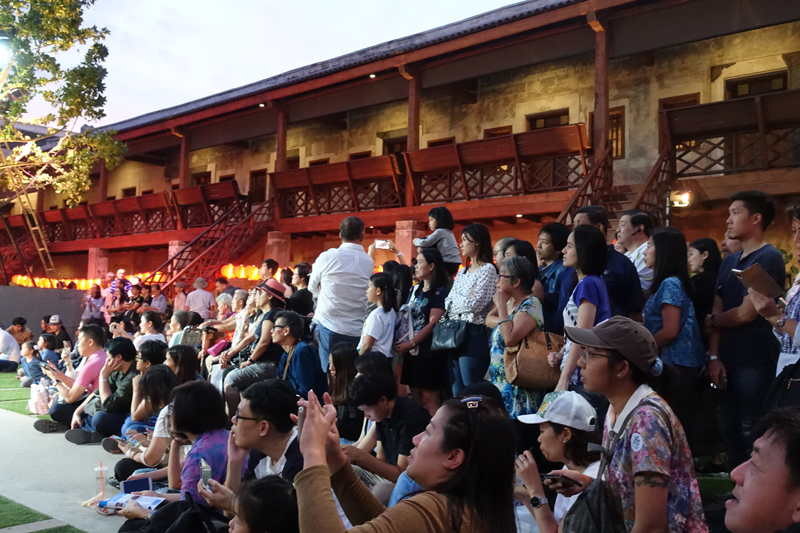
Audience members at the Sai Tee Lui Im Yee Vegetarian Hall in October.Audience members at the Sai Tee Lui Im Yee Vegetarian Hall in October.The Meng Por Pla troupe performs a scene from Romance of the Three Kingdoms Nov. 4 at Lhong 1919.An actor from the Meng Por Pla troupe poses with fans after a Nov. 4 performance at Lhong 1919 in Bangkok.
An audience member poses for a photo with a ngiew actor from Meng Por Pla troupe in early November at Lhong 1919.Meng Por Pla ngiew actors rehearse at Lhong 1919.Audience members watching ngiew at Lhong 1919.
Grigor Dimitrov of Bulgaria lifts the trophy after beating David Goffin of Belgium in their ATP World Tour Finals singles final tennis match Sunday at the O2 Arena in London. Photo: Tim Ireland / Associated Press
LONDON — Grigor Dimitrov’s talent took him to the brink of his biggest career win — but he needed more than that to get over the line.
The sixth-seeded Bulgarian claimed the title at the season-ending ATP Finals on Sunday, prevailing on his fifth match point to beat David Goffin 7-5, 4-6, 6-3 in the final.
“I felt I had a good mental toughness throughout the whole year,” Dimitrov said. “So when my body’s allowing me to do this kind of preparation, I feel I already have an advantage over any other player. And right now those are the moments that I rise up to.”
It wasn’t the Roger Federer-Rafael Nadal matchup many fans had hoped for, but they were left satisfied as the two 26-year-olds delivered the longest final since the tournament returned to a three-set format in 2008.
Dimitrov won in 2 hours, 30 minutes, 15 seconds, adding 11 minutes to the mark set by Federer and Jo-Wilfried Tsonga in 2011.
That wasn’t the only record Dimitrov set. After winning all five of his matches at the O2 Arena, he became the first player to win the elite tournament on debut since 1998, when Alex Corretja of Spain triumphed in Hanover.
“I was a little bit tired,” said Dimitrov, who beat Goffin for the loss of just two games when they met on Wednesday. “I had to play a few matches obviously back-to-back against solid opponents. I knew that David is going to try something new. He had to be aggressive in order so he doesn’t let me play my game.”
Goffin’s adjustments paid off early as he broke Dimitrov’s first two service games either side of losing his own, before settling down to control the opener.
However, Dimitrov fought his way back. He leveled in the eighth game before breaking once more in the 12th to snatch the set, despite Goffin hitting eight more winners.
Dimitrov’s confidence carried into the second set, where he brought up the first break point in the sixth game, only for Goffin to produce a stunning cross-court backhand winner to save it. The momentum back with him, Goffin broke the following game for a 4-3 lead and calmly closed out the set.
Having become the sixth player to beat Nadal and Federer at the same tournament – the latter from a set down in the semifinals – Goffin had every reason to be confident after drawing level. But he wasted four break points in the opening game and they would turn out to be his only chances in the decider.
“I think after this week I’m a better player mentally,” said Goffin, who ends the season at a career-high No. 7 ranking. “I proved to myself that I can do it.”
Dimitrov was more clinical, striking in the sixth game to take control of the third set. However, the Bulgarian has had problems closing matches out this season – losing three times after holding match points – and had cause for concern when Goffin saved his first three to hold from 0-40 down at 2-5.
Dimitrov served his way to 40-15 but saw another chance drift away, before Goffin finally netted a backhand volley to end the match.
“I was a little bit tired in the third,” Goffin said. “It’s the only game maybe I didn’t serve well. I didn’t put a lot of first serves in that game … He was really solid.”
Dimitrov claimed his first Masters title in Cincinnati in August, and having risen to a career-high No. 3-ranking with victory in London, his next target is a Grand Slam.
“I don’t want to get too hyped up because I’ve done well, now I’m No. 3 in the world,” Dimitrov said. “Of course, one of my main goals is to win a Grand Slam tournament. This has always been, again, a dream of mine.”
(This story has been corrected to show it was the longest three-set final since the tournament returned to a three-set format in 2008, not the longest three-set final ever.)
BANGKOK — Some Bangkokians slumping into the subway this morning may have noticed something missing – seats. Did a mass theft occur Sunday night? Nope. They were removed from sections of one train on the MRT Blue Line as an experiment to reduce passenger congestion in what metro deputy Gov. Ronnachit Yaemsaard said was an experiment.
“We’d like to ask cooperation from passengers to move inside so that other passengers can journey together,” the BEM and Metro Co. Ltd. tweetedjust after 8am. It did not say when the experiment would end.
Passenger crush for metro commuters has become critical as ridership has grown, especially in the morning and evening rush hours. There did not seem to be any announcement of the removal other than the tweet.
BEM เพิ่มพื้นที่ว่างในขบวนรถไฟสายสีน้ำเงิน โดยถอดเก้าอี้นั่งผู้โดยสารออกเฉพาะที่นั่งแถวกลาง เพื่อให้ผู้โดยสารสามารถเดินทางได้มากขึ้น เริ่มทดลองให้บริการขบวนแรก ตั้งแต่วันที่ 20/11/60 เป็นต้นไป และขอความร่วมมือผู้โดยสารช่วยขยับนิดชิดในให้ผู้โดยสารท่านอื่นสามารถเดินทางไปด้วยกัน pic.twitter.com/INNLypD4wP
Ronnachit said the experiment is one of several measures being taken to lessen rush-hour congestion, such as reminding passengers to move deeper into the compartment and wear their backpacks in front.
The move drew anger from commuters who said the MRT would serve the public better if it simply bought more trains.
“Why didn’t they just add more trains? They still charge full fares. They already canceled their monthly card, and now they’ve removed seats, too,” tweeted @Ssummersnoww.
“Isn’t it better to increase train frequency during rush hours rather than remove the seats?” wrote @_andxJ.
But some also accept that adding more trains would be a complicated move that could take years.
“You can’t simply conjure up trains whenever you wish it. They have to order and assemble trains,” @Nuttyi tweeted.
The MRT has previously said it was looking to bring more trains into service by 2019. Ronnachit said the current approaches were stop-gap measures until then.
“These solutions cannot solve every problem,” he said. “However, we will continue to come up with new measures to increase passengers convenience before the new trains operate in 2019.”
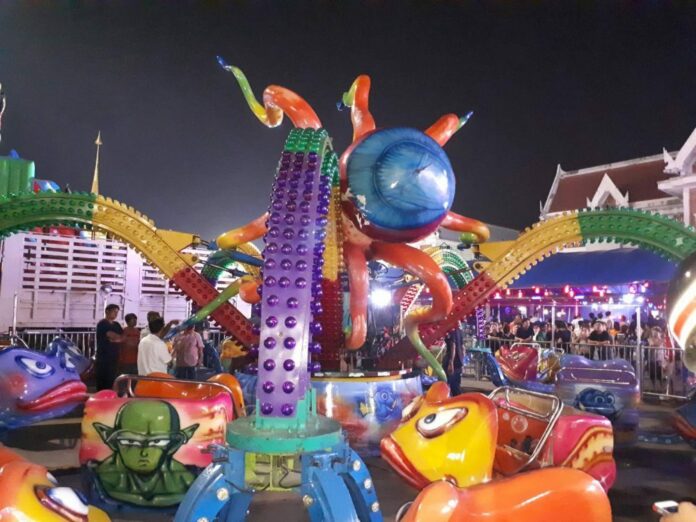
The aftermath at ‘The Octopus’ ride Sunday night at a temple fair in Samut Prakan. 15 were injured.
SAMUT PRAKAN — The owner of a temple fair carnival ride faces a charge of reckless endangerment after his spinning ride malfunctioned, injuring more than a dozen people.
Somdet Rassamee, who owned “Octopus” ride, was being questioned Monday by police, who said he could be charged with recklessness causing injury after 15 people were hurt when the ride’s hydraulics failed Sunday night at the annual Phra Samut Chedi Temple in southeast metro Bangkok.
At about 9:30pm, carnival attendees were screaming and running in chaos after one of the ride’s arms and a large decorative octopus at the center came crashing down. The injured were taken for treatment at local hospitals with injuries including several broken ankles, according to Col. Sopon Phunooch of Samut Prakan city police.
As of Monday morning, police were still investigating the cause of the accident.
MAINZ, Germany — The China under-20 team walked off in protest during its friendly against a German fourth-tier side on Saturday after a small group of fans held up Tibetan flags.
The game at TSV Schott Mainz was delayed for about 25 minutes and resumed once the protestors were convinced by stewards to remove their flags.
The game was the first friendly for China’s under-20 team against sides from the southwest division in the fourth tier of Germany’s league system.
The German soccer federation invited the Chinese to compete within the structure of the league to fill free match-days due to an uneven number of teams competing. The friendlies do not count toward the league’s final outcome but each of the 19 clubs was offered about 15,000 euros (USD $17,700) in compensation for two home games each against the Chinese side.
Waldhof Mannheim, Stuttgarter Kickers and TuS Koblenz are not participating in the one-off action, which allows China’s under-20 team to prepare for the 2020 Olympics in Tokyo.
China and Germany agreed to a five-year soccer partnership in November 2016, aimed at developing the game in China with training and other programs.
A TR-1700 class submarine seen here in 2007 in the Mar del Plata in Buenos Aires, Argentina. Photo: Martín Otero / Wikimedia Commons
BUENOS AIRES, Argentina — Argentina’s navy could not confirm Sunday if seven brief satellite calls received a day earlier were from a lost submarine with 44 crew members on board.
“We do not have clear evidence that (the calls) have come from that unit,” said Adm. Gabriel Gonzalez, commander of the Mar del Plata Naval Base. “We are analyzing more closely to reliably determine that they were not calls coming from the submarine.”
Gonzalez said the navy had intensified an aerial hunt off the country’s southern Atlantic coast after adverse weather conditions spurred waves up to 26 feet (8 meters) and made a maritime search difficult.
Navy spokesman Enrique Balbi said the low-frequency satellite signals received Saturday lasted a “few seconds,” but had not connected with a base, partly due to inclement weather. The communication attempts were originally thought to indicate that the crew was trying to re-establish contact.
On Sunday, search units were largely relying on information gathered from a British polar exploration vessel, the HMS Protector, which was equipped with an underwater search probe and was following the path taken by the submarine, the ARA San Juan.
“Our thoughts remain with the crew of the ARA San Juan and their families at this time,” said HMS Protector Cmdr. Angus Essenhigh, according to a statement from Britain’s Royal Navy.
The gesture has attracted attention since the nations fought a bloody war in 1982 after Argentine troops invaded the Falklands Islands.
Gonzalez also confirmed that the U.S. Navy’s Undersea Rescue Command had been deployed to the search area, along with aircraft from Argentina, Brazil and the U.S., and 11 surface vessels.
Among the 44 crew members is Eliana Krawczyk, the first female submarine officer in Argentina.
Authorities last had contact with the German-built, diesel-electric sub on Wednesday as it was sailing from the extreme southern port of Ushuaia to Mar del Plata.
LPGA Tour pro Ariya Jutanugarn is embraced by her sister and fellow pro Moriya Jutanugarn after sinking a birdie putt on the eighteenth hole to claim outright victory during the final round of the CME Group Tour Championship at Tiburón Golf Club Sunday in Naples, Florida. Photo: Luke Franke / Associated Press
NAPLES, Florida — Lexi Thompson never had a putt so short that was potentially worth so much.
She had a one-shot lead when she settled over a 2-foot par putt on the final hole Sunday at the CME Group Tour Championship. A victory would be worth USD $500,000 in prize money and USD $1 million in a bonus. She would win LPGA player of the year and the Vare Trophy for the lowest scoring average.
She would rise to No. 1 in the world.
She missed.
Moments later, Ariya Jutanugarn capped off her birdie-birdie finish with an 18-foot putt to win the tournament and deny Thompson three of those perks.
“I don’t really know what happened there,” Thompson said. “It just happens. I guess it’s golf. I guess we all go through situations we don’t like sometimes.”
Thompson has gone through her share of them this year. Unlike the others, this one came with a USD $1 million consolation.
Ariya birdied four of his last six holes for a 5-under 67 and seized on her good fortune when Thompson missed the short putt to win the CME Group Tour Championship and the USD $500,000 first prize.
A wild end to the LPGA season sent four players home with a trophy of some variety.
Although she lost the tournament, Thompson still won the CME Race to the Globe and the USD $1 million bonus, along with the Vare Trophy.
Thompson had to win the tournament to be player of the year. Instead, the points-based LPGA player of the year was a tie between a pair of major champions from South Korea, So Yeon Ryu and LPGA rookie Sung Hyun Park. It was the first time the award was shared since it began in 1966.
Park, the U.S. Women’s Open champion, was trying to become the first rookie since Nancy Lopez in 1978 to sweep the major awards. She already had won rookie of the year. She had to settle for a tie for player of the year, and her 75 in the third round damaged her chances of winning the Vare Trophy.
What stood out on another sunny afternoon was the sterling performance of Ariya, who won for the second time this year.
Ariya was at 13 under on the par-5 17th when she hit a hybrid for her second shot into the bunker and blasted out to about 18 feet. Ahead of her on the 18th green, Thompson was at 15 under and lagged a 50-foot birdie attempt beautifully down the slope on the 18th to 2 feet left of the cup.
Ariya made birdie. Thompson missed her par putt, and there was a three-way tie for the lead at 14 under that included Jessica Korda, who was playing with Thompson and had left her 25-foot birdie attempt well short.
Thompson and Korda each closed with a 67.
Ariya hit her approach about 18 feet above the hole and made it for winning birdie. She finished at 15-under 273.
“I had no expectation at all,” Ariya said. “I really did not think about the outcome.”
Ariya was part of a four-way tie for the lead going into the final round, and the CME Group Tour Championship was up for grabs most of the day until Thompson seemingly seized control with 32 on the front nine, a 10-foot birdie on the 13th and then a superb pitch from left of the 17th green that set up a 3-foot birdie.
Pernilla Lindberg had reason to believe she needed birdie from long range on the 18th to have a chance. She ran that 7 feet by the hole and three-putted for a bogey and a 68. She wound up finishing two shots behind, along with Eun-Hee Ji (67).
Michelle Wie, trying to win for the first time since the U.S. Women’s Open in 2014, had a share of the lead until she hit near the edge of a bunker and made double bogey on No. 9, and then dropped two more shots on the back nine. Even with seven birdies, Wie still only managed a 70. She tied for sixth with Park, who closed with a 69. Park was at 13 under through 35 holes and played 1 over the final 37 holes.
Ryu was coping with a shoulder injury and was happy to squeeze in 72 holes. She wound up a part-winner of LPGA player of the year.
Thompson was on the putting green when she heard the cheer for Ariya’s final birdie.
It was the second time this year that Thompson appeared to be in control and was stunned to not win. She had a four-shot lead in the final round of the ANA Inspiration when she was penalized four shots – two for incorrectly marking her golf ball on the green in the third round, and two more shots because the infraction wasn’t discovered by a viewer until the next day, and so she signed an incorrect scorecard in the third round.
She wound up losing to Ryu in a playoff, though Thompson said this week it made her a stronger person.
“I continue to work hard in my off weeks,” she said. “I didn’t stop me, and this won’t either.”
Indonesian House Speaker Setya Novanto sits on a wheelchair Sunday as he is escorted by investigators and aides upon arrival at Corruption Eradication Commission office in Jakarta, Indonesia. Photo: Associated Press
JAKARTA — Indonesia’s anti-graft commission has arrested the speaker of the country’s Parliament who for weeks evaded questioning over his alleged role in the theft of USD $170 million of public money.
Attempts to question Setya Novanto took an unexpected twist on Thursday night when he was involved in a car crash and admitted to hospital. The previous day he had evaded arrest in a police raid on his home.
Novanto’s lawyer said he was badly injured in the crash, but Corruption Eradication Commission spokesman Febri Diansyah said Monday that an independent panel of doctors concluded there was no need for his continued hospitalization.
Diansyah said Novanto was moved to a detention center around midnight Sunday. Photos showed him in a wheelchair wearing the commission’s orange vest for prisoners.
He is accused of being among 80 people, mostly officials and politicians, and several companies who used the introduction of a USD $440 million electronic identity card system in 2011 and 2012 to steal more than a third of the funds.
Novanto, also chairman of Golkar, a major party in Indonesia’s governing coalition, has denied any wrongdoing.
Diansyah said Novanto will be detained for 20 days to assist with the commission’s investigation.
The car accident unleashed a wave of incredulity in Indonesia with some seeing it as an outrageous move to stymie the investigation.
A Donald Trump admirer, Novanto made an unexpected appearance at the future president’s news conference at Trump Tower in New York in September 2015 along with another Indonesian lawmaker. Trump introduced Novanto as one of Indonesia’s most powerful men who would do great things for the U.S.
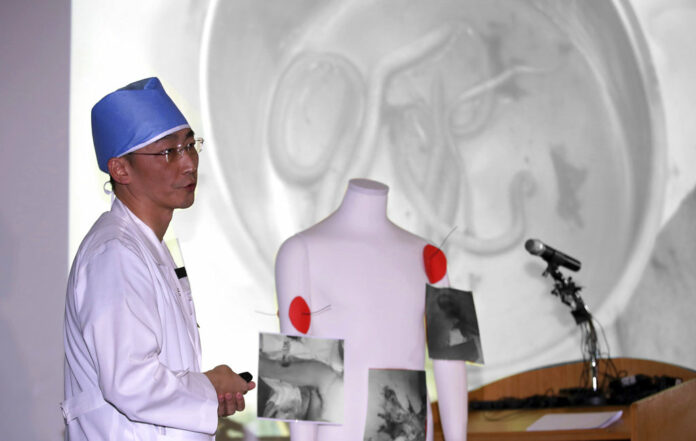
Medical doctor Lee Cook-jong describes the parasites found inside the body of a North Korean soldier on Wednesday at Ajou University Medical Center in Suwon, South Korea. Photo: Kim In-chul / Yonhap
SEOUL, South Korea — Surgeons treating a North Korean soldier who was severely wounded by gunfire while escaping to South Korea have removed dozens of parasites from his body, including presumed roundworms as long as 27 centimeters, hospital officials said.
The soldier, whose name and rank have not been disclosed, defected to South Korea last Monday by driving a military jeep near a line that divides the Koreas and then rushing across it under a barrage of bullets. Hospital officials said Saturday that it was too early to tell whether he will make a recovery.
While treating the wounds, surgeons found the large parasites, which may be reflective of poor nutrition and health in North Korea’s military, the hospital said. Doctors measured the soldier as being 1.7 meters tall, but weighing just 60 kilograms.
“I spent more than 20 years of experience as a surgeon, but I have not found parasites this big in the intestines of South Koreans,” Lee Cook-jong, who leads the soldier’s medical team, told reporters last week.
Lee is a famous trauma specialist who was hailed as a hero in 2011 after conducting life-saving surgeries on the captain of a South Korean freighter ship who was shot during a rescue mission after being held by Somali pirates.
While the North Korean soldier’s vital signs were stabilizing on Saturday, he continued to remain unconscious and relying on a breathing machine. After consecutive surgeries to repair internal organ damage and other injuries, no further surgeries are planned as of yet, said Shin Mi-jeong, an official at the Ajou University Medical Center near Seoul.
South Korea’s military said four North Korean soldiers used handguns and AK rifles to fire about 40 rounds at their former comrade, who was hit at least five times. He was found beneath a pile of leaves on the southern side of the Joint Security Area, and South Korean troops crawled there to recover him. A United Nations Command helicopter later transported him to the Ajou hospital.
It remains unclear whether the North Koreans chasing the soldier fired at him even after he crossed into the southern side of the border, which would be a violation of an armistice agreement that ended the 1950-53 Korean War. The U.N. Command, which is investigating the incident, postponed a plan to release video footage of the soldier’s escape on Thursday.
The Joint Security Area is jointly overseen by the American-led U.N. Command and by North Korea, with South Korean and North Korean border guards facing each other only meters apart. It is located inside the 4-kilometer-wide Demilitarized Zone, which forms the de facto border between the Koreas since the Korean War.