28.8 C
Bangkok
Monday, June 29, 2026
Home Blog Page 2183

Hamilton Wins 4th F1 Championship at Mexican Grand Prix

Mercedes driver Lewis Hamilton, of Britain, celebrates at the end of the Formula One Mexico Grand Prix auto race at the Hermanos Rodriguez racetrack Sunday in Mexico City. Photo: Rebecca Blackwell / Associated Press

MEXICO CITY — Lewis Hamilton grabbed the British Union Jack for a “victory” lap, and then draped it over his shoulders. There was no way he was going to let it go.

Hamilton won his fourth career Formula One championship Sunday with a ninth-place finish at the Mexican Grand Prix, a rare finish away from the podium but one good enough to win a title that makes him the most decorated British driver in history.

“It’s been a long journey,” said Hamilton, who won his first championship in 2008. “This week I’ve been reminiscent of where I came from, dreaming of being in Formula One.”

None of it came easy Sunday in a race where he had to overcome a first-lap tire puncture and scramble to finish off title rival Sebastian Vettel of Ferrari. It was a bump from Vettel shortly after the start that made an expected title more stressful than anyone at Mercedes expected.

The ninth-place finish was Hamilton’s worst of the season, but it also closed out Vettel with two races left.

“Not the race you wanted, but who cares?” Mercedes boss Toto Wolff radioed Hamilton after the race.

Not Hamilton.

He passed Sir Jackie Stewart for the most championships won by a British driver. Formula One’s first and only black driver also joined Vettel and Alain Prost as four-time winners. Only Argentina’s Juan Miguel Fangio (five) and Germany’s Michael Schumacher (seven) have won more.

Hamilton also passed his idol, Brazil’s Aryton Senna, who won three titles before he was killed in a crash and is still considered one of the most skilled drivers in F1 history.

“It’s crazy to think I continue to put the Hamilton stamp, the Hamilton name, in the history books. Beyond my time there will be kids that read my name,” Hamilton said.

Red Bull’s Max Verstappen got the win in Mexico for his third career victory and second this season.

Vettel made it an adventure for everyone.

The German started in pole position and the beginning was a furious sprint through the long straight at the Autodromo Hermanos Rodriguez. Verstappen got the edge through the first turn and Hamilton made a move to get past Vettel, who drifted left. Vettel’s left front wing clipped Hamilton’s right rear tire, damaging both cars and forcing both drivers to the pits for repairs.

Verstappen disappeared into the distance as a seething Hamilton asked his team over the radio if Vettel made contact “on purpose.”

“Not sure, Lewis,” the team replied. Race stewards determined no investigation was necessary.

Vettel had to finish first or second to push the championship to the next race in Brazil. Both drivers made a mad scramble to get back toward the front, weaving through the traffic on the short track. Hamilton was struggling and on lap 23, he was so slow he was shown a blue flag, the humiliating order to let a faster car  Verstappen  go past him.

“I knew the car was good. I didn’t know it would be that good,” Verstappen said.

“Throughout the race, I was thinking don’t give up,” Hamilton said.

Vettel pushed hard but finished fourth and the title chase was over. Late in the race, Vettel asked his team if he could get second, but when told how far behind he was, Vettel replied, “Oh mama mia, that’s too much.”

After their cars crossed the finish line, Vettel drove alongside Hamilton and applauded. Hamilton seemed momentarily overwhelmed, placing his helmet in his hands.

“He’s done a superb job all year round and deserves to win the title. So congratulations to him. It’s not about anyone else today, it’s about him. It’s his day,” Vettel said.

Although denied the podium, the finish allowed Hamilton to celebrate championships in four cities over his career, with Mexica City joining Sao Paolo, Brazil, in 2008, Abu Dhabi in 2014 and Austin, Texas, in 2015.

“Viva Mexico!” Hamilton told the crowd when he got out of his car.

Hamilton’s championship will spur debate about his place among the best drivers in F1 history. His Mercedes car and team have dominated the era of turbo-hybrid engines adopted in 2014. Of Hamilton’s 62 career victories, 40 have come over the last four years, a span of 77 races.

He chased down this championship over the second half of the season after Vettel won two of the first three races. Ferrari faltered as Hamilton racked up five wins over the past seven races. His car has been as steady as his driving, with Hamilton finishing every race.

“This was a championship I was hoping for, fighting another team,” Hamilton said.

Story: Jim Vertuno

Advertisement

Army Supporters, Buddhist Nationalists March in Myanmar City

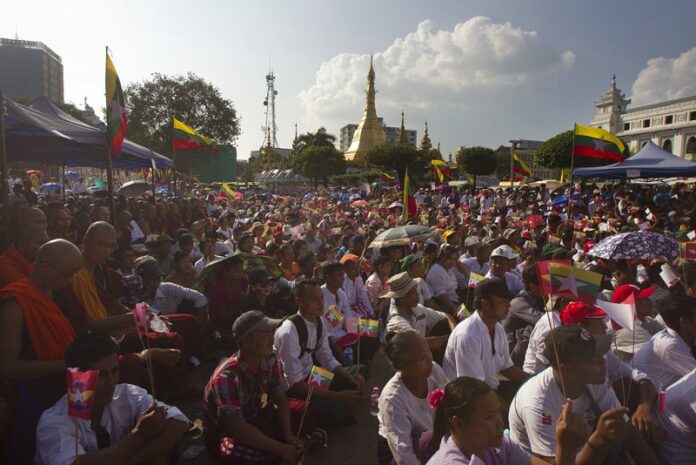
Participants attend a ceremony supporting the country's military and government servants Sunday in Yangon, Myanmar. Photo: Thein Zaw / Associated Press

YANGON — People marched in Myanmar’s largest city on Sunday to support the military, which has come under heavy criticism over violence that has driven hundreds of thousands of Rohingya Muslims to flee to neighboring Bangladesh.

More than 2,000 army supporters, including Buddhist nationalists and monks, took part in the march.

“I want to urge you to support the military. Only if the military is strengthened will our sovereignty will be secured,” a senior Buddhist nationalist monk, Zagara, told the crowd.

More than 600,000 Rohingya from northern Rakhine state have fled to Bangladesh since Aug. 25, when Myanmar security forces began a scorched-earth campaign against Rohingya villages. Myanmar’s government has said it was responding to attacks on police outposts by insurgents, but the United Nations and others have said the response was disproportionate.

The exodus of the Rohingya has become a major humanitarian crisis and sparked international condemnation of Myanmar.

Nyunt Yi, a 70-year-old retired military soldier who served in the army for more than 40 years, said Sunday that “only the army can protect the national security and stop the illegal intruders,” referring to the Rohingya.

Myanmar’s Buddhist majority denies that Rohingya are a separate ethnic group and regards them as having migrated illegally from Bangladesh, although they have lived in Myanmar for generations.

Advertisement

Huge Rally in Barcelona Rejects Catalan Secession Bid

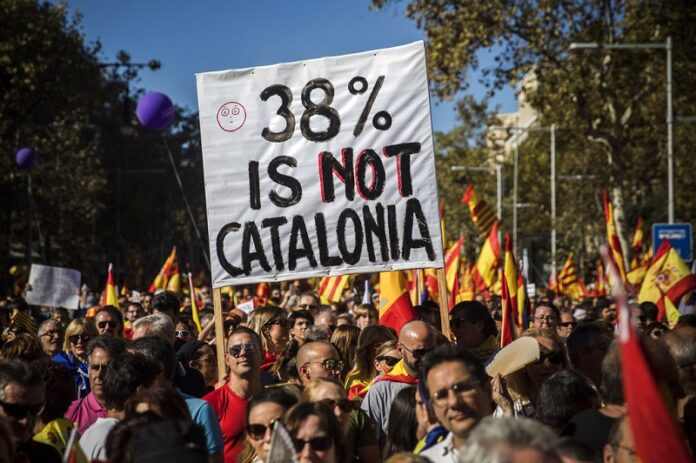
Nationalist activists hold up a banner during a mass rally against Catalonia's declaration of independence,Sunday in Barcelona, Spain. Photo: Santi Palacios / Associated Press

BARCELONA, Spain — Hundreds of thousands of Catalans took to the streets of Barcelona on Sunday to voice their opposition to the region’s declaration of independence amid vast political uncertainty for the region in northeast Spain.

Catalonia’s political leadership was fired Saturday by central authorities in Madrid who are trying to tame the worst political crisis Spain has seen in decades. So far, Catalan’s former leader has insinuated that he won’t step down.

Waving Spanish, Catalan and European Union flags, the protesters described themselves as the silent majority who have been ignored during the wealthy region’s bid for independence, which came to a head Friday when the regional parliament voted to secede from Spain.

“We have organized ourselves late, but we are here to show that there is a majority of Catalans that are no longer silent and that no longer want to be silenced,” said Alex Ramos, head of Catalan Civil Society, a pro-union grassroots group.

The organizers said more than 1 million people turned out but police put the figure at 300,000. There was no way to immediately reconcile the figures.

The mood at Sunday’s rally was festive. “We won’t let Spain be torn apart into pieces,” read one banner. “The awakening of a silenced nation,” read another.

In response to the lawmakers’ secessionist vote, Spanish Prime Minister Mariano Rajoy triggered unprecedented constitutional powers, firing Catalonia’s secessionist regional government and calling an early regional election for Dec. 21.

Monday will be the first working day since the region declared independence and its leadership was fired. It was not known how Catalonia’s estimated 200,000 public workers would react to their bosses’ dismissal.

Ousted regional leader Carles Puigdemont has called for Catalans to engage in peaceful opposition to Spain’s takeover of regional affairs, saying he and his fired cabinet would keep “working to build a free country.”

Separatist parties and grassroots groups have spoken of waging a campaign of disobedience to hamper the efforts by central authorities to run the region.

Puigdemont and his ministers could face prison for their separatist actions. Spain’s government has said the ousted Catalan leaders could be charged with usurping others’ functions if they refuse to comply with their firing. Spanish prosecutors have also said they may consider rebellion charges against leading separatists.

Oriol Junqueras, the ousted vice president of Catalonia’s rebellious government, wrote in an open letter Sunday saying that separatists should consider participating in the election Rajoy called for Dec. 21. Some secessionists have argued to boycott the vote.

The top politicians for pro-union parties hoped to use Sunday’s rally to launch their election campaigns.

“It’s time to take over the streets and take over the ballot boxes,” said Albert Rivera, the leader of the center-right Citizens party.

Separatists won 48 percent of the vote in Catalonia in the 2015 regional election, although they took more seats in the regional parliament because of an election law that gives more weight to sparsely populated areas.

Organizers said the rally’s goal Sunday was to defend Spain’s unity and reject “an unprecedented attack in the history of democracy.” Three weeks ago, the same group organized another mass rally that brought hundreds of thousands onto Barcelona’s streets  the largest pro-union show of force in Catalonia in recent years.

“Catalan leaders have broken the law. The central government has let this situation go for too long, for even 30 or 40 years, thinking that we were never going to arrive at this extreme, but here we are,” said Angelita Cuesta, a 66-year-old retiree at the rally.

“Our society is fractured, there are family members and friends who no longer can talk about politics to avoid conflict,” she added.

The Catalan parliament’s vote to secede came after an Oct. 1 referendum in favor of independence that was deemed illegal by Spain’s constitutional court.

There are fears the political turmoil in Catalonia could have a severe economic impact, both in the region and on Spain itself.

Addressing the crowd at Sunday’s rally, Josep Borrell, former European Parliament president, said the central government’s move to take control of some regional affairs was the only thing preventing a full-blown economic crisis in Catalonia.

If the government had not triggered its constitutional powers to run Catalonia, “many of you would have lost your jobs” he said. “If that hasn’t happened, it’s because … businesses and markets understand that there won’t be (secession).”

Some 1,700 companies have already relocated their headquarters to other parts of Spain in recent weeks amid the political turmoil.

Story: Elena Becatoros, Aritz Parra, Joseph Wilson

Advertisement

19 Million Turnout For Cremation Raises Debate

People on Thursday lineup to offer Sandalwood flowers to King Bhumibol near the Sanam Luang.

BANGKOK — Thursday’s cremation ceremony saw 19 million people participate, based on a government count of how many sandalwood flowers were offered for King Bhumibol.

More than 2.9 million people in the capital and millions more at nearly 900 locations outside Bangkok bade their final farewell to King Bhumibol by queuing to lay folded sandalwood flowers, the Interior Ministry announced Sunday. The Interior Ministry reported that another 16.2 million went through the same ceremony in 76 provinces outside Bangkok.

The number was less than a third of the total population of about 70 million, a fact met with consternation by some people upset it wasn’t higher.

Tassanee Thantawanit, a language professor at Burapha University, criticized the figure of 29 percent participation.

“Why does it have to be calculated that it’s about 29 percent? … They should have added that there are still many Thais who couldn’t make it due to various constraints, such as being hospitalised, living in elderly homes or residing in faraway places, etc.,” Tassanee wrote Saturday on Facebook, stressing that any such media reports should “stress that all Thais love the king.”

Some offered different readings of the 19 million figure in comments on a BBC Thai infographic.

“Thailand has a population of about 70 million but only 20 million are quality people. Don’t those who didn’t show up have a conscience?” user Sujittra Panyasub wrote. “Not counting small children, the sick, monks and inmates, say about 2 million, and about 2 million who live abroad, where were the other 45 million?”

In Bangkok, topping the most offerings were recorded in the Bang Na district at BITEC, a large venue normally used as a convention center. Nearly 91,000 people participated in the ceremony there.

In related stats, City Hall said it collected 339 tons of rubbish on Thursday alone. It vowed to handle the waste appropriately.

Advertisement

Final Procession Sets Out in King’s 5-Day Funeral (Video)

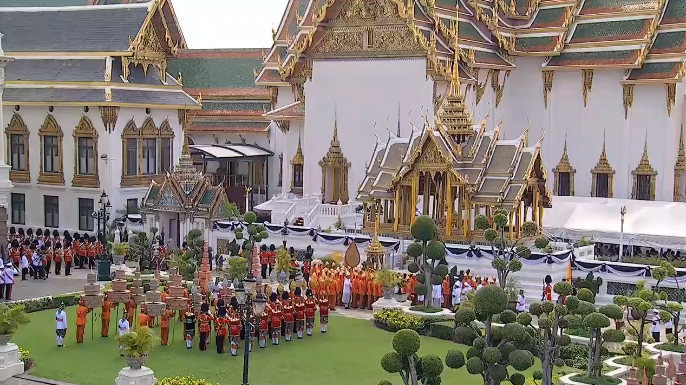
BANGKOK — The yearlong mourning period and elaborate five-day funeral rites for Thailand’s king of seven decades officially end Sunday when his relics and ashes are enshrined in the royal palace and two temples.

At the ceremony at Bangkok’s Grand Palace, broadcast live nationwide and led by new King Maha Vajiralongkorn, King Bhumibol Adulyadej’s relics were escorted to Chakri Maha Prasad Throne Hall, where he used to host dinners, receptions and receive the credentials of foreign ambassadors. There, the golden urn of Rama IX — as the king of the Chakri dynasty in known — will be interned in the Heavenly Abode, joining the relics of kings Rama IV, V, VI, VII and VIII.

Later Sunday, in the final act of the funeral ceremony, the king’s ashes will be transferred in the palanquin made of golden teak from the Temple of the Emerald Buddha to two royal temples, Wat Rajabophit and Wat Bovoranives.

Bhumibol had stayed at Bovoranives during his 15-day ordination in 1956. It’s the center for the Theravada Buddhist Dhammayutika order, established by Rama IV with the emphasis on discipline and monastic practices.

The king was cremated on Thursday following his death Oct. 13, 2016, at age 88. His passing sparked a national outpouring of grief for a monarch who was regarded by many Thais as a father figure. Yet it also ushered in a sense of uncertainty for Thais who had grown used to Bhumibol serving as a unifying presence in a country regularly beset by political upheaval.

Starting Monday, the black-and-white cloth that has adorned buildings for a year must be taken down as the mourning period ends, the prime minister’s office was quoted as saying. It encouraged the public to continue to dress in subdued colors, the Bangkok Post reported.

Advertisement

EU Official Says No One Will Recognize Catalonia

Demonstrators with "estelada", or Catalonia independent flag, gather in protest in front of the Spanish police station Tuesday in Barcelona, Spain. Photo: Francisco Seco / Associated Press

BARCELONA, Spain — The European Parliament’s president says no one will ever recognize Catalonia as an independent country.

Antonio Tajani says Catalonia’s independence referendum was illegal and state of law should be restored. He also spoke against EU mediation, saying the crisis is an internal Spanish issue.

Catalonia’s separatist leader on Saturday called on Catalans to peacefully oppose Spain’s takeover.

Advertisement

Govt Issues Rules to View Royal Cremation Site

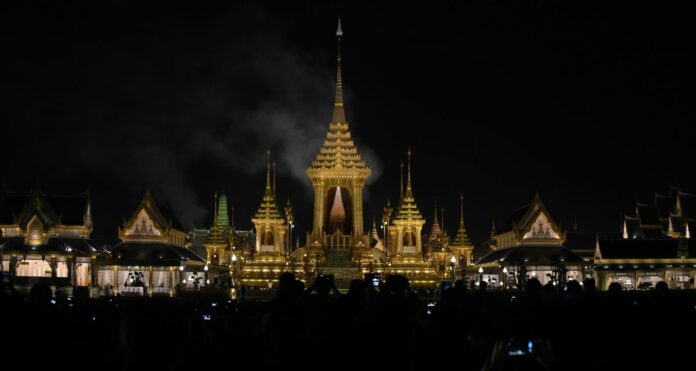
Smoke lingers in the air above the crematorium Thursday in Sanam Luang.

BANGKOK — With the official mourning period ending at midnight on Sunday, the culture ministry has issued dress and behavioral guidelines for those wanting to visit the royal crematorium at Sanam Luang.

The site, which saw the cremation of King Bhumibol, will be open to the general public starting Thursday. It will be open four weeks until Nov. 30. There will also be an exhibition on display.

The guidelines said women are required to refrain from wearing sleeveless shirts or blouses. Skirt must be knee-length and not too tight or body-hugging. Sandals are not permitted and shoes must look polite.

ข้อปฏิบัติแต่งกายเข้าชมพระเมรุมาศ
Guidelines issued by the culture ministry. Photo: Ministry of Culture

The guidelines also said men are required to refrain from wearing sleeveless shirts as well as tight, body-hugging shirts. Faded, tight and torn jeans are also forbidden.

Like women, men are also not required to wear slippers or sandals on site.

School and university students meanwhile are required to wear uniforms as dictated by official regulations.

Ethnic minorities are required to wear respective ethnic dresses.

All visitors are banned from touching the crematorium and exhibited objects. They are also asked not to touch, pluck or destroy flora and fauna on site.

Photo taking will only be allowed at designated sites and rubbish must be only disposed at designated areas, the document concluded.

Advertisement

Opioid Epidemic Shares Chilling Similarities With the Past

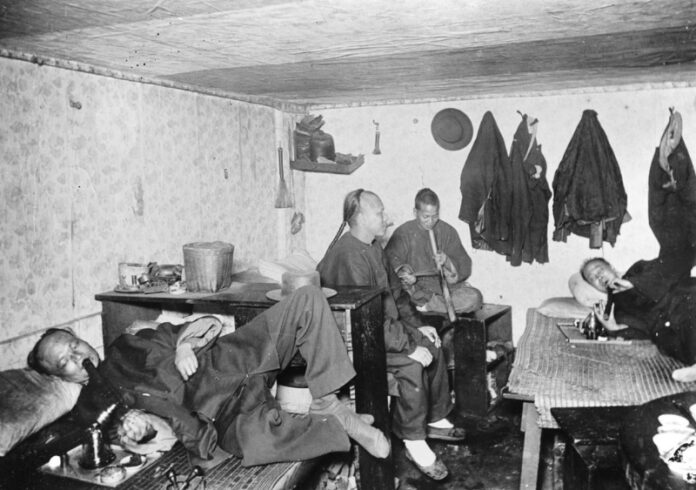
Chinese Americans in an opium den. Rev. Frederick Masters, a 19th century Methodist missionary, described opium dens in San Francisco as dark, fumy basements “sepulcher-like in their silence save for the sputtering of opium pipes or the heavy breathing of their sleeping victims.” Photo: Associated Press

NEW YORK — While declaring the opioid crisis a national public health emergency Thursday, President Donald Trump said: “Nobody has seen anything like what’s going on now.”

He was right, and he was wrong.

Yes, this is the most widespread and deadly drug crisis in the nation’s history. But there has been a long string of other such epidemics, each sharing chilling similarities with today’s unfolding tragedy.

There was an outbreak after the Civil War when soldiers and others became addicted to a new pharmaceutical called morphine, one of the first of many man-made opioids. There was another in the early 1900s after a different drug was developed to help “cure” morphine addiction. It was called heroin.

Cocaine was also developed by drugmakers and sold to help morphine addiction. It cleared nasal passages, too, and became the official remedy of the Hay Fever Association. In 1910, President William H. Taft told Congress that cocaine was the most serious drug problem the nation had ever faced.

Over the next century, abuse outbreaks of cocaine, heroin, and other drugs like methamphetamine, marketed as a diet drug, would emerge and then fall back.

“There are one or two or three wolves ahead of the pack that seem to be the most pressing threat, their jaws closest to you,” said David Courtwright, a University of North Florida historian who has written books on U.S. drug epidemics. “But there’s always a pack. The history is that the lead wolves keep shifting.”

Trump vowed in his recent remarks “we will free our nation from the terrible affliction of drug abuse.” But the grim reality is that these drugs never disappear completely once they’ve emerged.

The good news, though, is that drug epidemics do fade considerably – usually because reduced supply and demand eventually diminish the number of new addictions, experts say. And that history offers some hope for the future.


The 1800s: Better – And More Dangerous – Medicines

Most U.S. drug epidemics over the past two centuries were sparked by pharmaceutical companies and physicians pushing products that gradually proved to be addictive and dangerous. In the 1800s the drug was often opium, usually sold as a liquid in products like laudanum, and given to patients for pain or trouble sleeping. Mary Todd Lincoln, President Lincoln’s wife, took it for headaches and became addicted.

The drug was also used to get high. “Opium fiends” smoked it in opium dens like those in San Francisco’s Chinatown. Rev. Frederick Masters, a 19th century Methodist missionary, described opium dens in that city as dark, fumy basements “sepulcher-like in their silence save for the sputtering of opium pipes or the heavy breathing of their sleeping victims.”

The young nation’s drug problem grew because of morphine, a painkiller derived from opium through a chemical process that was perfected by E. Merck & Company of Germany. It made battlefield injuries more bearable for Civil War soldiers, but so many veterans got hooked that morphine addiction was sometimes called “the army disease.”

It would get worse. Cocaine and heroin were soon developed – in part to help morphine addiction.

Merck introduced cocaine, which became a prime ingredient in a variety of over-the-counter tonics for sinus problems and other ailments. Because of its energizing effects, beverage makers put it in their wines and sodas and laborers in the South sniffed it to get through grueling work shifts.

Bayer, another German pharmaceutical company, began marketing heroin in the 1890s. It often came in pill form, without prescription, and was used to treat the flu and respiratory ailments. But it came to be sniffed – and later injected – by those looking for a more intense high or a substitute for other drugs, whether it was morphine in 1905 or opioid pain pills like Vicodin in 2015.


The Early 1900s: From Cure to Curse

In the early 1900s cocaine shifted from a consumer fad into reviled epidemic, as physicians began documenting addiction problems and police chiefs linked recreational cocaine use to prostitution and violent crime. It led to the first national effort to contain a drug epidemic: In 1914, Congress passed the Harrison Act, which said cocaine and heroin could be sold only as a prescription medicine, not in over-the-counter remedies or in consumer products.

Historians believe a growing stigma attached to cocaine use was the main reason the epidemic declined, but they say enforcement of the Harrison Act – and its impact on prices – also was important. Cocaine and heroin got much more expensive when they were driven underground.

Drugs were still abused in the later years in pockets of society – cocaine use was rampant in Hollywood in the 1920s, for example. But economics and politics helped prevent large-scale epidemics for a time. The Great Depression meant few had the disposable income for an illicit drug habit, and World War II decimated the supply of drugs from overseas.

“There’s no customs patrol more efficient than a U-boat,” said Courtwright, the University of North Florida historian.


Mid-20th Century: The First War on Drugs

Alcohol and cigarettes were – and remain – the nation’s primary addictions. Both kill far more people than drugs. But since the middle of the century, there’s been wave after wave of other drug abuse outbreaks.

Amphetamines, developed in the 1930s, took off in the 1950s. Marketed by drug companies and promoted by doctors, they were used for weight loss, anxiety and depression. Methamphetamine, developed by the Burroughs Wellcome drug company, was often prescribed as a diet pill and abused by those attracted by the surge of energy it produced. Users who injected it were known as “speed freaks.”

“The speed freak is, in many ways, an outcast in a society of outcasts. He is regarded as a fool by heroin addicts, as insane and violent by those using psychedelics and marijuana, and a ‘bust’ by non-drug using hustlers,” wrote Dr. Roger Smith, a criminologist who studied drug use in San Francisco in the late 1960s.

Greater regulation of the drugs in 1970, along with the stigma attached to speed freaks, caused the drugs to recede as others became more widely used.

In the 1960s and 1970s, heroin use surged, prompted in part by Vietnam War soldiers who were exposed to it while fighting overseas. Unlike the doctor-driven previous drug epidemics, this one victimized poor inner-city neighborhoods most.

In 1970 and 1971, in New York City, more adolescents, many of them black and Puerto Rican, died of heroin-related incidents than any other cause. There was little compassion then for heroin addicts, recalled John de Miranda, a longtime addiction professional who worked with homeless men in Boston’s South End in the early 1970s. “We basically cared for the men nobody else wanted to deal with,” he said.

President Richard Nixon’s 1971 “war on drugs” declaration kicked off a long period of attacking the drug problem with beefed up law enforcement and tougher sentences for users and dealers. The approach did cut down foreign shipments of heroin and marijuana, but those successes were temporary and many historians argue Nixon’s war ultimately was a losing effort.


Late 20th Century: Cocaine on High

Heroin use faded in the late ’70s, but cocaine was on its way back, first in powder form and then becoming an epidemic of crack in the 1980s when a supply glut prompted dealers to sell hardened cocaine rocks that sold for USD $5 to USD $10 on the street.

Many young thrill-seekers, wary of heroin and needles, thought crack was less dangerous because it was smoked like marijuana.

Like the heroin surge before it, crack was seen as tied to urban blight and violent crime. This triggered a new drug war, including the “this is your brain on drugs” TV spots that showed frying eggs, and harsh jail sentences for the sale and possession of crack that were far more severe than the penalties for regular cocaine.

The crack epidemic died out in the 1990s, tailing off at roughly the same time both in cities that aggressively arrested people and cities that didn’t. Experts said the police crackdown contributed, but more important was society’s growing repulsion to the drugs. Families and communities were shattered by crack-related murders and arrests. The drug’s users came to be regarded as disgraceful “crackheads.” Even risk-taking kids, looking for new highs, started to avoid crack.


Today’s Opioid Epidemic

In 1900, when cocaine and heroin were legal and popular, there were 250,000 Americans with a drug addiction, according to one historical estimate. That was about 1 in 300 Americans. The estimate today is 1 in 133, and the drugs are deadlier than ever.

“In all my years I’ve worked in the substance abuse field, I’ve never had so many patients die,” said Joan Hartman, vice president of behavioral health services for Illinois-based Chestnut Health Systems, who has been working in treatment for three decades.

There were fewer than 3,000 overdose deaths in 1970, when a heroin epidemic was raging in U.S. cities. There were fewer than 5,000 recorded in 1988, around the height of the crack epidemic.

More than 64,000 Americans died from drug overdoses last year, according to the U.S. Centers for Disease Control and Prevention.

This epidemic started around 1995, kicked off by a drug called OxyContin, which like heroin and morphine before it, was meant to be a safer and more effective opioid. OxyContin and competitor drugs were designed to release the medication slowly over long periods of time, making them and supposedly safe and effective enough to use for months to treat chronic pain. But patients found themselves hooked and wanting more, and drug abusers found they could crush the tablets and snort or inject them, delivering the drug to the bloodstream much more quickly.

Aggressive marketing and distribution pushed hundreds of millions of pills into communities. Then more and more addicts turned to cheaper alternatives, bought illegally, like heroin and fentanyl, an opioid medication developed to treat intense, end-of-life pain in cancer patients that is 50 to 100 times more powerful than morphine.

“It’s a very complex epidemic” that is nowhere close to being over, said Dr. Anne Schuchat, the CDC’s principal deputy director, in an interview earlier this year.


Lessons of the Past

What has worked for previous epidemics?

The supply is often reduced by a combination of regulations, law enforcement and economics. And historians say that demand slows when drug users became so outcast that even those looking for a risky thrill or a way to escape began to stay away.

Past epidemics have also shown what doesn’t work. Many experts, including some in law enforcement, say that arresting users and dealers does not seem to slow epidemics. “We cannot arrest our way out of the heroin and opioid addiction crisis,” said Brian Moran, Virginia’s secretary of public safety and homeland security, speaking at a federal hearing in July.

But while health experts want to urge people to shun drugs to reduce the number of new addictions, they say ostracizing the people already suffering from addiction does little to help them. It may even impede attempts to get people into treatment, Hartman said.

Health officials are fighting the current epidemic on three fronts: Preventing overdose deaths, helping people recover from addiction, and preventing new addictions.

There appears to be some success on the first front. The number of new addictions may be receding.

A recent federal report noted a downward trend in “opioid misuse” in adults younger than 50. Prescription rates are falling, though they remain far higher than years ago. And according to a closely watched University of Michigan study of adolescents, use of the opioids OxyContin and Vicodin has been low and falling for several years. In 2016, heroin use was the lowest in the survey’s 41-year history.

“I suspect we may be past the peak (of the epidemic), at least in terms of initiation,” said Jonathan Caulkins, a drug policy scholar at Carnegie Mellon University.

The other two fronts – preventing deaths and treating addiction – are not so promising, despite more attention and money flowing to programs. Deaths are still rising, and University of Pittsburgh researchers estimate as many as 300,000 will die from overdoses over the next five years.

“Honestly, we’re at a point where the horses are out of the barn after the gate has closed,” said Dan Werb, an expert at the University of California, San Diego. “I’m not optimistic about the capacity of our classic approaches to rein this in.”

Story: Mike Stobbe

Advertisement

Military Frees Man Detained For Vowing to Wear Red

Ekachai Hongkanwan holds a book on Thai democracy last June. Photo: Ekachai Hongkangwan / Facebook

BANGKOK — A former lese majeste convict vowed legal action Saturday against soldiers he claims injured him while taking him into custody during King Bhumibol’s funeral.

Upon his release today from four nights in military detention, Ekachai Hongkangwan posted on Facebook that he would file a complaint against three soldiers he said caused him to fall and suffer scratches on his arm while dragging him away Tuesday.

He said he was held four nights in Kanchanaburi province. Ekachai, who previously served nearly three years in prison after being convicted of defaming the monarchy, was taken in by 11 army officers Tuesday morning after he had publicly vowed to wear a red shirt on the day King Bhumibol Adulyadej was cremated.

Ekachai posted about his release at 3pm on Saturday to say he had been released along with three photos he claimed showed injuries resulting from his detention.

Calls to his mobile phone went unanswered Saturday afternoon.

Advertisement

LA Woman Booted From Ceremony For Dress Invites Fury Online

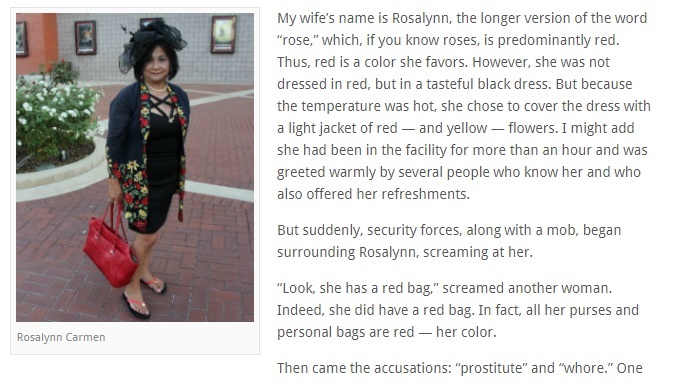
A screen cap of a column published by online California news outfit Times of San Diego. Leonard Novarro / Times of San Diego

BANGKOK — A Thai-American woman turned away Thursday from a Thai temple in Los Angeles for her attire has become an object of contempt online.

Rosalynn Carmen of San Diego, California, visited the Wat Thai Temple to join a symbolic cremation ceremony but was chided and booed by Thais there who insisted what she was wearing was inappropriate, according to an account by her journalist husband.

“Thank you all. You have engendered a great story about intolerance. Below is the story that is going out to one of the largest and prominent communities in America. Now they can see how intolerant ignorant people can become in this country – right here on American soil,” Carmen wrote Friday on Facebook, with a link to a column written by her husband Leonard Novarro for the Times of San Diego.

According to the opinion piece written by Carmen’s husband, Leonard, his wife was not dressed in red but in a “tasteful black dress.” An image from said to be from the event shows Carmen in a black dress covered with a black garment fringed with yellow and red flowers.
After the story got the attention of Thai netizens, ultra-royalists accused Carmen of being part of an anti-monarchist network trying to sabotage the event.

Novarro said there was no provocation intended.

rosalynn.king e1509184089509
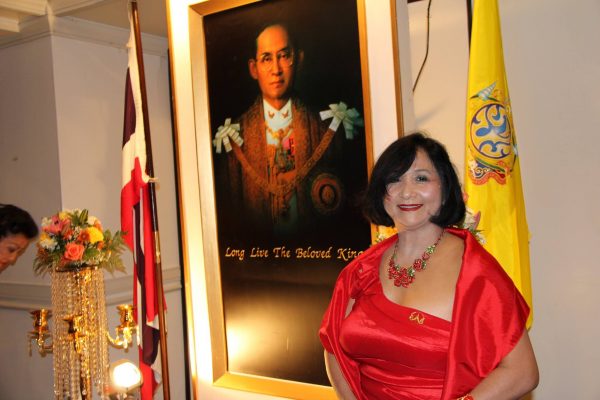
Rosalynn Carmen in a Dec. 5, 2014 photo at an event celebrating King Bhumibol’s 87th birthday in 2014 in Los Angeles.

“But because the temperature was hot, she chose to cover the dress with a light jacket of red – and yellow – followers,” wrote Novarro, adding that the two had been inside the temple over an hour before her outfit drew attention.

“But suddenly, security forces, along with a mob, began surrounding Rosalynn, screaming at her. ‘Look, she has a red bag,’ screamed another woman. Indeed, she did have a red bag. In fact, all her purses and personal bags are red – her color,” he wrote, explaining that she had a thing for red because of her name.

“As I entered the fray, trying to calm the crowd now numbering more than 40 people, all screaming absurdities and accusations in Thai, I thought: ‘This, indeed, is what Nazi Germany was all about.’ There was no misunderstanding the sheer hatred and vitriol against a woman I have always been proud of, for her accomplishments and also for her love of her native country.”

Novarro said the crowd became more infuriated when Carmen insisted she had the right to be there, on US soil. The crowd told her wife that her dress was inappropriate, then shouted “Get out! Get out! Get out!”

In response, some Thais commented on the article, saying Carmen intentionally meant to disrespect the late king.

“When you was born Thai, you’re always be Thai,” Facebook user Khun Pant wrote in English. “Three institutions are always above you: Nation, Religions and Monarchy. You should love, protect and respect. Stop believing that you are better and has rights. Such a crock of s—t. I live in California for 30 years with dual citizens, I have no right to insult anybody. You had forgotten where you are from, shame on you. Go eat s—t and die…”

“He don’t realize that his wife attitude is inappropriate and disgusting, and had insulted Thai community. The only way for him to realize this is for him and his wife to go to a Middle East country and wear bikinis in red, throw a big party into a royal funeral… The Thai are too kind, for people as low as this writer and his wife,” user Nhong Manit Boonmana, wrote in English.

The controversy arrived in Thailand on Saturday when conservative-royalist news agency TNews cited Facebook sources branding Carmen an anti-junta and anti-monarchy Redshirt. TNews posted photos of her with a group of Thai-looking people flashing three-finger salutes, a sign of opposition to military rule used in the early days after the May 2014 coup. In the photos, Carmen merely gives a thumbs-up.

Thailand-based Facebook user Kittitouch Chaiprasith was among those to accuse Carmen of being part of an anti-monarchy network, saying she was “faking her way to disrupt” the ceremony in the California. Facebook user Kamolwan Yoosin, called Carmen an “evil bitch” and added that if she was in Thailand, she would have been assaulted by foot by many people.

On Saturday morning, Carmen reshared photos from an event she attended at the Beverly Hills Country Club to celebrate the king’s birthday three years ago, in which she also wore red.

Attempts to reach Carmen and Novarro via Facebook were unsuccessful as of Saturday afternoon.

Advertisement

Hot News

LATEST NEWS

Bangkok
overcast clouds
28.8 ° C
28.8 °
28.8 °
74 %
2.5kmh
97 %
Mon
33 °
Tue
32 °
Wed
33 °
Thu
35 °
Fri
27 °