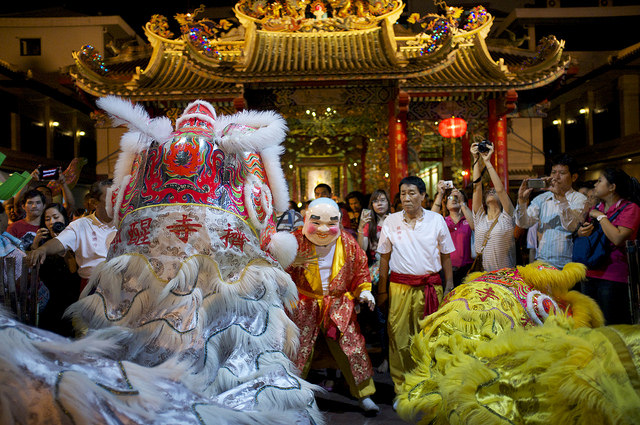
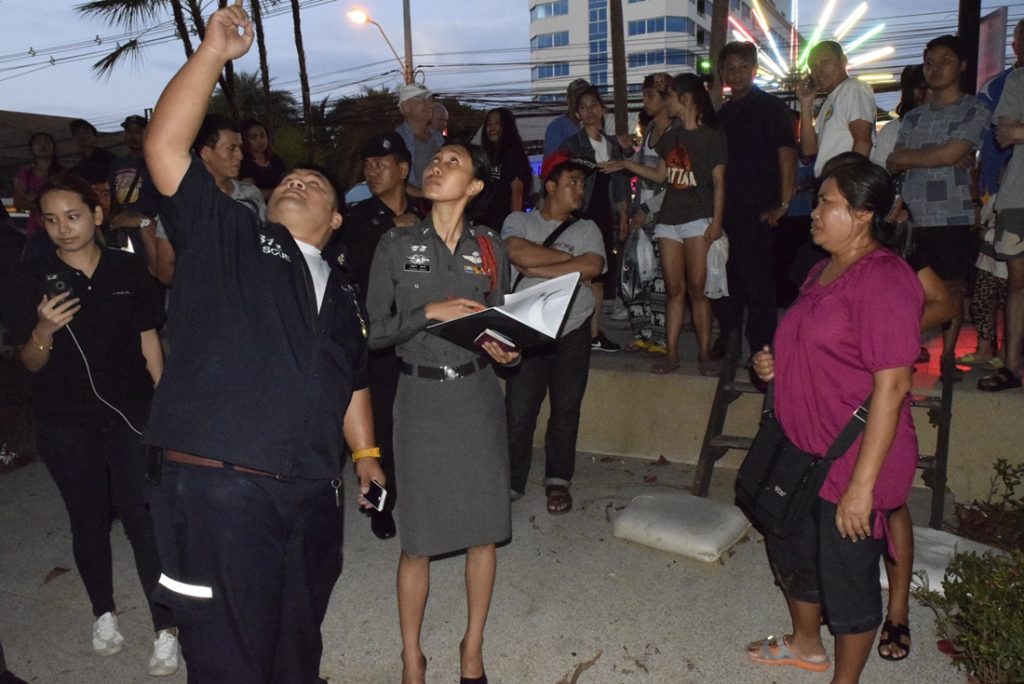
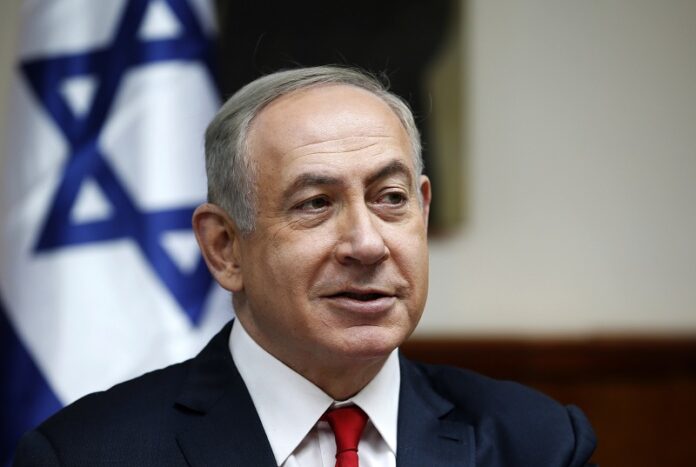
Activists on Saturday gather at Roadhouse BBQ in Bangkok in support of Women's March events around the world. Image: Nima Chandler / Facebook
BANGKOK — Activists in Thailand who joined global protests against U.S. President Donald Trump over the weekend said Monday they hope more such events follow in the future.
Since the junta’s ban on political protests means street demonstrations like the ones in Washington D.C. and other major cities across the world were not possible, activists in Chiang Mai held a picnic in a park Saturday where they advocated for the advancement of women around the world and in solidarity with American women threatened by a new administration.
“We also hope this gathering could be a starting point for more of this kind in the future,” organizer Molly Ferra said in a message. “That will allow us to engage across interests and identities, better inform ourselves, and create collective action points for constructive and meaningful forms of resistance.”
About 35 people including men, women and children, showed up for the picnic, Ferra said. She said the event was set up by a team of women from different countries including the United States, Thailand, Myanmar, Fiji and India.
Nima Chandler, an American citizen, said she and her friends decided to set up the event to show support for those marching in the United States and other countries after seeing no plans to do so in Bangkok.
“We were very surprised and pleased with the turnout, as we only had it on Facebook for a few days,” she said in a message. About 90 people joined the event, she said, including expats and tourists.
The events coincided with Women’s March demonstrations in cities around the world, in which millions took to the streets in support of women’s rights in response to the election of Trump, who took the oath of office on Friday.
Trump, who once boasted of sexually assaulting a woman and was accused by a dozen of similar conduct, has remarked that women should be punished for having abortions and other comments worrying to advocates of reproductive rights. There are also reports that his administration may move to defund Planned Parenthood and bar foreign aid from assisting abortions or family planning.
Another picnic organizer, Emily Hong, said she and fellow activists were demoralized by Trump’s electoral victory. Saturday’s event, she said, served a rallying point for opposition.
“Many of us have been in denial and despair since the election of Donald Trump,” Hong, a U.S. national, said in a message. “But participating in the global women’s march, in our own way, felt like an important step to begin resisting Trump’s agenda, and the combination of patriarchy and authoritarianism that he represents.”
The military government formally congratulated Trump on his inauguration on Sunday. Junta chairman Prayuth Chan-ocha sent a message to the American president expressing his wish to work with Trump for closer bilateral relations and the “prosperity of the Asia-Pacific region,” according to a government spokesman.
Chinese New Year in Bangkok in 2014. Photo: Aleksandr Zykov / Flickr
BANGKOK — The Year of the Rooster will have less to crow about this year as for the first time in many years, Chinese New Year will not be celebrated on Yaowarat Road.
All events marking the occasion will be moved to Lumphini Park on Wednesday through Sunday out of concern the celebrations were incompatible with mourning for the late King Bhumibol.
Government workers are required to wear black during the mourning period, so the annual auspicious celebrations set for Saturday on Yaowarat Road were canceled by the Samphanthawong district committee. However there will be offerings made for 80 monks and novices in front of the Grand China Hotel at 5:30am.
Bangkok’s Chinatown, through which Yaowarat Road runs, has been known for its grand celebrations filled with traditional Chinese performances.
Instead, Lumphini Park was chosen by tourism officials to celebrate the Year of the Rooster. As Thailand is one of the biggest destinations for the holiday outside of China, the five-day event will seek to recreate the Chinatown vibe with opportunities for people to pay their respects to revered Chinese gods and appreciate Chinese performances and food.
The Tourism Authority of Thailand expects the event to attract 825,000 international visitors and generate 19.1 billion baht in revenue.
Apart from Bangkok, Chinese New Year celebrations will be held in various provinces such as Nakhon Sawan through Feb. 1; Chiang Mai on Saturday and Sunday; Pattaya on Saturday; Ayutthaya on Sunday to Feb. 3; and Phuket from Feb. 2 to Feb. 4.
Puu Oo volcano seen here in 1983 on Kilauea, Hawaii. Photo: G.E. Ulrich / Associated Press
PORTLAND, Maine — What could an Indonesian volcanic eruption, a 200-year-old climate disaster and a surge in the consumption of mackerel tell us about today’s era of global warming?
Quite a bit, researchers say.
A group of scientists and academics with the University of Massachusetts and other institutions made that assessment while conducting research about a long-ago calamity in New England that was caused by the eruption of Mount Tambora half a world away in 1815.
A cooled climate led to deaths of livestock and changed fish patterns in New England, leaving many people dependent on the mackerel, an edible fish that was less affected than many animals. The researchers assert that bit of history gives clues about what food security could be like in the modern era of climate change.
“How we respond to these events is going to be critically important for how we come out of this in the long term,” said Karen Alexander, the lead author of the study and a research fellow in environmental conservation. “We can learn from the past how people dealt with the unanticipated.”
The research group’s findings were published this month in the journal Science Advances . They looked at what the catastrophic Tambora eruption meant for the Gulf of Maine and nearby human food systems.
The Tambora eruption was one of the most powerful in recorded history, and was followed by a short time of climate change – specifically, global cooling – and severe weather. Its impact on weather, food availability and human and animals deaths worldwide has been studied extensively. The year that followed the eruption, 1816, is often described as the “Year Without a Summer.”
The researchers behind the Science Advances article found that alewives, a fish used for everything from fertilizer to food by 19th-century New Englanders, did not fare well. But mackerel had better survival rates and became a critical source of protein and jobs, Alexander said.
As crops failed and famine began to spread, the little fish emerged as a staff of life, the report states. It’s a scenario similar to what parts of the developing world are experiencing today as climate change affects food security.
The study states there is a parallel between the need for immediate adaptation after Tambora and the challenges in coping with the climate-driven devastation caused by storms, floods and droughts today. It notes that the loss of food staples due to climate change caused people in the northeastern states to move – something seen today in places such as Pakistan and Syria.
“Understanding how adaptive responses to extreme events can trigger unintended consequences may advance long-term planning for resilience in an uncertain future,” the report states.
How fisheries in the developing world will adapt to future climate change is an important contemporary food security issue, because fish are a vitally important protein resource worldwide. More than a billion of the world’s poor obtain most of their animal protein from fish, and 800 million depend on fisheries and aquaculture for livelihoods, according to the nonprofit research group WorldFish.
The report illustrates how abrupt changes in climate can have unexpected consequences long after conditions moderate, said Andy Pershing, chief scientific officer and ecosystem modeler for the Gulf of Maine Research Institute in Portland.
“Good stewardship of our natural resources can help buffer against some climate impacts. Unlike the people in 1815, we have an idea of what’s coming, and we need to make sure we are prepared,” he said.
Russian President Vladimir Putin chairs a government meeting in January in the Kremlin in Moscow, Russia. Photo: Alexei Druzhinin / Associated Press
MOSCOW — In Russia, giving one’s spouse a slap is nothing extraordinary for many people. This week, the Russian parliament is expected to take a step closer toward decriminalizing it altogether.
Battery is a criminal offense in Russia, but nearly 20 percent of Russians openly say they think it is sometimes OK to hit a spouse or a child. In a bid to accommodate conservative voters, deputies in the lower house of parliament have given initial approval to a bill eliminating criminal liability for domestic violence that stops short of serious bodily harm or rape.
If the measure passes its second reading in the Duma on Wednesday, when the draft can be changed, approval in the third and final reading would be a foregone conclusion. From the Duma, it would proceed to the upper house, largely a rubber-stamp body, and then to President Vladimir Putin’s desk.
Data on domestic violence in Russia are obscure, but Interior Ministry statistics show that 40 percent of all violent crimes in Russia are committed in family surroundings. In 2013, more than 9,000 women were reported to have been killed in incidents of domestic violence.
The bill stems from a Supreme Court ruling last summer to decriminalize battery that doesn’t inflict bodily harm, but to retain criminal charges for those accused of battery against family members. Conservative activists objected, saying the ruling meant a parent spanking a child could be punished more harshly than a non-relative striking the child.
Ultra-conservative lawmaker Yelena Mizulina, who also authored Russia’s “gay propaganda” ban, then introduced the bill to decriminalize domestic violence. It initially was shelved after a disapproving review from the government.
Tables turned at the end of the year when a journalist from a conservative publication pressed Putin about it at his annual news conference.
“If the father spanks his child for a good reason as a means of education, a traditional Russian one, he will be sentenced to two years in prison – and if a neighbor does this, he will get away with a fine!” the journalist told Putin.
Putin replied that “it’s better not to spank children and refer to some traditions,” but then said, “We should not go overboard with it (punishment for battery). It’s not good, it harms families.”
The bill would make battery on a family member punishable by a fine of less than 30,000 rubles (USD $500) or a 15-day arrest.
The Moscow-based Anna Center foundation, which runs Russia’s only domestic violence hotline, received more than 5,000 calls last year. The foundation says many more calls that go unanswered since the line operates only between 7 a.m. and 9 p.m.
The Duma bill “is not going to improve the situation to say the least,” said Irina Matvienko, who runs the hotline.
“Domestic violence is a system which makes it difficult for a woman to seek help,” she said. “It’s not a traditional value. It’s a crime. ”
Calls to the Anna Center hotline show that a lot of Russian women initially don’t even realize that domestic violence is an offense, Matvienko says.
A survey this month by state-run pollster VTsIOM showed that 19 percent of Russians say “it can be acceptable” to hit one’s wife, husband or child “in certain circumstances.” The nationwide poll by phone of 1,800 people was held Jan. 13-15. The survey had a margin of error of 2.5 percentage points.
Russian police are notoriously reluctant to react to domestic violence calls, which many regard as meddling in family affairs. Prosecutors in November began investigating a police officer who took a call from a woman complaining about her boyfriend’s aggressive behavior. Instead of offering help, the officer reportedly told the woman that the police would only come if she got killed. Shortly thereafter, the man beat the woman to death, prosecutors say.
Activist Alyona Popova, whose online petition against the bill has attracted more than 180,000 signatures, sees the efforts to decriminalize domestic violence as a continuation of the Kremlin’s increasingly aggressive policies after several repressive laws targeting various groups, from foreign-funded NGOs to gay people.
“I think it’s part of an overall ideology: aggression and violence are on the rise in society in general since war is everywhere and we’re surrounded by enemies,” Popova said, referring to the state media narrative that portrays Russia as a besieged fortress.
Council of Europe Secretary-General Thorbjorn Jagland earlier this week sent a letter to the speakers of both houses of Russia’s parliament, expressing deep concern at the legislation. Duma speaker Vyacheslav Volodin dismissed the letter as an “unacceptable” attempt to influence parliament.
Olga Batalina, one of the bill’s co-authors, said in the Duma last week that the penalty for battery should be lenient for acts of violence “committed in an emotional conflict, without malice, without grave consequences.”
“Battery doesn’t even involve grave bodily harm. We’re only talking about bruises, scratches, which is bad, too, of course,” Batalina said.
The comment rattled some lawmakers.
“Has anyone tried going around with a bruise for a week?” deputy Oleg Nilov asked Batalina at the hearing. “Does anyone think it’s OK?”
There haven’t been any significant protests against the bill so far.
Activist Popova is not surprised: discussing domestic violence still is taboo in Russia.
“Society is judgmental,” she said. “It goes like this: you’re a bad woman if you allow this to happen to you, or you’re airing dirty laundry and you’re to blame, or it’s he beats you it means he loves you. And a lot of people don’t want to go public about it.”
The tree branch which fell Sunday evening in Pattaya, killing a 91-year-old Italian man.
PATTAYA — Police on Monday said a heavy tree branch which fell and killed an Italian retiree on Jomtien Beach was most likely overlooked by city maintenance workers.
Giacomo Smedile, 91, was hit in the head by a sharp tree branch as he walked on the beachside road Sunday evening with his wife, according to Apichai Klobpetch, chief of Pattaya Police Station.
He said Pattaya city workers routinely trim potentially dangerous tree branches along the roads of Pattaya and Jomtien beaches, but must have failed to notice the one that killed Smedile.
“The branch was already dead, and it was windy, so it fell down,” Col. Apichai said. “They [city workers] look out for these branches. They might have not seen this one, or they might have overlooked it.”
Police have ruled the death an accident but said city hall would deliberate on compensation for Smedile’s family, Apichai said.
He added that police will assist city workers by looking out for dangerous tree branches and other hazards “in order to protect the image of tourist safety in Pattaya.”
Police at the scene on Sunday where a tree branch killed a 91-year-old man in Pattaya.
Customers wait for recall of their Samsung Electronics Galaxy Note 7 smartphones as powered-off Galaxy Note 7 smartphones are displayed at the company's service center in 2016 in Seoul, South Korea. Photo: Ahn Young-joon / Associated Press
SEOUL, South Korea — Samsung Electronics said Monday that tests of more than 200,000 Galaxy Note 7 smartphones found defects in two sets of batteries from two different manufacturers that made the devices prone to catch fire.
Samsung’s mobile division president, Koh Dong-jin, ruled out any problems with other aspects of the Note 7, either in its hardware or its software. He said Samsung would use what it learned from its investigations to improve lithium ion battery safety for the industry, though analysts questioned if the company had really gotten to the heart of the problem.
Samsung discontinued the Note 7 just two months after it was launched on Aug. 2, in one of its worst product fiascos ever.
The company said 700 hundred researchers and engineers tested more than 200,000 devices and more than 30,000 batteries and replicated what happened with the Note 7 phones trying to pin down why some of the phones were overheating.
U.S. companies UL and Exponent also examined the batteries supplied by South Korea-based Samsung SDI and China-based Amperex Technology Ltd., or ATL. The German company TUV Rheinland analyzed the Note 7 supply chain as part of the investigation, Samsung said.
The Galaxy Note 7 featured one of the biggest battery capacities so far for smartphones at 3,500 mAh, or milliampere hour, which gave it the highest energy density of all Samsung’s devices. However, Koh said Samsung and the outside inspectors found no evidence that the high energy density alone had made the phones prone to overheating.
Rechargeable lithium batteries are more susceptible to overheating than other types of batteries if they are exposed to high temperatures, are damaged or have manufacturing flaws. A highly technical explanation of Note 7 problems boiled down to the relatively large battery cells not fitting well into their pouches, with not enough insulating material inside.
In batteries by one manufacturer – likely Samsung SDI – used in the phones in the initial Note 7 recall, inspectors found damage to their upper corners. That, combined with thin separators and high energy density, caused the phones to overheat. The cell-pouch design of the battery did not include enough room to safely accommodate its electrodes – another flaw.
It was unclear to what extent the battery maker was responsible for those problems: Samsung said only that it had provided “targets” for the batteries.
“We suggested that the Note 7 has innovations and a compact design and a 3500 mAh (battery) but we did not know how to make the separators within (the battery) or how many millimeters thick they should be,” Koh told reporters.
That may suggest a breakdown both in communication between Samsung and its suppliers and in quality control and testing.
In other batches of batteries from a second manufacturer, presumably ATL, the researchers found welding defects and a lack of protective tape in some battery cells.
Patrick Moorhead, president of Moor Insights & Strategy, said the odds of two different suppliers having issues with the same phone are extremely low.
Though Samsung faulted the batteries from its suppliers, it said in a statement “we provided the target for the battery specifications for the innovative Note 7, and we are taking responsibility for our failure to ultimately identify and verify the issues arising out of battery design and manufacturing.”
Koh said Samsung would treat the event as a “chance to strengthen the safety of lithium-ion batteries for the entire industry, not only us.”
Analysts said the root cause of the fires remains unclear. “Samsung said the weaknesses could make the phone prone to catch fire. That I understand but what did trigger fires in such conditions? Did they discuss if there is another cause? No,” said Park Chul Wan, a former director of the next generation battery research center at the state-owned Korea Electronics Technology Institute.
Recalls of the Note 7s began in September after reports emerged that some of the phones were overheating and catching fire. At the time, Samsung blamed a flaw in batteries from one of its two suppliers, without saying which manufacturer was to blame.
In October, Samsung dropped the phone for good after new Note 7s with different batteries issued as replacements also were found to be catching fire. It estimates the problems will cost it at least USD $5.3 billion through early 2017.
The company has recalled 3.06 million Note 7 phones. About 4 percent, or 120,000 units, of the recalled Galaxy Note 7, are still not returned.
Gay parade on Silom Road in 2006. Photo: Rainbow Sky Association of Thailand / Facebook
BANGKOK — The capital’s first pride parade in a decade has been postponed to the end of the year due to ongoing mourning for King Bhumibol.
Out BKK founder Paul Heymans, one of the organizers of the event which had been planned for May, said the decision to postpone the celebration was made last week at a meeting with another organizer, the Rainbow Sky Association.
“We … are deeply saddened by the passing of His Majesty King Bhumibol Adulyadej. Therefore, out of respect of the national one year mourning period, and our love for the beloved late King, we will be postponing Bangkok Pride to the end of the year,” read a statement online.
Paul denied the decision was made under pressure, saying it was the desire of the organizers.
“It wasn’t by order of the government. We decided that it is the most respectful thing to do,” Heymans said.
New dates for the event will be announced in February, Heymans added.
King Bhumibol died in October at 88 after 70 years on the throne. The government announced a mourning period of one year that will end with his cremation rites later this year.
Israeli Prime Minister Benjamin Netanyahu attends the weekly cabinet meeting in 2017 in Jerusalem. Photo: Ronen Zvulun / Associated Press
JERUSALEM — Israel’s prime minister on Sunday accepted an invitation to visit the White House next month in hopes of forging a “common vision” for the region with President Donald Trump that could include expanded settlement construction on occupied territories and a tougher policy toward Iran.
Prime Minister Benjamin Netanyahu announced his plans to head to Washington in early February hours after delaying a vote on an explosive proposal to annex one of the West Bank’s largest settlements, apparently to coordinate his policy toward the Palestinians with the new administration.
The move put on hold legislation that threatens to unleash fresh violence and damage already faded hopes for Palestinian independence. It also may have marked Trump’s first presidential foray into Middle East diplomacy.
After eight years of frosty relations with President Barack Obama, Netanyahu has welcomed Trump’s election as an opportunity to strengthen ties between the two allies. Israeli media reported that Netanyahu was gearing up plans to expand settlement construction in the occupied West Bank and east Jerusalem – a policy that had been condemned by Obama.
Late Sunday, the two men held what Netanyahu’s office described as a “very warm conversation” by phone. It said they discussed the international nuclear deal with Iran, which both men have harshly criticized, and the Palestinian issue.
“The prime minister expressed his desire to work closely with President Trump to forge a common vision to advance peace and security in the region, with no daylight between the United States and Israel,” the statement said. It said a date for Netanyahu’s visit would be finalized in the coming days.
The White House said Trump told Netanyahu that peace with the Palestinians “can only be negotiated directly between the two parties” and that the U.S. will work closely with Israel on that goal.
Trump also affirmed his “unprecedented commitment to Israel’s security” and his administration’s focus on countering terrorism, the White House added.
With Trump signaling a more tolerant approach toward the much-maligned settlement movement, Israel’s nationalist right now believes it has an ally in the White House, and Israeli hard-line leaders make no secret they will push for aggressive action in the occupied West Bank.
Education Minister Naftali Bennett, leader of the pro-settlement Jewish Home Party, has been pushing Netanyahu to abandon the internationally backed idea of a Palestinian state and to annex the Maaleh Adumim settlement near Jerusalem.
But after convening his Security Cabinet on Sunday, Netanyahu said his Cabinet ministers, including Bennett, had decided “unanimously” to delay action on the annexation plan until he goes to Washington to meet with Trump.
In order to placate Bennett, Israeli media reports said Netanyahu had promised the ministers to clear the way for expanded settlement construction in east Jerusalem and in major West Bank settlement “blocs” that Israel hopes to keep under a future peace deal. He was quoted as saying his “vision” is to place all settlements under Israeli sovereignty.
In Washington, Trump described their phone call as “very nice.”
Netanyahu, a longtime supporter of the settlements, has nonetheless been cautious about expanding them in the face of strong opposition from the international community. In a final showdown with Israel last month, the Obama administration allowed the U.N. Security Council to pass a resolution condemning settlements as illegal.
But Bennett and other hard-liners believe there is no longer any reason for restraint.
“For the first time in 50 years, the prime minister can decide: either sovereignty or Palestine,” Bennett wrote on Twitter.
Annexing Maaleh Adumim, a sprawling settlement of nearly 40,000 people east of Jerusalem, could cause a major clash with the Palestinians and the rest of the international community.
The Palestinians seek all of the West Bank and east Jerusalem – areas captured by Israel in the 1967 Mideast war – for a future state. The Palestinians and the international community consider all settlements illegal, and unilaterally making Maaleh Adumim part of Israel would deal a powerful blow to hopes for a two-state solution.
To the Palestinians, it would be seen as undermining negotiations. Maaleh Adumim is also strategically located in the middle of the West Bank, potentially hindering the establishment of their state.
“If they are serious about making it part of Israel and closing it down, then it is actually cutting the West Bank into two,” said Hagit Ofran of the anti-settlement group Peace Now.
While Trump has not expressed an opinion on the annexation, he has signaled a softer approach toward the settlement movement than any of his predecessors.
His designated ambassador to Israel has close ties to Jewish West Bank settlements, and a delegation of settler leaders attended Friday’s inauguration as guests of administration officials.
Trump also has already said he supports one of Israel’s key demands – moving the U.S. Embassy from Tel Aviv to Jerusalem. The president ignored a question Sunday from reporters about the issue.
The U.S., like other countries, maintains its embassy in Tel Aviv, saying the conflicting claims to Jerusalem must be worked out in negotiations.
Trump, however, faces heavy pressure from the Palestinians and Arab countries against moving the embassy. The fate of east Jerusalem, home to the city’s most sensitive religious sites, is deeply emotional, and disagreements have boiled over into violence in the past.
The White House dispelled rumors that Trump had imminent plans to announce the move. It said it was only at the “very beginning” of discussing plans to move the embassy.
Palestinian President Mahmoud Abbas has sent a series of messages to Trump urging him not to move the embassy and warning that he would revoke recognition of Israel if the move takes place.
Abbas met Sunday with Jordan’s King Abdullah II in Amman. Jordan, which serves as the custodian of Muslim holy sites in Jerusalem, has warned that moving the embassy would cross a “red line.” Jordan is a key Israeli and Western ally in the battle against Islamic militants.
“We discussed the possibility of moving the embassy, and we say that if this thing happens, then we have measures that we agreed to implement together with Jordan,” Abbas said. “And we hope that the American administration will not do that.”
Also Sunday, Jerusalem city officials granted building permits for 566 new homes in east Jerusalem. The permits had been put on hold for the final months of the Obama administration.
“We’ve been through eight tough years with Obama pressuring to freeze construction,” said Jerusalem Mayor Nir Barkat. “I hope that era is over.”
Unlike other West Bank settlements, Israel annexed east Jerusalem and considers its neighborhoods inseparable parts of its capital. But the annexation is not internationally recognized.
Palestinian official Nabil Abu Rdeneh and condemned the building plans and called on the U.N. to act. “It is time to stop dealing with Israel as a state above the law,” he said.
An image of flip flops sold on e-commerce website Amazon depicting Indian independence leader Mohandas Gandhi. Image: Kanak News / YouTube
How can you get under the skin of an Asian country? Diplomatic body searches, bomber flights, shrine statues and even doormats have set governments on edge.
Here’s a nation-by-nation look at Asia’s figurative, and in one case literal, sacred cows:
South Korea
Flag of the Resident-General of Korea during the period between 1910 and 1945 in which the Korean Peninsula was governed by the Japanese Empire. Image: Himasaram / Wikimedia Commons
South Korea takes offense first, and most regularly, with Japan, largely over disputes stemming from Tokyo’s 35-year colonization of the Korean Peninsula in the early 20th century.
But President Donald Trump has proven surprisingly good at pushing buttons in Seoul in recent months.
During his campaign, Trump suggested that the United States would let South Korea defend itself from North Korean aggression if Seoul didn’t pay more for the stationing of 28,500 American troops in the country. He also described a 2012 bilateral free trade agreement that was portrayed as a major landmark as killing American jobs.
Fewer or no U.S. boots on the ground and calls for re-negotiating the trade accord would raise serious questions for many in South Korea about the decadeslong military alliance between the countries that was forged in the bloodshed of the Korean War.
And then there’s Seoul’s northern rival. North Korean leader Kim Jong Un staged two nuclear tests and a string of ballistic missile test-firings last year. There’s always the fear a direct attack like the deadly 2010 shelling of a South Korean island. Another attack will likely trigger retaliatory strikes by the South, which has grown tired of Pyongyang’s repeated provocations.
Japan regularly infuriates Seoul when senior politicians visit a shrine that honors war dead including convicted criminals; when Tokyo renews claims to disputed islets; and when officials approve history textbooks that Seoul believes whitewash Japan’s wartime aggression.
India
A doormat depicting the Indian flag formerly sold on e-commerce. Image: NewsBeat Social / YouTube
Indians have long been known as a touchy bunch, so much so the makers of last year’s blockbuster sequel “Independence Day 2” reportedly excluded all Indian landmarks from the scenes of mayhem and devastation wrought by the movie’s invading aliens.
In some cases, Indians have been so easily offended that it’s taken everyone else by surprise, such as when a superbug discovered in New Delhi was named after the Indian capital, or when an Indian diplomat was subjected to a routine body search when arrested in 2013 for allegedly mistreating her Indian maid in New York City.
When the world was celebrating the 2012 discovery of the Higgs boson particle, some Indians griped that all the credit was going to British physicist Peter Higgs while the world was ignoring Indian scientist Satyendranath Bose whose work in the 1920s helped define the subatomic boson particle named after him.
In recent years, many in Hindu-dominated India have been perceived to be intolerant of criticism against Prime Minister Narendra Modi as well as their religion. Self-appointed “cow vigilantes” have attacked villagers suspected of killing cows, considered sacred in Hinduism and yet a vital source of income for many Muslims. When former President Barack Obama in 2015 urged greater tolerance and harmony in India’s multicultural society, he was derided for taking a shot at India’s dignity.
Last week, Amazon.com Inc. pulled doormats depicting the Indian flag from its Canadian retail website after the Indian External Affairs Minister Sushma Swaraj threatened to deny Indian visas to Amazon employees if the company did not apologize and withdraw the product.
Protests erupted a year ago after doormats depicting Hindu gods were sold online. There were also reports that India’s independence leader Mohandas K. Gandhi was featured on flip-flops in what many Indians view as disrespectful.
British rock band Coldplay triggered anger with a music video on India that showed stereotypical images of the country with Hindu holy men, peacocks and colorful festivals. Critics argued that it ignored the vast changes in the country following the economic boom that has transformed the face of Indian cities and towns.
In 2008, Danny Boyle’s multiple-Oscar winning film, “Slumdog Millionaire” also faced similar criticism for its portrayal of poverty and corruption in India.
China
The President of Taiwan CALLED ME today to wish me congratulations on winning the Presidency. Thank you!
No issue is perhaps more sensitive and important to China than the status of Taiwan and Trump thrust the issue into the spotlight weeks before his inauguration by taking a congratulatory phone call from the island’s president.
That led Beijing to reiterate the one-China principle that has underpinned China-U.S. relations since they were normalized in 1979. While China is keeping its powder dry for now, further moves to bestow legitimacy on the island’s government or offer it big arms packages and other forms of support would like draw a furious response.
China has also been irked over recent U.S. comments on the South China Sea, particularly its building of man-made islands equipped with airstrips and military defenses. Despite the construction, Beijing intensely dislikes accusations of militarizing the sensitive region, which it claims virtually in its entirely. However, the issue appears significantly less volatile now than last summer, when China was incensed by an international arbitration ruling invalidating its maritime claims.
Economic concerns remain foremost for the leadership and officials have responded to complaints from Trump and others over alleged unfair trade practices by again arguing against restrictions on the export of sensitive U.S. technologies, along with growing negative sentiment against Chinese investment in economies overseas that keep companies such as communications giant Huawei out of the U.S. market.
And as always, China is prone to lash out against all criticism of its policies toward political dissidents and ethnic minorities in Tibet and Xinjiang.
North Korea
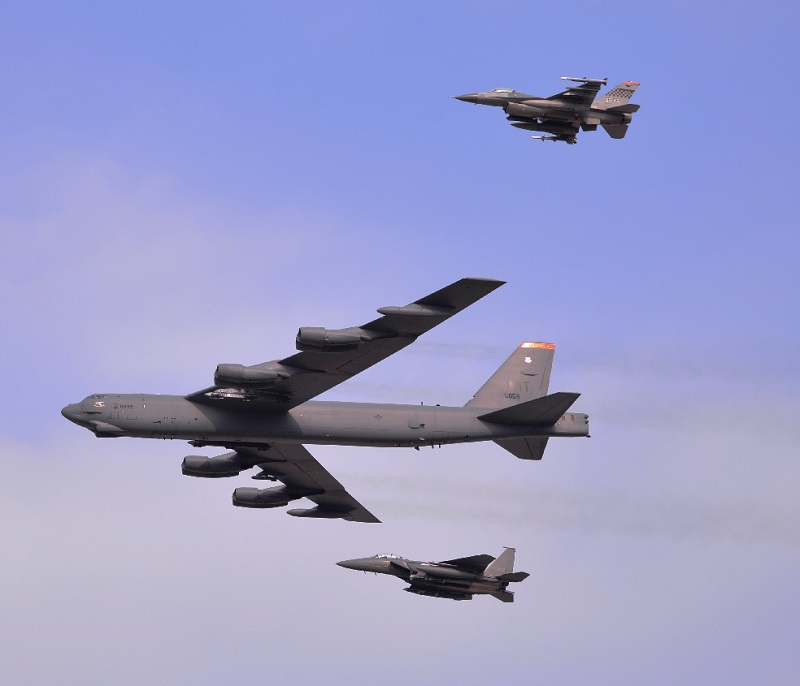
A B-52 in 2016 overflies Korea in response to North Korean nuclear test. Photo: Benjamin Sutton / Wikimedia Commons
Although just about anything that the United States does can be counted on to push North Korea’s buttons – and be used by the regime to whip up popular anti-U.S. sentiment – one thing the U.S has started doing with more regularity lately hit an especially sore nerve.
Because of the massive, wide-scale destruction caused by bombing during the Korean War, which essentially flattened the very vulnerable Pyongyang, flights by U.S. long-range bombers like the B-52 not only get the regime’s attention but do seem to cause genuine anger and anxiety.
Such flights have become a more common response following North Korean nuclear tests or other military activities seen by Washington as particularly provocative. They have the added benefit of reassuring American allies Japan and South Korea, but at the same time underscore the vast gap in perceptions between the United States, where the 1950-53 fighting on the Korean Peninsula is known as the “forgotten war,” and in North Korea, where it was a defining an extremely brutal chapter in the nation’s history.
Australia
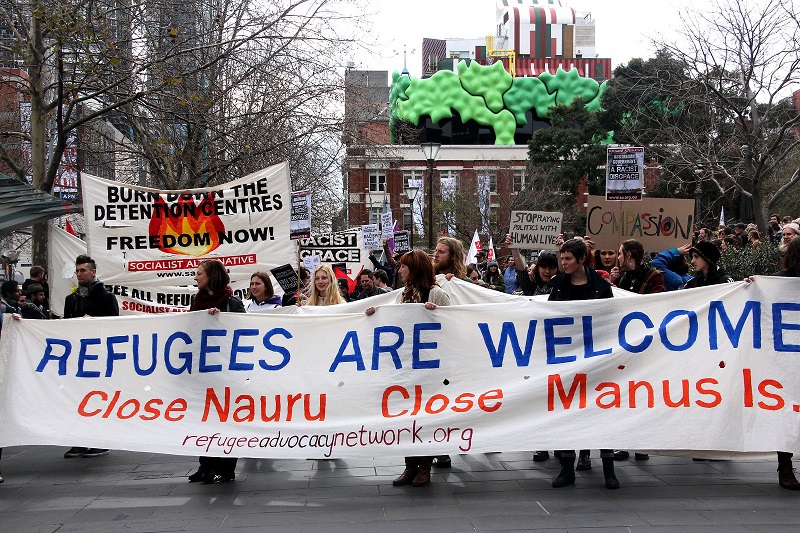
Melbourne Refugee and asylum seeker rights rally in 2013, to protest both new government proposal for assessment and resettlement of asylum seekers in Papua New Guinea, and the Liberal Party’s hard line stand to use the military to turn back the boats. Photo: Takver / Flickr
Australia’s hard-line stance on asylum seekers has frayed ties with its neighbor and close ally Indonesia, and drawn global condemnation from human rights groups. Under Australia’s policies, asylum seekers from Asia, the Middle East and Africa who arrive by boat, usually from Indonesian ports, are sent to grim detention camps in remote Pacific island nations and are refused settlement in Australia. Any boats intercepted at sea are turned back or sunk, with their passengers and crews sent to Indonesia in life boats. The turn-back policy has caused friction with Indonesia, which was especially rankled after reports emerged that the Australian navy paid people smugglers to return a boat of migrants to Indonesian waters.
Japan
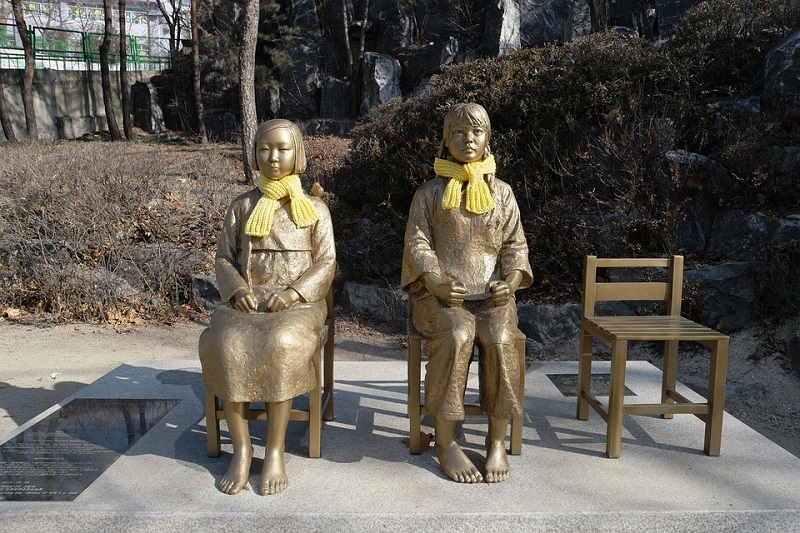
An undated photo showing statues of comfort women in Japan. Photo: Lisy_ / Pixabay
A “comfort women” statue is currently the hottest button between Japan and South Korea.
The statue of an anonymous Asian-faced girl is supposed to represent all the women across Asia and from The Netherlands who were the victims of sexual abuses by Japanese wartime military. It is part of Seoul’s campaign to gain global sympathy for its suffering under the Japanese colonial rule, just as Japan has increasingly pushed back from its earlier recognition of responsibility.
Also reflecting Seoul’s deep-rooted colonial-era enmity is a statue of South Korean patriot Ahn Jung-Geun, who assassinated Japan’s former top official in Korea, Hirobumi Ito, in 1909.
Then there are islands. Japan’s Foreign Minister Fumio Kishida described as “unacceptable” the use of the South Korean name for disputed islands in the official website for the 2018 Pyeongchang Olympics.
The website introduces the islets as Dokdo, while Japan refers to them as Takeshima. The website also refers to the waters that Japan calls Sea of Japan under the South Korean name, East Sea.
In China, a memorial hall of Nanjing that highlights the 1937 massacre by Japanese troops is a thorny issue that still divides the view between the two sides.
Story: Hyung-jin Kim, Katy Daigle, Nirmala George, Christopher Bodeen, Eric Talmadge, Kristen Gelineau, Mari Yamaguchi
A collection of Roald Dahl’s books sold at the Big Bad Wolf Book Sale posted Aug. 15, 2016. Photo: Big Bad Wolf Books / Facebook.
NONTHABURI — After having impressed readers in August with a 60-hour shopping marathon, The Big Bad Wolf Book Sale will be back in February for young bookworms.
Parents and teachers will get a chance to fill their children’s bookshelves from a million English-language children and young adult books, cookbooks and parenting titles on sale at up to 60 percent and 80 percent off at the Big Bad Wolf Children’s Book Sale.
Posts about the event in both Thai and English have been shared more than 3,000 times since being announced announced Wednesday evening on Facebook.
The warehouse book sale was first held in Malaysia in 2009 before traveling to several Southeast Asian countries.
It’s suggested to bring bags and boxes to carry newfound treasures home.
Admission is free. More information and a book preview will be posted online.
The sale goes from 10am to 10pm, Feb. 10 to Feb. 19 in Hall 9 of Impact Forum. It can be reached by taxi or Impact Link van from BTS Mo Chit Station’s exit No. 4 and MRT Chatuchak Park exit No. 3.