Marchers display banners opposing passage of the junta-sponsored charter referendum in a march held May 22, 2016, on the second anniversary of the military coup.
BANGKOK — The latest annual report on the state of human rights around the world by Human Rights Watch accuses Thailand’s military regime of increased repression.
In its section on Thailand, the report cited wide-ranging issues from the past year, including 1,800 people awaiting military trials despite the junta’s revocation of such practice last September, suppression of campaigning before a vote on the new constitution and censorship.
“Prime Minister Prayuth [Chan-ocha] has fed the UN and its member country empty promises on human rights,” Human Rights Watch’s Asia Director Brad Adams wrote Friday. “The junta needs to be pressed to end repression, respect fundamental freedoms, and return Thailand to democratic civilian rule.”
Junta spokesman Col. Winthai Suvari was not available for comment Sunday, but officials have routinely complained organizations like Human Rights Watch do not understand the situation in Thailand.
The report noted an uptick in lese majeste cases since the death of King Bhumibol in October, with 68 known cases since the May 2014 coup.
A section of the report noted the lead up to the August 2016 charter referendum saw curtailed rights of expression and assembly.
“Thai authorities arrested at least 120 politicians, activists, journalists, and supporters of political movements who had criticized the proposed constitution, publicly announced they would vote “no,” urged voters to reject the draft constitution or sought to monitor voting.”
It added that the government did not provide equal access to state media for opponents of the proposed charter, which it noted ensures the junta cannot be held accountable for any abuses.
“Instead of paving the way for a return to democratic civilian rule as promised in its so-called road map, the junta has created and imposed a political structure that appears designed to prolong the military’s grip on power.”
The New York-based organization also said at least 45 civilians were detained at a special prison inside the 11th Army Circle base in Bangkok without effective safeguards against abuse.
As for free expression, the report cited the suspension of news analysts at Voice TV and forcing Redshirt-aligned Peace TV temporarily off the air as evidence of continued censorship.
In other sections, the reported addressed security forces not being held responsible for abuses in the Deep South, abuse of migrant workers from neighboring countries, and the lack of progress in cases of disappeared activists such as Por Cha Lee “Billy” Rakchongcharoen, Muslim lawyer Somchai Neelapaijit and land rights defender Den Khamlae.
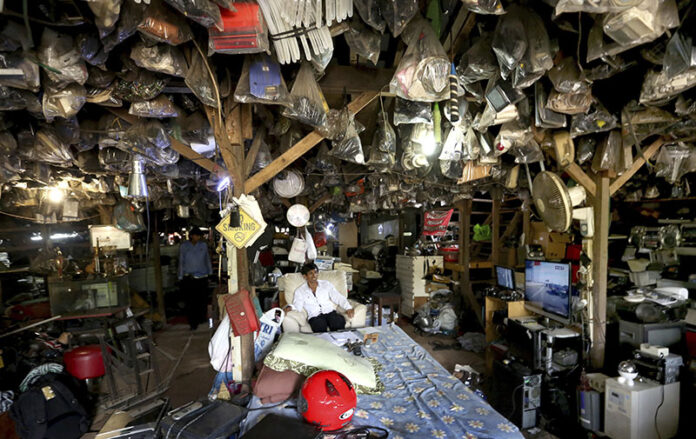
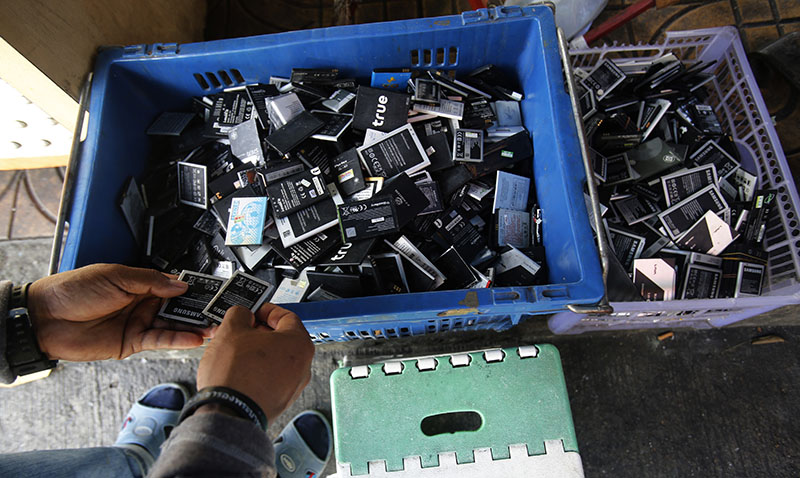
The owner of a used electronic goods stall sits Friday as he waits for customers at his shop in the outskirts of Jakarta, Indonesia. Photo: Tatan Syuflana / Associated Press
JAKARTA, Indonesia — The waste from discarded electronic gadgets and electrical appliances has reached severe levels in East Asia, posing a growing threat to health and the environment unless safe disposal becomes the norm.
China was the biggest culprit with its electronic waste more than doubling, according to a new study by the United Nations University. But nearly every country in the region had massive increases between 2010 and 2015, including those least equipped to deal with the growing mountain of discarded smartphones, computers, TVs, air conditioners and other goods.
On average, electronic waste in the 12 countries in the study had increased by nearly two thirds in the five years, totaling 12.3 million tons in 2015 alone.
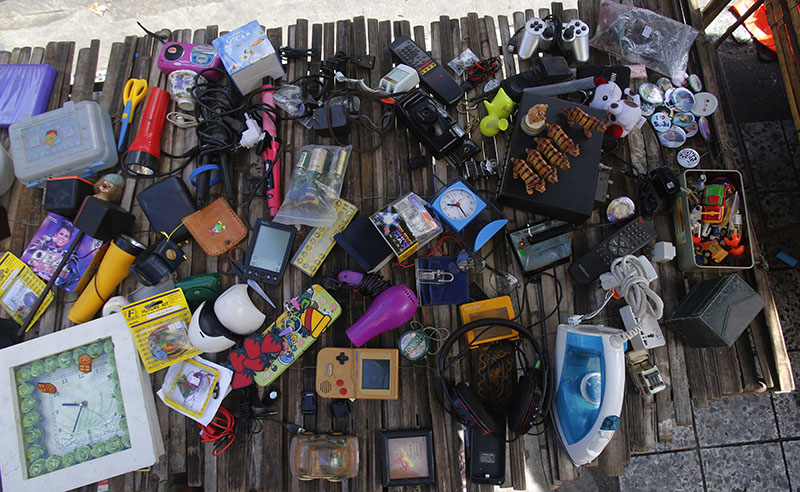
Second-hand electronics are sold Thursday on a sidewalk Bangkok. Photo: Sakchai Lalit / Associated Press
Rising incomes in Asia, burgeoning populations of young adults, rapid obsolescence of products due to technological innovation and changes in fashion, on top of illegal global trade in waste, are among factors driving the increases.
“Consumers in Asia now replace their gadgets more frequently. In addition, many products are designed for low cost production, but not necessarily repair, refurbishment or easy recycling,” said the study. It urges governments to enact specific laws for management of electronic waste or rigorously enforce existing legislation.
Only South Korea, Taiwan and Japan have long established recycling systems based on laws introduced in the 1990s. Open dumping of lead- and mercury-laden components, open burning of plastics to release encased copper and unsafe backyard operations to extract precious metals are the norm in most countries including Indonesia, Thailand and Cambodia, which also lack laws governing the treatment of electronic and electrical waste.
The study said open burning and unsafe recycling is associated with a slew of health problems for workers and communities near recycling operations They include infertility, childhood development problems, impaired lung function, liver and kidney damage, inheritable genetic damage and mental health problems.
Backyard recyclers are after gold, silver, palladium and copper, mainly from printed circuit boards, but the crude acid bath extraction process releases toxic fumes and is also inefficient, recovering only a portion of the valuable material.
Asia as a whole is the biggest market for electronics and appliances, accounting for nearly half of global sales by volume, and produces the most waste.
Photo: Sakchai Lalit / Associated Press
Guiyu, a heavily-polluted rural town in China that specializes in dismantling consumer electronics, some of it exported from rich countries, has become synonymous with the costs of a throwaway high-tech world.
China has cleaned up Guiyu and other centers like it but the Basel Action Network, which brought Guiyu to international attention, said most of the dangerous practices continue in Guiyu albeit concentrated within a new industrial park on its outskirts.
Ruediger Kuehr, one of the study’s authors, said the amount of waste being generated is higher than governments estimate, partly because of their narrower definitions, and should be a wake-up call to policymakers and consumers.
“We are all benefiting from the luxury of these electrical and electronic products to a certain extent, it makes our lives easier, sometimes more complicated,” he said. “However if we want to continue like this we must be reusing the resources contained in electronic and electrical equipment.”
A smartphone, for example, uses more than half the elements in the periodic table, some of which are very rare, and in the longer-run will be exhausted without recycling, Kuehr said.
The SpaceX Falcon 9 rocket loaded with 10 Iridium NEXT communications satellites lifts off in 2017 from launch complex 40 at Space Launch Complex 4E at Vandenberg Air Force Base in California. Photo: SpaceX
LOS ANGELES — A SpaceX Falcon 9 rocket blasted off from California on Saturday and placed a constellation of satellites in orbit, marking the company’s first launch since a fireball engulfed a similar rocket on a Florida launch pad more than four months ago.
The two-stage rocket lifted off from Vandenberg Air Force Base at 9:54am carrying a payload for Iridium Communications Inc., which is replacing its entire global network with 70 next-generation satellites.
The satellites were deployed about an hour after launch.
About nine minutes after the rocket blasted off, to cheers from the control room, its jettisoned first stage landed upright on a so-called droneship in the Pacific Ocean south of Vandenberg — part of Spacex’s effort to make boosters reusable.
The company has succeeded six times previously with landings on a barge or ashore.
A camera aboard the first stage gave viewers a you-are-there experience as it returned to Earth, flared landing rockets and made a perfect upright touchdown on the floating pad.
The return to flight is an important step for SpaceX, billionaire Elon Musk’s California-based company that has about 70 launches in line, worth more than $10 billion. In addition to commercial launches, SpaceX ferries supplies to the International Space Station and is developing a capsule capable of carrying astronauts to the station.
SpaceX officials say they identified all possible causes of the Sept. 1 accident during prelaunch testing at Cape Canaveral Air Force Station, Florida, and took corrective action.
The accident destroyed the rocket and its payload — a satellite that Facebook wanted to use to spread internet access in Africa — and grounded the Falcon 9 program as an investigation took place.
SpaceX announced this month that investigators concluded the accident involved a failure of one of three helium tanks inside the rocket’s second-stage liquid oxygen tank.
The investigation involved the Air Force, NASA, the National Transportation Safety Board and the Federal Aviation Administration, which issued a license for the launch.
The September accident was the second time a Falcon 9 was destroyed. In June 2015, a Falcon loaded with space station supplies disintegrated shortly after liftoff. SpaceX determined that a support strut broke.
The 10 satellites launched Saturday are part of McLean, Virginia-based Iridium’s project to replace its existing network of satellites that provide global voice and data communications.
The program, called Iridium NEXT, was not only delayed by the SpaceX accident but again most recently as a powerful storm headed into California last weekend.
Iridium plans six more Falcon 9 launches, each carrying 10 satellites, as part of a technology upgrade expected to be completed in 2018.
SpaceX’s effort to recover Falcon first stages is intended to reduce costs by recycling a major piece of the launch system.
The first stage contains tanks for liquid oxygen and kerosene as well as nine engines that power the rocket and payload into space, then separates 2½ minutes into flight as the single-engine second stage ignites and continues on to place payloads in the proper orbit.
The first Falcon booster to safely land back on Earth now stands outside the company’s headquarters.
ELLENTON, Florida — After 146 years, the curtain is coming down on “The Greatest Show on Earth.” The owner of the Ringling Bros. and Barnum & Bailey Circus told The Associated Press that the show will close forever in May.
The iconic American spectacle was felled by a variety of factors, company executives say. Declining attendance combined with high operating costs, along with changing public tastes and prolonged battles with animal rights groups all contributed to its demise.
“There isn’t any one thing,” said Kenneth Feld, chairman and CEO of Feld Entertainment. “This has been a very difficult decision for me and for the entire family.”
The company broke the news to circus employees Saturday night after shows in Orlando and Miami.
Ringling Bros. has two touring circuses this season and will perform 30 shows between now and May. Major stops include Atlanta, Washington, Philadelphia, Boston and Brooklyn. The final shows will be in Providence, Rhode Island, on May 7 and in Uniondale, New York, at the Nassau County Coliseum on May 21.
The circus, with its exotic animals, flashy costumes and death-defying acrobats, has been a staple of entertainment in the United States since the mid-1800s. Phineas Taylor Barnum made a traveling spectacle of animals and human oddities popular, while the five Ringling brothers performed juggling acts and skits from their home base in Wisconsin. Eventually, they merged and the modern circus was born. The sprawling troupes traveled around America by train, wowing audiences with the sheer scale of entertainment and exotic animals.
By midcentury, the circus was routine, wholesome family entertainment. But as the 20th century went on, kids became less and less enthralled. Movies, television, video games and the internet captured young minds. The circus didn’t have savvy product merchandising tie-ins or Saturday morning cartoons to shore up its image.
“The competitor in many ways is time,” said Feld, adding that transporting the show by rail and other circus quirks — such as providing a traveling school for performers’ children— are throwbacks to another era. “It’s a different model that we can’t see how it works in today’s world to justify and maintain an affordable ticket price. So you’ve got all these things working against it.”
The Feld family bought the Ringling circus in 1967. The show was just under 3 hours then. Today, the show is 2 hours and 7 minutes, with the longest segment — a tiger act — clocking in at 12 minutes.
“Try getting a 3- or 4-year-old today to sit for 12 minutes,” he said.
Feld and his daughter Juliette Feld, who is the company’s chief operating officer, acknowledged another reality that led to the closing, and it was the one thing that initially drew millions to the show: the animals. Ringling has been targeted by activists who say forcing animals to perform is cruel and unnecessary.
People for the Ethical Treatment of Animals, a longtime opponent of the circus, wasted no time in claiming victory.
“After 36 years of PETA protests, which have awoken the world to the plight of animals in captivity, PETA heralds the end of what has been the saddest show on earth for wild animals, and asks all other animal circuses to follow suit, as this is a sign of changing times,” Ingrid Newkirk, president of People for the Ethical Treatment of Animals, wrote in a statement.
Wayne Pacelle, president and CEO of The Humane Society of the United States, acknowledged the move was “bittersweet” for the Felds but said: “I applaud their decision to move away from an institution grounded on inherently inhumane wild animal acts.”
In May of 2016, after a long and costly legal battle, the company removed the elephants from the shows and sent the animals to live on a conservation farm in Central Florida. The animals had been the symbol of the circus since Barnum brought an Asian elephant named Jumbo to America in 1882. In 2014, Feld Entertainment won $25.2 million in settlements from groups including the Humane Society of the United States, ending a 14-year fight over allegations that circus employees mistreated elephants.
By the time the elephants were removed, public opinion had shifted somewhat. Los Angeles prohibited the use of bull-hooks by elephant trainers and handlers, as did Oakland, California. The city of Asheville, North Carolina nixed wild or exotic animals from performing in the municipally owned, 7,600-seat U.S. Cellular Center.
Attendance has been dropping for 10 years, said Juliette Feld, but when the elephants left, there was a “dramatic drop” in ticket sales. Paradoxically, while many said they didn’t want big animals to perform in circuses, many others refused to attend a circus without them.
“We know now that one of the major reasons people came to Ringling Bros. was getting to see elephants,” she said. “We stand by that decision. We know it was the right decision. This was what audiences wanted to see and it definitely played a major role.”
The Felds say their existing animals — lions, tigers, camels, donkeys, alpacas, kangaroos and llamas — will go to suitable homes. Juliette Feld says the company will continue operating the Center for Elephant Conservation.
Some 500 people perform and work on both touring shows. A handful will be placed in positions with the company’s other, profitable shows — it owns Monster Jam, Disney on Ice and Marvel Live, among other things — but most will be out of a job. Juliette Feld said the company will help employees with job placement and resumes. In some cases where a circus employee lives on the tour rail car (the circus travels by train), the company will also help with housing relocation.
Kenneth Feld became visibly emotional while discussing the decision with a reporter. He said over the next four months, fans will be able to say goodbye at the remaining shows.
In recent years, Ringling Bros. tried to remain relevant, hiring its first African American ringmaster, then its first female ringmaster, and also launching an interactive app. It added elements from its other, popular shows, such as motorbike daredevils and ice skaters. But it seemingly was no match for Pokemon Go and a generation of kids who desire familiar brands and YouTube celebrities.
“We tried all these different things to see what would work, and supported it with a lot of funding as well, and we weren’t successful in finding the solution,” said Kenneth Feld.
‘Mermaid Cupcake’ from Mermaid Island Cafe, ’Mad Hatter Mousse’ from Perhaps Rabbits, and ‘Stolen Dwarf’ from Mocking Tales.
Drive past Don Mueang Airport and Rangsit University, and among uniform townhouses on Ek Charoen Road it’s hard to miss the burst of bright pastel blues and purples that is Mermaid Island Cafe.
Step inside to enter an undersea home for fans of equally fluid identities to slip on a tail and lounge on shell-shaped pillows as they eat sweets, sing songs and hang out.
Kuliga Pongsooksiri, 22, co-owner of Mermaid Island Cafe.
“I think people like the theme because it’s something that you know is definitely not reality,” 22-year-old owner Kuliga Pongsooksiri said.
She opened the cafe with her girlfriend about two months ago.
“I painted the walls and strung all the beads myself,” she said, pointing to the fish scales painted on the pastel walls and sparkling beads hanging from the ceiling.
From the waist up on a recent afternoon, Kuliga was a fourth-year Bangkok University. From the waist down, she was all mermaid, with purple tail and large pink fins.
Why did she open a mermaid-themed cafe where she and strangers could lie around in mermaid costumes? Where “Part of Your World,” a popular ballad from the 1989 Disney animated film, blasts on repeat?
“I just love ‘The Little Mermaid,’” she explained.
Mermaid Island Cafe’s ‘Signature Set.’
It’s one of a handful of fairy-tale cafes popping up around Bangkok with themes such as Alice in Wonderland or otherwise to offer cute havens of candied escapism.
The menu at Mermaid Island, which opened two months ago, is limited to a few savory dishes, Italian sodas and a Signature Set (590 baht). Arguably the most nerdmaid-centric, the set includes three red velvet Mermaid Cupcakes (85 baht) topped with purple-blue cream cheese frosting and a sugar mermaid tail.
There are also Mermaid’s Shells (69 baht) cookies filled with a purple-colored white chocolate mousse with Mentos “pearl.” It’s served with slices of rainbow crepe cake and macadamia cake, and tea or cocoa is served in a teapot and cup shaped like Mrs. Potts and Chip from “Beauty and the Beast.”
The taste is buttery and sugary, nothing to write to Triton about.
Cafe food is not so much the point here. It’s the chance to be Ariel, belting out songs while wearing a plush mermaid tail.
“Almost all of my customers are female: children, teens, office ladies, and sao song,” she said, referring to transgender women. “I remember on the first day the cafe opened, there was a group of seven to eight sao song who sang and danced to Ariel songs.”
Another time, a child ran up to her.
“She asked me for an extra fork, so I gave it to her. She used it to comb her hair, just like Ariel in the movie.”
The pet-friendly Mermaid Island Cafe is located on Ek Charoen Road past Rangsit University. It’s open 11am to 8pm every day except Tuesday.
Perhaps Rabbits
Mad Hatter Mousse
For a taste of high fantasy that’s less pink, follow the white rabbit to Ekkamai.
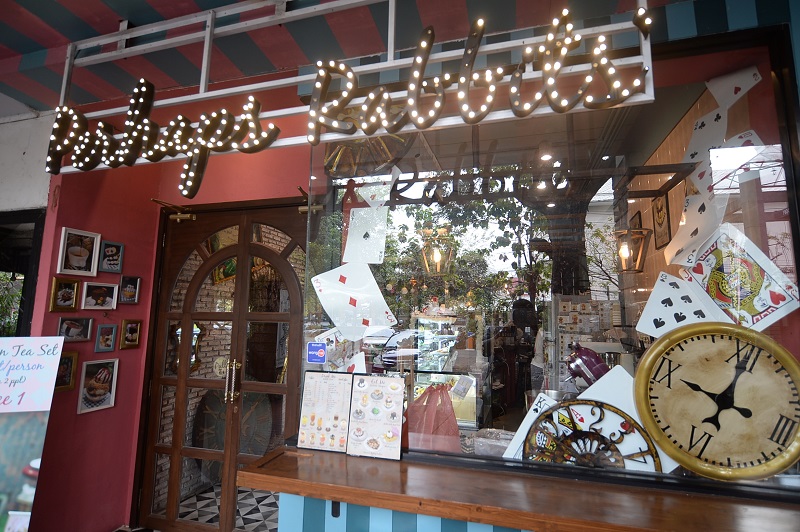
Perhaps Rabbits is an Alice in Wonderland-themed, rabbit hole-sized cafe with dazzling diamond-pattern floors, a large faux tree and private tea party area.
Sitting in a tiny, plush armchair surveying her Wonderland on a recent visit was 29-year-old co-owner Rubkwan Jirabonvisut.
“This place is like an escape from the normal world for my customers,” Rubkwan said.
About half of the two-year-old cafe’s customers are girls in their teen and early 20s, he said, with mostly Chinese, Singaporean and Hong Kong tourists making up the rest.
Beside Rubkwan’s chair is a signpost reading “This Way,” “Not This Way,” decorative macarons and an airbrushed white rabbit mural.
Green Tea Bush
Curiouser and curiouser.
“When choosing the theme for our cafe, my investors and I chose this because we were all born in the Year of the Rabbit,” Rubkwan said. “We also all liked Alice in Wonderland from the Disney movie, even before the live action ones.”
She said people like to come in and take photos.
“Sometimes, even anime cosplayers come in full costume to pose with the decor,” she said.
Customers can have tea with the Mad Hatter with a selection of heavy, cheesy desserts that pair well with, well, teas.
Green Tea Bush (190 baht) is a dense, dome-shaped mousse with a sponge cake base and slight green tea flavor, topped with sugar roses and Alice’s skirt, bloomers and legs made of fondant, depicting her falling into shrubbery.
Pony Poops Lemon Tart
The Mad Hatter Mousse (160 baht) is a hat-shaped, white-and-dark chocolate layered mousse topped with more chocolate, sugar rabbit ears, and a white choc clock face.
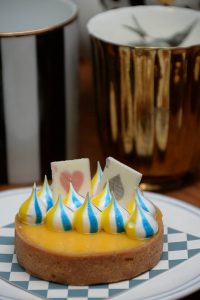
The delightful Pony Poops Lemon Tart’s (160 baht) filling is the right blend of tangy and creamy, topped with whimsical multicolored striped whipped cream and white chocolate playing cards.
Perhaps Rabbits is on the corner of Soi Sukhumvit 63 and Soi Ekkamai 10 and right next to Health Land. It’s open daily 9am to 9pm. Private tea parties can be booked in advance so that you have the whole back room to go mad in. Take a motorcycle from BTS Ekkamai station.
Mocking Tales
Photo: Mocking Tales / Courtesy
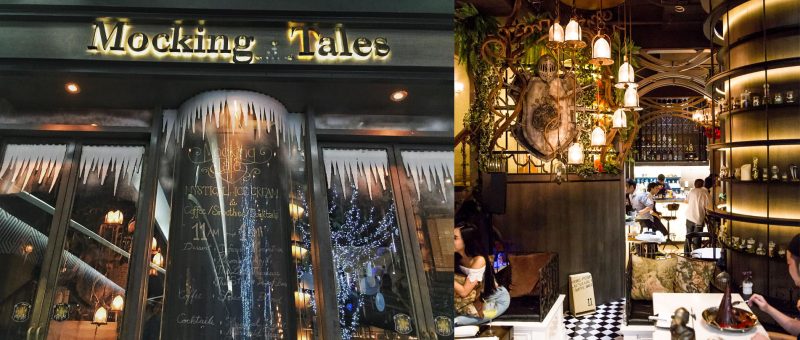
For a darker, more adult taste of fantasy, there’s cafe-by-day, bar-by-night Mocking Tales, tucked into Thonglor.
“We’re mocking themes about fairy tales,” co-founder Kritsada Atsawaphonsakun, 25, said, explaining the name had nothing to do with “The Hunger Games.”
Instead, the look and feel of his shop came from the Beauty and the Beast stage musical, he said.
Mocking Tales serves food, dessert and alcohol with loose fairytale themes you can enjoy with live music that plays 9pm to 11pm, Wednesdays through Fridays.
“There aren’t many fairytale-themed cafes, especially ones with a darker theme like ours. I wanted to make a place for adults who love fantasy,” he said.
Indeed the medieval wrought-iron interior is a departure from the pastel whimsy of other theme establishments.
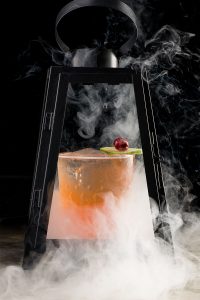
The ‘Magical Light’ cocktail. Photo: Mocking Tales
Loose fantasy dishes coincide with general fairytale canon and all the pop fantasy series and movies.
There’s a Snow White-themed “Poisoned Apple” (280 baht) baked apple dessert and a Christmas Carol-inspired trio of desserts named after the spirits in the story. Curiously, “Spirit of the Present” (350 baht) resembles a green Troll’s head.
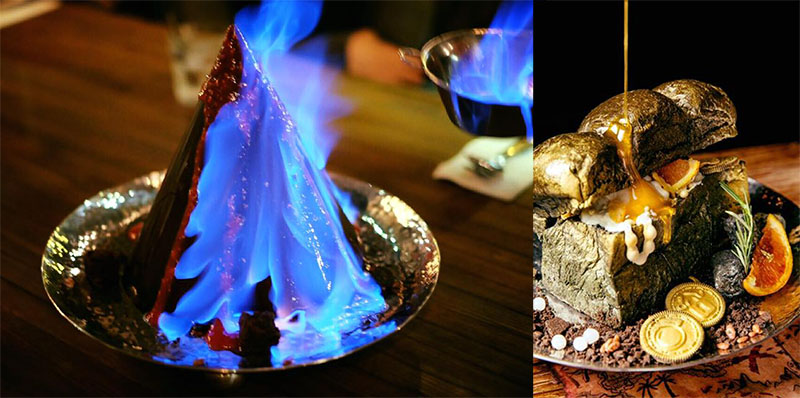
More movie-specific desserts are Harry Potter-inspired lantern-shaped cocktail “Magical Light,” (380 baht, mocktail 220 baht) Pirates of the Caribbean-themed toast-and-ice cream “Lost Treasure” and Lord of the Rings-inspired “Infernal Mountain,” a flammable, chocolate Mount Doom.
The little-bit-of-everything, loosely-adapted-from-popular canon melting pot of fairytale fare offered by Mocking Tales may be an accurate representation of the average Thai’s treatment and understanding of Western fantasy.
Does “Magical Light,” a cocktail of Rosso vermouth peach liqueur, gin and rose scent, fit the Harry Potter theme? Maybe, maybe not, but it’s fantastic enough for a good Instagramming, a rush of sweetness and the alcohol can always help recall other fantasy worlds where lanterns light the way.
‘Inferno Mountain’ (450 baht) and ‘Lost Treasure,’ (499 baht) Lord of the Rings and Pirates of the Caribbean-inspired desserts by Mocking Tales, respectively. Photo: Mocking Tales
A boy sights down the barrel of an Israeli TAR-21 assault rifle for Children's Day at the King's Guard's 2nd Cavalry Division in Bangkok.
BANGKOK — Guarding his M60A3 tank with pride and a sense of mission is Master Sgt. 1st Class Techasit Yoophagdee.
Techasit, 53, is not at war, but insisted Saturday from beside his tank at the 2nd Cavalry Division King’s Guard on Phaholyothin Road, where children played on and with heavy weapons, that his annual mission on National Children’s Day is just as important.
“What we’re doing is familiarizing them with soldiers and weaponry. By familiarizing them, they learn to love soldiers and even become soldiers,” he said as children as young as 3 take turns crawling atop beloved tank and smiling for their parents’ photos.
Enthusiasm by the Barrel
Arrayed around them a veritable playground for making war: more tanks, artillery, armored vehicles, machine guns, even a Black Hawk helicopter for the children. It’s noisy as many parents take photos of their young children climbing the tanks or holding M16 or Israeli-made TAR-21 Tavor assault rifles.
Techasit, who is based just north of the capital in Saraburi province, said he himself is a product of such conditioning. His late father, also an army officer, took him to see the guns and tanks on Children’s Day after he turned 10.
By the time he turned 17 he knew he wanted to be a soldier. His mission for the day, once a year now, is to leave a lasting positive impression on the hundreds of children visiting the place, and his tank in particular.
Master Sgt. 1st Class Techasit Yoophagdee poses before his M60A3 battle tank Saturday at the 2nd Cavalry Division King’s Guard grounds in Bangkok.
“We convince them that these are the things used to defend our country, and they must be studious so they can protect our nation.”
Admittedly, the sergeant said most children brought today were simply too young to learn much of anything
“They should be at least older than 7 or 8 to really be able to learn,” he said, pointing out that most of the little ones getting excited by their exposure to weapon systems were 5 or even younger. “Their parents at least take photos and let their children look at it when they grow up, so they will have a good impression. If 100 showed up and 10 became soldiers when they grew up, then that’s worth it.”
The sergeant was right. Two mothers with 5 year olds said it was their decision to take their sons to see tanks instead of toys on Children’s Day. The children didn’t really say anything.
Room to Grow Into
“We will just visit this place for the day,” Pimpa Srathongthong who dressed her 5-year-old son in fatigues. “My son just wanted to climb up tanks.”
When asked whether he liked coming, the child, Nitaphat, smiled but didn’t elaborate.
The whole business of displaying military weapons for children to touch, fondle and fantasize about is controversial, however, as Thailand is now under years-long military rule following the least of its dozen “successful” military coups in eight decades.
Parit Chiwarak, 18, a well-known student activist said exposing children to weapons of war inculcates them to a militarized, autocratic and violent culture.
“So when the military rules the country, we are used to it, actually, since our childhoods,” Parit said.
Pimpa Srathongthong brings her boy, 5, in mini-fatigues to the 2nd Cavalry Division King’s Guard for Children’s Day on Saturday in Bangkok.
Back to Techasit, the master sergeant said that between 8am and noon, only one child asked him some details about his tank. He was about 10.
“He asked me what kind of engine the tank uses. He wore eyeglasses and looked rather nerdy,” he said.
The sergeant looked eager to proselytize to more children, but most were simply too young to understand that it was equipped with automatic target tracking, a laser rangefinder and thermal body detector camera, all upgrades made last year to his U.S.-made battle tank last year by an Israeli firm.
His old tank, Serial No. 31701, was one of the first five to be retrofitted.
How much did those upgrades made under the military regime cost the taxpayer?
“I won’t answer. It’s not my duty to answer. It’s a matter for the big officers,” he said. “I have no duty to answer the question.”
Boop Records' system works by integrating a cutting stylus mounted onto a modified turntable. Photo: Boop Records
Top: Boop Records integrates a cutting stylus mounted onto a modified turntable. Photo: Boop Records
Let me wax lyrical about a place to press your very own record and where to shop for vinyl – including the mother-of-all vintage markets this weekend – in this my first NFTU of 2017. But before I start, I would like to give a shout-out to local artist TRK for the redesigned logo for the column.
The phonograph record, or vinyl as it’s most commonly known, has been around since the 1800s. In current times it has even enjoyed a bit of renaissance. As a matter of fact, in 2016, David Bowie’s final studio album Blackstar was reported to have sold 54,000 units, making it the highest selling LP of 2016. Topping that off, formerly defunct turntable manufacturer Technics rose from the dead to give us (or those who could afford it) the SL-1200G.
On the flip side, vinyl is expensive, cumbersome and wears down over time. Others attest to the warmth of its sound. Hip-hop DJs and producers like vinyl for finding rare samples and loops, and DJs such as myself like the feel of mixing and scratching on it. After all, if it weren’t for that medium, us DJs wouldn’t have any of those techniques to rock dancefloors today.
Vinyl was kept alive in the ‘90s and early 2000s mainly because of DJs. Times have changed and today vinyl has made way for MP3s and digital downloads.
While that may cost less and be more convenient, not everyone likes the sound of MP3s, and here in the kingdom, there are those who prefer vinyl.
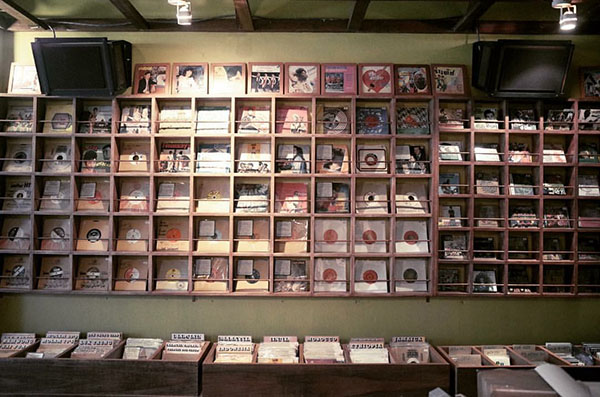
While there are a few worthy places to go hunting for it, let’s start with the only place in Thailand you can go to get a record pressed.
“Now recordings are mostly made digitally, but since I was a kid, I’ve always had a love for analog sound,” Traithep “U” Wongpaiboon says.
U, one third of electro-pop trio Kidnappers, runs Boop Records, the only place in Thailand that specializes in vinyl mastering.
Mastering is the final process where a finished recording is transferred to a medium.
Beside mastering, the studio also cuts dubplates. A dubplate, or test press, is a record that is cut by a lathe onto acetate. Recording studios back in the day would use these as reference discs before sending the recorded music to get mastered and manufactured. They were also made popular by DJs in the early ‘60s reggae scene, as top DJs would have exclusive remixes or “versions” of tracks. This kind of one-upmanship continued and became popular in the Drum n’ Bass and Dubstep scenes, as it was – and still is – common for DJs to play a set of special unreleased tracks and remixes.
Dubplates are made differently at Beep Records because they are cut from vinyl and not acetate, making them last longer. U’s customers aren’t just DJs and producers, but bands as well. Be warned though: These records are special one-offs and don’t come cheap. Each costs over 2,000 baht to make.
Zudrangma is the go-to place for local record collectors. It’s also a must-visit destination when DJ royalty such as Giles Peterson or Peanut Butter Wolf come to town. When it comes to finding the rarest of the rare, it’s no wonder DJs and record collectors from around the world flock here. Owner Nattapon Siangsukon, aka DJ Maft Sai, is the the Indiana Jones of Bangkok’s record-collecting scene. His own personal collection boasts some of the rarest Thai music pressed to vinyl. His shop not only specializes in rare Thai funk and rock, but also stocks an extensive catalogue of music from around the world. If you like reggae, jazz or funk, you’ll probably find some gems; but be prepared to fork out some serious cash.
Speaking about the state of the vinyl scene here in Thailand, Maft Sai compares Bangkok to that of Japan, a country that takes record collecting very seriously
“There are quite lot of people who collect records here in Thailand, but they tend to collect things that remind them of their past and don’t want to explore or find any new sounds,” he said. “Another group which is are the audiophile collectors who don’t really focus on music but only want to get records that show the quality of their tube sound systems.”
Zudrangma is just inside Soi Sukhumvit 51, a short walk from BTS Thong Lo.
A few years ago I found this place through word of mouth. Nobody wanted to give up the details about this spot, as it was the secret digging spot for many of the cities hardcore collectors.
It was and still is a great place to find second-hand records.
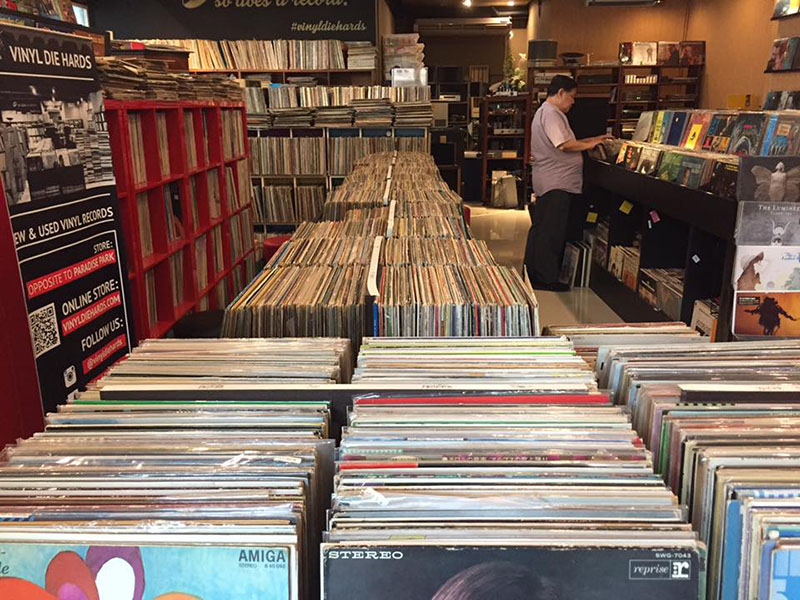
Vinyl Die Hards started out as a small shop opposite Paradise Park in Srinakarin. Inside there were vintage radios and stacks of dusty records cluttered everywhere.
Now the shop is in a bigger location where customers can buy new releases and reissues as well as second-hand records. Apart from these recent changes, the cool thing about this place is that prices here won’t leave eating cup noodles for the entire month.
It’s located on the first floor at The Ninth Place Serviced Residence, opposite Paradise Park on Srinakarin Road. It would be about a 20-30 minute taxi drive from BTS Phra Khanong or Udom Suk.
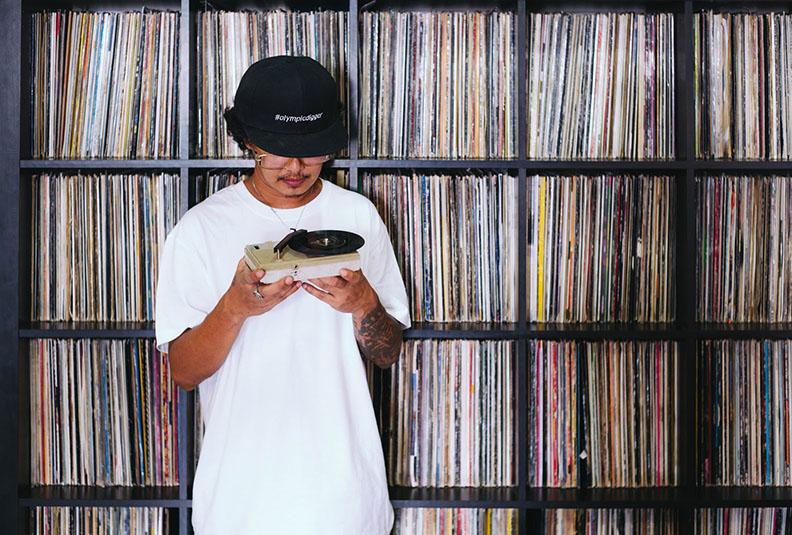
Today and Sunday, American-style vintage flea market Made By Legacy is hosting its eighth event at Fortune Town. Joining the event will be DJ Nanziee, a guy who’s earned a reputation in Bangkok as one of the few remaining DJs that plays vinyl. Besides that, he runs Olympic Digger, an online community for the cities audiophiles, DJs and record collectors. Nanziee and Olympic Digger people will set up a shop and sell some of their vinyl this weekend. Expect to find everything from old school hip-hop to rock and electronica. The event will also host talks with record collectors, artist exhibitions and showcase DJs from the Beatlounge, Nite Ride, Quay Records, Phatfunk and my very own Dubway sessions crew spinning some wax.
You’re a coup leader, a military dictator. What can you do to improve your image?
Try rebranding, repositioning yourself as a bridge for society to overcome all its troubles, perhaps. This is exactly what dictator Gen. Prayuth Chan-ocha did last week when he supposedly wrote the lyrics of a new ballad entitled “Bridge” and forced it into the public’s ears.
The song’s title actually refers to the junta leader himself as looming metaphor. “I am ready to be the bridge for you to cross,” part of the melodramatic song goes. If that’s not explicit enough, another part of the same song reminds Thai people that he is “fighting for you.” Never mind that Prayuth and his armed men in uniform unconstitutionally robbed Thai citizens of their political rights when they staged the May 2014 coup.
Such rebranding or self-characterization goes a long way toward enabling those who were already biased toward or still unsure about Prayuth to see the dictator as a selfless volunteer who reluctantly staged a coup to save the nation from uneducated and misled Thais who kept voting for anyone with Shinawatra in their name.
It’s “reassuring” to see Prayuth perceive himself as a bridge. Never mind if hundreds have been detained without charge on his order, myself included, for merely thinking loudly and differently from the dictator-cum-prime-minister.
A true bridge facilitates dialogue and doesn’t censor those who disagree. When not even five people can gather to be heard in public without breaking Prayuth’s ban assembly ban which threatens arrest and detention, talk of bridges is just, forgive the alliteration, bullshit.
One can imagine being whatever one likes, and Prayuth has the right to perceive himself – loudly – as a bridge. Those who loathe the dictator perceive him differently, however.
One of the most popular characterizations of the dictator by anti-junta Thai netizens is to compare Prayuth and his men to security guards who used weapons they had to seize control of a gated community or a condominium.
In this alternative characterization or branding, Prayuth is a security guard who is completely unqualified to run the kingdom’s affairs due to his low level of knowledge and lack of legitimacy.
Characterizing Prayuth as a security guard is important in that these people reminded themselves they are the owners (taxpayers) who paid for Prayuth’s salary and perks as head of security (army chief) before he seized control of the building (nation).
One can detect a discourse on rights and legitimacy in this characterization of Prayuth as an armed guard who turned out to be a loose cannon.
On the other hand, the self-characterization of Prayuth as a bridge dwells on the discourse of selflessness and devotion to the public. Nothing about the illegitimate coup or the horrors of political repression are mentioned in the song.
Instead, the junta leader refers to a common dream, as if there’s no differing opinions in Thai society, not to mention rifts, in his latest song when he assures: “What we dreamed of will come true.”
In yet another part of the ballad, Prayuth even promises: “My two hands won’t let you go.”
Very reassuring for junta supporters, I’m sure. But troubling if you are wondering how much longer he plans to illegitimately hold power.
In the end, no matter who you are, or how powerful you may be, you cannot prevent people from branding you differently. History will duly note both the “selfless bridge” and the “armed security guard running amok” as among the two of the various characterization of Prayuth.
LOS ANGELES — The makers of “Star Wars” have put a quick end to rumors that while Carrie Fisher has died, her Princess Leia may live on.
Making a rare foray into the sprawling world of “Star Wars” speculation, Lucasfilm said Friday night that there are no plans to digitally recreate Fisher to appear in future episodes of the movie saga.
“There is a rumor circulating that we would like to address,” a company statement said. “We want to assure our fans that Lucasfilm has no plans to digitally recreate Carrie Fisher’s performance as Princess or General Leia Organa.”
Fisher, who reprised her role as Leia in 2015’s “Star Wars: Episode VII — The Force Awakens,” had finished shooting “Star Wars: Episode VIII,” due out next December, when she died Dec. 27 of cardiac arrest at age 60. Her mother Debbie Reynolds died the next day.
But Fisher had also been slated to appear in “Episode IX,” scheduled for release in 2019. That film is still being scripted, and the writers are deciding how to handle her death.
Adding to the speculation was the brief appearance of a digitized 1977-era Fisher in “Rogue One: A Star Wars Story,” which was released last month.
That film also had a much larger role for a digitized version of the late Peter Cushing as Grand Moff Tarkin.
The renderings of Fisher and Cushing, who died in 1994, were embraced by many fans but hated by just as many, who thought the characters looked cartoonish, distracting, or even spooky.
John Knoll, the effects guru who came up with the idea of the revitalized characters, told Yahoo Movies on Friday that Fisher “loved” her appearance in “Rogue One,” which consists of one short-but-significant shot, and a single word of dialogue.
“She was very much in favor of it,” Knoll said.
But Lucasfilm insists “Episode VIII” will be Fisher’s last.
“Carrie Fisher was, is, and always will be a part of the Lucasfilm family,” the company’s statement said. “She was our princess, our general, and more importantly, our friend. We are still hurting from her loss. We cherish her memory and legacy as Princess Leia, and will always strive to honor everything she gave to “Star Wars.'”
China's aircraft carrier Liaoning berths at a Chinese port in a file photo. Photo: Lit Tang / Xinhua News
BEIJING — China’s sole aircraft carrier has returned home following a far-ranging three-week training mission during which its combat capabilities were closely scrutinized and speculation soared over what future role the flat-top will play amid China’s growing military ambitions.
The Defense Ministry said the 60,000-ton Liaoning sailed in to the eastern port of Qingdao on Friday along with its battle group that includes destroyers, frigates, a supply ship and anti-submarine craft.
The ministry quoted the group’s commander, Rear Adm. Chen Yueqi, as saying the drill simulated real combat as closely as possible and “achieved all targets set for it.” China commissioned the carrier in 2012 and declared it combat ready in November, shortly after which it launched its first live-fire exercises.
The cruise that began on Christmas Day took it through the Miyako Strait, south of Okinawa, Japan, and then the Bashi Channel separating Taiwan from the Philippines as it entered the disputed South China Sea that China claims virtually in its entirety.
It headed home through the Taiwan Strait in what was seen by many as a threatening message to the island’s independence-leaning President Tsai Ing-wen. Taiwan’s Defense Ministry said it was closely monitoring the passage but that there was no cause for alarm.
China and Taiwan split amid civil war in 1949 and Beijing has vowed never to renounce its threat to use force to recover what it considers lost territory.
Japanese and Taiwanese surveillance aircraft and ships closely monitored the Liaoning along its journey, seen by some as a sign of how China plans to use it to demonstrate its willingness to back up its territorial claims with military muscle.
The Liaoning originated in 1990 as the unfinished Varyag for the now-defunct Soviet fleet. Purchased as a shell by China in 1998, it was towed from the Black Sea to the northeastern Chinese port of Dalian where it underwent an extensive overhaul of its hull, radar, electronics and other systems.
Designated first as an experimental and training platform, the Liaoning represents a new degree of sophistication in the Chinese armed forces that includes ballistic missile submarines and prototype stealth fighters. It’s also considered a blueprint for future Chinese carriers built using entirely domestic technology, at least one of which has been under construction since 2015.
Yet, analysts point out major limitations in both the carrier’s design and the Chinese navy’s ability to utilize its full capabilities.
Considerably smaller than the 100,000-ton U.S. Nimitz-class carriers, it can carry just 24 fixed-wing aircraft compared to 55 for the American flat-tops, according to a recent report by the Center for Strategic and International Studies.
While the Liaoning’s J-15 multirole fighters — a Chinese version of the Russian Su-33 — are highly capable, they lack the low-observable stealth technology of fifth-generation fighters such as the U.S. F-35C.
CSIS also says the ship’s Soviet steam turbine power plant was badly designed and poorly maintained, probably limiting it to a typical speed of around 20 knots. That is far slower than the Nimitz-class’ 30 knots, meaning it would take longer to arrive at target and be less able to flee from threats.
Its aircraft are also launched from a “ski jump” style deck rather than the powerful steam catapults that U.S. carriers use, requiring China’s jets to use more fuel for takeoff and limiting them to smaller payloads.
The Liaoning’s pilots and crew are also far less experienced than their American counterparts, although they benefit from lessons learned by the U.S. and others in the decades since carriers entered operation, CSIS said. Other analysts point out that the Liaoning doesn’t appear yet able to launch and recover aircraft at night, a crucial ingredient for combat effectiveness.
The CSIS study concludes that those shortcomings make the Liaoning unsuited for “sustained, high-intensity combat operations,” at least for now. That will likely restrict it to humanitarian aid and disaster relief operations, training and diplomatic missions and cruises in the South China Sea asserting Beijing’s territorial claims.
Despite that, the Liaoning “represents an important step in advancing China’s ability to project naval power,” the study said.
“Regardless of the Liaoning’s future abilities, the ship commands a degree of political utility as a tool of naval diplomacy through various operations, regional and global.”










































 “Almost all of my customers are female: children, teens, office ladies, and sao song,” she said, referring to transgender women. “I remember on the first day the cafe opened, there was a group of seven to eight sao song who sang and danced to Ariel songs.”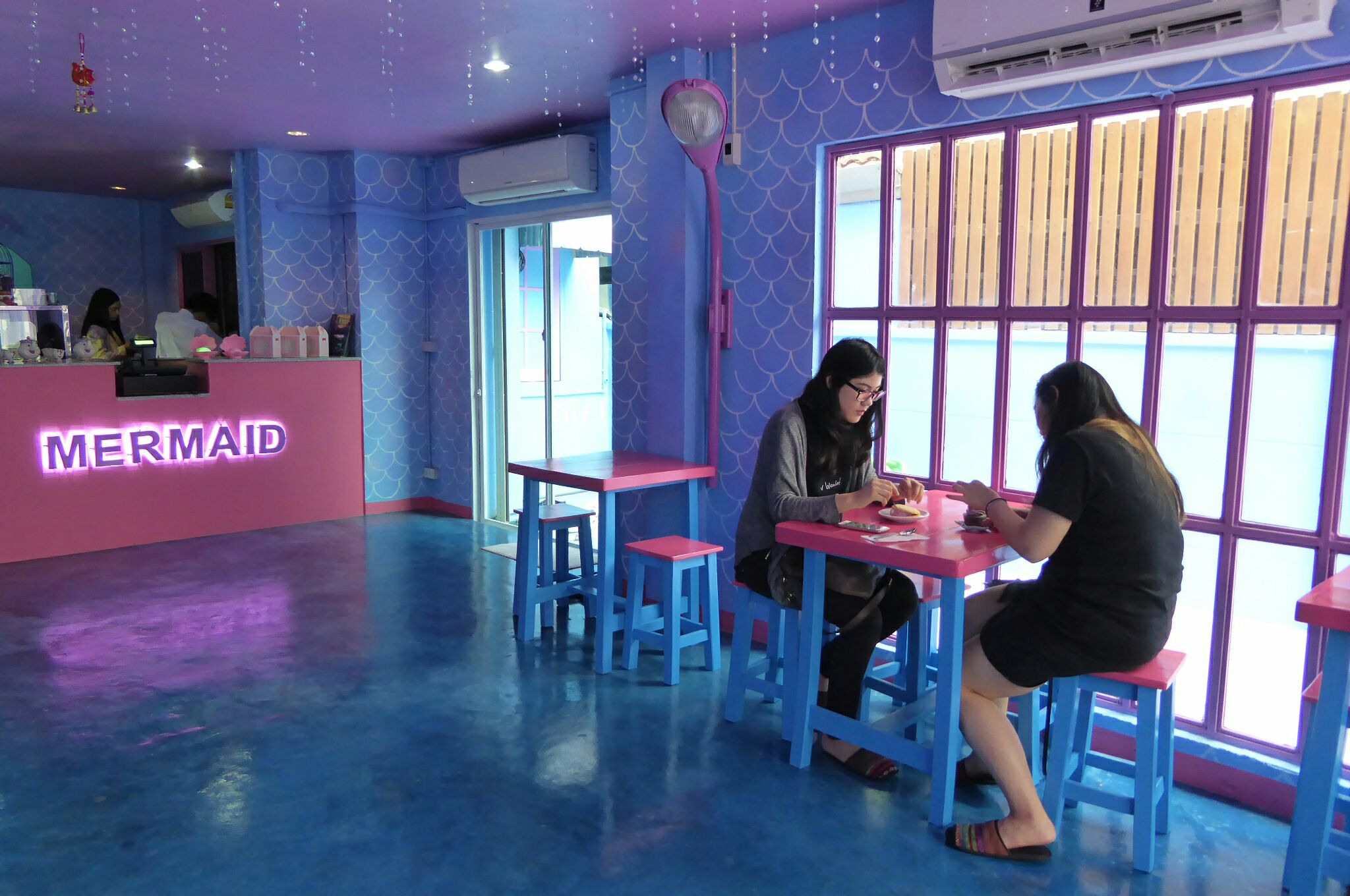











 The phonograph record, or vinyl as it’s most commonly known, has been around since the 1800s. In current times it has even enjoyed a bit of renaissance. As a matter of fact, in 2016, David Bowie’s final studio album Blackstar was reported to have sold 54,000 units, making it the highest selling LP of 2016. Topping that off, formerly defunct turntable manufacturer Technics rose from the dead to give us (or those who could afford it) the SL-1200G.


 One of the most popular characterizations of the dictator by anti-junta Thai netizens is to compare Prayuth and his men to security guards who used weapons they had to seize control of a gated community or a condominium.