GEORGE TOWN, Malaysia — With one stunning goal, Faiz Subri has given himself the chance to put his name beside the likes of Cristiano Ronaldo, Neymar, Zlatan Ibrahimovic and James Rodriguez on the honor roll for Puskas Award winners.
The Penang player is on a shortlist of three to pick up the FIFA prize, which came into existence in 2009, for the most beautiful goal of 2016. The winner will be announced next week in Zurich.
“It is exciting to be the first Malaysian to be nominated,” Faiz told The Associated Press before leaving for Switzerland. “Many great players have won the prize before and it is a great honor for me just to have a chance to win.”
His free kick in a Malaysia Super League game against Pahang last February gained global attention because of its wild swerve and dip from a distance of 32 meters. It was dubbed ‘The Knuckleball’ free kick after a kind of baseball pitch. In football terms, it means the ball is hit with little or no spin and moves unpredictably.
“It was a great feeling to see it go in,” Faiz added. “I had tried in training, but to do it in a game was different.”
Pahang goalkeeper Nasril Nourdin insisted earlier this week that there was nothing he could do to stop the shot. “It was unbelievable,” he told Bernama, Malaysia’s national news agency.
“I had positioned myself well to face the free kick but at as soon as the kick was in motion, I was completely deceived as the ball swerved in front of me, and was in the net before I could do anything.”
The other contenders for the award are Brazil’s Marlone, for his strike in the Copa Libertadores, and Daniuska Rodriguez, for her goal in South America’s Under-17 Women’s Championship.
“My family will be there and I hope to win for them but also for Penang and for the whole of Malaysia to make the fans happy,” Faiz said. “There has not been much to smile about for Malaysian fans recently.”
Malaysia, which qualified for the 1980 Olympics only to boycott the Moscow Games, has dropped to No. 161 in FIFA’s rankings. In 2015, the national team lost 10-0 to the United Arab Emirates and was beaten 6-0 by Oman and twice by Palestine.
Last November, Malaysia exited the AFF Suzuki Cup, Southeast Asia’s biennial tournament, at the group stage after losses to Vietnam and Myanmar.
With some clubs in the Malaysia Super League struggling financially ahead of the coming season, the outlook remains grim. So the prospect of the Puskas Award coming to the country has been greeted with excitement.
“It would be good for Malaysian football if Faiz can win this prize,” Ashley Westwood, head coach at Penang, told the AP. “It would also be good for the club. We wish him well and then will welcome him back to prepare for the new season.”
The 29-year-old Faiz still has not given up hopes of playing in Europe, although his dream of signing for English Premier League giant Manchester United, where coach Westwood started his career, seems unlikely.
“I want to inspire young Malaysians. If they see me win the prize then they will believe they can do the same as me,” Faiz said. “I want to show them that anything is possible in football.”
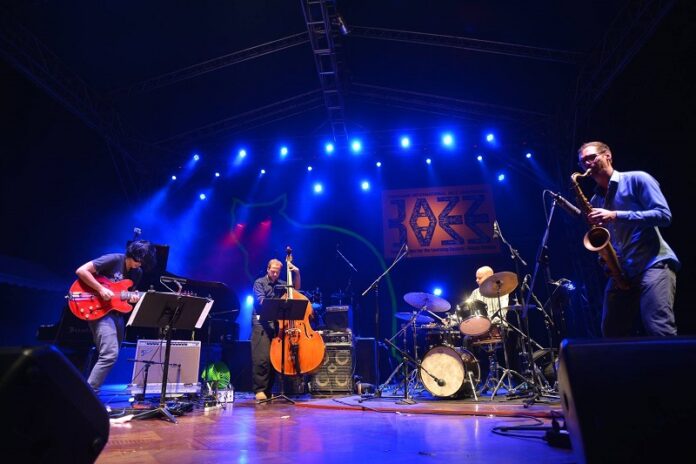
A band playing in Thailand International Jazz Conference in January 2016. Photo: Thailand International Jazz Conference / Facebook
NAKHON PATHOM — Jazz vibes are going to spread over Salaya as leading artists are coming to take the stage this month at the ninth edition of Thailand International Jazz Conference.
It’s a rare chance to find fine Jazz music in Thailand, but world-class captivating trio Shai Maestro, Julian Lage, along with Donald Harrison Quartet are not only headlining international artists to perform in the biggest annual Jazz festival in Thailand, but also offering intensive jazz education to those interested in workshops and camps.
Among the sixty bands featured are Thai singer Nop Ponchamni, guitarist Jack Thammarat and big bands from various universities and professional musicians.
Apart from the concerts and workshops, there will also be a competition and showcase to enrol in.
Schedule and more information can be found online.
Tickets are 800 baht for one evening concert and 3,000 baht for access to the entire 3-day event. Students, Music Lover Card holders and BTS Rabbit Card holders are given a 20% discount. Tickets are available at the venue.
Leading Jazz bands will perform in the 3-day concerts Jan. 27-29 at the College of Music, Mahidol University in Salaya. It can be reached by taxi from BTS Bang Wa Station or bus number 515 or 125 from Victory Monument.
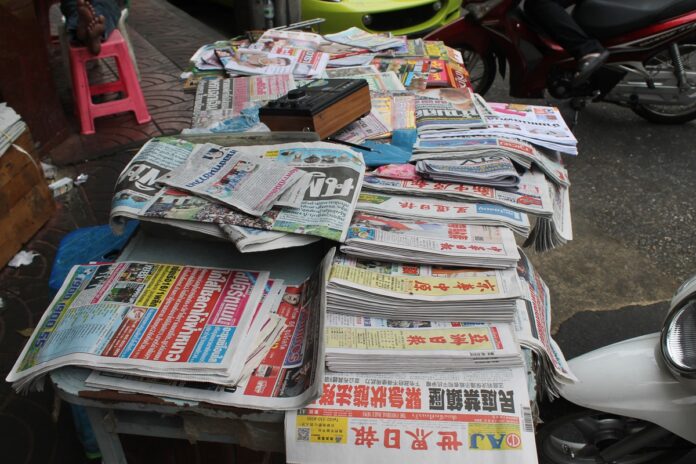
A pile of newspapers in Thailand in a photo from Feb. 20, 2014. Photo: Connie Ma / Flickr
BANGKOK — The end of 2016 brought the final run of a 45-year-old daily newspaper, capping a punishing year for print media.
Driven by plummeting advertising revenues, the global print decline caught up with Thailand’s publishers, the largest of which have begun taking drastic measures in response to large losses to avoid the fate of Baan Muang, which ceased production New Year’s Day.
“Baan Muang is a clear case. It’s medium or small papers that have been affected by changing consumer behaviors, decreasing ads and more targeted ads [online],” said Mana Treelayapewat, dean of the communications department at the University of the Thai Chamber of Commerce. “Then there’s the cost of printing physical newspapers and retaining staff.”
According to The Nielsen Co., a leading global data measurement company, the Thai newspaper industry’s advertising revenues have declined continuously since 2013. What stood at 15.4 billion baht in 2006 had fallen to 12.3 billion baht in 2015. Advertising budgeted 20.1 percent less for newspaper buys in the first 11 months of 2016 compared to the same period in 2015, down to 8.89 billion baht.
While print media continues to generate revenue, many are built atop monolithic organizations that had avoided some of the painful measures taken elsewhere since the turn of the millennium. Observers now acknowledge that print in Thailand is a sunset industry.
If you don’t believe the so-called experts, an article published in July by no less than the the kingdom’s leading journalism association used the same language and said both newspaper sales and advertising revenues have been in “steep decline.”
Those losses have been felt all around.
Material Losses
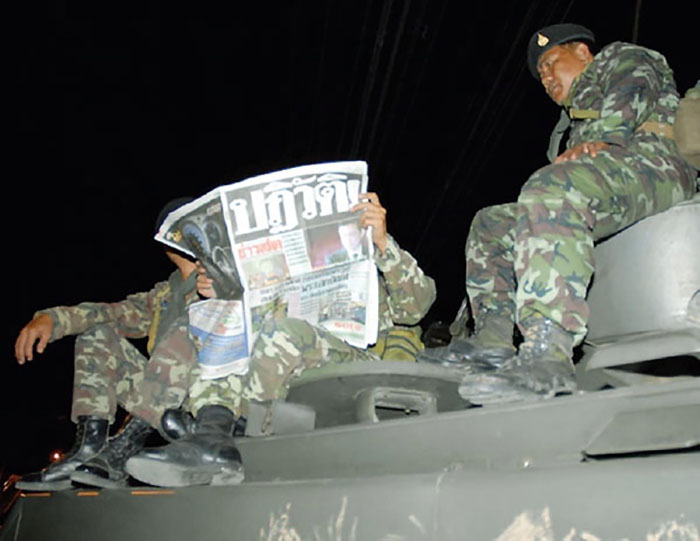
‘Coup!’ reads the front page of a Khaosod newspaper read by soldiers atop a tank on Sept. 20, 2006, one day after the military staged a coup against then-PM Thaksin Shinawatra.
The Matichon Group of newspapers, which includes Khaosod English, registered a loss of 86 million baht by the end of the third quarter, according to reports filed with the Stock Exchange of Thailand, or SET. In that same period, SET-listed Post Publishing Co., publisher Bangkok Post, Post Today and M2F newspapers, returned from the red under austerity measures to eak out a modest profit of 450,000 baht compared to a 42.1 million baht loss in 2015.
Measures taken by different newspapers vary, according to the journalist association’s report, as well as past and present employees.
At Post Publishing, there has been a freeze in salary increases and the size of the newspaper has shrunk on weekdays with fewer pages printed. Travel upcountry by staff has been curbed and a hiring freeze put in place, including backfilling vacant positions.
One former staffer who wished not to be identified said the paper was considering moving its website behind a paywall, where only paid subscribers could read stories, such as the New York Times and some other papers have done.
Since the mid-year replacement of longtime editor Pichai Chuensuksawadi with Umesh Pandey, the paper also lost Deputy Editor Nopporn Wong-Anan to BBC Thai. The paper’s award-winning Sunday Spectrum section was all but gutted with the departures of editors Michael Ruffles, Dane Halpin and marquee reporter Nanchanok Wongsamuth, who has also joined BBC Thai.
Long-standing perks such as complimentary copies of newspapers delivered to employees’ homes have also ended.
Matichon Group has also imposed hiring freezes and offered early retirement to some senior personnel, whose positions were left vacant. Cost reductions include saving water and electricity costs. The number of newspaper pages has also been reduced. Talk of launching Khaosod English as a print product were shelved due to market conditions.
At Nation Multimedia Group, which includes English-language The Nation newspaper, Kom Chad Luek and Bangkok Biz News, the Thai Journalists Association’s July report noted a big drop in advertising revenues led to the reduction of the number of some of the newspapers printed.
At Daily News newspaper, new hiring has stopped even for staff who have resigned.
At Thai Rath, the kingdom’s largest-circulation newspaper, cost-cutting measures have included pooling office vehicles on duty and reducing the use of paper in the office. Annual bonuses there have also been reduced from six months to three months.
Shrinking advertising income, downsizing, smaller papers, early retirement, hiring freezes the disappearing newsstands have become the norm in the terminally newspaper industry. Experts and journalists agree the physical newspaper is in terminal decline as an industry, but differ on what that means for society, however.
Adapt or Die
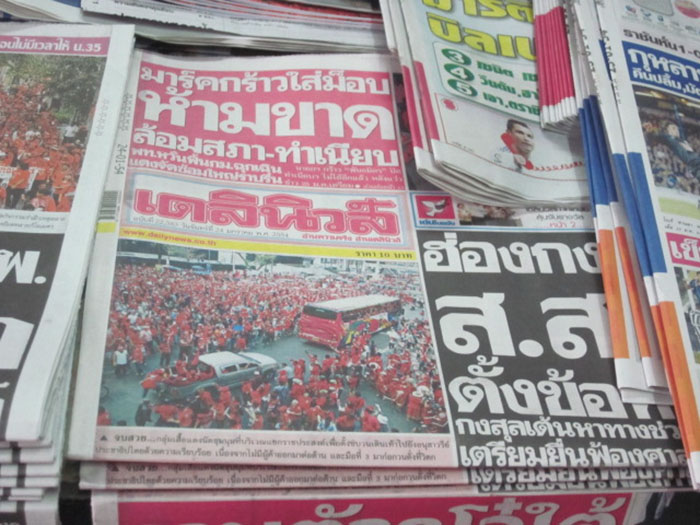
A 2010 edition of Daily News newspaper. Photo: Nist6dh / Flickr
Mana Treelayapewat, dean at the School of Communication Arts at University of the Thai Chamber of Commerce, said print became a sunset industry many years ago when even the best-selling papers began to see declining sales.
“Nobody is paying,” the 50-year-old dean said, adding that consumers have moved online and confessing he hardly buys newspapers any longer.
Mana attributes the decline to print media’s failure to offer a distinct product and transition advertising baht to online media and other platforms.
Those sentiments were shared by Ubonrat Siriyuwasak, a former lecturer at Chulalongkorn University’s Faculty of Communication Arts.
“Those who want to survive must downsize and have something online,” said the 65-year-old former lecturer who also confided that she seldom buys newspapers.
A veteran Baan Muang columnist by the pen name of Chalarm Kiew, who worked as a journalist since 1979, wrote parting words on Dec. 3.
In the widely read column, he said more factors were contributing to the demise of the newspaper industry.
He blamed the erosion of democracy for going on three years under the ruling junta, the so-called National Council for Peace and Order, for making the economy even worse.
“When advertising dries up for two years [under the junta], this is sadness,” Chalarm Kiew wrote before admonishing his fellow journalists to hew to principle:
“If you are a journalist – do not be pro-dictatorship.”
Tough Transition
The good news from the Nielsen data was that total online advertising spending grew by 63.4 percent between January November last year to 1.59 billion.
But for now advertising online has yet to generate the same sales to offset the losses. An old world is dying while the new is yet to come of age and become self-sustaining, according to media experts.
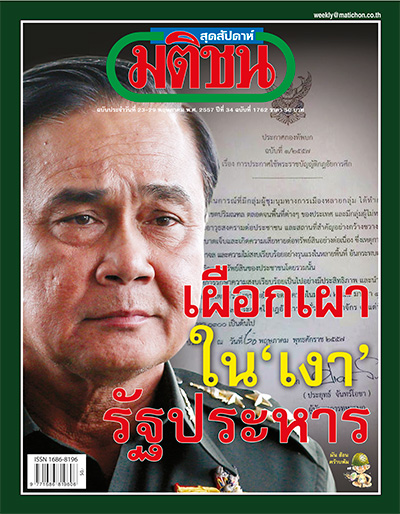
Cover of an edition of Matichon Weekly days after the 2014 military coup.
Mana said this is partly because he hasn’t seen any online media with the kind of content that readers are willing to pay for. This, he said, is made more difficult by the fact that the public has become used to reading things online for free.
On the other hand, people 30 or under hardly read any physical newspapers any longer, Mana added.
“It was different 10 or 20 years ago when people would still buy papers, say to check the football results,” he said.
Even upcountry, the dead said, old newspapers stands are closing because younger-generation shop owners feel that the profit margins are too small. In Bangkok, some of the newspaper and magazine stands located inside the capital’s BTS Skytrain stations closed down this past year after being in operation for more than a decade.
Part of the undoing is the quality of journalists and print media journalists who have become trapped in routine work and prioritize sensational news over investigative reporting, said Sirinart Sirisuntorn, the 44-year-old former social and environmental news editor at Bangkok Biz News, the kingdom’s leading financial daily.
Sirinart said the way print media reacted to the decline in revenues is partly to blame. Sirinart worked at the paper for 20 years before leaving for Voice TV two years ago. She said reporters are being told to juggle among too many news items at the same time over too many media platforms, and they are turning into news-factory workers unable to produce content of any distinction or quality.
For Sirinart, the only way for some print media to survive is to provide distinct and quality content, not more content that can be easily found freely on the internet.
“If print media don’t adapt, they will surely die,” she said. “People will just read online, which is more accessible.”
Additional writing and reporting Todd Ruiz.
Correction: An earlier version of this story misspelled the name of former Bangkok Post reporter Nanchanok Wongsamuth.
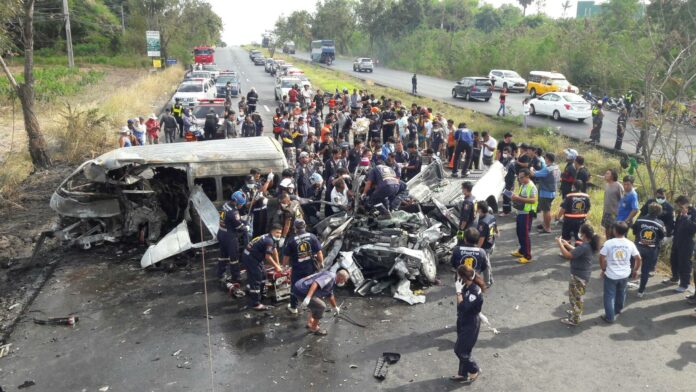
On Jan. 2, 2017, Policemen and rescue officials at the scene of a collision in Chonburi where 25 people died.
BANGKOK — When the New Year’s holiday ended in tragedy for the families of 25 people killed in a flaming wreck in Chonburi, the military government responded with a plan to replace the ubiquitous vans that travel between provinces with minibuses.
While the idea was met with skepticism by a public suddenly demanding urgent solutions, experts who met to discuss the root causes for Thailand’s dubious rise to lead the world in road fatalities agreed vans should not be used for traveling across provinces.
“The vans which we are using are modified. It creates more risks,” said Thanapong Jinvong, a member of governmental road safety organization. “When the incidents happens, it’s difficult to rescue passengers from them.”
Under pressure to rein in the carnage, the Department of Land Transportation said it will move forward a plan to phase out the vans in favor of 20-seat buses – originally slated for 2019 – to begin in the middle of this year.
With 215 accidents, vans were involved in the most public transportation accidents last year, according to a study. Nine people were killed on average and 100 injured each month.
The top causes were reckless driving and aftermarket vehicle modifications which turn them into death traps.
“When accidents happen, vans tend to have more deaths than bigger vehicles due to their structure,” civil engineering professor Saksith Chalermpong said at a Friday forum held at Chulalongkorn University.
The vans to the central, north and northeastern regions park at the Bangkok Bus Terminal Chatuchak, aka the Mo Chit bus terminal, behind the main building.
Today’s vans are altered from their stock form with an extra row of seats so they can carry 15 passengers instead of 10 or 11. Sometimes it’s pushed to 18 seats. The vans have also been modified to run on gas instead of petrol.
But most importantly, vans were not designed to serve as public transportation. A transportation and logistics expert said studies found that in many cases, passengers did not die from the initial impact, but like what happened Jan. 2 in the Chonburi wreck which killed 14 van passengers, because they were trapped inside and burned to death.
“A bus has wider windows and an emergency door,” said Sumet Ongkittikul from the Thailand Development Research Institute.
Three experts agreed that despite being inappropriate, vans have become the norm for fast and convenient public transportation in Thailand.
In order to change that decade-old norm, the government must facilitate van operators and passengers to gradually switch to minibuses without sacrificing time or revenue.
A model proposed by Thanapong was a blend of vans and minibuses in service, depending on demand during peak hours – if minibuses prove reliable replacements.
“That’s also based on the assumption that minibuses meet standards,” he said.
Sumet said the government can start small by reducing the distance vans are allowed to travel from Bangkok, now 300 kilometers, to 200 kilometers and 100 kilometers until they can only offer local services.
Regulations Unenforced
In theory, Land Transport Department regulations say vans can travel no more than 300 kilometers from Bangkok. They are not allowed to travel over 100kph. Every van must be registered and display a yellow license plate, undergo a biannual mechanical inspection and be taken out of service after 10 years.
In practice, the regulations are less than effective. Sumet said authorities never conduct random checks; therefore, drivers always know when to prepare their vehicles to look the best.
Sumet said taking vans out of the equation wouldn’t address the problems behind the wheel.
“As important as changing the vehicle model, is changing the habits of drivers and the way van station owners regulate them,” Sumet said.
The driver of the van who left the road, crossed the center divider and collided with a truck, killing 25 including himself, was found to be sober. But he had been behind the wheel for at least 31 hours, having driven five back-to-back trips between Chanthaburi province and Bangkok.
“As long as driver income depends on the number of trips they can make daily, I would also want to do more if I was a driver,” Thanapong said.
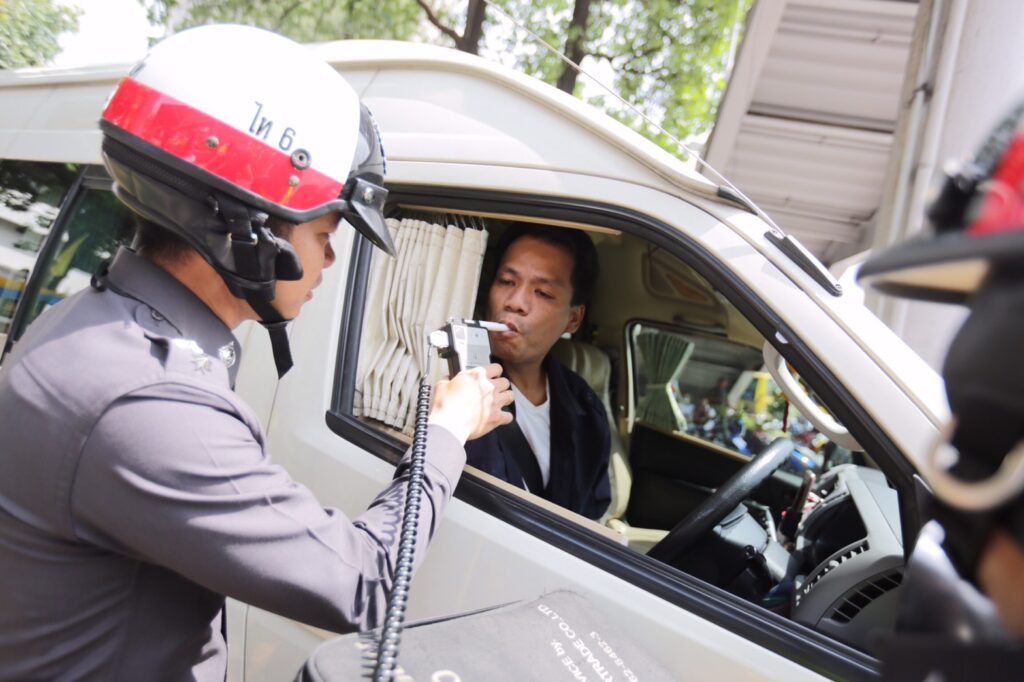
Police test a public van driver on July 15, 2016 for alcohol consumption in Bangkok.
But driver capacity needs not rely on subjective measures, he said, but quantifiable factors such as hours of workload and blood alcohol.
Saksith from Chulalongkorn University said one solution would be to guarantee driver salaries and benefits to remove the incentive of driving as far and as fast as possible.
Following the fatal accident, Prime Minister Prayuth Chan-ocha said stricter law enforcement will be applied in the next three months before the next holiday period, Songkran, arrives in April.
“All public vehicles must have a book recording drivers’ names and their operating hours,” Prayuth said Wednesday. “We already did our best. We have more checkpoints and more authorities than last year.”
Other practical solutions included installing GPS devices in each vehicle, former civilian Transport Minister Chatchart Sitthiphan said at Friday’s forum.
“The signal sent back will tell us how fast these vehicles go and how risky a driver has been driving for 24 hours,” Chatchart said. “Checkpoints can only check the second the car passes by.”
Chatchart said a GPS tracking system already installed on public buses has succeeded in reducing accidents.
Following the deadly crash, the Department of Land Transport suddenly announced all public vans must use such systems by the end of March.
Thanapong from the Road Safety Group said authorities must also tighten registration to allow only qualified public transportation operators.
“The lesson of this story is to know that accidents can happen,” Thanapong said. “But what we can do is reduce the chance of losing lives.”
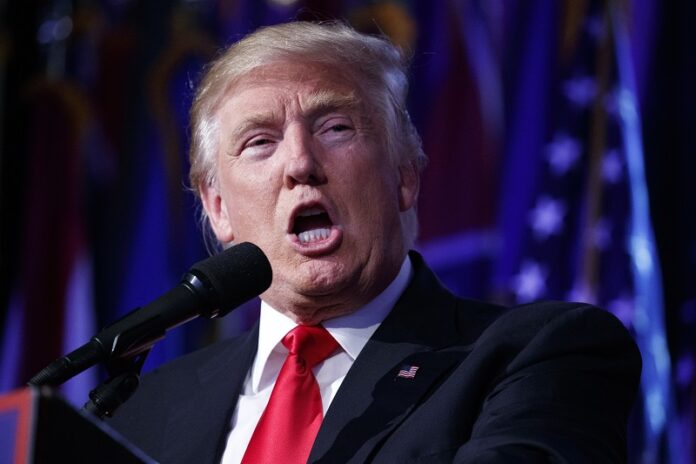
President-elect Donald Trump speaks during an election night rally Nov. 9 in New York. Photo: Evan Vucci / Associated Press
NEW YORK — President-elect Donald Trump said Saturday that “only ‘stupid’ people or fools” would dismiss closer ties with Russia, and he seemed unswayed after his classified briefing on an intelligence report that accused Moscow of meddling on his behalf in the election that catapulted him to power.
“Having a good relationship with Russia is a good thing, not a bad thing,” Trump said in a series of tweets.
He added, “We have enough problems without yet another one,” and said Russians would respect “us far more” under his administration than they do with Barack Obama in the White House.
Trump repeatedly has questioned the assessment by American intelligence agencies that the Kremlin interfered in the 2016 election, and a classified report presented to him Friday seemed to have little changed his thinking.
The report explicitly tied Russian President Vladimir Putin to election meddling and said that Moscow had a “clear preference” for Republican Trump in his race against Democrat Hillary Clinton.
But Trump tweeted that with the many global issues confronting the United States, it doesn’t need testy ties with Russia on the list. “Only ‘stupid’ people, or fools, would think that it is bad” to have a good relationship, he said, and suggested his approach might allow the adversaries to work together to solve “some of the many great and pressing problems and issues of the world!”
Even as intelligences officials looked back in their reports on the election, they also made a troublesome prediction: Russia isn’t done intruding in U.S. politics and policymaking.
Immediately after the Nov. 8 election, Russia began a “spear-phishing” campaign to try to trick people into revealing their email passwords, targeting U.S. government employees and think tanks that specialize in national security, defense and foreign policy, the report said.
The report was the most detailed public account to date of Russian efforts to hack the email accounts of the Democratic National Committee and individual Democrats, among them Clinton’s campaign chairman, John Podesta.
The unclassified version said Russian government provided emails to the anti-secrecy group WikiLeaks even though the website’s founder, Julian Assange, has denied that it got the emails it released from the Russian government. The report noted that the emails could have been passed through middlemen.
Russia also used state-funded propaganda and paid “trolls” to make nasty comments on social media services, the report said. Moreover, intelligence officials believe that Moscow will apply lessons learned from its activities in the election to put its thumbprint on future elections in the United States and allied nations.
The public report was minus classified details that intelligence officials shared with President Barack Obama on Thursday.
In a brief interview with The Associated Press on Friday, Trump said he “learned a lot” from his discussions with intelligence officials, but he declined to say whether he accepted their assertion that Russia had intruded in the election on his behalf.
After finally seeing the intelligence behind the claims of the outgoing Obama administration, Trump released a one-page statement that did not address whether Russia sought to meddle. Instead, he said, “there was absolutely no effect on the outcome of the election” and that there “was no tampering whatsoever with voting machines.”
Intelligence officials have never made that claim. And the report stated that the Department of Homeland Security did not think that the systems that were targeted or compromised by Russian actors were “involved in vote tallying.”
The report released publicly lacked details about how the U.S. learned what it said it knows, such as any intercepted conversations or electronic messages among Russian leaders, including Putin, or about specific hacker techniques or digital tools the U.S. may have traced back to Russia in its investigations. Exactly how the U.S. monitors its adversaries in cyberspace is a closely guarded secret. Revealing such details could help foreign governments further obscure their activities.
The unclassified version included footnotes acknowledging that it “does not include the full supporting information on key elements of the influence campaign.” It said its conclusions were identical to the classified version, which was more detailed.
The unclassified report said the Russian effort was both political and personal.
“Russia’s goals were to undermine public faith in the U.S. democratic process, denigrate Secretary Clinton and harm her electability and potential presidency,” it said. “We further assess Putin and the Russian government developed a clear preference for President-elect Trump.”
Putin most likely wanted to discredit Clinton because he blames her for inciting mass protests against his regime in late 2011 and early 2012, and because he resents her for disparaging comments she has made about him, the report said.
Before the intelligence agencies completed their assessment, Obama announced sanctions against Russia. Trump has not said whether he will undo them once he takes office, but lawmakers are calling for more punitive measures against Russia and have little to no appetite to roll back any current sanctions.
Trump said he would appoint a team within three months of taking office to develop a plan to “aggressively combat and stop cyberattacks.”
On Saturday, he said he wanted retired Sen. Dan Coats to be national intelligence director, describing the former member of the Senate Intelligence Committee as the right person to lead the new administration’s “ceaseless vigilance against those who seek to do us harm.”
Coats, in a statement released by Trump’s transition team, said: “There is no higher priority than keeping America safe, and I will utilize every tool at my disposal to make that happen.”
Suspect Esteban Ruiz Santiago, 26, Saturday, in Fort Lauderdale, Florida. Photo: Associated Press
FORT LAUDERDALE, Florida — The Iraq war veteran accused of killing five travelers and wounding six others at a busy international airport in Florida was charged Saturday and could face the death penalty if convicted.
Esteban Santiago, 26, told investigators that he planned the attack, buying a one-way ticket to the Fort Lauderdale airport, a federal complaint said. Authorities don’t know why he chose his target and have not ruled out terrorism.
Santiago was charged with an act of violence at an international airport resulting in death — which carries a maximum punishment of execution — and weapons charges.
“Today’s charges represent the gravity of the situation and reflect the commitment of federal, state and local law enforcement personnel to continually protect the community and prosecute those who target our residents and visitors,” U.S Attorney Wifredo Ferrer said.
Authorities said during a news conference that they had interviewed roughly 175 people, including a lengthy interrogation with the cooperative suspect, a former National Guard soldier from Alaska. Flights had resumed at the Fort Lauderdale airport after the bloodshed, though the terminal where the shooting happened remained closed.
Santiago spoke to investigators for several hours after he opened fire with a Walther 9mm semi-automatic handgun that he appears to have legally checked on a flight from Alaska. He had two magazines with him and emptied both of them, firing about 15 rounds, before he was arrested, the complaint said.
“We have not identified any triggers that would have caused this attack. We’re pursuing all angles on what prompted him to carry out this horrific attack,” FBI Agent George Piro said.
Investigators are combing through social media and other information to determine Santiago’s motive, and it’s too early to say whether terrorism played a role, Piro said. In November, Santiago had walked into an FBI field office in Alaska saying the U.S. government was controlling his mind and forcing him to watch Islamic State group videos, authorities said.
“He was a walk-in complaint. This is something that happens at FBI offices around the country every day,” FBI agent Marlin Ritzman said.
On that day, Santiago had a loaded magazine on him, but had left a gun in his vehicle, along with his newborn child, authorities said. Officers seized the weapon and local officers took him to get a mental health evaluation. His girlfriend picked up the child.
On Dec. 8, the gun was returned to Santiago. Authorities wouldn’t say if it was the same gun used in the airport attack.
Santiago had not been placed on the U.S. no-fly list and appears to have acted alone, authorities said.
The attack sent panicked witnesses running out of the terminal and spilling onto the tarmac, baggage in hand. Others hid in bathroom stalls or crouched behind cars or anything else they could find as police and paramedics rushed in to help the wounded and establish whether there were any other gunmen.
Mark Lea, 53, had just flown in from Minnesota with his wife for a cruise when he heard three quick cracks, like a firecracker. Then came more cracks, and “I knew it was more than just a firecracker,” he said.
Making sure his wife was outside, Lea helped evacuate some older women who had fallen, he said. Then he saw the shooter.
“He was just kind of randomly shooting people,” he said. “If you were in his path, you were going to get shot. He was walking and shooting.”
Over the course of about 45 seconds, the shooter reloaded twice, he said. When he was out of bullets, he walked away, dropped the gun and lay face down, spread eagle on the floor, Lea said.
By that time, a deputy had arrived and grabbed the shooter. Lea put his foot on the gun to secure it.
Lea went to help the injured and a woman from Iowa asked about her husband, who she described. Lea saw a man who fit his description behind a row of chairs, motionless, shot in the head and lying in a pool of blood, he said. The man, Michael Oehme, was identified as one of the dead victims on Saturday.
Santiago had been discharged from the National Guard last year after being demoted for unsatisfactory performance. Bryan Santiago said Saturday that his brother had requested psychological help but received little assistance. Esteban Santiago said in August that he was hearing voices.
“How is it possible that the federal government knows, they hospitalize him for only four days, and then give him his weapon back?” Bryan Santiago said.
His mother declined to comment as she stood inside the screen door of the family home in Puerto Rico, wiping tears from her eyes. The only thing she said was that Esteban Santiago had been tremendously affected by seeing a bomb explode next to two of his friends when he was around 18 years old while serving in Iraq.
Santiago will make his first court appearance Monday.
It is legal for airline passengers to travel with guns and ammunition as long as the firearms are put in a checked bag – not a carry-on – and are unloaded and locked in a hard-sided container. Guns must be declared to the airline at check-in.
Despite his mental evaluation, U.S. Attorney Karen Loeffler said Santiago would have been able to legally possess a gun because he had not been judged mentally ill, which is a high standard.
Santiago arrived in Fort Lauderdale after taking off from Anchorage aboard a Delta flight Thursday night, checking only one piece of luggage – his gun.
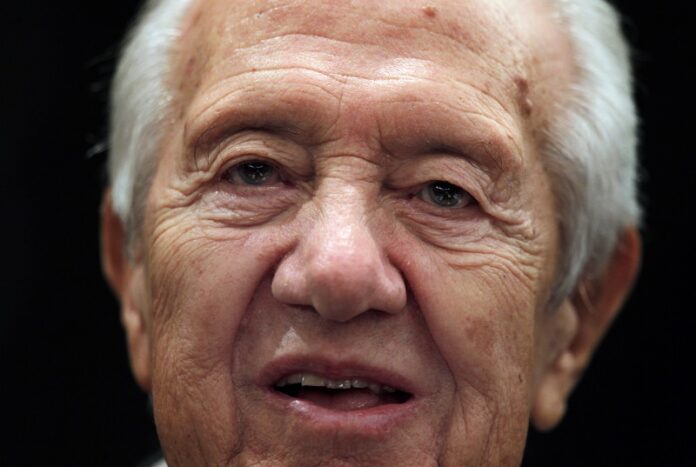
Portugal's former President and former Prime Minister Mario Soares smiles during the launch of his book "The Hope is Necessary" in 2013 at the Belem Cultural Center in Lisbon, Portugal. Photo: Francisco Seco / Associated Press
LISBON, Portugal — Mario Soares, a former prime minister and president of Portugal who helped steer his country toward democracy after a 1974 military coup and grew into a global statesman through his work with the Socialist International movement, has died. He was 92.
Lisbon’s Red Cross Hospital said in a statement he died there on Saturday afternoon with his son and his daughter at his bedside. The hospital did not provide a cause of death, but Soares had been a patient since Dec. 13 and in a coma for the past two weeks.
Soares, a moderate Socialist, returned from 12 years of political exile after the almost bloodless Carnation Revolution toppled Portugal’s four-decade dictatorship in 1974. As a lawyer, he had used peaceful means to fight the country’s regime, which eventually banished him.
Soares was elected Portugal’s first post-coup prime minister in 1976 and thwarted Portuguese Communist Party attempts to bring the NATO member under Soviet influence during the Cold War. He helped guide his country from dictatorship to parliamentary democracy and a place in the European Union.
“The loss of Mario Soares is the loss of someone who was irreplaceable in our recent history. We owe him a lot,” Socialist Prime Minister Antonio Costa said in India, where he was on a state visit.
Costa said three days of national mourning will begin Monday and that Soares would have a state funeral at an unspecified date.
“His cause was always the same: freedom,” President Marcelo Rebelo de Sousa, said in a televised speech. “At decisive moments, he was always a winner.”
Soares’ role as an international statesman was solidified through his work with the International Socialist movement. As a vice president from 1976, he led diplomatic missions that sought to help resolve conflicts in the Middle East and Latin and Central America.
Soares was visiting Palestinian leader Yasser Arafat in the Gaza Strip when Israeli prime minister Yitzhak Rabin was assassinated in Tel Aviv in 1995. Both Arafat and Rabin were longtime friends of Soares.
In 1986, Soares became Portugal’s first civilian president in 60 years. His broad popularity brought him two consecutive five-year terms.
During terms as prime minister and foreign minister, Soares helped rehabilitate Portugal on the international stage after decades of isolation under the dictatorship established by Antonio Salazar in the 1930s. Soares’ insistence on using the ballot box instead of weapons to end the dictatorship won him respect around the world.
Soares belonged to a generation of influential European Socialist leaders that also included his close friend Francois Mitterrand of France, Germany’s Willy Brandt, Olof Palme in Sweden, and Felipe Gonzalez in Spain.
The 1974 coup shot Lisbon to the center of Cold War attentions as Portugal lurched to the political left after the dictatorship’s fall.
Days after the Carnation Revolution – so named because people stuck red carnations in soldiers’ rifle barrels – Soares returned home by train from Paris to a rapturous welcome from crowds that flocked to meet him at Lisbon’s Santa Apolonia train station.
The Communist Party’s influence surged following the coup, prompting fears in the West that Portugal — a founding member of the Atlantic military alliance – would come under the Soviet Union’s influence and encourage other radical leftist movements in western Europe.
Soares said that at an October 1974 meeting in Washington, then-U.S. Secretary of State Henry Kissinger told him he thought Portugal was doomed to communist rule. But Frank Carlucci, the new U.S. ambassador to Lisbon and later head of the CIA, argued that moderate democratic forces, especially Soares’ Socialists, would prevail. The 1976 election proved Carlucci right.
Soares, an affable figure and eloquent campaigner who led the Socialist Party, won the country’s first entirely free elections and became prime minister.
Portugal had western Europe’s last colonial empire, and Soares was instrumental in quickly granting independence to Portugal’s five colonies in Africa. Protracted wars had sapped the Portuguese economy and soured its relations with other western nations that had turned away from colonial rule years earlier.
Soares later was criticized for cutting the colonies loose so abruptly. All of them – Angola, Mozambique, Guinea-Bissau, Cape Verde, and Sao Tome and Principe – became single-party Marxist states supported by the Soviet Union and Cuba after their independence. Angola and Mozambique drifted into civil wars as proxies in the Cold War struggle for influence in Africa.
Soares held posts in a string of governments that lasted less than a year in the post-revolution political chaos. Banks were nationalized, spooking wealthy financiers who fled the country, and poor farmers seized the land they had long worked at large private estates.
Born in Lisbon in 1924, Soares started out as a radical student organizer and became a renowned defense lawyer.
He was a relentless opponent of Salazar’s regime, which along with Franco’s roughly contemporary rule in neighboring Spain, shut off the Iberian peninsula to outside influences. Salazar’s secret police, known by its acronym PIDE, jailed Soares 12 times and exiled him twice, once to the island of Sao Tome off west Africa.
After democracy, Soares served four times as the country’s foreign minister and three times as prime minister.
As prime minister in 1986 he ushered Portugal into the European Economic Community – later the European Union. That turned out to be a watershed year which placed the country on a fast-track modernization program.
Soares capped his political career that year by becoming head of state. He rapidly set about keeping his campaign pledge to serve as “President of all the Portuguese” after years of division and unrest which brought eight governments between 1978 and 1985.
He was a fierce critic of the economic liberalism embraced by U.S. President Ronald Reagan and British leader Margaret Thatcher which was alien to his Socialist convictions about the benefits of welfare capitalism.
As president, Soares established a professional, if cool, relationship with center-right Social Democratic Prime Minister Anibal Cavaco Silva, who admired Thatcher. Though an unlikely team, Soares and Cavaco Silva together oversaw the shedding of many left-inspired economic structures, such as the nationalization of banks, adopted after the coup.
Opponents claimed Soares had abandoned his Socialist ideals, but Soares insisted his “cohabitation” with Cavaco Silva contributed to the country’s new-found stability. He won a thumping re-election victory to serve a second five-year term in 1991.
Soares then retired from politics to set up a cultural foundation. At the request of the United Nations, he became head of the Independent World Commission of the Oceans. He also led a U.N. fact-finding mission on human rights to Algeria in 1998.
He returned to politics in 1999, winning a seat in the European parliament as the main candidate of the Socialist Party but then failing to be elected head of the assembly.
He also ran again for Portugal’s presidency in 2006, at the age of 82. Younger voters had little grasp of his historic achievements and he finished third.
He is survived by two children and five grandchildren.
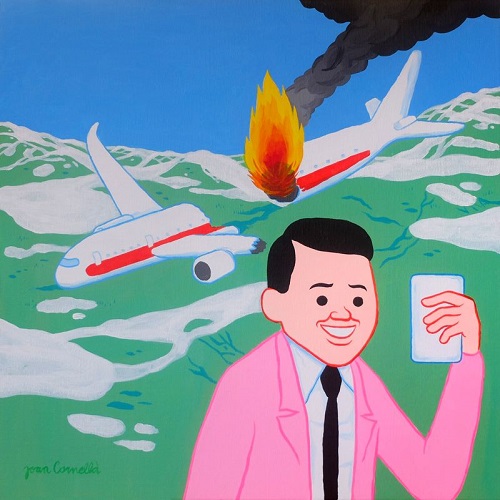
BANGKOK — An armless man wearing a free hugs t-shirt, a person taking a selfie before the backdrop of a flaming plane crash or cupid striking a deer with a love arrow only to make a succulent meal out of it, are all part of cartoonist Joan Cornella’s macabre view of the world.
Portraying the more cynical and hypocritical aspects of modern society through the black humor of his ever-grimacing characters, Cornella will put his artwork on display at his Bangkok Solo Exhibition in March for the first time in Thailand.
In a presentation of his classic series-of-six comic strips, the Catalan cartoonist will present a display of thought-provoking scenarios embedded with striking social messages. Using his contrasting pop-art style of vivid primary colors to express dark and twisted situations, the Barcelonian will set out to showcase his work among the Bangkok faithful.
Be warned that the exhibition is neither for the overly sensitive nor for the faint hearted – or the easily offended – and that children under 16 will have to be accompanied by adults.
Cornella will be present at the exhibition during a number of days to sign books and accessories.
The admission fee is 200 baht, tickets are available online and limit only 130 people per hour. Bangkok Solo Exhibition will run from 11am to 10pm, March 10 through March 26 at Future Factory Bangkok, which can be reached by a five minute walk from BTS Sanam Pao’s Exit 3.
Image: Joan Cornellà / FacebookImage: Joan Cornellà / Facebook
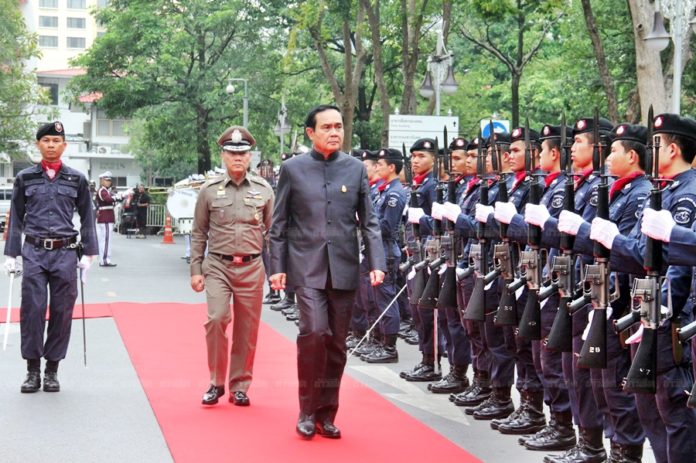
Junta chairman Prayuth Chan-ocha on Dec. 7 inspects a guard of honor at Royal Thai Police headquarters.
A long, long time ago, just one day after junta leader Gen. Prayuth Chan-ocha staged his May 2014 coup, I was asked by Al Jazeera TV what I thought of him.
My reply was that Prayuth, as army chief, had repeatedly said on the record that he would not stage a coup, then staged one. I reminded viewers that it means either he abruptly changed his mind or lied. Either one means Prayuth is unreliable.
Fast-forward to the first days of 2017, 32 months after the songwriting general begged for “a little more time” and promised elections within a year, and find he still hasn’t lived up to his word.
The elections promised for 2017 may not happen after all.
This time the harbingers of news were members of the junta-appointed National Legislative Assembly. On Sunday, assembly member Gen. Somjet Boontanom said another 15 months were needed to pass necessary legislation before an election could be held. That would mean rewriting the “roadmap” for restoring democratic rule yet again.
Some say the junta wants to ensure it can continue pulling the levers of power after an election. The thing is, even with his supposedly “absolute power,” Prayuth and his men still feel insecure, as witnessed by them sending undercover officers to trail former premier Yingluck Shinawatra and her son while they were on vacation.
There’s simply no way to make the junta leader feel secure, now or after elections, because Prayuth knows he robbed power from the people to make himself prime minister. It’s not hard to prevent thieves from feeling remorse as long as they still have a conscience reminding them of their guilt.
Prayuth is no exception. Unless he has no conscience, that is.
In case you missed it, after a few days of post-New Year chaos, Prayuth and his deputy cleared the air and insisted the original roadmap was still good.
The man who steadfastly denied he would stage a coup before he did, a man who has torn up his previously sworn roadmaps is once again telling us to take him at his word.
Truth or lie, junta-supporting Shinawatraphobes won’t care. In fact, some may wish Prayuth remains dictator for life without any future voting, so their favorite political faction won’t lose, or lose face, again.
As for those concerned Prayuth and his men will lose credibility by postponing the promised elections to 2018 or beyond, they should not be too alarmed. After all, what credibility does the regime have left after all the lies?
These days, lying has become part of the job description of not just some politicians but military dictators. Some Thais are willing to forgive the latter because they believe Good Men can do no wrong, even after repeated lies.
“Rule with an iron fist. Lie without shame.”
Could this be Prayuth’s slogan or that of the self-styled National Council for Peace and Order?
Prove me wrong, Prayuth. And acknowledge, I shall.
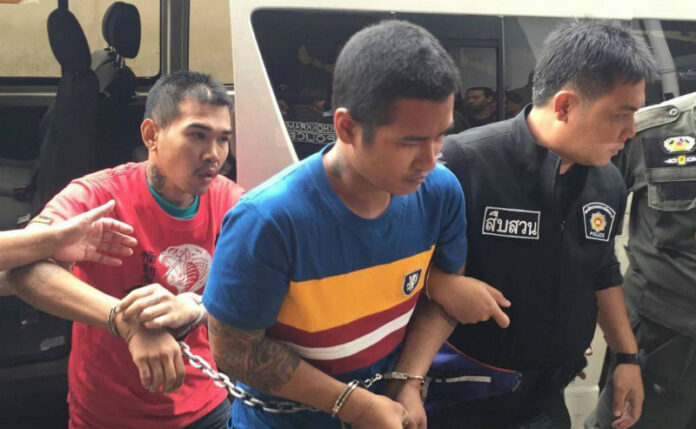
Kittikorn Wikaha, 26, confessed to the stabbing of Vasin Lueangcham, also 26, and was taken to the Criminal Court with his accomplice, Supatchai Jansri, 25. The couple’s bail was denied as the court deemed them a flight risk.
Kittikorn was arrested Friday morning at his residence.
Supatchai, who rode the motorcycle on which Kittikorn arrived and escaped the crime scene, was arrested Friday afternoon at a friend’s house in Nonthaburi province.
The attack captured by security camera footage went viral and sparked outrage among the public. Many among the crowd gathered to witness police’s re-enactment Friday demanded Kittikorn be executed.
The pair will be jailed for 12 days under court order. Police said they will urge the case to be brought to prosecutors within the next week.