




















29.4 C
Bangkok
Friday, June 26, 2026
Home Blog Page 2491

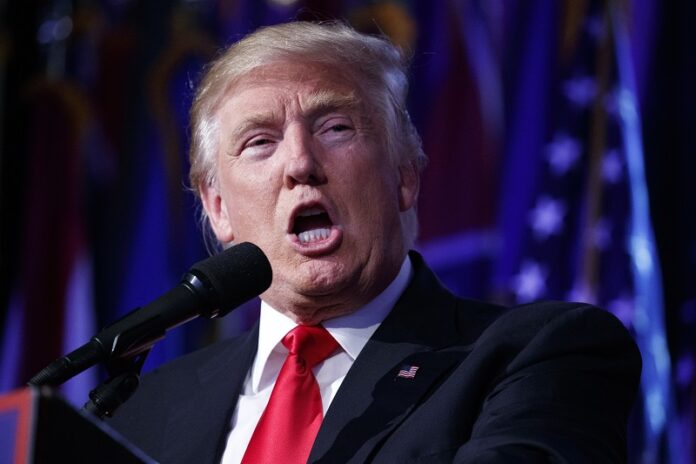
Trump: Only ‘Stupid’ People, Fools Oppose Better Russia Ties

President-elect Donald Trump speaks during an election night rally Nov. 9 in New York. Photo: Evan Vucci / Associated Press

NEW YORK — President-elect Donald Trump said Saturday that “only ‘stupid’ people or fools” would dismiss closer ties with Russia, and he seemed unswayed after his classified briefing on an intelligence report that accused Moscow of meddling on his behalf in the election that catapulted him to power.

“Having a good relationship with Russia is a good thing, not a bad thing,” Trump said in a series of tweets.

He added, “We have enough problems without yet another one,” and said Russians would respect “us far more” under his administration than they do with Barack Obama in the White House.

Trump repeatedly has questioned the assessment by American intelligence agencies that the Kremlin interfered in the 2016 election, and a classified report presented to him Friday seemed to have little changed his thinking.

The report explicitly tied Russian President Vladimir Putin to election meddling and said that Moscow had a “clear preference” for Republican Trump in his race against Democrat Hillary Clinton.

But Trump tweeted that with the many global issues confronting the United States, it doesn’t need testy ties with Russia on the list. “Only ‘stupid’ people, or fools, would think that it is bad” to have a good relationship, he said, and suggested his approach might allow the adversaries to work together to solve “some of the many great and pressing problems and issues of the world!”

Even as intelligences officials looked back in their reports on the election, they also made a troublesome prediction: Russia isn’t done intruding in U.S. politics and policymaking.

Immediately after the Nov. 8 election, Russia began a “spear-phishing” campaign to try to trick people into revealing their email passwords, targeting U.S. government employees and think tanks that specialize in national security, defense and foreign policy, the report said.

The report was the most detailed public account to date of Russian efforts to hack the email accounts of the Democratic National Committee and individual Democrats, among them Clinton’s campaign chairman, John Podesta.

The unclassified version said Russian government provided emails to the anti-secrecy group WikiLeaks even though the website’s founder, Julian Assange, has denied that it got the emails it released from the Russian government. The report noted that the emails could have been passed through middlemen.

Russia also used state-funded propaganda and paid “trolls” to make nasty comments on social media services, the report said. Moreover, intelligence officials believe that Moscow will apply lessons learned from its activities in the election to put its thumbprint on future elections in the United States and allied nations.

The public report was minus classified details that intelligence officials shared with President Barack Obama on Thursday.

In a brief interview with The Associated Press on Friday, Trump said he “learned a lot” from his discussions with intelligence officials, but he declined to say whether he accepted their assertion that Russia had intruded in the election on his behalf.

After finally seeing the intelligence behind the claims of the outgoing Obama administration, Trump released a one-page statement that did not address whether Russia sought to meddle. Instead, he said, “there was absolutely no effect on the outcome of the election” and that there “was no tampering whatsoever with voting machines.”

Intelligence officials have never made that claim. And the report stated that the Department of Homeland Security did not think that the systems that were targeted or compromised by Russian actors were “involved in vote tallying.”

The report released publicly lacked details about how the U.S. learned what it said it knows, such as any intercepted conversations or electronic messages among Russian leaders, including Putin, or about specific hacker techniques or digital tools the U.S. may have traced back to Russia in its investigations. Exactly how the U.S. monitors its adversaries in cyberspace is a closely guarded secret. Revealing such details could help foreign governments further obscure their activities.

The unclassified version included footnotes acknowledging that it “does not include the full supporting information on key elements of the influence campaign.” It said its conclusions were identical to the classified version, which was more detailed.

The unclassified report said the Russian effort was both political and personal.

“Russia’s goals were to undermine public faith in the U.S. democratic process, denigrate Secretary Clinton and harm her electability and potential presidency,” it said. “We further assess Putin and the Russian government developed a clear preference for President-elect Trump.”

Putin most likely wanted to discredit Clinton because he blames her for inciting mass protests against his regime in late 2011 and early 2012, and because he resents her for disparaging comments she has made about him, the report said.

Before the intelligence agencies completed their assessment, Obama announced sanctions against Russia. Trump has not said whether he will undo them once he takes office, but lawmakers are calling for more punitive measures against Russia and have little to no appetite to roll back any current sanctions.

Trump said he would appoint a team within three months of taking office to develop a plan to “aggressively combat and stop cyberattacks.”

On Saturday, he said he wanted retired Sen. Dan Coats to be national intelligence director, describing the former member of the Senate Intelligence Committee as the right person to lead the new administration’s “ceaseless vigilance against those who seek to do us harm.”

Coats, in a statement released by Trump’s transition team, said: “There is no higher priority than keeping America safe, and I will utilize every tool at my disposal to make that happen.”

Story: Jill Colvin
Advertisement

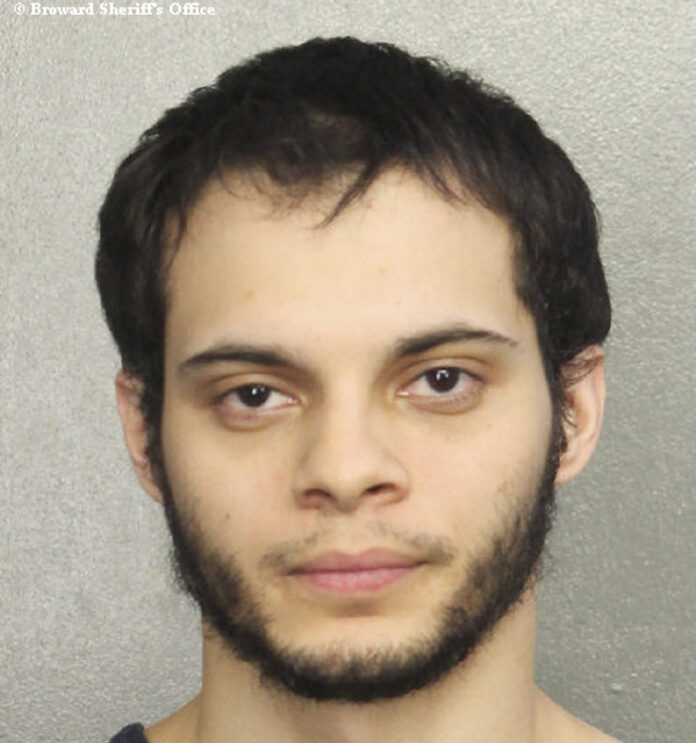
Florida Airport Gunman Charged, US Seeks Death Penalty

Suspect Esteban Ruiz Santiago, 26, Saturday, in Fort Lauderdale, Florida. Photo: Associated Press

FORT LAUDERDALE, Florida — The Iraq war veteran accused of killing five travelers and wounding six others at a busy international airport in Florida was charged Saturday and could face the death penalty if convicted.

Esteban Santiago, 26, told investigators that he planned the attack, buying a one-way ticket to the Fort Lauderdale airport, a federal complaint said. Authorities don’t know why he chose his target and have not ruled out terrorism.

Santiago was charged with an act of violence at an international airport resulting in death — which carries a maximum punishment of execution — and weapons charges.

“Today’s charges represent the gravity of the situation and reflect the commitment of federal, state and local law enforcement personnel to continually protect the community and prosecute those who target our residents and visitors,” U.S Attorney Wifredo Ferrer said.

Authorities said during a news conference that they had interviewed roughly 175 people, including a lengthy interrogation with the cooperative suspect, a former National Guard soldier from Alaska. Flights had resumed at the Fort Lauderdale airport after the bloodshed, though the terminal where the shooting happened remained closed.

Santiago spoke to investigators for several hours after he opened fire with a Walther 9mm semi-automatic handgun that he appears to have legally checked on a flight from Alaska. He had two magazines with him and emptied both of them, firing about 15 rounds, before he was arrested, the complaint said.

“We have not identified any triggers that would have caused this attack. We’re pursuing all angles on what prompted him to carry out this horrific attack,” FBI Agent George Piro said.

Investigators are combing through social media and other information to determine Santiago’s motive, and it’s too early to say whether terrorism played a role, Piro said. In November, Santiago had walked into an FBI field office in Alaska saying the U.S. government was controlling his mind and forcing him to watch Islamic State group videos, authorities said.

“He was a walk-in complaint. This is something that happens at FBI offices around the country every day,” FBI agent Marlin Ritzman said.

On that day, Santiago had a loaded magazine on him, but had left a gun in his vehicle, along with his newborn child, authorities said. Officers seized the weapon and local officers took him to get a mental health evaluation. His girlfriend picked up the child.

On Dec. 8, the gun was returned to Santiago. Authorities wouldn’t say if it was the same gun used in the airport attack.

Santiago had not been placed on the U.S. no-fly list and appears to have acted alone, authorities said.

The attack sent panicked witnesses running out of the terminal and spilling onto the tarmac, baggage in hand. Others hid in bathroom stalls or crouched behind cars or anything else they could find as police and paramedics rushed in to help the wounded and establish whether there were any other gunmen.

Mark Lea, 53, had just flown in from Minnesota with his wife for a cruise when he heard three quick cracks, like a firecracker. Then came more cracks, and “I knew it was more than just a firecracker,” he said.

Making sure his wife was outside, Lea helped evacuate some older women who had fallen, he said. Then he saw the shooter.

“He was just kind of randomly shooting people,” he said. “If you were in his path, you were going to get shot. He was walking and shooting.”

Over the course of about 45 seconds, the shooter reloaded twice, he said. When he was out of bullets, he walked away, dropped the gun and lay face down, spread eagle on the floor, Lea said.

By that time, a deputy had arrived and grabbed the shooter. Lea put his foot on the gun to secure it.

Lea went to help the injured and a woman from Iowa asked about her husband, who she described. Lea saw a man who fit his description behind a row of chairs, motionless, shot in the head and lying in a pool of blood, he said. The man, Michael Oehme, was identified as one of the dead victims on Saturday.

Santiago had been discharged from the National Guard last year after being demoted for unsatisfactory performance. Bryan Santiago said Saturday that his brother had requested psychological help but received little assistance. Esteban Santiago said in August that he was hearing voices.

“How is it possible that the federal government knows, they hospitalize him for only four days, and then give him his weapon back?” Bryan Santiago said.

His mother declined to comment as she stood inside the screen door of the family home in Puerto Rico, wiping tears from her eyes. The only thing she said was that Esteban Santiago had been tremendously affected by seeing a bomb explode next to two of his friends when he was around 18 years old while serving in Iraq.

Santiago will make his first court appearance Monday.

It is legal for airline passengers to travel with guns and ammunition as long as the firearms are put in a checked bag – not a carry-on – and are unloaded and locked in a hard-sided container. Guns must be declared to the airline at check-in.

Despite his mental evaluation, U.S. Attorney Karen Loeffler said Santiago would have been able to legally possess a gun because he had not been judged mentally ill, which is a high standard.

Santiago arrived in Fort Lauderdale after taking off from Anchorage aboard a Delta flight Thursday night, checking only one piece of luggage – his gun.

Advertisement

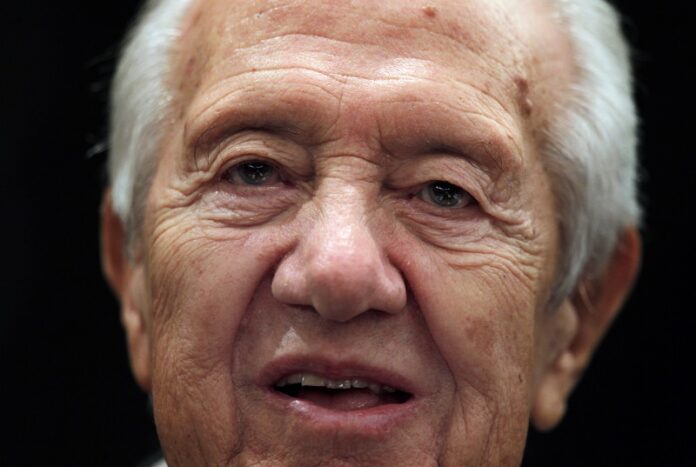
Mario Soares, Ex-President and PM of Portugal, 92

Portugal's former President and former Prime Minister Mario Soares smiles during the launch of his book "The Hope is Necessary" in 2013 at the Belem Cultural Center in Lisbon, Portugal. Photo: Francisco Seco / Associated Press

LISBON, Portugal — Mario Soares, a former prime minister and president of Portugal who helped steer his country toward democracy after a 1974 military coup and grew into a global statesman through his work with the Socialist International movement, has died. He was 92.

Lisbon’s Red Cross Hospital said in a statement he died there on Saturday afternoon with his son and his daughter at his bedside. The hospital did not provide a cause of death, but Soares had been a patient since Dec. 13 and in a coma for the past two weeks.

Soares, a moderate Socialist, returned from 12 years of political exile after the almost bloodless Carnation Revolution toppled Portugal’s four-decade dictatorship in 1974. As a lawyer, he had used peaceful means to fight the country’s regime, which eventually banished him.

Soares was elected Portugal’s first post-coup prime minister in 1976 and thwarted Portuguese Communist Party attempts to bring the NATO member under Soviet influence during the Cold War. He helped guide his country from dictatorship to parliamentary democracy and a place in the European Union.

“The loss of Mario Soares is the loss of someone who was irreplaceable in our recent history. We owe him a lot,” Socialist Prime Minister Antonio Costa said in India, where he was on a state visit.

Costa said three days of national mourning will begin Monday and that Soares would have a state funeral at an unspecified date.

“His cause was always the same: freedom,” President Marcelo Rebelo de Sousa, said in a televised speech. “At decisive moments, he was always a winner.”

Soares’ role as an international statesman was solidified through his work with the International Socialist movement. As a vice president from 1976, he led diplomatic missions that sought to help resolve conflicts in the Middle East and Latin and Central America.

Soares was visiting Palestinian leader Yasser Arafat in the Gaza Strip when Israeli prime minister Yitzhak Rabin was assassinated in Tel Aviv in 1995. Both Arafat and Rabin were longtime friends of Soares.

In 1986, Soares became Portugal’s first civilian president in 60 years. His broad popularity brought him two consecutive five-year terms.

During terms as prime minister and foreign minister, Soares helped rehabilitate Portugal on the international stage after decades of isolation under the dictatorship established by Antonio Salazar in the 1930s. Soares’ insistence on using the ballot box instead of weapons to end the dictatorship won him respect around the world.

Soares belonged to a generation of influential European Socialist leaders that also included his close friend Francois Mitterrand of France, Germany’s Willy Brandt, Olof Palme in Sweden, and Felipe Gonzalez in Spain.

The 1974 coup shot Lisbon to the center of Cold War attentions as Portugal lurched to the political left after the dictatorship’s fall.

Days after the Carnation Revolution – so named because people stuck red carnations in soldiers’ rifle barrels – Soares returned home by train from Paris to a rapturous welcome from crowds that flocked to meet him at Lisbon’s Santa Apolonia train station.

The Communist Party’s influence surged following the coup, prompting fears in the West that Portugal — a founding member of the Atlantic military alliance – would come under the Soviet Union’s influence and encourage other radical leftist movements in western Europe.

Soares said that at an October 1974 meeting in Washington, then-U.S. Secretary of State Henry Kissinger told him he thought Portugal was doomed to communist rule. But Frank Carlucci, the new U.S. ambassador to Lisbon and later head of the CIA, argued that moderate democratic forces, especially Soares’ Socialists, would prevail. The 1976 election proved Carlucci right.

Soares, an affable figure and eloquent campaigner who led the Socialist Party, won the country’s first entirely free elections and became prime minister.

Portugal had western Europe’s last colonial empire, and Soares was instrumental in quickly granting independence to Portugal’s five colonies in Africa. Protracted wars had sapped the Portuguese economy and soured its relations with other western nations that had turned away from colonial rule years earlier.

Soares later was criticized for cutting the colonies loose so abruptly. All of them – Angola, Mozambique, Guinea-Bissau, Cape Verde, and Sao Tome and Principe – became single-party Marxist states supported by the Soviet Union and Cuba after their independence. Angola and Mozambique drifted into civil wars as proxies in the Cold War struggle for influence in Africa.

Soares held posts in a string of governments that lasted less than a year in the post-revolution political chaos. Banks were nationalized, spooking wealthy financiers who fled the country, and poor farmers seized the land they had long worked at large private estates.

Born in Lisbon in 1924, Soares started out as a radical student organizer and became a renowned defense lawyer.

He was a relentless opponent of Salazar’s regime, which along with Franco’s roughly contemporary rule in neighboring Spain, shut off the Iberian peninsula to outside influences. Salazar’s secret police, known by its acronym PIDE, jailed Soares 12 times and exiled him twice, once to the island of Sao Tome off west Africa.

After democracy, Soares served four times as the country’s foreign minister and three times as prime minister.

As prime minister in 1986 he ushered Portugal into the European Economic Community – later the European Union. That turned out to be a watershed year which placed the country on a fast-track modernization program.

Soares capped his political career that year by becoming head of state. He rapidly set about keeping his campaign pledge to serve as “President of all the Portuguese” after years of division and unrest which brought eight governments between 1978 and 1985.

He was a fierce critic of the economic liberalism embraced by U.S. President Ronald Reagan and British leader Margaret Thatcher which was alien to his Socialist convictions about the benefits of welfare capitalism.

As president, Soares established a professional, if cool, relationship with center-right Social Democratic Prime Minister Anibal Cavaco Silva, who admired Thatcher. Though an unlikely team, Soares and Cavaco Silva together oversaw the shedding of many left-inspired economic structures, such as the nationalization of banks, adopted after the coup.

Opponents claimed Soares had abandoned his Socialist ideals, but Soares insisted his “cohabitation” with Cavaco Silva contributed to the country’s new-found stability. He won a thumping re-election victory to serve a second five-year term in 1991.

Soares then retired from politics to set up a cultural foundation. At the request of the United Nations, he became head of the Independent World Commission of the Oceans. He also led a U.N. fact-finding mission on human rights to Algeria in 1998.

He returned to politics in 1999, winning a seat in the European parliament as the main candidate of the Socialist Party but then failing to be elected head of the assembly.

He also ran again for Portugal’s presidency in 2006, at the age of 82. Younger voters had little grasp of his historic achievements and he finished third.

He is survived by two children and five grandchildren.

Story: Barry Hatton

Advertisement

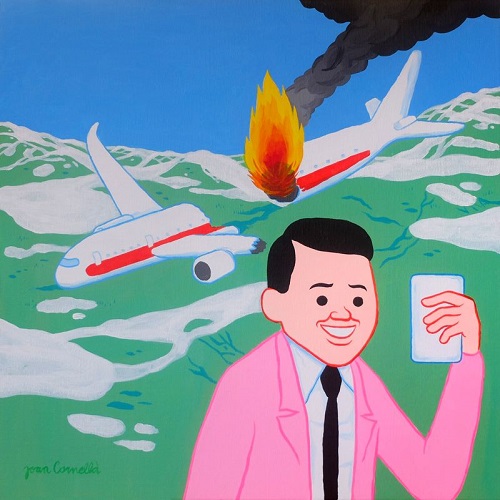
Cringe at Catalan Cartoonist Joan Cornella’s World of Weirdness

Photo: Have You Heard? / Facebook

BANGKOK — An armless man wearing a free hugs t-shirt, a person taking a selfie before the backdrop of a flaming plane crash or cupid striking a deer with a love arrow only to make a succulent meal out of it, are all part of cartoonist Joan Cornella’s macabre view of the world.

Portraying the more cynical and hypocritical aspects of modern society through the black humor of his ever-grimacing characters, Cornella will put his artwork on display at his Bangkok Solo Exhibition in March for the first time in Thailand.

In a presentation of his classic series-of-six comic strips, the Catalan cartoonist will present a display of thought-provoking scenarios embedded with striking social messages. Using his contrasting pop-art style of vivid primary colors to express dark and twisted situations, the Barcelonian will set out to showcase his work among the Bangkok faithful.

Be warned that the exhibition is neither for the overly sensitive nor for the faint hearted – or the easily offended – and that children under 16 will have to be accompanied by adults.

Cornella will be present at the exhibition during a number of days to sign books and accessories.

The admission fee is 200 baht, tickets are available online and limit only 130 people per hour. Bangkok Solo Exhibition will run from 11am to 10pm, March 10 through March 26 at Future Factory Bangkok, which can be reached by a five minute walk from BTS Sanam Pao’s Exit 3.

Image: Joan Cornellà / Facebook

Advertisement

Rule With an Iron Fist. Lie Without Shame.

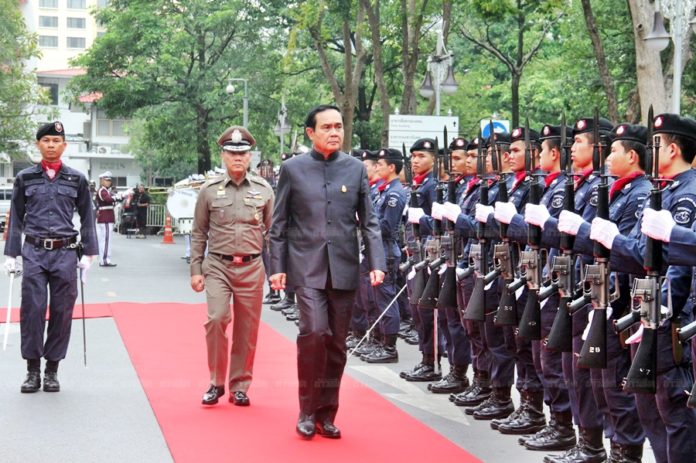
Junta chairman Prayuth Chan-ocha on Dec. 7 inspects a guard of honor at Royal Thai Police headquarters.

Retention

A long, long time ago, just one day after junta leader Gen. Prayuth Chan-ocha staged his May 2014 coup, I was asked by Al Jazeera TV what I thought of him.

My reply was that Prayuth, as army chief, had repeatedly said on the record that he would not stage a coup, then staged one. I reminded viewers that it means either he abruptly changed his mind or lied. Either one means Prayuth is unreliable.

Fast-forward to the first days of 2017, 32 months after the songwriting general begged for “a little more time” and promised elections within a year, and find he still hasn’t lived up to his word.

The elections promised for 2017 may not happen after all.

This time the harbingers of news were members of the junta-appointed National Legislative Assembly. On Sunday, assembly member Gen. Somjet Boontanom said another 15 months were needed to pass necessary legislation before an election could be held. That would mean rewriting the “roadmap” for restoring democratic rule yet again.

Some say the junta wants to ensure it can continue pulling the levers of power after an election. The thing is, even with his supposedly “absolute power,” Prayuth and his men still feel insecure, as witnessed by them sending undercover officers to trail former premier Yingluck Shinawatra and her son while they were on vacation.

There’s simply no way to make the junta leader feel secure, now or after elections, because Prayuth knows he robbed power from the people to make himself prime minister. It’s not hard to prevent thieves from feeling remorse as long as they still have a conscience reminding them of their guilt.

Prayuth is no exception. Unless he has no conscience, that is.

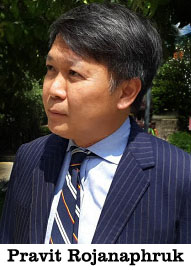
Pravit Rojanaphruk

In case you missed it, after a few days of post-New Year chaos, Prayuth and his deputy cleared the air and insisted the original roadmap was still good.

The man who steadfastly denied he would stage a coup before he did, a man who has torn up his previously sworn roadmaps is once again telling us to take him at his word.

Truth or lie, junta-supporting Shinawatraphobes won’t care. In fact, some may wish Prayuth remains dictator for life without any future voting, so their favorite political faction won’t lose, or lose face, again.

As for those concerned Prayuth and his men will lose credibility by postponing the promised elections to 2018 or beyond, they should not be too alarmed. After all, what credibility does the regime have left after all the lies?

These days, lying has become part of the job description of not just some politicians but military dictators. Some Thais are willing to forgive the latter because they believe Good Men can do no wrong, even after repeated lies.

“Rule with an iron fist. Lie without shame.”

Could this be Prayuth’s slogan or that of the self-styled National Council for Peace and Order?

Prove me wrong, Prayuth. And acknowledge, I shall.

Advertisement

Suspects of Robbery Turned Brutal Murder Jailed

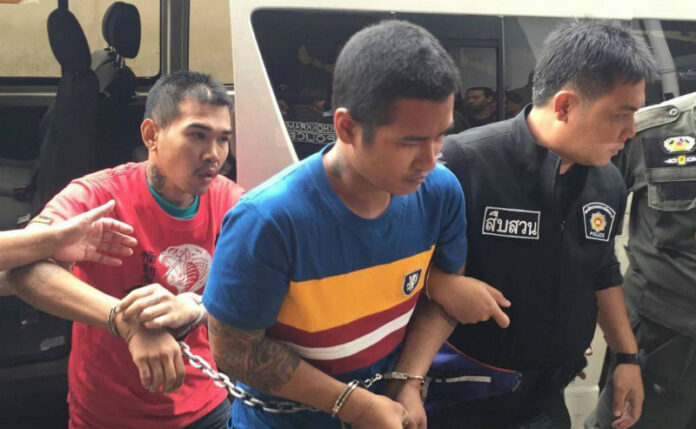
Kittikorn Wikaha, 26 (right) and Supatchai Jansri, 25, are taken to Criminal Court Saturday morning.

BANGKOK — Two suspects involved in the murder of a man whose iPhone they were trying to rob were brought to seek the court’s approval for detention Saturday morning.

Kittikorn Wikaha, 26, confessed to the stabbing of Vasin Lueangcham, also 26, and was taken to the Criminal Court with his accomplice, Supatchai Jansri, 25. The couple’s bail was denied as the court deemed them a flight risk.

Kittikorn was arrested Friday morning at his residence.

Supatchai, who rode the motorcycle on which Kittikorn arrived and escaped the crime scene, was arrested Friday afternoon at a friend’s house in Nonthaburi province.

The attack captured by security camera footage went viral and sparked outrage among the public. Many among the crowd gathered to witness police’s re-enactment Friday demanded Kittikorn be executed.

The pair will be jailed for 12 days under court order. Police said they will urge the case to be brought to prosecutors within the next week.

Related stories:

Suspect in Brutal Bangkok Knife Murder Video Arrested

No Suspects Yet in Murder of Bangkok Man for iPhone (Video)

Advertisement

Tilikum, Icon of Anti-Captivity ‘Blackfish’ Documentary, 36

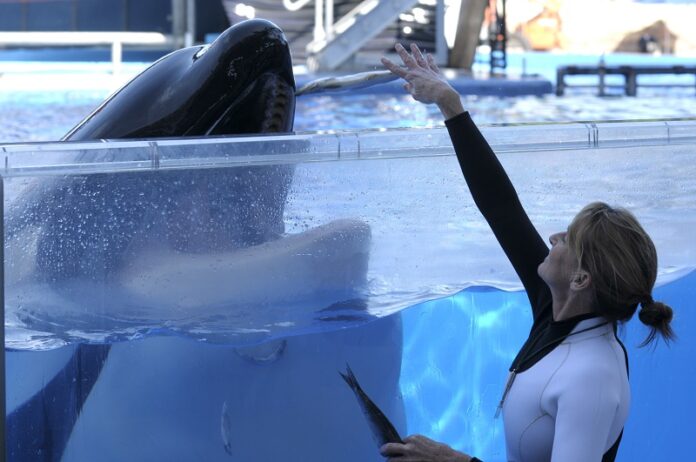
Kelly Flaherty Clark, right, director of animal training at SeaWorld Orlando, works with killer whale Tilikum during a training session in 2011 at the theme park's Shamu Stadium in Orlando, Florida. Photo: Phelan M. Ebenhack / Associated Press

ORLANDO, Florida — Tilikum the orca has died after more than two decades at SeaWorld Orlando, where he gained notoriety for killing a trainer in 2010 and was later profiled in a documentary that helped sway popular opinion against keeping killer whales in captivity.

He will not be replaced. He was the first of SeaWorld’s orcas to die since the company announced the end of its orca breeding program in March 2016.

In a statement announcing Tilikum’s death early Friday, SeaWorld officials said he had serious health issues including a persistent and complicated bacterial lung infection. Tilikum was estimated to be 36 years old. A necropsy will determine the cause of death.

The 2010 death of SeaWorld trainer Dawn Brancheau during a performance with Tilikum after a “Dine with Shamu” show shocked the public and changed the future of orcas at SeaWorld parks.

Brancheau was interacting with Tilikum before a live audience at SeaWorld Orlando when he pulled her from a platform by her arm and held her underwater. An autopsy report said Brancheau drowned but also suffered severe trauma, including multiple fractures.

Former SeaWorld orca trainer John Hargrove said Tilikum’s death offered some closure in the violent death of his friend and colleague. But he said Tilikum also finally found relief.

“Tilikum has been sick, very sick, for so long, and after everything he’s had to endure, this is to me like he’s free,” said Hargrove, who left SeaWorld in 2012 and was featured in the documentary “Blackfish.”

“He lived a tortured existence in captivity. I think all the whales do, but if you had to pinpoint one of them, hands down I would say Tilikum.”

Animal rights advocates who want orcas and other marine mammals at SeaWorld parks released into sea pens or coastal sanctuaries said Tilikum was snared in a business model that led only to tragedy. Lisa Lange, senior vice president for the group People for the Ethical Treatment of Animals, urged SeaWorld to release its remaining orcas and marine mammals to “spend the rest of their lives in as natural a setting as possible.”

SeaWorld supporters found something worthwhile in Tilikum’s time at the park.

“His story is a complicated one, but I also think he represented his species well,” said Grey Stafford, president of the International Marine Trainers’ Association. He’s also a former SeaWorld employee, though he never worked with Tilikum. “In retrospect, there are a lot positives to say.”

SeaWorld President and CEO Joel Manby said, “Tilikum had, and will continue to have, a special place in the hearts of the SeaWorld family, as well as the millions of people all over the world that he inspired.”

According to National Oceanic and Atmospheric Administration figures, male killer whales in the wild typically live about 30 years and females typically live about 50 years. Institutions displaying marine mammals and their critics disagree over whether orcas’ life expectancy in captivity differs from their life span in the wild.

Tilikum had been SeaWorld’s most prolific male orca, siring 14 calves since his arrival at the park about 25 years ago. He was noticeable for his size at more than 22 feet and 11,800 pounds.

He was born off the waters of Iceland and brought to Sealand of the Pacific in Canada after being captured. While at Sealand in 1991, Tilikum and two female orcas were responsible for the death of a part-time trainer who fell into their pool and was submerged by them.

Tilikum was moved to SeaWorld Orlando in 1992, and Sealand later closed.

SeaWorld’s decision to end the breeding program and phase out the theme parks’ traditional orca performances came three years after the release of the documentary, “Blackfish,” which chronicled Tilikum’s life and Brancheau’s death.

Her death was not the only one linked to Tilikum at SeaWorld. In 1999, a naked man who had eluded security and sneaked into SeaWorld at night was found dead the next morning draped over Tilikum in a breeding tank in the back of Shamu Stadium.

“Blackfish” argued that killer whales in captivity become more aggressive toward humans and each other. Because of it, several entertainers pulled out of planned performances at SeaWorld parks and animal rights activists increased their demonstrations outside the parks.

SeaWorld attendance dipped, company profits fell and Southwest Airlines ended its 25-year relationship with the theme park company.

Gabriela Cowperthaite, who directed “Blackfish,” said in an email that it’s time to focus on other whales in captivity. “He lived a horrible life, he caused unspeakable pain, so at least his chapter is over,” she said.

In March, SeaWorld’s CEO acknowledged that the public’s attitude had changed about keeping killer whales captive.

“We needed to move where society was moving,” Manby said.

Tilikum’s death was another blow for SeaWorld employees already reeling from job cuts announced last month across SeaWorld Entertainment Inc.’s 12-park system, Stafford said. He worried the loss of employees trained to care for marine mammals may inadvertently weaken other conservation efforts, such as a captive breeding program proposed for endangered porpoises called vaquitas in the waters off Mexico.

“That human experience isn’t likely to be replaced,” Stafford said.

Story: Mike Schneider, Jennifer Kay

Advertisement

5 Dead, 8 Injured as US Veteran Opens Fire in Florida Airport

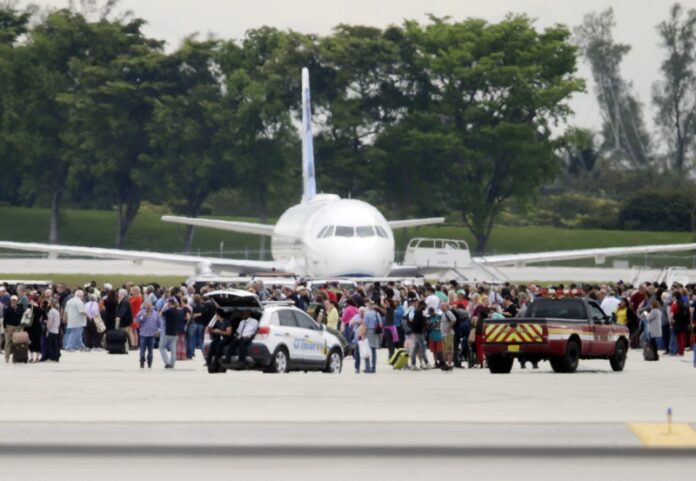
People stand on the tarmac Friday at the Fort Lauderdale-Hollywood International Airport after a shooter opened fire inside a terminal of the airport, killing several people and wounding others before being taken into custody in Fort Lauderdale, Florida. Photo: Lynne Sladky / Associated Press

FORT LAUDERDALE, Florida — An Army veteran who complained that the government was controlling his mind drew a gun from his checked luggage on arrival at the Fort Lauderdale airport and opened fire in the baggage claim area Friday, killing five people and wounding eight, authorities said.

He was taken into custody after throwing his empty weapon down and lying spread-eagle on the ground, one witness said.

“People started kind of screaming and trying to get out of any door they could or hide under the chairs,” the witness, Mark Lea, told MSNBC. “He just kind of continued coming in, just randomly shooting at people, no rhyme or reason to it.”

The gunman was identified as 26-year-old Esteban Santiago of Anchorage, Alaska, who served in Iraq with the National Guard but was demoted and discharged last year for unsatisfactory performance. His brother said he had been receiving psychological treatment recently.

A law enforcement official told The Associated Press that Santiago had walked into the FBI office in Anchorage in November to say that the U.S. government was controlling his mind and making him watch Islamic State videos.

Agents questioned an agitated and disjointed-sounding Santiago and then called police, who took him for a mental health evaluation, according to the official, who was not authorized to discuss the case and spoke on condition of anonymity.

FBI agent George Piro, who is in charge of the Miami field office, confirmed that Santiago had come into the Anchorage office and said he clearly indicated at the time that he was not intent on hurting anyone.

Authorities said the motive for the attack was under investigation. Shortly after the shooting, and before details of Santiago’s mental health became public, Sen. Bill Nelson of Florida said that it remained to be seen whether it was terrorism or the work of “someone who is mentally deranged.”

Piro said authorities are looking at leads in several states and have not ruled out terrorism. “We’re looking at every angle, including the terrorism angle,” he said

Santiago, who is in federal custody, will face federal charges and is expected to appear in court Monday, Piro said.

One witness said the attacker gunned down his victims without a word and kept shooting until he ran out of ammunition for his handgun, sending panicked travelers running out of the terminal and spilling onto the tarmac, baggage in hand.

Others hid in bathroom stalls or crouched behind cars or anything else they could find as police and paramedics rushed in to help the wounded and establish whether there were any other gunmen.

Bruce Hugon, who had flown in from Indianapolis for a vacation, was at the baggage carousel when he heard four or five pops and saw everyone drop down on the ground. He said a woman next to him tried to get up and was shot in the head.

“The guy must have been standing over me at one point. I could smell the gunpowder,” he said. “I thought I was about to feel a piercing pain or nothing at all because I would have been dead.”

It is legal for airline passengers to travel with guns and ammunition as long as the firearms are put in a checked bag – not a carry-on – and are unloaded and locked in a hard-sided container. Guns must be declared to the airline at check-in.

Santiago arrived in Fort Lauderdale after taking off from Anchorage aboard a Delta flight Thursday night, checking only one piece of luggage – his gun, said Jesse Davis, police chief at the Anchorage airport.

At Fort Lauderdale, “after he claimed his bag, he went into the bathroom and loaded the gun and started shooting. We don’t know why,” said Chip LaMarca, a Broward County commissioner who was briefed by investigators.

The bloodshed is likely to raise questions of whether aviation safety officials need to change the rules.

The attack also exposed another weak point in airport security: While travelers have to take off their shoes, put their carry-on luggage through X-ray machines and pass through metal detectors to reach the gates, many other sections of airports, such as ticket counters and baggage claim areas, are more lightly secured and more vulnerable to attack.

In 2013, a gunman with a grudge against the Transportation Security Administration shot and killed one of the agency’s screeners and wounded three others during a rampage at Los Angeles International Airport. Last November, an airline worker was shot and killed near an employee parking lot at Oklahoma City’s airport, and in 2015 a machete-wielding man was shot to death after he attacked federal security officers at the New Orleans airport.

“The fact is that wherever there are crowds, such as at our airports, we remain vulnerable to these types of attacks,” Nelson said.

The Fort Lauderdale gunman said nothing as he “went up and down the carousels of the baggage claim, shooting through luggage to get at people that were hiding,” according to Lea. The killer went through about three magazines before running out of ammunition, Lea said.

“He threw the gun down and laid spread-eagle on the ground until the officer came up to him,” Lea said.

The gunman was arrested unharmed, with no shots fired by law enforcement officers, and was being questioned by the FBI, Sheriff Scott Israel said.

Broward County Sheriff Scott Israel said 30 to 40 people were injured – scrapes, bruises and broken bones – after the shooting.

The condition of the wounded was not disclosed. At least one of the victims was seen lying in a pool of blood with what appeared to be a head wound.

The airport was shut down, with incoming flights diverted and outgoing flights held on the ground. Airport Director Mark Gale said it will try to reopen at 5 a.m. Saturday but urged travelers to check with their individual airlines on flight status. He said 10,000 of the airport’s stranded travelers were being bused overnight to the city’s spacious Port Everglades cruise ship terminal.

President Barack Obama was briefed by his Homeland Security adviser, the White House said. President-elect Donald Trump said that it is a “disgraceful situation that’s happening in our country and throughout the world” and that it was too soon to say whether it was a terrorist attack.

Santiago’s brother, Bryan, told the AP that his brother had been receiving psychological treatment in Alaska. He said Santiago’s girlfriend alerted the family to the situation in recent months. Bryan Santiago said that he didn’t know what his brother was being treated for and that they never talked about it.

He said Esteban Santiago was born in New Jersey and moved to Puerto Rico when he was 2. He was sent to Iraq in 2010 and spent a year there with the 130th Engineer Battalion, according to Puerto Rico National Guard spokesman Maj. Paul Dahlen. He later joined the Alaska National Guard.

The Pentagon said Santiago had gone AWOL several times during his stint with the Alaska National Guard and was demoted – from specialist to private first class – and given a general discharge, which is lower than an honorable discharge.

John Schilcher told Fox News he came up to the baggage claim and heard the first gunshot as he picked up his bag off a carousel.

“The person next to me fell to the ground and then I started hearing other pops. And as this happened, other people started falling and you could hear it and smell it, and people on either side of me were going down and I just dropped to the ground,” said Schilcher, who was there with his wife and mother-in-law. “The firing just went on and on.”

“I was down on the floor. When we finally looked up there was a policeman standing over me,” he said. “That’s when I assumed it was safe.”

Story: David Fischer

Advertisement

In Myanmar Crackdown, Abuses Appear ‘Normal’

Rohingya women and children wait in a queue to collect water in December at the Leda camp, an unregistered camp for Rohingya in Teknaf, near Cox's Bazar, a southern coastal district about, 296 kilometers (183 miles) south of Dhaka, Bangladesh. Photo: Associated Press

WASHINGTON — Abuses appear “normal and allowed” in Myanmar’s response to an armed uprising by Rohingya Muslims, a senior U.S. official said in an interview, casting a pall over one of President Barack Obama’s legacy foreign policy achievements.

Obama and his advisers have long held up the former pariah nation’s U.S.-backed shift from military rule as a breakthrough for American interests and democratic values in Southeast Asia. But the situation in strife-hit Rakhine State makes the transition no straightforward success story.

Rakhine has been largely closed off to foreigners, including aid workers, since a deadly insurgent attack against police in October. Subsequent “clearance operations,” led by the military and reminiscent of its decades of junta rule, have left at least dozens dead. Tens of thousands of Rohingya have escaped to neighboring Bangladesh.

A Myanmar government-appointed commission, led by a former general, this week said there was insufficient evidence so far to support allegations of rape and killings by security forces that have been made by Rohingya villagers fleeing northern Rakhine, which remains off-limits to journalists.

Tom Malinowski, the State Department’s human rights chief, questioned the credibility of that investigation. He said a video of Myanmar police kicking and beating Rohingya – filmed by the police and recently surfaced on social media – suggests a disturbing pattern.

“People don’t film themselves committing a human rights abuse unless they think that doing so is normal and allowed,” Malinowski told The Associated Press.

“What that video suggests to me is that this kind of behavior, at least with respect to whatever unit or elements of the security forces was involved, has become normalized, much as the photographs at Abu Ghraib taught us the same lesson about things that were going on in our military in Iraq at the time,” he said.

The government of Myanmar, also known as Burma, has verified the video and detained the police officers involved. But it insists the incident is an “isolated case.”

Human rights groups and neighboring, Muslim-majority Malaysia accuse Myanmar’s civilian leader, Aung San Suu Kyi, of failing to protect the Rohingya. The Nobel peace laureate is hobbled by her lack of control over the powerful military but harsh national politics also play a role.

Myanmar’s majority Buddhists loathe the Rohingya. Many of the more than 1 million-strong community have lived there for generations, but they lack citizenship. The Rohingya bore the brunt of intercommunal violence with Buddhists in Rakhine in 2012 that left hundreds dead and forced more than 100,000 into squalid camps.

The plight of the Rohingya has attracted the attention of Muslim extremists. U.S. officials say there are credible reports that wealthy backers in Gulf nations and the Rohingya diaspora are providing funds and training for a newly emerged insurgency in Rakhine.

The Myanmar government says the insurgent group – known as Harakah al-Yaqin, or Faith Movement – has hundreds of fighters. It says the group is led by Havid Tuhar, a 45-year-old Rohingya who was raised in Saudi Arabia. The government claims he trained with Taliban in Pakistan.

Havid Tuhar has appeared in several videos posted on social media surrounded by rag-tag, barefoot guerrillas, urging young Rohingya men to fight.

As early as two years ago, Malinowski said, the U.S. expressed fears to Myanmar’s government that the grievances of Muslims needed to be addressed. Otherwise, he said, “outside forces would eventually exploit those grievances to promote a violent reaction.”

“It does seem that something like that, at least on a small scale, has happened,” Malinowski said.

The U.S. would be prepared to share with Myanmar credible threat information to help the civilian leadership respond effectively to attacks, he said. He would not say if any actionable intelligence has been shared to date.

“We do want to support the government of Burma in protecting its people and its borders. We want to help them do it the right way. That means not falling into the trap of an indiscriminate response that fuels recruitment for groups that may be using violence,” Malinowski said.

Story: Matthew Pennington

Advertisement

Court Denies Bail to Activist Suspect in Lese Majeste Case

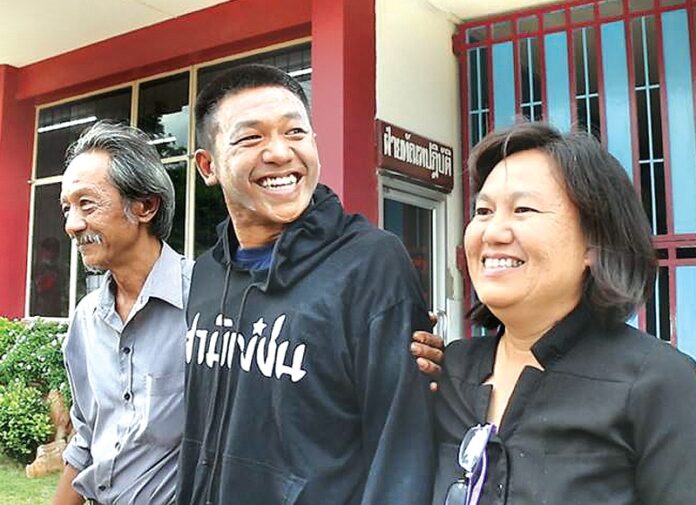
Jatupat ‘Pai’ Boonpattararaksa poses with his parents Aug. 24 in front of the Khon Kaen military court upon being freed on bail in another court case.

KHON KAEN — A Khon Kaen appeals court Friday dismissed a request to free activist Jatupat “Pai” Boonpattararaksa on bail.

Jatupat, a community rights and democracy activist who has campaigned against military rule, has been held in prison since December for sharing a BBC Thai biography of King Rama X the authorities deemed offensive to the monarchy. His was briefly released on bail only to have it revoked Dec. 22 for complaining about its cost.

Jatupat’s lawyers had appealed, but the upper court today affirmed the lower court’s ruling.

Defense lawyers said they will offer a higher bond when they seek bail again in the coming days.

Jatupat was arrested Dec. 3 for sharing on Facebook the BBC Thai article, which was published after King Vajiralongkorn ascended to the throne. He was later charged with defaming the monarchy, a crime known as lese majeste which is punishable by up to 15 years in prison.

After Jatupat was freed the next day, police asked the court to revoke his bail because he complained online about the large bond – 400,000 baht – required by the court. Investigators said his remarks mocked the justice system and instigated unrest.

Related stories: 

 Authorities Visit BBC Thai Offices, Block Article Online

Advertisement

Hot News

LATEST NEWS

Bangkok
broken clouds
29.4 ° C
32.2 °
29.4 °
74 %
5.4kmh
58 %
Fri
29 °
Sat
36 °
Sun
37 °
Mon
37 °
Tue
32 °