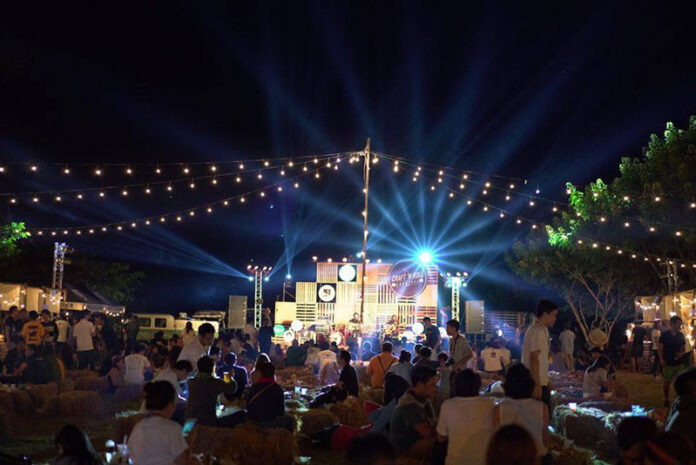
KANCHANABURI — Take three-hour ride out of the capital to enjoy a weekend getaway downing fine craft beer in a tropical garden next along the Khwae Yai River.
Billed as the biggest craft beer festival in the country, Craft ‘N Roll Carnival 2will bring together more than 30 domestic breweries including fresh-to-the-field homebrew What the Pug Beer, the two beer bros behind Nonthaburi’s Devanom Beer and My Beer Friend from Chiang Mai.
Many top Thai brewers will be there along with live performances by indie rock band De Flamingo, glam rock trio Chanudom and folk-pop crew Arak and the Pisatband.
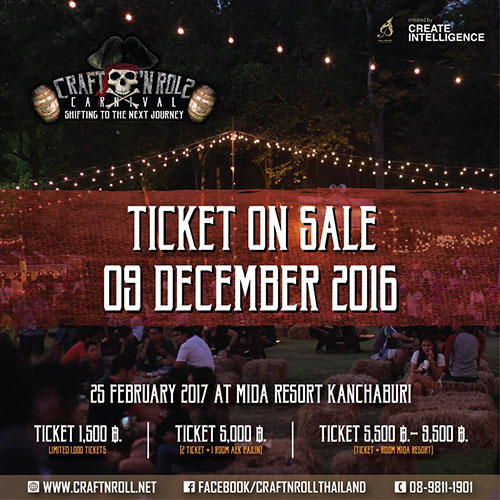
The free-flow craft drink event is hosted by Craft ‘N Roll, an active craft beer community, and will go from 7pm to midnight on Feb. 25 at the Mida Resort Kanchanaburi.
Tickets are 1,500 baht and limited to only 1,000 tickets. Two tickets with a room at the resort are 5,000 baht, but limited to 30 rooms only. The tickets will be sold onlineon Dec. 9.
Mida Resort Kanchanaburi is an upscale resort located in Kanchanaburi’s Muang district, and close to tourist attractions the River Kwai Bridge and Kanchanaburi War Cemetery.
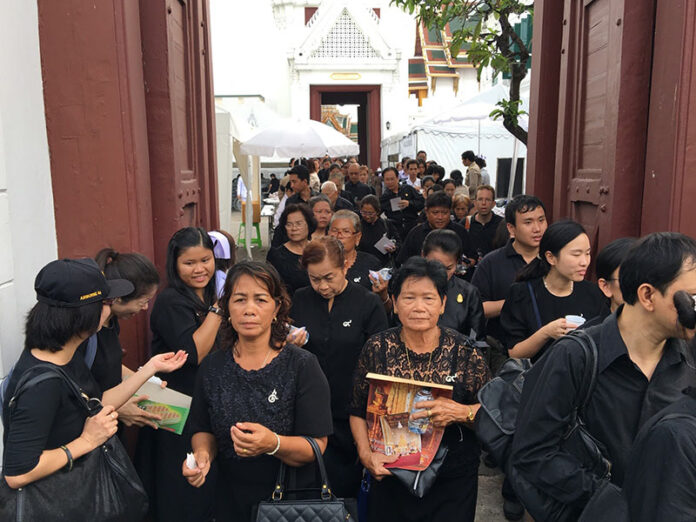
Mourners Wednesday at the Grand Palace in Bangkok.
BANGKOK — The palace will be closed to mourners Thursday and Friday for a ritual marking the 50 days since the death of King Bhumibol, during which time a massive cleanup of the Sanam Luang and surrounding areas will be undertaken.
The “Big Cleaning Day” event will begin at 9:30pm on Nov. Wednesday with military officers and volunteers cleaning the drainage and canals at Sanam Luang, Phra Pin-klao Bridge and Ratchadamnoen Avenue. People will also clean the roads and sidewalks in the area by picking up trash, washing sidewalks and cleaning the food tents.
Those interested in volunteering can call 1555 to contact the Peace and Order Maintainenance Command, the army division in charge of the event.
Maj. Gen. Pongsawat Pannajit, deputy commander of the 1st Army, said Friday that this weekend’s mourners would find more women’s restrooms to accommodate more mourners. Weekend mourners should be expected to wait in longer queues, with 10,000–12,000 mourners getting to prostrate before the King’s royal coffin in the morning.
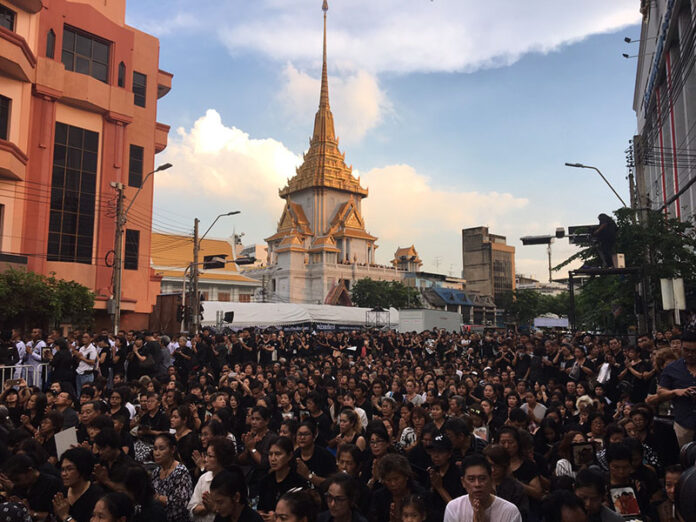
Mourners at an event organized by the Thai-Chinese Chamber of Commerce Saturday on Yaowarat Road in Bangkok.
BANGKOK — An online booking system for mourners to pay their respects at the Grand Palace has been pushed back to Jan. 21.
Work on developing the queuing system by government technology ministries was completed, according to Suwapan Tanyuwantana of the Prime Minister’s Office, but its release would be delayed until until Jan. 21, which will mark 100 days since the death of King Bhumibol in October.
Suwapan said Friday that people coming to the palace should arrive after 2pm, as that’s when lines are shortest, according to data they’ve tracked. They are longest in the early morning, he said.
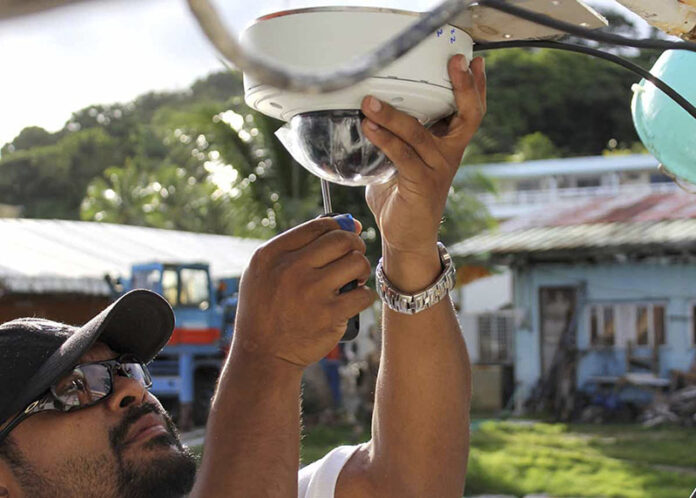
Kalie Luii, a compliance officer for the Division of Oceanic Fisheries Management in Palau, installs a Satlink camera faceplate with waterproof cover on a longline tuna boat on Sept. 29. Cameras are recording everything that comes over the rail and onto the deck of a few dozen tuna boats loaded with motion sensors and GPS systems in the western Pacific Ocean. Photo: Roll’em Productions / The Nature Conservancy / Associated Press
BANGKOK — Fishing boats used high-tech systems to find vast schools of fish for decades, depleting stocks of some species and leading to the complete collapse of others. Now more than a dozen apps, devices and monitoring systems aimed at tracking unscrupulous vessels and the seafood they catch are being rolled out — high-tech solutions some say could also help prevent labor abuses at sea.
Illegal fishing, which includes catching undersized fish, exceeding quotas and casting nets in protected areas, leads to an estimated USD$23 billion (819.4 billion baht) in annual losses, according to the United Nations. Meanwhile, overfishing close to shore has pushed boats farther out, where there are few laws and even less enforcement to protect workers from abuse. Slavery has been documented in the fishing sectors of more than 50 countries, according to U.S. State Department reports.
Earlier this year, U.S. Secretary of State John Kerry said using technology at sea could eventually mean “there is not one square mile of ocean where we cannot prosecute and hold people accountable…”
However, Phil Robertson, deputy Asia director of Human Rights Watch, cautions that catching human traffickers goes beyond finding boats.
“Technology is all about knowing where the fishing boats are on the ocean, but that does precious little for crews being physically abused and worked to the bone on those vessels,” he said.
Nonprofit anti-trafficking organization Project Issara is tapping into near-ubiquitous smartphones with an app that allows Burmese and Cambodian migrant workers around the world to share information about their working conditions. Their reviews reach nonprofits, governments and businesses which can monitor and learn from the feedback. Combined with a new multilingual hotline, victims of labor abuses have a safer, discreet way of seeking help.
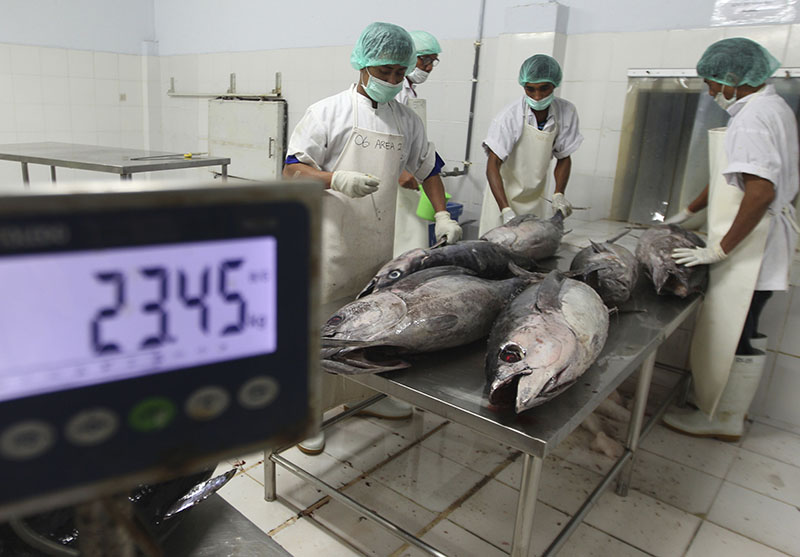
Workers weigh newly landed tuna before they are given barcodes on Sept. 9, 2015, at a port facility in Benoa, Bali, Indonesia. The bar-code will give each fish a tag that can provide details about the location,it was caught, boat, species, weight and could easily be expanded to include crews on individual boats to help fight against labor abuse. Photo: Firdia Lisnawati / Associated Press
A worker runs a gadget over a fish just after it’s pulled from the boat, giving it a bar code that creates a permanent record of where it was caught. It’s a simple swipe with profound potential. Thomas Kraft at Norpac Fisheries Export established one of the industry’s first bar-code systems that give each fish a tag that can provide details about location, boat, species, and weight. He’s been using the technology in locations worldwide and says it could easily be expanded to include crews on individual boats to help fight against labor abuse.
A close-up look inside a Satlink high definition electronic monitoring camera before it was installed on a longline tuna boat in Palau. Cameras are recording everything that comes over the rail and onto the deck of a few dozen tuna boats loaded with motion sensors and GPS systems in the western Pacific Ocean. Photo: Roll’em Productions / The Nature Conservancy / Associated Press
Eyes on the Seas uses satellite trackers, radar signals, drone images, even radio signals to create a dynamic world map. Analysts using algorithms and observations can identify boats that appear to be illegally fishing in protected areas or pulling near each other to offload illicitly caught seafood. They can then contact national authorities with detailed evidence about where a boat is and what it appears to be doing. Eyes on the Seas can spot boats even if they turn off their basic safety satellite trackers, which may be a deterrent for would-be bad actors, but confidential data used in the system means it cannot be publicly available. Built by the Pew Charitable Trusts and a U.K. government satellite start-up initiative, the system is still being fine-tuned.
Like Eyes on the Seas, this tool provides a nearly-live view of fishing boats at sea around the world. But the data it uses to identify boats comes almost exclusively from Automatic Identification Systems, satellite trackers used in large vessels that are easily switched on and off. Rolled out earlier this year, Global Fishing Watch is on the web and open to the public in beta form, with tracks for 35,000 fishing boats going back more than four years. Oceana, SkyTruth and Google partnered to build the site, with support from Leonardo DiCaprio Foundation.
Cameras are recording everything that comes over the rail and onto the deck of a few dozen tuna boats loaded with motion sensors and GPS systems in the western Pacific Ocean. The goal of The Nature Conservancy’s project is to get the recording systems on thousands of tuna boats in the Palau longline fleet. The challenge is reviewing the video: about 800 hours of footage from each two-month fishing trip. This month the nonprofit environmental group is launching a $150,000 prize for machine-learning software that can spot turtles, shark finning and undersized tuna being illegally reeled in.
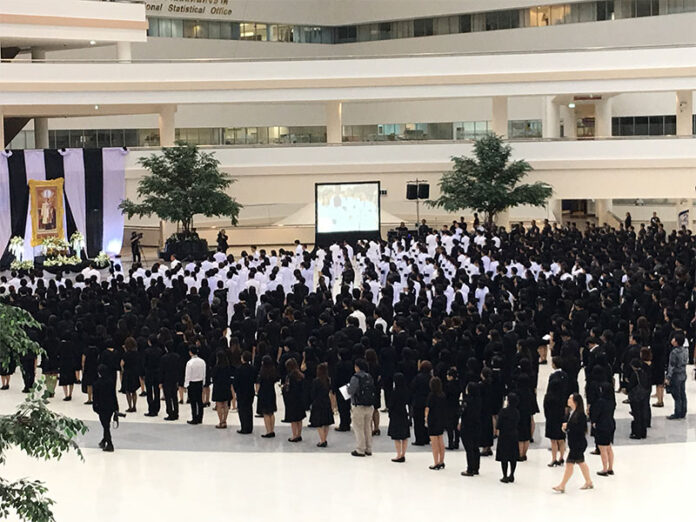
More than 1,000 government workers at an oath-swearing ceremony to Rama IX on Tuesday at the Government Complex in Bangkok.
Thailand has seen abundant love and reverence since the death of His Majesty King Bhumibol. On Tuesday, some 40 days later, the military government of Gen. Prayuth Chan-ocha led civil servants nationwide in performing activities which included pledging oaths of loyalty to all kings of the Chakri Dynasty – past and future – and singing the royal anthem.
For some, love and reverence is a performance that must be repeatedly displayed to prove one’s love and reverence to others. Love and reverence which requires repeated performance is essentially insecure and fragile, however.
Weeks ago, the military regime vowed to seek the extradition from abroad all Thais who criticized the late king or the monarchy. A month has passed and no one has yet been extradited, partly due to the fact that most countries in the West, including France where some have been granted asylum, do not recognize lese majeste as a crime.
The reason why the military government is still very vocally vowing to have these two dozen or so people extradited to Thailand has become a performance for the sake of the domestic audience of royalists and ultra-royalists to reinforce the military’s claim to leadership in loving and revering the monarchy.
By vocally pursuing these anti-monarchists, the regime inadvertently contradicted it own oft-repeated claim that all Thais love and revere the monarchy without exception.
Any shade or nuance between those who totally love and revere the monarchy and those who oppose the institution often gets buried in repeated performance of loyalty, however.
Take a recent example of lawyer Karom Polpornklang who made a police complaint claiming that Orapim Raksaphol, aka Best, a well-paid young motivation speaker have allegedly defamed people of the northeastern region by accusing them of not loving the late King.
It is as if to not love the king is worse than being a criminal and no one except those now already in exile would be willing to acknowledge that publicly.
From my personal experience, there are Thais who neither love nor revere the monarchy and are critical if not hateful of the institution. There are also Thais who are simply indifferent to it. Due to the draconian lese majeste law, they simply have to hide their true feelings if asked to say something publicly, however.
Unless one is ready to live in exile for the rest of his or her life, or risk being imprisoned, it is not constructive to admit to being anti-monarchist.
In a climate where being an anti-monarchist is worse than being a rapist, and where everyone publicly says everyone loves the late king, truth and honesty are casualties, along with subtle nuance.
Thammasat University law lecturer Piyabutr Saengkanokkul, for example, was recently attacked verbally for having simply suggested at a symposium in Paris that the lese majeste law no longer protects the late king because, as written, it only protects the reigning king, queen, heir apparent and regent. Some have accused Piyabutr of tipping people who want to attack the late king.
The meta-narrative, or meta-script is that all Thais love and revere the king and anyone straying from the script will be regarded as un-Thai and must be prosecuted, or brought back for punishment if they live abroad.
In a free and open society, Thailand would be able to accommodate people who are not emotionally attached to the king, people who are against the draconian lese majeste law, and people who are against the monarchy as a person or institution. The current climate dictates that you must either love and revere the king (Good People) or you must definitely hate the monarchy and be anti-monarchist (Bad People), however.
Anything in between, any nuance and shade that exists, have been purged at the price of truth and honesty.
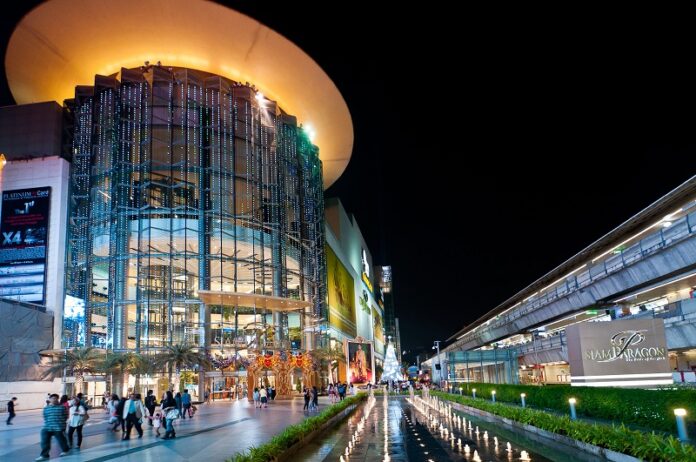
BANGKOK — A man who fell from an escalator to the ground floor of the Siam Paragon shopping mall Friday night died of his injuries after being rushed to the hospital.
Lt. Col. Thanawut Prasertnoo of Pathumwan police said Saturday the man, 44-year-old Samret Sangteerapeetikul, died during the night as he was being treated for severe injuries at the Police Hospital. They believe it was a suicide.
“At first we thought he had just slipped from the escalator,” Thanawut said. “But turns out, the doctors said he was suffering from depression.”
Samret was critically injured after falling from the second floor of the popular mall all the way to the basement-level Siam Ocean World floor. He suffered a broken arm, punctured lungs and other serious injuries in the fall.
“We believe he came alone to the mall,” Thanawut said.
At left, the Christmas display in front of Bangkok’s CentralWorld shopping mall on Dec 18, 2015. At right, the same plaza was mostly empty Friday night.
BANGKOK — Instead of the usual sparkling decor, shining lights and towering Christmas tree that last year was crowned Southeast Asia’s tallest, the plaza at CentralWorld in Bangkok was dark Friday night.
The end-year holiday season won’t be shimmery or white, as malls across the capital and nation forego their annual festive decorations in deference to mourning for His Majesty the Late King Bhumibol, who died in October.
“It’s unfortunate, but I can accept it because of the mourning,” said Charisara Advakultep, a third-year engineering student at Kasetsart University strolling through the empty plaza with classmate Natdanai Romin.
Nattakit Tangpoonsinthana, a marketing executive with Central Pattana, said its 29 Central shopping malls, including CentralWorld, would not set up their usual displays outside their properties.
“There will be smaller Christmas trees and decorations inside the mall, but not a large tree out front,” he said. To his knowledge it applied all of Central’s malls, including those in Pattaya and Phuket.
When asked whether the large trees would come back next year he said that the mall decorations, “would have to respond to the ongoing mourning.”
Although Thailand is overwhelmingly Buddhist, Christmas-style festivities have grown increasingly popular among consumers – and the merchants who enjoy the year-end boost. In recent years, major malls have been festooned with elaborate displays where people throng to pose for photos before heading inside to shop to the tunes of Christmas music.
A public relations officer at The Mall Group, who would not give his name because a final decision had not been reached, said their many malls such would instead erect displays related to His Late Majesty King Bhumibol, who died in October at 88.
“After mourning comes a time for doing good,” he said. “That’s why instead of a celebratory theme, we will be setting up decorations and displays based on the theme ‘Let’s Give Good,’ or on combining our powers to do good for the Father.”
The Mall Group’s holdings in Bangkok include Siam Paragon, Emporium and EmQuartier.
Back at CentralWorld, where Charisara said she usually comes to see the tree every year, Natdanai said understood the decision to skip it all this year.
“I don’t feel anything,” he said about the lack of a fake fir tree. “It’s something that should be understandable.”
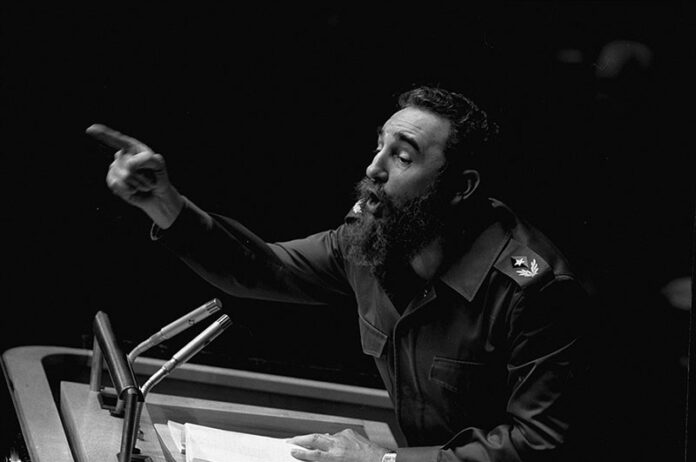
Cuban President Fidel Castro points during his lengthy speech before the United Nations General Assembly in New York on Oct. 12, 1979. Photo: Marty Lederhandler / Associated Press
HAVANA — Former President Fidel Castro, who led a rebel army to improbable victory in Cuba, embraced Soviet-style communism and defied the power of 10 U.S. presidents during his half century rule, has died at age 90.
Castro’s reign over the island-nation 90 miles from Florida was marked by the U.S.-backed Bay of Pigs invasion in 1961 and the Cuban Missile Crisis a year later that brought the world to the brink of nuclear war. The bearded revolutionary, who survived a crippling U.S. trade embargo as well as dozens, possibly hundreds, of assassination plots, died eight years after ill health forced him to formally hand power over to his younger brother Raul, who announced his death late Friday on state television.
Castro overcame imprisonment at the hands of dictator Fulgencio Batista, exile in Mexico and a disastrous start to his rebellion before triumphantly riding into Havana in January 1959 to become, at age 32, the youngest leader in Latin America. For decades, he served as an inspiration and source of support to revolutionaries from Latin America to Africa.
His commitment to socialism was unwavering, though his power finally began to fade in mid-2006 when a gastrointestinal ailment forced him to hand over the presidency to Raul in 2008, provisionally at first and then permanently. His defiant image lingered long after he gave up his trademark Cohiba cigars for health reasons and his tall frame grew stooped.
“Socialism or death” remained Castro’s rallying cry even as Western-style democracy swept the globe and other communist regimes in China and Vietnam embraced capitalism, leaving this island of 11 million people an economically crippled Marxist curiosity.
He survived long enough to see Raul Castro negotiate an opening with U.S. President Barack Obama on Dec. 17, 2014, when Washington and Havana announced they would move to restore diplomatic ties for the first time since they were severed in 1961. He cautiously blessed the historic deal with his lifelong enemy in a letter published after a month-long silence.
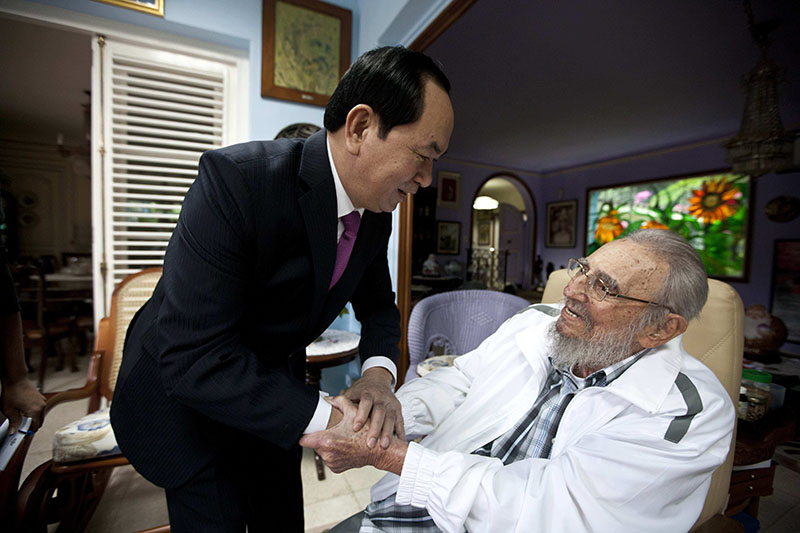
Cuba’s former leader Fidel Castro, right, shakes hands with Vietnamese President Tran Dai Quang, left, in Havana, Cuba, on Nov. 15. Photo: Alex Castro / Associated Press
Fidel Castro Ruz was born Aug. 13, 1926, in eastern Cuba’s sugar country, where his Spanish immigrant father worked first recruiting labor for U.S. sugar companies and later built up a prosperous plantation of his own.
Castro attended Jesuit schools, then the University of Havana, where he received law and social science degrees. His life as a rebel began in 1953 with a reckless attack on the Moncada military barracks in the eastern city of Santiago. Most of his comrades were killed and Fidel and his brother Raul went to prison.
Fidel turned his trial defense into a manifesto that he smuggled out of jail, famously declaring, “History will absolve me.”
Freed under a pardon, Castro fled to Mexico and organized a rebel band that returned in 1956, sailing across the Gulf of Mexico to Cuba on a yacht named Granma. After losing most of his group in a bungled landing, he rallied support in Cuba’s eastern Sierra Maestra mountains.
Three years later, tens of thousands spilled into the streets of Havana to celebrate Batista’s downfall and catch a glimpse of Castro as his rebel caravan arrived in the capital on Jan. 8, 1959.
The U.S. was among the first to formally recognize his government, cautiously trusting Castro’s early assurances he merely wanted to restore democracy, not install socialism.
Within months, Castro was imposing radical economic reforms. Members of the old government went before summary courts, and at least 582 were shot by firing squads over two years. Independent newspapers were closed and in the early years, homosexuals were herded into camps for “re-education.”
In 1964, Castro acknowledged holding 15,000 political prisoners. Hundreds of thousands of Cubans fled, including Castro’sdaughter Alina Fernandez Revuelta and his younger sister Juana.
Still, the revolution thrilled millions in Cuba and across Latin America who saw it as an example of how the seemingly arrogant Yankees could be defied. And many on the island were happy to see the seizure of property of the landed class, the expulsion of American gangsters and the closure of their casinos.
Castro’s speeches, lasting up to six hours, became the soundtrack of Cuban life and his 269-minute speech to the U.N. General Assembly in 1960 set the world body’s record for length that still stood more than five decades later.
As Castro moved into the Soviet bloc, Washington began working to oust him, cutting U.S. purchases of sugar, the island’s economic mainstay. Castro, in turn, confiscated $1 billion in U.S. assets.
The American government imposed a trade embargo, banning virtually all U.S. exports to the island except for food and medicine, and it severed diplomatic ties on Jan. 3, 1961.
On April 16 of that year, Castro declared his revolution to be socialist, and the next day, about 1,400 Cuban exiles stormed the beach at the Bay of Pigs on Cuba’s south coast. But the CIA-backed invasion failed.
The debacle forced the U.S. to give up on the idea of invading Cuba, but that didn’t stop Washington and Castro’s exiled enemies from trying to do him in. By Cuban count, he was the target of more than 630 assassination plots by militant Cuban exiles or the U.S. government.
The biggest crisis of the Cold War between Washington and Moscow exploded on Oct. 22, 1962, when President John F. Kennedy announced there were Soviet nuclear missiles in Cuba and imposed a naval blockade of the island. Humankind held its breath, and after a tense week of diplomacy, Soviet leader Nikita Krushchev removed them. Never had the world felt so close to nuclear war.
Castro cobbled revolutionary groups together into the new Cuban Communist Party, with him as first secretary. Labor unions lost the right to strike. The Catholic Church and other religious institutions were harassed. Neighborhood “revolutionary defense committees” kept an eye on everyone.
Castro exported revolution to Latin American countries in the 1960s, and dispatched Cuban troops to Africa to fight Western-backed regimes in the 1970s. Over the decades, he sent Cuban doctors abroad to tend to the poor, and gave sanctuary to fugitive Black Panther leaders from the U.S.
But the collapse of the Soviet bloc ended billions in preferential trade and subsidies for Cuba, sending its economy into a tailspin. Castro briefly experimented with an opening to foreign capitalists and limited private enterprise.
As the end of the Cold War eased global tensions, many Latin American and European countries re-established relations with Cuba. In January 1998, Pope John Paul II visited a nation that had been officially atheist until the early 1990s.
Aided by a tourism boom, the economy slowly recovered and Castro steadily reasserted government control, stifling much of the limited free enterprise tolerated during harder times.
As flamboyant as he was in public, Castro tried to lead a discreet private life. He and his first wife, Mirta Diaz Balart, had one son before divorcing in 1956. Then, for more than four decades, Castro had a relationship with Dalia Soto del Valle. They had five sons together and were said to have married quietly in 1980.
By the time Castro resigned 49 years after his triumphant arrival in Havana, he was the world’s longest ruling head of government, aside from monarchs.
In retirement, Castro voiced unwavering support as Raul slowly but deliberately enacted sweeping changes to the Marxist system he had built.
His longevity allowed the younger brother to consolidate control, perhaps lengthening the revolution well past both men’s lives. In February 2013, Raul announced that he would retire as president in 2018 and named newly minted Vice President Miguel Diaz-Canel as his successor.
“I’ll be 90 years old soon,” Castro said at an April 2016 communist party congress where he made his most extensive public appearance in years. “Soon I’ll be like all the others. The time will come for all of us, but the ideas of the Cuban Communists will remain as proof that on this planet, if one works with fervor and dignity, they can produce the material and cultural goods that human beings need and that need to be fought for without ever giving up.”
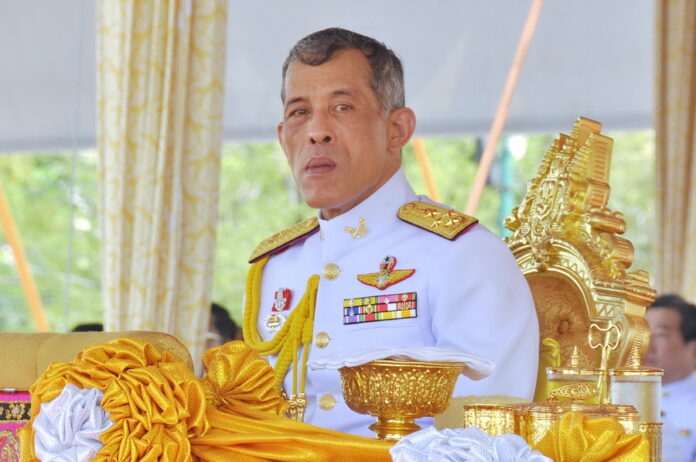
Crown Prince Vajiralongkorn presides over the royal ploughing ceremony May 9, 2016 in Bangkok. Image: Royal Household Bureau
BANGKOK — The prolonged interregnum following the death of His Majesty the Late King will shortly come to an end, junta chairman Prayuth Chan-ocha said at a business conference Friday.
His remark is the highest-profile confirmation of the imminent ascension to the throne by Crown Prince Vajiralongkorn, 64, who had declined to immediately succeed his father King Bhumibol upon his death on Oct. 13. Gen. Prayuth also spoke on the same day the interim parliament called an urgent meeting for Tuesday, believed to be a formal endorsement of the prince’s kingship.
“Please do not be worried about the situation in Thailand,” Gen. Prayuth said in a keynote address to the Joint Foreign Chamber of Commerce of Thailand. “Everything is stable. And in a short time, we shall have a new King.”
Crown Prince Vajiralongkorn surprised many when he delayed his ascension to the throne after King Bhumibol died at 88 nearly a month and a half ago. The prince said he needed time to grieve for his father before he could ascend to the throne, government leaders said.
Earlier on Friday the National Legislative Assembly, which serves a rubber-stamp parliament under the junta, announced that it would convene Tuesday for an undisclosed agenda, reportedly on the military government’s order. The meeting is believed to be related to the royal succession. According to the constitution, the succession will be completed after the Crown Prince tells the parliament chairman of his intention to ascend the throne, and the latter will in turn informs members of parliament.
Tuesday’s meeting will start at 11am and will be broadcast live on television.
BANGKOK— A 44-year-old man fell from an escalator to the basement-level floor of the Siam Paragon shopping mall Friday night.
At about 8:40pm Friday, Samret Sangteerapeetikul fell from the third floor of the popular mall. He was critically injured and was taken for treatment at the Police Hospital.
Police were investigating and questioning witnesses.