32.3 C
Bangkok
Monday, June 8, 2026
Home Blog Page 2555

Vintage Mad Scientist Collects Faces This Weekend at Alt Cinema

‘Eyes Without a Face’ (1960)

BANGKOK — Halloween is just around the corner, so get a headless start this weekend by enjoying some chilling madness in a classic French-Italian horror film at Bangkok’s new alternative cinema.

“Eyes Without a Face” (Les Yeux Sans Visage) is set in the French countryside where an obsessive surgeon kidnaps young girls in an attempt to restore the beauty of his disfigured daughter.

Although the 1960 film eked past European censors, it faced controversy at the time for its abundant blood and gore.

The 90-minute film will be screened in the original French with English and Thai subtitles at 9pm on Saturday and Sunday at the Bangkok Screening Room. Tickets are available online for 300 baht for adults and 250 baht for students.

The Bangkok Screening Room is located on the second floor above a 7-Eleven on Soi Saladaeng 1, which is walkable from MRT Lumphini’s exit No. 2 or BTS Sala Daeng’s exit No. 4.

Related stories:

Opening Weekend For Bangkok’s New Alt Cinema

Finally, an Alternative Cinema to Open in Bangkok

Advertisement

Group: Russia, Saudi Don’t Belong on UN Human Rights Council

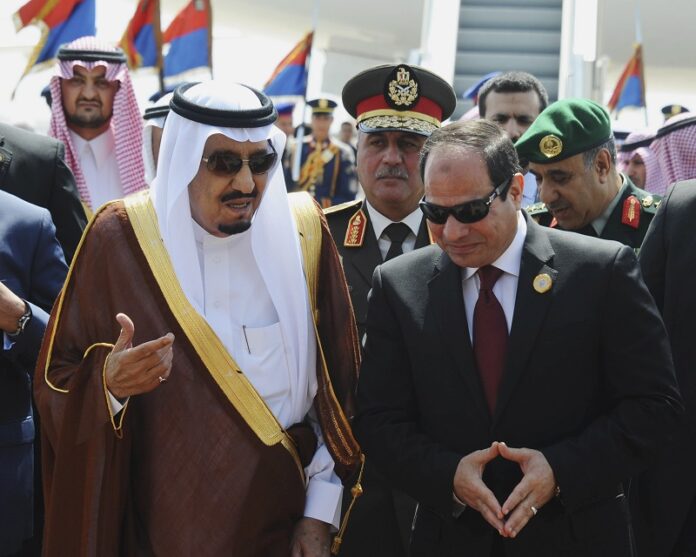
Egyptian President Abdel-Fattah el-Sissi, right, talks with Saudi King Salman in 2016 after the monarch arrived in Sharm el-Sheikh, Egypt. Photo: Associated Press

UNITED NATIONS — Human Rights Watch says Saudi Arabia and Russia’s candidacies for the U.N.’s top human rights body are compromised by their actions in Yemen and Syria respectively, where they have been accused of unlawful attacks on civilians.

In a statement issued Tuesday, the group said the two countries’ membership bids risked undermining the credibility of the U.N. Human Rights Council and its ability to hold rights abusers accountable.

The group also flagged the candidacies of China and Egypt for their poor human rights records.

The General Assembly will hold elections for the 47-nation council on Oct. 28.

Advertisement

The Wetness: Tuesday Morning More Hustle Than Bustle as Streets Flood

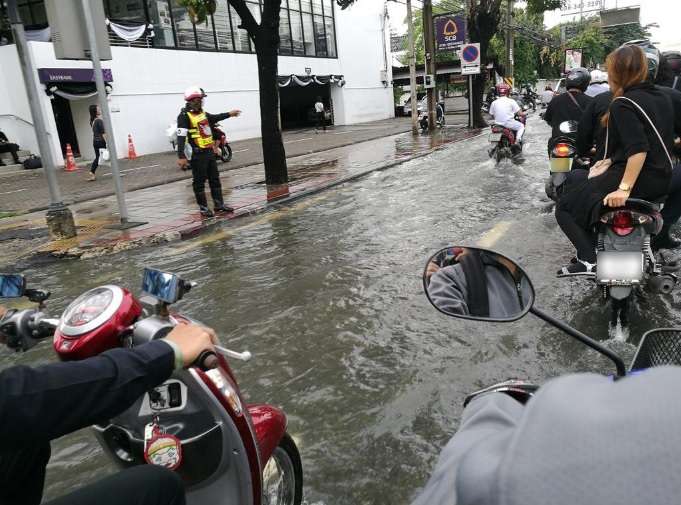
Motorcycles make waves Tuesday morning on Phahon Yothin Road near the Bang Khen roundabout in Bangkok.

BANGKOK — Tuesday’s return to work was more sluggish than usual as a powerful night’s storm left parts of the capital flooded, with more to come as rain is expected to fall throughout the country through Wednesday.

Two locations that flooded Tuesday morning were the Bang Khen roundabout on Phahon Yothin Road and Vibhavadi Rangsit Road’s Laksi Intersection.

The skies over the capital will be overcast today, heavy rain expected to hit 60 percent of metro Bangkok.

Ongoing downpours and scattered heavy rains are predicted during the next 24 hours in the north, northeastern, central, and southern regions. Waves in the Andaman Sea will reach up to two meters, so small craft advisories have been issued.

Nationwide, rains are due to high-pressure air from the South China Sea, causing precipitation over the northern, central and northeastern regions. Rains in the south are being caused by monsoons from the Andaman Sea.

Advertisement

Hong Kong Court Sees Chilling Video Describing Torture

Taken through a tinted glass, Rurik Jutting, a British banker, sitting in a prison bus arrives at a court in 2014 in Hong Kong. Photo: Vincent Yu / Associated Press

HONG KONG — A jury in Hong Kong watched chilling video Tuesday of a British banker describing how he tortured and killed an Indonesian woman he met in a bar, saying he repeatedly raped her and “tortured her badly.”

In the video he shot, Rurik Jutting, a Cambridge University graduate on trial in Hong Kong’s High Court for the murder of two Indonesian women, can be seen shirtless in his apartment.

“My name is Rurik Jutting. About five minutes ago I just killed, murdered, this woman here,” he says into the camera. He also pointed the camera down briefly to show the body of Sumarti Ningsih, 23, lying face down in a bathroom.

Moments later he holds up his hand, which can be seen shaking.

“It’s Monday night. I’ve held her captive since early Saturday, I’ve raped her repeatedly, I tortured her, tortured her badly.”

He rambles on to the camera in several video clips, talking about doing cocaine and using prostitutes, in Hong Kong and the Philippines.

Jutting, 31, watched the video from the glass-screened dock, at times looking down at a transcript of the video in front of him. He wore a pale blue shirt and appeared much slimmer than court appearances last year.

The graphic video was shown on the second day of Jutting’s trial for murdering Sumarti and Seneng Mujiasih, 26.

Their bodies were found in his upscale apartment near the Asian financial center’s Wan Chai red-light district in 2014 in a case that shocked the city, which has a reputation for being safe but also has extreme inequality among its foreign workers. The former British colony has a sizable white-collar expatriate elite alongside more than 300,000 migrant domestic workers, almost all of them women from Indonesia or the Philippines.

Earlier, the jurors were played about 20 minutes of video in which Jutting is apparently torturing Sumarti. The media and public could not view it, but were able to hear the audio.

At one point he can be heard saying: “If you scream I will punish you. Understand?”

That is followed by the sound of smacking and slapping.

Jutting, who worked in the Hong Kong office of Bank of America-Merrill Lynch in structured equity finance and trading, pleaded not guilty Monday to two murder charges, with prosecutors rejecting his attempt to plead guilty to the lesser charge of manslaughter. If convicted, he faces life in prison.

At the start of the trial, Judge Michael Stuart-Moore warned jurors that the evidence would include “extremely upsetting” photo and video evidence.

Prosecutor John Reading said in his opening remarks that Sumarti, who was in Hong Kong on a tourist visa, had gone to Jutting’s apartment when the banker offered her “a large sum of money,”

After she died, Jutting put her remains in a suitcase he left on the balcony.

Seneng was officially in Hong Kong as a foreign maid but was working at a bar where Jutting met her and offered her money for sex, Reading said, according to facts agreed on by both sides. In the banker’s apartment, Seneng started shouting when she saw a rope gag near the sofa, and Jutting grabbed her and cut her throat with a knife hidden under a cushion, the prosecutor said.

Jutting apparently started hallucinating after using cocaine, and he called police himself. Officers who arrived found Seneng’s body and arrested Jutting. Sumarti’s remains were found a few hours later. In interviews, Jutting told police everything that happened as well as discussing his drug use, Reading said, adding that traces of cocaine were detected in more than two dozen small plastic bags found in the apartment.

Story: Kelvin Chan

Advertisement

48 Police Trainees Killed in Attack, Pakistani Officials Say

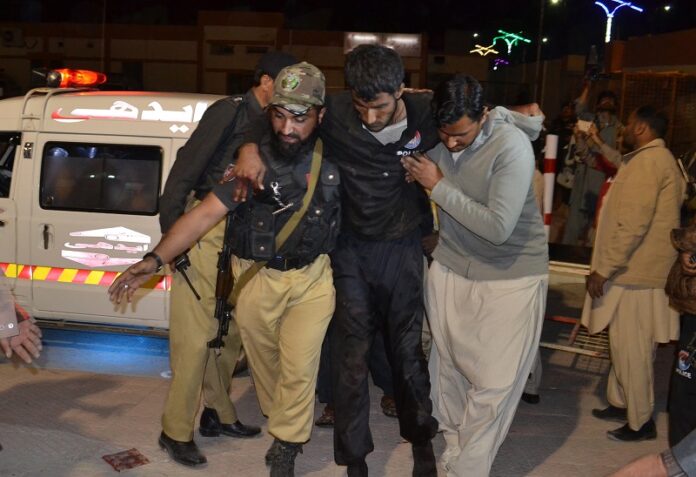
A Pakistani volunteer and a police officer rush an injured person to a hospital on Monday in Quetta, Pakistan after two separate attacks in Pakistan. Photo: Arshad Butt / Associated Press

QUETTA, Pakistan — Gunmen stormed a police training center late Monday in Pakistan’s restive Baluchistan province and detonated explosive vests, killing at least 48 police trainees, authorities said.

Baluchistan’s top health official, Noorul Haq, said at least 116 people were wounded — mostly police trainees and some paramilitary troops.

A security official put the death toll at 51. He spoke on condition of anonymity because he was not authorized to speak to media,

Major General Sher Afgan, chief of the paramilitary Frontier Corps, told reporters Tuesday that the attackers appeared to be in contact with handlers in Afghanistan. He said the attackers belonged to the banned Lashker-e-Jhangvi Al-Almi group, an Islamic militant group affiliated with al-Qaida.

Neither Lashker-a-Jhangvi nor any other group has claimed responsibility for the attack. But the Islamic State group and breakaway Taliban faction Jamaat-ul Ahrar have claimed responsibility for past attacks in Baluchistan. Lashker-e-Jhangvi has mainly targeted members of minority Shiite sect of Muslims.

The attack started when between four and six gunmen opened fire as they rushed the hostel at the police training center in a suburban area of the provincial capital of Quetta.

“They were rushing toward our building firing shots so we rushed for safety toward the roof and jumped down in the back to save our lives,” one of the police trainees told Geo television.

Security was tight Tuesday morning around the training center and hospitals.

Haq, the top health official, said many of the trainees were killed when the gunmen detonated explosive vests. He said the death toll was expected to climb as many of the injured were in critical condition.

General Afgan said the attackers may have had inside help, although he did not give details. “This is an open war and when you have enemy inside and outside, they can easily exploit the situation,” he said.

He said the security forces and police were clearing the area and searching for any possible hidden attackers.

Baluchistan has been the scene of a low-intensity insurgency by Baluch separatist groups for more than a decade. Islamic militants also have a presence in the province that borders Afghanistan.

The provincial home minister, Sarfaraz Bugti, said one attacker was killed by security forces and two died when they detonated their explosive vests.

He said that about 700 trainees were at the base when it was attacked.

Baluchistan police chief Ahsan Mahboob told reporters that four gunmen attacked the training center, attempting to enter the hostel housing the trainees. A gun battle erupted when the guards resisted, he said.

A statement issued by the military put the number of attackers at up to six.

Footage shot by local television showed ambulances rushing out of the main entrance of the training center as fire engines rushed to put out fires set off when the gunmen threw incendiary devices.

Most of those being treated at city hospitals had gunshot wounds, although some sustained injuries jumping off the roof of the hostel and climbing a wall to escape the gunmen. Nearly all of the wounded were police, authorities said.

Local television reported that two explosions were heard, but it was not immediately clear what caused them.

Violence is common in the province, and the attack came hours after gunmen shot and killed two customs officers and wounded a third near the town of Surab, about 90 miles (145 kilometers) south of Quetta.

Earlier Monday, two gunmen on a motorcycle killed a police intelligence officer in the country’s northwestern Khyber Pakhtunkhwa province, said Khalid Khan, a local police officer.

The Pakistani Taliban claimed responsibility for that attack. The group’s spokesman, Muhammad Khurasani, said in a statement that the shooters returned to their hideout after the attack.

Pakistan has carried out military operations against militants in tribal areas near Afghanistan and in cities across Pakistan, but extremists are still capable of staging regular attacks.

Story: Abdul Sattar

Advertisement

The World Economy Without China

Chinese shoppers stand near a sale advertisement on July 10, 2016, at a shopping area in Beijing. Photo: Ng Han Guan / Associated Press

NEW HAVEN – Is the Chinese economy about to implode? With its debt overhangs and property bubbles, its zombie state-owned enterprises and struggling banks, China is increasingly portrayed as the next disaster in a crisis-prone world.

I remain convinced that such fears are overblown, and that China has the strategy, wherewithal, and commitment to achieve a dramatic structural transformation into a services-based consumer society while successfully dodging daunting cyclical headwinds. But I certainly recognize that this is now a minority opinion.

For example, U.S. Treasury Secretary Jacob J. Lew continues to express the rather puzzling view that the United States “can’t be the only engine in the world economy.” Actually, it’s not: The Chinese economy is on track to contribute well over four times as much to global growth as the US this year. But maybe Lew is already assuming the worst for China in his assessment of the world economy.

So what if the China doubters are right? What if China’s economy does indeed come crashing down, with its growth rate plunging into low single digits, or even negative territory, as would be the case in most crisis economies? China would suffer, of course, but so would an already-shaky global economy. With all the hand-wringing over the Chinese economy, it’s worth considering this thought experiment in detail.

For starters, without China, the world economy would already be in recession. China’s growth rate this year appears set to hit 6.7 percent – considerably higher than most forecasters have been expecting. According to the International Monetary Fund – the official arbiter of global economic metrics – the Chinese economy accounts for 17.3 percent of world GDP (measured on a purchasing-power-parity basis). A 6.7 percent increase in Chinese real GDP thus translates into about 1.2 percentage points of world growth. Absent China, that contribution would need to be subtracted from the IMF’s downwardly revised 3.1 percent estimate for world GDP growth in 2016, dragging it down to 1.9% – well below the 2.5 percent threshold commonly associated with global recessions.

Of course, that’s just the direct effect of a world without China. Then there are cross-border linkages with other major economies.

The so-called resource economies – namely, Australia, New Zealand, Canada, Russia, and Brazil – would be hit especially hard. As a resource-intensive growth juggernaut, China has transformed these economies, which collectively account for nearly 9 percent of world GDP. While all of them argue that they have diversified economic structures that are not overly dependent on Chinese commodity demand, currency markets say otherwise: whenever China’s growth expectations are revised – upward or downward – their exchange rates move in tandem. The IMF currently projects that these five economies will contract by a combined 0.7 percent in 2016, reflecting ongoing recessions in Russia and Brazil and modest growth in the other three. Needless to say, in a China implosion scenario, this baseline estimate would be revised downward significantly.

The same would be the case for China’s Asian trading partners – most of which remain export-dependent economies, with the Chinese market their largest source of external demand. That is true not only of smaller Asian developing economies such as Indonesia, the Philippines, and Thailand, but also of the larger and more developed economies in the region, such as Japan, Korea, and Taiwan. Collectively, these six China-dependent Asian economies make up another 11% of world GDP. A China implosion could easily knock at least one percentage point off their combined growth rate.

The United States is also a case in point. China is America’s third-largest and most rapidly growing export market. In a China-implosion scenario, that export demand would all but dry up – knocking approximately 0.2-0.3 percentage points off already subpar US economic growth of around 1.6 percent in 2016.

Finally, there is Europe to consider. Growth in Germany, long the engine of an otherwise sclerotic Continental economy, remains heavily dependent on exports. That is due increasingly to the importance of China – now Germany’s third-largest export market, after the European Union and the United States. In a China implosion scenario, German economic growth could also be significantly lower, dragging down the rest of a German-led Europe.

Interestingly, in its just-released October update of the World Economic Outlook, the IMF devotes an entire chapter to what it calls a China spillover analysis – a model-based assessment of the global impacts of a China slowdown. Consistent with the arguments above, the IMF focuses on linkages to commodity exporters, Asian exporters, and what they call “systemic advanced economies” (Germany, Japan, and the US) that would be most exposed to a Chinese downturn. By their reckoning, the impact on Asia would be the largest, followed closely by the resource economies; the sensitivity of the three developed economies is estimated to be about half that of China’s non-Japan Asian trading partners.

The IMF research suggests that China’s global spillovers would add about another 25% to the direct effects of China’s growth shortfall. That means that if Chinese economic growth vanished into thin air, in accordance with our thought experiment, the sum of the direct effects (1.2 percentage points of global growth) and indirect spillovers (roughly another 0.3 percentage points) would essentially halve the current baseline estimate of 2016 global growth, from 3.1 percent to 1.6 percent. While that would be far short of the record 0.1 percent global contraction in 2009, it wouldn’t be much different than two earlier deep world recessions, in 1975 (1 percent growth) and 1982 (0.7 percent).

I may be one of the only China optimists left. While I am hardly upbeat about prospects for the global economy, I think the world faces far bigger problems than a major meltdown in China. Yet I would be the first to concede that a post-crisis world economy without Chinese growth would be in grave difficulty. China bears need to be careful what they wish for.
Stephen S. Roach, a faculty member at Yale University and a former chairman of Morgan Stanley Asia, is the author of “Unbalanced: The Codependency of America and China.”

Copyright: Project Syndicate, 2016.

Advertisement

Politicos and Activists Agree to Pause Politics – For Now

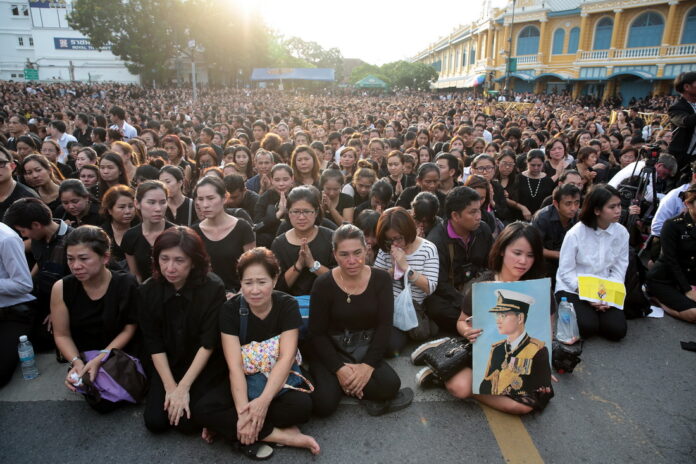
A crowd of black-clad mourners Friday outside the Grand Palace in Bangkok.

BANGKOK — Sirawith Seritiwat, a prominent student activist and persistent junta critic, said it wasn’t long after the Oct. 13 death of His Majesty the Late King that soldiers rang him up to ask whether he would engage in any political activities and urge him not to make any moves during the mourning period.

Sirawith, like a number of politicians and political activists, said Monday they would abstain from politics while the nation mourns the late King but any expectation it continue for a year was neither practical nor fair.

“I am willing to stop for one month, but one year would be too lengthy for anyone to cite the King as an excuse,” said Sirawith, who is better known by his nickname Ja New.

Reactions by those from across the political divide came after junta leader Gen. Prayuth Chan-ocha said Friday he wants no politics during the mourning period. While not specifying a time frame, Prayuth earlier declared the state would mourn for one year while the general public was requested to do so for a month.

Former Democrat Party MP Kraisak Choonhavan said the parties would need to get to work before that.

“Elections may be postponed, but political parties should be allowed to meet to prepare for elections, so they can choose appropriate people to run and prepare their policies and see how they can survive,” said Kraisak, a senior member of his party. “The government got a constitution through a referendum that hugely benefited the army and junta, so it should only be fair to political parties as well… I hope they have adequate decency on the matter.”

Phongthep Thepkanjana, a former deputy prime minister from rival Pheu Thai Party said Prayuth should recognize that running any government is itself a political act.

“Thus, if this is what Prayuth desires, he should stop running the government. Perhaps what he understands [as politics] differs from what we understand?” Phongthep said.

He said any request beyond a short period of mourning would be impractical, adding that many politicians, including former premier Yingluck Shinawatra, are already limiting any political remarks during this mourning period.

Prayuth was speaking at a government conference Friday when he made his desire clear.

“The media should not write about politics these days, because we don’t have politics these days. Write only about what work the government is doing, as guided by the wisdom of his Majesty, to fit with the situation. Please, don’t start any fights. Give us some time. Give some time for peace,” Prayuth said at the Muang Thong Thani exhibition hall.

Kraisak said it wasn’t a clearly defined area.

“It’s very difficult, the matter is very difficult. What is politics to Prayuth?” asked the veteran politician. “Prayuth should not see these matters as politics.”

The president of the Thai Journalists Association, Wanchai Wongmeechai, said the request to not write about politics was understandable, given the circumstances. He noted it was not an order, and the Thai media were already complying.

“The press understands the situation and what is appropriate now. In fact, regarding political news, even sources may now not want to speak,” he said, without specifying how long the arrangement should last.

Kraisak the Democrat said there were active issues going on that were unlikely to go quiet for long.

He pointed to grassroots campaigns opposing mega-projects initiated by the regime that won’t be able to remain silent for a year.

A student political activist leader said they would refrain from public protests for a month to observe mourning.

“Our stance is that politics should not grind to a halt in order to observe mourning,” said Rangsiman Rome, a leader of the New Democracy Movement. “Politics goes on because people have to defend their interests.”

So how long should be adequate? Kraisak suggested somewhere between a month and a year.

“One year is too long. One month may be too long for the young [activists],” he said. “I think 100 days is appropriate.”

His party has not met to discuss the matter, Kraisak said, as such gatherings remain banned under the junta’s prohibition on political gatherings.

Rangsiman said he recognized the time was not now, saying that although his group had not met to discuss the matter, the consensus seemed to be that one month would be appropriate.

“We won’t fix an exact time, however,” he said. “But one month should suffice.”

Either way, some public activism is likely to resume in three-weeks time.

Chotisak Onsoong is one of the leaders of relatively new group of anti-junta activists called the People’s Party for Freedom. He said they would hold a discussion on the new constitution’s provisions for religion on Nov. 18.

Chotisak said some speakers may think that’s too early, but he was confident that there would be other takers.

“Why should we wait? I don’t see the benefits of pausing. Life goes on. It’s not like we’re organizing an event where people [are mourning]. Those who grieve can grieve, but life goes on,” Chotisak said.


Advertisement

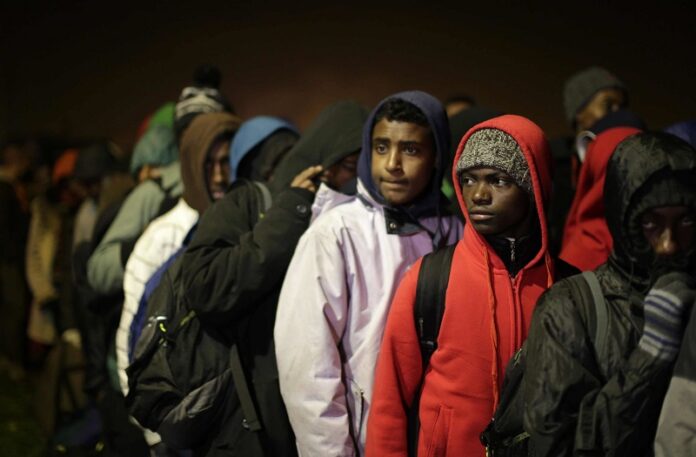
France Moving More Than 6,000 Migrants, Destroying Huge Camp

Migrants line-up to register at a processing centre Monday in the makeshift migrant camp known as "the jungle" near Calais, northern France. Photo: Emilio Morenatti / Associated Press

CALAIS, France — Lines of migrants with their lives in small bags walked to a registration center in the French port city of Calais Monday, the first day of the mass evacuation and destruction of the filthy camp they called home.

French authorities are beginning a complex operation, unprecedented in Europe, to shut down the makeshift camp, uprooting thousands who made treacherous journeys to escape wars, dictators or grinding poverty and dreamed of making a life in Britain.

Under the eye of more than 1,200 police, the first of hundreds of buses were arriving to begin transferring migrants to reception centers around France where they can apply for asylum, and level the camp in a weeklong operation. Hotels and even castles are among the hundreds of centers officials have been converting to migrant housing ahead of the big move.

Unaccompanied minors, many with family members in Britain, were to be housed on-site in containers set up earlier this year as their files are studied in London to see if they qualify for a transfer across the English Channel. The humanitarian organization France Terre d’Asile, says 1,291 unaccompanied minors live in the camp.

Authorities say the camp, known as the jungle, holds nearly 6,500 migrants who are seeking to get to Britain. Fourteen migrants have died this year in the Calais area.

Officials were expected to begin dismantling hundreds of tents and shelters as their occupants depart, gradually closing down the camp that sprung up behind an official shelter housing women and providing showers and daily meals.

Story: Elaine Ganley

Advertisement

Fining Yingluck for Rice Subsidy in ‘Grey Area,’ Critic of Policy Says

Former PM Yingluck Shinawatra on Jan. 15 receives a bundle of rice from her supporters outside court just before her trial on charges of negligence commences.

BANGKOK — The military government’s decision to fine Yingluck Shinawatra for 35 billion baht over her rice subsidy program lacks clear legal grounding, a prominent critic of the former prime minister’s policy said Monday.

Economist Viroj NaRanong said in an interview the punishment, under which she must pay an amount equal to USD$1 billion from her own pocket for the program’s losses, appeared disproportional.

“If there is clear evidence of who in the government defrauded the rice mortgage policy, action must be taken,” said Viroj, an economist at an independent policy think tank and opponent of the rice subsidy. “But the word being used here is negligence, so it’s starting to enter a grey area.”

In its Friday order, the government indicated it was not seeking to fine the former prime minister, whose government was toppled in 2014, on the grounds of corruption but on her failure to acknowledge and stop widespread corruption in the program.

Yingluck’s party, Pheu Thai, has decried the fine as politically motivated.

Findings by the regime that replaced Yingluck’s elected government ruled the agricultural subsidy, under which the state paid farmers premium prices for their rice, cost about 178 billion baht due to corruption and mismanagement. The former leader had to take responsibility by paying 20 percent of the damages, or 35 billion baht, Deputy Prime Minister Wissanu Krea-ngam said last month.

But fining Yingluck on the grounds of negligence would require authorities to first prove she conspired with the people engaged in the corruption, said Viroj, a member of Thailand Development Research Institute who’s published articles about the rice policy .

“If there was no conspiracy, it should end with her taking responsibility politically, not legally,” the economist said.

Yingluck said upon being notified Friday that she would use all legal means to overturn the decision. The leader of her Pheu Thai Party said Sunday the military regime was applying a new standard on Yingluck.

“In the past, there were many public policies that used state funds to solve problems, but no former prime minister had to take responsibility for them, even in clear cases of losses of state funds,” Pheu Thai Secretary General Phumtham Wechayachai wrote on Facebook. “What’s also important: Does a government from a coup have legitimacy to demand accountability from the government that it seized power from?”

Apart from the fine, Yingluck is also being tried on charges of negligence. She faces up to 10 years in jail if convicted.

Viroj said it’s rare for the government to fine senior officials for losses of state funds because of their negligence.

In fact, he said he could name only one case: a 2005 court order that former Bank of Thailand president Rerngchai Marakanond pay 180 billion baht for his decision to float the baht in 1997, which contributed to the Asian financial crisis and collapse of Thailand’s financial sector.

Earlier this month, on Oct. 5, the Supreme Court acquitted Rerngchai after a 15-year legal battle.

In an interview Monday, Viroj maintained his belief that Yingluck’s rice policy was destructive to the economy and rife with corruption, but he said authorities need a watertight case of legal evidence to prove her intent before punishing her for negligence.

“Some people said the government was warned many times already that it was a bad idea, but they neglected to hear the warnings. But I don’t think that’s sufficient grounds [for the charge of conspiracy],” Viroj said. “Suppose they believed out of their honest intentions it was a good idea? I still criticize them. But if someone were to hold them legally responsible, I think it’s not fair.”

He compared it to the 2015 indictment of commerce minister Boonsong Teriyapirom for damages stemming from the same policy; in Boonsong’s case, the indictment was for corruption, which was more clear-cut than an elusive conviction for negligence.

Yingluck’s next court hearing is set for Nov. 4.

Correction: An earlier version of this story incorrectly quoted Viroj as saying there was insufficient cause for the charge of negligence, when in fact he meant a count of conspiracy.

Advertisement

Bill Murray Accepts Humor Prize After Gentle Roast

Bill Murray accepts the 19th Annual Mark Twain Prize for American Humor on Sunday in Washington. Photo: Owen Sweeney/ AP.

WASHINGTON — In an evening filled with jokes about Bill Murray’s elusiveness and quirky personality, it was David Letterman who provided the most touching moment as Murray was honored with the nation’s top prize for comedy.

Murray, 66, received the Mark Twain Prize for American Humor on Sunday night at the Kennedy Center, joining several other “Saturday Night Live” alumni to win the annual award. After he was presented with a bust of Mark Twain, Murray handed it to a man in the first row of the audience and urged the crowd to pass it around.

Known for living outside the Hollywood bubble, Murray admitted he was uncomfortable sitting in a box with his family while more than a dozen of his co-stars and collaborators spoke warmly about his body of work.

“It’s really hard to listen to all those people be nice to you for two days,” Murray said. “You just get real suspicious.”

His acceptance speech followed a heartfelt tribute by the bearded Letterman, who made a rare public appearance since his late-night show ended last June. Murray was a guest on Letterman’s shows 44 times over the years, and the two grew close, even spending time together at Letterman’s vacation home in Montana.

After an appearance in 2003, Letterman told Murray that his then-infant son would be christened that weekend. An hour later, Letterman said, a package was delivered to his office containing a handmade Irish linen christening gown.

“That Saturday, my son, in Bill Murray’s christening gown, was christened at St. Ignatius in Manhattan, and we have this memory, we have this gift, we have this gesture for the rest of our lives,” Letterman said.

There were plenty of laughs at Murray’s expense in evening that took on the tone of a gentle roast. Jimmy Kimmel, Aziz Ansari, Sigourney Weaver and Steve Martin were among those who ribbed Murray for being aloof, unpredictable and difficult to reach — and somehow still lovable.

“I think you and I are about as close as two people can be, considering that one of them is you,” Martin said in a video tribute.

The show, which was taped for broadcast Friday on PBS, had one major stumble, courtesy of Miley Cyrus, who cursed repeatedly and made an excuse about smoking too many cigarettes after she botched the lyrics to a version of “My Way.” Despite not having a microphone, Murray came to her rescue, joking with the crowd from his seat as Cyrus and the crew set up for a second attempt at the song, which went more smoothly.

After getting his break on “Saturday Night Live,” Murray went on to star in some of the most successful comedies of the 1980s and 1990s before transitioning into more dramatic roles. He was nominated for an Oscar for his soulful turn as a washed-up actor in Sofia Coppola’s “Lost in Translation.”

He’s become a folk hero in the social-media era by turning up unannounced at wedding receptions, kickball games and house parties. He’s also a regular at Chicago Cubs games and celebrity golf tournaments.

This weekend, he got to meet President Barack Obama. And what did the two men talk about? “Putting,” Murray said before the show.

Murray lives in South Carolina, doesn’t have an agent or a publicist and rarely does in-depth videos. He famously forces people offering him scripts to call an 800 number and leave a voicemail. He said he would have been happy to skip the festivities surrounding the prize, especially if his beloved Chicago Cubs hadn’t already advanced to the World Series.

“If this could all have been done in a letter that I received, that would have been enough,” Murray told The Associated Press on the red carpet. “It’s hard to stand still for this. It’s a squirm-a-thon for me.”

The prize was first awarded in 1998 and goes to those who influence society in the tradition of Samuel Clemens, the writer, satirist and social commentator better known as Mark Twain. Other “Saturday Night Live” alumni who’ve received it include Tina Fey, Will Ferrell and last year’s winner, Eddie Murphy.

In his speech, Murray — the fifth of nine children — also paid tribute to his older brother, Brian Doyle-Murray, who helped him get his start in improvisational theater. His brother had to be the breadwinner for the family after their father died, and Murray said it took courage for Brian to pursue his dreams.

“My brother had more guts than anyone I ever knew, and the only reason I’m here tonight is because of the guts of my brother Brian,” Murray said. “He’s been waiting a long time to hear that.”

Story: Ben Nuckols


Advertisement

Hot News

LATEST NEWS

Bangkok
overcast clouds
32.3 ° C
33.3 °
30 °
80 %
5kmh
100 %
Mon
32 °
Tue
37 °
Wed
35 °
Thu
34 °
Fri
32 °