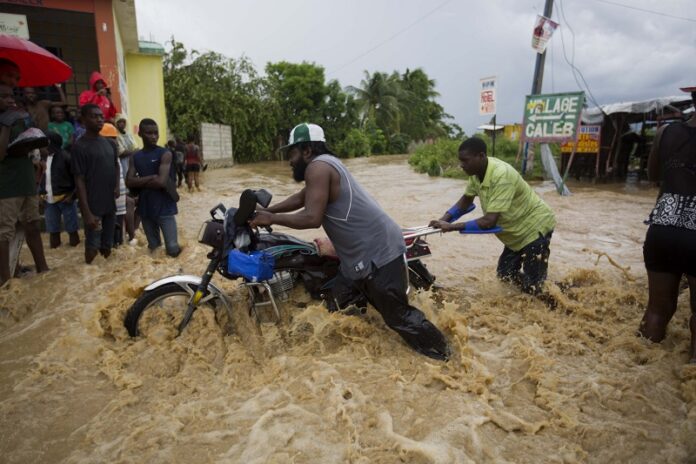
Men push a motorbike through a street flooded by a river that overflowed from heavy rains caused by Hurricane Matthew Wednesday in Leogane, Haiti. Photo: Dieu Nalio Chery / Associated Press
LES CAYES, Haiti — Two days after Hurricane Matthew rampaged across Haiti’s remote southwestern peninsula with roaring winds and flooding rains, local authorities and international aid workers still lack a clear picture of the storm’s destruction.
But the weather began calming Wednesday and a way was found around a key bridge that was washed away, allowing convoys and helicopters to start ventruing to marooned corners to assess the damage and determine how to help thousands of people who lost homes, livestock and crops.
The death toll was raised to 10 by Haiti’s civil protection agency Wednesday evening, but the number was expected to tick upward as more hard-hit rural areas are reached Thursday and people tell their stories.
In Aquin, a south coast town outside the battered city of Les Cayes, people trudged through the mud around the wreckage of clapboard houses and tiny shops.
Cenita Leconte was one of many coastal residents who initially ignored official calls to evacuate vulnerable shacks before Matthew roared ashore at dawn Tuesday as a Category 4 hurricane. The 75-year-old is thankful she finally complied and made it through the terrifying ordeal with her life.
“We’ve lost everything we own. But it would have been our fault if we stayed here and died,” she told The Associated Press as neighbors poked through wreckage hoping to find at least some of their meager possessions.
Marie Alta Jean-Baptiste, head of the civil protection agency, said authorities were starting to get a better view of the situation in the Grande Anse department, where the storm made roads impassable and knocked out communications.
“We do know there’s a lot of damage in the Grand Anse, and we also know human life has been lost there,” Jean-Baptiste said, adding that the official death toll did not yet include reports from that severely raked area.
Civil aviation authorities reported counting 3,214 destroyed homes along the southern peninsula, where many families live in shacks with sheet metal roofs and don’t always have the resources to escape harm’s way.
The government has estimated at least 350,000 people need some kind of assistance after the disaster, which U.N. Deputy Special Representative for Haiti Mourad Wahba has called the country’s worst humanitarian crisis since the devastating earthquake of 2010.
International aid groups are already appealing for donations to sustain a lengthy recovery effort in Haiti, the hemisphere’s least developed and most aid-dependent nation.
In coming days, U.S. military personnel equipped with nine helicopters were expected to start arriving in the capital to help deliver food and water to hard-hit areas.
Jean-Michel Vigreux, the country director in Haiti for the non-profit group CARE, said the lack of communication with people in the Grande Anse region was deeply worrisome.
“We don’t know the exact impact yet. We currently aren’t able to communicate with our team in one region, Grande Anse. It is very scary,” he said.
As answers were slow to come, some Haitians were convinced their troubled homeland was largely spared the kind of human suffering that severe weather has wrought in the past.
“It seems like Haiti dodged a bullet. The news on the radio doesn’t seem nearly as bad as it could have been,” upholsterer Daniel Wesley said as he walked down a rain-slicked street in downtown Port-au-Prince.
The last Category 4 storm to pound Haiti was Hurricane Flora in 1963, which killed as many as 8,000 people.
In nearby Cuba, Matthew blew across that island’s sparsely populated eastern tip, destroying dozens of homes and damaging hundreds in the island’s easternmost city, Baracoa. But nearly 380,000 people were evacuated and strong measures were taken to protect communities and infrastructure, U.N. officials said.
Early Thursday, Matthew was churning through the Bahamas on a path forecast to take it close to the U.S. East Coast, where authorities were pursuing large-scale evacuations.
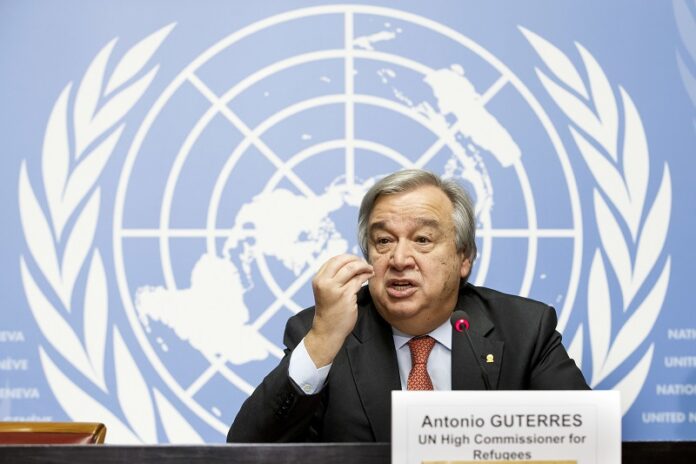
The then United Nations High Commissioner for Refugees Antonio Guterres speaks in 2015 during a news conference at the European headquarters of the United Nations in Geneva, Switzerland. Photo: Salvatore Di Nolfi / Associated Press
UNITED NATIONS — Portugal’s former prime minister Antonio Guterres won the Security Council’s unanimous backing Wednesday to become the next U.N. secretary-general, winning plaudits for his strong leadership but disappointing campaigners for a woman or East European to be the world’s top diplomat for the first time.
The veteran politician and diplomat, who served as the U.N.’s refugee chief until December, topped all six informal polls in the council after his performance in the first-ever question-and-answer sessions in the 193-member General Assembly, which received high marks from almost every diplomat.
Britain’s U.N. Ambassador Matthew Rycroft said the assembly hearings showed that Guterres “was an outstanding candidate … who will take the United Nations to the next level in terms of leadership” and will provide “a moral authority at a time when the world is divided on issues, above all like Syria.”
Russia’s U.N. Ambassador Vitaly Churkin, the current Security Council president, appeared before reporters surrounded by the 14 other council ambassadors after the sixth informal poll of the 10 remaining candidates was held behind closed doors saying: “You are witnessing, I think, a historic scene.”
Churkin then thanked all the candidates saying they displayed “a lot of wisdom, understanding and concern for the fate of the world” and announced: “We have a clear favorite, and his name is Antonio Guterres.”
He said the Security Council would hold a formal vote on Thursday morning and expressed hope that the council will recommend Guterres by “acclamation” to the 193-member General Assembly, which must approve a successor to Ban Ki-moon whose second five-year term ends on Dec. 31.
By tradition, the job of secretary-general has rotated among regions. Asia, Africa, Latin America and Europe have all held the post. East European nations, including Russia, argue that they have never had a secretary-general and it was their turn. There has also never been a woman secretary-general and more than 50 nations and many others campaigned to elect the first female U.N. chief.
There was disappointment among East Europeans, who fielded many candidates in the race but never united behind one, and among supporters hoping for a woman. Seven of the 13 candidates who entered the race were women.
Antonia Kirkland, program manager for Equality Now, which has campaigned for a woman secretary-general since 1996, said: “While it is disappointing that a man has once again been proposed by the U.N. Security Council as secretary-general, we are at least hopeful that he will continue the feminist agenda.”
She said this should include “first of all, ensuring gender parity among his staff at the Secretariat, and also prioritizing violence and discrimination against women as a pivotal issue.”
Christiana Figueres of Costa Rica, the U.N. official who played a key role in shaping last December’s historic agreement to fight climate change and one of three candidates who dropped out of the race, tweeted: “Bittersweet results #NextSG. Bitter: not a woman. Sweet: by far the best man in the race. Congrats Antonio Guterres! We are all with you.”
In the fifth “straw” poll on Sept. 28, Guterres received two “discourage” votes and there was a lot of speculation about whether Russia would support him.
The sixth poll on Wednesday morning was considered key because it was the first to use colored ballots to distinguish the votes of the five veto-wielding Security Council members — the United States, Russia, China, Britain and France.
“The permanent members had red ballots and the non-permanent members had white ballots,” Britain’s Rycroft told reporters later.
He said “the crucial moment” for him was the announcement of the result of the fifth permanent member which showed Guterres had no “discourage” votes from any council member.
In that final vote, Guterres had 13 “encourage” votes, no “discourage” votes and two “no opinions.” He was the only candidate to top the required nine “encourage” votes and no “discourage” vote from a permanent member.
Far behind in second place was Slovakia’s Foreign Minister Miroslav Lajcak with a vote of 7-6-2 including two “discourage” votes from permanent members. Serbia’s former foreign minister Vuk Jeremic had the same result but three “discourage” votes from permanent members.
The highest-ranked woman, UNESCO chief Irina Bokova of Bulgaria, was fourth. Bulgaria’s Prime Minister Boiko Borisov dropped the government’s support for Bokova last week in favor of European commissioner Kristalina Georgieva, who came in seventh.
The 1 for 7 Billion Campaign, which lobbied for greater openness, inclusivity and meritocracy in the selection of the new secretary-general, called Guterres’ top showing “a triumph” for its goals.
“He was ‘wrong’ in terms of gender and region, but was widely considered to have done well in his General Assembly dialogue and in other events, with many commenting on his experience and ability to inspire,” said campaign co-founder Natalie Samarasinghe.
U.S. Ambassador Samantha Power praised the “much more transparent process” of selecting a new U.N. chief and said Guterres’ “breakthrough” was his performance in the General Assembly and his experience.
“I think this is a day of unity,” she said. “In the end there was just a candidate whose experience, vision and versatility across a range of areas proved compelling and it was remarkably uncontentious, uncontroversial.”
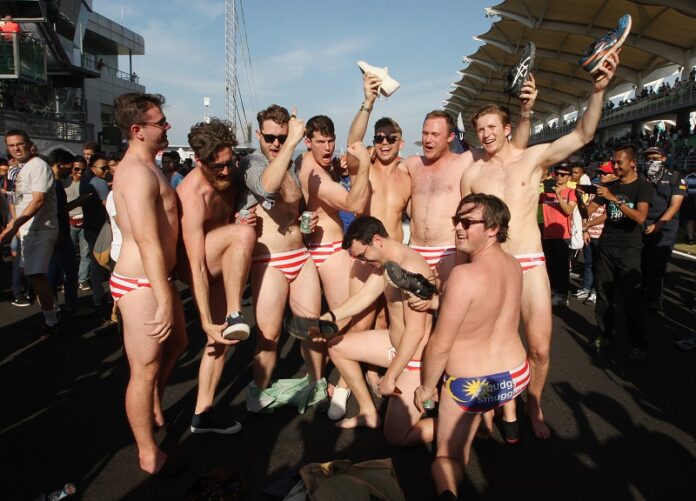
Australian men celebrate in Budgy Smuggler-brand swimsuits decorated with the Malaysian flag Sunday at the conclusion of the Malaysian Formula One Grand Prix in Sepang, Malaysia. Photo: Associated Press
KUALA LUMPUR — Nine Australians who stripped down to skimpy briefs and drank beer from shoes at the Malaysian Formula One Grand Prix appeared in a Malaysian court Thursday, where they are likely to be charged for public indecency.
The nine were detained Sunday after they partied in Budgy Smuggler-brand swimsuits decorated with the Malaysian flag in full view of thousands of spectators at the Sepang track after Australian driver Daniel Ricciardo won the race.
Police say the men were being investigated for intentionally causing insult with intent to provoke a breach of the peace and public indecency. They face up to two years in jail, a fine or both if they are found guilty.
The men, mostly Sydney University graduates, were dressed in suits when they appeared in court Thursday.
John Walker, the father of one of the men, Jack Walker, told reporters he was “hopeful” of their release. Jack Walker is an adviser to Australian Defense Industry Minister Chris Pyne.
Australian Department of Foreign Affairs and Trade First Assistant Secretary Jon Philp said he did not know what would happen in court today.
“Something could happen quickly, but it’s entirely up to the magistrate and the legal authorities,” Philp told Nine Network television.
“We’d like to think that they’ll be home soon, but it’s up to the Malaysian authorities to decide what to do now,” he added.
The men could be charged or police could ask the magistrate for their detention to be extended while they continue their investigation.
Ricciardo, the driver whose success inspired the Australians’ beer-fueled revelry, described the incident as “pretty harmless.”
“I respect the laws of Malaysia, but beyond that I don’t think they deserve any further punishment,” Ricciardo told Sydney’s The Daily Telegraph newspaper.
“In Australia, it’s a bit different, but I’m very sure they didn’t intend to offend anyone,” he added.
The Australian media has dubbed the men the Budgie Nine, using a spelling variation of the abbreviated name of the budgerigar, a small Australian parrot. The name plays on nine Australians arrested in Indonesia for heroin trafficking in 2005 who became known as the Bali Nine.
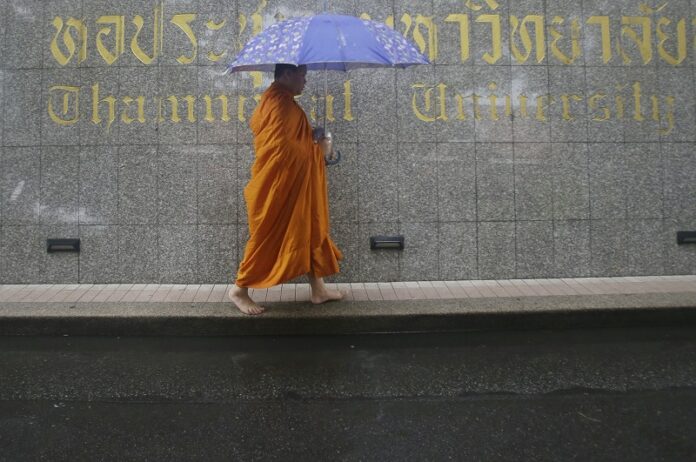
Buddhist monks, mourners, activists and others gathered Thursday to mark the 40th anniversary of one of the darkest days in Thailand's history, when police killed scores of university students at a peaceful protest, and ghoulish vigilantes defiled the dead. Photo: Sakchai Lalit / Associated Press
BANGKOK — Buddhist monks, mourners, activists and the merely curious gathered Thursday to mark the 40th anniversary of one of the darkest days in Thailand’s history, when police killed scores of university students at a peaceful protest, and ghoulish vigilantes defiled the dead.
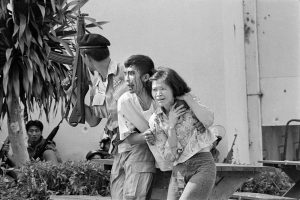
Students at Bangkok’s Thammasat University had been protesting the return from exile of a hated former dictator when they were trapped by a right-wing mob and heavily armed paramilitary police, who fired guns and grenades at the defenseless crowd of several thousand.
After subduing the students, thugs rushed in and grabbed as many as a dozen. They were then taken to a nearby public field, beaten to death, hanged and otherwise abused, with the bodies unceremoniously tossed onto a makeshift funeral pyre. The official death toll was 46, though credible independent estimates put it at more than 100.
The disorder was used as an excuse for the army to seize power later that day, undoing a student-led democratic revolution of three years earlier.
This year’s commemoration has drawn broader interest than usual because an invited speaker, Hong Kong democracy activist Joshua Wong, was not allowed into the country by Thai authorities, making headlines worldwide. Wong was supposed to speak at Bangkok’s Chulalongkorn University, which this year for the first time was joining Thammasat in marking the anniversary.
The rector of Thammasat, Somkit Lertpaithoon, said the university teaches its students about the violence, and even has survivors on its staff.
“Even though the events of Oct. 6 may not be documented in Thai history, the new generation still strives to learn about it,” he said in a speech at the university to mark the day.
The Thammasat massacre has always been a sensitive issue, both because the images of lynchings speak to a dark side of the Thai character and because the assault on the university showed how the state can carry out human rights abuse with impunity – no perpetrators were ever punished.
The latest anniversary comes as Thailand is again under military rule since a 2014 coup d’etat, and as an increasing awareness of human rights since 1976 has led to much questioning of the use of state violence, especially because of a sometimes violent struggle for political power that has troubled Thailand for the past decade, including bloody street battles in the capital Bangkok in 2010.
“The massacre is still of interest 40 years after the fact because it remains officially unresolved. Those who were involved in the violence have not been held to account, even as there has been a wave of transitional justice processes around the world, and even expanded questioning and investigations in relation to the violence of April-May 2010,” Tyrell Haberkorn, a fellow in political and social change at the Australian National University, said earlier this week before the anniversary.
“The incident has relevance to the current state of Thai politics because it becomes possible to continue to stage coup after coup while repressing dissent because those who have done so in the past have not been held to account for doing so,” she said.
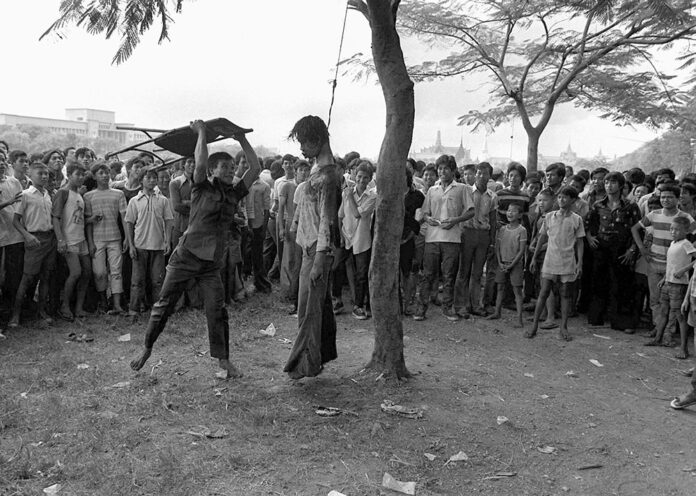
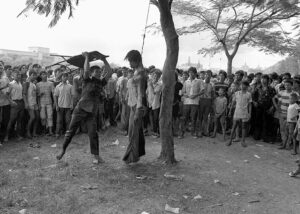
Patporn Phoothong, a member of a research team probing the events of 1976, said one goal is to identify the people in a famous photo showing a man using a folding chair to beat a disfigured corpse hanging from a tree while a crowd watches. No one has learned the names of the victim, the attacker or any of the spectators
“The obstacle that we face, I think it is because even though 40 years have passed, people are still scared and afraid to talk and do not feel that talking will make anything better,” she said.
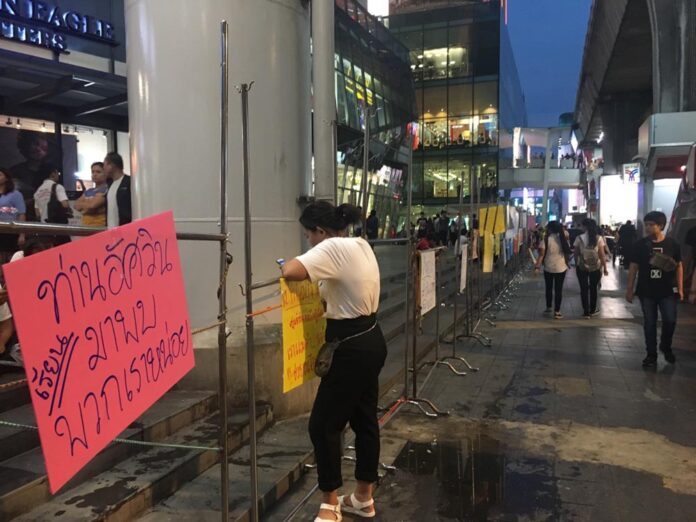
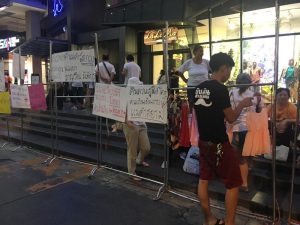
A sign seeking the attention of a specific city official is temporarily set up Wednesday where vendors usually sell goods in front of Siam Square in Bangkok.
BANGKOK — Sidewalk vendors outside Siam Square protested briefly Wednesday on the second night they were blocked by municipal officers and officials from setting up their stalls.
After partially setting up their stalls and hanging signs in protest, the group of vendors left after being told that district officials would sit down with them Thursday morning.
“We only have one condition, let us continue selling!” Prapoj Bootanaphalit, a retired police officer said. “Can you not think in a pessimistic way? Let us sell, and let’s talk about other conditions later.”
The vendors left but vowed that whatever the outcome to the meeting tomorrow, they will be back to sell in the evening.
City Hall has long sought to dislodge the vendors there, where portions of the sidewalk become all but impassable on many evenings. That’s partly due to the popularity of the stalls, which draw many customers – but also complaints.
While a city campaign to clear irregular and informal trade from public spaces has been met by many skeptics, clearing the congestion from in front of Siam Square seems to enjoy wide support.
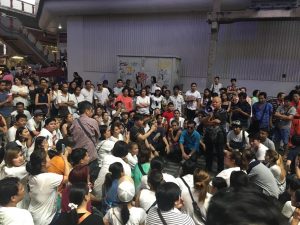
Retired police officer Prapoj Bootanaphalit addresses protesting vendors through a megaphone Wednesday evening in Bangkok. They chose representatives for a Thursday meeting with city officials.Vendors protest Wednesday evening at Siam Square in Bangkok.
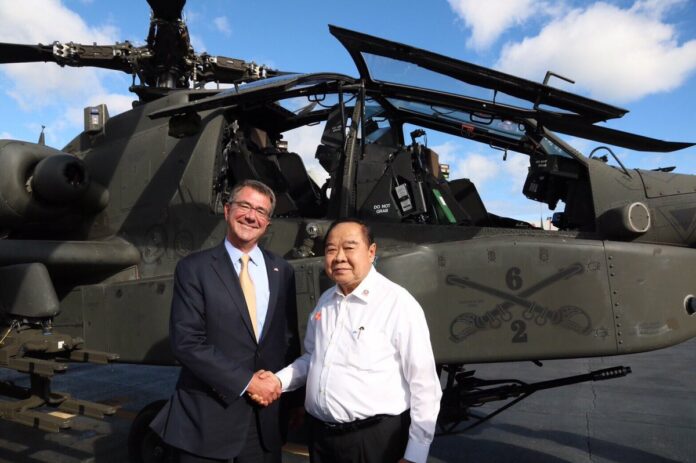
In an undated photo, junta deputy chairman Prawit Wongsuwan shakes hand with then-U.S. Secretary of Defense Ashton Carter during a visit to Hawaii. Image: Matichon
BANGKOK — The military government on Wednesday refused to disclose who accompanied the junta’s No. 2 general on a 20.9 million baht trip to attend an informal discussion with American officials in Hawaii last week.
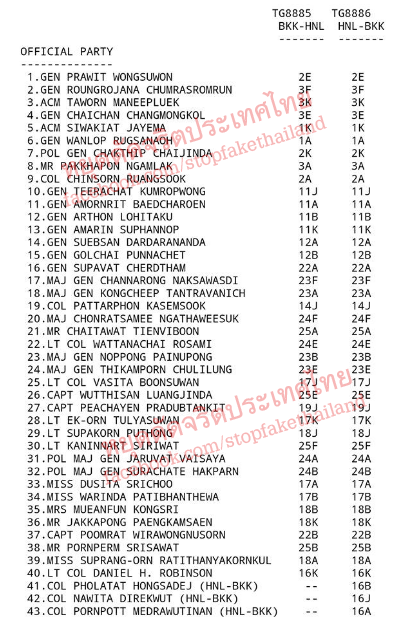
The regime also would not confirm or deny the authenticity of what’s alleged to be a leaked passenger list of deputy junta chairman Prawit Wongsuwan’s flight, which included a TV reporter rumored to be a romantic partner of the general. The reporter said she wasn’t on the flight.
“If we disclose the list, what good will that do?” Maj. Gen. Kongcheep Tantravanich, spokesman for the Ministry of Defense, said Wednesday.
Prawit and his entourage visited Honolulu from Thursday to Friday for an event described as “ASEAN-US Defense Informal Meeting.” It later emerged that air fare for the trip cost taxpayers 20.9 million baht, of which 600,000 baht was spent on in-flight dining alone.
Khaosod English filed a request Wednesday under the freedom of information law requesting the Defense Ministry disclose the names of the 38 people in Prawit’s entourage. Kongcheep said the request was being deliberated by a committee and gave no timeframe for its response.
“Steps must be taken in accordance with protocols,” said Maj. Gen. Kongcheep, who was on the flight. “Is it [disclosing the list] appropriate or not? If it affects national security or affects any agency, then we will not disclose it.”
An anti-junta Facebook page called Stop Hypocrisy in Thailand on Wednesday night published what it said was full list of the passengers on the charter flight. It listed 40 people, including Gen. Prawit for the outbound flight, with three more officials joining the return trip.
Document published by Stop Hypocrisy in Thailand.
Among the purported list was Chonratsamee Ngathaweesuk, a reporter for the army-owned Channel 5 TV, who is rumored to be a romantic partner of Gen. Prawit, who is unmarried.
Kongcheep said he could not comment on whether the list was authentic, except for Chonratsamee. He said she was not one of the passengers.
Prior to the appearance of the photos and list, Chonratsamee wrote Tuesday on Facebook that she didn’t accompany Prawit to Hawaii. As proof, she posted a screenshot of a live news program she did on Friday, when the deputy junta chief was in Hawaii.
“This is funny! I was in Bangkok, reading live news on Channel 5, but people imagined that I was overseas,” Chonratsamee wrote. “This means that the news I do live from Monday to Friday isn’t famous enough.”
She hasn’t further commented on the matter publicly.
Nevertheless, the news revived the public’s curiosity about the 34-year-old reporter, who also holds the rank of army major.
Isra News, an investigative news site, reported in December 2014 that a media company owned by Chonratsamee won at least 3.3 million baht worth of contracts with state agencies that year.
On Wednesday, Isra published a note saying it received an email from its internet service provider to remove the 2014 article, citing an unspecified “request of cooperation from the bureaucracy.”
As of late Wednesday afternoon, the page was still on the site.
Note: The original image published with this article, which showed photos purporting to be of Chonratsamee Ngathaweesuk in Honolulu, were removed at the request of the management of Khaosod, which owns Khaosod English.
JAKARTA — Indonesian police say a man they arrested for broadcasting pornography on an electronic billboard in the country’s capital gained access to the system after it displayed its log-on credentials.
Jakarta Police Chief Muhammad Iriawan said Wednesday that the suspect, 24-year-old Samudera Al Hakam Ralial, admits he hacked the IT system of the billboard operator but claims that the broadcast of the Japanese porn movie was accidental.
Twitter in social media-mad Indonesia was set alight by the incident, which occurred not long after Friday prayers last week in the Muslim-majority country.
Many users posted clips of the billboard as it displayed a Japanese porn movie to passing traffic.
According to Iriawan, Samudera said he didn’t realize a pornographic website he accessed after breaking into the computer system was uploaded to the billboard.
A member of a Thai political faction strikes at the lifeless body of a hanged student outside Thammasat University in Bangkok on Oct. 6, 1976. Photo: Neal Ulevich / Associated Press
Associated Press Photographer Neal Ulevich won the Pulitzer Prize for his photos of the suppression of a left-wing student protest at Bangkok’s Thammasat University on Oct. 6, 1976, and the brutal lynchings in its wake. Ulevich, then 30, arrived as a night of tension at the campus broke into a full-scale assault by paramilitary police on thousands of trapped and defenseless students.
What follows was his first-person account as it was published.
BANGKOK — In a real riot no one knows you’re there. So as gunfire crackled over the campus of Bangkok’s Thammasat University Wednesday morning, I pushed my way through an angry sea of rightists and found a hole in the high metal fence surrounding the campus.
I paused momentarily while Boy Scouts pushed through the fence the body of a soldier with a chest wound. I jumped through.
The police were on the attack and the rightists were cheering their support. Troops armed with M-16 rifles were spraying wild fire across a quadrangle, shattering classroom windows and nicking holes in the walls.
With some Indochina combat coverage behind me, I could hear that more than 90 percent of the fire was going in one direction – toward the students. Occasionally it seemed a round came back.
On the quadrangle, troopers worked their way toward classrooms.
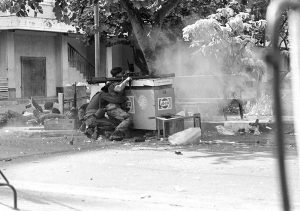
Some of the troopers tossed hand grenades through the windows. The “garrumph” of a grenade going off was followed by a puff of smoke and the tinkle of showering glass. Then the recoilless rifle crew moved up.
It wasn’t immediately clear why the border patrol police were there, or why they thought they needed an armor-piercing antitank weapon to conquer students. The two-man crew moved forward, followed by a shaggy right-winger carrying a box of ammunition. They blasted more classrooms.
A few minutes later, about 9:30 a.m., the battle seemed over.
Students began to pour out of campus buildings, some wounded. I began to move forward, 50 yards behind the soldiers. I began to feel apprehensive, just as I did in Vietnam when crossing open ground. And with good reason. The shooting began again.
Neal Ulevich. Photo: Courtesy
The students threw themselves to the ground – I did, too – as the Thai police emptied more thousands of rounds into the classrooms. The fire slackened and the students got up.
I reached the nearest classroom building.
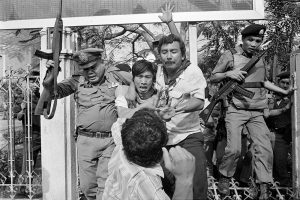
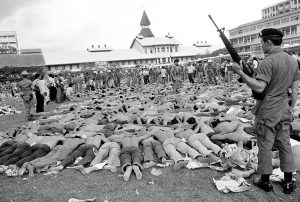
At the door, students were running out, diving to their hands and knees and crawling past soldiers who told them to take off their shirts, and coeds their blouses. Slow performance earned a kick.
A grenade went off in a classroom above us, showering troops and their captives with glass and plaster. The students crawled toward the center of the quadrangle to lie in the hot sun.
I was joined by a German reporter who speaks Thai, and we walked out through the gate.
Then we were out on the street – close by the pleasant green trees that surround the Pramaine Ground site of Bangkok’s colorful weekend fair. But then we saw the angry swarm of Thais around two of those trees and their anger was white hot. I saw the body of a dead student hanging from one tree. The scene was being repeated just a few feet away.
I don’t know how much earlier the students had been lynched – probably just a few minutes – but enraged rightists felt robbed by death and continued to batter the bodies.
Other Thais who witnessed the 1973 student riots here said the earlier uprising, which left 70 dead, never evoked the brutality or hatred of Wednesday’s attack on the students.
No one had seen me. I had wandered throughout and taken pictures unmolested. But I had seen enough, and left.
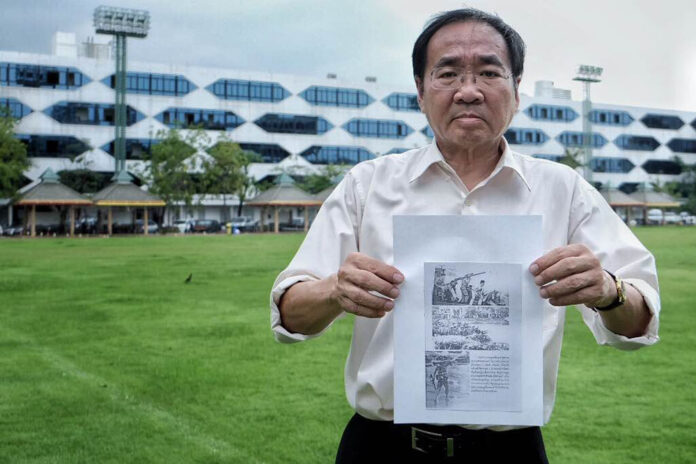
Krisadang Nutcharut stands Monday in the football field of Thammasat University's Tha Prachan campus. He holds a sheet printed with photos taken during the massacre of student protesters there 40 years ago on Oct. 6, 1976.
Top: Krisadang Nutcharut stands Monday in the football field of Thammasat University’s Tha Prachan campus. Photo: Thiti Meetam
BANGKOK — It was from the front gate to the campus that Krisadang Nutcharut recalls the first shots fired. Not far away from the football field, where later a large explosion killed some of the thousands of students gathered.
On Monday, Krisadang toured the campus of Thammasat University, where he was just 19 on Oct. 6, 1976, when he saw his classmates assaulted, shot, murdered and mutilated before dramatically escaping into the Chao Phraya River in search of safety.
The government said 46 were killed that day. Those who were there have put the number at more than 100.
It all began when a dictator ousted three years earlier in a popular revolt quietly returned to Bangkok in the robes of a monk. The students wanted Field Marshal Thanom Kittikachorn either prosecuted or expelled, but nothing was done by the the civilian government led by Seni Pramoj.
Krisadang, a sophomore law student and member of the student council, recalled that It was at the university’s Lan Pho, or the Bodhi Lawn, where a tall tree representing the Buddha’s enlightenment was planted, that Krisadang, a sophomore law student, recalls they first gathered in protest on Oct. 4.
Krisadang Nutcharut holds a photograph of a dead young woman who was sexually assaulted across from where it happened in Bangkok’s Sanam Luang adjacent to Thammasat University. Photo: Thiti Meetam
“Demands were made the Thai-language examination be canceled,” he said, as more students were urged to join the demonstration, by then numbering 400 or 500 people.
Some students staged a play which mocked the lynching of two factory workers who earlier had protested Thanom’s return.
An ominous sign came in print the next day on Oct. 5, when at least one right-wing newspaper published a photo of the play – some believed it was doctored – accusing the students of making one of the performers hanged look like HRH the Crown Prince. To this day, Krisadang accuses one English-language newspaper, The Bangkok Post, of publishing a doctored version of the photo. The paper has denied this and, at the time, did not write that the students had mocked the prince.
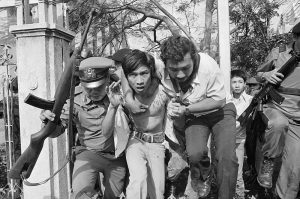
Photo: Associated Press
A Call to Terrible Purpose
Cold War, anti-Communist sentiments were at fever pitch, and whatever happened on the stage was seized upon as a pretext to set events in motion.
A call from the military went out over more than 200 radio stations and was heard by right-wing reactionaries, from the state-sponsored rural militia known as the Village Scouts to anti-Communist extremists established by the military called Red Gaurs. Even the military’s Housewives Association mobilized.
Photo: Associated Press
The same message was repeated again and again.
“The call was to come out and kill students,” Krisadang said was his understanding, backed by other accounts, of what was broadcast over AM radio. After all, as a famous monk had recently declared: “Killing a Communist is not a sin.”
The students soon learned that right-wing, ultra-royalist forces had gathered around the statue of King Rama V at the Royal Plaza, a 40-minute walk from Thammasat.
“By that evening, forces organized by the military arrived in front of Thammasat,” Krisadang said.
Inhumanity on Display
Forty years later, Krisadang and other members of the so-called Oct. 6 generation still try to make sense of the atrocity.
“The other side believed that we were armed Communists and had defamed the monarchy,” Krisadang said, trying to explain the raw sadism of lynching, murder, rape and torture that seemed to have no precedent.
That sadism struck the world through photographs of mad mobs leering and grinning over defiled corpses, some burned, some sexually violated and at least one with a wooden stake driven into its chest.
A member of a Thai political faction strikes at the lifeless body of a hanged student outside Thammasat University in Bangkok on Oct. 6, 1976. Photo: Neal Ulevich / Associated Press
American photojournalist Neal Ulevich, working for the Associated Press, would win the Pulitzer Prize for the most remembered photo of the day.
In it, a student believed to be from Chulalongkorn University hangs by the neck from a tree. A barefoot man visibly exerts himself as he swings a folded metal chair downward to strike the body. Some faces in the crowd look horrified, yet many more beam with smiles and laughter.
Krisadang said he had no idea the paramilitary mob was capable of unleashing such hatred and violence. He faults political passions being whipped up to divide people and make them turn on one another.
“It came to a point where the ruling class felt they couldn’t let go of their power and believed Thailand would be the next ‘fallen domino,’” he said, referring to the Cold War jingoism that saw communism as an existential threat to the free world.
Krisadang said anyone who was seen as a political opponent was branded a Communist and anti-monarchist.
“It’s like now how people have been divided into yellow and red shirts,” he said. “Are we going to continue to be used as pawns?”
Photo: Associated Press
October 6
One man who claims he knew in advance the students were doomed was Jaran Ditapichai, then 29. Jaran was a mid-ranking Communist Party member dispatched to Thammasat University to save those “important” lives he could. He failed and barely managed to save himself.
“I entered because I was worried and wanted to offer suggestions,” Jaran said. “Some should be spared. Not all should be arrested or killed. My intelligence liaison told me I should leave immediately, however, saying they were going in for the kill tonight.”
By the night of Oct. 5, Jaran had heard border patrol police had occupied the National Museum compound on the north of the university.
Later that night, witnesses such as Jaran and Krisadang recall hearing shots fired intermittently.
Just before dawn on Oct. 6 came a signal things of what was to come.
Someone fired either a mortar shell or M79 grenade into the campus’ football field, where Krisadang estimates some 2,000 to 3,000 people, mostly students, were gathered.
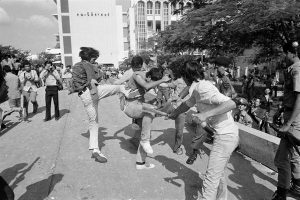
Photo: Associated Press
The explosions instantly killed students where it hit and shook the buildings inside the historic university, once a command center for the Thai resistance movement against Japanese occupation during World War II.
“Many were killed,” Krisadang said. “Then we heard gunshots coming from Wat Mahathat,” he said, referring to a temple on the south side of the university.
Two student leaders on stage, Thongchai Winichakul and Somsak Jeamteerasakul, called futilely for the attack to stop, Krisadang said.
By 5am, gunfire erupted from the direction of the National Museum.
Jaran said several people around him were gunned down and killed. He said it was only by luck that he fell to a spot of lower ground – not the footpath or the football field where others were being shot – where he was shielded from the bullets.
“I smelled blood mixed with brains in the air,” he said. “Two or three people were lying dead.”
About the time the sun rose, two or three buses plowed through the gate of the university. That’s when Krisadang fled west from the gate toward the Chao Phraya River. It was low tide when he stumbled into the water, and he waded and swam south to the Tha Prachan Pier, where a kindly Thai-Chinese shopkeeper hid him.
Jaran made his way south across campus to the Faculty of Social Administration. He found a way into the basement and hid there overnight. He was arrested the following morning after soldiers noticed his footprints.
Photo: Associated Press
Making of a Massacre
Jaran managed to escape after a few days when a guard forgot to lock his cell, then fled into the jungle to join other members of the Communist Party of Thailand in hiding. Today he lives in exile in Paris, where he remains to avoid prosecution on a charge of insulting the royal family.
He notes that most of those who had gathered at Thammasat to protest Thanom were not communists. But he also thinks it’s time history shows there were communists present four decades ago.
He said the status quo saw them as a threat.
“Too many students and people were becoming ‘red’ too soon, and the ruling class became fearful, leading to the call for a total crackdown,” Jaran said.
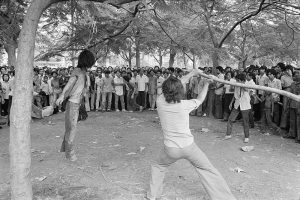
Photo: Associated Press
He faults a persistent media campaign which demonized students and citizens for playing a major role. He compared it to the vilification of Redshirts today by the right-wing press.
“It went on until people lost their basic conscience, believing that all were communists, were demons, and that there was no sin in killing them. It was these decisive factors that led to Oct. 6,” he said.
The massacre should also be remembered for enabling a military coup later the same day, he said, just three years after the public had risen up to drive out a military dictatorship.
Untreated Trauma
Vipa Daomanee, then a 21-year-old Chulalongkorn University student and part of the Oct. 6 generation, was not present but remains deeply affected by what happened.
Photo: Associated Press
Vipa was on her campus drafting the last statement by the Students’ Confederation of Thailand at 1am on Oct. 6 while some of her friends were being murdered. It weighs on her that nobody has ever been held responsible for the atrocity, even after 40 years.
Attempts to bury it with the past have just made the wound fester, she said.
“It was a state crime wherein the ruling class used violence against its opponents,” Vipa said. “It has become a wound in society that has yet to heal.”
Sinsawat Yodbantoey, like Vipa and Krisadang, has actively commemorated the massacre for decades. He’s among those who see the massacre’s lessons as yet unlearned and unregistered in Thailand’s collective memory.
“There are things that have been recorded, and there are things that have been forgotten. There are selective memories and selective forgetting. This results in confusion,” Sinsawat said.
Sinsawat was a 22-year-old art student at Pho Chang College. He was saved that day by a childhood friend who had joined the Village Scouts and recognized him.
No commission has ever been established to gather evidence about who masterminded the massacre. It wasn’t until 2000 that an effort to build a small memorial on the campus prevailed.
Sinsawat said those in power today still do not want this episode of Thai history remembered.
“We have yet to be able to find evidence to launch a lawsuit, saying this or that person made the order,” Sinsawat said.
On the brighter side, Sinsawat said there’s renewed interest among young people in the issue as a result of the 2014 military coup.
While Krisadang was giving his tour of the campus on Monday, two young people were there taking photos, curious to learn about the incident.
As for Jaran, the man acknowledges that attempts to make Oct. 6 a collective memory have been a part – but not total – failure.
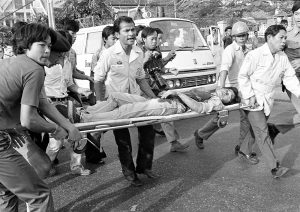
Photo: Associated Press
“The first 20 years was a period when nobody was willing to speak or write about it. People were still afraid,” said Jaran, the 69-year-old political exile said from Paris. A Redshirt leader, he fled the kingdom in 2014 after the coup and obtained asylum status in France.
“Oct. 6 is about defeat, and people try not to discuss it because of that. There’s also the allegations they were communists, and that made them even more reluctant to talk,” he said in an interview over the telephone.
“The ruling class and the military want us to forget while the other side is struggling for people to remember,” Jaran said. “Those who want to forget may forget, but I shall never. I was almost killed.”
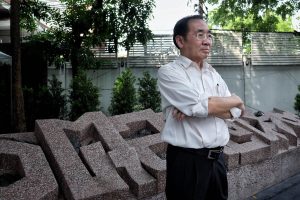
Krisadang Nutcharut stands in front of the memorial to the victims of the 1976 massacre at Thammasat University in Bangkok. Photo: Thiti Meetam
Collective Amnesia
There are forces suppressing knowledge and memory of that day that go beyond those responsible wanting it forgotten.
Today, with the massacre unmentioned in the classroom or textbook, Sinsawat said some university students can’t comprehend the cruelty depicted in the photographs. Some even doubt it happened.
“Some think it can’t be real, as if the picture must have been photoshopped,” he said.
Other youth simply refuse to engage with the issue, saying the topic is “too heavy.”
Krisadang and Vipa said there are others who just don’t want the orgy of violence and murder known publicly.
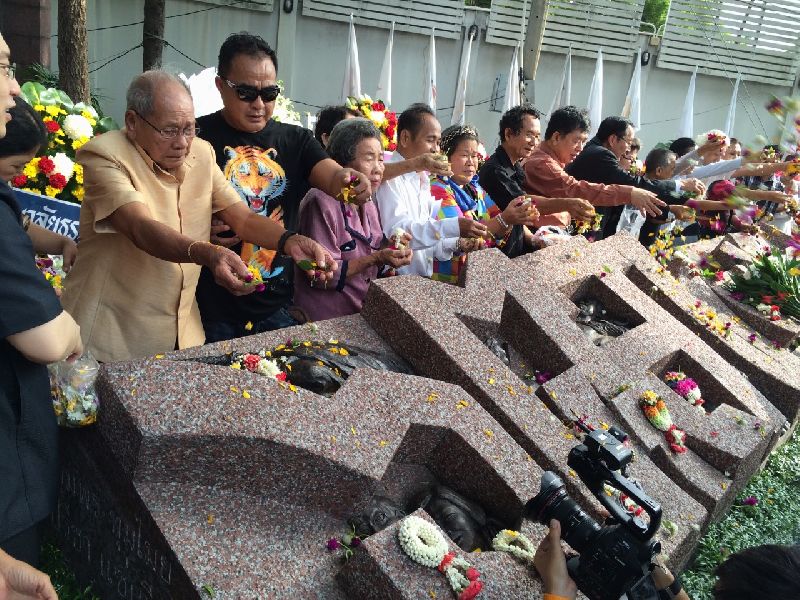
More than 50 participants laid flowers at the October 1976 massacre monument at Thammasat University on Oct. 6, 2014.
Forty years on, Vipa said some relatives of those killed are still unwilling to speak publicly. The Oct. 6 generation has its own infighting and bad blood, and those trying to chronicle what was arguably the cruelest episode of modern Thai history quibble over whether just two, four, or even five people were hanged by the mob that day.
Despite that, Vipa, who’s known for emotional outbursts when it comes time to commemorate the event, said there’s a power in the sheer fact 40 years have passed.
She said more people have become interested in what happened, with events planned in at least three universities.
“The number 40 is powerful. Those who should have become interested about the issue earlier and have not are now becoming curious,” said Vipa, who eventually became an academic before retiring. “We need to be reminded and keep holding the commemoration every year. No matter how many people show up, we must stress and link it to the present.”
Even more attention was called when Thai authorities on Wednesday detained a 19-year-old pro-democracy leader from Hong Kong who was invited to an event on the anniversary tomorrow to commemorate the massacre. Joshua Wong was held for some hours before being deported back home.
As for those who were there such as Krisadang, there are still new things to learn.
As he walked through Thammasat reminiscing about the past on Monday, he said just last year a friend and fellow member of the Oct. 6 generation, historian Thongchai Winichakul, was able to pin down one elusive detail. On the campus, one of the tamarind trees growing there, he concluded, once bore the weight of a murdered student left hanging beneath it.
Joshua Wong on Sept. 4 shakes hand with a voter during his party's election campaign in Hong Kong. Photo: Demosisto / Facebook
BANGKOK — Pro-democracy activist Joshua Wong has boarded a plane back to Hong Kong after being denied entry to Thailand by immigration authorities, his political organization said.
The 19-year-old activist will arrive in Hong Kong at about 3:45pm local time, according to a statement posted online by Demosisto Party, of which he is a leader. Wong was supposed to speak at Chulalongkorn University on Thursday but was barred from entering the country upon landing at Suvarnuabhumi Airport.
Wong and Demosisto chairman Nathan Law will hold a news conference about the incident at Hong Kong’s parliament Thursday night, the statement said.
The well-known activist flew from Taiwan to Thailand on invitation by a student group to speak Thursday at an event commemorating the 40th anniversary of the Oct. 6 Massacre, in which dozens of left-wing students were killed by paramilitary and police forces.
The massacre remains a topic of taboo in Thailand due to the involvement of royalist groups at the time.
Immigration officials previously refused to clarify why Wong was denied entry, while Wong’s associates in Thailand alleged Thai immigration was following orders from the Chinese government, a claim the junta would neither confirm nor dispute.
Demosisto, which advocates for greater autonomy from the mainland government, staged a protest in front of the Thai Consulate in Hong Kong on Wednesday afternoon to denounce Wong’s detention.