






























27.7 C
Bangkok
Thursday, July 2, 2026
Home Blog Page 2632

Obama Aide to Meet Wife of Missing Activist Sombath

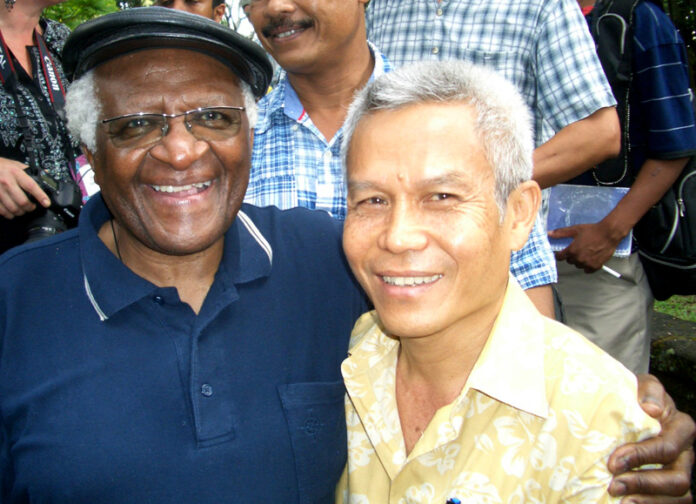
Sombath Somphone, seen here in 2006 with Desmond Tutu, is a respected community development worker from Laos abducted in Vientiane on Dec. 15, 2012. Photo: Shui-Meng Ng

VIENTIANE — A top aide of President Barack Obama said Tuesday he will meet with the wife of a missing Laotian activist, whose case has been repeatedly highlighted by human rights groups as an example of authoritarian excesses of Laos’ one-party Communist government.

Deputy National Security Adviser Ben Rhodes told reporters he will meet with Shui Meng Ng on Thursday while Obama is visiting Laos. The president arrived on Monday to attend a regional summit.

Human rights activists were hoping that Obama would speak about Ng’s husband, Sombath Somphone, who was picked up apparently by security forces on Dec. 15, 2012. He has not been seen since.

Obama has not mentioned him so far in his public remarks, but Rhodes said that “we care very deeply about her case and her husband, and we believe she deserves to know what happened to her husband.”

He said he also met Ng during a recent visit to Laos, and planned to stay in “regular contact” with her. Rhodes said the Laotian government has told the U.S. the same thing it tells Sombath’s wife – that it’s looking into his disappearance.

“Oftentimes, they indicate that they do not know, and that there’s an ongoing investigation,” Rhodes said.

He said that typically, Obama addresses human rights issues with foreign leaders more broadly, and lets his staff raise specific cases with their counterparts.

Sombath’s disappearance was captured on a traffic video camera, in which he is seen being stopped at a police outpost in Vientiane and asked to step out of his Jeep, according to Amnesty International. Within a few minutes a man on a motorcycle arrives, drives away Sombath’s vehicle, and a pickup truck takes Sombath away with armed people on a motorcycle leading the way. The passenger on the motorcycle fires a gunshot into the air, Amnesty International said.

The human rights group said it believes the authorities are either directly responsible for his disappearance, or have simply failed to take steps to find out what happened to him.

“President Obama and world leaders gathering in Laos need to demand answers and accountability from their Lao government hosts on the case of disappeared NGO leader Sombath Somphone. The message has to be clear that the cover up has to end, Sombath needs to be found, and that no other outcome is acceptable,” Phil Robertson, deputy director for Asia at Human Rights Watch, said Tuesday.

The U.S.-educated Sombath mostly worked in rural development, showing farmers creative ways to raise fish and make handicrafts. But he was also vocal about land deals that left thousands of villagers homeless without compensation, sparking rare political protests. He also had international connections.

Sombath is not the only possible victim of a government crackdown.

In 2015, an ethnic Lao who is a Polish citizen disappeared while visiting Laos, according to his Polish wife, allegedly for posting critical comments on Facebook. He was subsequently sentenced to 4 years and 9 months in prison.

In March this year, three young Laotian migrant workers who returned to Laos to renew their passports vanished and reappeared on state TV in prison uniforms to state that they had used the internet to “defame the government.” They have not been charged and their parents have not been allowed to visit them. Another dissident, Ka Yang, who fled to Thailand was deported to Laos in 2011 and imprisoned.

Most Laotians are unaware of such events because of the government’s tight control over the media, the security forces and the judiciary.

Advertisement

Avoid Ramkhamhaeng Road Tonight Due To World Cup Qualifier

A Japanese fan among thousands of people gathering at Rajamangala National Stadium on Tuesday afternoon for a 2018 World Cup qualifying match between Thailand and Japan.

BANGKOK — The public is urged to avoid Ramkhamhaeng Road this evening due to the World Cup qualifying match to be held.

Fans are already gathering outside Rajamangala National Stadium to watch Team Thailand face off against Japan in a 2018 World Cup qualifying match which will get underway at about 7:15pm.

No cars are allowed to park inside the stadium and those going to see the game should take public transportation.

It is the second match for Thailand in the final stage for Asian teams trying to make the World Cup cut. Thailand lost the first qualifier to Saudi Arabia on Thursday and in a match that left some fans feeling cheated.

The match will be broadcast nationwide on Channel 7.

Advertisement

Obama Visit Opens New Era in US-Laos Relations

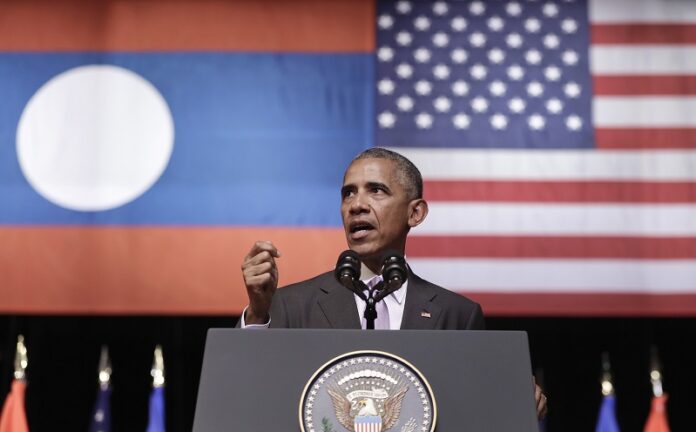
U.S. President Barack Obama speaks on Tuesday at the Lao National Cultural Hall in Vientiane, Laos. Photo: Carolyn Kaster / Associated Press

VIENTIANE — Acknowledging the scars of a secret war, President Barack Obama on Tuesday said the United States has a “moral obligation” to help this isolated Southeast Asian nation heal and vowed to reinvigorate relations with a country with rising strategic importance to the U.S.

Making the first visit for a sitting U.S. president, Obama said too few Americans know of the United States’ covert bombing of Laos during the Vietnam War. He offered no apologies, calling the campaign and its aftermath reminders that “whatever the cause, whatever our intentions, war inflicts a terrible toll.”

“Given our history here, I believe that the United States has a moral obligation to help Laos heal,” Obama said, as he addressed an audience of more than 1,000 students, business people and officials.

For nine years, the U.S. conducted a punishing, covert bombing campaign on landlocked Laos in an effort to cut off communist forces in neighboring Vietnam. The bombardment dropped more than 2 million tons of ordnance on the small nation, more than “we dropped on Germany and Japan, combined, in all of World War II,” Obama said.

The bombing left behind deep scars, millions of unexploded cluster bombs across the countryside and decades-worth of cleanup.

Obama is one of several world leaders arriving for a meeting of the Association of Southeast Asian Nations. Taking its turn as the chair of the regional forum, the Laos’ communist government is seizing a rare moment in the spotlight.

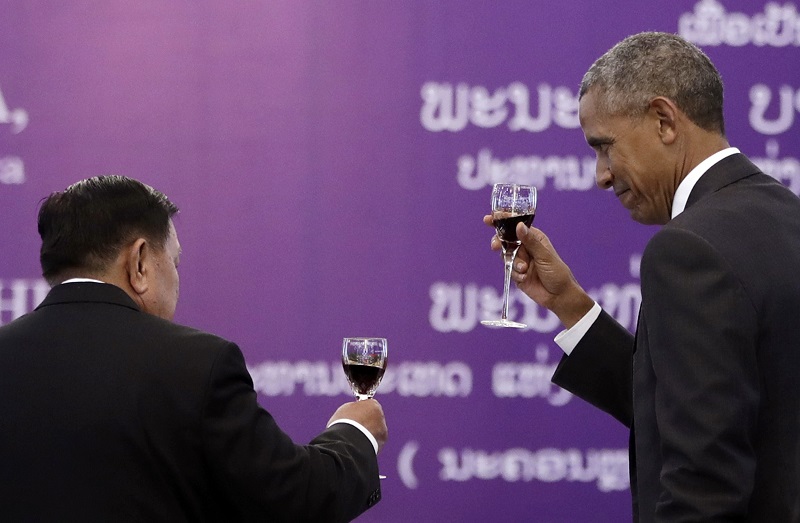
Laotian President Bounnhang Vorachit, left, and U.S. President Barack Obama toast during an official state luncheon Tuesday at the Presidential Palace in Vientiane, Laos. Photo: Carolyn Kaster / Associated Press

For Obama, the visit serves as a capstone to his yearslong effort to bolster relations with Southeast Asian countries long overlooked by the United States. The outreach is a core element of Obama’s attempt to shift U.S. diplomatic and military resources away from the Middle East and into Asia in order to counter China’s dominance in the region and ensure a foothold in growing markets.

Obama’s project – dubbed his Asia pivot – has yielded uneven results, as conflict in the Middle East has continued to demand attention and China has bristled at what it views as meddling in its backyard.

Obama said America’s interest in the Asia-Pacific isn’t new and is not a passing fad.

“The United States is more deeply engaged across the Asia-Pacific than we have been in decades,” Obama said. “Our positon is stronger and we’ve sent a clear message that as a Pacific nation, we are here to stay.”

With just four months left in office and eying his legacy, Obama used the moment to reassert his aims. He touted new military aid and U.S. support for regional cooperation in addressing maritime disputes. He made a plug for the massive Trans-Pacific Partnership free trade agreement, the policy’s central economic component that is now stuck in Congress. He sought to address worries that United States’ new focus on Asia will leave smaller nations as pawns in a chess match between the U.S. and China.

“We believe that bigger nations should not dictate to smaller nations and that all nations should play by the same rules,” he said.

As a first sign of a new relationship with Laos, Obama said his administration would address the legacy of war. Obama announced he would double spending for unexploded ordnance, committing $90 million over the three years. The U.S. has contributed $100 million to the effort in the last 20 years, as annual deaths have fallen from more than 300 to fewer than 50, the White House said.

The Lao government said it would increase efforts to recover remains and account for Americans missing since the VietnamWar.

As he opened a day of ceremony and diplomacy, Obama was greeted by a military band, traditional dancers and a warm, tropical rain. He met with Lao President Bounnhang Vorachit, was feted at a welcome banqueted, where he toasted to a relationship he said would “mean greater progress and opportunity for the people of Laos.”

Obama’s outreach to those regional powers hit a snag just as he arrived in the region from China. The White House called off a planned meeting Tuesday with Philippine President Rodrigo Duterte, after the brash new leader referred to Obama as a “son of a bitch.”

Duterte, who had been expecting Obama to criticize his deadly, extrajudicial crackdown on drug dealers, later said he regretted the personal attack on the president.

In a statement read out Tuesday by his spokesman, Duterte said his “strong comments” to certain questions by a reporter “elicited concern and distress.”

“We look forward to ironing out differences arising out of national priorities and perceptions, and working in mutually responsible ways for both countries,” the statement said.

Story: Josh Lederman, Kathleen Hennessey

Advertisement

Bangkok Man Hangs Himself Via Facebook Live

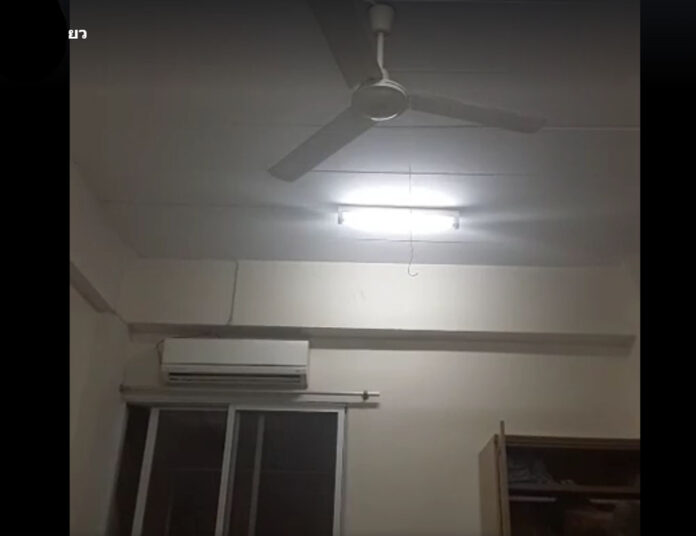
Still image from Monday night livestream

BANGKOK — A man was found dead Tuesday after livestreaming his suicidal via Facebook Live.

Charoen Chimphuk was found dead inside an apartment in Soi Phaholyothin 48 the morning after he filmed himself hanging himself in a streaming video running about 30 minutes.

Sangrawee Omdee, 24, his wife, told police she rushed to the residence after seeing the 30-year-old was preparing to hang himself through the live broadcast streamed via his personal account on 11:46pm.

Titled “Just a man going to die,” the live video showed a calm Charoen making preparations for about 19 minutes to hang himself from a ceiling fan. He is mostly silent the entire time apart from some comments about his family.

“I have nothing left,” he says at one point.

His body remains suspended motionless for another dozen minutes or so. The video is still available but a content warning had been added by Facebook by Tuesday afternoon.

“His wife was not suspicious about his death and believes it was a suicide,” said police Col. Amnat Intharasuan of Bang Khen Police Station. “Though the case is being investigated by the police’s office of forensic science, as it must be.”

Sangrawee told police she has lived with Charoen for five years, and the two have a 3-year-old daughter. She recently found out he was having an affair with another woman, so she had left him.

Sangrawee said the room where Charoen hanged himself was where he went to see the other woman.

Police said they did not find the live video suspicious and believe Charoen hanged himself of his own free will.

Earlier this year, an internet celebrity pretended to shoot himself on Facebook’s livestreaming service in order to promote a skin cream.


Related stories:

Police Find No Evidence Net Idol Shot Himself on Facebook Live
Did a Thai Net Idol Just Shoot Himself on ‘Facebook Live?’


Advertisement

Cinema Dolce: Watch Splendid Tales From Italy at EmQuartier

BANGKOK — Harvey Keitel and Michael Caine are a pair of faltering creatives while a more surreal couple scour an empty world to repair a broken friend in films to show at next week’s Italian Film Festival.

Seven films include three contenders for the 2015 Palme d’Or will bring the best of Italian cinema to audiences Sept. 13 through 18 at EmQuartier.

In “Youth,” Caine and Keitel are men at the end of life’s accomplishments on vacation in the Swiss Alps where they confront the struggle between age and youth, life and death. The English-language dramedy by Paolo Sorrentino got a positive response after its Cannes premiere was nominated for Best Original Song at the Academy Awards.

A troubled female director melts down on the set in “My Mother,” which also received a warm welcome as a Palme d’Or entry.

Things take an avante garde turn in 2015 dark fantasy “The Bear Tales,” with two lonely, surreal figures journeying through a world abandoned by humans in their quest to reanimate a torn teddy bear. The story is adapted from famous fables such as Cinderella, Rapunzel and Sleeping Beauty. It stars Salma Hayek.

Ferdinando Cito Filomarino’s first feature “Antonia” is a biopic about the transient life of Antonia Pozzi who after his death has become one of the most important Italian poets of the 20th century. Lead actress Linda Caridi will attend the opening ceremony of the festival.

For those looking for a laugh, “An Italian Name” unfolds over the course of a dinner between old friends who get tangled up on politics and relationships while debating what to name a coming child. “The Repairman” portrays the rambling life of a failed engineer who earns a living by fixing coffee machines.

For some controversy, check out “Me, Myself and Her,” a love story between two women and their struggles to find true identity.

Tickets range from 150 baht to 300 baht and can be reserved via the Major Cineplex website.

The festival runs Sept. 13 – 18 at EmQuartier’s CineArt theater. The full schedule can be found online. All films show in Italian with English subtitles except “Youth” which is in English. EmQuartier can be reached via skywalk from BTS Phrom Phong.

http://www.youtube.com/watch?v=8gevnrK0400

Advertisement

Europe’s Rosetta Probe Finds Lost Lander on Comet

A rendering by the European Space Agency showing its Philae lander on Comet 67P/Churyumov-Gerasimenko.

BERLIN — Europe’s Rosetta space probe has located its lost Philae lander, wedged in a “dark crack” on a comet, the European Space Agency said Monday.

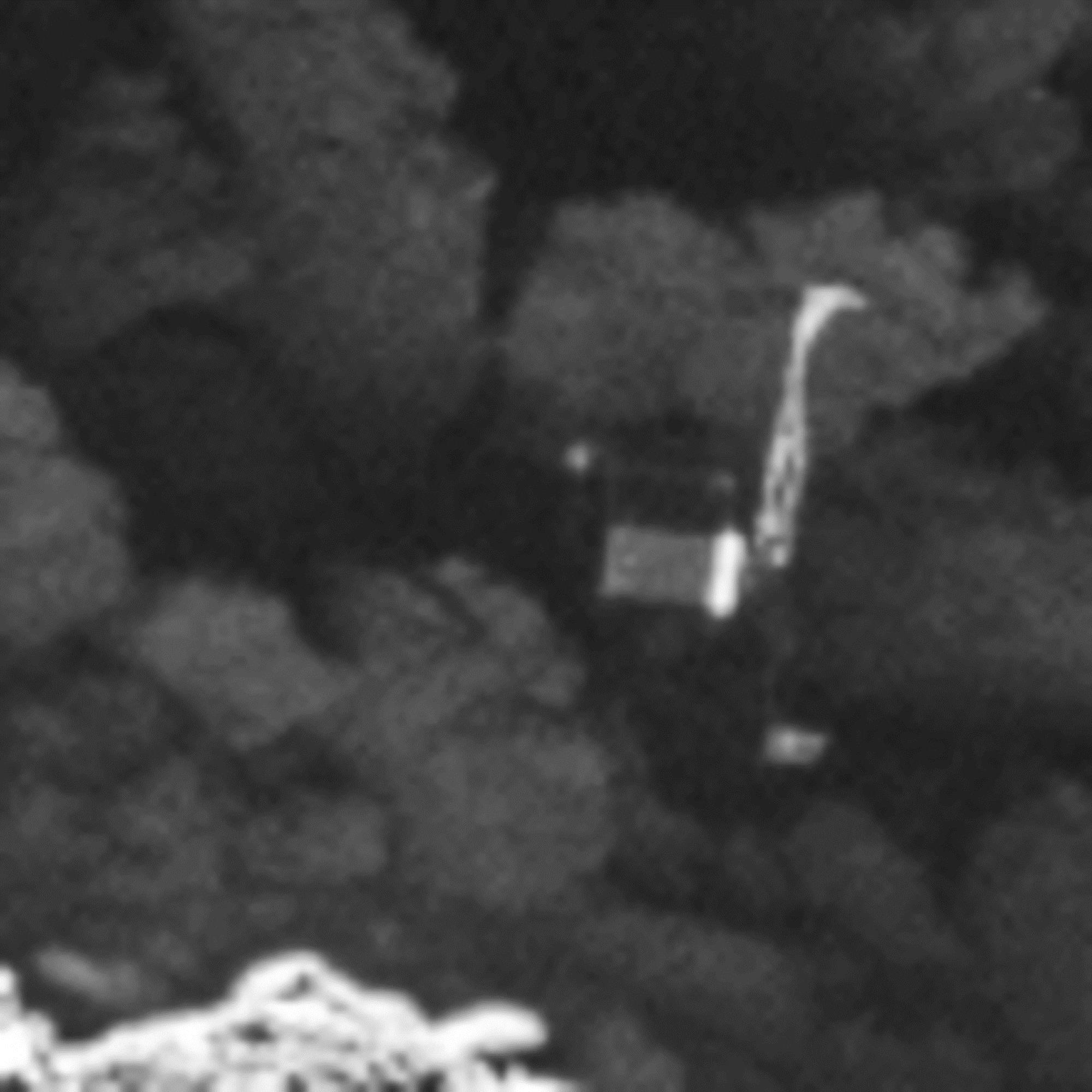
Rosetta’s camera finally captured images on Friday of the lander on comet 67P/Churyumov-Gerasimenko, weeks before the probe’s own mission ends, the agency said. The pictures showing the lander’s body and two of its three legs were taken as Rosetta passed within 2.7 kilometers of the surface.

After being launched in 2004, Rosetta took 10 years to accelerate and catch up with comet 67P. In November 2014 it released Philae, achieving the first landing of a spacecraft on a comet.

Philae bounced after its initial touchdown and its precise location on the comet couldn’t be pinned down until now, though its general vicinity was known.

After sending data to Earth for three days its battery ran out and it went into hibernation, only to recharge enough as thecomet came closer to the sun to communicate briefly with Rosetta in mid-2015.

Comet lander Philae can be seen in this photo taken Friday by Rosetta's OSIRIS narrow-angle camera from a distance of 2.7 kilomters of the Comet 67P/Churyumov/Gerasimenko. Image: European Space Agency
Comet lander Philae can be seen in this photo taken Friday by Rosetta’s OSIRIS narrow-angle camera from a distance of 2.7 kilomters of the Comet 67P/Churyumov/Gerasimenko. Image: European Space Agency

ESA plans to crash Rosetta into the comet Sept. 30, because the probe is unlikely to survive lengthy hibernation in orbit as the comet heads away from the sun.

Data from Rosetta and Philae have already improved scientists’ understanding of the nature of comets and the role they played in the early universe. Analyzing the data fully is expected to keep researchers busy for years.

“We were beginning to think that Philae would remain lost forever,” said Patrick Martin, ESA’s Rosetta mission manager. “It is incredible we have captured this at the final hour.”

Rosetta project scientist Matt Taylor said that locating Philae provides missing information “needed to put Philae’s three days of science into proper context.”

Advertisement

Tied Up and Beaten: Pantippers Trade Tales of Harrowing Discipline

Rescue workers on March 16 show caning marks on a 4-year-old girl’s body who was reportedly beaten by her stepfather and mother in Pathum Thani province.

BANGKOK — Tied to a tree and beaten unconscious. Slapped in the skull so hard an ear is partially sliced off. Forced to inhale smoke from a pot of hot coals mixed with spices.

Those may sound like medieval torture or Khmer Rouge interrogation techniques, but they were punishments some users of the Pantip webforum said they endured as children after upsetting their parents.

The stories were shared by Pantippers in a thread titled “When you were kids, what was the most cruel way your parents punished you?” started back in May which suddenly went viral over the weekend, drawing more than 900 replies by Tuesday.

While commonplace punishments such as caning and slapping were expected, some methods sounded disturbingly sadistic.

“I skipped class when I was in Grade 5. My teacher came to see me at home. After the teacher left, dad tied my hands to a mango tree, then he used an electric cable to whip me until the coating came off, leaving only the copper. After I passed out and woke up, he whipped me again until I passed out yet again. When I woke up, mom had already taken me to a doctor,” wrote user Smarter Than a Dog, Funnier Than a Horse.

Of course the stories are impossible to verify, but the pattern of accounts, many provided by regular users, provided a narrative of the abuse which passes as fierce discipline.

User Confused With Myself wrote about being slapped until “a piece of my ear was sliced off … “

The offense?

“I didn’t come home to eat lunch at home,” the user wrote. “I was playing Legos at my friend’s place.”

A report released by Ministry of Public Health said over 23,000 cases of violence against women and children were recorded by state hospitals throughout the country in 2015. Many of those incidents were domestic violence, the report said.

“When I was young, I was really stubborn. For non-serious offenses , mom would cane me with a galangal plant. For serious offenses, mom would fill coconut shells with red hot coals mixed with a bits of coconut and dry chili. And she would force my head down to smoke it. It was so painful to my eyes and nose. As for my dad, he would cane me with stingray tails,” wrote user Piglet Looking at the Moon.

User Nighttime Circus wrote that the memory remains strong and led to a depression that is still suffered today.

“What stuck in my memory was when I hurried up with … writing because I wanted to go out and play, so my handwriting was not pretty. My booklet was torn to pieces in front of me,” Nighttime Circus wrote. “I cried so hard. It was seared into my memory. I was also caned because I didn’t write with my right hand like other people. I was left-handed.”

Crocodile of the Nile recounted being wrongly accused of stealing a look at a housemaid taking a shower:

“So dad used a metal badminton racket to slap me repeatedly, not caring where it hit me. I and my sibling were hurt; we were scared. We ended up running away to live with our grandmom who lived close by. I think I was in grade 5 or 6.”

Many comments end with disclaimers that they still love and respect their parents, despite the cruel and unusual treatment.

Corporal punishment is still widespread, even though legal protection of children rights has progressed much in recent decades, said social worker Sappasit Khumprapan.

“First of all, it’s illegal,” said Sappasit, director of Centre for the Protection of Children’s Rights. “Secondly, it doesn’t solve anything … Physical punishment such as beating doesn’t teach children what they should or should not do.”

Section 26 of the 2003 Child Protection Act outlaws any “action or inaction that is considered a physical or mental cruelty to children.”.

Instead of resorting to violence, Sappasit said Thai parents should find out why their children fail them in certain tasks.

“For example, your kid doesn’t do homework. You have to find out, was it because of addiction to video games? … Did they have a problem with self-motivation? Or was it because they couldn’t understand the classroom instruction?” Sappasit said.

He noted that violence against children is not only confined to the home but also happens at schools, as often seen in news. In February, a Bangkok school teacher was disciplined for slapping schoolgirls. Two years ago in Mae Hong Son, a teacher reportedly sawed off a 4-year-old boy’s ear.

Some comments in the Pantip thread drew a link between brutal punishment of children and the violence prevalent in the society.

“I’m not surprised that many Thai kids grew up with issues of fear, lack of confidence … and they’re willing to be exploited and taken advantage of while cowering in fear,” wrote user Please Chase Me Off to Bed. “It’s because you are raised with violence. A violence that you don’t even know is violence.”

Advertisement

Duterte Regrets ‘Son of a Bitch’ Obama Took Comment Personally

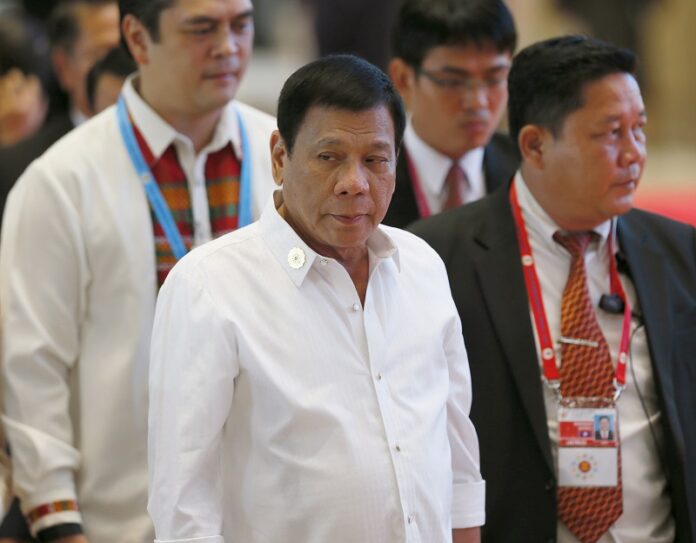
Philippine President Rodrigo Duterte, center, arrives Tuesday at the National Convention Center for scheduled bilateral meetings with ASEAN leaders on the sidelines of the 28th ASEAN Summit in Vientiane, Laos. Photo: Bullit Marquez / Associated Press

VIENTIANE — Philippine President Rodrigo Duterte expressed regret Tuesday over his “son of a bitch” remark while referring to President Barack Obama, in a rare display of contrition by a politician whose wide arc of profanities has unabashedly targeted world figures including the pope and the U.N. chief.

In a statement read out by his spokesman, Duterte said that while his “strong comments” in response to certain questions by a reporter “elicited concern and distress, we also regret it came across as a personal attack on the U.S. president.”

Duterte had made the intemperate remarks Monday before flying to Laos, where he is attending a regional summit. He had been scheduled to meet Obama separately, but Obama indicated he had second thoughts.

Read: Duterte Warns ‘Son of a Bitch’ Obama Not to Question Killings in Philippines

On Tuesday, Duterte said both sides mutually agreed to postpone the meeting.

Even though Duterte’s latest comment does not amount to an apology, the expression of regret is unusual for the tough-talking former mayor, who is unapologetic about his manner of speech and liberally peppers his casual statements with profanities such as “son of a bitch” and “son of a whore.”

But perhaps Duterte’s aides realized it would be unwise to take on the most powerful official in the world, and there would be a price to pay for insulting the president of the United States.

The U.S. is one of the Philippines’ largest trading partners and a key security ally in its fight against terrorism in the country’s south. Manila also needs Washington’s help in dealing with a more assertive China in the disputed South China Sea.

Duterte likely had realized his folly by the time he arrived in the Laotian capital of Vientiane on Monday night.

Speaking to reporters here, he said, “I do not want to quarrel with the most powerful country on the planet,” but immediately took his typical combative approach by saying: “Washington has been so liberal about criticizing human rights, human rights and human rights. How about you? I have so many questions also about human rights to ask you. So … people who live in glass houses should not” throw stones at others.

He said if the White House had problems with him, it could have sent him a diplomatic note and let him respond. “There’s a protocol for that,” Duterte said. “You just cannot shoot a statement against the president of any country.”

But by Tuesday, he had done a complete U-turn in the tone of his statement.

“We look forward to ironing out differences arising out of national priorities and perceptions, and working in mutually responsible ways for both countries,” the statement said.

The flap over Duterte’s remarks started when a reporter asked him how he intends to explain the extrajudicial killings of drug dealers to Obama. More than 2,000 suspected drug dealers and users have been killed since Duterte launched a war on drugs after taking office on June 30.

In his typical foul-mouthed style, Duterte responded: “I am a president of a sovereign state and we have long ceased to be a colony. I do not have any master except the Filipino people, nobody but nobody. You must be respectful. Do not just throw questions. Putang ina, I will swear at you in that forum,” he said, using the Tagalog phrase for “son of a bitch.”

Duterte has previously cursed Pope Francis and U.N. Secretary-General Ban Ki-moon.

“Who is he (Obama) to confront me?” Duterte said, adding that the Philippines had not received an apology from the United States for misdeeds committed during its colonization of the country.

He pointed to the killing of Muslim Moros more than a century ago during a U.S. pacification campaign in the southern Philippines, blaming the wounds of the past as “the reason why (the south) continues to boil” with separatist insurgencies.

Last week, Duterte said he was ready to defend his bloody crackdown on illegal drugs, which has sparked concern from the U.S. and other countries.

Duterte said he would demand that Obama allow him to first explain the context of his crackdown before engaging the U.S. president in a discussion about the deaths.

Duterte has had a troublesome relation with the United States, questioning its inability to stop genocidal killings in the Middle East and Africa, and citing U.S. police shootings of black Americans that have set off protests.

He has also taken on a more conciliatory position with U.S. rival China. Philippines-China ties were strained under Duterte’s predecessors due to territorial conflicts in the South China Sea. Duterte proclaimed early in his presidency that he would pursue a foreign policy not dependent on the United States.

Former Philippine Foreign Secretary Albert del Rosario, under whose watch U.S.-Philippine relations blossomed, expressed disappointment over the aborted meeting with the U.S.

“An invaluable occasion to have our leaders meet for the purpose of discussing how to strengthen our comprehensive areas of cooperation would have been a golden opportunity,” del Rosario said.

Story: Vijay Joshi

Advertisement

1,000 Protest in Myanmar to Greet ‘Meddling’ Annan

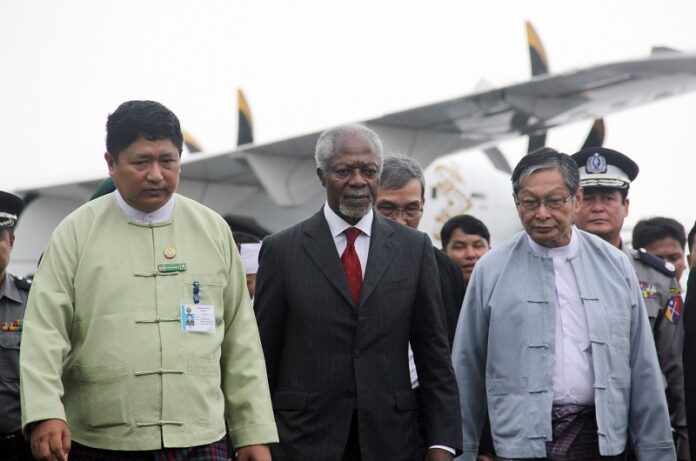
Former United Nations Secretary-General Kofi Annan, center, who chairs the recently created Rakhine State Advisory Commission, escorted by local authorities as he arrived September at the airport in Sittwe, Myanmar. Photo: Esther Htusan / Associated Press

SITTWE, Myanmar — More than 1,000 Buddhists in a Myanmar state wracked by religious and ethnic strife protested Tuesday’s arrival of former U.N. Secretary-General Kofi Annan, saying the Ghanaian is meddling in the country’s affairs by leading a government-appointed commission to find solutions to the conflict.

The Southeast Asian country set up the commission last month to help find solutions to “protracted issues” in western Rakhine state, where human rights groups have documented widespread abuses by majority Rakhine Buddhists against minority Rohingya Muslims.

The state’s dominant Arakan National Party and the Rakhine Women Network led the protest about 300 meters (yards) from the airport in Sittwe, the Rakhine capital, where Annan and other members of the Rakhine Advisory Commission arrived Tuesday morning. As Annan’s car passed, the crowd shouted, “Dismiss the Kofi Annan-led Rakhine Advisory Commission now.”

Read: Myanmar Group Dismisses Offensive ‘Coffee’ Annan Post

“We came here because we don’t want that foreigner coming to our state,” said May Phyu, a local Rakhine Buddhist resident. “I don’t know exactly what this group is and what they are doing, but I came here to protest as I don’t like them to come here.

“I cannot accept them talking about the Rakhine and kalar case in our state,” said protester Soe Thein. “Kalar” is a derogatory word used in Myanmar to refer to Muslims.

Many Buddhists in Rakhine and across Myanmar consider Rohingya to be Bangladeshis living in the country illegally, though the ethnic group has been in Myanmar for generations. Hundreds of Rohingya were killed and tens of thousands forced to flee their homes in 2012 unrest in Rakhine state, and many continue to be confined to squalid camps there.

“We are here to help provide ideas and advice,” Annan said at the Rakhine state government office, where he met government and police officials, community leaders and members of nongovernmental organizations.

“To build the future, the two major communities have to move beyond decades of mistrust and find ways to embrace, share values of justice, fairness and equity,” he said. “Ultimately, the people of Rakhine state must charge their own way forward.”

Hundreds of demonstrators hold banners and shout slogans in protest of the arrival of former United Nations Secretary-General Kofi Annan on Tuesday. Photo: Esther Htusan / Associated Press

Before Myanmar leader Aung San Suu Kyi’s government created the commission, her international reputation as a Nobel Peace Prize-winning democracy icon had been diminished by what some have viewed as her inaction on the Rohingya issue. Her government still does not even use the word “Rohingya.”

“You will see for yourself all the problems on the ground now,” Suu Kyi, officially Myanmar state counselor and foreign minister, told Annan and other commission members at a news conference Monday. “You will be able to assess for yourself the roots of the problems itself, not in one day, not in one week. But I am confident that you will get there, that you will find the answers because you are truly intent on looking for them.”

The commission is to address human rights, ensuring humanitarian assistance, rights and reconciliation, establishing basic infrastructure and promoting long-term development plans.

During their six-day Rakhine trip, the commission will visit the Rohingya camps and meet members of political and religious groups. But the Arakan National Party said it will not meet or work with the commission.

“Rakhine state is in Myanmar and our country has its own sovereignty and there is no way we can accept a commission that is formed by foreigners,” ANP official Aung Than Wai said Tuesday.

Story: Esther Htusan

Advertisement

Yellowshirt Leader Sondhi Jailed 20 Years for Fraud

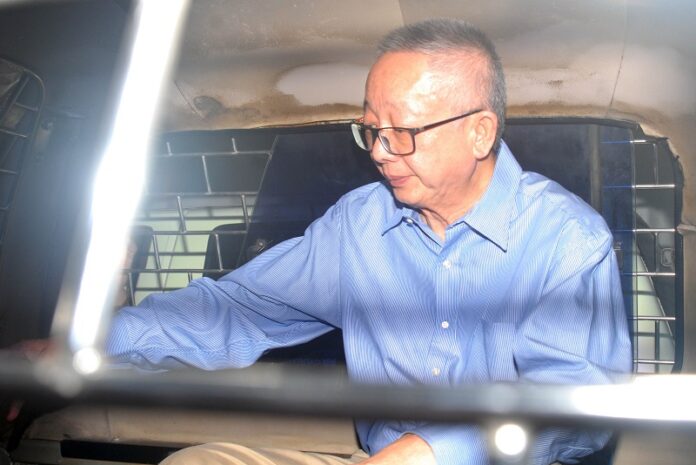
Sondhi Limthongkul is taken to prison Tuesday in Bangkok after the Supreme Court upheld the verdict to imprison him 20 years.

BANGKOK — Years of legal maneuvering ended with one-time Yellowshirt leader Sondhi Limthongkul sent directly to prison Tuesday morning after the Supreme Court ruled he must serve his sentence without it being suspended.

The final verdict upheld a former Appeals Court ruling that Sondhi; founder of Manager Media Group Co., Ltd.; was guilty for creating a fraudulent report under which Manager guaranteed a billion baht loan in 1997 for another company in which he also held a stake.

Sondhi and three other executives were convicted and sentenced to 20 years in prison in 2012 but had been fighting through the appeals process until today’s decision.

Read: Anti-Graft Crusader and Yellowshirt Founder Convicted of Fraud

The courts found the four forged the report to obtain the loan without seeking approval from Manager’s board when they guaranteed a 1.08 billion baht loan from Krung Thai Bank to The M Group Co., Ltd.

They also kept the shareholders of Manager Group Co., Ltd. in the dark by not reporting to the Stock Exchange of Thailand that Manager had guaranteed the loan.

The M Group later defaulted on the loan, forcing Manager Group to repay the massive debt.

The Supreme Court said the executives’ appeal was without merit because they used the same false report six times to acquire loans, illustrating a clear intent to defraud on the part of the defendants.

Sondhi, the founder of prominent media group Manager, led the People’s Alliance for Democracy, or PAD, whose street demonstrations culminated in shutting down Suvarnabhumi International Airport in 2008 to unseat a government aligned with ousted premier Thaksin Shinawatra.

Sondhi played a lead role in the anti-Thaksin movement and rallied against corruption.

He was charged for occupying the airport and shutting down parliament, but the trial against him and other Yellowshirt leaders has hardly moved forward after eight years.


Related stories:

Yellowshirt Leader Released On Bail After Two Weeks In Jail

Imprisoned Yellowshirt Founder ‘Not Enjoying Any Privileges’

Convicted Yellowshirt Leader To Share Prison With Redshirts

Anti-Graft Crusader and Yellowshirt Founder Convicted of Fraud


Advertisement

Hot News

LATEST NEWS

Bangkok
overcast clouds
27.7 ° C
27.7 °
27.7 °
83 %
2.3kmh
100 %
Thu
36 °
Fri
34 °
Sat
28 °
Sun
28 °
Mon
31 °