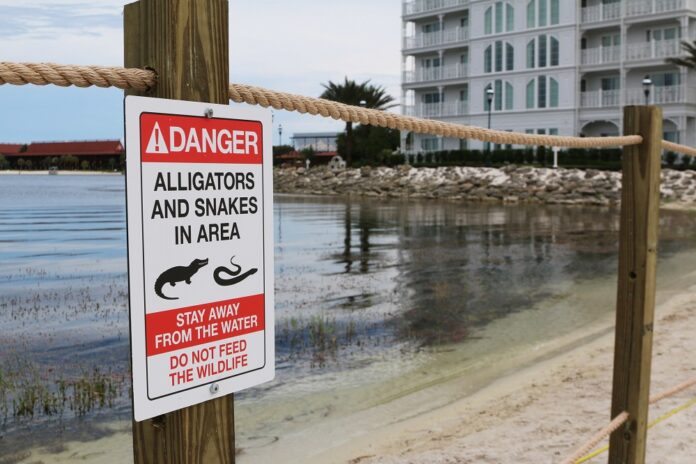
A new sign is seen posted on a beach outside a hotel at a Walt Disney World resort in Lake Buena Vista., after a 2-year-old Nebraska boy killed by an alligator at Disney World on June 14th.
LAKE BUENA VISTA, Florida — The father of a toddler killed by an alligator at Disney last month told rescue officials two alligators were involved in the attack, according to emails from the Reedy Creek Fire Department.
Matt Graves said he was attacked by a second alligator as he tried to reach his 2-year-old son after the boy was pulled into the water outside Disney’s upscale Grand Floridian Resort.
Capt. Tom Wellons described his interaction with the Nebraska father in emails to his supervisors obtained byThe Orlando Sentinel. Wellons said Graves initially refused to leave the area as rescuers searched for little Lane Graves even though the father needed stitches and antibiotics from gator bite marks. Wellons said he eventually persuaded Graves to get medical treatment, promising he could return afterward.
“This incredibly sweet couple insisted on showing us pictures of their happy son. (The) mom kept referring to him as her ‘happy boy,'” Wellons wrote in the emails.
On the way to the hospital, Graves shared “the horror that he experienced” as his son was being pulled into the water and “how another gator attacked him as he fought for his son,” according to the email to supervisors.
The emails were forwarded to Orange County officials to alert them there may be a second gator. The boy’s body was discovered intact about 14 meters from the shore, six feet underwater.
Signs posted in the area advised against swimming but did not warn of alligators. In the days after the attack Walt Disney posted signs warning of alligators in the area.
Florida Fish and Wildlife Conservation Commission officials have said they’re “confident” they caught the alligator that killed the boy.
Agency records listed 15 alligators caught on Disney property from the beginning of this year through May. It didn’t include the six trapped since the June 14 attack.
Walt Disney World recently erected “No fishing” signs on several properties. Fishing at Disney World is now limited to excursions. Netting was also added to the rope fences that were installed after the attack and hotel beaches are now being staffed by employees and closing at night, except during fireworks.
Disney has beaches at eight hotels and at the Fort Wilderness campground.
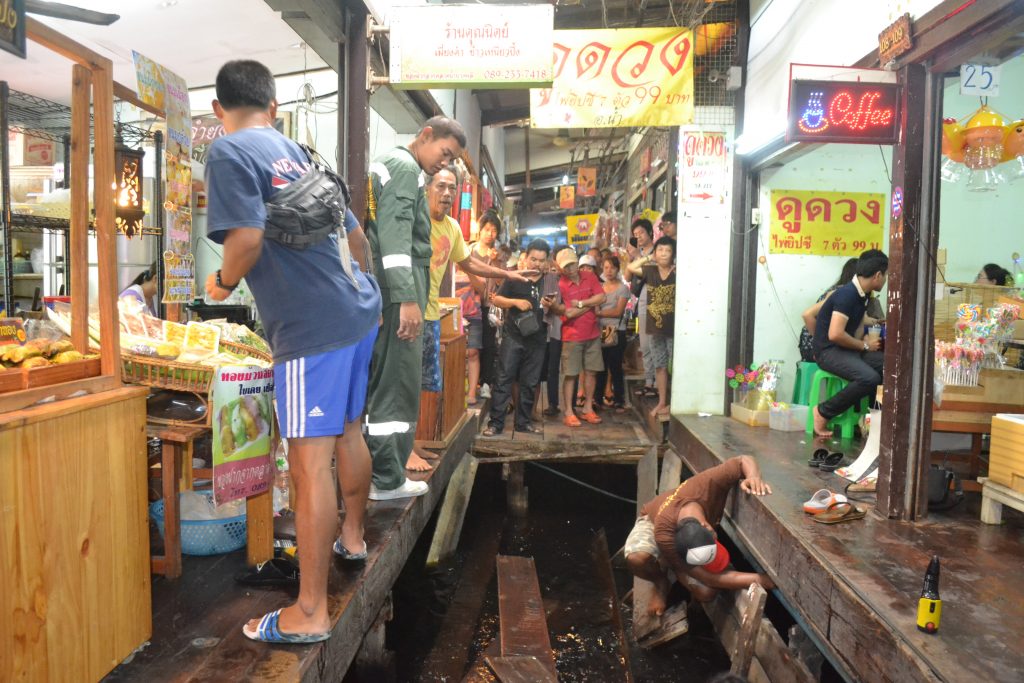
SAMUT PRAKAN — More than 20 tourists fell into waist-deep water at a floating market Sunday when a wooden walkway collapsed.
Officials were scheduled Monday afternoon to inspect the damage and determined the cause of the accident at the century-old floating market in the Bang Phli district. No one was seriously hurt, and the venue remains open to the public.
“After the incident yesterday, we put a large wooden plank over the spot so people could walk,” said Sriprapha Ranrorn, a local tourism official.
The 10-meter walkway collapsed Sunday afternoon while the market was packed with shoppers. More than 20 people fell into the meter-deep water, and one woman was sent to hospital with bruises, but no one was seriously injured, Sriprapha said.
Established around 150 years ago by Chinese merchants, The Old Bang Phli Market is one of several popular floating markets frequented by both Thais and foreigners.
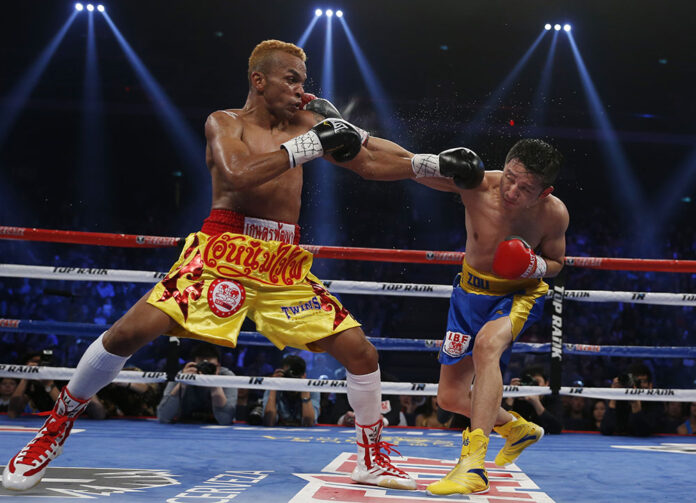
Amnat Ruenroeng, left, exchanges blows with Chinese double-Olympic gold medalist Zou Shiming. Photo: Kin Cheung / Associated Press
VARGAS, Venezuela — Former IBF flyweight champion Amnat Ruenroeng and a French-Cameroonian middleweight contender are the most prominent professional boxers attempting to win berths in the Rio de Janeiro Olympics during the final qualifying tournament.
The International Boxing Association, or AIBA, announced the entrants Saturday for the tournament beginning Sunday in Vargas, Venezuela.
AIBA decided earlier this year to allow professional boxers to compete for an Olympic berth, but Amnat and Hassan N’Dam are the most prominent professionals to accept the organization’s invitation.
AIBA’s decision sparked renewed interest in the often-overlooked Olympic sport, drawing tentative interest from some pros. It also sparked widespread condemnation from fighters and coaches concerned about safety.
After so much drama, it’s increasingly likely that no prominent professional fighters will be in the Rio tournament.
Amnat and N’Dam are both former Olympians, who both fell one victory shy of a medal in their first trips to the Games.
The 36-year-old Amnat is competing at the 60-kilogram lightweight limit in Venezuela. He is most famous for taking up boxing while serving a 15-year jail sentence for robbery.
Amnat fought for Thailand at the 2008 Olympics in Beijing, losing to Mongolia’s Purevdorjiin Serdamba in the quarterfinals.
He didn’t turn pro until 2012, but he won the IBF flyweight title in January 2014 and defended it five times, including a unanimous decision over Chinese star Zou Shiming, a two-time Olympic gold medalist.
Amnat lost his title on May 25, getting stopped by John Riel Casimero. Less than six weeks later, he will attempt to win a spot in the Rio Olympics.
The 32-year-old N’Dam is competing for Cameroon at the 81-kilogram light heavyweight limit in Venezuela. He also fought for Cameroon at the Athens Olympics in 2004, losing in the quarterfinals to Russia’s eventual gold medalist Gaydarbek Gaydarbekov.
N’Dam won his first 27 pro fights, mostly in France. He briefly held interim middleweight titles with the WBO and WBA.
But Peter Quillin beat N’Dam by unanimous decision in October 2012 for the first loss of his career. N’Dam then was battered by Canada’s David Lemieux in June 2015 in a bout for the IBF middleweight title.
AIBA’s Olympic invitations to pros drew scathing condemnation from professional boxing’s sanctioning bodies, who have obvious reasons to protect their own position in the sport. Yet their questions about the safety of matching grown fighters against younger amateurs were echoed by dozens of prominent fighters, including Lennox Lewis and Ricky Hatton.
The Mexico-based WBC announced it will ban any of its top-15 boxers for two years for competing in the Olympics, while the IBF said it would strip a champion’s title or level a one-year banishment from its rankings. While the governing bodies hold little power to prevent pros from fighting, their imprimatur is often a major factor in a professional boxer’s financial success.
Many pros, including Amir Khan and Wladimir Klitschko, showed initial interest in Rio before backing away, citing numerous reasons.
Two-time Olympic gold medalist Vasyl Lomachenko believes pros would need more time to adjust to the daily weigh-ins, three-round bouts and intensive tournaments in the Olympics-style sport. While Rio appears to be a bust for AIBA in attracting top pros, Lomachenko believes bigger names will attempt to fight at the 2020 Games in Tokyo.
Chatree Ruamsungnoen, 27, is brought Monday to regional police headquarters in Bangkok where he confessed to killing a Saraburi province teacher.
BANGKOK — A 27-year-old man publicly confessed Monday to murdering a Saraburi teacher he had sexually assaulted.
Arrested in Saraburi province and brought to the capital, Chatree Ruamsungnoen said at a police news conference that he broke into the unlocked room of Chularat Towanna, 26, on Friday night while she was asleep because he wanted to rape and rob her.
“She woke up before I did anything, so I turned around and found a knife on a shelf,” the cement factory worker said.
Chularat was found dead and unclothed inside her room Saturday morning with her neck savagely slashed. The case has stoked anger across Thailand and reignited calls for mandatory death sentences for rapist-murderers.
Regional police said they were able to identify the perpetrator by reviewing the criminal records of residents in the area. Investigators found Chatree had been released from prison in November where he was serving time on a 2013 rape conviction.
Police said he confessed during interrogation, and they found a knife wound on his left hand.
Although Chatree denied raping the teacher, police Lt. Gen. Chaiwat Kateworachai said they were still examining the victim to determine what happened.
Maria Ehrich and Daweerit Chullasapya in ‘Twilight Over Burma’
BANGKOK — Thailand wants to show off films shot in the kingdom – just maybe not all of them.
The annual Thailand Film Destination Festival still lacked a final lineup two days before it’s set to open, with several notable absences among the 10 films confirmed so far, including a highly anticipated movie about the 1962 Burmese coup censors rejected after it was announced.
The ever-shrinking festival – first announced with 14 films, then 12 and now 10 – has had several films blocked by censors. Although the last unofficial schedule listed 12 films, festival staff said two films — a Swedish movie about an alcoholic priest in Phuket called “Happy Hour in Paradise” and French film about a young boy who dreams to be a mahout in “Sunny and the Elephant” — were still held up Monday by the Ministry of Culture’s board of censors.
A publicist for the event said they hoped to have a final answer on the films by late Monday afternoon.
Most notably missing is “Twilight Over Burma,” a film based on the true story of an Austrian woman who marries a Shan prince that was banned from showing in Myanmar last month at a human rights-oriented film fest.
The film, partly shot in northern Thailand and starring Thai actors, had been announced as part of the festival before being twice rejected by Film and Video Censorship Board without any reason given, according to its producer who had been preparing to travel to Thailand to present his film.
“Friends told me about a press conference on June 13, telling that 13 films were selected, including ‘Twilight Over Burma,’” Alfred Deutsch said. “I suppose a later decision was made not to screen … I don’t know by whom and why [the film] was rejected.”
The film’s production coordinator responded with disappointment to the news.
“We have not been give a good reason why yet,” Chris Lowenstein said by email Monday afternoon. “We are quite proud of the film and hopefully there will be a chance in the future to screen the film in Thailand to the general public.”
As late as noon on Monday, the event’s PR firm was still promoting three films that were given the axe, including the spiritual sequel to a comedy credited with drawing a massive influx of Chinese tourists.
“Detective Chinatown,” made by the same team behind 2012’s “Lost in Thailand,” won’t be showing. Several other films shot in Thailand went unmentioned, such as “Pattaya,” a French comedy in the vein of “The Hangover” that is about what you would expect given its titular setting.
Included in the festival will be Canadian thriller “River” (2015), the true-life tale of an Italian transwoman in “Un Nuovo Giorno,” Bollywood drama “Fireflies” and “Sayonara Itsuka” (2010), a romantic drama of two Japanese old flames rekindle their romance in Bangkok.
Those films are part of the festival’s mission of showing off “the best films shot in the best locations” in Thailand, according to the British programming consultant who has been involved for the past four years.
“Obviously it’s disappointing if for any reason some of the best films don’t get shown,” said Paul Spurrier, the filmmaker behind Bangkok’s Friese-Greene Club. “But it may be for many different reasons.”
Admission is free. The festival starts Wednesday and runs through July 12 at Paragon Cineplex. Moviegoers are encouraged to pick up their tickets 30 minutes before showtime.
Neither Thailand Film Office Director Worateera Suvarnsorn nor Wanasiri Morakul, director of tourism department, could be reached Monday for comment.
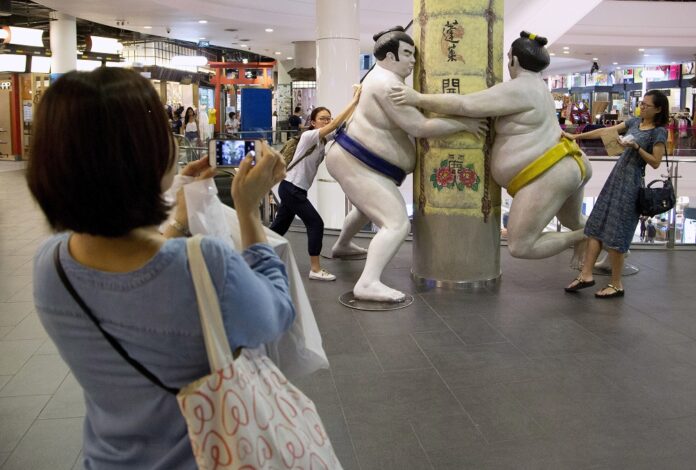
Shoppers pose for a photo with sumo wrestler statues on a Japanese themed floor of a major shopping mall in central Bangkok, Thailand. Photo: Mark Baker / Associated Press
BANGKOK — Thailand is smitten by Japan: Sushi restaurants fill the malls, Issey Miyake’s luxury “Bao Bao” bags are all the rage and Thai tourists are flocking to Japan in record numbers to visit a country many view as a role model.
“I love Japan. They really put their heart into whatever they do,” says Aunyawee Sahachalermphat, 26, who has traveled to Japan more than a dozen times since studying there five years ago and owns at least 10 Comme des Garcons shirts, another popular brand that sounds French but is actually Japanese.
Like many Thais, she loves Japanese food and admires the quality of its products and its advanced, orderly economy that retains a respect for tradition. “We look up to them,” she says.
Japan, too, has a soft spot for Thailand, although it doesn’t loom nearly as large in the public mind. It’s seen more as a warm, easygoing tourist spot — a welcome break from Japan’s often onerous social codes — and a vital production and export hub for more than 4,500 Japanese companies, including behemoths such as Toyota, Honda and Canon.
All this has resulted in a mutual affection between these two nations that’s rare in Asia, where historical, political and territorial tensions often complicate ties.
Typical of many in her generation, Aunyawee traces her positive feelings to watching Japanese cartoons such as “Doraemon” and “Sailor Moon” as a child. As an adult, she instinctively trusts anything “Made in Japan” and admires the courteous, subdued manners of many Japanese — widespread sentiments among Thais.
Economic and bureaucratic changes have helped foster these ties. Three years ago, Japan waived visas for Thais for up to 15 days, prompting tourist numbers to surge to nearly 800,000 last year, up five-fold from 2011.
As Thai incomes have grown and budget carriers such as AirAsia have intensified competition, trips to Japan have become more affordable. Likewise, Japanese tourists can now fly from Tokyo to Bangkok for about the same price as to Okinawa, in southern Japan.
There seems to be a cultural affinity between these two peoples — a gentleness, an aversion to conflict and an emphasis on proper etiquette — that creates a sense of familiarity and safety.
Yet there are still enough intriguing differences to make the other culture appealing in a non-threatening way.
Buddhism, for example, has influenced both countries, although in Thailand it plays a more overt role and it is epitomized by brilliantly colored temples and monks in orange robes, while in Japan it takes on a more subdued form. Both countries have royal families, although the Thai king holds greater sway over society than the emperor does in Japan.
“There’s a kindred feeling” with Thais, more so than with other Asians, said Mariko Uehara, an English instructor from Chigasaki, southwest of Tokyo, who recently visited Thailand for a second time since 2012. “We have something in common that makes us feel secure.” Some 1.38 million Japanese tourists came to Thailand last year, a similar level to previous years.
Japan and Thailand aren’t encumbered by historical baggage that has strained ties with their respective neighbors.
Tokyo’s ties with China and South Korea are tainted by territorial disputes and lingering resentment over Japan’s aggression before and during World War II. After briefly resisting Japanese troops, Thailand formally became an ally of Tokyo during most of the war and served as a supply base and so suffered less. Japan’s infamous “Death Railway” in western Thailand was built by British, U.S. and Australian POWs and thousands of other Asians.
Japan’s rosy image here has been partly shaped by popular books, TV dramas and movies.
“Khu Kam,” a novel that has been made into movies many times — titled “Sunset on the Chaophraya” in English — depicts a wartime romance between a Japanese naval officer and a Thai woman in the resistance. He manages to win her over before being killed.
Japanese food, once considered a delicacy in Thailand, has become more affordable and popular as more than 2,300 Japanese restaurants have opened up across the country, tripling since 2008.
Now a top reason Thais want to go to Japan is to eat authentic Japanese food — in Japan.
Chaitee Tandhanskul, a 29-year-old manager in his family’s chemical business, says he makes bookings at restaurants in Japan weeks ahead of time, and bases his itinerary around those reservations.
“I’ve traveled many times to Japan just for the culinary experience,” he said.
Japan is more popular than previous favorites Hong Kong or Singapore because “it’s much more exotic” and less “robotic,” said Chaitee, who also roams the country taking pictures.
Taking their cues from Thai fashion magazines and websites that highlight the latest Japanese styles, Thai women line up in Tokyo to buy Issey Miyake’s “Bao Bao” brand bags, which can cost several hundred dollars and have become a staple of Bangkok’s fashion elite. Shiseido cosmetics, Kenzo shoes and Casio G-Shock watches are also hot.
Many Thais also like Japan because it is safe and they believe they won’t get cheated by shopkeepers or taxi drivers, said Kavi Chongkittavorn, a senior fellow at Chulalongkorn University’s Institute of Security and International Studies.
The two countries’ economies have become increasingly intertwined.
Thailand’s importance to Japanese manufacturers was made plain when severe flooding here in 2011 swamped many factories and suppliers, disrupting markets as far away as Chicago and London, Japanese Ambassador Shiro Sadoshima said in an interview.
“We need to think in terms of being in the same boat as they are — that whatever Thailand is doing well is good for Japan, too,” said Sadoshima, who was surprised to find a big “Ippudo” restaurant in Bangkok serving ramen noodles native to his home island of Kyushu.
“It’s bigger and grander than the main shop in Japan,” he said.
Japan’s official development aid to Thailand shows up prominently in places like the “Thai-Japanese Bridge” sign — with national flags — on a flyover at a major Bangkok intersection. Assistance from Tokyo helped build 14 of the 21 bridges across the Chao Phraya River that runs through the capital. Officials from the two countries are doing feasibility studies on three high-speed railway lines that would cross the country, the ambassador said.
Bangkok has a large Japanese community, many of whom live clustered in an area that resembles parts of Tokyo, with Japanese eateries and yakitori shops lining side streets and Thai hostesses calling out in Japanese. There are at least a couple streets of go-go bars devoted to Japanese customers.
Each country offers something appealingly different to the other.
The very discipline and proper etiquette that Thais admire about Japanese culture can become an enormous burden to some Japanese who find Thailand’s easygoing, accepting ways a welcome refuge.
Kazue Takenaga moved with her three children to Bangkok two years ago to escape the growing educational and social pressures facing her family, especially her 11-year-old daughter. Her husband had car parts factories in Thailand, so she decided to move here and enroll her children in an international school because the country and environment seemed more accepting and diverse than Japan, and yet also familiar.
“It’s so good that we came to Thailand,” she said. “Our family’s overall health is much better. The lifestyle is much easier here. The thought of returning to Japan is daunting.”
Thais, meanwhile, want to see and experience things in Japan they can’t at home, like snow, cherry blossoms and colored autumn leaves — without traveling all the way to Europe or North America, said Tanong Prakuptanon, who runs a “Japanthaifanclub” Facebook page, which has tips for travelers and more than 230,000 followers.
“It’s different, but not too foreign,” he said. “It’s a dream destination.”
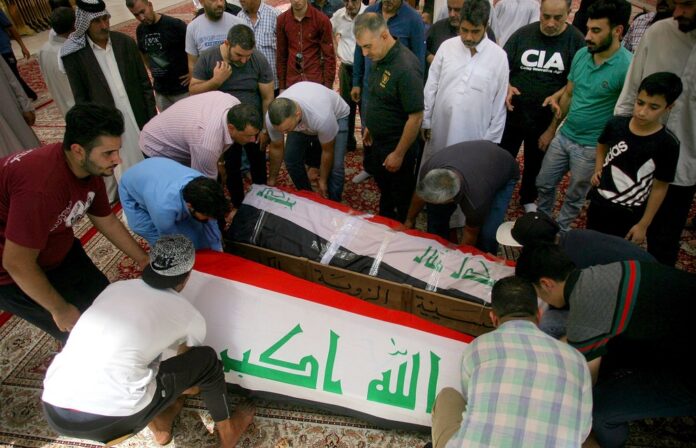
Mourners carry the Iraqi flag-draped coffins of bomb victims, Talib Hassan, 35, and Hamza Jabbar, 37, during their funeral processions Sunday south of Baghdad. Photo: Anmar Khalil / Associated Press
BAGHDAD — A devastating truck bombing on a bustling commercial street in downtown Baghdad killed 115 people early Sunday, brutally underscoring the Islamic State group’s ability to strike the capital despite a string of battlefield losses elsewhere in the country.
It was the deadliest terror attack in Iraq in a year and one of the worst single bombings in more than a decade of war and insurgency, and it fueled anger toward Prime Minister Haider al-Abadi.
When al-Abadi visited the site of the suicide blast in the city’s Karada district, a furious mob surrounded his convoy, yelling expletives, hurling rocks and shoes and calling him a “thief.”
Many Iraqis blame their political leadership for lapses in security in Baghdad that have allowed large amounts of explosives to make their way past multiple checkpoints and into neighborhoods packed with civilians.
Karada, a mostly Shiite section, is lined with clothing and jewelry stores, restaurants and cafes. The blast struck during the holy month of Ramadan, with the streets and sidewalks filled with young people and families after they had broken their daylight fast.
Eleven people were missing and 187 were wounded, authorities said. Many of the victims were women and children who were inside a multi-story shopping and amusement mall. Dozens burned to death or suffocated, a police officer said.
IS swiftly claimed responsibility in a statement posted online, saying the organization had targeted Shiites. The Associated Press could not verify the authenticity of the statement, but it was posted on a militant website commonly used by the extremists.
A second bombing early Sunday on another busy commercial street in a Shiite-dominated neighborhood, this one in east Baghdad, killed five people and wounded 16, authorities said. There was no immediate claim of responsibility.
Hospital and police officials provided the death tolls and spoke on condition of anonymity.
Iraqi forces, supported by U.S.-led coalition airstrikes, have secured a string of victories against IS over the past year and a half, retaking the cities of Tikrit, Ramadi and Fallujah, which was declared fully liberated from the extremist group just over a week ago.
But IS has repeatedly demonstrated the ability to carry out large-scale operations in territory removed from the front-line fighting.
Iraqi officials have repeatedly linked the operation to retake Fallujah to improving security in and around Baghdad, citing the large numbers of bomb factories uncovered in Fallujah, less than an hour drive west of the capital.
However, within Baghdad, security forces that screen for explosives at the ubiquitous checkpoints in and around the city often rely on electronic wands that have been repeatedly discredited.
And security across the capital is fragmented. Baghdad is handled by an array of armed groups that are allied with the government but also loyal to political parties or militias and often do not coordinate or share information.
By early Sunday evening, the crowd at the Karada site had grown, but the yelling had largely ceased.
Exhausted family members sat on sidewalks silently awaiting news of missing loved ones as others began to hang freshly printed death notices for the police officers and shop owners killed. Young people lit candles on street corners.
Karim Sami, a 35-year-old street vendor in Karada, was just leaving work when the blast shook the ground beneath him. He said he saw a fireball rise from the blast site and immediately began trying to call his family and friends, but none of his calls went through.
Hours later he discovered one of his friends had been killed, one was wounded and another was missing.
“We are in a state of war,” Sami said, but “the security can’t focus on the war (against IS) and forget Baghdad.”
It was the deadliest bombing in Iraq since July 2015, when a truck bombing in eastern Diyala province killed at least 115 people.
While the U.S.-led coalition conducts police training in Iraq as part of the battle against IS, the vast majority of resources go toward fighting the extremist group on the front lines.
U.S. Army Col. Christopher Garver said that while the coalition and Iraq are concerned about the Islamic State’s insurgent abilities, the current anti-IS effort “is more of a conventional fight.”
Before announcing the operation to retake Fallujah in late May, al-Abadi faced growing unrest sparked in part by anger at the state of security in the capital. In one month, Baghdad’s highly fortified Green Zone, which houses government buildings and diplomatic missions, was stormed twice by anti-government protesters.
Al-Abadi issued a statement Sunday condemning the attack and describing the loss of life as a “painful tragedy” that “robbed Iraqis of the delight of their victories against the reprehensible (Islamic State group) in Fallujah.”
“These attacks only strengthen our resolve to support Iraqi security forces as they continue to take back territory from ISIL, just as we continue to intensify our efforts to root out ISIL’s terrorist network and leaders,” White House National Security Council spokesman Ned Price said in a statement, referring to IS by an alternative acronym.
At the height of the extremist group’s power in 2014, IS had driven the government from control across nearly one-third of Iraqi territory. Now the militants are estimated to control only 14 percent, according to the prime minister’s office.
An ad from the 1800s suggests margarine is made from dead animals and toxic chemicals, versus the purity of butter.
CAMBRIDGE – Technological innovation is often extolled for its power to overcome major development challenges, fuel economic growth, and propel societies forward. Yet innovations frequently face high barriers to implementation, with governments sometimes banning new technologies outright – even those that could bring far-reaching benefits.
Consider the printing press. Among other things, the new technology was a boon to world religions, which suddenly had an efficient means of reproducing and disseminating sacred texts. Yet the Ottoman Empire forbade the printing of the Koran for nearly 400 years. In 1515, Sultan Selim I is said to have decreed that “occupying oneself with the science of printing was punishable by death.”
Why oppose such a beneficial technology? As I argue in my book “Innovation and Its Enemies: Why People Resist New Technologies,” the answer is not simply that people are afraid of the unknown. Rather, resistance to technological progress is usually rooted in the fear that disruption of the status quo might bring losses in employment, income, power, and identity. Governments often end up deciding that it would be easier to prohibit the new technology than to adapt to it.
By banning the printing of the Koran, Ottoman leaders delayed employment losses for scribes and calligraphers (many of whom were women who were glorified for their mastery of the art). But protecting employment was not their main motivation; after all, beginning in 1727, they did allow non-religious texts to be printed, despite protests by calligraphers, who responded to the edict by putting their inkstands and pencils in coffins and marching to the High Porte in Istanbul.
Religious knowledge was a different matter. It was both the glue that held society together and a pillar of political power, so maintaining a monopoly over the dissemination of that knowledge was critical to maintaining the authority of Ottoman leaders. They feared going the way of the Catholic pope, who lost considerable authority during the Protestant Reformation, when the printing press played a key role in spreading new ideas to the faithful.
Of course, the erection of barriers to technological innovation does not always start with the government. Those with a vested interest in thestatus quo may push their governments to impose bans. They may do so through protest, as the Ottoman calligraphers did, and as Irish opponents of genetically modified potatoes did in 2002, by marching in Dublin to express their opposition to the “death of good food.”
Opponents of new technologies may also employ slander, misinformation, and even demonization – an approach that has certainly succeeded in the past. In 1674, English women issued a petition against coffee, alleging that it caused sterility and thus should be consumed only by people over 60 – a very small market at the time. The following year, King Charles II ordered the suppression of coffeehouses, though he was probably motivated more by the desire to protect the market share of local beverages, such as alcoholic drinks and then-newly introduced tea, than by the infertility rumors.
In the 1800s, the American dairy industry spearheaded a similar misinformation campaign about margarine, claiming that it caused sterility, stunted growth, and male baldness. Derided as “bull butter,” opponents claimed that margarine contained “diseased and putrid beef, dead horses, dead hogs, dead dogs, mad dogs, and downed sheep.”
In response, the federal government introduced new restrictions on margarine, covering everything from labeling (as with genetically modified foods today), the use of artificial coloring, and interstate movement. New taxes reinforced butter’s primacy further. In 1886, a Wisconsin congressman declared outright his “intent to destroy the manufacture of the noxious compound by taxing it out of existence.”
Resistance to tractors in the early 1900s took a slightly different form. Producers and traders of draft animals feared mechanization, which threatened their way of life. But they knew that they could not improve their product faster than engineers could improve theirs, and thus that blocking the spread of tractors would be impossible. Instead, they sought to prevent the displacement of farm animals, by pursuing a campaign touting their virtues. The Horse Association of America issued leaflets declaring that, “A mule is the only fool-proof tractor ever built.” The group also pointed out that horses could reproduce themselves, whereas tractors depreciated.
People almost never reject technological progress out of sheer ignorance. Rather, they fight to protect their own interests and livelihoods, whether that be operating a dairy farm or running a government. As we continually attempt to apply new technologies to improve human and environmental wellbeing, this distinction is vital.
Avoiding barriers to technological progress requires understanding and addressing its downsides. For example, as machines become increasingly capable, robots are replacing a growing number of workers. It will not be long before those robots will be able not only to perform more complex tasks, but also to learn faster than workers can be trained. The notion that some workers will not go the way of the draft animal is irrational.
But if we recognize these losses and address them head-on, we can avoid a backlash against potentially beneficial technological innovations, including advances in robotics. The key will be to focus on “inclusive innovation,” ensuring that those who are likely to lose from the displacement of old technologies are given ample opportunity to benefit from new ones. Only then can we make the most of human creativity.
Calestous Juma (@calestous) is Professor of the Practice of International Development at Harvard’s Kennedy School of Government. He is the author of the forthcoming book Innovation and Its Enemies: Why People Resist New Technologies.
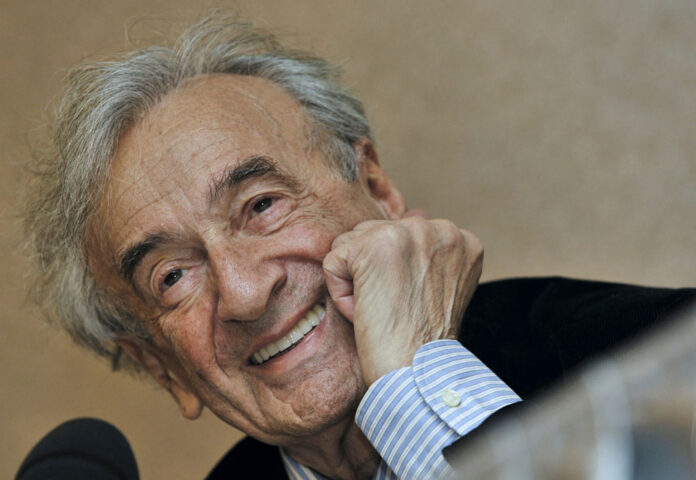
Elie Wiesel smiles during a December 2009 news conference in Budapest, Hungary. Photo: Bela Szandelszky / Associated Press
NEW YORK — Nobel laureate Elie Wiesel, the Romanian-born Holocaust survivor whose classic “Night” became a landmark testament to the Nazis’ crimes and launched Wiesel’s long career as one of the world’s foremost witnesses and humanitarians, has died at 87.
His death was announced Saturday by Israel’s Yad Vashem Holocaust Memorial. No other details were immediately available.
The short, sad-eyed Wiesel, his face an ongoing reminder of one man’s endurance of a shattering past, summed up his mission in 1986 when accepting the Nobel Peace Prize: “Whenever and wherever human beings endure suffering and humiliation, take sides. Neutrality helps the oppressor, never the victim. Silence encourages the tormentor, never the tormented.”
President Barack Obama said of Wiesel on Saturday, “As a writer, a speaker, an activist, and a thinker, he was one of those people who changed the world more as a citizen of the world than those who hold office or traditional positions of power. His life, and the power of his example, urges us to be better.”
Wiesel’s wife, Marion, described her husband as “a fighter” in a statement Saturday night.
“He fought for the memory of the six million Jews who perished in the Holocaust, and he fought for Israel,” she said. “He waged countless battles for innocent victims regardless of ethnicity or creed.”
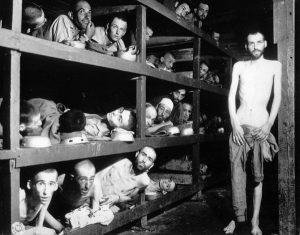
In This April 16, 1945 file photo provided by the U.S. Army, Elie Wiesel, seventh from left in the middle row, is among inmates at the German KZ Buchenwald concentration camp near Weimar a few days after it was liberated by U.S. soldiers. Photo: US Army / Associated Press
For more than a half-century, Wiesel voiced his passionate beliefs to world leaders, celebrities and general audiences in the name of victims of violence and oppression. He wrote more than 40 books, but his most influential by far was “Night,” a classic ranked with Anne Frank’s diary as standard reading about the Holocaust.
“Night” was his first book, and its journey to publication crossed both time and language. It began in the mid-1950s as an 800-page story in Yiddish, was trimmed to under 300 pages for an edition released in Argentina, cut again to under 200 pages for the French market and finally published in the United States, in 1960, at just over 100 pages.
“‘Night’ is the most devastating account of the Holocaust that I have ever read,” wrote Ruth Franklin, a literary critic and author of “A Thousand Darknesses,” a study of Holocaust literature that was published in 2010.
“There are no epiphanies in ‘Night. There is no extraneous detail, no analysis, no speculation. There is only a story: Eliezer’s account of what happened, spoken in his voice.”
Wiesel began working on “Night” just a decade after the end of World War II, when memories were too raw for many survivors to even try telling their stories. Frank’s diary had been an accidental success, a book discovered after her death, and its entries end before Frank and her family was captured and deported. Wiesel’s book was among the first popular accounts written by a witness to the very worst, and it documented what Frank could hardly have imagined.
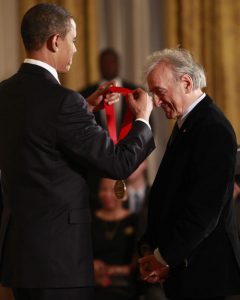
US President Barack Obama presents the 2009 National Humanities Medal to Elie Wiesel, in the East Room of the White House in Washington, on Feb. 25, 2010. Photo: Pablo Martinez / Monsivais
“Night” was so bleak that publishers doubted it would appeal to readers. In a 2002 interview with the Chicago Tribune,Wiesel recalled that the book attracted little notice at first. “The English translation came out in 1960, and the first printing was 3,000 copies. And it took three years to sell them. Now, I get 100 letters a month from children about the book. And there are many, many million copies in print.”
In one especially haunting passage, Wiesel sums up his feelings upon arrival in Auschwitz:
“Never shall I forget that night, the first night in camp, which has turned my life into one long night, seven times cursed and seven times sealed. Never shall I forget that smoke. Never shall I forget the little faces of the children, whose bodies I saw turned into wreaths of smoke beneath a silent blue sky. … Never shall I forget these things, even if I am condemned to live as long as God Himself. Never.”
“Night” was based directly on his experiences, but structured like a novel, leading to an ongoing debate over how to categorize it. Alfred Kazin was among the critics who expressed early doubts about the book’s accuracy, doubts that Wieseldenounced as “a mortal sin in the historical sense.” Wiesel’s publisher called the book a memoir even as some reviewers called it fiction. An Amazon editorial review labeled the book “technically a novel,” albeit so close to Wiesel’s life that “it’s generally — and not inaccurately — read as an autobiography.”
In 2006, a new translation returned “Night” to the best-seller lists after it was selected for Oprah Winfrey’s book club. But the choice also revived questions about how to categorize the book. Amazon.com and Barnes & Noble.com, both of which had listed “Night” as fiction, switched it to nonfiction. Wiesel, meanwhile, acknowledged in a new introduction that he had changed the narrator’s age from “not quite 15” to Wiesel’s real age at the time, 15.
“Unfortunately, ‘Night’ is an imperfect ambassador for the infallibility of the memoir,” Franklin wrote, “owing to the fact that it has been treated very often as a novel.”
Wiesel’s prolific stream of speeches, essays and books, including two sequels to “Night” and more than 40 books overall of fiction and nonfiction, emerged from the helplessness of a teenager deported from Hungary, which had annexed his native Romanian town of Sighet, to Auschwitz. Tattooed with the number A-7713, he was freed in 1945 — but only after his mother, father and one sister had all died in Nazi camps. Two other sisters survived.
After the liberation of Buchenwald, in April 1945, Wiesel spent a few years in a French orphanage, then landed in Paris. He studied literature and philosophy at the Sorbonne, and then became a journalist, writing for the French newspaper L’Arche and Israel’s Yediot Ahronot.
French author Francois Mauriac, winner of the 1952 Nobel in literature, encouraged Wiesel to break his vowed silence about the concentration camps and start sharing his experiences.
In 1956, Wiesel traveled on a journalistic assignment to New York to cover the United Nations. While there, he was struck by a car and confined to a wheelchair for a year. He became a lifetime New Yorker, continuing in journalism writing for the Yiddish-language newspaper, the Forward. His contact with the city’s many Holocaust survivors shored up Wiesel’s resolve to keep telling their stories.
Wiesel became a U.S. citizen in 1963. Six years later, he married Marion Rose, a fellow Holocaust survivor who translated some of his books into English. They had a son, Shlomo. Based in New York, Wiesel commuted to Boston University for almost three decades, teaching philosophy, literature and Judaic studies and giving a popular lecture series in the fall.
Wiesel also taught at Yale University and the City University of New York.
In 1978, he was chosen by President Carter to head the President’s Commission on the Holocaust, and plan an American memorial museum to Holocaust victims. Wiesel wrote in a report to the president that the museum must include denying the Nazis a posthumous victory, honoring the victims’ last wishes to tell their stories. He said that although all the victims of the Holocaust were not Jewish, all Jews were victims. Wiesel advocated that the museum emphasize the annihilation of the Jews, while still remembering the others; today the exhibits and archives reflects that.
Among his most memorable spoken words came in 1985, when he received a Congressional Gold Medal from President Ronald Reagan and asked the president not to make a planned trip to a cemetery in Germany that contained graves of Adolf Hitler’s personal guards.
“We have met four or five times, and each time I came away enriched, for I know of your commitment to humanity,”Wiesel said, as Reagan looked on. “May I, Mr. President, if it’s possible at all, implore you to do something else, to find a way, to find another way, another site. That place, Mr. President, is not your place. Your place is with the victims.”
Reagan visited the cemetery, in Bitburg, despite international protests.
Wiesel also spoke at the dedication of the U.S. Holocaust Memorial Museum in Washington in 1993. His words are now carved in stone at its entrance: “For the dead and the living, we must bear witness.”
Wiesel defended Soviet Jews, Nicaragua’s Miskito Indians, Cambodian refugees, the Kurds, victims of African famine and victims of ethnic cleansing in Bosnia. Wiesel was a longtime supporter of Israel although he was criticized at times for his closeness to Prime Minister Benjamin Netanhayu. When Netanhayu gave a highly controversial address to Congress in 2015, denouncing President Obama’s efforts to reach a nuclear treaty with Iran, Wiesel was among the guests of honor.
“What were you doing there, Elie Wiesel?” Haaretz columnist Roger Alpher wrote at the time. “Netanyahu is my prime minister. You are not an Israeli citizen. You do not live here. The Iranian threat to destroy Israel does not apply to you. You are a Jew who lives in America. This is not your problem.”
The Elie Wiesel Foundation for Humanity, which he established in 1988, explored the problems of hatred and ethnic conflicts around the world. But like a number of other well-known charities in the Jewish community, the foundation fell victim to Bernard Madoff, the financier who was arrested in late 2008 and accused of running a $50 billion Ponzi scheme.
Wiesel said he ended up losing $15.2 million in foundation funds, plus his and his wife’s own personal investments. At a panel discussion in February 2009, Wiesel admitted he bought into the Madoff mystique, “a myth that he created around him that everything was so special, so unique, that it had to be secret.” He called Madoff “a crook, a thief, a scoundrel.”
Despite Wiesel’s mission to remind the world of past mistakes, the greatest disappointment of his life was that “nothing changed,” he said in an interview.
“Human nature remained what it was. Society remained what it was. Too much indifference in the world, to the Other, his pain, and anguish, and hope.”
But personally, he never gave up — as reflected in his novel “The Town Beyond the Wall.”
Wiesel’s Jewish protagonist, Michael, returns to his native town in now-communist Hungary to find out why his neighbors had given him up to the Nazis. Suspected as a Western spy, he lands in prison along with a young man whose insanity has left him catatonic.
The protagonist takes on the challenge of “awakening” the youth by any means, from talking to forcing his mouth open — a task as wrenching as Wiesel’s humanitarian missions.
“The day when the boy suddenly began sketching arabesques in the air was one of the happiest of Michael’s life. … Now he talked more, as if wishing to store ideas and values in the boy for his moments of awakening. Michael compared himself to a farmer: months separated the planting from the harvest. For the moment, he was planting.”
Armored vehicles arrive after militants took hostages at a restaurant popular with foreigners Saturday in Dhaka, Bangladesh. Photo: Associated Press
DHAKA, Bangladesh — Bangladeshi forces stormed an upscale Dhaka restaurant where heavily armed militants held dozens of people hostage Saturday morning, killing at least six of the attackers and rescuing 13 captives including foreigners at the end of the 10-hour standoff.
About 35 people were taken hostage, including about 20 foreigners, when gunmen stormed the Holey Artisan Bakery in Dhaka’s Gulshan area, a diplomatic zone, on Friday night.
“We have gunned down at least six terrorists and the main building is cleared but the operation is still going on,” Lt. Col. Tuhin Mohammad Masud, commander of the Rapid Action Battalion, told The Associated Press three hours after the commandos launched the rescue operation.
He said there were casualties among other hostages, but did not provide details.
Masud said the rescued included a Japanese, who was injured, and two Sri Lankans. He said that some of the militants were captured.
The Islamic State group claimed responsibility for the attack, according to the SITE Intelligence Group, which monitors jihadis activity online. A news agency affiliated with the Islamic Group claimed that 24 people had been killed and 40 wounded, including foreigners, according to SITE. The figures could not be independently confirmed.
The Amaq news agency also posted photos purportedly showing the bodies of hostages. The authenticity of the pictures could not be confirmed either.
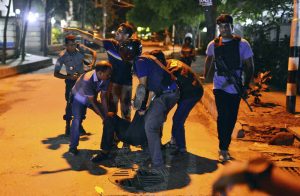
People help an unidentified injured person after a group of gunmen attacked a restaurant popular with foreigners in a diplomatic zone of the Bangladeshi capital of Dhaka on Saturday. Photo: Associated Press
With the sound of gunfire and explosions, local TV stations reported that the rescue operationbegan at 7:40 a.m. It included army personnel with automatic weapons and at least seven armored vehicles and ambulances.
Local media reported that an Argentine and two Bangladeshis also were rescued from the restaurant early Saturday, but details about their condition were not immediately available.
Commandos storming the restaurant discovered five bodies lying in blood, a police official who was not identified told Channel 24 TV station. It wasn’t clear if they were militants or hostages.
The attack marks an escalation in the growing drumbeat of militant violence to hit the traditionally moderate Muslim-majority nation in the past three years, but with increasing frequency in recent months. Most attacks have been by machete-wielding men singling out individual activists, foreigners and religious minorities.
Bangladesh did not immediately respond to the claim of responsibility by IS, but in the past have denied that the extremist group has a presence in the country. The U.S. State Department said it had seen the IS claim, but could not confirm its authenticity.
The attackers “have not responded to authorities’ calls for negotiation,” said Masud.
He said that the security cordon would prevent any of the attackers from escaping. Authorities also ordered internet services to be blocked across the country, according to internet service provider Aamra.
Police said the two officers died at a hospital after being wounded in the initial gunfire with as many as nine attackers, who also hurled bombs. Ten of 26 people who were wounded when the militants opened fire were listed in critical condition, and six were on life support, according to hospital staff. The injuries ranged from broken bones to gunshot wounds. Only one civilian was among the wounded.
Kitchen staffer Sumon Reza, who escaped, said the attackers chanted “Allahu Akbar” (God is Great) as they launched the attack around 9:20 p.m. Friday, initially opening fire with blanks.
The nationalities of the hostages were not immediately clear. On Saturday, Japan’s top government spokesman Yoshihide Suga said at a hastily called news conference in Tokyo that the government is trying to confirm that Japanese were among the hostages. Prime Minister Shinzo Abe told reporters that saving lives is the top priority.
Among the hostages was a businessman and his wife and two children, according to his uncle Anwarul Karim.
“My nephew Hasnat Karim called me and said he was inside with his family. He told me, ‘Please save us, please!’ And he hung up,” he said. “We do not know what is going on there.”
In Washington, a White House official said President Barack Obama was briefed on the attack by his chief counterterrorism adviser Lisa Monaco. The president asked to be kept informed as the situation develops, said the official, who was not authorized to speak publicly about the president’s meetings.
State Department spokesman John Kirby says the U.S. is in contact with the Bangladesh government and has offered its assistance to bring those responsible to justice.
He said all official American personnel are accounted for with no injuries reported, and the department is working with local authorities to determine if any U.S. citizens and locally-employed staff were affected.
The spree of recent attacks in Bangladesh have raised fears that religious extremists are gaining a foothold in the country, despite its traditions of secularism and tolerance.
About two dozen atheist writers, publishers, members of religious minorities, social activists and foreign aid workers have been slain since 2013. On Friday, a Hindu temple worker was hacked to death by at least three assailants in southwest Bangladesh. IS and and al-Qaida affiliates have claimed responsibility for many of the attacks.
Prime Minister Sheikh Hasina’s government has cracked down on domestic radical Islamists. It has accused local terrorists and opposition political parties — especially the main opposition Bangladesh Nationalist Party and its Islamist ally Jamaat-e-Islami — of orchestrating the violence in order to destabilize the nation, which both parties deny.