Chanthaburi Gov. Witoorat Srinam and Maj.Gen.Suriya Pawaree, 19th Military Circle commander, beseech local spirits for help finding a missing Royal Thai Air Force helicopter and its crew.
CHANTHABURI — A search and rescue operation resumed for a third day Monday for a missing Air Force helicopter and its crew of three.
Officials said they’re still not sure what happened to the Bell-UH1 after contact was lost Saturday over the Khao Chamao-Khao Wong National Park, which straddles the border between Rayong and Chanthaburi provinces. The helicopter was on its way to resupply an air force radar station.
Chanthaburi Gov. Witoorat Srinam said Sunday evening the searching operation involving 300 officers still did not succeed. Reports that some villagers might have seen members of the crew could not be verified due to poor weather, which was keeping rescue efforts limited to ground operations.
The governor and regional military commander on Sunday joined in an animistic prayer ceremony appealing to nature spirits for help..
Those who vanished with the helicopter included pilots Squadron Leader Pasit Techasen and Flight Lt. Alongkorn Chankrachan, along with maintenance officer Flight Sgt. 1st Class Visut Puttharaksa.
KUALA LUMPUR — A Malaysian woman has died after the airbag in her Honda City ruptured in a minor collision, a safety official said Monday.
The incident Sunday came days after Honda Malaysia announced an additional recall of more than 145,000 vehicles to replace defective front passenger airbag inflation devices.
Fire and rescue official Rosdi Hainan said the steering-wheel airbag had ruptured when he arrived at the site of the accident, and the victim was bleeding from her chest.
Rosdi said the woman died a short time later.
Honda officials could not be immediately reached for comment.
There has been a massive recall involving millions of vehicles around the world because of faulty inflator and propellant devices that may deploy improperly in an accident, shooting out metal fragments that can injure or kill.
Worldwide, 11 known deaths and more than 100 injuries have been blamed on exploding Takata-made airbag inflators
In November last year, a 43-year-old pregnant Malaysian housewife was killed after a collision activated the airbag in her Honda. Honda also confirmed two other deaths that are linked to airbag issues in April and May this year.
Pradit Prasartthong in ‘1932’ The Musical / Courtesy: Anatta Theatre Troupe and Democrazy Theatre Studio
BANGKOK — Though Friday marked the 84th birthday of Thai Democracy, its essence has faded, with the bloodless turning point for the nation hardly mentioned, not even in the arts.
Apart from the practical political change it brought, the end of almost 700 years of feudalism and absolute monarchy proved a wellspring of free of expression in the arts, especially literature, inspiring important and interesting works about the incident and those involved in the performing arts and cinema.
As the revolution’s acclaim has turned to unease – the day is no longer a holiday and activists were arrested Friday for recognizing it – here’s a look at its troubled legacy in different mediums.
Literature
Suchart Sawadsri / Photo: Matichon
After the 1932 Revolution, literature flourished in terms of content reflecting the bloom of democracy and progressive attitudes in the middle class, which had been previously obsessed with romanticism. Authors were treated as pioneers of social realism such as Kulap Saipradit, aka Siburapha; Malai Chupinit; and M.L. Buppha Nimmanhemin, aka Dokmaisot; who gave voice to feminism.
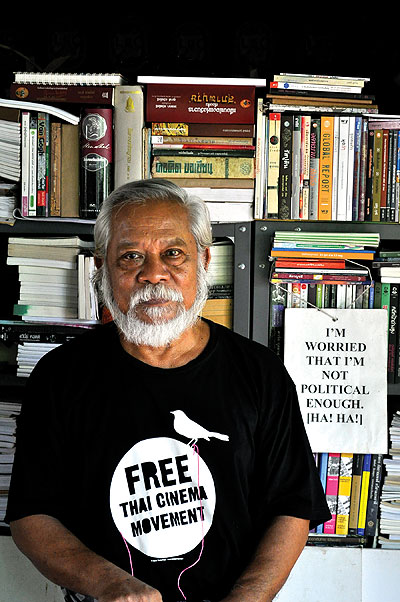
“Written works always reflect society, and our society isn’t perfect, so its literature echoes that,” said Suchart Sawadsri, the 2011 National Artist awardee in Literature.
The 71-year-old writer and editor explained that after the democratic revolution, poets, writers and journalists realized their pens were mightier than swords and suddenly unafraid of expressing themselves. And after the 1947 coup, the writers joined a progressive literary movement which became known as Literature for Life, or Phuea Chiwit.
“For me, Literature for Life ended in 1980 with Order 66/2523, in which the government outlined policies to fight against the communist insurgency. It turned Thai literature from social realism to capitalist realism, where most writers no longer strove for justice and some even censored themselves,” the prolific writer said.
To test his theory, Suchart responded to the 2014 coup by coming out of retirement to resume his role as editor of Chor Karaked, a magazine of short stories, to pursue themes on militarism and society.
He said that today he has hope again.
“Although I gave up hope in most writers in my generation, I’ve found some promising prospects in the new generation who stay true to their standpoint and aren’t afraid to express it,” he said.
Performing Arts
Kue Pu Apiwat (The Revolutionizer) / Photo: Crescent Moon Theatre
The 1932 Revolution once took the stage in the form of a portrayal of one of its leaders from the Khana Ratsadon, or People’s Party.
Crescent Moon’s 1987 production of “Kue Pu Apiwat (The Revolutionizer)” about Pridi Banomyong intercut his politically active years with the words of his manifesto during an hour-long performance. It has been restaged several times domestically and abroad, and the script has been published.
B-Floor Theatre was founded in 1999 to stimulate social and political awareness through physical movement. Teerawat “Ka-Ge” Mulvilai, its founder and artistic director, created “Typhoon: The Remains” in 2013 to commemorate the 40 year anniversary of the watershed uprising of Oct. 14, 1973. The performance was praised for wisely representing a broad picture of political history beginning from the 1932 Revolution and subtly portraying the clash between commoners and elites.
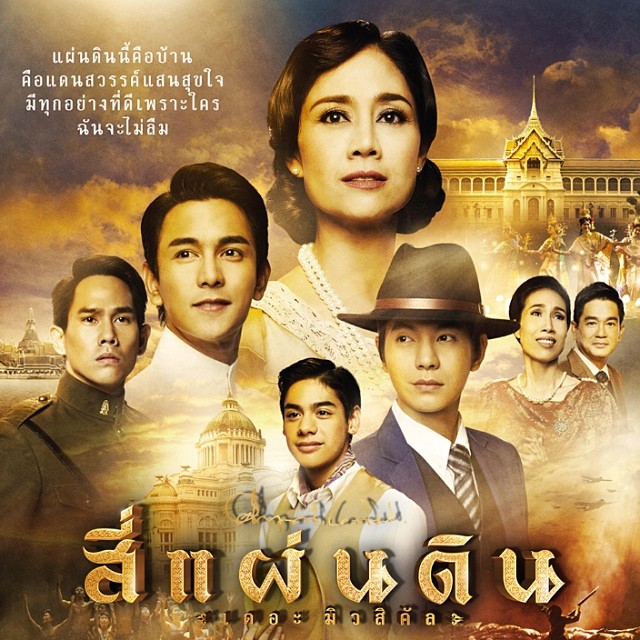
‘Si Phaen Din’ (The Four Reigns) / Photo: Rachadalai / Facebook
After being made and remade as a TV drama five times, Kukrit Pramoj’s famous novel “Si Phaen Din (The Four Reigns)” debuted on stage in 2011 by the grace of theatrical guru Takonkiet Viravan. It tells the story of Phloi, a woman who has lived through major transitions in the political order, from 1932 onward, with an emphasis on how individuals adapt. Although being criticized as conservative melodrama, the play was successful and was revived in 2014.
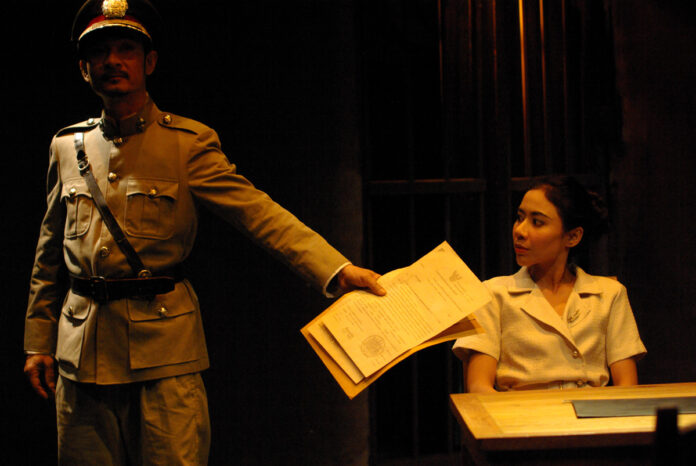
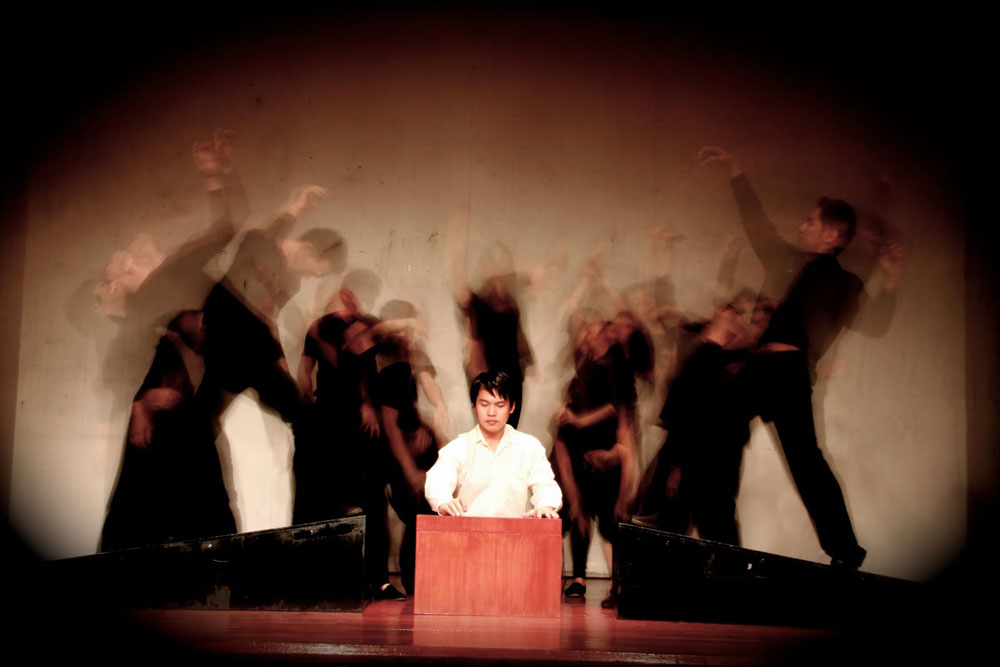
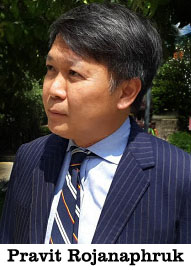
In the same year, Pradit Prasartthong, 56, a renowned theatrical actor and director who founded the Anatta Theatre company, staged the “‘1932’ The Musical” to depict the time of upheaval from the perspective of Pridi’s wife, Poonsuk Banomyong.
‘1932 the Musical’ / Courtesy: Anatta Theatre Troupe and Democrazy Theatre Studio
“I wanted to break the stereotypical ideas of the 1932 incident and show that women contributed to the men’s success,” Pradit explained. “I’m not afraid to tell the story, even though some might think it’s sensitive, because the incident has passed, and the play was not 100-percent truth. Still, it helped the audience to reflect about what’s happening now and see if we’ve learned from the past.”
Pradit spent a year researching the event before producing the play. Also in 2014, he created another play about social realist writer Siburapha. Also, he plans to stage a play based directly on the events of 1932.
“As an artist, there’s nothing wrong with telling an untold story. There’s an attempt to use history as a tool to justify and incriminate what’s happening in the present. If this hasn’t been fixed, one day what happened in 1932 will be forgotten,” Pradit said.
Film
The bloodless 1932 revolution and birth of the modern Thai state was among the early Thai films made, noted director Khun Wichitmatra in “Principles of Thai Cinema,” because it was filmed in newsreels by the Wasuwat bros. The director, who also composed the national anthem, pointed out the moment King Rama VII signed the incorrectly named “Permanent Constitution of Siam” was also captured on film afterward in December.
In the realm of fiction, stories about the end of absolute monarchy have been scarce.
In 2009, “October Sonata” by Somkiat Vituranich told a love story punctuated by social turning points such as the 1973 uprising and Siburapha’s tragic novel “War of Life.”
It failed commercially, but critics liked it.
One year later, ML Bhandevanov Devakula aka Mom Noi began using classic novels to express his critical view of the revolution in films such as “Chua Fah Din Salai (Eternity)”, “U Mong Pa Meung (The Outrage),” “Jan Dara,” “Plae Kao (Scar)” and “Mae Bia.”
His reinterpretations of classic works by the likes of Malai Chupinit, Kukrit Pramoj and Pramool Unhathoop were criticized for being absurdly sexed-up and unfaithful to their originals, adding subtle and not subtle attacks on the people who staged the revolt.
“Mom Noi’s recent films don’t directly criticize the revolution but use metaphor, background, and conservative characters to achieve that. From the director’s point of view, the incident is the root of current political problems,” said former political science professor Sirote Klampaiboon.
Film critic Chayanin Tiangpitayagorn said the changes from the source material were obvious in Mom Noi’s remake of “Plae Kao,” Thailand’s Romeo-and-Juliet tale (Kwan and Riam, actually) about love across class lines.
“The characters based on real life people appeared in the film such as Chomphon Por [Field Marshal Plaek Phibunsongkhram] and other elites. The movie refuses the third Thai Prime Minister’s attempt to make Thailand civilized in the way of Western countries,” Chayanin said.
So why are politics and real history difficult to find in Thai cinema? It’s just a reflection of the lack of openness in society, he said.
“It’s the nature of Thai film business that rarely involves any politic aspect. Not only 1932, but the turmoils in this century are also neglected,” said Chayanin. “The market also gives negative response to political films. As a result, Thai showbiz is limited to a few politically related avenues of expression.”
He laments that this rich material has been effectively placed out of reach.
“The 1932 Revolution is important, as it’s the point when all humans became equal, and it was the first time this principle was used as a premise to governing the whole country,” Sirote said. “In an open-minded society, the stories about 1932 would be interesting resources and subjects to explore, like how the Americans and French turned their revolutionary history into plays and films.”
Note: This article has been revised to reflect that Siam went through 700 years of feudalism and absolute monarchy prior to the 1932 revolution.
An updated Huey, the TH-1H, in US Air Force Service at Randolph Air Force Base in 2005. Photo: Wikimedia Commons
BANGKOK — Rescuers are searching for an air force helicopter a day after contact was lost during heavy rains.
Radar contact with the Bell UH-1 helicopter with three crewmen aboard was lost Saturday afternoon and an initial search was suspended due to the rains.
Air force spokesman Air Vice Marshal Pongsak Semachai said Sunday that the helicopter was on a mission to resupply a radar station in Chanthaburi province, 215 kilometers east of Bangkok.
It began its mission at a base in Lopburi, about 150 kilometers northeast of the capital.
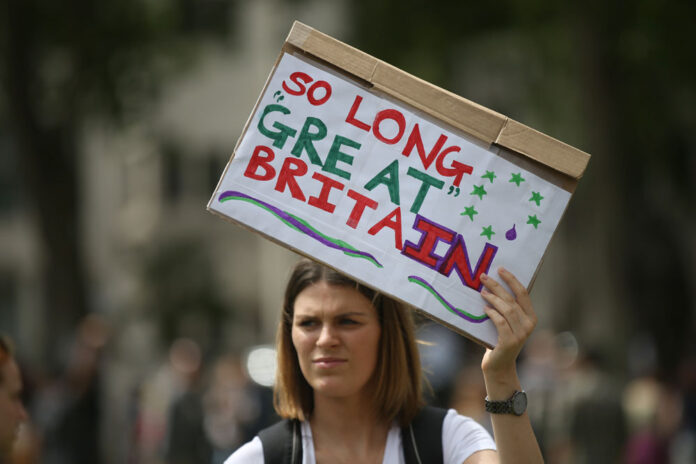
Demonstrators opposing Britain's exit from the European Union in Parliament Square following the EU referendum result protest Saturday in London. Photo: Tim Ireland / Associated Press
LONDON — With its vote to leave the European Union, the United Kingdom has staged a revolt so forceful that it will shake – and potentially even destroy – the European project. Indeed, as the UK pursues its extraordinary experiment in applied democracy, there will undoubtedly be calls elsewhere in Europe – mostly in northern countries like Denmark, Finland, the Netherlands, and Sweden – to follow the British example. But what are those who would leave revolting against?
The EU was built in the aftermath of World War II as a way, finally, to escape Europe’s centuries-long legacy of violent conflict. Following two brutal wars in which the creation and competing ambitions of nation-states played a central role, Europeans embraced internationalism as the foundation of a new political order, one that had to be protected at all costs.
To that end, it was crucial to construct supranational bodies that tied Europeans to one another and, in the name of integration, imposed limits on individual countries. European courts became responsible for protecting the rule of law, and new institutions such as the European Central Bank asserted increasing control over the economy.
As a result, Europe quickly came to resemble a nagging nanny, constantly telling countries what they couldn’t do, from trying to spend their way out of economic crisis to paying their pensioners the benefits they deserve. Feeling constrained in their capacity to manage the massive economic challenges they faced, countries began to turn on Europe, with anti-EU campaigners, particularly in smaller countries like Greece, claiming that they had faced unfair, even cruel, treatment. The dream of easy prosperity through integration seemed to be dead.
Then came the worries about migration and mobility, with dynamic economies like the UK concerned about being inundated by workers from struggling countries. In requiring all members to remain open to migration from other member states, the EU looked like a maniacal party host, demanding that all the guests mingle, whether they want to or not. Many Europeans simply had no interest in meeting new people.
Of course, unlike the value of new friendships, the importance of economic migration is not a personal judgment. But pro-EU campaigners in Britain never managed to address the migration issue clearly and convincingly. Prime Minister David Cameron declared passionately that Europe was important for Britain’s security, but lacked the courage to say that migration is good for Britain, and that venerated institutions like the National Health Service depend on foreigners, from doctors to cleaners, to function.
In any case, the most detested feature of European integration lay elsewhere. National political establishments became so immersed in the EU that they seemed out of touch with their own people. Finance ministers talked to other finance ministers more than to their own colleagues, let alone the voters.
With virtually all of the mainstream parties having formed the same habit, the electorate’s only means of expressing its discontent was to vote for anti-establishment forces, many of which made opposition to the EU a central tenet of their platform. Most recently, in May 2015, large numbers of traditional Labour voters deserted their party in order to vote for the UK Independence Party (UKIP), which was at the forefront of the Brexit campaign.
To be sure, establishment leaders have long been trying to save their own skins by ramping up criticism of the EU, blaming it for demanding that national governments pursue unpopular or failed policies. But that merely put ideas for alternate policies out of reach, while causing the voters to direct their opposition against the EU itself.
Though the establishment parties criticized the EU, for the most part they did not lose sight of the benefits of membership. Indeed, in the UK referendum, both major parties backed the “Remain” campaign, though they were split internally. While most of the Labour Party actively campaigned for Europe, its leader, Jeremy Corbyn, was less than enthusiastic. The split in the Conservative Party ran much deeper.
So British voters entered the voting booth feeling that the EU had failed them, and that their national leaders could not protect their interests unless the UK left. But there was one more group against which Brexit voters were protesting: the “experts.”
Almost every economist warned that Brexit would have serious consequences, from the immediate shock – and, indeed, the pound has already dropped to a 31-year low – to longer-term trade challenges. George Soros anticipates financial meltdown. Political scientists have highlighted the security and other risks. Even British football bosses have argued that UK clubs are better off in Europe.
The problem is that citing expert views seemed patronizing to many voters. Given that the EU was already viewed as a project that benefited elites disproportionately, maybe even exclusively, this is not surprising. Like a frustrated child being scolded by an overweening schoolmaster, many Britons decided that they would show them.
The vote for Brexit was driven by the sense that political and economic the “elites” were both corrupt and wrong about the likely consequences. That hypothesis is about to be tested – and against a background of mistrust and division, no less. The time of subsisting on criticism is over. Brexit’s supporters must now prove that they made the right choice, by reaching a workable solution that upholds British economic and political stability. Unfortunately, they may well find that there is no better alternative to Europe. Harold James is Professor of History and International Affairs at Princeton University and a senior fellow at the Center for International Governance Innovation.
Sweepee Rambo is held by owner Jason Worz. Photo: Karen Spencer / World's Ugliest Dog Contest
PETALUMA, California — A 17-year-old Chinese Crested Chihuahua with legs bowed out like a frog and an oozing sore is the winner of this year’s World’s Ugliest Dog contest.
SweePee Rambo took home the title at the annual Petaluma World’s Ugliest Dog Contest Friday night at the Sonoma-Marin Fairgrounds after besting 15 other malformed pooches, local media reported Saturday.
Sweepee Rambo. Photo: World’s Ugliest Dog Contest
Judges in the contest, now in its 28th year, take into account bad appearance, including stench, poor complexion and a host of other inherited and acquired maladies.
SweePee has a mohawk that glistens in the sun and a tongue that sticks out. She is blind in both eyes and has to wear doggie diapers.
Owner Jason Wurtz, 44, of Encino, said he got the dog as a gift for his first wife but after a week she didn’t want anything to do with the gremlin-like pooch. Wurtz, however, said he couldn’t bear to let her go, calling her a “ride-or-die chick” in the description he wrote for the contest.
When the 4-pound Chinese Crested Chihuahua mix was announced the winner, Wurtz’s younger brother, Jeffrey Wurtz, burst into tears, shouting SweePee’s name, and shaking a homemade sign that read “SweePee Rambo for President 2016.”
The presidential election was a theme present in the contest.
World’s Ugliest Dog Contest
One pup named Himisaboo, who didn’t place, had a flowing golden tuft that resembled that of the presumptive Republican nominee for president.
“Whether you love him, or loathe him, a vote for Himisaboo is a vote for a dog that looks like Donald Trump,” said Heather Wilson, Himisaboo’s owner, who drove out from Idaho for the occasion.
Jason Wurtz and SweePee took the first-place title and trophy and a prize of $15,000. He says he will use the money to pay for the removal of a tumor that recently popped up on SweePee’s gum line.
A distraught mother searches the burned-out dorm of Pitakkiat Witthaya school on May 24 for belongings of her daughter who died in the fire.
CHIANG RAI — When the fire broke out on the ground floor of Pitakkiat Witthaya boarding school just before midnight on May 22, all of the schoolchildren were fast asleep on the second floor. The girls were said to be still sleeping when toxic fumes seeped into their room.
Because the all-girls school was not equipped with any smoke detector, many of the victims died without ever realizing there was a fire. By the time the blaze was doused, 17 young girls were dead.
“The kids didn’t have a chance to flee,” Bussakorn Saensuk, a fire safety expert who inspected the scene of the burned-out dorm, said by telephone Friday. “This is why we need to have smoke detectors. Even if you have proper fire exits, but if the kids couldn’t wake up and weren’t alerted of the fire, it’s useless.”
Bussakorn, who works with the Engineering Institute of Thailand, added, “Having a smoke detector should be the first priority.”
Like other public buildings, the dorm at Pitakkiat Witthaya school is required by law to have safety equipment like smoke detectors and fire alarms, yet enforcement is lax and violations very rarely punished.
On Monday, the police told grieving parents they had ruled the fire an unfortunate accident, meaning no one will be charged with any crime. Winai Pisailert, father of a girl killed in the fire, said he and other victim families had doubts about the police’s decision and will consult with independent experts about whether the fire was indeed unpreventable as said.
Pitakkiat Witthaya is run by a Christian charity called Panthakit Suksan Foundation. Its directors have yet to agree to any financial compensation to parents of the 17 victims, Winai said.
“This is not about the amount of money, large or small,” Winai said. “I just want them to show some responsibility.”
Malleable Law
According to a 1997 law, three fire items must be installed in all public buildings: fire exits, smoke detectors and fire extinguishers. But Songtham Allapach, deputy commander of regional police, said the school dorm was built years before the law was enacted, so police did not consider it in violation.
“It has nothing to do with smoke detectors,” Pol. Maj. Gen. Songtham said. “They didn’t have to install that. The building is really old.”
Songtham said inspection of the building falls to the Ministry of Social Development and Human Security, since it has jurisdiction over charity foundations registered with the agency.
If Panthakit Suksan Foundation passed the inspection by the ministry, Songtham reasoned, it must be in compliance of regulations and codes.
Pathita Samutharin, a ministry official, said the foundation obtained its license as a charity in 1983, long before fire regulations came into effect, so all the officials could do was to “reprimand” the directors and tell them to update their fire alarm system to comply with what’s now in the law books.
“We already inspected there. There was no fire exit. There were fire extinguishers, but no fire alarm. We have already reprimanded them,” Pathita said.
Bussakorn from the Engineering Institute of Thailand said such apathy is common across Thailand, and therefore why so many buildings aren’t up to fire safety standards.
According to Bussakorn, local officials are required by 1997 fire safety law to inspect outdated buildings and order their owners to comply with current regulations. If the officials did not push for the compliance, and usually that’s the case, nothing would happen.
“We have to rely on the enforcing officials to inspect the buildings and order them to fix it,” Bussakorn said, adding, “In my reading, there’s not much of a punishment. So people are not enthused to follow the laws. This issue is very old, it’s been going on for a long time already, but no one campaigned for the public to see its importance.”
She said she can’t think of one incident in which building owners were punished for failing to comply with the inspection.
“The law isn’t severe,” Bussakorn said. “It’s just like motorcycle safety helmets. The law [on that] is so laxly enforced. Even basic safety issue like that, very few people comply.”
Winai, whose 11-year-old daughter perished in the fire, hoped that same tragedy of lax enforcement will not be repeated in the future.
“The flaw in the dorm where my child died, I want it to be a lesson for the state agencies to check safety of other dorms and foundations,” he said.
Patitha, the official from the Ministry of Social Development and Human Security, said authorities did learn some lesson, and enforcement will be more serious from now on.
“Our new policy is that we will recheck all the places,” Patitha said. “It means that all the charity foundations will have to renew their license on a year-by-year basis … we will inspect them and order them to comply with current laws.”
Bussakorn said she also felt that authorities are stepping up efforts to regulate fire safety in the wake of the deadly fire in Chiang Rai.
“I think officials are becoming more active. They carry out inspections more often, which is good,” she said. “But it’s something that’s owed to a violent incident. Our country is like this. Some people have to die first.”
SAMUT PRAKAN — Police are looking for a group of knife-wielding men who brawled in a road in southern metro Bangkok Friday evening.
Witnesses said two groups of what looked to be teens numbering about 20 ran into each other on Nakhon Kuan Kan Road in Phra Pradaeng district at around 6pm and threw down a melee using knives, sticks and other improvised weapons, including at least one broom.
Gunshots were also heard as onlookers scurried for cover.
By the time police and soldiers arrived at the scene the brawlers were already gone.
Officers at Phra Pradaeng Police Station said they’re studying security cameras in the area to identify the perpetrators, who are suspected of being rival gang members from local polytechnic colleges.
Street gang fights between warring college students is common in the metropolitan area. In a June 8 incident, two students were left injured by a similar clash in front of the Future Park Rangsit shopping mall north of Bangkok.
Savory Burmese Tea Leaf Salad from a restaurant in ... San Francisco. Photo: Ron Dollete / Flickr
It wasn’t something 26-year-old Thawng Tha Lian expected would be an issue when he left Myanmar nine months ago on a scholarship to earn a master’s degree at Bangkok’s Chulalongkorn University.
Given the two-to-three million migrant workers from Myanmar estimated to be in Thailand, plenty of whom live in the capital, Tha Lian thought finding a decent Burmese restaurant or two would be easy.
But struggle Tha Lian did. And when he found one nondescript eatery serving foods from Myanmar hidden in the Ratchaprarop area, he quickly lost his appetite.
“When I tried, I didn’t like it because I felt it was so dirty,” Tha Lian said. “There are many Burmese people in Thailand but why we don’t have [restaurants]?”
He attributes it to the poverty among most of the migrant workers, where at least a million are not recognized under the law, basically making them illegal and without rights.
I think there are other factors at play as well.
The biggest obstacle to having a decent Burmese restaurant is not the distance from Bangkok to Yangon, or the lack of able cooks, but the attitudes of many of us Thais.
Brought up by ultranationalist educations, most are taught that Burma is a historical enemy to this day. Many Thais are also brainwashed by the notion of Thai exceptionalism into believing their food is the best in the world, with little or nothing of value from their immediate neighbors, Myanmar included, because it is “boring” food.
Thais are generally not just ignorant about cuisine of Myanmar, but with its diverse ethnic groups.
I am not alone in thinking people of Myanmar are kept invisible, intentionally or not. An on-going exhibition at Museum Siam entitled “Myanmar Up-Close” shares my sentiment.
“On the sociocultural level, we know so little about our neighbor, despite the fact that Thailand and Myanmar have long exchanged cultures, and Myanmar is such an integral part of our daily lives, more than we can imagine,” wrote Rames Promyen, Director of National Discovery Museum Institute.
The exhibition, geared toward the middle class, reflects the lack of meaningful interaction with the Myanmar in Bangkok and elsewhere. The workers are just workers, and their identities as Burmese, Shan, Karen, Mon or Pa-O is irrelevant and of no interests to parochial Thais.
The exhibition, which runs through July, highlights issues such as the hardships migrants face, like the fact some can only visit home after five years, must endure shared living arrangements where roommates trade use of small spaces by working different shifts.
The exhibition urges Thais to think more about exchanging with the people of Myanmar today rather than historical aggressors, an anachronism referring to the fact the old Siamese capital of Ayutthaya was sacked by the Burmese twice before it was abandoned in favor of Bangkok. The last time the “enemies” destroyed Ayutthaya was 1767, five decades before the British burned Washington D.C. in 1814, but the sentiments remain, thanks to excellent and open-minded history books written to instill nationalism.
But back to the food. The otherwise laudable exhibition revealed little about it apart from a June 5 cooking workshop and a reference that gaeng hung lae, a popular Northern Thai curry, originated from Myanmar. No mention of the bizarre absence of Burmese restaurants in most of Bangkok, however.
Call it indifference, contempt, bigotry, historical animosity or a mere lack of curiosity, the fact there’s a dearth of decent Burmese restaurants in Bangkok, a city bursting with Japanese, Korean and Western establishments, says a lot about the invisibility of Myanmar and its people in Thailand.
I feel sorry for Tha Lian but he expects to be back home in three months.
This is more a lost culinary opportunity for millions of Thais who could otherwise enrich themselves savoring more diverse food from a country it shares over 2,401 kilometers of land border with.
Burmese food is popping up an urban eating trend elsewhere in the world, according to Gourmet Gourmand, and hopefully an ascendant Myanmar and tourism there will spark interest here.
Now, could anyone kindly direct me to a nice Burmese restaurant in Bangkok where I can order a plate of soothing Tea Leaf Salad? Thonglor? Soi Ari?
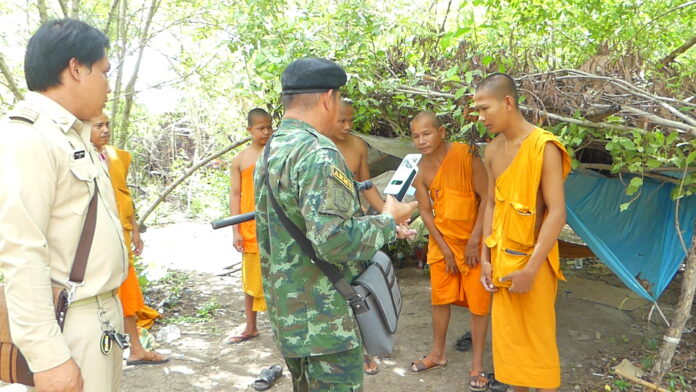
Police take a group of Cambodian monks into custody Saturday in northern metro Bangkok. They were later stripped of their robes and sent for deportation.
PATHUM THANI — Six Cambodian monks were arrested in a forest north of Bangkok Saturday for allegedly entering the kingdom illegally.
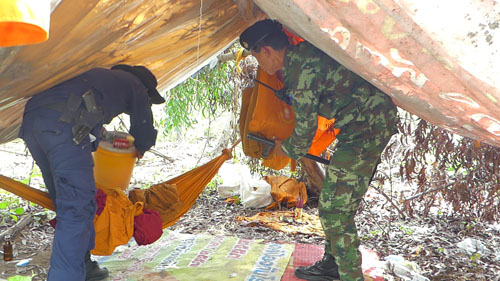
A combined force of soldiers and officials raided their camp in a wooded area in Pathum Thani province’s Sam Khok district at around 9:30am in response to complaints from local residents that Cambodian monks were begging for morning alms in town.
Five of the six monks did not carry passports, while the others did but lacked entry stamps, said Saichol Phuchalermtrakul, a local administrator.
Police search through the belongings of a group of Cambodian monks Saturday in northern metro Bangkok.
The six, whose names were withheld by officers, were taken to a temple for a defrocking ceremony and later sent to Immigration Police for deportation proceedings.
Saichol said officials are expanding their investigation to seek and capture other monks in Pathum Thani who might have entered Thailand illegally.








































 He attributes it to the poverty among most of the migrant workers, where at least a million are not recognized under the law, basically making them illegal and without rights.