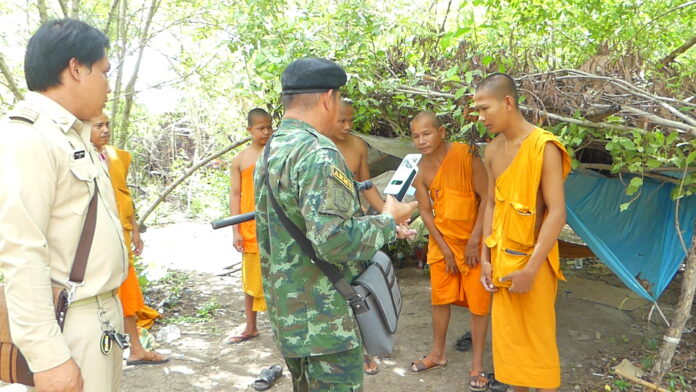
Police take a group of Cambodian monks into custody Saturday in northern metro Bangkok. They were later stripped of their robes and sent for deportation.
PATHUM THANI — Six Cambodian monks were arrested in a forest north of Bangkok Saturday for allegedly entering the kingdom illegally.
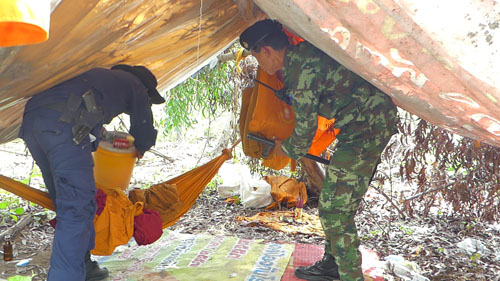
A combined force of soldiers and officials raided their camp in a wooded area in Pathum Thani province’s Sam Khok district at around 9:30am in response to complaints from local residents that Cambodian monks were begging for morning alms in town.
Five of the six monks did not carry passports, while the others did but lacked entry stamps, said Saichol Phuchalermtrakul, a local administrator.
Police search through the belongings of a group of Cambodian monks Saturday in northern metro Bangkok.
The six, whose names were withheld by officers, were taken to a temple for a defrocking ceremony and later sent to Immigration Police for deportation proceedings.
Saichol said officials are expanding their investigation to seek and capture other monks in Pathum Thani who might have entered Thailand illegally.
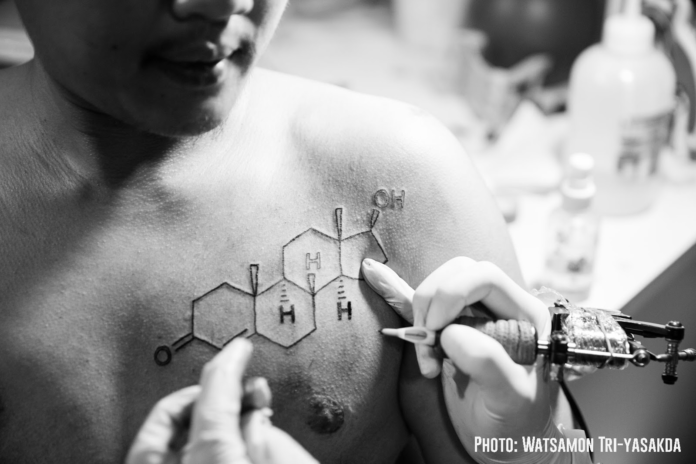
Kanattsanan 'Mukk' Dokput receives a tattoo in February representing the testosterone molecule to signify his transition to a male identity. Photo: Watsamon Tri-yasakda
BANGKOK — Kanattsanan “Mukk” Dokput was 27 when he sank the first needle full of black market testosterone into his thigh.
He chose a dose recommended by veterans of DIY hormone therapy. The needle was too short to reach muscle; his entire thigh swelled painfully.
That first injection came after a nine-year obsession sparked by a documentary on sex reassignment surgery. “This is what I’m gonna do,” he told himself when the program ended.
Mukk’s mom was the first to learn of his plan. “Couldn’t you just be a tomboy?” she asked, using the Thai label for women who adopt a masculine appearance.
Yes, Mukk replied,“But I won’t be happy for the rest of my life.” Mukk, now 32, was born female but showed masculine tendencies from an early age. His mother had to chase him around their home to slip on the skirt worn by girls in kindergarten. He cried all day until he could take it off.
Many more injections would follow. For the first year, Mukk struggled with the mechanics of getting male hormones into his body. By the second, third and fourth, he’d become an expert. But at times his self-administered treatment left him light-headed, among other side effects. Late last year, he began suffering chronic fatigue.
Kanattsanan ‘Mukk’ Dokput, seated at middle, at the Tangerine Health Community Center in Bangkok.
While the world is just catching up to Thailand’s awareness of the full spectrum of gender and sexual identity, the attention here and elsewhere remains fixed on transgender women.
There’s a broad base of knowledge and community supporting transwomen, who in Thailand often begin hormone treatment at the onset of puberty. There’s little available for transmen, who retain all the medical needs of women and put their health in jeopardy by going it alone to realize their full identity.
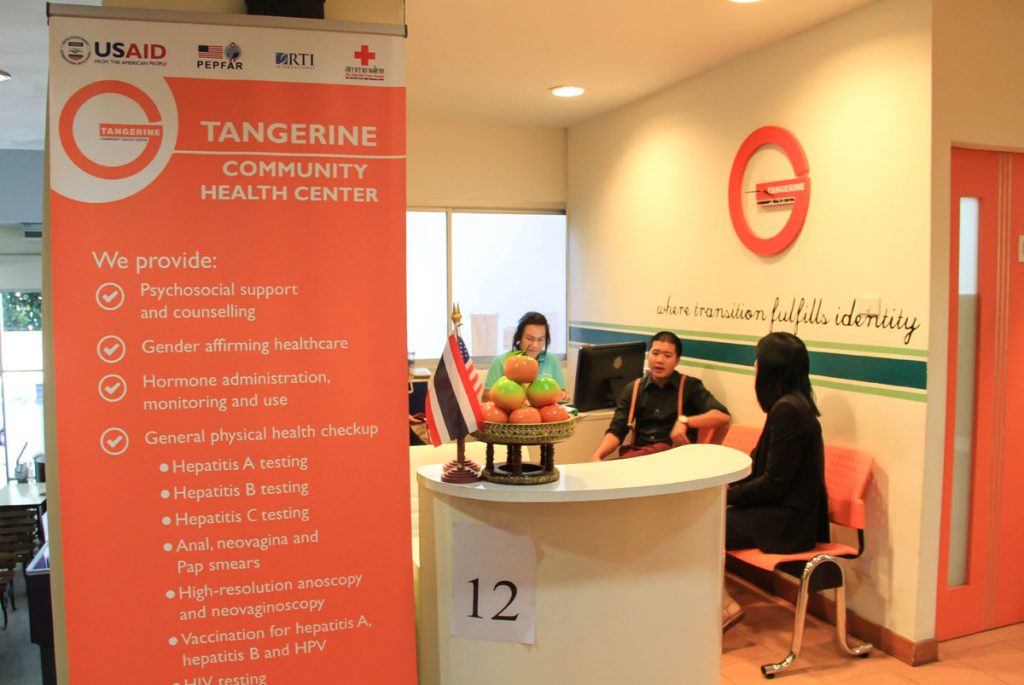
That changed late last year with the opening of the first transgender health clinic in Thailand and all of Asia. At the Tangerine Health Community Center, Mukk learned from a doctor his liver was ravaged from years of overdosing on testosterone, with levels twice that occurring naturally in men.
Tangerine offers full services for transgender clients including psycho-social counseling, vaccines, hormone treatment, pap smears and STD tests.
As Mukk learned, hormone overdoses are common among transmen, who sometimes overdo it out of a desire for “manliness.”
“Testosterone administration has been spread word of mouth from one transman to another. There have been a lot of hormone overdoses, which can cause liver function problems, high levels of blood fat and diabetes in the long term,” Nittaya said.
The clinic’s head doctor said they were unaware of the demand for services from transgender men until they opened to find female-to-male transsexuals at the front of the line.
“We didn’t expect we’d have this many transmen coming to us,” said Nittaya Phanuphak Pungpapong, who also heads AIDS prevention efforts for the Thai Red Cross Society. “This shows they couldn’t find any service like this before, as if they had been waiting for this to happen for a long time.”
Escalating Needs
The first patient diagnosed with HIV/AIDS in Thailand was reported in 1985. By 1999, HIV/AIDS had become the leading cause of death in men 24-44, according to USAID.
Though HIV prevalence and AIDS-related deaths fell sharply over the past decade, HIV infections are still mostly found among men who have sex with men, male sex workers and transgender women.
Tangerine Clinic is located in the Thai Red Cross’ Anonymous Clinic, the first such in Asia. It resulted from the natural progression of services and resulted from discussion between Thai Red Cross and its partners, who came up with an idea of promoting safe hormonal therapy instead of just shouting out for everyone to take HIV tests.
While hospitals offering sex reassignment surgery are easy to find, Nittaya said most don’t provide the follow-up care available at Tangerine, such as hormone therapy, hormone-balance tests, blood tests and pap smears.
Although Thailand is somewhat tolerant of its identity diversity, that’s not to say attitudes are progressive. As anywhere, the transgender population suffers discrimination, bullying and abuse.
This carries over into essential, professional services.
“In Thailand, transgender people have limited access to healthcare services because they have had unpleasant experiences with stigma and discrimination,” Nittaya said. “Therefore, we want to be a transgender-friendly clinic to eliminate stigmatization and discrimination towards trans people.”
Before Tangerine opened, the staff and medical personnels were trained to be gender sensitive: They learned what expressions, apart from not being medically useful, could be considered offensive.
“A sensitive question like ‘You’re so beautiful. Where did you go for your surgery?’ which we assume a transwoman would be flattered to hear,” Nittaya said. “But many of them don’t think so.”
Under the anonymous system, patients are assigned codes instead of being publicly announced by title and names.
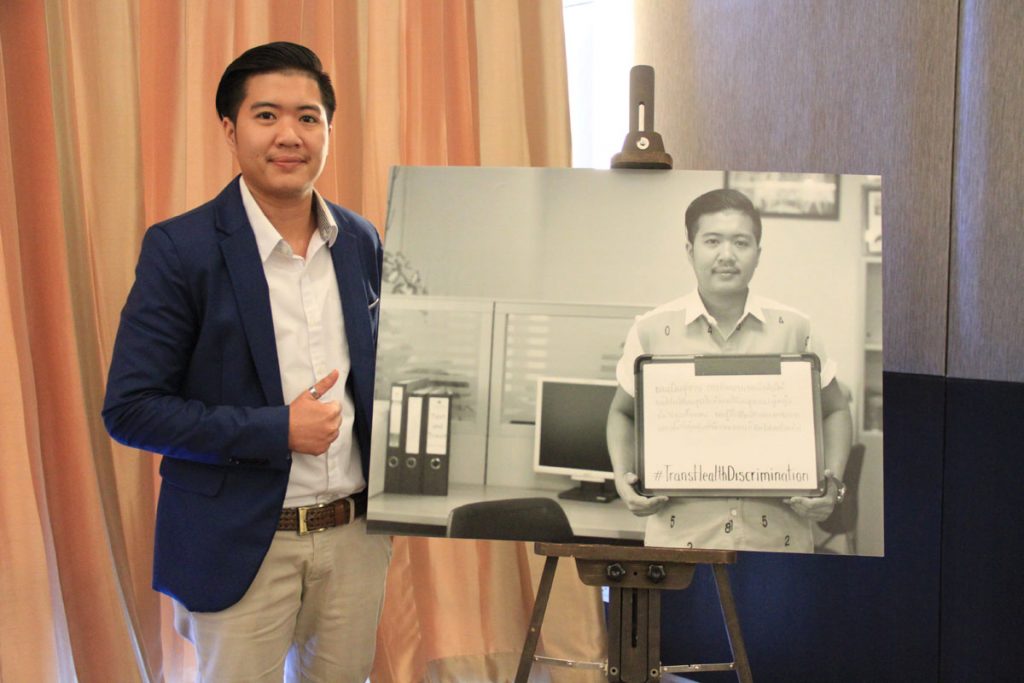
Kanattsanan ‘Mukk’ Dokput at an April 4 conference, “Demanding Care: Transgender Health Discrimination in Thailand,” at Bangkok’s Novotel Ploenchit hotel.
Identity: Male – Biology: Complicated
With close-cropped hair, a bearded chin, flat chest and deep voice, Mukk looks like any other man in his early 30s. Speak to him awhile, and he might confide that he once attended an all-girls school.
Mukk had his breasts removed around the time he started taking hormones. But because he is likely to always have ovaries, a vagina, and the medical needs that come with them, things get awkward when he has to sit among dozens of women in the hospital gynecologist’s waiting room. He doesn’t like presenting his ID, which identifies him as female.
“I don’t feel it’s right at all,” he said. “I felt very uncomfortable and embarrassed, and I believe that the women staring at me would feel the same.”
That’s why he’s keen on Tangerine’s sensitivity, where he’s called by a code rather than having his name shouted along with “Miss” over a loudspeaker as would happen at a regular hospital.
He admits cost has been another barrier for people accessing services.
“That’s the main problem why many transmen choose to inject themselves and buy hormones from the black market,” Mukk said. “Buying hormones without a prescription is common in Bangkok.”
Testosterone can be bought online through web forums and at local pharmacies, but can be dangerous as some is made under poor standards and not approved by the Thai FDA. Those self-administering injections learn how to do so through word of mouth or even read about it online.
That leads to overdose, Mukk said, partly due to the misconception that the more testosterone they shoot up, the more fully masculine they will become.
“Testosterone administration has been passed along from one transman to another,” Nittaya said. “There have been a lot of hormone overdose cases, which can cause liver function problems, high fat levels in the blood and diabetes in the long term.”
At Tangerine, a session costs about 300 baht (USD$8), about a third the cost of private hospitals.
Trans-Cultural
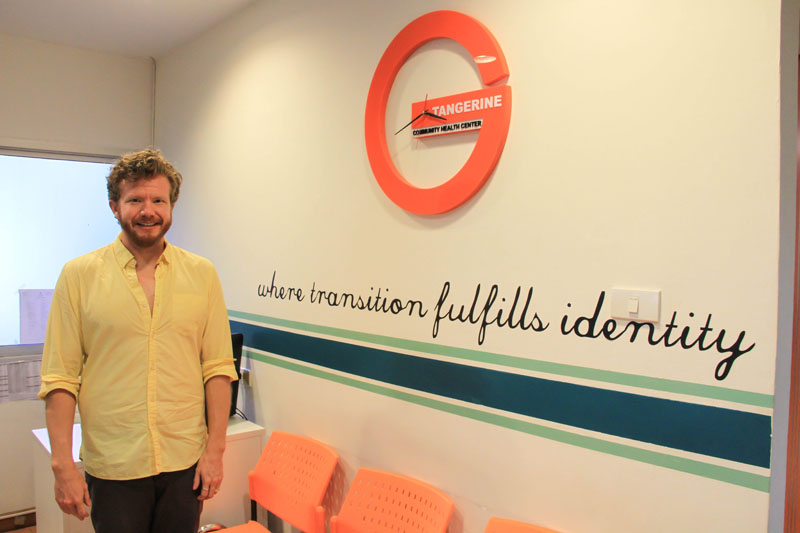
Cianan Russell at the Tangerine Community Health Center on April 25 in Bangkok.
Thais aren’t the only residents of the Thai capital, an international city that became a destination for sex reassignment long before the term “medical tourism” became vogue.
Three years ago, Cianan Russell arrived to find a country different than what he expected. An activist who transitioned to male in 2001, he struggled to find medical services in Bangkok for three years.
“I didn’t find anywhere I felt comfortable to go for a regular blood test,” he said.
The 33-year-old American expat, who now goes to Tangerine for hormone treatment, said it didn’t take long to realize “transgender” almost always refers to women.
And going to a regular doctor unfamiliar with transgender issues can be traumatic, he said.
“It makes people just not go. They just don’t do it. Or don’t do it often enough. And then all of a sudden you have Stage 4 cervical cancer, and you didn’t know … until it’s too late.”
That makes clinics such as Tangerine indispensable.
“They’re not doing anything else, it’s just about making sure trans people get effective and respectful care,” he said.
Funded by USAID and operated by the Thai Red Cross Society, Tangerine Clinic has partners in various local and regional LGBT organizations such as Sisters, Asia Pacific Transgender Network and Thai Transgender Alliance.
Tangerine Community Health Center is located at the Thai Red Cross AIDS Research Centre. The clinic opens at 7:30am until 4:30pm from Monday through Friday.
Top: Kanattsanan ‘Mukk’ Dokput receives a tattoo in February representing the testosterone molecule to signify his transition to a male identity. Photo: Watsamon Tri-yasakda
Our world is changing—in many ways for the better. Poverty and child mortality rates are declining, increasing numbers of primary age children attend school, and world leaders are taking collective action to counter climate change.
The media is uniquely placed to tell the individual stories behind trends like these. The World Association of Newspapers and News Publishers, or WAN IFRA, has also identified solutions journalism as a growing pillar for the media. In our challenging times, the public is eager to read news about hope and positive impact.
So are we, at Sparknews. That’s why we invited the world’s leading media to do something different: report on initiatives that are improving lives. When they first answered our call four years ago, inspired by Christian de Boisredon’s track record in the field of solutions journalism, Impact Journalism Day was born.
This year, 55 international print and digital media have come together to share stories of innovation and success.
You and 120 million other readers around the world will find that today’s news covers the same places and issues as usual, but in a different light. Meet those who have successfully brought answers in the fields of health, water, energy, finance, education, employment and more. Allow these stories to change your perspective on what citizens can accomplish. Be inspired.
Together, our 55 media partners believe that they can be part of the change they want to see in the world.
If you feel the same way, join the conversation. We want your feedback. That’s why we’ve developed new widgets, including one that many newspapers will incorporate at the bottom of articles in their web sections. Tell us if similar problems affect you, and if you want to see these solutions implemented in your country. Follow the change-makers featured in the articles. Write to us and to your newspapers and share your experiences.
To keep up with all the activity taking place during Impact Journalism Day, follow our hashtags and accounts on Facebook and Twitter (#ImpactJournalism, #StoryOfChange, @Sparknews, @KhaosodEnglish or write to us at [email protected]. To discover more inspiring stories, follow the AXA People Protectors Facebook page, where AXA, as founding partner of Impact Journalism Day since 2012, spreads innovative solutions to better protect people and the planet.
If you know entrepreneurs, companies or projects that deserve to be featured in IJD next year, suggest them at tellsparknews.com. Anyone can become part of the story.
Christian de Boisredon, Founder of Sparknews and Ashoka Fellow Marie-Elie Aboul-Nasr, Media Alliance Development Manager at Sparknews, Amy Serafin, Editor-in-Chief of Impact Journalism Day
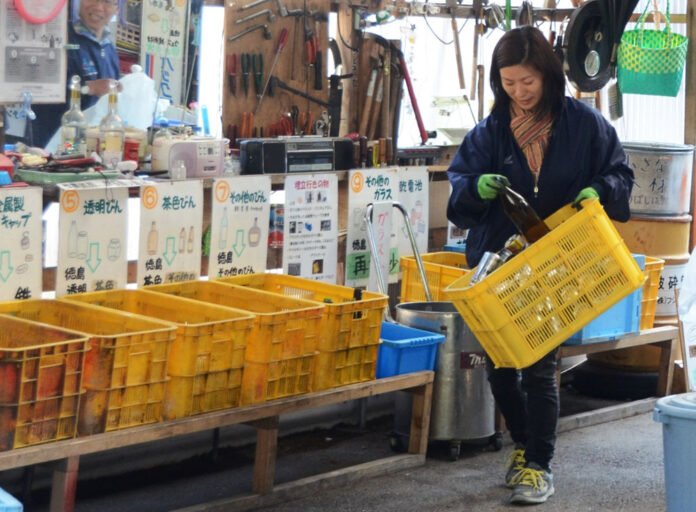
Akira Sakano heads a nonprofit organization that operates the garbage station in Kamikatsu, Tokushima Prefecture. Photo: Yu Fujinami / The Asahi Shimbun
By YU FUJINAMI
Staff Writer
Asahi Shimbun
KAMIKATSU, Japan — This small mountainous town on the island of Shikoku has proved so effective at recycling that the annual number of visitors seeking waste-reduction advice exceeds its population.
Residents and businesses in Kamikatsu have all joined the effort to achieve the town’s goal of “zero waste” by 2020. That goal was announced in 2003, following concerns of dioxin poisoning.
So far, the town of 1,700 has progressed steadily toward the target. In fiscal 2014, Kamikatsu achieved a recycling rate of 77.2 percent, nearly quadruple the national average of 20.6 percent.
Around 2,500 annual visitors from within and outside Japan come to the town seeking tips on how to reduce garbage.
Kamikatsu’s recycling project centers on its only garbage collection site, known as “Gomi Station” (garbage station), operated by a town-commissioned nonprofit organization called Zero Waste Academy.
Residents take their household waste to the station, which is open from 7:30am to 2pm daily except for year-end holidays.
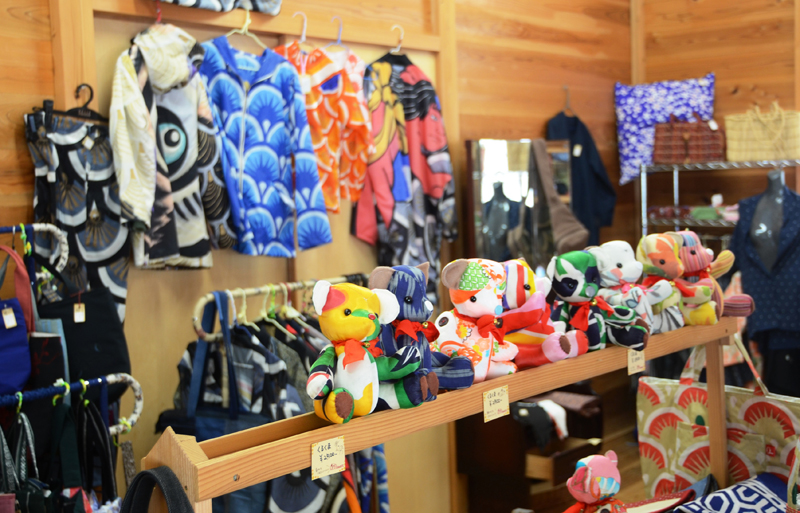
Stuffed animals and clothes made of used “koinobori” carp streamers are sold at a studio next to the garbage station in Kamikatsu, Tokushima Prefecture. Photo: Yu Fujinami / The Asahi Shimbun
Plastic boxes at the facility come with signs showing the separation categories, such as aluminum cans, steel cans, plastic bottle caps and metal caps. The signs also indicate what the trash will be recycled into, as well as the selling price to dealers.
For example, disposable chopsticks will be recycled into materials for paper, and aluminum cans will be sold for JYP155 yen (USD$1.46) a kilogram.
The Kamikatsu government’s guidelines instruct households to separate litter into 34 categories. At the garbage station, there are about 60 categories.
With help from staff at the site, Toshihide Toge, 37, finished separating two months of waste he brought by truck in about 20 minutes.
“I am grateful because they help me when I am at a loss,” he said.
Burnable waste that cannot be recycled is handed over to dealers in Tokushima, the prefectural capital, for incineration.
Each household in Kamikatsu disposes of food scraps with a device bought with town government subsidies.
The catalyst for the Kamikatsu’s commitment to recycling came after it bought a small incinerator in 1998. The incinerator was shut down only two years later because the exhaust fumes did not clear the standards under the law controlling dioxin emissions.
Town officials urged residents to sort their rubbish for recycling to reduce the amount of waste for incineration or disposal.
In 1997, the town had nine waste-separation categories. The number jumped to 34 in 2002.
The following year, Mayor Kazuichi Kasamatsu proposed the zero-waste target, giving residents a numerical goal. The town assembly approved his proposal.
In fiscal 1998, the town produced 137 tons of waste for incineration. The year the zero-waste goal was announced, the amount was 62 tons. It has since remained around 60 tons annually.
It has been a widespread effort.
Rather than throw away unneeded daily items, residents look for new owners.
Kurukuru Shop, which stands adjacent to the garbage station, offers free second-hand furniture, clothes, tableware and other items that are brought in by locals.
People from out of town can also take home these goods.
About 10 tons of used articles were taken to the shop in fiscal 2014, and about 9.7 tons found new owners.
The town also tries to avoid using things that require later disposal.
Cafe Polestar, for example, does not provide paper napkins on its tables. Receipts are only provided to customers who request them. And restaurant employees use their own shopping bags when they buy ingredient for dishes served at Cafe Polestar.
“We were initially reluctant to deviate from services that are taken for granted at other establishments,” said Takuya Matsumoto, 31, manager of the restaurant. “But we would like our customers to know that is also part of our appeal.”
Akira Sakano, director of the Zero Waste Academy, is ready to move to the next stage because she believes residents’ endeavors so far have reached a limit.
“We don’t want to just separate garbage in a large number of categories, but we also want to reduce the amount produced in the first place,” said Sakano, 27.
One way to achieve this, she said, is working with businesses to change conventional methods of packaging on products.
She said waste from agricultural supplies can be curbed if recyclable substances replace the commonly used materials of vinyl chloride and rubber.
Sakano noted that some outside officials attribute Kamikatsu’s success to its small population, enabling the easy spread of efforts to save the environment.
She recommends that residents swap unwanted goods among themselves and set up waste stations at several sites to match the size of their communities.
“All communities can devise their own zero-waste projects by taking into account their circumstances,” Sakano said. “We are ready to share our knowledge as well as the ways and means.”
The specially modified van with two washing machines and creators Kostas Katsigiannis, at left, and Thanos Spiliopoulos. Photo: Kostas Katsigiannis
By Manos Charalampakis
Ta Nea, Greece
ATHENS — For several days now, the homeless of Athens have been able to keep their clothes clean even though they don’t have a home. A mobile laundrette has made its appearance on the streets of the capital where the homeless can get their clothes washed and dried and feel nice – albeit briefly – giving them the opportunity to pursue a brighter future on better terms.
Behind this innovative idea to help the homeless improve their self-esteem and increase their dignity, there is a team of young scientists, led by Athens graduates Thanos Spiliopoulos and Fanis Tsonas. The laundrette is in a van in which two washing machines and two dryers have been installed. The team named the mobile laundrette the “Ithaca Laundry” since, as they note, through their action they want to help the homeless rediscover their ‘Ithaca’; that feeling of discovery and fulfilment. “Cleanliness leads to dignity and this, in turn, to new opportunities” is the motto of the non-profit civil partnership Spiliopoulos and Tsonas created to realize their project.
“When a homeless person can wash their clothes and be clean, they automatically feel better. First of all, you make their daily life better,” explains Thanos Spiliotopoulos, a 23-year-old graduate of the Department of Management Science and Technology of the Athens University of Economics and Business. Spiliotopoulos was the initiator of the “Ithaca Laundry” and the person responsible for organizational issues. “By providing the homeless the opportunity to have clean clothes we give them a psychological boost to enter society” adds co-founder Fanis Chonas, a 23-year-old graduate chemical engineer of the National Technical University of Athens and responsible for the technical aspects of the mobile laundrette.
I met the two 23-year-olds a few days after the first “outing” of the mobile laundrette in Athens and their enthusiasm was evident. “We had been waiting eagerly for this day,” Fanis tells me. Thanos is satisfied and restrained at the same time when I ask him about the first reactions of the homeless to the appearance of the “Ithaca Laundry”; he says that the team offers the homeless something humane: “Okay, it’s not that we are providing them with a home but it is definitely nice to give them the opportunity to wash their clothes and at the same time offer them a cup of coffee.”
While the two men are explaining their idea to me, they simultaneously perform a last check to the washing machines and the van’s equipment since they had planned another outing of the “Ithaca Laundry” for that night. This time they were going to station their van opposite the Varvakeio Market in the area where the government community building project, “Syn Athina”, of the municipality of Athens operates.
In terms of how they came up with the idea of creating a mobile laundrette for the homeless, Thanos says that he had seen mobile laundrettes for the homeless that were in operation in San Francisco and Australia in old media reports. “At the same time I could see that in Greece there was a big problem with the homeless. So the idea to create a similar mobile laundrette in Athens was born.”
Scholarships and the Beginning
The cleanliness and smiles that the mobile laundrette has been offering to the homeless for a little time now did not happen instantly. As Thanos Spiliotopoulos and Fanis Chonas explain, a lot of work and perseverance was needed, while scholarships and grants provided them with considerable impetus. At the end of 2014 they received an “Ithaca Laundry” team consists of five people.
The foundation of a non-profit partnership followed and the van was bought in the summer of 2015. “It was a used van. It took hard work to modify it to its present form,” says Thanos Spiliotopoulos. The familiar procedure of getting the licence and number plates soon followed.
Significant support for the mobile laundrette project – as highlighted by the group – was provided by a grant from Impact Hub Athens network, while the electrical equipment was provided by the company LG.
In the autumn of 2015, the team began to look for suitable places in Athens frequented by homeless or where homeless passed by, where they could station the mobile laundrette. They also contacted the Municipality of Athens for suggestions. The goal of the “Ithaca Laundry” is to regularly operate on specific days of the week and for a number of days to gradually increase the laundrette’s visibility. The activity will also be carried out with the assistance of a group of volunteers: “7–8 people have already been mobilized, while we have received around 40 applications from people who want to help voluntarily,” the group state. Volunteers will help in the collection of the clothes, transferring them from the washing machines to the dryers, returning them to the homeless and generally in the organization of the process.
How it Works
The functioning of the mobile laundrette is simple: First, the team and the volunteers establish contact with the homeless and collect the clothes from them. The clothes are then automatically washed in the washing machines, dried and returned to the individual. The whole process takes about two hours. Water is supplied from nearby parks or other points in the Municipality where the van is stationed. The mobile laundrette operates at specific, well-known and distinguishable parts of the city; at different places every day.
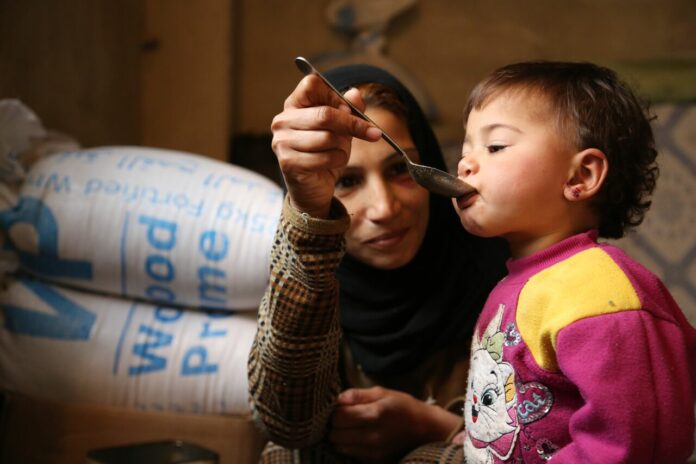
In the Syrian city of Homs, young mothers were the beneficiaries Share The Meal in this undated photo.
By Stephan Dörner
Die Welt
BERLIN — An advertising billboard stands in Times Square showing New Yorkers what they can get for 50 cents (about 40 cents EUR): 90 seconds of a sightseeing tour, for example, or 1.8 seconds with the street performer “Naked Cowboy,” who can often be seen at New York’s most famous street crossing.
Or they could provide a malnourished child with meals for a day.
The Times Square advertisement introduces New Yorkers to “ShareTheMeal,” a smartphone app from a Berlin start-up that is an initiative of the United Nations World Food Programme. The video itself was donated by the World Food Programme – there is no money for marketing – but even without a huge advertising budget, the app, for iPhone and Android, has spread over all social networks in a very short time and the aid provided has fed tens of thousands of schoolchildren and pregnant women.
Share the Meal app
“ShareTheMeal” founder, Sebastian Stricker, who was already working for the UN World Food Programme, asked himself a simple question: in a world where there are more smartphones than hungry people, why not fight hunger with a click on an app? Whenever a smartphone user is having his breakfast, lunch or dinner, he has the opportunity to share 40 Euro cents with someone in need – thus the name “ShareTheMeal.” The 40 cents donation covers the whole cost: from payment processing up to the logistics of food distribution.
Since the app was launched, initially in Germany in June 2015 and then internationally in November the same year, the user numbers have mushroomed: “5.4 million meals were distributed by about 500,000 donors up to the end of April,” says the “ShareTheMeal” founder. “That means we are feeding between 10,000 and 15,000 children every day.” The “ShareTheMeal” app has already won many prizes – including the Interactive Innovation Award of the technology festival “South by Southwest”, two prizes from Google and a renowned Webby Award.
Stricker is currently in Lebanon, managing the distribution of food via “ShareTheMeal”. “Lebanon has taken in over one million refugees, within a total population of 4.4 million,” he remarks. “Some have to live on rooftops, where tools are normally stored.” The schools are staying open in the afternoons as well, so the Syrian refugee children can go to school. “Poverty is immense – and yet there is still an unbelievable spirit and optimism. They treat the refugees well, with dignity.”
“ShareTheMeal” first began its fight against world hunger by providing food for schoolchildren in Lesotho. The distribution of school meals has a twofold effect: in the short term hunger is stemmed, but in the long run the economic development of the country is furthered. Meals mean children can attend school more often, instead of being sent out to work.
In the Syrian city of Homs, young mothers were the beneficiaries – another very efficient form of aid according to experts. “If you don’t get enough food as an infant or pregnant woman, or if you get the wrong nutrients, the child won’t develop properly – and mental development is impaired as well,” says Stricker. The ramifications for an individual’s entire lifetime are “impossible to make up. These are the so-called first Thousand Days, from pregnancy to the second year. If you don’t give support then, it can’t be made up for later.”
The fight against global hunger may seem like battling an invisible enemy – but it is showing progress, step by step, country by country. In Lesotho, after about a third of malnourished children were provided for via “ShareTheMeal” for a year, private initiatives stepped in and carried on the aid work. The money collected via the app was then allocated to care for refugee children in Jordan, and then pregnant women and mothers with small children in the Syrian city of Homs. Now “ShareTheMeal” aims to provide for all Syrian refugee children in Beirut, the capital of Lebanon. The underlying idea is to prove that the aid put in place thanks to donations from the app is working, so that other initiatives can then take over.
The 40 cents per meal that “ShareTheMeal” advertises is a global average for provision through the United Nations World Food Programme. “In some countries and situations it is a lot more expensive, in others clearly cheaper,” says Stricker.
Some foreign aid critics argue that the countries concerned might become dependent on it in the long run. Stricker, however, disagrees: “A certain minimum level of health, nutrition and education must be in place,” he says. “If you constantly remain below this minimum, you will remain ill, will have few opportunities and will pass this on to your children as well.”
For the future, Stricker dreams of establishing smartphones as a direct link between helpers and those in need of help. “If you ask me what the top two future topics in this area are, I would answer: virtual reality and peer-to-peer help.” The term “peer-to-peer” is used in the IT field to describe a direct connection between two computers in a network.
In the future, smartphone users might even be able to see who they have shared their meal with. Stricker is currently carrying out initial experiments with virtual reality in Lebanon. “This is really touching,” he says. “The children are holding up their food to the camera with big smiles.” Stricker describes how milk, apples and muffins were handed out to the children. “They liked the apples best of all,” says Stricker with a smile. “In Germany, children must be forced to eat fruit – and here they love apples more than anything.”
Pro-democracy activists gather in front of military court Friday night in Bangkok to show support for the 13 referendum campaigners arrested yesterday.
BANGKOK — Seven of the thirteen activists arrested on Thursday for campaigning against the junta-sponsored charter draft were ordered to be locked up Friday by a military tribunal as they await their trial.
The military court released six activists on 50,000 baht bonds Friday evening, according to lawyer Anon Nampha. The other seven were jailed as they refused to pay bonds , demanding to be released without any conditions, arguing that they did nothing wrong and that the legal action against them is illegitimate.
The military judges declined to comply.
“The court says it’s necessary to have them detained while the prosecutor investigates the case,” said their lawyer Anon Nampha.
The seven, which includes longtime pro-democracy activist Rangsiman Rome, will be immediately escorted to prison, while the bail hearing for the other six suspects has just started, Anon said by phone shortly before 7pm Friday.
“At this moment, we will try to secure bail for these six,” the lawyer said.
Security officers arrested the 13 campaigners in Samut Prakan’s Bang Phli district Thursday evening while they were handing out leaflets urging the public to vote against the charter draft in the Aug. 7 referendum.
They have been charged with violating the junta’s ban on protests, and the referendum law that outlaws any campaign for or against the charter – a sweeping law that critics say is stifling freedom of expression in the run-up to the referendum.
Security officers arrest activist Rangsiman Rome yesterday in Bang Phli district of Samut Prakan province.
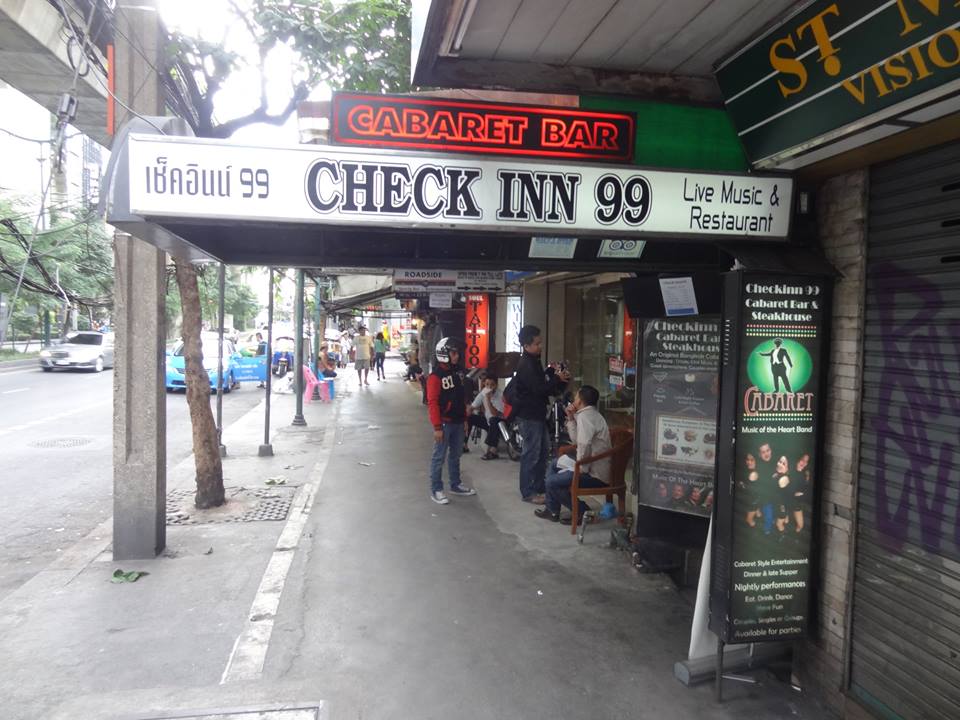
Music of the Heart posing for a picture. Photo: Checkinn 99 / Facebook
BANGKOK — Another piece of Bangkok history will bite the dust when a nightlife fixture of six decades shuts down July 2.
Check Inn 99, which for 59 years has entertained guests in keeping with the changing times, will close its doors forever after being evicted in the name of commercial development.
“It’s sad. It’s the only original Bangkok bar from the ‘50s,” said owner Chris Catto-Smith, who took over the bar in 2011 with his wife and business partner.
Catto-Smith said he was given one month’s notice his bar had to close, as the landlord wants to develop the building into what he described as a “trinket market” and hotel lobby.
“There always was a plan to develop it,” Catto-Smith said. “The lease expires on July 5, and we gotta move out.”
Asked what’s next, Catto-Smith said he’s unsuccessfully been looking for another venue.
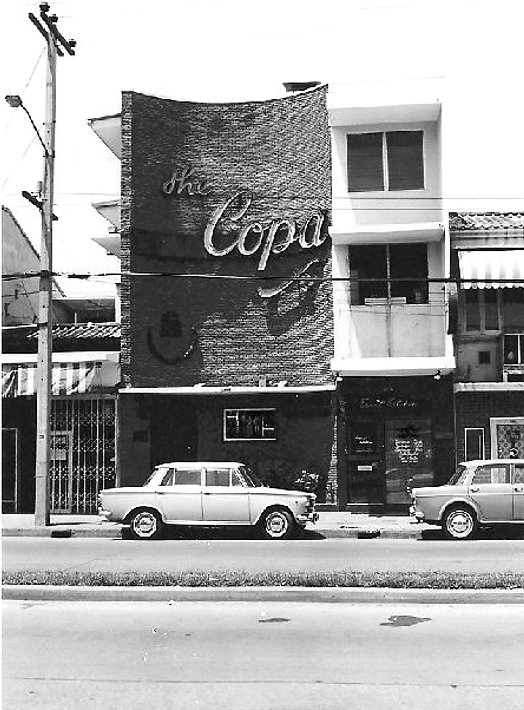
The nightclub, also styled as Checkinn and formerly known as the Copacabana, has operated continuously since 1957. Many celebrities have passed through its doors, Catto-Smith said, such as Bing Crosby and Bob Hope, who dropped by in the late ‘60s. Musicians Sammy Hagar, Mick Jagger and the late Freddy Mercury are others who paid a visit.
“People were coming in,” Chris said. “But they stayed low profile. They didn’t come to perform, they came to relax.”
Check Inn 99 in an image from September 2014. Photo: Checkinn99 / Facebook
It was home to some famous courtesans, such as the much-celebrated “Mama Noi” who until her death earlier this year would still drop by to regale guests with her stories.
The bar-restaurant-lounge was little more than a seedy brothel and in dire straits before Catto-Smith bought it back in 2011. Long gone was the tuxedoed dwarf who once welcomed guests around the turn of the century (He died).
The Australian owner made it a labor of love and revived its fortunes as a retro-kitsch lounge where regulars swapped stories over cocktails under the roar of Music of the Heart, the Filipina family act belting out cover songs night after night.
Check Inn joins the bygone remnants of a previous generation’s Bangkok, part of the rapidly receding men’s world where go-go bars and commercial sex services were mainstays in a cosmopolitan nightlife scene which mostly catered to foreigners.
Photo: Sukhumvit Road in the late ‘50s with the visible Copacabana (left), former Check Inn 99. Photo: Chris Catto-Smith / Courtesy
The club’s last hurrah will be July 1. It will host a series of farewell parties starting this Sunday with Vanishing Bangkok, showing a collection of 200 unpublished vintage photos of old Bangkok, taken by Mama Noi and a “Peace Corps guy,” along with jazz session.
The countdown parties will take place from Monday until Thursday. Friday is the last chance to say buh-bye with a big party that promises to carry on until early Saturday morning.
House band Music of the Heart will sing and dance their hearts out every evening, Sunday through Friday’s farewell party.
Check Inn 99 is located between Sukhumvit sois 5 and 7, reachable on foot from BTS Nana exit No. 1.
Photo: Before Check Inn 99, it was the Copa Cabana, seen here in the early 1950s. Photo: Chris Catto-Smith / CourtesyPhoto: Check Inn 99 / FacebookPhoto: Check Inn 99 / Facebook
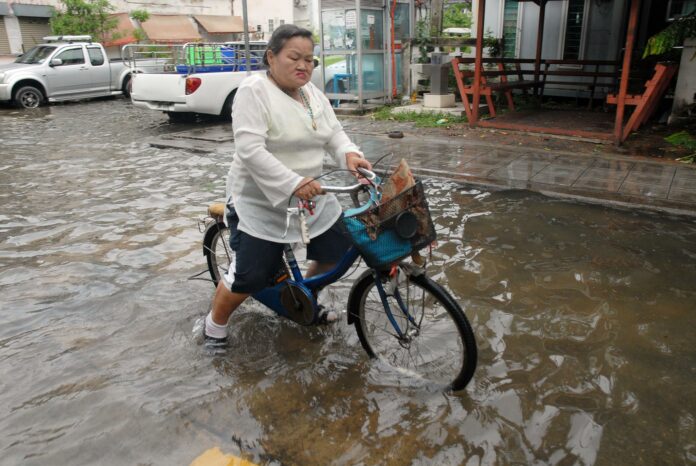
A woman cycles through Lat Phrao district after heavy rain in Bangkok Tuesday.
BANGKOK — Thunderstorms and showers will continue dousing much of the capital this weekend as nine provinces are on alert for floods, strong winds and landslides, emergency officials said Friday.
A warning has been issued for the five southwestern provinces of Phuket, Phang Nga, Krabi, Trang and Ranong by the Department of Disaster Prevention and Mitigation, along with the four eastern provinces of Chonburi, Rayong, Chanthaburi and Trat. Residents are warned to prepare for the worst as rain is expected to continue falling through Tuesday, according to state-run media.
The Meteorological Department echoed the warning Friday, saying Thailand faces more rain caused by a tropical depression weighing down the South China Sea.
It added that there will be more rain in most of the country on Friday and Saturday as a southwestern monsoon moves across the Andaman Sea.
Small boats are recommended to stay ashore from Friday to Wednesday as waves of up to two to three meters in height are expected in both the Andaman Sea and the upper part of the Gulf of Thailand.
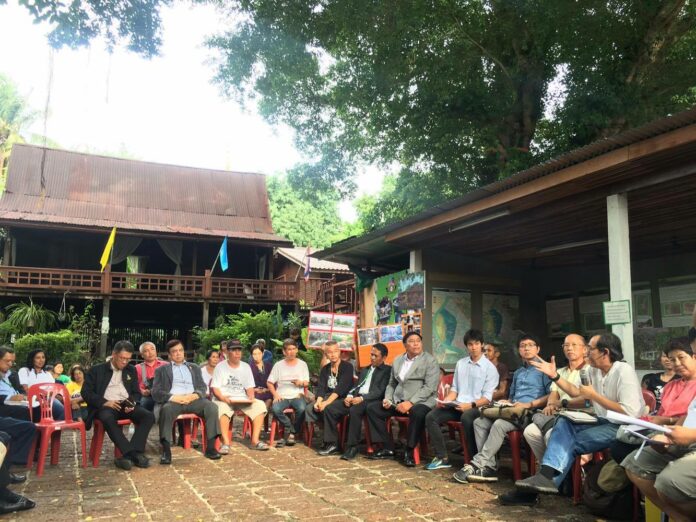
Residents, officials and others sit down at the first public hearing held in the 24-year history of conflict between local government and the community it has sought to evict from behind the walls of fort Pom Mahakan.
BANGKOK — After 24 years of trying to kick out a small community dug in behind the walls of a historic fort, City Hall sat down with them for the first time yesterday to talk about solutions.
The first public discussion over the unending conflict was arranged to find a way forward, given the Bangkok Metropolitan Administration’s last ultimatum for the 100-year-old community near Wat Saket to leave passed on April 30.
“At least today they promised they won’t break into the community to evict us at night,” community leader Thawatchai Woramahakhun said. “I have been sleeping not more than three hours since the eviction news came out. Now I can sleep better.”
In 2005 the Supreme Court ruled the administration, or BMA, had the right to clear the homes and residents as they sat on public land. The city has said it wants to build a park on the site. But the more than 300 residents who have lived there for three generations asked authorities to share the space instead of erasing their historical community from the map.
Though no conclusion was reached yesterday, Thawatchai said he was pleased just to see an effort by authorities to reach out and talk about solutions directly with residents. He said for the past two decades, Pom Mahakan residents have only read about the city’s demands in the pages of newspapers.
One point of agreement in the discussion attended by a deputy provincial governor, Pom Mahakan residents, academics, media and concerned parties, was that developing the site should be an inclusive process.
What the law actually says though is a sticking point. Though City Hall and Pom Mahakan agreed in writing to share the land following the 2005 court verdict, a 1992 royal decree reclaiming the whole area remains in force.
Deputy Bangkok Gov. Aswin Kwanmuang said the government was compelled by duty to both execute the law and serve its residents. Aswin listened to proposed solutions but said he could not make any decisions.
“I need to pass it all on to Gov. Sukhumbhand [Paribatra],” he said. “We should be able to reach a solution in a few days.”
Community representatives were invited to further discussion at City Hall on Friday morning, but no conclusion was reportedly reached.