


































25.5 C
Bangkok
Sunday, July 5, 2026
Home Blog Page 2718

Car Bomb Attack Targeting Police Kills 11 People in Istanbul

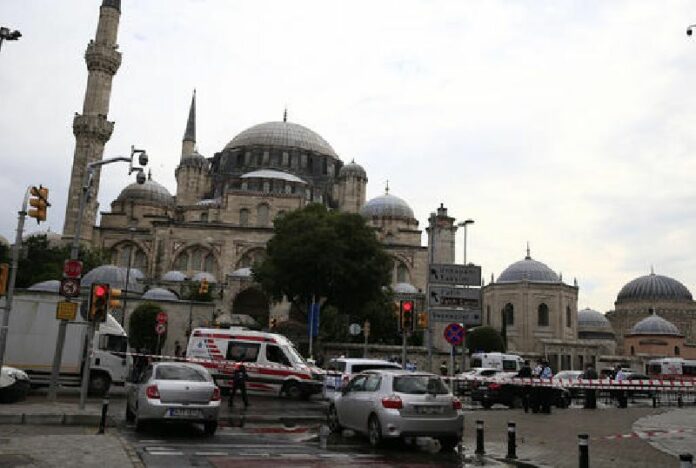
Turkish police gather at the scene of an explosion in Istanbul, Tuesday, June 7, 2016. Photo: Lefteris Pitarakis / Associated Press

ISTANBUL — A rush-hour car bomb attack targeting a bus carrying riot police killed 11 people and wounded 36 others Tuesday, Istanbul’s governor said.

Speaking at the scene of the blast in the district of Beyazit, Istanbul Governor Vasip Sahin said the dead included seven police officers and four civilians. At least three of the wounded were in serious condition.

The explosion was caused by a bomb placed inside a car and was detonated as the police vehicle was passing by, Sahin said.

The police bus was overturned from the force of the blast which also damaged nearby buildings, including a hotel whose entrance appeared gutted and windows were blown out. The hotel however, was closed and had no guests. Several cars were also wrecked.

1465292628 Turkey3
Turkish security officials and firefighters work at the explosion site after a bus carrying riot police official was struck by a bomb in Istanbul, Tuesday, June 7, 2016. At least five police officers were wounded. Photo: DHA / Associated Press

The blast occurred on a busy intersection near an Istanbul University building, forcing officials to cancel exams.

Foreign Minister Mevlut Cavusoglu condemned the attack, which occurred on the second day of the holy Muslim month of Ramadan.

“They are cold-heartedly exploding bombs on a Ramadan day,” Cavusoglu said in a television interview.

Prime Minister Binali Yildirim was meeting with the country’s interior minister to discuss the attack.

There was no immediate responsibility claim and Sahin would not comment on who may be behind the attack.

Tuesday’s attack was the fourth major bombing in Istanbul this year. Two of them targeting tourists and two hitting security forces. The spike in violence has led to a sharp dip in tourism, a mainstay of the economy.

The rebels of the Kurdistan Workers’ Party, or PKK, have been targeting police and military personnel with bombs since July, when a fragile peace process between the rebels and the government collapsed.

The Islamic State group has also been blamed for a series of deadly bombings in Turkey, which is part of the U.S.-led coalition against IS.

An estimated 500 Turkish security personnel have been killed in attacks or in conflict with the Kurdish rebels, according to the military, which claims to have killed 4,900 PKK militants in operations in Turkey and northern Iraq, where the group has a major bastion. Turkish warplanes regularly raid PKK bases in northern Iraq.

Limited access to conflict areas in the southeast has made it difficult to verify casualty figures.

The PKK is fighting for autonomy for Turkey’s Kurds in the southeast of the country. The decades-long insurgency against the Turkish state in a conflict that has claimed 40,000 lives. The group is considered a terrorist organization by Turkey and its allies.

Last month, eight people were wounded in Istanbul after car bomb similarly targeted a military vehicle near the entrance of a garrison as the evening rush hour began.

1465292513 Turkey%202
Turkish police work at the scene of an explosion in Istanbul, Turkey, Tuesday, June 7, 2016. Photo: Lefteris Pitarakis / Associated Press

Story: Mehmet Guzel / Associated Press

Related stories:

Turkey Sees Hand of Islamic State in Bombing

Advertisement

Thai-Cambodian Flame War Erupts Over Traditional Dance. Both Are Wrong.

Photo posted by official Facebook page of Cambodian Prime Minister Hun Sen.

BANGKOK — In a drama of epic proportions, Thailand and Cambodia are feuding once again after simultaneously claiming ownership of the traditional elaborate masked dance known as Khon in Thailand and Khol in Cambodia.

It started June 3 when the Cambodian Ministry of Culture and Fine Arts asked UNESCO, the cultural arm of the United Nations, to recognize its Khol as an “intangible cultural heritage,” something that Thailand has talked about doing for years. A red-hot flame war soon broke out between the two nations on social media.

“This dance is belong to Cambodia, not Thailand,” declared one image shared on Facebook 10,000 times since Saturday.

Meanwhile, a thread on the popular Pantip forum is seething with calls to defend Thailand’s culture.

“I ask Thais not to stay idle about this,” wrote user Fenrir. “Don’t just say, ‘Let’s do nothing and let Khmers do whatever they want. It’s ours anyway!’ If we do nothing, it will be too late when the world understands that [Khon] belongs to Khmer.”

But experts say both sides are right: Khon or Khol or whatever it’s called, belongs to both cultures, as they are both regional twists on the Indian epic Ramayana.

Shared Treasure

“Arghhhhhhh! I have both said and written about this so much that it bores me,” Sujit Wongthes, historian and prolific writer on Southeast Asian cultures, wrote Monday. “I said: Khon is a shared culture of Southeast Asia. Ok? I’m too tired for this drama.”

In his 2013 work, frankly titled “Where Did Khon Come From?” Sujit elaborated and dissected the art now considered a national treasure by both nations: The story is of southern Indian origin, costumes Indo-Persian, name Java-Malay and moves based on local animist traditions.

“[Evidence] says that Khon is a culture shared by Suvarnabhumi,” Sujit wrote in the conclusion, referring to an ancient name for Southeast Asia. “The origins and roots are shared. One cannot separate clearly whose treasure it is; it’s from this or that.”

Pichet Klunchun, a choreographer and dancer whose contemporary interpretation of Khon has made him the nation’s best known practitioners of the art, said Tuesday he agreed.

But Pichet also said the Thai Ministry of Culture’s campaign to win UNESCO recognition as being Thai is pointless, because Khon dancers in Thailand face bigger problems, such as making a decent living, and an artform now mostly limited to funerals, restaurants and entertainment for tourists.

“[UNESCO] registration doesn’t mean anything if Khon students still have to do their Thai dance in restaurants next to rivers and get 200-300 baht for their performance,” Pichet wrote. “We don’t own Khon simply by registering it, but by making Khon truly a part of Thais’ daily life. This idea is better than registering it.”

Thailand Unconcerned by Cambodia’s Bid

The latest squabble over Khon is a time-honored regional tradition in which neighboring countries claim their ancient art is the “real one,” despite the intermixing of beliefs and cultures which are as vaguely marked as the natural borders.

In 2009, when Indonesia successfully won UNESCO recognition for batik as its intangible heritage, some Malaysians were outraged because they saw the textile as their national treasure.

Bad blood between Cambodia and Thailand has occasionally turned violent. The most notable was a 2003 riot that saw the Thai Embassy in Phnom Penh burned down because of a false rumor a Thai actress said she believes Angkor Wat belonged to Thailand.

But, so far, the authorities in Cambodia and Thailand are pleading for calm in the midst of ongoing patriotic rage on social media.

Thai Culture Minister Weera Rojpotchanarat told reporters Monday that Thais should not be alarmed by the Cambodian application because the same “intangible heritage” can be held by more than one nation.

“UNESCO doesn’t forbid registration of similar cultural heritage,” Weera said. “Anyone can go for it first, because UNESCO wants each country to register their wonderful and unique cultures.”

He cited tango as an example. Argentina and Uruguay share the dance as an “intangible heritage” in the UNESCO list.

Weera’s Cambodian counterpart, Culture Ministry spokesman Thai Norak Satya, also extended an olive branch, saying that the agency would not oppose a Thai bid for Khon recognition.

Related stories:

Thailand Considers Cloning Ancient Contested Temple

Thais Advised To Be Wary of ‘Fake Cambodian Buddha’ 

Thai-Cambodian Journalists Vow Reconciliatory Reporting

Relief In Thailand Follows Border Temple Verdict

Advertisement

Engineers Cast Doubt on Police ‘Light Bulb’ Explanation For Deadly School Fire

Pitakkiat Witthaya School in Chiang Rai where the fire broke out and killed 17 school girls opens as usual on Monday. Photo: Pitakkiat Witthaya School / Facebook

CHIANG RAI — Sixteen days after 17 schoolgirls died in a fire in their dormitory, which lacked smoke detectors or fire alarms, engineers and at least one parent expressed doubt today about the police version of what happened – and no one has yet to be held accountable.

A police spokesman said a report from regional forensic examiners said the May 22 fire at the Pitakkiat Witthaya School in Chiang Rai started with a light located on the first floor. Spokesman Krissana Pattanacharoen said investigators still needed more time to deliberate before they could file any charges.

According to police Maj. Gen. Sun Sukwat, who headed the forensic examination, the threading of a light bulb overheated and melted. The light then fell onto clothing belonging to the children which readily fueled the fire.

A father of one one of the victims isn’t buying it.

“The generosity of people from across the country who donated has been great,” Winai Pisailert, who lost his 11-year-old daughter, said . “But I still doubt about the cause of the fire.”


Parents Held Big Dreams for Children Lost in Fire. Now They Want Answers.


The national engineering association was also skeptical the fire was caused by a melting light bulb unscrewing itself.

Pichaya Chantranuwat headed a team from the Council of Engineers who conducted an inspection of the burned dormitory after the fire.

According to him, all other light bulbs in use at the school were up to standards and installed not long ago. Also, he wrote online, none of the children would have died had there been basic, legally mandated safety equipment in the building.

“If they installed smoke alarms, which could detect smoke from fire in the very first minute, all children would have been safe,” Pichaya wrote on his Facebook.

All 17 students, hospital examiners concluded, were killed by carbon monoxide poisoning which meant they were already dead when the fire reached their room.

After declining to identify the fire’s cause for two weeks, police provided the light bulb explanation on Friday, the same day national police authorities traveled to Chiang Rai, and a press event was staged at which Chiang Rai Gov. Boonsong Techamaneesathit posed for photos handing over donations to the families of the dead girls.

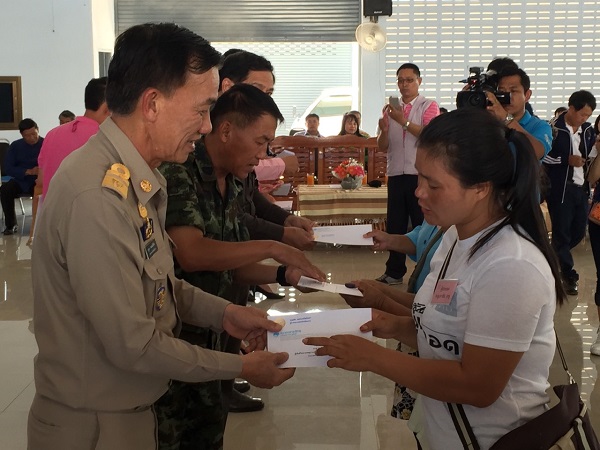
Chiang Rai Chiang Rai Gov. Boonsong Techamaneesathit on Friday hands over donations to families of dead and injured school girls at the Wiang Pa Pao District Office in Chiang Rai province.

Pitakkiat Witthaya School reopened May 30 without any apparent safety inspection. Some of the students are now sleeping in a temporary building there.

Winai, an Akha ethnic father, said that while he received 750,000 baht Friday for the loss of his daughter Fai, he didn’t get what he really wanted: answers for why she is dead, and someone to answer for it.

“I asked the police, and they said they had no idea. They need to wait for further investigation,” he said. “I want them to give me some reasonable explanation.”


Related stories:

Parents Held Big Dreams for Children Lost in Fire. Now They Want Answers.

Students to Bed Down Again at School Where 17 Girls Just Burnt to Death

No Smoke Detectors in Dorm Where 17 Schoolgirls Died

Police Tight-Lipped About Cause of Fire That Killed Schoolgirls

Fire Kills 17 Sleeping School Girls

Advertisement

Grief Goes Bicultural as Death Surrogates Come Alive in Thai, English

James Lever plays Samuel, a man grieving over his wife’s death. Photo: Tatisara Changmanee / Courtesy

BANGKOK — The world has birth surrogates, those moms who bear children on behalf of others. At the other end, when life ends in grief and loss, imagine if those left behind had “death surrogates” to offer a chance for final farewells — to thank, apologize to or say goodbye.

In “Stick Figures,” Molly is a daughter to one family and wife to another. Filling the roles of those absent, she dresses in their clothes, listens to their favorite music and speaks like them until her bereaved clients are ready to process the reality of the situation and grief.

Given cultural differences between the American source material and Thailand, the play, now a week into its Bangkok run, is being staged in two languages by two distinct casts — five actors for the English version and five performing in Thai. The script for the Thai-language version was modified to better fit Thailand.

It also avoided the need for surtitles, according to Director Pattarasuda Anuman Rajadhon, who said they would be a distraction.

These changes are both practical and cultural, such as changed names, substituting burning for burial and some more emotionally restrained family relations. Those who’ve seen both versions recommend the English for being truer to the source material.

“I actually was inspired by birth surrogacy,” Brooklyn-based playwright Josh Ginsburg wrote. “There was a special on the news about a family hiring a birth surrogate, and I began to think of the opposite. It is very common to hire someone to help bring life into the world, but what would happen if we hire someone to help [another] leave?”

Josh denied the play’s characters are based on anyone in particular, but elements of each were drawn from people in his life, including himself.

“I took each character and based them on different ways in which we grieve: becoming combative, ignoring it entirely, desperately trying to hold it together, et cetera.”

unnamed (4).jpg
Photo: Tatisara Changmanee / Courtesy

Pattarasuda said she heard about “Stick Figures” nearly two years ago and read it in a day.

“It’s a great play,” Pattarasuda said. “The original play is witty, illustrative and concise … and the rounded characters really portray how everyone has different ways to cope with death.”

Filled with moments to make audiences gasp, laugh, sob or cry, “Stick Figures” is being staged in both languages on alternate days through the end of June at Thong Lor Art Space.

Tickets are 550 baht at the door and can also be purchased online for 450 baht and 400 baht for students.

Thong Lor Art Space is located on Soi Sukhumvit 55. The studio-gallery-shophouse can be reached on foot from BTS Thong Lo exit No. 3.

Photos: Tatisara Changmanee and Thitiporn Kaikaew / Courtesy

unnamed (3).jpg

unnamed12.jpg

525a1ba1-0e4d-499b-aaf6-612cff6b2f9a.jpg

23f2ec35-b90a-4582-8562-5d573f3a7edf.jpg

ffa8f1bf-5e2b-4430-8e16-42f10a8e837d.jpg

unnamed.jpg

Advertisement

No Thais Can Monitor Vote Because Law Didn’t Say They Can, Commission Reasons

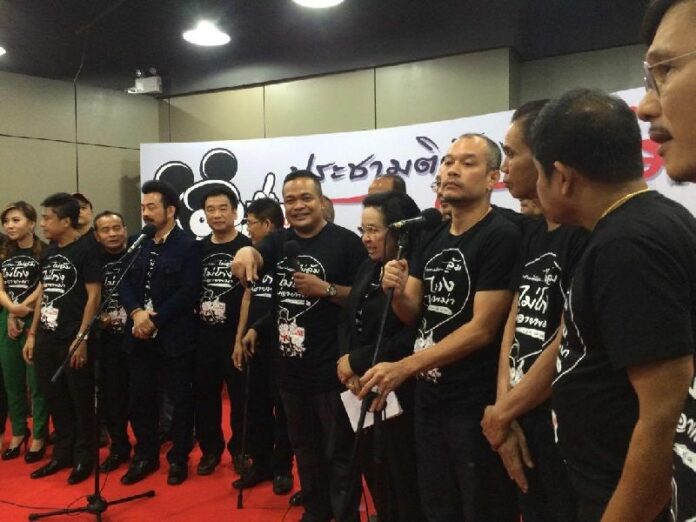
Redshirt leaders, wearing black to protest the political climate in the run-up to a planned referendum, opened a center Sunday at the Imperial World Lat Phrao mall in Bangkok to monitor possible voting fraud. Photo: Matichon

By Pravit Rojanaphruk
Senior Staff Writer

BANGKOK — A veteran election observer and Redshirt leader were disappointed yesterday by the Election Commission’s insistence that no Thais could be granted election observer accreditation because the recent referendum law did not expressly permit it.

Although Commissioner Somchai Srisuthiyakorn said this omission prohibited any domestic group from monitoring the polls, such as a Redshirt effort announced Sunday in Bangkok, he said people can do so outside polling booths as ordinary citizens.

“I am most disappointed. We still want to talk with the Election Commission again,” said Pongsak Chanon, an advisor to We Watch Thailand, a local election observation network which planned to field 200 observers throughout the kingdom for the Aug. 7 charter referendum.

Pongsak added that the fact that the Referendum Law doesn’t mention referendum observers should not stop the commission from accrediting observers, as the law doesn’t forbid the commission from doing so.

The referendum law was passed in late April to criminalize campaigning for or against the proposed constitution written by junta appointees.

Pongsak said his group will have more difficulties without observer-status accreditation. This comes at a time when there’s growing speculation the junta may scrap the plebiscite for fear of the their charter draft being overwhelmingly rejected in the vote. What’s more, Pongsak said rumors are spreading that there may be attempts to rig the referendum results.

“We may be asked ‘Who are you? What right do you have to investigate?” said Pongsak, referring to their lack of accreditation. He confirmed that the group will go ahead with their task, “Whether we receive accreditation or not, we will proceed.”

Prime Minister Prayuth Chan-ocha said Redshirts should be careful not to violate the referendum law and asked them to keep clear of voting booths.

Somchai said foreign or international observers are welcome; however, they will most likely be accredited by the Election Commission to maintain the reciprocal norm when Thai election observers are fielded abroad. Somchai also warned informal observers not to try to influence the vote, one way or the other.

Redshirt leader Weng Tojirakarn said there’s not much they can do but warned of the consequences of veering away from international standards on what constitutes a free and fair referendum.

Weng took a snipe against Somchai – once a prominent election observer himself – saying it’s a shock coming from a man who made his name observing elections.

“We want to see a fair referendum,” Weng said.

The Redshirt movement, the umbrella organization of which is called the United Front of Democracy Against Dictatorship, opened a fraud-monitoring center for the referendum on Sunday, saying it would mobilize about 100,000 people to watch out for possible fraud come referendum day.

“This is standard for civilized countries around the world,” Weng said.

Weng said Redshirt volunteers may not be allowed inside polling stations, but they will try to take photos and record possible fraud if they see any. He added that he believes there will be attempts to cheat if the referendum is eventually held.

Related stories:

Regional Monitors In, International Monitors Out for Charter Vote

Redshirts Alarmed by Vague Restrictions on Charter Campaigns

Critics: Keeping Public in Dark About Draft Charter Rejection Unfair

Public Can Register for Right to Speak Out on Draft Charter

Advertisement

If Nordic Nations Are So Happy, What’s Their Secret?

BANGKOK — Nordic countries are happy places partly because of their welfare systems and high levels of personal freedom, according to the CEO of the Happiness Research Institute in Denmark.

In the 2016 World Happiness Report published by the United Nations, Denmark ranked first, Iceland third, Norway fourth, Finland fifth and Sweden the 10th happiest.

Thailand is ranked 33rd in the same report, second to only Singapore in Southeast Asia, while the bottom includes Rwanda at 152, Syria at 156 and finally Burundi in the list of 157 countries.

“The Nordic welfare model is very good at reducing extreme unhappiness. We try to give quite generous unemployment benefits. We try to reduce extreme unhappiness and reduce inequalities,” said Wiking, who was in Bangkok on May 31 to discuss the Nordic Model of Society at the Danish Embassy.

While income tax is high at around 50 percent in some Nordic countries; which includes Finland, Iceland, Norway and Sweden; it also means there are more public services for everyone and people face less stress if unemployed.
1465269945 happiness


Kirsti Westphalen, the Finnish Ambassador to Thailand, said that due to high taxes there’s a safety net in times of life crisis, thus happiness is “knowledge that everybody I know has a [social] safety net.”

For Mikael H. Winther, the Danish Ambassador to Thailand, high taxes are converted into public goods that are free for all to use.

In Nordic countries like Finland, which is a welfare state, university education is free and its primary school education has an excellent reputation.

“We believe education creates wellbeings, builds democracy and reduces inequalities between regions and social groups,” said Westphalen. “Critical thinking, tolerance and being able to justify your opinions are skills that are needed throughout our lives. Finnish educational system focuses more and more on skills that are required in the real world.”

Teachers at some Thai schools run by the Bangkok Metropolitan Administration are receiving training from their Finnish counterparts through a co-operation scheme. Kongkiti Phusavat, an expert in the Finnish education system and an advisor on education to the BMA said the Finnish educational system places a lot of attention on quality teachers and creating an active learning process.
1465270510 meik.happiness
Happiness expert Meik Wiking speaks May 31 at the Danish Embassy in Bangkok.

“In Thailand, students only listen because we think learning is listening alone. Students’ happiness is also key,” Kongkiti said. “Thai school children spend 1,400 hours a year in the classroom while their Finnish counterparts spend only 800 hours.”

There’s also an emphasis on proper classroom lighting, color and noise control to ensure a happy and productive learning environment. In the Finnish educational system, stressed Kongkiti, who was a guest lecturer at Vaasa and Oulu universities in Finland, “no one is left behind”.

Another key aspect for a high happiness index in Nordic society is the level of personal freedom, said Wiking. This includes freedom of expression. Other key factors cited by Wiking are trust among strangers in society, democracy and good governance, an active civil society and work-life balance.

Wiking said more and more countries are becoming interested in the happiness index. He cited countries like the United Arab Emirates which recently appointed a Minister of Happiness while The Organisation for Economic Co-operation and Development now has 11 life satisfaction indicators.

Asked if he’s worried that some dictatorships are abusing the notion of happiness to justify their rule, adding that the Thai military regime talks about returning happiness to the people, Wiking said such possibilities are real but made no comment about Thailand.

“Do I worry that regimes can abuse it? Yes. Venezuela has a Minister of Happiness. I don’t think they do well. You can’t use happiness measures to justify making life hard for minorities.”

Related stories:

Junta Embarks On ‘Happiness’ Project

Army ‘Returns Happiness’ to Thais With Free Music, Photo Ops

Advertisement

Eight Years Later, Clinton Ready to Break One Glass Ceiling

Democratic presidential candidate Hillary Clinton visits a restaurant, Monday, June 6, 2016, in Watts, Calif. Photo: John Locher / Associated Press

LOS ANGELES — Eight years after conceding she was unable to “shatter that highest, hardest glass ceiling,” Hillary Clinton is embracing her place in history as she finally crashes through as the presumptive Democratic presidential nominee.

Throughout her surprisingly rocky primary campaign, Clinton has been cautious about emphasizing her trailblazer status. But as she campaigned in California in recent days, the former secretary of state signaled she was ready to acknowledge her distinction as the first woman to top the presidential ticket of a major U.S. political party.

The Associated Press determined Monday that Clinton had reached the 2,383 delegates needed to become the presumptive Democratic nominee.

During a rally in Los Angeles Monday night, Clinton said she was on the brink of a “historic, unprecedented moment,” while acknowledging there was still work to be done in six states voting Tuesday.

It’s a remarkable moment for a candidate who’s spent much of her life at the center of a heated national conversation about the role of women. From stridently defending her own career, famously saying in 1992 that she never “stayed home and baked cookies,” to a 2008 presidential bid that shied away from mentioning her gender, Clinton has addressed the issue of her historic role from nearly every angle.

Now she’s trying something new: owning it.

“Starting next Tuesday we’re on our way to breaking the highest and hardest glass ceiling,” Clinton said last week in Culver City, echoing the speech she made in 2008 when she conceded the Democratic primary to Barack Obama.

Her supporters are already there: At events in California, they chanted “deal me in” when she joked about “playing the woman card.”

“Having a woman president will make a great statement, a historic statement about what kind of country we are, about what we stand for,” Clinton told reporters at a community center in Compton Monday. “It’s really emotional and I am someone who has been very touched and really encouraged by this extraordinary conviction people have.”

Campaign aides say Clinton is mindful of the significance, especially when she thinks about her mother, Dorothy Rodham, who was born before women had the right to vote. Rodham, who died in 2011, was in attendance at Clinton’s concession speech in 2008 and Clinton has made her life story a focal point of the campaign.

That’s a reversal from her first presidential bid. In 2008, Clinton believed she needed to project an image of strength to persuade voters she could be the first woman to serve as commander in chief — a “kind of tough single parent” rather than a “first mama,” as Mark Penn, her chief strategist at the time, described it.

Aides and allies believe that her previous presidential run helped normalize the idea of a woman in the country’s highest position,

This year, Clinton wants to focus on how her groundbreaking achievement is symbolic of the kind of change she wants to effect as president, aides say. “Breaking down barriers” has been one of her campaign slogans, as she pledges to improve access to education, jobs and opportunity.

1465270286 Clinton2

Democratic presidential candidate Hillary Clinton speaks at a rally, Monday, June 6, 2016, in Lynwood, Calif. Photo: John Locher / Associated Press

After a challenging primary against Vermont Sen. Bernie Sanders’ insurgent campaign, Clinton feels confident about the contrast this message offers with likely Republican nominee Donald Trump, who has made disparaging comments about women. In recent days, Clinton has drawn wild applause for a newly aggressive line of attack against Trump.

Her campaign thinks she can use Trump’s incendiary rhetoric against him, particularly to win over white, suburban women — a demographic Obama lost.

But that remains to be seen. Trump has shown himself willing to go after her with gender-related attacks, accusing her of “shouting” and of playing the “woman’s card” to get ahead. He has also sniped at her marriage to Bill Clinton as well as his personal indiscretions.

The unpredictability concerns some of Clinton’s strongest allies.

“There’s still a huge difference between the way in which female and males either running for or being in executive positions are treated,” said Randi Weingarten, president of the American Federation of Teachers. “Because we have not had a female executive as president of the United States, we have no idea how all of this is going to play out.”

When she started her campaign, Clinton frequently joked about being the “youngest woman president.” But in recent months she had largely stopped mentioning her place in history because her campaign found it was not effective with voters. That’s started to change.

All along, Clinton has heavily emphasized issues of importance to women, like paid family leave, equal pay and affordable child care. In California, she was joined by 17 female leaders and celebrities, including Sally Field, Mary Steenburgen and Debra Messing.

Field drew huge applause as she asked why Clinton gets accused of not being likable.

“What is this, a high school popularity contest? She’s not running to be anybody’s friend. She’s running to be the president of the United States,” Field said.

Story: Catherine Lucey and Lisa Lerer

Related stories: 

Clinton Wins Puerto Rico’s Democratic Presidential Primary

Clinton, Sanders in Tight Kentucky Race; Sanders, Trump Win Oregon 

Trump Routs Rivals in Northeast; Clinton Carries Four States

Front-Runners Clinton and Trump Win NY Primary

Advertisement

On University Judgment Day, Students Seek Divine Help in 140 Characters or Fewer

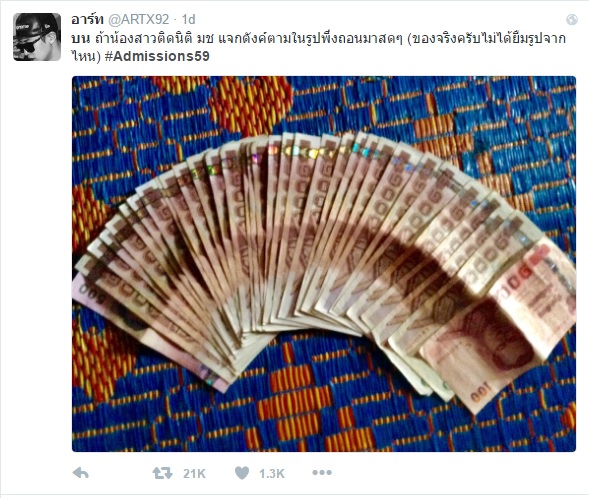
A photo posted by Twitter user @ARTX92 Sunday promising to give all the money in the photo if his sister gets into the university she wants.

BANGKOK — There were no pig heads, traditional dances, floral garlands or the usual ceramic zebras. When it came time to seek divine help, Gen Z bribed the gods with more practical things such as 1,000 baht banknotes, teen novels and Line sticker sets.

And in the latest development to the mass culture of superstition, they’re not taking their bribes to any shrine. Rather, the children of the net have embraced a platform they find more familiar – one that only requires their bon not exceed 140 characters.

In a country where a bachelor’s degree matters less than where you obtain it, it’s no exaggeration to say Sunday was a big day for Grade 12 students, who found out if they were accepted by any of the four universities where they sought entry.

It’s a time when even the most modern youth resort to superstition such as bon, a sort of prayer-cum-bribe in which promises are made in return for divine assistance. In the run-up to Sunday’s announcement, they took their cyber-bon to Twitter, specifically those who cared enough to retweet their prayers.

“Bribe: If I get into any of faculties on my first to third rank, I will pay 500 [baht] to those who retweet this #Admissions2016 #dek2016,” @poppyishappy tweeted Saturday night. It was retweeted nearly 8,000 times.

https://twitter.com/poppyishappy/status/739338612588716032

The bon tweets were among more than 350,000 messages hashtagged #Admissions59 to trend on Twitter during the weekend. Many seemed to target entry into science and technology related faculties.

Others just laid out cash for all to see.

“Bribe : If my sister gets into Faculty of Law, Chiang Mai University, I will give away all the money in this photo I just withdrew,” @ARTX92 tweeted along an attached photo the author insisted was genuine. That went on to be retweeted 21,000 times.

https://twitter.com/ARTX92/status/739385660818132992

It’s a digital take on the bribery of the gods found across the country. People make such bribes asking for pretty much anything, from finding a lover to not to being conscripted into the military. While people get creative with the bribes, there’s one important rule: make good on your end of the deal once you get what you want.

But it might be the first time the practice has made the move onto social media. For the 2016 version, the system was more lucky draw than bribe: Those who retweeted would be randomly selected for the specified prize.

It’s just another example of the technologization of superstition, like online horoscopes or the Luk Thep haunted doll fad, according to a Silpakorn University professor of religion and philosophy.

“Scientific thought has not developed in Thai society despite all the developed technology,” Komkrit Uitekkeng said. “So when technology was introduced, it ended up serving our old beliefs.”

Komkrit does not, however, find this absurd. Unlike cultures where religion and beliefs are more likely to correlate with general thinking and living, he said, Thailand has long separated superstition from book-learning.

“Hence we cannot guarantee that people who study science will have a scientific thinking process,” he said.

Even though youth have more access than ever before to the world’s information and knowledge, Komkrit said nothing has really changed because they still learn and study under the same structures.

“The schools never help them develop critical minds,” he said. “And even in a school that wins some awards for scientific or technological contests, you can still see they have their own sacred things they worship.”

It was unclear by Monday afternoon whether the tweeted offerings had worked. But one thing the phenomenon made clear is the persistency of habits rooted in the cultural long, long ago.

To Komkrit, the teen phenomenon reflects the problems of dependency, which stem from social power relations.

“Bribing the gods reflects dependence on some special, outside power,” Komkrit said, saying it was similar to the special favors sought through social and other connections.

“We wait for special power even in politics, just like how we wait for the spirits to save us,” he said.


Related stories:

‘Luk Thep’ Craze Draws Haunted Doll Backlash (Photos)

Media Enables Sorcerers, Seers to Capitalize on Stricken Star

Advertisement

Teen Says He Stabbed Engineer to Death for His Motorbike

BANGKOK — Two weeks after he was seen stabbing a man to death on a busy Lat Phrao district street, the confessed murderer said he just wanted to take his motorcycle.

Waranyoo Choomanee, 19, was arrested Saturday in his hometown Nakhon Si Thammarat for the May 25 murder of Narate Wangthangmee, who was seen on video being stabbed to death as he waited on his parked motorcycle in front of the Baan Klang Muang community between sois Lat Phrao 23 and 25.

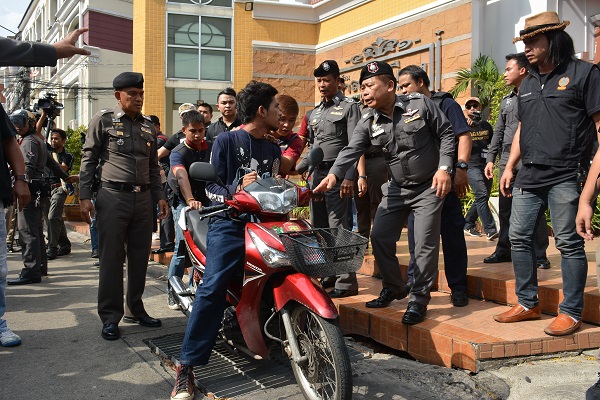
Brought to participate in a police “reenactment” of the crime Sunday, Waranyoo reportedly told police he didn’t mean to kill the 32-year-old engineer when he walked up and drove a blade into his torso. He said he just wanted to steal his motorcycle.

He denied having known Narate personally, but acting metro police chief Sanit Mahathavorn said they’ve yet to determine his motive.

The security camera footage from that day showed Waranyoo abruptly attack Narate by stabbing him in the chest and pushing him off his motorcycle. While Narate struggled to resist him, Waranyoo tried to escape the scene on his victim’s motorcycle, but was stopped by a passer-by who intervened. He then fled on foot.

Soon thereafter, Narate died on the scene next to his motorcycle.

Waranyoo’s had a prior arrest in the same area last year on a drug-related charge. He is currently being held at the Phahonyothin Police Station.


Stab Reenactment 2

Stab Reenactment (2)

Related stories:

Engineer Stabbed to Death on Busy Lat Phrao Roadside (Video)

Advertisement

Ukraine Arrests French Man for Plotting Attacks on Euro 2016

In this photo taken on Friday, Oct. 17, 2014, a view of the renovated Velodrome stadium, in Marseille, southern France. Marseille is one of the 10 playing venues of the Euro 2016 in France. Photo: Claude Paris / Associated Press

MOSCOW — Ukraine’s intelligence agency SBU said on Monday it has thwarted a plot to attack soccer’s European Championships in France by arresting a Frenchman who wanted to cross from Ukraine into the European Union armed to the teeth.

The SBU said in a statement it had followed the man since December and allowed him to purchase five machine guns, two rocket propelled grenades and other weapons before he was arrested on the border between Ukraine and Poland last month.

The SBU didn’t identify the man but said he was driven by ultra-nationalist views and planned 15 attacks on bridges, railways and other pieces of infrastructure for Euro 2016 that will be held in France.

Extremist attacks are a major concern for French authorities as they prepare to host the month-long tournament at stadiums in the Paris area and eight other cities from Friday through July 10. Islamic State extremists have threatened France during the tournament, but authorities have not confirmed specific dangers.

France is deploying 90,000 security forces for the tournament, and French President Francois Hollande said Sunday night that the threat of attacks won’t stop it from being successful.

Ukrainian authorities released photos of a fair-haired man, with his face blurred, holding various weapons.

The SBU said the French man came up on their radar last year during his stay in eastern Ukraine, and where he was “trying to establish ties with Ukrainian troops under the guise of volunteering.”

Ukrainian troops and Russia-backed separatists have fought in the east since April 2014, killing more than 9,400 people. It was not immediately clear which side of the conflict the French man had stayed at.

“The Frenchman spoke negatively about his government’s migration policies, the spread of Islam and globalization,” the SBU said. “He also said that he wanted to perpetrate acts of terror in protest.”

Advertisement

Hot News

LATEST NEWS

Bangkok
overcast clouds
25.5 ° C
26.1 °
25.5 °
46 %
2.4kmh
100 %
Sun
30 °
Mon
31 °
Tue
36 °
Wed
31 °
Thu
33 °