31.6 C
Bangkok
Monday, June 29, 2026
Home Blog Page 2757

Swedes Invite World to Call 'Random' Citizens on New Hotline

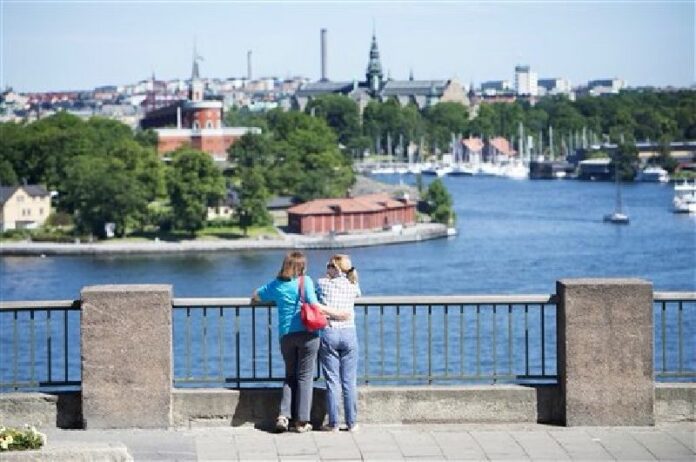
In this July 2, 2015 file photo, tourists looking at a view of Stockholm. Photo: Jessica  Gow / Associated Press

STOCKHOLM — Ever felt like calling up a complete stranger in Sweden?

Now is your chance.

The Swedish Tourist Association has set up a hotline that lets callers worldwide "get connected to a random Swede."

On its website, the nonprofit group says the idea is "to spark people's curiosity about Sweden — our culture, nature and mindset. To help us do this, we have the people of Sweden."

It's not completely random. The Swedes who take the calls have volunteered by downloading an app. But they are not vetted or given any instructions about what to say.

"It's like when Swedes travel the world. You don't know who they're going to talk to and what they're going to say," said Magnus Ling, the head of the Swedish Tourist Association.

About 3,000 people had dialed the "Swedish Number" by midday Thursday, a day after it was launched, and roughly the same number of Swedes had signed up to answer calls, Ling said.

The website says the initiative honors the 250th anniversary of Sweden's 1766 Freedom of the Press Act, believed to be the world's first law supporting the freedom of expression.

Ling admitted there was another motive: recruiting members to the tourism association, which is funded through membership fees. Swedes who sign up to receive calls will receive an email inviting them to join the group, he said.

The calls are not monitored but they are recorded, "so that if someone says I was threatened or harassed we can go back and see who it was and even block that number," Ling said.

The website didn't say that calls are recorded when AP checked it Thursday. Ling said it was listed in the user terms, which those answering the calls — but not those making them — must agree to. He later called back saying the information would be added to the FAQ section of the website.

The biggest number of incoming calls has come from Turkey. Ling said he didn't know why, but thought it had to do with the initiative getting attention there both in traditional media and social media.

After signing up to test the service, this Stockholm-based AP reporter received four calls, about one an hour. The first was a woman from Turkey with limited English skills. The second hung up. The third was an engineering student from Britain. And the fourth was another journalist: Tim Nudd, creative editor at Adweek in New York.

"I just wanted to call and see how this whole thing works," said Nudd.

He, too, was writing an article about it.

The hotline follows a similar initiative on Twitter by the Swedish Institute, the government's own PR agency. Since 2011 it lets a different Swedish citizen manage its official @Sweden account every week.

Ling said the feedback he had received on the hotline was almost all positive, though he said a small number of callers were just trying to hook up with Swedish women.

"I've heard of just one or two such calls," Ling said.

Story: Karl Ritter / Associated Press

Advertisement

Charter Vote a Time Bomb in the Making

The symbolic representation of democracy and the Thai Constitution, which sits atop the Democracy Monument in Bangkok

By Pravit Rojanaphruk
Senior Staff Writer

\

If not handled fairly, the referendum on the junta-sponsored draft charter could light the fuse of a political time bomb rather than be the solution some hope it will prove.

In truth, the vote now planned for Aug. 7 looks increasingly to also be a de facto referendum on the junta, aka the National Council for Peace and Order, itself.

\For its part, the junta through its subordinates has harassed and prevented Anurak Jeantawanich from freely campaigning against the charter, stifled debate by refusing to relax its ban of political gatherings, forbade a bookshop from discussing it, and more.

Such actions curb space for critical voices and fair debate on what will be the foundation of law in the land, therefore ensuring the referendum cannot be considered free and fair.

With just under four months to go before the promised vote, it will be too late come August unless immediate steps are taken to permit open and fair debate on its merits by allowing those calling for its rejection to campaign and deliberate.

Seeing charter supporters campaign freely, often with support from the military regime, while its opponents are silenced only makes a mockery of the referendum.

The climate of fear has reached the point where a veteran Thai election observation confided that he and his peers are still deliberating whether to express any concern about the process.

I told him the public vote has no chance of being free and fair if they wait until the last few weeks to speak out. If there are no voices pressuring the junta to allow free deliberation on the topic while there’s an ongoing crackdown, many may decide against holding such public discussions before trying, particularly those in rural areas, far from the spotlight and with no connections to save their skin.

At least a group of ambassadors and senior diplomats from 18 E.U. member states sent a clear message Thursday when they met Panyarak Poolthup, a deputy permanent secretary at the Foreign Ministry.

“E.U. Ambassadors called upon the Thai Government to uphold principles of freedom of expression and opinion, and allow all voices to be heard. This is of utmost importance for the referendum in order to be considered the result of a free and fair expression of the will of all people of Thailand and to be accepted,” it read.

Another equally troubling factor is that the junta still won’t show its cards regarding what the Thai people will get if they reject the draft charter, already denounced as undemocratic by many groups including the well-known Nitirat group of law lecturers.

To make matters worse, the junta-appointed National Legislative Assembly resolved Thursday to push for a second question to be put to voters in the referendum. They want to ask voters whether members of the Senate, which will be largely and indirectly picked by the junta, to join the house of representatives in selecting the prime minister.

The military dictatorship is forcing people to choose between a charter of its own indirect concoction and an unknown drink which could be more hemlock than elixir of democracy. That they don’t bother laying out the choice fairly and squarely says a lot about their sincerity and honesty toward the Thai people. It’s no surprise that some, like poet Wad Ravi, are now calling this a phony referendum.

Why even bother holding a referendum if they are bent on ensuring it will not become free and fair?

It’s about legitimacy, or barring that, the perception of legitimacy, something the junta did not attain through the coup it staged in May 2014.

The rationale is that if the draft charter is endorsed by the electorate, it will give the impression of a mandate for the junta to share power with a post-election government comprised of elected MPs and those politicians in the Senate, which will be largely and indirectly appointed by the junta itself.

Even if the draft charter is shot down, junta leader Gen. Prayuth Chan-ocha still reserves the right to revive or combine different past charters and use his absolute (and illegitimate) power under Article 44 of the interim military charter to impose a Franken-constitution that could even be worse for everyone.

The current situation is more than a Catch-22 – it’s nothing short of a ticking time bomb that would be more likely to prolong and deepen the crisis already facing Thailand for another decade.

Thais, particularly the millions opposed to the coup, are virtually held hostage by the regime.

Instead of offering a real light at the end of the tunnel, the public is more likely to get a sham vote on a bogus ballot.

Advertisement

Anne Frank’s Diary Opera Comes to Bangkok

BANGKOK — Selections from the diary of a young victim of the Holocaust will come to life in a one woman show in Bangkok.

Opera Siam, with support from the Israeli and German embassies, will bring “The Diary of Anne Frank” to Bangkok as part of a four day festival of Russian composers at the Bangkok Art and Culture Centre later this month.

The opera was written by the late Russian composer Grigori Frid, who was inspired by reading Anne Frank’s diary and penned his operatic tribute in 1969. It was first performed in 1972 in Moscow.

For the upcoming Bangkok performance, Kaleigh Rae Gamache will take on the role of Anne Frank, the 13-year-old Jewish girl forced into hiding with her family as the Third Reich orchestrated a massive genocide of Jews and other groups deemed undesirable.

Adrian Tan will conduct the Siam Philharmonic Orchestra for the hour-long monodrama.

The Israeli diplomatic mission has actively sought to increase Holocaust awareness in Thailand, where it is little understood, and a brand of “Hitler chic” regularly offends foreigners.

The musical tragedy will be performed in English at 7pm on April 20 and April 21 at Bangkok Art and Culture Center.

Other shows featured in the festival include concerts Igor Stravinsky’s “Symphonies for Wind Instruments,” Mozart’s “Serenade No. 10”and a choral concert performance of “All-night Vigil.”

The schedule and registration information for free tickets is available online.


Related stories:

Israel Embassy Condemns Thai Aristocrat's Praise of Hitler

Director Defends 'Hitler Scene' in Thai Junta Film

University 'Hitler Mural' Leads To Flurry Of Apologies – And Gag Order


Advertisement

Free Entry to National Parks for Thais on ‘Family Day’

Erawan National Park in an undated photo. Photo: Department of National Parks, Wildlife and Plant Conservation

BANGKOK — All national parks throughout the country will waive admission for Thai citizens for one day during the Songkran festival.

Throughout the nation, 147 national parks offer free admission for Family Day on April 14, according to Thanya Netithamkul, the deputy director general of the National Parks Department.

Thanya said that although many national parks have faced difficulties during the drought crisis, the protected areas can still provide recreation and relaxation to visitors.

The free admission is only for those holding Thai National ID cards.

Foreign visitors holding such cards can show them to obtain free entry.


Advertisement

Police Ban ‘Marie Claire,’ Citing Lese Majeste

The French edition of Marie Claire in December 2013

BANGKOK — Police today ordered a ban on the import and distribution of a 6-month-old French magazine on the grounds it included libelous remarks about the Royal Family.

In order No. 156/2559 published in the Friday evening edition of the Royal Gazette, police said the November 2015 French edition of Marie Claire published an article that contained content that “insults, defames or threatens His Majesty the King, Her Majesty the Queen, the Heir Apparent or the Regent.”

Import, sale and distribution of the magazine is hereby forbidden under the 2007 publishing act, the police order said. It also instructed police to “confiscate or destroy” any copies of the said issue in Thailand.

Due to strict royal defamation laws, Khaosod English is withholding information about the article in question. 

The order was signed by police chief Chakthip Chaijinda on March 16, but only enacted and made public today.

Police spokesman Dechnarong Sutticharnbancha said he was unaware of the ban and referred inquiries to the Special Branch Police, which he said was responsible for monitoring publications that affect national security. The Special Branch could not be immediately reached for comment.

Any remark deemed insulting toward the monarchy is punishable by up to 15 years in jail under Section 112 of the Thai Penal Code, a law also known as lese majeste.


Related stories:

Thai Police Ban Controversial Book On Royal Succession

'Conversation With Thaksin' Book Sued For Lèse Majesté


Teeranai Charuvastra can be reached at [email protected] and @Teeranai_C.


\

Advertisement

Seoul: 13 North Korean Workers at Foreign Restaurant Defect

n this Feb. 18, 2016, photo, North Korean performers entertain customers at the Okryugwan restaurant in Beijing. Photo: Ng Han Guan / Associated Press

SEOUL, South Korea — Thirteen North Koreans working at the same restaurant in a foreign country have defected to South Korea, Seoul officials said Friday.

People working in North Korean-operated restaurants overseas have previously defected, but this is the first time multiple workers have escaped from the same restaurant, South Korean Unification Ministry spokesman Jeong Joon Hee told reporters in Seoul.

North Korean defections are a bitter point of contention between the rival Koreas. Pyongyang usually accuses Seoul of enticing North Korean citizens to defect, something Seoul denies.

Overseas North Korean workers are usually thought to be chosen largely because of their loyalty.

Jeong said one male and 12 female North Korean workers arrived in the South on Thursday. He didn't reveal the country where they were working or the route they took to avoid diplomatic problems and possibly endanger North Koreans still working in the country.

The Associated Press called a number of North Korean restaurants in Asia, and all were open except one located in the Crowne Plaza Hotel in Danang, Vietnam. A person who answered the telephone at the hotel said the Pyongyang Restaurant had closed two weeks ago and all the Korean staff had left the country. She declined to provide more details or identify herself. It was unclear whether the restaurant was connected to the defections.

The North Korean defectors told South Korean officials that they learned about the South and began to distrust North Korean propaganda by watching South Korean TV dramas and movies and from searching the Internet while living overseas, Jeong said.

South Korean officials believe overseas North Korean restaurants have been suffering economically since stronger international sanctions were applied against North Korea over its recent nuclear test and long-range rocket launch. Jeong said the defectors told South Korean officials that their restaurant was struggling to meet demands from North Korean authorities at home for foreign currency.

South Korea recently advised its citizens not to patronize North Korean restaurants, although such visits are not illegal. South Korea's spy agency estimates that North Korea runs about 130 restaurants in other countries — about 100 in China and the others in Russia, Southeast Asia and South Asia.

In a report to the U.N. General Assembly in October last year, Marzuki Darusman, a U.N. special rapporteur on human rights in North Korea, said more than 50,000 North Koreans are working in foreign countries, mostly in China and Russia, providing a source of money for Pyongyang. He cited various studies, including a 2012 report by the International Network for the Human Rights of North Korean Overseas Labor that estimated North Korea was earning as much as USD$2.3 billion annually from the workers it sent abroad.

The Unification Ministry's website says more than 29,000 North Koreans have defected to South Korea as of March. But there have been only a few incidents in which large groups of North Korean defectors entered South Korea at once.

North Korea in 2004 accused South Korea of kidnapping its citizens after the South airlifted 468 North Koreans from Vietnam. Seoul said the North Koreans fled their country into China and then traveled overland to Vietnam. In 2011, nine North Koreans used a small boat to defect to South Korea by sea.

Story: Associated Press


Related stories:

N. Korean Restaurants in Bangkok and Beijing Emptier Amid Standoff with South

North Korean Follows Path to Freedom in Bangkok

South Koreans Told to Boycott Overseas North Korean Restaurants

Table the Politics and Bite Into North Korean Cuisine at 'Pyongyang Okryu'


Advertisement

Uighur, Chechen Militants in Thailand to Stage Attacks, Memo Warns

Phuket’s Patong Beach community seen in a Dec. 4, 2015 file photo. It is a popular destination for travelers.

BANGKOK — Four militants – two from Turkey and two from Russia – are plotting terror attacks on foreign interests in Thailand and the region, a leaked intelligence warning claims.

The memo, issued by Surat Thani’s governor to local police, identified the two Turkish men by name as Uighurs and the two Russians as Chechens in a threat warning originally issued by the kingdom’s intelligence information agency, the National Intelligence Coordinating Center. Police chief Chakthip Chaijinda on Friday said the warning was real.

“I have been proceeding with this matter in secret for a week now,” Gen. Chakthip said. “I don’t know how this news got out.”

According to the memo, two Uighur men who go by the names Ali Yalcin Egin and Hidayet Dorsun entered Thailand via Phuket on March 23. The pair “may stage attacks on Chinese targets and interests in Southeast Asia,” the memo said.

The two unidentified Chechens, it said, are plotting to attack Russian targets and interests in Thailand.

The memo concluded by saying that the potential attacks may take place either on Phuket or Samui islands, and urged local police to step up security measures around crowded places and transportation hubs.

Both Phuket and Samui islands are popular with foreign tourists, who will be joining in the Songkran new year festival next week.

Despite the grim language in the leaked memo, police chief Chakthip said it is still unclear why the four men entered Thailand, and called upon the public to stay calm.

“Right now, we still don’t know the intention of their entry into the country, we believe they aren’t here with good intention,” Chakthip said. He added, “I’d like to ask the people to be confident in their safety. The Royal Thai Police and other national security agencies are working at the fullest to protect all citizens and foreigners.”

In December, Russia’s Federal Security Service warned Thailand that up to 10 Syrian members of the Islamic State had entered Thailand to attack Russian interests. Thai officials dismissed it as a routine memo and threatened to prosecute the media for reporting its details.

Chechnya is a Russian republic where Islamic separatists fought a long and still unsettled campaign against Moscow. Uighurs are a Chinese ethnic group with deep cultural and linguistic links to Turkey. Two Uighur men are on trial for alleged involvement in the Aug. 17 bombing of Bangkok’s Erawan shrine. Thai officials ruled it a criminal act and not terrorism.


Related stories:

No Credible ISIS Threat, Thai Interpol Head Says

Police Investigate Source of ISIS Memo Leak

Police Caught Off Guard by Memo About Possible ISIS Attack

Moscow Warns That ISIS in Thailand to Attack Russian Targets


Teeranai Charuvastra can be reached at[email protected] and @Teeranai_C.


\


Advertisement

Man Seeks Karmic Justice for Dead Dogs

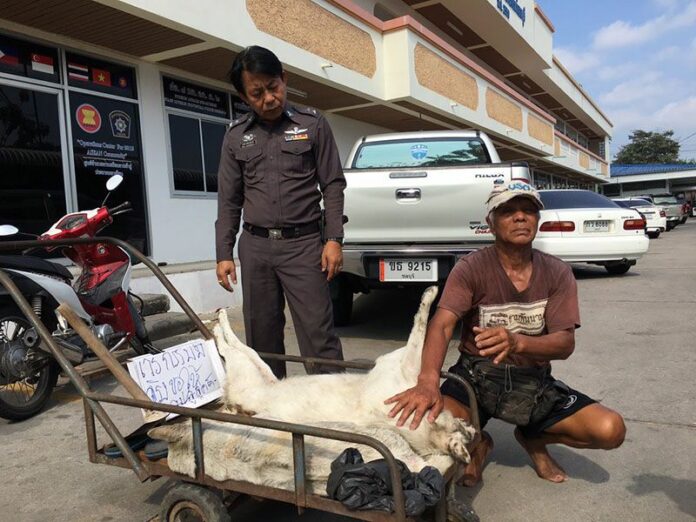
‘Karma is real - may you rest in peace’ reads the sign on Niwat Chuansan’s cart laden with the bodies of dogs he cared for Friday in front of Chonburi city police station.

CHONBURI — A 65-year-old Chonburi man paraded two dead dogs – poisoned, he said – around city center today to protest their deaths and call on karma to punish the perpetrator.

The two female dogs, Khao Yai (big white) and Khao Lek (small white), were found dead Friday morning next to pools of their bloody vomit, which Niwat Chuansan said convinced him they had been poisoned.

Although Niwat said he’s aware of the animal cruelty act, he did not file charges because he believed it would be futile, as the investigation would not go anywhere. A police officer told him as much when he arrived at the police station Friday morning with the two dead dogs in a push cart.

“I think it would be very difficult to [track down the perpetrator],” Niwat said. “A policeman also told me it would be difficult. So, if I press charge, it would just be a waste of their time, and a waste of their paper.”

But Niwat hopes that what goes around will come around, and the cosmic force of karma will punish the wrongdoer.

“I want all the residents to jointly curse the perpetrator, because I believe that karma will catch up with that person faster than the law,” he said.

Animal abuse is punishable by up to a 40,000 baht fine and two years in prison under the 2014 animal protection law, which covers killing animals in a cruel or “unnecessarily painful” way.

According to Niwat, someone poisoned dog food and left it in his community last night in an apparent attempt to kill stray dogs in the area. Five dogs took the bait, and three died, including one that had an owner. The other dogs survived but remain in critical condition, he said.

Niwat said he and his neighbors suspect that another neighbor might be behind the poisoning, because the man berated Niwat angrily two days ago for feeding the strays. He declined to name the person.

“He was yelling at me just two days ago. People around there have also told me those dogs would soon be dead if they stay here. And it really happened,” Niwat said.

His neighbor who owned one of the dead dogs also declined to press charge because they don’t want to create conflict with their neighbors, Niwat added.

He defended caring for Khao Yai and Khao Lek, saying they were kind and never caused trouble for anyone. Niwat pledged to continue to care for the rest of the stray dogs in the area.

“They were like ladies,” Niwat said. “I am feeling disheartened about this, but if I am down, who will take care of the dogs?”


Related stories:

Drive-By Dog Shooter Gets Suspended Sentence

Pheu Thai Politico Insists He Shot Dog in Self-Defense

Soldiers, Police Arrest Condominium Manager for Beating Dog 

Woman Jailed for Defenestrating Chihuahua


Teeranai Charuvastra can be reached at [email protected] and @Teeranai_C.

Follow Khaosod English on Facebook and Twitter for news, politics and more from Thailand. To reach Khaosod English about this article or another matter, please contact us by e-mail at [email protected].


Follow @KhaosodEnglish

\

Advertisement

Fishing Amid Territorial Disputes in the South China Sea

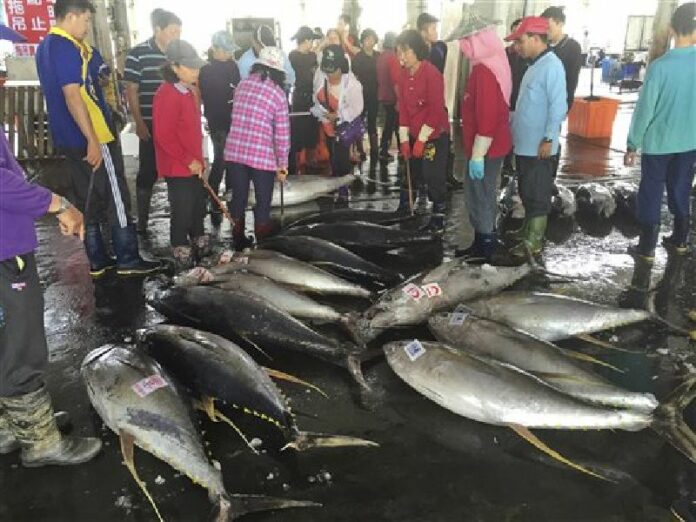
In this March 31, 2016, photo, fishermen and buyers gather at a tuna auction at Donggang fishery port in Taiwan. Fishermen from around the South China Sea tell stories of contending with bandits and coast guards. Photo: Johnson Lai / Associated Press

CATO, Philippines — As Asian countries jostle for territory in the South China Sea, one Filipino fisherman is taking a stand.

He has faced down Chinese coast guard rifles, and even engaged in a stone-throwing duel with the Chinese last month that shattered two windows on his outrigger.

"They'll say, 'Out, out of Scarborough,'" Renato Etac says, referring to Scarborough Shoal, a rocky outcropping claimed by both the Philippines and China. He yells back, "Where is the document that shows Scarborough is Chinese property?"

At one level, the territorial disputes in the South China Sea are a battle of wills between American and Chinese battleships and planes. At another level, they are cat-and-mouse chases between the coast guards of several countries and foreign fishermen, and among the fishing boats themselves.

Indonesia seized a Chinese fishing boat last month and arrested eight fishermen, only to have a Chinese coast guard vessel ram the fishing boat as it was being towed, allowing it to escape.

Vietnam's coast guard chased away more than 100 Chinese boats over a two-week period, its state media reported this week, and made a rare seizure of a Chinese ship carrying 100,000 liters (26,400 gallons) of diesel oil, reportedly for sale to fishing boats in the area.

The South China Sea, a hodgepodge of overlapping territorial claims in the Pacific, is both strategically important and a vital shipping route for international trade. It may also contain valuable oil and natural gas reserves.

As tensions ratchet up, though, it is perhaps those who make a living at sea who feel it the most. Here are some stories from fishermen around the region:

\

In this Feb. 20, 2015, photo, provided by Renato Etac, a Chinese Coast Guard boat approaches Filipino fishermen on Scarborough Shoal in the South China Sea. Photo: Renato Etac / Associated Press


Philippines: The Guardian of Scarborough Shoal

Renato Etac has had dozens of encounters with Chinese ships.

More than once, a small team of Chinese coast guardsmen on a rubber boat approached his boat and pointed their rifles at him, but he says he knew they would not fire and risk starting a war.

At other times, the Chinese will surge as if to hit his boat, but the 37-year-old fisherman uses his keen knowledge of Scarborough Shoal — where he has fished for Spanish mackerel, trevally and grouper since he was a teenager — to outmaneuver them.

Etac says he just wants to defend his livelihood in waters that used to be open to all. China took control of Scarborough Shoal in 2012 after a two-month standoff with Philippine government ships. It sits about 230 kilometers west of the Philippines, and 1,000 kilometers from the Chinese coast.

"It's like quarreling, like playing games," he says. "Yelling, dirty finger, everything's there. Sometimes I use expletives in different dialects and I get to laugh when I see them, because they don't understand what I'm saying."

He enjoys what he calls the territorial "debates" in the high seas, though his earnings from a weeklong fishing expedition have dropped by more than half to 3,000 pesos (2, 285 baht), because of both the Chinese disruptions and competition.

"He's like the guardian of Scarborough, sir," said Greggy Etac, a relative and a fellow fisherman. "I used to sail with him, but now, I'm scared."

\

In this Dec. 24, 2015, photo, provided by Filipino fisherman Renato Etac, a Chinese Coast Guard boat approaches Filipino fishermen near Scarborough Shoal in the South China Sea. Photo: Renato Etac / Associated Press


China: Coast Guard To The Rescue

Chinese fishermen working out of the Hainan island port of Tanmen say they now enjoy much greater support from their country's beefed-up coast guard.

They have been forced to range further out to sea because of the heavy depletion of coastal fisheries, says Li Xianchuan, a 64-year-old crew member who has been fishing in and around Scarborough, the Spratly islands and the closer-in Paracels — claimed also by Vietnam — for 40 years.

"There are many more fish in the Nansha islands, particularly Huangyan island," he says, using the Chinese terms for the contested Spratly group and Scarborough Shoal.

In previous years, Chinese government ships would issue radio warnings about the presence of Philippine patrol ships around Scarborough Shoal.

"It was very dangerous and scary," he says, as his 90-ton vessel takes on fresh water in preparation for a foray into the South China Sea. "We had to run around the reefs to get away from big (Philippine) boats. Thanks to the shallow water and submerged reefs, their big boats could not enter the reefs. We played hide-and-seek inside the reef until their boats gave up and left."

Conditions for Chinese fishermen have vastly improved with the addition of new and larger Chinese coast guard vessels and a more proactive approach, Li says. A call to the coast guard will bring help within two to three hours, he says.

Fishing in the South China Sea remains perilous, Li says. Fishermen must contend with rogue sailors from Vietnam, the Philippines and Malaysia who might try to rob them of their catches and fishing equipment. Li says he has been fired on once, and knows of several fishermen killed in encounters with Philippine boats.

\

In this March 31, 2016, photo, Taiwanese fisherman Hong Huai-jen, stands on his boat at Donggong Fishery Port in Pingtung County, in southern Taiwan. Photo: Johnson Lai / Associated Press


Taiwan: Fear of Banditry at Sea

Heightened competition, and even banditry, is making it ever-harder to make a living, says Taiwanese fishing boat owner Hong Huai-jen.

"Now, they are not only fishing in the South China Sea, but have also broken into our territorial waters," Hong says, standing by his boat in the southern Taiwan port of Donggang, which looks out on the Taiwan Strait.

His boat was surrounded last November by a group of Vietnamese fishing boats in waters off Taiwan, presumably for the purpose of robbing him. He managed to give them the slip and called the Taiwanese coast guard for help. The Vietnamese boats had dispersed by the time help arrived.

"Taiwanese fishermen don't have any weapons," Hong says. "Once they board our boats, there's nothing we can do. We would be detained and we have to pay for our release."

He has been fishing for 14 years from his home port on Xiaoliuqiu, an island in the Taiwan Strait.

"There's a big difference compared with the business we had before," he says. "My father has worked as a fisherman for about 40 years. The fishery resources were rich, and there were fewer fishing boats before. But now, the resources are thin and there are lots of boats."

\

In this April 6, 2016, photo, Secretary-General of Indonesian Fishermen’s Association Anton Leonard speaks during an interview with the Associated Press in Jakarta, Indonesia. Photo: Tatan Syuflana / Associated Press


Indonesia: Ancestral Disputes

Fish-rich waters around Indonesia's Natuna Islands have a long history of being contested, says Anton Leonard, a fisherman and exporter who is secretary-general of the Indonesian Fishermen's Association representing traditional fishermen.

"Fishermen that come from Vietnam, Thailand, Malaysia and China have told native fishermen that Natuna waters are their traditional fishing grounds since the time of their ancestors," says Leonard. "Local fishermen in Natuna could not resist their presence because some of them believe the claims, others because such vessels are much bigger, more advanced and sometimes also carrying weapons."

Native fisherman haven't been directly affected by South China Sea incidents that involve Chinese patrol boats, likely because they don't venture far out into Indonesia's exclusive economic zone, he says. But Indonesia's crackdown on foreign fishing vessels in its waters and a policy against "transshipment" of fish between boats at sea has affected the livelihood of traditional fisherman because they have fewer opportunities to sell their catch. At the same time, the government lacks a comprehensive strategy to empower the fishermen and improve their industry, Leonard says.

"We are not afraid to face foreign boats coming into our territory," Leonard said. "We're eager to help the government and waiting to be involved in the defense of the country, even if only to be able to inform the local authorities about their presence within our waters."

\

In this March 26, 2016, photo, Vietnamese fisherman Tran Lan piles fishing nets on his boat in Tho Quang port, Danang, Vietnam. For five generations, Tran Lan’s family has been fishing in the South China Sea.(AP Photo/Hau Dinh)


Vietnam: Fearing China

For five generations, Tran Lan's family has been fishing in the South China Sea. He was 17 when he started going out in a small boat with his father. The family did well enough to buy two wooden trawlers for USD$90,000 (3.2 million baht) each. His four sons, now aged 19 to 30, joined him.

The decades-old routine changed in the early 2000s when their boat was threatened and nearly rammed by Chinese maritime police four times near the Paracel Islands in South China Sea. They switched their fishing grounds to the less bountiful Tonkin Gulf, but still work in constant fear of being attacked by the Chinese.

"We have equipped GPS and navigation to identify Chinese boats so we can avoid them," Lan says. "The last thing I want is to get too close to Chinese boats. They have bigger boats and definitely would outrun us."

His boats were among about 1,000 anchored at Tho Quang terminal, the biggest in the central port city of Danang. He and others were busily readying their boats to go back to sea. Each expedition lasts up to 30 days, punctuated by two to three weeks in port to rest and repair boats and gear.

Vietnam, China and Taiwan all claim the Paracel Islands, which have been controlled by China since 1974. Vietnam has accused China of harassing and attacking its fishermen in what it says are traditional fishing grounds near the Paracels that they have been working for generations.

"I was fishing near the Paracel Islands for a long time, but the Chinese have sealed it off," Lan says, whose family earns about USD$27,000 (950,000 baht) a year catching squid. "It was a good area for fishing."

Story: Associated Press


Advertisement

Khaosod English Speaks With Yingluck Shinawatra

Former Prime Minister Yingluck Shinawatra visits Khaosod offices Friday in Bangkok.

BANGKOK — Former Prime Minister Yingluck Shinawatra was among the well-wishers who turned out to celebrate Khaosod newspaper’s 25th anniversary, during which she agreed to a brief chat with Khaosod English.

Yingluck was among hundreds of representatives from the public and private sectors who turned out to mark the occasion, including members of the armed forces and junta spokesman Col. Winthai Suvaree, who attended on behalf of Prime Minister Prayuth Chan-ocha.

Since the government she led was deposed in the 2014 coup, Yingluck remains under close scrutiny by the military government and is being tried on corruption charges stemming from her government’s rice subsidy. Under those constraints, she said that she could would have to “cool down” any questions on matters related to politics.

We streamed the brief interview live over Facebook, but unprepared with a proper microphone, the audio quality was poor. Following is a partial transcript of her exchange with Khaosod English editor Todd Ruiz.


Khaosod English: Tell me, you have not been in politics for some time, but you’ve watched, you read, you pay attention. What do you think are the challenges in Thailand’s near future?

Yingluck Shinawatra: The challenge of Thailand in the near future is, I think, now it’s time for Thailand to keep moving forward into the referendum on the constitution. We hope this time it will be free and fair for everyone to understand both sides of the content and then to consider based on the future of Thailand.

So I hope during this time, hope the charter tries to create an environment to be peaceful and fair, and freedom for everyone to express their thoughts along the way and try to compromise to find the solutions in the future
KE: Do you see a future where you’re back in politics?

YS: No, I just think about the current situation would be better because as you know now I have been banned. So we think that in whatever, wherever position, I will be with Thai people. So I think this is best to think about now. Whatever I can help the country … it doesn’t mean I only have to be politician.

KE: Will you take a position on the draft charter? Yes or no?

YS: I think we just say this time we talk about Songkran, it’s better. (laughs) Now so your anniversary will be the same as Songkran. So we will have to say as in Thai, ‘Happy Songkran Anniversary. Happiness, prosperity, also all the peacefulness.


\
Junta spokesman Col. Winthai Suvaree, uniformed at left, visits Khaosod offices Friday in Bangkok

Advertisement

Hot News

LATEST NEWS

Bangkok
overcast clouds
31.6 ° C
33.9 °
30.5 °
69 %
5.8kmh
100 %
Mon
31 °
Tue
34 °
Wed
30 °
Thu
34 °
Fri
33 °