



























30 C
Bangkok
Sunday, June 28, 2026
Home Blog Page 2782

Htin Kyaw Wins Historic President Vote in Myanmar Parliament

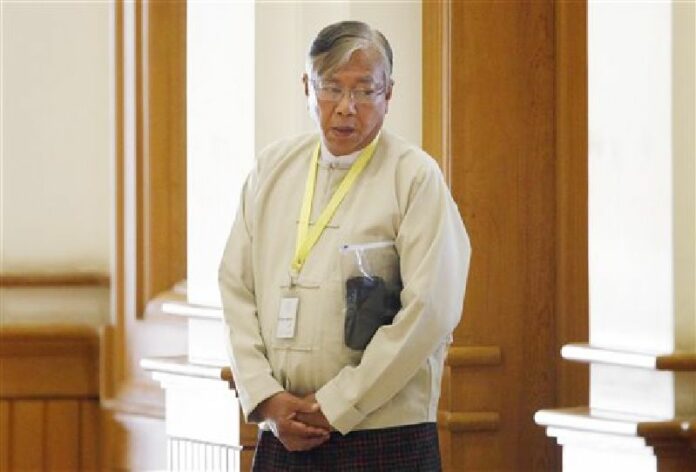
Htin Kyaw, the next president of Myanmar, stands in a corridor of Myanmar's parliament in Naypyitaw, Myanmar, Tuesday, March 15, 2016. Photo: Aung Shine Oo / Associated Press

NAYPYITAW, Myanmar — Myanmar's parliament has elected Htin Kyaw as Myanmar's new president, a watershed moment that ushers the longtime opposition party of Aung San Suu Kyi into government.

The 70-year-old Htin Kyaw, a longtime confidant of Suu Kyi, will take office April 1 to become Myanmar's first democratically elected leader after more than half a century of military rule.

Htin Kyaw's secured 360 votes from among 652 ballots cast in the bicameral parliament, winning a strong majority. The vote count was read aloud and announced by a parliament official.

The military's nominee, Myint Swe, won 213 votes and will become the first vice president. Htin Kyaw's running mate from the National League for Democracy party, Henry Van Tio, won 79 votes and will take the post of second vice president.

Suu Kyi led her National League for Democracy party to a sweeping victory in Nov. 8 elections, a reflection of the widespread public support she earned during her decades-long struggle for democracy in Myanmar which was ruled for half a century by a military junta.

The Nobel laureate and longtime political prisoner is the party's unquestionable leader but is blocked from becoming president because of a constitutional clause that excludes anyone with a foreign spouse or children. Suu Kyi's two sons are British, as was her late husband. The clause is widely seen as having been written by the military with Suu Kyi in mind.

To assume the top post in her place, the NLD nominated Suu Kyi's trusted friend and adviser Htin Kyaw, the son of a national poet and the son-in-law of a founding member of the country's pro-democracy movement.

Myanmar's electoral system requires that the president be chosen from candidates put forward by each of the two houses of parliament, and a third nominee from the military, which retains a quarter of the legislative seats.

Myint Swe is seen as a close ally of former junta leader Than Shwe and remains on a U.S. State Department blacklist that bars American companies from doing business with several tycoons and senior military figures connected with the former junta.

Story: Esther Htusan / Associated Press
Advertisement

Is Myanmar's New President Just a Puppet for Suu Kyi?

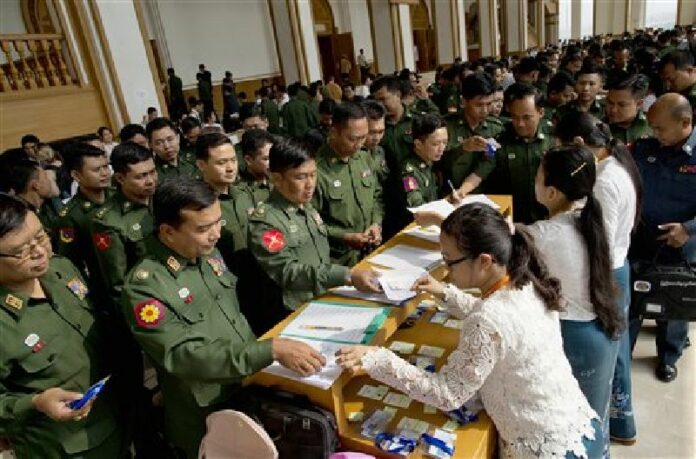
Military officers, appointed members of Myanmar's parliament stand in lines to mark attendance registry in Naypyitaw, Myanmar, ahead of a parliamentary session on Tuesday, March 15, 2016.  Photo: Gemunu Amarasinghe / Associated Press

NAYPYITAW, Myanmar — Myanmar's parliament elects a new president on Tuesday to head the country's first democratically elected government, but it won't be Aung San Suu Kyi, the face of the nation's decades-long struggle against military rule. Here's why:

What Prevented Suu Kyi?

The military has been in power in Myanmar since 1962. Faced with unrelenting international pressure and a democracy campaign led by Suu Kyi, the junta began to pave the way toward a civilian government in 2011. Suu Kyi's nonviolent campaign won her the Nobel Peace Prize. But such was the antipathy of some generals toward Suu Kyi that they inserted a clause in the constitution to stymie her. The clause forbids anyone with a foreign spouse or child from becoming president. Suu Kyi's two sons are British, as was her late husband.

\

Aung San Suu Kyi arrives at parliament in Naypyitaw, Myanmar, Tuesday, March 15, 2016. Photo: Gemunu Amarasinghe / Associated Press


What Did Suu Kyi Do?

Her National League for Democracy party won the Nov. 8 parliamentary elections by a landslide. At that point, she had still hoped to convince the generals to allow the constitutional clause to be scrapped. The military, which controls a quarter of the seats in parliament, refused to relent during several rounds of negotiations with her. So the NLD had to nominate someone else as its candidate for president, who is chosen by members of parliament.


Who Did She Choose?

Foreseeing such an eventuality, Suu Kyi told the media before and after the election that she would be the real power in the government, and whoever becomes president would do her bidding. While her statement may sound undemocratic, she could argue that she was only reflecting the will of the people who voted for the party because of her. So she chose a trusted friend she has known for more than 60 years, a confidant who has been by her side for decades and an astute adviser all these years: Htin Kyaw, a 70-year-old former computer programmer and bureaucrat.


What Are The Pitfalls?

Experts say that Suu Kyi's position on being the real power will ensure that Htin Kyaw will be seen as a seat warmer, and therefore an easy target for military leaders keen to reassert control. It gives him little clout in making policy decisions, even among his own colleagues. Experts also warn that it is possible that foreign leaders and governments will bypass him and go directly to Suu Kyi, making him less relevant.

Story: Associated Press

Advertisement

Chiang Mai Bikers Turn Parched River into Motocross

Dirtbikers practice Sunday on a dry stretch of the Ping River in Chiang Mai province. Photo: Pakon Gunman / Facebook

CHIANG MAI — As the drought crisis grows worse across the country, residents have adapted by transforming a rocky, dried out stretch of the Ping River into a temporary motocross track.

In February the river through Chiang Mai’s Chom Thong district and Lamphun’s Ban Hong district went completely dry. Ban Thung Mak Num village chief Nirut Atama said it was the first time in memory, but locals chose to turn the crisis into opportunity.

The 850 meter by 500 meter area was transformed into a dirt bike track by volunteers from a local motorcycle club who will stage a motocross rally this weekend.

Pakon Jaimoon, the head of Enduro Chom Thong, said locals usually fish and produce rafts for tourists but have lost their incomes since the water vanished.

Part of the money earned from the racing events will go to support a public campaign against road races, Pakon said.

The Chom Thong Enduro Charity @ Cyclecross No. 1 race will take place Sunday.
 

201603141354453-20021028190509.jpeg

201603140943037-20021028190509.jpg

10524335_10206352593509904_1120224442654704691_n.jpg

Poster for the Chom Thong Enduro Charity @ Cyclecross No. 1. Photo: Pakon Gunman / Facebook


Chayanit Itthipongmaetee can be reached at[email protected] and @chayaniti92.


\

Advertisement

Chiang Mai Bikers Turn Parched River into Motocross

Dirtbikers practice Sunday on a dry stretch of the Ping River in Chiang Mai province. Photo: Pakon Gunman / Facebook

CHIANG MAI — As the drought crisis grows worse across the country, residents have adapted by transforming a rocky, dried out stretch of the Ping River into a temporary motocross track.

In February the river through Chiang Mai’s Chom Thong district and Lamphun’s Ban Hong district went completely dry. Ban Thung Mak Num village chief Nirut Atama said it was the first time in memory, but locals chose to turn the crisis into opportunity.

The 850 meter by 500 meter area was transformed into a dirt bike track by volunteers from a local motorcycle club who will stage a motocross rally this weekend.

Pakon Jaimoon, the head of Enduro Chom Thong, said locals usually fish and produce rafts for tourists but have lost their incomes since the water vanished.

Part of the money earned from the racing events will go to support a public campaign against road races, Pakon said.

The Chom Thong Enduro Charity @ Cyclecross No. 1 race will take place Sunday.
 

201603141354453-20021028190509.jpeg

201603140943037-20021028190509.jpg

10524335_10206352593509904_1120224442654704691_n.jpg

Poster for the Chom Thong Enduro Charity @ Cyclecross No. 1. Photo: Pakon Gunman / Facebook


Advertisement

Malaysian Police Say Australian Reporters Will be Deported

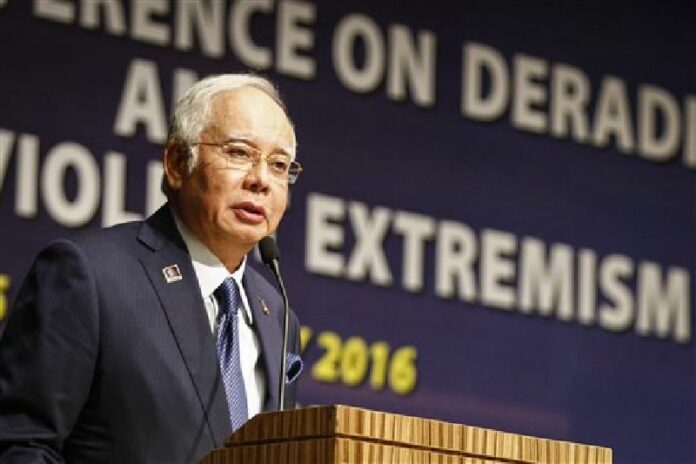
In this Monday, Jan. 25, 2016 file photo, Malaysian Prime Minister Najib Razak speaks at a conference in Kuala Lumpur, Malaysia. Photo: Joshua Paul / Associated Press

CANBERRA, Australia — Malaysian authorities have decided against charging two Australian journalists who attempted to interview the Malaysian prime minister over corruption allegations and will instead deport them, police said Tuesday.

The decision came after the Australian government intervened and suggested the detention was part of a Malaysian crackdown on press freedom.

Australian Broadcasting Corp. television reporter Linton Besser and camera operator Louie Eroglu had been told to appear in a Sarawak state court on Tuesday morning charged with obstructing a public servant from discharging his duties when they questioned Prime Minister Najib Razak as he entered a mosque in the state capital Kuching on Saturday.

The state broadcaster reported that two hours after a press release was issued Monday confirming the charge, the lawyer for the two was told they would not be charged.

ABC said no explanation was given for the change.

The pair can leave Malaysia after visiting a police station to complete paperwork, ABC said.

Sarawak police said in a statement that they were told by prosecutors Tuesday that no charges would be filed.

The pair will be deported, the statement said without giving further details

On Monday, Foreign Minister Julie Bishop said the case would be raised at the "highest levels within the Malaysian government."

She said there were concerns about "a crackdown on freedom of speech."

Sarawak police said the pair were detained after they "crossed the security line and aggressively tried to approach" Najib, accusations that the ABC denied.

Najib is engulfed in a scandal over USD$681 million deposited into his bank accounts in early 2013. Critics accuse him of corruption and say the money came from an indebted state investment fund which he founded in 2009.

In January, Attorney-General Mohamed Apandi Ali decided not to prosecute the prime minister, saying the money was a "personal donation" from the Saudi royal family.

Besser and Eroglu, on assignment for an investigative current affairs program, had asked Najib as he entered a mosque why the money had been deposited into his accounts, the ABC reported.

Najib did not respond and his security detail surrounded the two.

\

Australian Broadcasting Corp. television reporter Linton Besser, right, and camera operator Louie Eroglu, center, prepare to leave at the Kuching International Airport in Sarawak, Malaysia, Tuesday, March 15, 2016.  Photo: Associated Press


Story: Rod McGuirk and Eileen Ng / Associated Press

Advertisement

AIS Set to Shutdown 2G Service

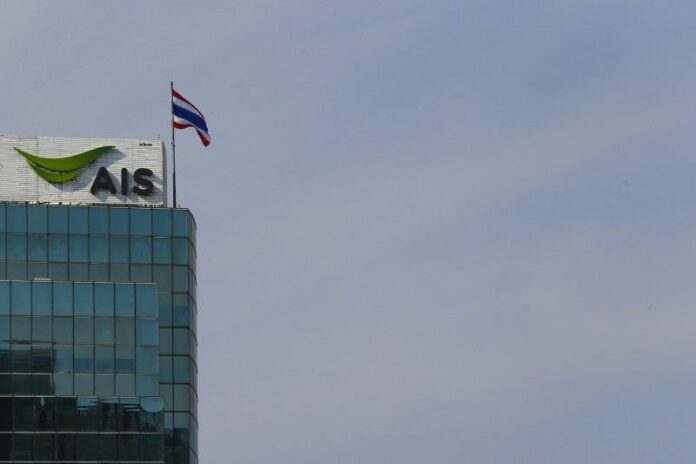
The logo of Advance Info Service Public Company Limited at its office building in central Bangkok, March 11, 2016. Photo: Athit Perawongmetha / Reuters

By Khettiya Jittapong and Manunphattr Dhanananphorn
Reuters

BANGKOK — Some 400,000 subscribers of Thailand's largest mobile operator Advanced Info Service Pcl (AIS) could be cut off from services after the nation's telecoms regulator said AIS has to shut down its 2G mobile services as of midnight on Tuesday.

AIS has been scrambling to migrate up to 12.9 million 2G customers after it lost in December an auction of spectrum to rival True Corp.

It has already shifted about 5 million of those to its 3G and 4G services and a further 7.6 million 2G users to the network of second-ranked Total Access Communication Plc & DTAC. The company said on Monday about 400,000 2G subscribers have not been migrated so far and could be cut off.

Late on Monday, AIS also said it has sought a court injunction to enable the 2G service to be extended. It was not immediately clear if the injunction was granted.

While the migration efforts are already raising costs for AIS, discontinuing the services would be bad publicity for the company and force some customers to switch to third-ranked True Corp, analysts said. True will use the spectrum from March 16, the regulator has said.

AIS shares ended down 2.5 percent at a two-week low on Monday, while the main Thai index SETI was 0.06 percent higher.

"We think AIS should be able to migrate its subscribers in time before the shutdown at midnight on March 15," Takorn Tantasith, secretary general at the National Broadcasting and Telecommunications Commission, said.

The regulator will not allow AIS to automatically move its 2G subscribers to 3G services without request from its customers, Takorn said.

AIS chief executive officer Somchai Lertsutiwong told a news conference on Monday the company has offered free smartphones to encourage 2G customers to shift to 3G or 4G services. He said the discontinuation of the 2G services will have only a marginal impact on its revenue.

"We have done whatever we could to ensure service continuity," Somchai said.

AIS, 23 percent owned by Singapore Telecommunications Ltd, has about 40 million subscribers.


Advertisement

National Boozebuster Notifies Thailand Pre-Mixed Cocktails are Illegal

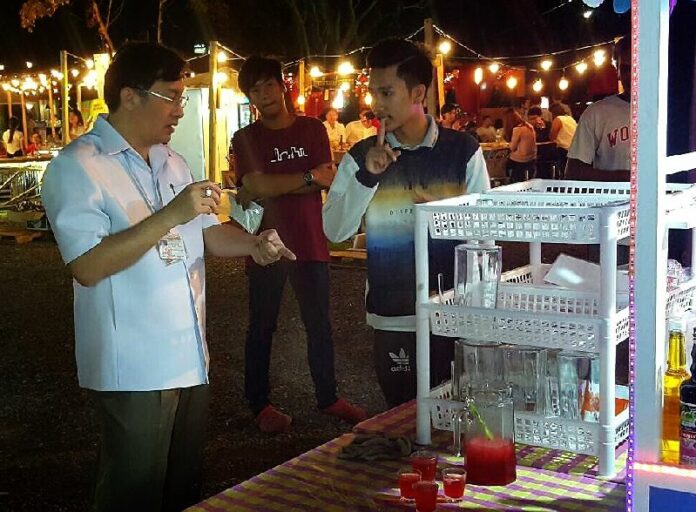
Samarn Futrakul lectures a vendor Friday night as he busts a 'lao pan' stand Friday night near Lumpini Park in Bangkok.

By Teeranai Charuvastra
Staff Reporter

BANGKOK — After going dark for some months, the nation’s top alcohol regulator is back with more bad news.

Lao pan, those ubiquitous iced cocktail jugs sold at every festival and night market in Thailand? Illegal since 1950, Samarn Futrakul, the renowned prohibitionist who heads the alcohol control board, pointed out to reporters Sunday.


Thai Bar Chides Legal Overreach of Anti-Alcohol Crusader


Samarn made the comment two days after he led a raid Friday on a night fair near Lumpini Park, in which officials busted cocktail stands and confiscated a number of alcoholic beverages said to violate the law, namely beer popsicles.

According to Samarn, the 1950 law specifically bans vendors from mixing large batches of alcohol to be sold in cups to customers. The law also outlaws giving out samples of cocktails to passers-by, he said. 

Under Section 23 of the Liquor Act, no one is allowed to mix alcohol with other substances put it in a different container “unless the customer specifically requests the alteration of the liquor for immediate consumption.” 

Because of that passage, Samarn warned, vendors are not allowed to prepare cocktails in large quantities, and they can only mix cocktails in small portions for customers who specifically order them, Samarn said. 

He gave no indication whether he would next go after the tanks of mojitos and other pre-mixed cocktails commonly found in places which sell alcohol.


On Booze and Buddhism, Culture Warriors Grasp for a Past Already Passed


In the raid at the former site of the Suan Lum Night Bazaar, officials arrested vendors selling beer popsicles, which Samarn determined were an “alteration” of alcohol and therefore an offense under the 1950 law. The vendors face fines for these violations, he said. 

The raid signaled Samarn’s return to the spotlight four months after he was chided for going too far with an overzealous campaign targeting increasingly mainstream activities, such as open-air beer gardens popular during the cool season (Illegal, he ruled).

\

A ‘lao pan’ stand Friday night at a night market near Lumpini Park.

An avowed Buddhist who believes alcohol is sinful, Samarn has sought to restrict its availability by drafting a number of laws and regulations as head of the National Alcohol Control Board. 

Late last year, Samarn was a daily news fixture due to his zealous efforts to limit alcohol sales, such as threatening to prosecute anyone posting photos of alcohol on social media, and raids on convenience stores that violated strict but unenforced advertising regulations

His rampage came to an abrupt end when he attempted to ban the beer gardens, a lucrative business for the kingdom’s major beer conglomerates and popular national past time. After being widely criticized for overreaching from figures including junta chairman Prayuth Chan-ocha, Samarn has kept a much lower profile.

Related Stories:

Thailand Back to the Booze Ban Future

2 Bars Closed Down Under Junta's Sweeping Booze Ban

Yes, Beer Pics Were Advertisements, Woonsen Concedes


Teeranai Charuvastra can be reached at [email protected] and @Teeranai_C.


\

Advertisement

‘Freelance’ Wins Big at Golden Swan Awards

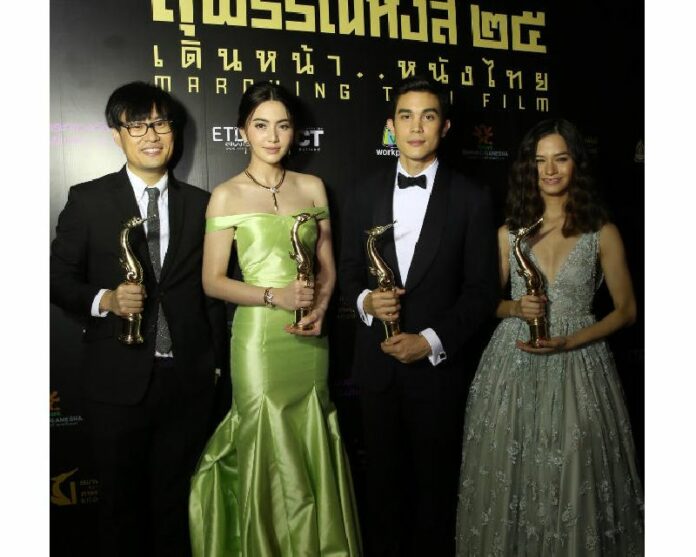
'Freelance' Director Nawapol Thamrongrattanarit and cast members Davika Hoorne, Sunny Suwanmethanon and Violette Wautier pose with their Golden Swan awards Sunday night in Bangkok.

BANGKOK — A movie about a workaholic graphic designer swept the top awards at the movie industry’s 25th annual awards show Sunday night.

It was a movie made by top indie director Nawapol Thamrongrattanarit for GTH, the nation’s most commercial studio, that walked away with eight Golden Swans at the Subannahongsa Award show held at the KBank Siam Pic-Ganesha theater in Bangkok.

“Freelance,” which picked up a social trend in the millenial workforce, won Best Picture and Best Director for Nawapol. The movie was also awarded Golden Swans for Best Screenplay, Best Leading Actor and Actress, Best Supporting Actress, Best Editing and Best Original Score.

Trailing in second was “Snap,” a romantic movie grounded in the context of Thailand’s political conflict which received awards for Best Art Direction, Best Sound Recording and Mixing, and was co-awarded a Best Screenplay award along with Freelance.

The documentary film “The Songs of Rice” followed with two prizes for Best Cinematography and Best Documentary. The horror-drama genre film “Run Phee” picked up two awards for Best Visual Effects and Best Original Soundtrack.

Sunday night was the 25th edition of the Subannahongsa Awards.

Related stories:

Film Giant GTH to Dissolve


Advertisement

Anti-Charter Campaigner Reports ‘Polite’ Visit by Soldiers

Anurak Jeantawanich, second from left, presents a T-shirt opposing the draft charter to soldiers today at his home southeast of Bangkok in Samut Prakan province.

By Pravit Rojanaphruk
Senior Staff Writer

BANGKOK — A man who’s become known for his Sunday campaigns against the junta-sponsored draft charter was visited by soldiers and special branch police this afternoon.

After having conducted his fifth straight Sunday protest in the Wongwian Yai area, Anurak Jeantawanich, aka Ford Red Path, wrote just before 5pm on Monday to say two soldiers and a police officer had just visited his home in Samut Prakan province in southeastern metro Bangkok.


Protesting With Precision, Anurak Jeantawanich Walks a Tight Legal Path


He said the trio politely asked questions but issued no warnings regarding his activities. Anurak didn’t specify what questions were asked.

“May I ask friends not to criticize the military or police? This is because they came as friends,” he wrote via Facebook. He added that he will continue to campaign every Sunday.

Anurak said he gave four “Vote No” T-shirts to the officers as well as some campaign stickers as memorabilia. Two attempts to reach him by telephone this afternoon were unsuccessful.

Advertisement

Intelligence Advice for Next President: Rocky Road Ahead

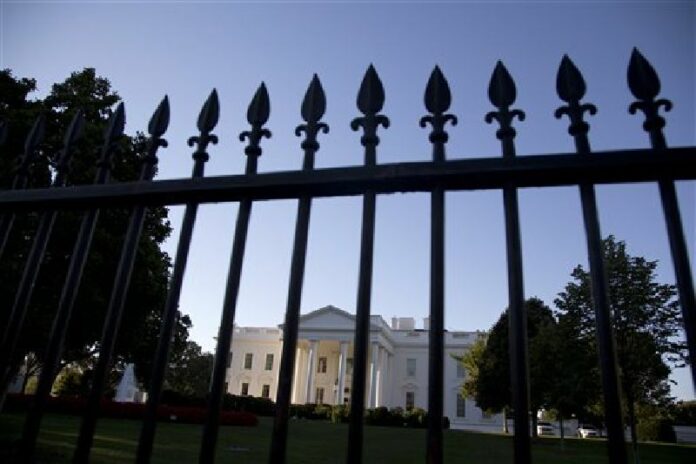
In this Sept. 22, 2014, file photo, the White House is photographed from Pennsylvania Avenue in Washington. Photo : Carolyn Kaster / Associated Press

WASHINGTON — To: The next president of the United States.

From: U.S. intelligence officials.

Welcome to the White House. Now read our take on global political landscape and trends for the next five years and beyond. Bottom line: Get ready for a rocky road.

Their forecast calls for a slowing global economy dragged down by sluggish growth in China, and political volatility across the world, spurred by disillusionment with the status quo. Insecurity will deepen rifts among social classes and religious groups. Extremists will consolidate into large-scale networks across Africa, the Arab world and parts of Asia.

Competition among the U.S, China and Russia will heat up, raising the risk of future confrontations. Climate change is a problem now. And technological advances will force governments and their citizens to wrestle with securing data, privacy, intellectual property and jobs lost to high-tech innovations.

The National Intelligence Council, part of the Office of the Director of National Intelligence, serves as a bridge between intelligence agencies and policymakers. Its global trends report is compiled every four years so it can be handed to an incoming president or the incumbent. A summary of a draft of its latest findings was to be released Monday at a conference in Austin, Texas.

These trends follow 20 years of unprecedented reductions in poverty and increased access to education and information, which have empowered citizens around the world.

Suzanne Fry, director of the council's Strategic Future Group, and about 10 of her colleagues visited 30 countries since September 2014 to talk about the future with an estimated 1,800 people from all walks of life.

"Really for the first time in human history, people as individuals, really, really matter," Fry said in an interview.

She recalled Mohammed Bouazizi, a fruit seller who killed himself in 2010 to protest police actions in Tunisia. His death sparked an uprising that led to the ouster of Tunisia's dictator and inspired Arab Spring protests against authoritarian rule across the region.

In America, public discontent is evidenced by the rise of two presidential candidates — Republican Donald Trump and Democrat Bernie Sanders — whose anti-establishment messages appeal to anger among the general electorate, Fry said.

"They're channeling something that we're observing in a lot of countries, not just the United States, which is this real dissatisfaction with the existing social bargains or compacts in societies," Fry said.

The report suggests that this type of populism being seen in industrial nations will percolate in the developing world as those affected by a slow-to-zero rise in wages and a hollowing out of the middle class start questioning the effectiveness of traditional policies.

The council's final report is expected to be released between Election Day, Nov. 1, and the inauguration of the next president, on Jan. 20, 2017. The aim is to provide information about emerging trends to guide decisions that could alter the way the world is expected to evolve during the next 20 years.

A significant trend cited in the report is a slowdown of China's economy, which has reduced demand for commodities, especially in Latin America, Africa and the Middle East. Also on the economic front, the report highlights a concern about increased concentration of wealth among a small number of people.

"We have seen lots of poverty reduction in recent years and people flowing into the middle class, but how do you keep this movie going? It's not clear that the political and economic reforms can keep it going," Fry said. "We've got brand new entrances to the middle class in the developing world. Their expectations are enormous and they are about to be crushed."

The report predicts increased competition and a "desire for status" by emerging and fading powers. This will play out as transnational terrorism, conducted by groups such as the Islamic State, al-Qaida and Boko Haram, and sectarian violence continue to threaten stability in the Middle East, Asia and parts of Africa.

"Multiple power centers are possible if regional aggression and flouting of international norms go unchecked," the report says.

Story: Deb Riechmann / Associated Press

 

Advertisement

Hot News

LATEST NEWS

Bangkok
overcast clouds
30 ° C
31.6 °
30 °
75 %
3.5kmh
98 %
Sat
30 °
Sun
34 °
Mon
34 °
Tue
33 °
Wed
32 °