A South Korean army soldier walks by a TV screen showing North Korean leader Kim Jong Un with superimposed letters that read: "North Korea's nuclear warhead" during a news program at Seoul Railway Station in Seoul, South Korea, Wednesday, March 9, 2016. Photo: Ahn Young-joon / Associated Press
SEOUL, South Korea — North Korea has caused a new stir with photos on the front page of its ruling party newspaper Wednesday that show the country's leader Kim Jong Un standing beside a purported mock-up of a miniaturized nuclear warhead during a meeting with his top nuclear scientists.
The Rodong Sinmun newspaper for the Workers' Party said Kim met his nuclear scientists for a briefing on the status of their work and declared he was greatly pleased that warheads had been standardized and miniaturized for use on ballistic missiles.
The party newspaper photos showed Kim and the scientists standing by what outside analysts say appears to be the model warhead — a small, silverish globe presented on a low table in a hangar with a ballistic missile or a model ballistic missile in the background.
South Korea's Defense Ministry said Wednesday it was analyzing the objects shown in the North Korean photos.
Pyongyang has previously said it has nuclear warheads small enough to put on long-range missiles, but experts have questioned such claims.
This was the first time the North has publicly portrayed what its designs look like, though it remains unclear whether the North has a functioning warhead of that size or if it is simply trying to develop one.
Protesters hold placards with defaced images of North Korean leader Kim Jong Un while shouting slogans during a rally in Seoul, South Korea, Monday, Feb. 22, 2016. Photo: Ahn Young-joon / Associated Press
North Korea warned Monday of pre-emptive nuclear strikes after the United States and South Korea began holding their biggest-ever war games, which will go on until the end of April. Tensions have been high after North Korea's recent nuclear test and rocket launch, which prompted the United Nations to adopt tough new sanctions.
The North claims it tested its first H-bomb in the Jan. 6 nuclear test, which was followed last month by the launch of a rocket that put a satellite into orbit but which is seen as a violation of U.N. resolutions because it contains dual-use technology that could also be applied to long-range ballistic missiles.
Its development of smaller nuclear weapons and long-range missiles that could be used to deliver them to targets overseas has long been a matter of concern and could potentially shake up the security balance in Asia.
If the North succeeds in developing a credible warhead and missile, it would most deeply impact the United States, South Korea and Japan, but Russia and China, which are friendlier to the North, have strongly denounced its nuclear program.
Story: Hyung-jin Kim and Eric Talmadge / Associated Press
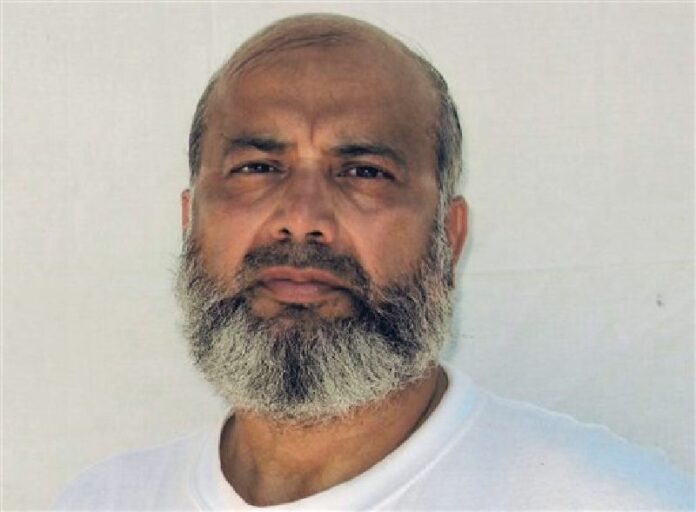
This undated photo made by the International Committee of the Red Cross and provided by lawyer David H. Remes, shows Guantanamo prisoner Saifullah Paracha. Photo: David H. Remes / Associated Press
MIAMI — The oldest inmate at the prison in Guantanamo Bay, Cuba, made his case Tuesday for freedom after more than a dozen years in custody.
Saifullah Paracha, a 68-year-old former businessman from Pakistan who also lived in the United States for more than a decade, appeared by video-teleconference link from the base before the Periodic Review Board, a panel of government officials in Washington that conducts parole-like hearings to determine if Guantanamo prisoners should be eligible for release.
Paracha, 68, would seem at first glance to be an unlikely candidate for freedom. The U.S. had at one time planned to try him by military commission and a profile released by the Pentagon before his review board hearing said he had provided financial and other assistance to al-Qaida, working with some of the group's most senior figures.
But his lawyer, David Remes, said before the proceeding that Paracha was hopeful about his prospects because the board is supposed to focus on whether the prisoner would pose a threat to the U.S. in the future, and not any alleged past conduct.
"He's a 68-year-old man. He has a serious heart problem. He has severe diabetes," Remes said in a phone interview. "This is not the man who was seized 14 years ago. The board has to make a fresh assessment."
A detainee profile released by the Pentagon before his review board hearing said he met Osama bin Laden in the early 2000s and later worked with Khalid Shaikh Mohammad to facilitate financial transactions and to develop al-Qaida propaganda.
It said Paracha and his eldest son, Uzair, tried to help an al-Qaida operative travel to the U.S. Uzair Paracha is serving a 30-year sentence in the United States for aiding terrorism.
Saifullah Paracha also conducted research on chemical, biological and nuclear weapons and offered suggestions to al-Qaida about how to smuggle explosives into the U.S., according to the profile released by the Pentagon.
He denies that he knew of any al-Qaida plots and says his involvement with the group was for profit, not out of loyalty, the profile said.
Paracha operated trading and real estate businesses in Pakistan as well as a broadcaster. He was captured in a U.S.-orchestrated sting in Bangkok in 2003 and sent the following year to Guantanamo, where his lawyer says he has been a "model prisoner," and taught English and business skills to other prisoners to help them upon release. "He has been a tremendously positive influence on his fellow detainees," Remes said.
He wore the white prison uniform reserved for the prisoners considered the "most compliant" as he testified from a trailer on the base before the board, whose members gather in the Washington D.C. area. The hearing was closed to the media except for a short portion at the beginning in which the prisoner's representative reads a prepared statement.
The lawyer told the board that Paracha would prefer to be sent to an English-speaking nation but could also return to Pakistan, to re-join his family and resume his business, or to the United States, where he lived as a legal resident from 1970-86 working as a travel agent and has extended family, mostly in the New York area. Congress has forbidden transferring any prisoners to the U.S.
The board was not expected to make an immediate decision. So far, it has approved the release of 19 prisoners. The U.S. holds 91 men at the base in Cuba, including 36 cleared for release.
A crowd watching a partial solar eclipse Wednesday morning at Benjakiti Park
By Simon Duncan
Deputy Editor
BANGKOK — Hundreds of people gathered in Benjakiti Park this morning to watch the moon temporarily shut out the sun.
The action peaked at 7:32am, according to the National Astronomical Research Institute, whose members were out in force in the park Wednesday morning and at locations in four other provinces providing filtered shades and telescopes.
The phenomenon was visible throughout the country for almost two hours, from about 6:30am to 8:40am. Unlike the total eclipse seen in parts of Indonesia, Bangkok enjoyed a less impressive 41 percent moon-eaten sun.
If you missed the partial eclipse you can catch the next one on Dec. 26, 2019. As for the next total eclipse visible from Thailand, it’ll be another 54 years on April 11, 2070, from a narrow region including in Prachuap Khiri Khan, Chanthaburi, Chumphon and Ranong provinces.
A capture of solar eclipse in Bangkok Wednesday morning
Follow Khaosod English on Facebook and Twitter for news, politics and more from Thailand. To reach Khaosod English about this article or another matter, please contact us by e-mail at [email protected].
A partial solar eclipse is seen behind passenger capsules of the Singapore Flyer on Wednesday in Singapore. Photo: Wong Maye-E / Associated Press
PALEMBANG, Indonesia — People gazed at the sky in wonder and cheered while others knelt in prayer as a total eclipse of the sun unfolded over Indonesia on Wednesday.
The rare astronomical phenomenon was witnessed along a narrow path that stretched across 12 provinces encompassing three time zones and about 40 million people. In other parts of the Indonesian archipelago and Asia, a partial eclipse was visible.
Thousands of eclipse-chasers came from abroad and the government, which has been the promoting the event for more than a year, forecast a substantial tourism boost. Some tour groups chartered ships to view the eclipse, which began in the Indian Ocean, at sea.
Thousands of men, women and children gathered in Sigi Biromaru, a hilltop town of Central Sulawesi province, shouted and clapped as the sun transformed into a dark orb for more than two minutes. Hundreds of others prayed at nearby mosques.
"The sun totally disappeared. How amazing this sunny morning suddenly changed to dark," said Junaz Amir, a Sigi resident who witnessed the eclipse with his family using special glasses that protect the eyes.
Children wear goggles to watch a solar eclipse in the sky during Nyepi, the annual 'Day of Silence' during which Balinese Hindus welcome the New Year in Bali, Indonesia, on Wednesday. Photo: Firdia Lisnwati / Associated Press
Most eclipses are partial but when the moon is close enough to the Earth, the sun is completely eclipsed by the moon's shadow and only a faint ring of rays known as the corona is visible.
The previous total solar eclipse was in March last year and was best viewed on Norway's Svalbard islands near the North Pole. The next total eclipse will occur in August 2017 and be visible over North America.
"I'm so happy that I can see this rare phenomenon in my life," said Nurjanah Hassan, a mother of three in Ternate in eastern Indonesia, one of the last cities in the eclipse's path.
Hassan said she and other residents use bowls filled with water to view the eclipse. Experts say the total eclipse can be viewed with the naked eye but filters should be used during its partial phases to avoid permanent damage to the retina.
The entire eclipse, which began with the first patch of darkness appearing on the edge of the sun, lasted about three hours.
For the viewer, the length of time the sun was totally eclipsed depended on their location along the path. The moments in which the sun was entirely eclipsed lasted between 90 seconds and 4 minutes though on land the durations were mostly between 1 and 3 minutes.
In the capital Jakarta, thousands of residents packed a planetarium at a downtown park where officials distributed about 4,000 filtered viewing glasses.
Cloudy skies in parts of Indonesia dampened the spectacle for some.
"It is now dark here, but unfortunately, we cannot see the sun. It is totally covered by clouds," said Hery Gus in Bengkulu, a southwestern province of Sumatra.
Scientists from NASA and Indonesia's aerospace agency observed the eclipse from Maba in the Maluku islands.
Story: Andy Jatmiko, Stephen Write / Associated Press
Lisa Zhang, at left, displays her certification as an asylum seeker alongside Amity Dong on Friday in Bangkok.
BANGKOK — Walking out of her school, home and life over a year ago to flee China with her family was one thing. Amity Dong couldn’t tell her friends; she had to just disappear. But it was another thing when, just last week, the 17-year-old asylum seeker’s father went off in search of a place for them.
Dong Junming, like the thousands of others in Bangkok awaiting resettlement, had a choice: wait in indefinite limbo for word that some nation would take them or strike out to find one.
After years of waiting for the former, Dong and eight other Chinese asylum seekers took a gamble by boarding a small boat they’d bought in Pattaya and setting a course to New Zealand.
None was an experienced sailor. The boat wasn’t in great shape. One day into the voyage, it broke down in rough seas and ran aground in the surf off the shore in Chumphon province.
The stakes were high: Three are in custody and face being thrown into immigration detention centers, despite holding U.N.-issued certificates indicating their legal status as asylum seekers. The only woman in the group had her infant taken from her arms and carried away, not to be seen again. Those that remained free because they had valid visas quickly reported being hounded by unidentified men they suspect are Chinese agents.
“I can’t sleep since he was arrested,” Amity said Friday of her father. “My mother can’t sleep. We can just wait.”
Interviews with family members of those who washed up on the shore last Wednesday night describe a numbing wait for an asylum process that has grown hopeless.
Although they hold documents from the U.N. refugee agency certifying their status as asylum seekers, they are only paper shields. Thailand does not recognize their status, and they risk detention and deportation every day.
“When we came here, the UNHCR gave us a book. [It said] in three months you will be interviewed, in three months you will be recognized and in three months you will be resettled,” said Lisa Zhang, whose 43-year-old husband Song Zhiyu also boarded the boat in hope of reaching New Zealand and then bringing her to join him.
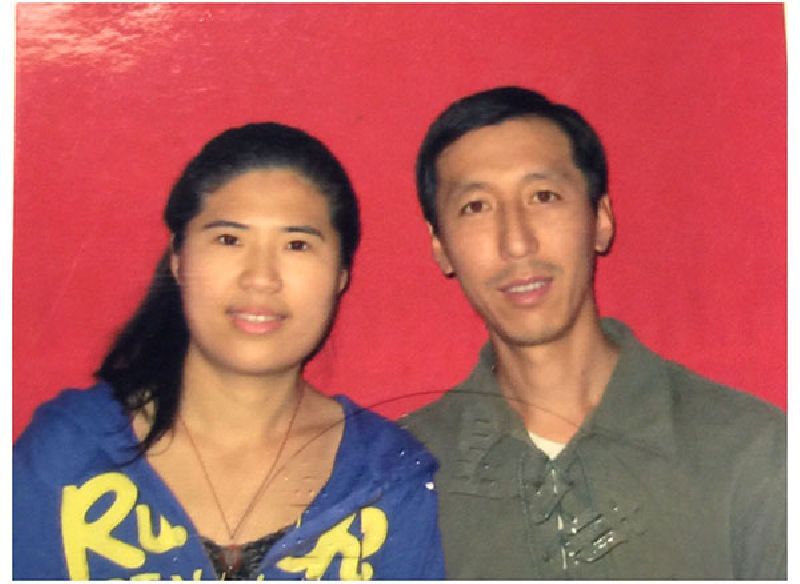
Lisa Zhang and husband Song Zhiyu on the day of their wedding. Lisa says it is the only photo she has of them together – all others were on a laptop destroyed when he swam for safety from a boat he’d hoped would get him to New Zealand.
Instead of nine months, Lisa and others interviewed described a process they said has grown unbearably long, during which they can’t do anything but live like church mouses and avoid contact with the authorities, who can place them in indefinite detention and possibly deport them back to China.
“Even [waiting] two or three years would be okay,” Lisa said. “But now, when you are in Thailand they will tell you about two years later that you will be interviewed. But even then, postponed. Postponed a year; postponed again and again.”
Repeated calls over several days to UNHCR’s offices in Bangkok went unanswered.
The long wait for resettlement into a “third country” has long been a source of complaints, according to a regional human rights campaigner. But the refugee crises unfolding around the globe are making it worse.
“I think at this point, UNHCR is a little overwhelmed,” said Phil Robertson, who heads New York-based Human Rights Watch in Asia. “It’s quite clear that the crises in the Middle East in places like Syria and Iraq are pulling away significant resources from UNHCR’s other regions. There is an impact.”
A photo said to be the last time Gu Qiao, now held in immigration detention, saw her baby in Chumphon province.
Gu Qiao and her infant son held in detention before they were separated. She is unlikely to see the baby again until she is released to be deported back to China or resettled in another country.
A Rescue Turned Capture
Heading the failed voyage which set sail from Pattaya on March 1 was Li Xiaolong, a Chinese dissident who bought the boat to transport himself, his two brothers, wife Gu Qiao, their infant son and young son.
After the boat’s engine failed again late Tuesday night during a storm, its hull was punctured by a rock, according to Lisa’s account. They all swam to shore. Gu, Li and Lisa’s husband Song were soon placed in detention. Their visas were expired and local officials were unswayed by their UNHCR paperwork.
A local official was said to have pulled the 1-year-old from her mother’s arms and departed. In exchange for their infant son, they were handed a handwritten note they couldn’t read.
A reporter called a number listed on the note and found the baby is being held at the state-run Chumphon Children and Family Shelter Home. A representative answering the phone said he will remain there until immediate family comes from China to take her back there, or her parents are released.
Li’s brothers and another man, Wei Zhang, managed to keep the 7-year-old son of Li and Gu with them. They were eventually freed, along with Amity’s father Dong, as they carried valid visas.
The five who remained free soon reported being hounded by Chinese men who took their photos. They believed them to be Chinese agents. On Tuesday morning, Lisa said Chinese men showed up at the immigration detention center where her husband is being held and were allowed to question him.
She did not know what they asked.
An Unwelcome Faith
Both Dong and Lisa’s husband Song practice Falun Gong, a spiritual following which has long complained of persecution by Chinese authorities. In return, Beijing accuses them of belonging to a dangerous cult.
Reports of persecution began a few years after Falun Gong was founded, after the group surprised authorities in 1999 with a massive protest outside Communist Party headquarters in Beijing. From that point onward, China has treated the movement, a kind of New Age mystical Buddhism that emphasizes an exercise routine called Qi Gong, as a threat and attempted to eradicate it.
At right, Song Zhiyu, in foreground, and Li Xiaolong seen held in immigration detention after their bid to leave Thailand ended late Tuesday night on a beach in Chumphon.
Lisa and another Falun Gong asylum seeker interviewed on Friday described life in China as one of discrimination, harassment and abuse owing to their faith. Lisa said she and her husband were sent to labor reeducation camps on multiple occasions.
A man in his 40s, who asked that he not be named for fear of reprisal against his family in China, grew visibly upset during an interview as he described escaping abduction from his home and leaving behind his job as a clerk to live semi-homeless.
Describing how he was arrested many times, the man jabbed his thumbs toward his head, where he said authorities subjected him to repeated torture by electrical shock.
“From the beginning until now in China, it’s the same for us,” he said. “There’s no ‘more relaxed’ or ‘more dangerous’ time. Maybe you think the surroundings are okay, but maybe some day you will be arrested. Every day we see our friends in China arrested because they practice [Falun Gong.]”
They estimate between 100 and 200 Falun Gong asylum seekers are in Bangkok.
Although their specific claims cannot be independently verified, they are consistent with reports of widespread imprisonment, abuse and even torture from human rights groups and the U.S. State Department.
Lisa said she and her husband Song longed to escape the fear they lived under in China. Song was blacklisted from travel as Falun Gong, she said, and thus unable to move freely. So he snuck out of China and made his way overland to Thailand in April 2014. Her passport was fine, so she soon followed.
Waiting Game
Seeking asylum puts one in a purgatory state. In Thailand, you can’t work, you can’t travel freely.
Your best hope is to wait in semi-stateless limbo until the phone rings with news a “third country” will accept you to be “resettled.”
Another outcome is being caught and placed into one of the country’s Immigration Detention Centers, overcrowded facilities where families languish in captivity for months or years until they are forcibly deported back to the homes they fled or allowed to resettle in another country.
“Thailand is trying to discourage people from coming, and in a sense that means not letting them do anything, not letting them seek jobs, discouraging their children from going to school,” Robertson of Human Rights Watch said. “What they should be doing is letting these people work legally until they’re resettled.”
More than 110,000 refugees and 8,166 asylum seekers live in Thailand, according to a 2015 UNHCR assessment. Historically, the UNHCR’s efforts have been focused on the border with Myanmar, as the overwhelming majority of those refugees are from Burma.
But the flow of refugees and asylum seekers into Thailand is increasing, according to the agency, now from more than 40 nations.
For those like Lisa’s husband Song, and all the others who end up in immigration detention, there are only two possible routes to freedom. One is ideal – being invited by another nation to resettle, at which point Thai authorities will release them on their way. The other is unthinkable for them: being forcibly returned to China or whatever home nation they originally fled.
For now Lisa, 35, has to continue alone in Bangkok. She’s comforted by the thought that Song is still alive.
“When my husband decided to take the boat, I couldn’t sleep,” she said. “Even though he is detained, he is alive. And that is enough for me.”
Amity has her father back, but she said that with the boat escape’s failure, it’s back to the waiting game. She isn’t sure what to expect or hope for.
“I don’t know. I want to go to a third country,” she said. “Any country is okay.”
More hardened was the older man, who had recounted being tortured in China.
“Here, we can’t work, we can’t study, we can’t have a normal life,” he said. “I don’t know why it is like this. Nobody can help us.”
Correction: An earlier version of this story identified the child of Li Xiaolong and Gu Qiao as their daughter; in fact he is their son. Also, those taken in custody after their boat ran aground are currently in police detention where they likely face detention in an immigration center.
Rally in support of Vivat Yodprasit at Bangkwang Prison in Bangkok today.
BANGKOK — A man convicted of opening fire on pro-election activists in 2014 got a prison visit and show of support from over 100 fans today.
Members of the People’s Committee for Absolute Democracy With the King as Head of State, or PCAD, the ultra-conservative group that led protests opposing the February 2014 election, rallied Tuesday in front of Bangkwang Prison where Vivat Yodprasit recently began serving his 37-year jail term.
The demonstrators said they wished to express solidarity with Vivat, who, according to prosecutors, wrapped an assault rifle in a popcorn bag and shot at rival protesters on Feb. 1, 2014, in the northern Bangkok district of Lak Si. The shooting left a 72-year-old man paralyzed, before he died seven months later.
After the incident, 24-year-old Vivat became known as the Popcorn Gunman and received widespread acclaim from PCAD members. Many of the demonstrators at the prison today donned T-shirts emblazoned with the words “Popcorn Superhero” as a show of support.
Despite the ban on protests and public gatherings imposed by the current military government which seized power in May 2014, security officers did not interfere with Tuesday’s prison rally.
Vivat’s wife, along with four of his supporters, were allowed in to see him. After visiting her husband, Manasnant Amorasith told reporters he is in good health and spirits.
According to a report on Matichon Online, Manasnant said Vivat still loves and respects PCAD leader and monk Buddha Issara as “his own father” and is relying on the monk to provide him with legal assistance.
Vivat is also gathering money to post bail and fight his case in the appeals court, Manasnant said. His bail has been set at 4 million baht.
The "popcorn gunman" in Lak Si district on 1 Feb 2014.
The gunbattle took place after PCAD activists, led by Buddha Issara, marched to besiege Lak Si District Office to prevent officials from distributing ballots in the area. The siege was a part of the PCAD’s campaign to block the Feb. 2, 2014 election called by former Prime Minister Yingluck Shinawatra two months after she dissolved the Parliament.
PCAD boycotted the poll and demanded Yingluck be replaced with a royally appointed government, which would then enact a series of unspecified national reforms.
In an attempt to lift the siege and rescue the ballot, pro-Yingluck protesters, some of whom were armed, moved on the PCAD position, and shooting broke out. PCAD’s guard unit appeared to be better equipped, and the pro-government protesters eventually retreated.
Vivat was arrested a month after the shootings and has been held in prison since.
In the verdict delivered Thursday, the court said one person died and three others were severely injured by Vivat’s actions. The court subsequently sentenced him to 37 years and four months in jail.
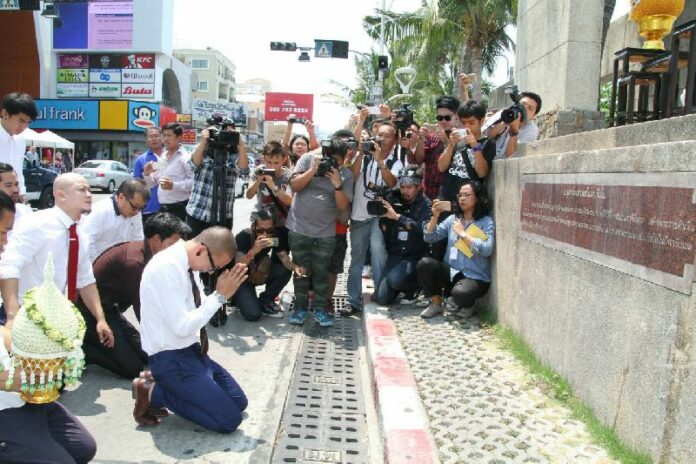
Singer-comedian Padung Songsaeng apologizes to a concrete monument Tuesday in Pattaya for having danced atop it in January while filming a music video.
PATTAYA — A singer-cum-comedian was fined and forced to apologize to the public today for allegedly desecrating a monument to His Majesty the King’s sailboat in a since-deleted music video filmed in Pattaya.
For showing fully clothed male dancers mimicking flashers atop a royal monument, Padung Songsaeng was charged with causing a public nuisance, which carries a maximum penalty of 10,000 baht. It was not clear how much he was fined.
“Officials from Pattaya Municipal Office came to the station and filed the charge this morning,” said Col. Sukthat Pumpanmuang, commander of Pattaya City Police Station.
Several officials have expressed outrage over the video and accused the 31-year-old singer of damaging the good reputation of Pattaya, a resort town renowned for its freewheeling sex trade.
Before arriving at the police station to be charged and fined, Padung was escorted by officials back to the monument on Pattaya Beach, which is dedicated to King Bhumibol’s favorite sailboat.
Video of Padung and his dance crew atop the monument. Photo: K Hyok Hyok / YouTube
Padung knelt and bowed in apology before the boat monument and the public for offending them.
A comedian by trade, Padung has appeared in many TV shows as a host and guest. He has also produced several humorous dance music videos with his band, the Jazz Spooknick Papiyoung Kookkook.
Padung’s previous hit, “Van For Lor Fiew” (The Amazingly Handsome Street-Racing Gangster), was released March 2015 and became a hit during the Songkran Festival.
Padung and his crew filmed the MV for his new single “Yap Mae” on Jan. 29. Other locations included the Walking Street and Pattaya’s beachfront road.
The video’s main selling point is its racy word play; “Yap Mae” sounds very close to “Yed Mae,” a Thai expletive that describes a graphic act with one’s own mother. The music video mostly consists of male dancers raising their skirts for the camera, revealing red pants underneath while chanting “Yap Mae.”
However after the video was posted to YouTube on March 2, it attracted so many negative comments that Padung removed it three days later, though an audio version and behind-the-scene videos are still available on YouTube.
Many comments on YouTube criticized Padung for his suggestive lyrics and provocative dance moves, according to media reports.
But the most visibly incensed were officials in Pattaya. Deputy mayor Ranakit Ekasingha told Thairath Online on Monday that Padung only asked for permission to film the video on Walking Street and identified the song name as “Mae Yap,” not “Yap Mae.”
“This has damaged the image of Pattaya,” he said.
Wilailak Chuchart, a spokeswoman for the Ministry of Culture, also warned the now-deleted video may mislead Thai youths into doing inappropriate things, like unwittingly dancing to the words “Yap Mae.”
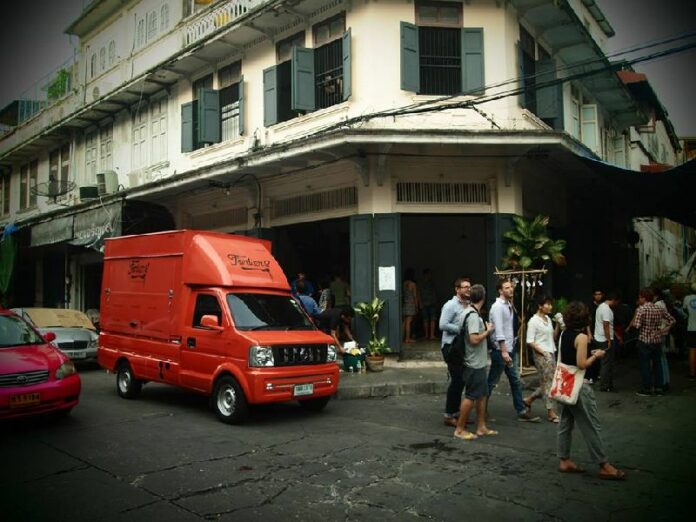
BANGKOK — Street food, art projects, crafts and more will transform a vintage street scene into a day-long festival Sunday near Chinatown.
More than 15 shops and galleries including Cho Why, Tep Bar, Patani Studio, Nahim Cafe and more will welcome visitors at Soi Nana Craft+Jumble Trail No. 3 with vendors, exhibitions, second-hand products and more this Sunday.
The event also welcomes a new eatery, Baan Yok, to its family of bars, restaurants and art spaces. Baan Yok will sling Vermouth alongside homemade Spanish tapas and seafood paella made by Broken Eggs.
Residents will get into the act by opening their private homes to the public and offering different activities, according to Cho Why’s David Fernandez.
Fernandez said Cho Why has invited some friends to serve their exclusive dishes including Let The Boy Die’s signature beer Golden Coins, coffee from Finca de Barn and food from Mad Moa and more.
This event is the best chance to let outsiders learn more about Soi Nana and its community, the owner of Nahim Cafe said.
“Sometimes people came to my cafe, and they didn’t notice the gallery located opposite because it was closed,” Chalocha “Pim” Ninthammachart said. “We will all open our spaces and welcome all visitors on that day.”
Photo: Cho Why / Facebook
Sunday marks the third edition of the Soi Nana craft event since last May. It will take place from noon to 11pm.
Those interested in attending should note: Although they were both owned by the same families, don’t confuse this Soi Nana near the Bangkok Railway Station with the seedier Soi Nana on Sukhumvit Road.
Follow Khaosod English on Facebook and Twitter for news, politics and more from Thailand. To reach Khaosod English about this article or another matter, please contact us by e-mail at [email protected].
‘Exols’ shelter from the stifling heat Tuesday while waiting for their boy band idols to hold court at a Bangkok shopping mall.
BANGKOK — Tuesday was definitely a hot one. Now, instead of 33C, imagine the mercury shooting up to 40C.
While in a month the nation will prepare to get weird and wet during the annual Songkran Festival, the Thai Meteorological Department has warned the summer heat may break into the frying forties.
Thailand officially entered summer this past Wednesday, and on Monday, Songkran Aksorn (no relation) of the Meteorological Department said the heat may rise to 40C by late April.
For the rest of March, temperatures are expected to remain around 36C to 38C in the afternoons and 26C to 27C at night.
Around mid-April, however, highs are expected to peak between 40C to 44C. Summer is expected to last until mid-May.
Scientists found 2015 was the hottest year ever recorded in cities around the world. Bangkok averaged 29.6C, 1.6C higher than normal, according to the data from Accuweather.
Photojournalist Anthony Kwan arrives for his Aug. 24, 2015 bail hearing. Photo: Veronica Pedrosa
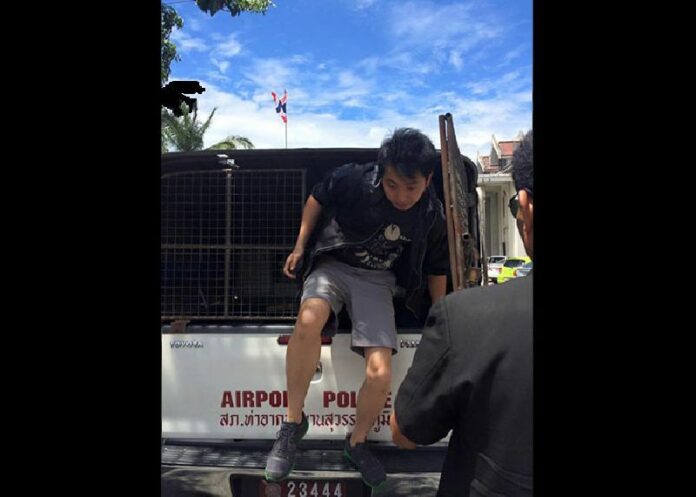
BANGKOK — The Thai government has dropped a case against a Hong Kong photojournalist who was arrested last year for possessing a bulletproof vest and a helmet, which are considered weapons in Thailand, two court officials said Tuesday.
The government filed for withdrawing the charges against Hok Chun Anthony Kwan on Dec. 30, 2015, in the Samut Prakan provincial court where he was on trial, the court's officials told The Associated Press.
Kwan accepted the government stance and the court ended the case on Jan. 29, they said.
The officials cannot be identified under court protocol. It was not clear what prompted the change of heart in the government, which had faced criticism for punishing Kwan for possessing items that journalists routinely carry in dangerous situations.
Kwan, a dual national of Canada and Hong Kong, was detained when he was about to board a plane on Aug. 23 after covering the aftermath of a deadly bomb explosion at a shrine in Bangkok.
Kwan works for the Hong Kong-based Initium media group. He earlier worked on the Minnesota Daily newspaper while attending the University of Minnesota.
His lawyer, Pawinee Chumsri, said he pleaded not guilty to the charge of weapons possession after being indicted by the court. Pawinee confirmed on Tuesday that the case has been dropped. Kwan, who was freed on bail, was not immediately available for comment.
Under the Arms Control Act, a license is needed to possess body armor. Violations are punishable by up to five years in jail. The law has rarely if ever been enforced for journalists covering the country's sometimes-violent political turmoil over the past nine years. Many large news organizations require their staff to wear protective gear in dangerous situations.
In a statement Tuesday, the Foreign Correspondent of Thailand welcomed Thailand's decision. It also urged the government to find a way for journalists, "who need to work in dangerous areas, to be able to use appropriate protective equipment legally in Thailand."