28.8 C
Bangkok
Saturday, June 27, 2026
Home Blog Page 2803

Ex-Top Cop Appoints Top Cop to Run Premier League

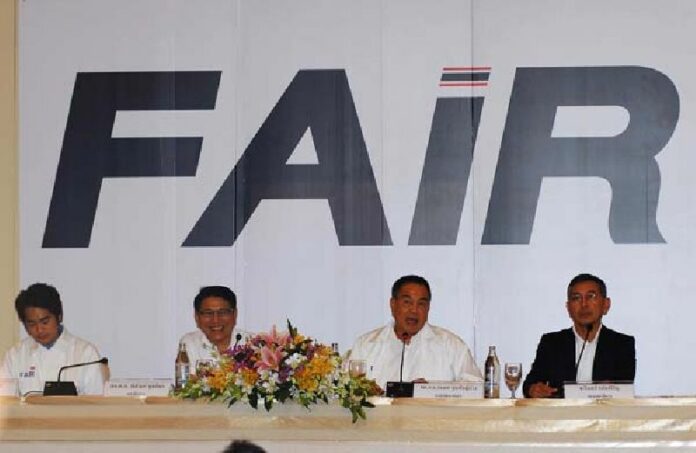
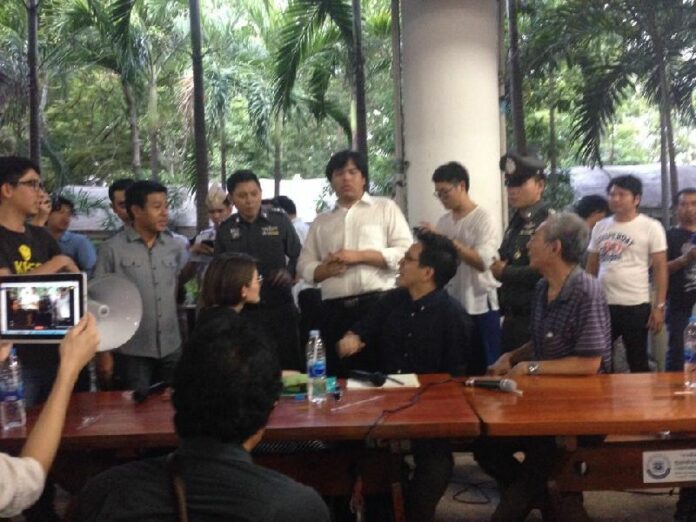
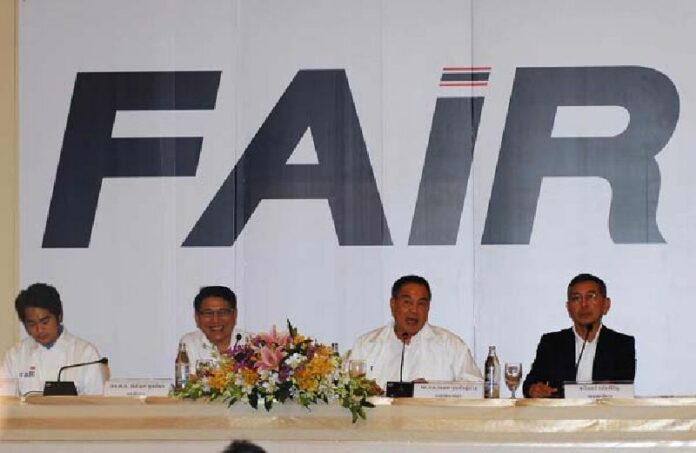
Former police chief Gen. Somyot Pumpanmuang, second from right, gave his first public address Friday as president of the Football Association of Thailand at The Emerald Hotel in Bangkok.

BANGKOK — Looking to expand the organizational culture he oversaw as Thailand’s top cop, the former national police chief-turned-president of Thai football today appointed his successor – the current police chief – to head the company behind the Thai Premier League series.

In his first meeting since his landslide win Feb. 11, newly elected Football Association of Thailand chief Somyot Pumpanmuang announced that Gen. Chakthip Chaijinda, who succeeded him as head of the Royal Thai Police, will serve as president of Premier League Thailand Co. Ltd.

The company is responsible for arranging the nation’s largest football competition. Somyot told reporters it was normal for top brass to be involved in organizations such as the state railway, national airline carrier and other large concerns.

Gen. Somyot, who sought the presidency after setting aside plans to lobby for legalized gambling, outlined other initiatives.

In his first week on the job, the man famous worldwide for giving his police a cash bounty for arresting a bombing suspect, has encouraged the public to send money to a bank account he says will help achieve a dream: Getting Thailand into the World Cup.

He claimed the private sector has already contributed 5 million baht to his “Send the Thai Team to the World Cup Fund.”

Any fans eager to support Somyot’s efforts to get Thailand into the World Cup can transfer money to account No. 127-240-870-2 at Siam Commercial Bank’s Chokchai 4 branch.

Somyot’s reign over Thai football follows the long and contentious presidency of Worawi Makudi. During his four terms, Worawi was attached to a series of scandals and accusations of corruption, few of which stuck until he was convicted of forging documents last year in relation to his 2013 re-election. Fifa later suspended him.

To clean the slate, Somyot said he’s dismissed all contracts the association signed prior to today, including all employment contracts except for permanent staff. He also lifted all previous bans placed on football teams under the Worawi administration and urged them to drop all ongoing litigation.

The freshly installed president moved back the first match of the Thai Premier League to March 5 from Feb. 27.


\

Advertisement

Ex-Top Cop Appoints Top Cop to Run Premier League

Former police chief Gen. Somyot Pumpanmuang, second from right, gave his first public address Friday as president of the Football Association of Thailand at The Emerald Hotel in Bangkok.

BANGKOK — Looking to expand the organizational culture he oversaw as Thailand’s top cop, the former national police chief-turned-president of Thai football today appointed his successor – the current police chief – to head the company behind the Thai Premier League series.

In his first meeting since his landslide win Feb. 11, newly elected Football Association of Thailand chief Somyot Pumpanmuang announced that Gen. Chakthip Chaijinda, who succeeded him as head of the Royal Thai Police, will serve as president of Premier League Thailand Co. Ltd.

The company is responsible for arranging the nation’s largest football competition. Somyot told reporters it was normal for top brass to be involved in organizations such as the state railway, national airline carrier and other large concerns.

Gen. Somyot, who sought the presidency after setting aside plans to lobby for legalized gambling, outlined other initiatives.

In his first week on the job, the man famous worldwide for giving his police a cash bounty for arresting a bombing suspect, has encouraged the public to send money to a bank account he says will help achieve a dream: Getting Thailand into the World Cup.

He claimed the private sector has already contributed 5 million baht to his “Send the Thai Team to the World Cup Fund.”

Any fans eager to support Somyot’s efforts to get Thailand into the World Cup can transfer money to account No. 127-240-870-2 at Siam Commercial Bank’s Chokchai 4 branch.

Somyot’s reign over Thai football follows the long and contentious presidency of Worawi Makudi. During his four terms, Worawi was attached to a series of scandals and accusations of corruption, few of which stuck until he was convicted of forging documents last year in relation to his 2013 re-election. Fifa later suspended him.

To clean the slate, Somyot said he’s dismissed all contracts the association signed prior to today, including all employment contracts except for permanent staff. He also lifted all previous bans placed on football teams under the Worawi administration and urged them to drop all ongoing litigation.

The freshly installed president moved back the first match of the Thai Premier League to March 5 from Feb. 27.


Advertisement

Citizens Should Resist Online Censorship, Advocates Say

Police break up a talk 18 Sep. 2014 at Thammasat University on the "Demise of Foreign Dictators" Photo: Provided by student who attended the event

By Pravit Rojanaphruk
Senior Staff Writer

BANGKOK — Citizens have a duty to not buy into state propaganda, be critical of the powers that be and resist censorship, anti-coup activist Sombat Boonngamanong said at a symposium yesterday.

Sombat was among five speakers invited to speak Thursday on the topic of online censorship by the Thammasat Student Union at the Pridi Banomyong lawn on the Tha Prachan campus.

He cited a recent, “very crazy” example of a man arrested for privately sending a link to a music video mildly mocking junta leader Gen. Prayuth Chan-ocha as an example of the absurdity of the military regime’s pursuit of censorship online.

People should not allow state propaganda to lead them by the nose like cows, he said.

“What’s our duty? We are the governed, and if someone puts a lead through our nose, your duty is to remove it. We have to stop behaving like children,” he said.

Sirawith Rojwattanasiri, a panelist and member of student discussion group Youth Network of Bangkok, received the junta’s blessing for Thursday’s event after tweaking the topic for the “Politics on Fiberoptics: Do Not Share, Do Not Click Like.” Sirawith thanked the junta for permitting the discussion and said he welcomed state censorship of the internet because people can then assured of getting only “good” information.

“The good thing about it is that they can select only good things for us to consume,” he said, adding that terrorism could be combated if the junta goes forward with its plan to route all internet traffic through a single gateway under its control.

“I think it’s a good thing the government can control what [information] we consume although the negative side is that people do not have freedom,” said the student from a prestigious Bangkok high school.

Natchaphon Sae Tan, a Thammasat University student and panellist, said he’s more worried about the state censoring what it thinks is unsuitable.

“I have no problem with the media being biased because you can decide by yourself,” he said. “I’m more concerned if the state were to remove media B and C and only leave us with media A.”

Arthit Suriyawongkul of the Foundation for Internet and Civic Culture – formerly known as the Thai Netizen Network – said he worries the single gateway project would enable officers to censor content online without seeking a court order as now required under the Computer Crime Act.

He said censorship proponents argue that it takes too long. In recent weeks a junta-appointed censorship committee has tried winning support from Google and other major service providers to waive their usual legal requirements.

Sombat, who’s facing sedition and computer crime charges for calling for peaceful opposition to the junta online, said criticism of junta leader Prayuth should not be regarded as a threat.

“Criticizing Prayuth won’t ruin the country,” he declared loudly to the crowd.

Sombat sought to underscore what he sees as the junta’s absurd paranoia over the internet.

He told the audience about a thick file of his Facebook posts used in his interrogation after his 2014 arrest for trying to organize peaceful resistance to the junta online.

“But I’m not a bomb maker,” Sombat said.

Sombat has since receded from the limelight, which he said is for pragmatic reasons.

“I am now rather well-behaved not because of the laws, but because they have guns. Everyone is just trying to censor themselves. I swear, I dare not click ‘Like’ on posts by people such as Somsak, and I believe there’re many people like me,” he said, referring to Paris-based exiled historian Somsak Jeamteerasakul, who often posts messages that risk being deemed as defaming the monarchy by authorities.

Related stories:

Libel Unclear in ‘Illegal’ Video Mocking Prayuth

Thailand Asks Google to Bend Censorship Rules


Pravit Rojanaphruk can be reached at [email protected] and @PravitR.

Follow Khaosod English on Facebook and Twitter for news, politics and more from Thailand. To reach Khaosod English about this article or another matter, please contact us by e-mail at [email protected].


Follow @KhaosodEnglish

\

Advertisement

Man Confesses to ‘Seducing’ 300 School Boys, Police Say

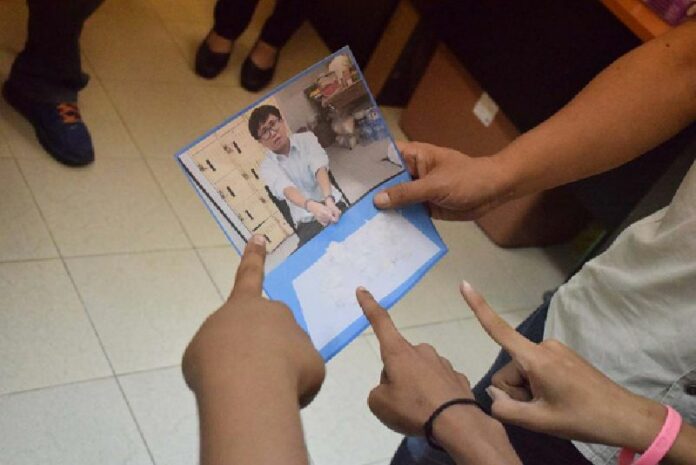
Accusing fingers are pointed toward a photograph of Chanabodin ‘Ja’ Nikulkan on Thursday at the Buppha Ram Police Station in western metro Bangkok.

BANGKOK — A 23-year-old man Thursday reportedly confessed to having inappropriate contact with hundreds of junior high school boys, some of whom were sexually abused, over the years since he himself graduated from high school.

Chanabodin “Ja” Nikulkan, 23, was charged Thursday morning with the abduction and abuse of children under 15 after parents of six boys went to police. Police said he subsequently admitted to seducing more than 300 children from the same boys school he once attended, and other nearby schools.

At least six boys made specific allegations of sexual abuse. Aged 13 to 15, they told police that Chanabodin treated them to food, alcohol and cigarettes before taking them to his room, showing them pornography, then sexually abusing them. Boys who offered resistance were not allowed to leave, according to police Maj. Gen. Montri Yimyam.

In front of the parents of the six boys, Chanabodin apologized and told them he contacted their children because he wanted to have a son. The children were said to all call him respectfully by his nickname as “Father Ja” or “Teacher Ja.”

The alleged abuser said in most cases he would ask boys to meet him after school finished at around 6pm. They would then go for a walk or dinner, and he would sometimes give them up to 30 baht.

He insisted not all of the 300 boys he had seduced were sexully assualted, saying that some were able to fend him off. He said the abuse consisted of oral sex and touching their genitals.

Police are collecting forensic evidence from his room in the west of Bangkok in Thonburi province and urged parents of other victims to come forward and report any suspicions of abuse at the Buppha Ram police station.


Advertisement

Fire Guts Muay Thai Stadium in Pattaya

Flames spread through the Max Muay Thai Stadium on Thursday in Pattaya.

PATTAYA — A well-known Muay Thai stadium caught fire Thursday afternoon, injuring four people and reportedly causing an estimated 200 million baht in damage.

It took a little more than an hour for firefighters to extinguish the fire at the Max Muay Thai Stadium on Soi Sukhumvit-Pattaya 42 in Central Pattaya. The stadium’s manager and three staff members were treated for minor burns, police said.

Police Col. Sukthat Pumpanmuang of Pattaya police station said over the phone Friday morning that police are investigating the cause of the fire. Witnesses told police that the air conditioning system was being serviced Thursday before the explosion, Sukthat said.


Stadium owner Nawat Tocharoensuk, a Pheu Thai party politician, said the fights will go on at a temporary venue. The severely damaged building will be renovated as quickly as possible, he added.

The one-story stadium opened in November 2014 and has become well-known in the local Thai boxing scene and with foreign fans as the arena for Channel 8’s Sunday “Max Muay Thai” program.

Advertisement

Thai Woman Accuses ‘Vic F4’ of Rape

Pear-on Sroyson shows the ring she claimed Vic Chou gave to her to the press on Thursday in Bangkok.

BANGKOK — A Thai woman on Thursday claimed she was sexually assaulted by Taiwanese superstar Vic Chou and pregnant with his child.

Pear-on Sroyson, 28, told reporters she was raped by the 34-year-old heartthrob in 2011 prior to entering a consensual relationship with Chou in 2012.

“He told me to sit at the end of the bed and then told me to lie down. But I refused to do so,” she said of what allegedly happened. “After a while he took my arm and told me to sit next to him and laid me down.”

Chou is perhaps best known throughout Asia as a former member of boy band F4, who were turn-of-the-century teen idols in Thailand.

Pear-on said she first knew Chou in 2009 through a friend in Taiwan and the two gradually developed a relationship. They mostly communicated through messaging applications.

From 2012 until this past November, when Chou married, the couple met regularly when he was traveling, yet Pear-on said it was kept secret due to his celebrity status.

When rumors began to spread in January that Chou had been unfaithful, he dismissed them as untrue through his manager. Neither Chou nor his manager have yet to address Thursday’s accusations by Pear-on.

Pear-on found out she was pregnant in August and claimed Chou’s refusal to take responsibility led her to terminate the pregnancy.

When his marriage to Reen Yu, his co-star in the famous television drama Meteor Garden, made headlines in November, Pear-on said she contacted him to find out about it. She said she was told to wait and never heard back from him again.

Asked why she waited until now to go public, Pear-on said, “I want him to admit the truth…I just want an apology.”

Pear-on also showed a ring she claimed Chou gave to her as well as records of their chat.


\

Vic Chou and his wife, Reen Yu, show their wedding rings when they officially announce their marriage in November 10, 2015. Photo: Reen Yu/ Facebook


\

Advertisement

Thai Woman Accuses ‘Vic F4’ of Rape

Pear-on Sroyson shows the ring she claimed Vic Chou gave to her to the press on Thursday in Bangkok.

BANGKOK — A Thai woman on Thursday claimed she was sexually assaulted by Taiwanese superstar Vic Chou and pregnant with his child.

Pear-on Sroyson, 28, told reporters she was raped by the 34-year-old heartthrob in 2011 prior to entering a consensual relationship with Chou in 2012.

“He told me to sit at the end of the bed and then told me to lie down. But I refused to do so,” she said of what allegedly happened. “After a while he took my arm and told me to sit next to him and laid me down.”

Chou is perhaps best known throughout Asia as a former member of boy band F4, who were turn-of-the-century teen idols in Thailand.

Pear-on said she first knew Chou in 2009 through a friend in Taiwan and the two gradually developed a relationship. They mostly communicated through messaging applications.

From 2012 until this past November, when Chou married, the couple met regularly when he was traveling, yet Pear-on said it was kept secret due to his celebrity status.

When rumors began to spread in January that Chou had been unfaithful, he dismissed them as untrue through his manager. Neither Chou nor his manager have yet to address Thursday’s accusations by Pear-on.

Pear-on found out she was pregnant in August and claimed Chou’s refusal to take responsibility led her to terminate the pregnancy.

When his marriage to Reen Yu, his co-star in the famous television drama Meteor Garden, made headlines in November, Pear-on said she contacted him to find out about it. She said she was told to wait and never heard back from him again.

Asked why she waited until now to go public, Pear-on said, “I want him to admit the truth…I just want an apology.”

Pear-on also showed a ring she claimed Chou gave to her as well as records of their chat.


\

Vic Chou and his wife, Reen Yu, show their wedding rings when they officially announce their marriage in November 10, 2015. Photo: Reen Yu/ Facebook


Advertisement

Scarred by Trafficking Abuses, Rohingya Stay Put in Myanmar Camps

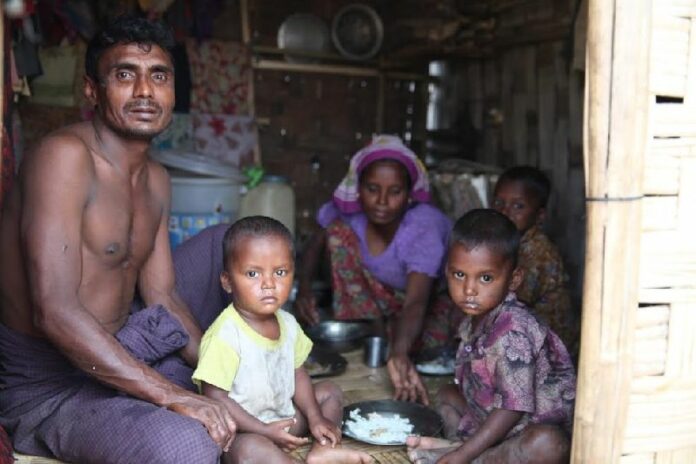
Win Naing, a 43-year-old Rohingya, lives in Thet Kel Pyin IDP camp in Rakhine State with his wife and three young children. Photo: Thin Lei Win/Myanmar Now

THET KEL PYIN, Rakhine State, Myanmar — After Husaina’s 20-year-old son fled poverty and discrimination in Myanmar’s Rakhine State by boat, she heard nothing from him for seven months.

Then, in a shocking phone call, she was told the young Rohingya Muslim was in the hands of people smugglers in Thailand, and had fallen severely ill. The only way for him to be released was to somehow find the money to pay a ransom.

“The man said: ‘If you don’t pay money, he will die… I was so upset. How did he get into the hands of the brokers? How did he become so ill?’” she said, her eyes downcast while sitting in her dank and crumbling one-room temporary home in Thet Kel Pyin displacement camp, a few kilometres outside Sittwe.

They found an employer in Malaysia willing to pay about USD$1,600 (51,000 baht) in exchange for Mamed Rohim’s labour. That was over a year ago and Rohim is still working to repay the debt. He only manages to send over about USD$50 (1,800 baht) every two to three months, which the family uses to repay their own debts. 

Since fleeing their home in Sittwe, the capital of Rakhine State in western Myanmar from which they are now barred, the family – seven other children and an asthmatic husband – is struggling to make ends meet. But Husaina says Rohim’s plight continues to haunt her. 

“Even though I want to send other children on the boat so they could find jobs, I’m really worried about the brokers so I dare not,” she said, as a Rohingya neighbour joined in with a similar tale.

Waves of Rohingya Muslims have fled communal violence and apartheid-like conditions in Myanmar in recent years, many of them swept up in trafficking rings, some of which hold men like Rohim for ransom, making threats to their impoverished families that their loved ones will be killed.

But human rights groups say there has been a dramatic drop in the number of Rohingya leaving Myanmar this year. They attribute this to a crackdown on human trafficking by countries such as Thailand and Malaysia and the political changes at home following the National League for Democracy’s landslide election win in November.

The Myanmar government does not recognise the 1.1 million Rohingya as citizens and calls them “Bengalis,” to suggest they are illegal immigrants from Bangladesh. The group is banned from travel within Myanmar and faces restrictions on access to education and healthcare.

Experiences such as Husaina’s are common among the Rohingya, confined to the squalid displacement camps outside Sittwe. The stories are shared among residents, making many fearful of the multi-day journey. Most of the Rohingya this correspondent spoke to say they are now too scared to attempt it. 

“There have been very few boats since the sailing season started in October and none at all this year, 2016. The key reason is that smugglers have no option for disembarkation due to Thailand being virtually closed. Another is the situation in Malaysia (where) there are regular immigration raids,” Chris Lewa of the Arakan Project, a Rohingya advocacy group which tracks migration, told Myanmar Now.

Malaysian police have carried out arrests of asylum seekers queuing up at the offices of the U.N. refugee agency in the last week or so, and some 2,500 Rohingya are currently held in immigration detention centres across Malaysia, Lewa said.

“The majority of Rohingya who arrived over the last two, three years are unregistered and jobs have become really difficult to find… The community feels very vulnerable,” she added.

Matthew Smith, executive director of Thailand-based human rights group Fortify Rights, agrees numbers leaving Rakhine have dropped, even though it is difficult to quantify the decrease in departures due to the clandestine nature of the voyages.

He warned, however, that the transnational trafficking rings have not been dismantled and “are poised to resume their activities at the first opportunity.”

Hope Keeps Some In Myanmar

Since 2012 – when communal violence between Rakhine Buddhists and Rohingya displaced some 140,000 people, an overwhelming majority of them Muslims – tens of thousands have left Rakhine State by boat. 

What began decades ago as a journey that would take weeks on rickety boats, has in recent years become a mass people trafficking and smuggling business. The trafficking grew to such a scale that it lead to a crackdown by Thai and Malaysian authorities last year.

In Thet Kel Pyin, home to some 5,600 displaced people, most of the Rohingya who have stayed behind have now settled down to a life of daily survival and a feeling that segregation is becoming more and more permanent.

Displaced teenagers now go to a high school near the camp that did not exist two years ago, and aid agencies as well as the government has set up more schools and clinics in and near the camps. 

Despite continued government restrictions, some Rohingya have not left because they are holding out hope for the new government led by Aung San Suu Kyi’s NLD, said Smith of Fortify Rights.

“Many Muslims in Rakhine State tell us they hope Daw Suu will usher in a better day for them. Anything, they say, will be better than the past,” he said.

This hope is held despite the fact that the Rakhine State parliament is dominated by the virulently anti-Muslim Arakan National Party (ANP). The NLD itself failed to field a single Muslim candidate and has refused to condemn the persecution faced by the Rohingya, who are viewed with suspicion by many in Myanmar. 

Sultan, 65, said the NLD government now offers the best hope for change. He says he is too old to go anywhere and refuses to countenance sending his daughters away, even though life in the camp is a far cry from his old life as the owner of three small businesses and a brick house in Sittwe.

He now goes around selling 150-kyat (4 baht) tooth powder in the villages and camps, driving a motorcycle a friend has bought for him.

“I feel really desolate over losing our right to vote, but I have hopes that things would improve under the new government,” he said, surrounded by his wife and seven daughters, the youngest of whom was just 26 days old.

The Thein Sein government took away the Rohingya’s last official identity papers last year, and with it their right to vote, prompting an outcry from the international community, who have been providing aid to the Rohingya.

Sultan said, “We are really thankful for the international community for helping us and I know we are still alive because of their help. But we want to stand on our own two feet. We just want to go back to where we were before.”

Tales of Abuse

For others, the tales of abuse during the boat journey are a powerful deterrent. Win Naing, a 43-year-old with three young children under the age of five, said, “What would my children and my wife do if something happened to me on the boat or in Thailand? I would rather die here.”

Kawri Mullah, Husaina’s neighbour, concurs. About six weeks ago, the 25-year-old father of two decided to leave the camp, desperate for a stable income that odd jobs cannot provide. But he has abandoned the plan for now after thinking it over, he told Myanmar Now.

His decision was influenced by what happened to his brother-in-law, who left the camp a year and a half ago and was sold by his broker to a butcher in Thailand for USD$850 (30,000 baht).

“He left with only two packs of energy biscuits. When they reached Thailand, a butcher apparently liked that my brother-in-law looks big and strong,” Mullah said.

After months of no pay and little to eat, the brother-in-law ran away to find another employer, but the butcher found him, and threatened and took him away, according to Mullah. That was nearly five months ago and the last time they heard from him. He wasn’t able to send any money back.

“I’m really scared after hearing his story. How can you live like that? I have two children and a wife. Here, even if I die, I have my family near me,” he said.

Story: Thin Lei Win

Related Stories: 

Stranded in Thailand, Rohingya Trafficking Victims in Limbo

New Rohingya Detention Camp Found in Thailand, More Arrest Warrants Issued

Advertisement

Pope 'Disgraceful' Trump Says for Questioning His Faith

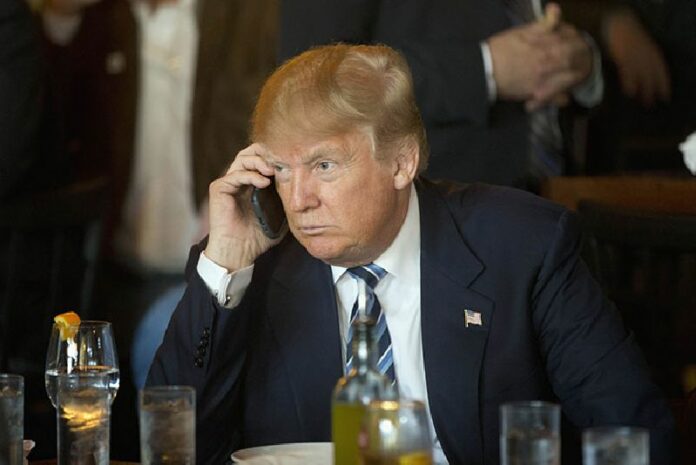
Republican presidential candidate Donald Trump listens to his mobile phone during a Thursday lunch stop in North Charleston, South Carolina. Photo: Matt Rourke / Associated Press
ABOARD THE PAPAL PLANE — Thrusting himself into the heated American presidential campaign, Pope Francis declared Thursday that Donald Trump is "not Christian" if he wants to address illegal immigration only by building a wall along the U.S.-Mexico border.

Trump fired back ferociously, saying it was "disgraceful" for a religious leader to question a person's faith.

The rare back-and-forth between pontiff and presidential candidate was the latest astonishing development in an American election already roiled by Trump's free-wheeling rhetoric and controversial policy proposals, particularly on immigration. It also underscored the popular pope's willingness to needle U.S. politicians on hot-button issues.

Francis' comments came hours after he concluded a visit to Mexico, where he prayed at the border for people who died trying to reach the U.S. While speaking to reporters on the papal plane, he was asked what he thought of Trump's campaign pledge to build a wall along the entire length of the border and expel millions of people in the U.S. illegally.

"A person who thinks only about building walls, wherever they may be, and not building bridges, is not Christian," he said. While Francis said he would "give the benefit of the doubt" because he had not heard Trump's border plans independently, he added, "I say only that this man is not a Christian if he has said things like that."

Trump, a Presbyterian and the front-runner for the Republican presidential nomination, responded within minutes.

"For a religious leader to question a person's faith is disgraceful," he said at a campaign stop in South Carolina, which holds a key primary on Saturday. "I am proud to be a Christian, and as president I will not allow Christianity to be consistently attacked and weakened."

Trump also raised the prospect of the Islamic State extremist group attacking the Vatican, saying that if that happened, "the pope would have only wished and prayed that Donald Trump would have been president because this would not have happened."

Francis, the first pope from Latin America, urged Congress during his visit to Washington last year to respond to immigrants "in a way which is always humane, just and fraternal." He irked Republicans on the same trip with his forceful call for international action to address climate change.

Immigration is among the most contentious issues in American politics. Republicans have moved toward hardline positions that emphasize law enforcement and border security, blocking comprehensive legislation in 2013 that would have included a path to citizenship for many of the 11 million people in the U.S. illegally.

Hispanics, an increasingly large voting bloc in U.S. presidential elections, have flocked to Democrats in recent years. President Barack Obama won more than 70 percent in the 2012 election, leading some Republican leaders to conclude the party must increase its appeal to them.

However, the current GOP presidential primary has been dominated by increasingly tough rhetoric. Trump has insisted that Mexico will pay for his proposed border wall and has said some Mexicans entering the U.S. illegally are murderers and rapists.

While Trump's words have been among the most inflammatory, some of his rivals have staked out similar enforcement positions. Texas Sen. Ted Cruz and retired neurosurgeon Ben Carson are among those who have explicitly called for construction of a wall.

Former Florida Gov. Jeb Bush, one of the few GOP candidates proposing a path to legal status for people already in the U.S. illegally, said Thursday he supports "walls and fencing where it's appropriate." Bush said that while he gets his guidance "as a Catholic" from the pope, he doesn't take his cues from Francis on "economic or environmental policy."

Marco Rubio, another Catholic seeking the GOP nomination, said that Vatican City has a right to control its borders and so does the United States.

Rubio said he has "tremendous respect and admiration" for the pope, but he added, "There's no nation on Earth that's more compassionate on immigration than we are."

Cruz said he was steering clear of the dispute. "That's between Donald and the pope," he said. "I'm not going to get in the middle of them."

Ohio Gov. John Kasich, on the other hand, said he was staunchly "pro-Pope."

"We have a right to build a wall," Kasich said Thursday night. But he added: "We need bridges between us if we're going to fix the problems in Washington 'cause all they do is have walls."

The long-distance exchange between the pope and Trump came two days before the voting in South Carolina, a state where 78 percent of adults identify as Christian, according to the Pew Research Center's 2014 U.S. Religious Landscape Study. Of that group, 35 percent identify as evangelical and 10 percent as Catholic, the survey found.

It's unclear what impact, if any, the pope's rhetoric will have, here or in other states. An October poll conducted by The Associated Press-NORC Center for Public Affairs Research found that most Americans had no strong opinion on the pope's approach to immigration issues, though he was overall viewed favorably.

Even before Thursday, Trump had been critical of Francis' visit to Mexico. He said last week that the pope's plans to pray at the border showed he was a political figure being exploited by the Mexican government.

Francis glossed over Trump's assertion that he was a pawn of Mexico, telling reporters on his plane that he would "leave that up to your judgment." But he seemed pleased to hear the candidate had called him a "political" figure, noting that Aristotle had described the human being as a "political animal."

Story: Julie Pace / Associated Press


Advertisement

Locals Ready to be Evicted for Chao Phraya Boardwalk, Official Says

Bangkok's Chao Phraya river in a 2010 photograph. Photo: rushdi13 / Flickr


BANGKOK — More than half of the residents living along the Chao Phraya River banks the government would like to pave for concrete walkways are ready to move out, an official said today.

Of 263 households that would need to be demolished for the 7-kilometer promenade, 70 percent are willing to abandon their homes if presented a concrete plan for relocation, Minister of Social Development and Human Security Adul Saengsingkaew said Thursday in Bangkok.

Adul’s claim could not be independently verified. But after visiting the affected community, he said locals biggest concerns were the effect on their jobs and children’s educations if they were relocated far from their home of 50 years.


Chao Phraya Promenade Should be Sent Back to Drawing Board, Architects Say


Adul said the ministry is preparing private and public land nearby to accommodate the river dwellers.

His visit followed the year’s first official meeting on Wednesday to discuss redevelopment projects along the capital city’s arterial river hosted by Deputy Prime Minister Prawit Wongsuwan. Part of that is concreting both banks for a 7-kilometer stretch, a project dubbed by the junta as Bangkok’s “new landmark.”

Despite widely being panned as ugly and poorly considered by architects, planners and community members, the project has nonetheless been pushed forward by the military government.

After being dealt a setback when all but one company dropped out of bidding to study its feasibility, but that hurdle was overcome when officials eliminated the legal need for a competitive bidding process.

King Mongkut’s Institute of Technology Ladkrabang and Khon Kaen University will oversee the study after its 120 million baht contract is approved by the end of the month.

According to the new time frame, a developer is expected to sign on to build the walkways by October with hope of completing the project by 2018.

Prawit reportedly urged the relevant government agencies to strictly follow the new schedule.


Related stories:

River’s Friends Float Hope for Public Hearings on 14B-Baht ‘Promenade’

Radical Makeover of Chao Phraya River Delayed

Chao Phraya Promenade Should be Sent Back to Drawing Board, Architects Say


Advertisement

Hot News

LATEST NEWS

Bangkok
overcast clouds
28.8 ° C
28.8 °
28.8 °
83 %
3.2kmh
100 %
Fri
29 °
Sat
37 °
Sun
36 °
Mon
36 °
Tue
33 °