


































35 C
Bangkok
Friday, June 19, 2026
Home Blog Page 2818

Thai Banks Urged to Beef Up Security in Wake of Cyberactivism

Graphic: Colin / Wikimedia Commons

By Teeranai Charuvastra
Staff Reporter

BANGKOK — Anxious about the possibility of looming cyberattacks, Thailand's banking association today called on its members to improve security measures and end the culture of data secrecy.

The call from the Thai Bankers’ Association came after it saw government websites taken down by a crude but effective assault late last year by technically unsophisticated activists protesting the junta’s plan to gain control over internet traffic. That was followed by more advanced and successful attacks by members of the a borderless hacking collective known as Anonymous.

At Wednesday’s news conference, Yos Kimsawate, an association security expert cited the October denial of service attack as the worst to hit the kingdom in recent years.

“The most serious case has to be the DDoS launched by the activists to protest the Single Gateway,” said Yos, who heads the association’s security unit.

Although the Distributed Denial of Service is among the most basic hacking tools available, it revealed vulnerability in the state’s online infrastructure and encouraged foreign hackers to target the Thai banking system, Yos said.

“Foreign hackers saw the gap and tried to do the same against banking system,” he said. “But luckily we cooperate with each other and share information, so we thwarted the attacks.”

Thailand has become a hub for transnational cyber crimes; most notably the 2014 hacking of U.S.-based Sony Pictures, which is thought to have been carried out from a luxury hotel in Bangkok.

Yos insisted Thai banks have not fallen victim to any major hacking so far, but he said his association is still concerned that an attack could happen one day.

“The issue is getting closer to us,” Yos said. “We don't want to wait until it caught us by surprise. we have to be proactive.”

He urged members of the association to step up their security systems by educating staff, improving online infrastructure to meet international standards and moving information to trusted cloud systems, among other measures.

But the most serious obstacle to that progress, he said, is the deep suspicion and reluctance among bank CEOs to share security information with each other. The secrecy makes the entire industry vulnerable because “without cooperation, if one bank is attacked, others will be attacked, too, and they wouldn’t have knowledge about it.”

“Trust is vital for cooperation,” he said. “But how do we build trust among CEOs? It’s not easy selling this kind of idea to CEOs.”


‘Above Average’

Thailand is currently ranked above the world’s average in the number of infected computers, according to a Microsoft security specialist present at Wednesday’s news conference.

Chris Peiris said Microsoft scanned and collected data about the infection rate of millions of computers around the world, and statistics showed it’s four times more likely to find infected computers in Thailand than the rest of the world.

For every 1,000 computers scanned, an average of three computers were found with something malicious, he said.

“When it comes to Thailand, the number is four times more,” he said. “It could be as high as 30 computers per 1,000 in some quarters … which can lead to further attacks.”

However, Michael Mudd, a sec-gen from a cyber security firm called the Open Computing Alliance, said the data does not mean Thailand’s banking system is particularly vulnerable to hackers.

Asked to rate how well-protected the online banking system is on a scale of one to 10, Mudd chose “eight.” 

“It’s pretty good compared to many other countries,” he said. “If we take Hong Kong and Singapore as the most advanced, Thailand is pretty close behind.”

Yos said he agreed with Mudd’s score but believes the domestic banking industry could improve much more. “Actually, you don’t have to write down the number,” he told reporters. “I fear it would look like a challenge for criminals to break into our system.”

Related stories:

Anonymous Hacks Police Sites to Campaign for ‘Justice’ in Koh Tao Murders

Anonymous Shuts Down Hundreds of Court Sites

‘Anonymous’ Declares War on Thai Junta

Cyber Activists Bring Down Govt Sites to Protest ‘Single Gateway’
 

Advertisement

At Least 6 Dead in Landslide at Myanmar Jade Mine

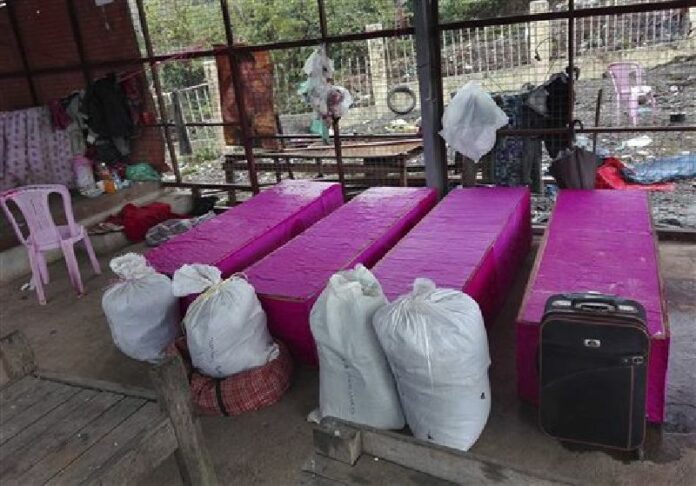
Coffins of landslide victims are kept Wednesday in Hpakant hospital morgue in northern Kachin State, Myanmar. Photo: Pan Aung / AP

YANGON — A church deacon says a landslide of mining waste has killed at least six people in northern Myanmar, the sixth deadly accident in the jade mining region since a November disaster killed more than 100 people.

Baptist deacon Dut La, who is organizing funerals for the victims, said Wednesday that six bodies were in the morgue but more than a dozen may be unrecovered from the accident in Kachin state's Hpakant mining region.

Hpakant, in Kachin State, 950 kilometers northeast of Myanmar's biggest city, Yangon, is the epicenter of the lucrative jade mining industry. Jade is mined with heavy equipment that leaves small pieces in the waste soil that is piled into huge mounds. The accidents usually involve people who settle near the mounds to scavenge through the precariously high pile.

Story: Associated Press


Advertisement

Vietnam Ruling Party Boss Re-Elected

Vietnam's Communist Party General Secretary Nguyen Phu Trong greets delegates at the opening ceremony of the 12th National Congress of Vietnam's Communist Party, Jan. 21, 2015 in Hanoi. Photo: Associated Press

HANOI — Vietnam's Communist Party Wednesday re-elected its chief Nguyen Phu Trong for a second term, officials said, an expected outcome that sees the conservative ideologue cementing his hold on power.

The party's congress elected Trong to a 19-member Politburo, the all-powerful body that handles the day to day affairs of the government and the party, and subsequently as the general-secretary, the de facto No. 1 leader of the country.

Also elected to the Politburo are deputy Prime Minister Nguyen Xuan Phuc, who is expected to become the prime minister, and Minister of Public Security Tran Dai Quang, who will be the country's new president, said the officials.

The officials spoke on condition of anonymity because they were not authorized to speak to the media.

The renewal of the leadership means little change for Vietnam.

Trong is expected to continue to push economic reforms, which his vanquished rival had led for the last 10 years. Despite having a reputation for being pro-China he is not likely to be totally subservient to Beijing as that would risk massive anger from ordinary Vietnamese who harbor a deep dislike and historical suspicion of China.

"Many people were afraid that a conservative trend would prevail if Mr. Trong is re-elected. But … whoever they may be, and however conservative they may be, when they are at the helm they are under pressure to carry out reforms," Le Hong Hiep, a visiting Vietnamese fellow at the Institute of Southeast Asia Studies in Singapore, told The Associated Press.

"However, we have to wait to see whether the reforms they carry out will be successful or not, or how far they can go," he said.

The Communist Party is entitled by the constitution to govern and Vietnam's 93 million people have no direct role in electing the leaders of the 4.5 million-member party.

Last week, Trong faced a brief challenge from Prime Minister Nguyen Tan Dung, his No. 2. But in behind-the scenes maneuvering, Dung was persuaded to withdraw from the contest.

It is believed that as a compromise, Trong will not serve his full five-year term but may hand over power to another leader mid-way through it.

Story: Vijay Joshi / Associated Press


Advertisement

‘Luk Thep’ Craze Draws Haunted Doll Backlash (Photos)

BANGKOK — On Wednesday, professor Pitak Sirawong made a deal with his students. He told them they could bring their trendy haunted spirit dolls into his research project classroom on one condition: The Luk Thep, believed to contain the spirit of a child, must do the same work as the students.

“If students are lonely and want something to lean on, they can bring it,” said Pitak, who teaches at Silpakorn University Phetchaburi IT Campus. “So I need to set the rule.”

As quickly as business and media embraced the opportunity to profit from the sudden trend, the inevitable backlash to the superstitious dolls has already begun from those who feel the whole thing has already gone too far.


Police Seize Contraband Child Spirit Dolls 


Luk Thep were a fading, 2015 cultural blip when they suddenly became the talk of the town this past weekend because Thai Smile Airways announced the dolls could fly as passengers.

On Wednesday, buzzkill aviation officials announced Thai Smile’s decision to qualify Luk Thep dolls as passengers – and require they wear lap belts – was against international standards, which dictate a passenger can only be a human being.

“Passengers can buy an extra seat to place a Luk Thep, but it needs to be kept properly,” said the Civil Aviation Authority’s Chula Sukmanop. “But if passengers don’t buy an extra seat ticket, it must be kept inside the overhead baggage container or under the seat during takeoff and landing.”

Chula warned passengers they risk a year in prison or a 40,000 baht fine under 2015’s new air safety laws for failing to stow their haunted child doll.

The backlash started with those who think affording rights and privileges to the doll is too absurd  and those worried it could affect their business.

In a widely shared announcement, The Country Farm Resort and Homestay in Sakon Nakhon province warned guests to leave their haunted dolls at home. The resort said it would not allow them for the sake of other guests.

After a doll-cum-drug mule was discovered at Chiang Mai Airport, crackdown-happy police have already launched a crackdown on Luk Thep, going after tax-dodgers who smuggled them in illegally. At least 150 dolls have already been seized in coordinated raids.

Religious authorities are fed up too. The National Office of Buddhism on Wednesday warned monks that performing the ritual to invite a child’s soul to possess the dolls for money ran counter to religious teachings.

The No. 2 monk at Bangkok’s Wat Saket, Phra Wijitthammaporn, said he’s concerned about what will happen when the fad is over. Given the dolls’ sacred association, he worries people will dump them all at temples, just like all the unwanted cats and dogs they accumulate.


\


\


\


\


\


\


\


\


\


Related stories:

Police Seize Contraband Child Spirit Dolls

‘Luk Thep’ Drug Mule Busted at Chiang Mai Airport


To reach us about this article or another matter, please contact us by e-mail at: [email protected].

Follow Khaosod English on and Twitter for news, politics and more from Thailand.

\

Advertisement

‘Luk Thep’ Craze Draws Haunted Doll Backlash (Photos)

Dozens of dolls await consecration and eventual sale for anything from 800 baht to 100,000 baht Tuesday at an occult shop west of Bangkok in Nakhon Phathom province.

BANGKOK — On Wednesday, professor Pitak Sirawong made a deal with his students. He told them they could bring their trendy haunted spirit dolls into his research project classroom on one condition: The Luk Thep, believed to contain the spirit of a child, must do the same work as the students.

“If students are lonely and want something to lean on, they can bring it,” said Pitak, who teaches at Silpakorn University Phetchaburi IT Campus. “So I need to set the rule.”

As quickly as business and media embraced the opportunity to profit from the sudden trend, the inevitable backlash to the superstitious dolls has already begun from those who feel the whole thing has already gone too far.

Read: Police Seize Contraband Child Spirit Dolls 

Luk Thep were a fading, 2015 cultural blip when they suddenly became the talk of the town this past weekend because Thai Smile Airways announced the dolls could fly as passengers.

On Wednesday, buzzkill aviation officials announced Thai Smile’s decision to qualify Luk Thep dolls as passengers – and require they wear lap belts – was against international standards, which dictate a passenger can only be a human being.

“Passengers can buy an extra seat to place a Luk Thep, but it needs to be kept properly,” said the Civil Aviation Authority’s Chula Sukmanop. “But if passengers don’t buy an extra seat ticket, it must be kept inside the overhead baggage container or under the seat during takeoff and landing.”

Chula warned passengers they risk a year in prison or a 40,000 baht fine under 2015’s new air safety laws for failing to stow their haunted child doll.

The backlash started with those who think affording rights and privileges to the doll is too absurd  and those worried it could affect their business.

In a widely shared announcement, The Country Farm Resort and Homestay in Sakon Nakhon province warned guests to leave their haunted dolls at home. The resort said it would not allow them for the sake of other guests.

After a doll-cum-drug mule was discovered at Chiang Mai Airport, crackdown-happy police have already launched a crackdown on Luk Thep, going after tax-dodgers who smuggled them in illegally. At least 150 dolls have already been seized in coordinated raids.

Religious authorities are fed up too. The National Office of Buddhism on Wednesday warned monks that performing the ritual to invite a child’s soul to possess the dolls for money ran counter to religious teachings.

The No. 2 monk at Bangkok’s Wat Saket, Phra Wijitthammaporn, said he’s concerned about what will happen when the fad is over. Given the dolls’ sacred association, he worries people will dump them all at temples, just like all the unwanted cats and dogs they accumulate.


\

\

\

\

\

\

\

\

\


Related stories:

Police Seize Contraband Child Spirit Dolls

‘Luk Thep’ Drug Mule Busted at Chiang Mai Airport


Advertisement

Watch ‘Wings of Desire’ by Moonlight in Lumpini Park

BANGKOK — An American television detective is really an angel watching over the toils and troubles of a grim 1987 Berlin, where a trapeze artist seeks love and Nick Cave and the Bad Seeds growl through sets.

It’s “Wings of Desire,” and it screens outdoors in Lumpini Park next month as one of nine movies by acclaimed German filmmaker Wim Wenders for a retrospective series hosted by the Film Archive and Goethe-Institut Thailand. (In German with English subtitles.)


The dark romantic fantasy of “Wings” aka “Der Himmel uber Berlin,” will show at 6pm on Feb. 25 in the Lumpini Park.

One of Wender’s recent works, a 2011 documentary about choreographer Pina Bausch shot in 3D will screen about an hour west of downtown at the Film Archive in March. “Pina” will be the archive’s first screening in 3D on March 5 at the archive located in Nakhon Pathom province.

The rest at The Film Archive: Thai and Eng subtitles (but most are English)

The eight Wenders films, with subtitles in Thai and English as needed, will be shown in order of release at the archive as follows:

Feb. 27

1pm : The Goalie's Anxiety at the Penalty Kick (Die Angst des Tormanns beim Elfmeter, 1972)

3pm : Alice in the Cities (Alice in den Stadten, 1974)

5pm : Kings of Road (Im Lauf der Zeit, 1976)


Feb. 28

1pm : The American Friend (Der Amerikanicshe Freund, 1977)

3pm : Paris, Texas (1984)

5pm : Faraway, So Close! (In Weiter Ferne, so Nah!, 1993)


March 5

1pm : Pina (2011)

3pm : Every Thing will be Fine (2015)
 

Wim Wenders was named as best director for “Wings of Desire” at the Cannes Film Festival in 1987.

The Film Archive is located on Putthamonthon Sai 5 in western metro Bangkok. Drive, take a taxi or air-con bus No. 515, which stops in front of the theatre.


\

Pina (2011)


To reach us about this article or another matter, please contact us by e-mail at: [email protected].

Follow Khaosod English on Facebook and Twitter for news, politics and more from Thailand.

Follow @KhaosodEnglish

\


Advertisement

Boy Injured When Bus Drives Into Post

A No. 147 bus rests against an electrical pole Tuesday night in western Bangkok after its driver said he intentionally drove into it to arrest the vehicle’s momentum.

BANGKOK — A young boy was injured Tuesday night on a passenger bus after its driver said the brakes failed, forcing him to deliberately crash it into a utility pole.

The pink No. 147 bus had just left The Mall Tha Phra when it drove into an electrical pole at the entrance of Soi Phetkasem 18/1 in western Bangkok. Bus driver Tontrakan Chanma, 35, said he decided to crash the bus because he saw a checkpoint ahead and could not slow the vehicle.

A 7-year-old boy was reportedly injured and sent to Phayathai 3 Hospital.


Advertisement

After Setting iPhone Record, Apple Forecasts Sales Drop

Apple CEO Tim Cook discusses the new iPhone 6s and iPhone 6s Plus during an Apple event in San Francisco in a Sept. 9, 2015, file photo.Photo: Eric Risberg / Associated Press

SAN FRANCISCO — Apple is bracing for its first sales decline in 13 years, despite selling a record 74.8 million iPhones in the final three months of 2015, in what may prove to be a turning point for the world's most valuable company.

The tech giant says revenue could fall at least 8.6 percent during the January-March quarter, compared with a year earlier. Analysts say the latest iPhone models aren't providing the boost Apple needs to match the massive sales growth it enjoyed last year.

Apple executives painted the downturn as a momentary hiccup. But they also acknowledged the company is working to broaden its business beyond the iPhone itself, which in recent years has provided the bulk of Apple's revenue.

"We have become more and more of a platform company," Chief Financial Officer Luca Maestri told The Associated Press. He said Apple has a large base of customers — with 1 billion Apple devices now in active use — who can be relied on to purchase new Apple gadgets, mobile apps and services like Apple Music.

Reporting on its financial performance in the December quarter, Apple said it managed to inch past its previous record, established when it sold 74.5 million iPhones in the holiday quarter of 2014. But Tuesday's forecast implies Apple doesn't expect to match the 61 million iPhones sold in last year's January-March quarter.

Apple's stock has been in a slump for months, as investors worry the company won't be able to duplicate last year's growth in sales, which were in the double-digit percentages. Tuesday's report confirmed those fears.

Executives blamed a strong dollar for reducing revenue from overseas sales in the December quarter. Apple is also confronting an economic downturn in China, one of its biggest markets.

"We're seeing extreme conditions, unlike anything we've experienced before, just about everywhere we look," CEO Tim Cook told analysts on a conference call.

But researchers also say global demand for new smartphones has been slowing over the last year. Apple relies on the iPhone for two-thirds of its revenue and a similar share of profit.

The giant tech company is in no financial danger. It earned $18.4 billion in profit for the October-December quarter, ending the period with USD$216 billion (7.7 trillion baht) in cash. Cook called it "the mother of all balance sheets."

Profit rose 1.8 percent from a year earlier, while revenue increased 1.7 percent to USD$75.9 billion. Earnings amounted to USD$3.28 a share, which beat the USD$3.23 average forecast among analysts surveyed by FactSet. Revenue fell short of analysts' estimates, which averaged USD$76.7 billion.

No one expects Apple to match those results in the current, January-March quarter, as sales traditionally drop after the holiday shopping season and the introduction of new models. But Apple's forecast, which calls for revenue between USD$50 billion and USD$53 billion in the current period, was lower than analysts expected and a significant drop from the USD$58 billion in sales Apple reported a year earlier.

That would be Apple's first year-over-year sales decline since the January-March quarter of 2003 — long before the company began selling iPhones and iPads. Back then, Apple was a fraction of its current size, reporting quarterly revenue of just USD$1.45 billion.

While the iPhone has been a phenomenal success, analysts say it's difficult to match the sales surge that Apple enjoyed last year after it introduced the first iPhone models with significantly larger screens to compete with big-screen phones from rivals like Samsung, which were hugely popular in Asia.

Analysts say last September's release of two more big-screen phones, the iPhone 6S and 6S Plus, made less of a splash because they were viewed as relatively similar to the previous models, despite some new features. Analysts say the slight increase in sales for the December quarter came in part because Apple began selling the newest models several days earlier in key markets such as China.

Apple is expected to release the next iPhone models, with new features, later this year. That could fuel another surge in sales. Along with first-time buyers and people who switch from competitors' phones, analysts say Apple can count on a loyal base of iPhone owners who will buy a new model every two years or so.

Maestri also cited USD$5.5 billion in revenue the company collected from sales of apps and services in the last quarter — a 15 percent increase from a year earlier.

Skeptics, however, note that Apple hasn't come up with a blockbuster product to replace the iPhone. The company's latest report showed sales of Mac computers and iPads both declined in the previous quarter.

At least for now, Apple "continues to be dominated by the iPhone and that will certainly, in the near run, continue to dictate the company's prospects," said analyst Bill Kreher of the Edward Jones investment firm.

Over the longer term, he said, revenue from apps and services, along with new products like the Apple Watch, "will be critical as the company attempts to re-ignite growth."

Story: Brandon Bailey / Associated Press

Advertisement

Brazil Fields 220K Soldiers to Eradicate 'Zika' Virus Mosquitoes

A municipal worker gestures during a Tuesday  operation to combat the mosquitoes that transmit the Zika virus in Recife, Pernambuco state, Brazil. Photo: Felipe Dana / AP

RIO DE JANEIRO — Brazil's health minister says the country is sending some 220,000 troops to battle the mosquito blamed for spreading a virus suspected of causing birth defects — but he also says the war is already being lost.

Marcelo Castro said that nearly 220,000 members of Brazil's Armed Forces would go door-to-door to help in mosquito eradication efforts ahead of the country's Carnival celebrations. Agency spokesman Nivaldo Coelho said Tuesday details of the deployment are still being worked out.

Castro also said the government would distribute mosquito repellent to some 400,000 pregnant women who receive cash-transfer benefits.

But the minister also said the country has failed in efforts against the Aedes aegypti mosquito that transmits Zika, dengue, chikungunya and yellow fever.

"The mosquito has been here in Brazil for three decades, and we are badly losing the battle against the mosquito," the ministers told reporters as a crisis group on Zika was meeting in the capital, Brasilia.

A massive eradication effort eliminated Aedes aegypti from Brazil during the 1950s, but the mosquito slowly returned over the following decades from neighboring nations, public health experts have said. That led to outbreaks of dengue, which was recorded in record numbers last year.

The arrival of Zika in Brazil last year initially caused little alarm, as the virus' symptoms are generally much milder than those of dengue. It didn't become a crisis until late in the year, when researchers made the link with a dramatic increase in reported cases of microcephaly, a rare birth defect that sees babies born with unusually small heads and can cause lasting developmental problems.

The World Health Organization repeated Tuesday that the link remains circumstantial and is not yet proven scientifically.

But worry about the rapid spread of Zika has expanded across the nation, and the hemisphere beyond. The U.S. Centers for Disease Control and Prevention has advised pregnant women to reconsider travel to Brazil and 21 other countries and territories with Zika outbreaks.

One of them, the U.S. territory of Puerto Rico, reported 18 new confirmed cases of Zika on Tuesday, though none involve pregnant women. One case had been reported earlier.

Officials in El Salvador, Colombia and Brazil have suggested women stop getting pregnant until the crisis has passed.

Repellent has disappeared from many Brazilian pharmacies and prices for the product have tripled or even quadrupled where it's still available in recent weeks since the government announced a suspected link between Zika virus and microcephaly

Nearly 4,000 suspected cases of microcephaly have been reported in Brazil since October, compared with fewer than 150 cases in the country in all of 2014.

Castro's remarks have proven controversial, both in and outside Brazil.

World Health Organization spokesman Christian Lindmeier said he hadn't seen the remarks, "but in general terms I think that this would be a bit of a fatalistic approach because this should mean we could lay down all our approaches now and declare the war lost.

"I don't think this is the case," he added at WHO headquarters, in Geneva.

In Brazil, some called for Castro to be fired.

"He is incapable of occupying his position," wrote Helio Gurovitz, a columnist with G1, the internet portal of the Globo television network. "To prove that Castro doesn't have the capacity to occupy such an important position, at such a delicate moment with the spread of the epidemic, all that's needed is a selection of such comments."

Both Brazil's Zika outbreak and the spike in microcephaly have been concentrated in the poor and underdeveloped northeast of the country, though the prosperous southeast, where Sao Paulo and Rio de Janeiro are located, are the second hardest-hit region. Rio de Janeiro will host the Aug. 5-21 Olympic games.

On Tuesday, officials in Rio also ramped up their fight against the Aedes aegypti, dispatching a team of fumigators to the Sambadrome, where the city's Carnival parades will take place next month, and the region's governor was distributing mosquito-fighting vehicles for poor suburbs of the city.

Officials in another hard-hit South American country, Colombia, also ramped up efforts against Zika on Tuesday.

Health Minister Alejandro Gaviria visited the city of Ibague, a hotbed of Zika, to start a "Tour of Colombia" campaign to educate local officials on how to fight the mosquitoes. Colombian officials say they've recorded more than 13,500 suspected cases and President Juan Manuel Santos said there could be 600,000 cases by year's end.

The WHO's Lindmeier said Tuesday that the U.N. agency plans a special session on the virus during a Geneva meeting of its executive board on Thursday.

Story: Jenny Barchfield / Associated Press

Additional reporting Jamey Keaten in Geneva and Cesar Garcia in Bogota, Colombia

Advertisement

Koh Tao Murders: Lawyer Alleges Prison Mistreatment

Protesters 'cosplay' as Zaw Lin and Wai Phyo at a Dec. 26, 2015, rally near Thai-Myanmar border.

BANGKOK — Two Myanmar men sentenced to death last month for killing two British tourists in 2014 are being singled out for mistreatment in prison, their lawyer said today.

Zaw Lin and Wai Phyo are forced to wear shackles and remain in their cell 24 hours a day, according to lawyer Nakhon Chompuchat, who said he will file an appeal of their conviction some time in February after being granted an extension by the court. 

“Their condition is good. They can watch TV, but they have some problems: They have to wear shackles 24 hours a day,” Nakhon said Tuesday. “We will campaign against this. We won’t only do it for them; this is about principles. The way they treated [Zaw Lin and Wai Phyo] is not in prison regulations. They claim it's a security measure."

\

Zaw Lin and Wai Phyo at the Oct. 3, 2014, police news conference on Koh Tao 

The two Myanmar men are being held at a prison in Nakhon Si Thammarat province. 

According to Nakhon, the prison wardens also withhold money transferred for their use by their supporters and families. 

“We deposit money for them, but it still hasn’t reached them,” Nakhon said. 

The two migrant workers were arrested two weeks after British tourists David Miller and Hannah Witheridge were found murdered on Koh Tao in the early morning of Sep. 15, 2014. Police accused Zaw Lin and Wai Phyo of raping Witheridge and killing both tourists. The two men denied the accusation.

After months of trial, the court ruled last month against Zaw Lin and Wai Phyo, finding them both guilty and sentencing them to die. 

The Dec. 24 verdict sparked outrage on social media and protests in Myanmar, including rallies in front of the Thai Embassy in Yangon. There was broad criticism of the verdict online, with skeptics of the ruling believe the two suspects were "scapegoats" falsely implicated by Thai police. 

Nakhon said his team is still working on their case to appeal the Dec. 24 verdict. The court had agreed to extend the time for submitting the appeal from Jan. 24 to Feb. 24, Nakhon said. 

He also told Khaosod English the defense team may request to transfer them to Bangkok because "it would be more convenient" for communication.

Related stories:

Koh Tao Murders: Court Says DNA Trumps Other Flaws in Case

Koh Tao Murders: Protest at Thai – Myanmar Border [PHOTOS] 


To reach us about this article or another matter, please contact us by e-mail at: [email protected].

Follow Khaosod English on and Twitter for news, politics and more from Thailand.

\

Advertisement

Hot News

LATEST NEWS

Bangkok
overcast clouds
35 ° C
35 °
34.4 °
55 %
3.1kmh
99 %
Fri
35 °
Sat
31 °
Sun
35 °
Mon
36 °
Tue
37 °