





























31.1 C
Bangkok
Wednesday, June 17, 2026
Home Blog Page 2852

A Kingdom in Denial

Children are posed for reporters Thursday in a Pathum Thani neighborhood.

By Pravit Rojanaphruk
Senior Staff Writer

\

A society which does not dare look straight at itself is a society in denial.

On Dec. 1, the frontpage of International New York Times in Thailand contained a large, blank white space where there was supposed to be a news article critical of Thailand. Two sentences were printed in that space, however.

\“The article in this space was removed by our printer in Thailand. The International New York Times and its editorial staff had no role in its removal,” read the note printed in place of the news article.

Lighting struck again on Dec. 4, when a commentary on Thailand’s Crown Property Bureau and its wealth were also redacted and replaced with the same note.

(If you think those two incidents are disturbing, they are an improvement for the Thai printer, Eastern Printing, which in September just decided to not print the whole newspaper for one day due to a long, front-page article about the succession of the throne.)

I cannot really blame the Thai printer for censoring news and articles which contain a less-than-flattering mention of HRH the Crown Prince, for the printer is not alone.

When it comes to censoring even the most trivial news and information critical or negative about the monarchy, the mainstream mass media in Thailand is very efficient, though people just don’t see it.

All major Thai newspapers and TV stations subscribe to foreign news agencies such as Reuters, AFP, Associated Press or Kyodo. And every now and then there are news items or commentaries critical of Thailand’s monarchy from these foreign news agencies, and those in charge routinely, automatically and almost unconsciously censor them because they all have decided beforehand that no news or commentary critical of the monarchy is fit for printing or broadcasting, reading or viewing.

This practice is so normal that when Thai media organizations and associations talk about press freedom, they do so without an iota of irony, as they don’t see it as self-censorship anymore.

For those who fail to heed the commandment that thou shalt not spread news critical of the monarchy, they risk ending up in prison.

Forty-year-old Ekachai Hongkangwan, a college-graduate and lottery-ticket vendor, served two years and eight months in prison for violating the lese majeste law for having peddled copies of a documentary news program about the future of the Thai monarchy produced by the Australian Broadcasting Corporation. He was released a few weeks ago and told me he’s finding it difficult to get a job as employers are unwilling to hire a lese-majeste convict.

This is a society living in fear if you happen to be critical of the monarchy. Most of them have to hide their true political views more discreetly and secretively than some members of the LGBT community shield their gender identity in Thailand.

It is also a society in a chronic state of clinical denial, as it opts to only consume positive-only news and information about the monarchy. Instead of risking a maximum term of 15 years in prison under the lese majeste law, some resort to gossiping in private among those whom they can trust, or at least believe they can trust.

The gap between what’s reported in the mainstream media and what many, including journalists, gossip about in private is ocean wide and disturbing.

On the flip side of censorship and self-censorship is the manufacturing of overt glorification of the monarchy on mainstream television stations.

Most Thai TV news hosts were given a Bike for Dad T-shirt in honor of His Majesty the King, and asked – in writing or verbally or both – to wear it whenever they’re on air.

A newscaster from a major, free TV channel told me many would only put in on before being on camera and remove it once the broadcast ended.

This is a subtle way of creating an appearance of overt consensus on the glorification of the monarchy.

Why the need to go this far? I have no ready answer for that.

The cost of such a predicament for Thailand is considerable, however.

How can we make a critical assessment of our own society’s strengths and weaknesses if the media and the rest cannot say anything critical at all about the royal institution?

Some may say people are free to gossip privately and cite hearsay. But are these un-rigorous and unreliable ways of communicating really adequate?

The need to be able to frankly talk about our own society, including the monarchy, is even more necessary as Thailand moves closer toward the transitional period in which a royal succession will eventually take place. In reality, it’s expected that there will be greater censorship, self-censorship and arrests under the lese majeste law in the foreseeable future.

We’re heading toward more big blank spaces, censorship, self-censorship, even news blackouts, and all we have are these crude tools called gossip and hearsay. This is definitely not a Thailand that I can be proud of.

This self-denial has been going on for a long time now, far too long even, and the question has become: “How much longer are we going to keep pretending that we’re not in self-denial?”

Pravit Rojanaphruk can be followed on Twitter at @PravitR

Advertisement

A Kingdom in Denial

By Pravit Rojanaphruk
Senior Staff Writer

\

A society which does not dare to look straight at itself is a society in denial.

On Dec. 1, the frontpage of International New York Times in Thailand contained a large, blank white space where there was supposed to be a news article critical of Thailand. Two sentences were printed on that space, however.

\“The article in this space was removed by our printer in Thailand. The International New York Times and its editorial staff had no role in its removal,” reads the note which replaced space that was supposed to contain the news article.

Lighting struck again on Dec. 4, when a commentary on Thailand’s Crown Property Bureau and its wealth were also redacted and replaced with the same note.

(If you think those two incidents are disturbing, they are an improvement for the Thai printer, Eastern Printing, which in September just decided to not print the whole newspaper for one day due to a long front-page article about the succession of the throne).

I cannot really blame the Thai printer for censoring news and articles which contain a less-than-flattering mention of HRH the Crown Prince, for the printer is not alone.

When it comes to censoring even the most trivial news and information critical or negative about the monarchy, the mainstream mass media in Thailand is very efficient, though people just don’t see it.

All major Thai newspapers and TV stations subscribe to foreign news agencies such as Reuters, AFP, Associated Press or Kyodo. And every now and then there are news items or commentaries critical of Thailand’s monarchy from these foreign news agencies, and those in charge routinely, automatically and almost unconsciously censor them because they all have decided beforehand that no news or commentary critical of the monarchy is fit for printing or broadcasting, reading or viewing.

This practice is so normal that when Thai media organizations and associations talk about press freedom, they do so without an iota of irony, as they don’t see it as self-censorship anymore.

For those who fail to heed the commandment that thou shalt not spread news critical of the monarchy, they risk ending up in prison.

Forty-year-old Ekachai Hongkangwan, a college-graduate and lottery-ticket vendor, served two years and eight months in prison for violating the lese majeste law for having peddled copies of a documentary news program about the future of the Thai monarchy produced by the Australian Broadcasting Corporation. He was released a few weeks ago and told me he’s finding it difficult to get a job as employers are unwilling to hire a lese-majeste convict.

This is a society living in fear if you happened to be critical of the monarchy. Most of them have to hide their true political views more discreetly and secretively than some members of the LGBT community shield their gender identity in Thailand.

It is also a society in a chronic state of clinical denial, as it opts to only consume positive-only news and information about the monarchy. Instead of risking a maximum term of 15 years in prison under the lese majeste law, some resort to gossiping in private among those whom they can trust, or at least believe they can trust.

The gap between what’s reported in the mainstream media and what many, including journalists, gossip about in private is ocean wide and disturbing.

On the flip side of censorship and self-censorship is the manufacturing of overt glorification of the monarchy on mainstream television stations.

Most Thai TV news hosts were given a Bike for Dad T-shirt in honor of His Majesty the King, and asked – in writing or verbally or both – to wear it whenever they’re on air.

A newscaster from a major, free TV channel told me many would only put in on before being on camera and remove it once the broadcast ended.

This is a subtle way of creating an appearance of overt consensus on the glorification of the monarchy.

Why the need to go this far? I have no ready answer for that.

The cost of such a predicament for Thailand is considerable, however.

How can we make a critical assessment of our own society’s strengths and weaknesses if the media and the rest cannot say anything critical at all about the royal institution?

Some may say people are free to gossip privately and cite hearsay. But are these un-rigorous and unreliable ways of communicating really adequate?

The need to be able to frankly talk about our own society, including the monarchy, is even more necessary as Thailand moves closer toward the transitional period in which a royal succession will eventually take place. In reality, it’s expected that there will be greater censorship, self-censorship and arrests under the lese majeste law in the foreseeable future.

We’re heading toward more big blank spaces, censorship, self-censorship, even news blackouts, and all we have are these crude tools called gossip and hearsay. This is definitely not a Thailand that I can be proud of.

This self-denial has been going on for a long time now, far too long even, and the question has become: “How much longer are we going to keep pretending that we’re not in self-denial?”

Advertisement

Whale Sharks Spotted off Krabi

A whale shark swims alongside the boat of a national park officer Friday in Krabi province. Photo: Courtesy Jampen Phompakdi

KRABI — A whale shark was spotted swimming off a small island in the Andaman Sea off the shore of Krabi yesterday.

The whale shark, thought to be six meters long and weigh one ton, was spotted about five kilometers from Koh Hong from the longtail boat of national park officer Jampen Phompakdi, who said it swam alongside the boat for a few minutes before diving down into the sea.

Whale sharks were also reportedly seen Dec. 5 by local fishermen at Koh Hong and Tha Lane Bay. Koh Hong is part of the Than Bok Khorani National Park. The marine wildlife is usually found offshore in December, sometimes in groups, Jampen said.

Whale sharks are the 18th reserved wildlife among the most recent four species (Bryde’s whale, Omura’s whale, whale shark and leatherback turtle) to be registered in October by the Ministry of Natural Resources and Environment. This makes 19 designated reserved wild animals in Thailand in total, defined by the Wild Animal Reservation and Protection Act of 1992.

Whale sharks in the Andaman are popular with tourists, as they are not shy and appear to have “friendly” behavior, however conservationists have worried about harmful fishing practices which have injured several in the past.

Advertisement

JJ Watch Sellers Defy the Digital Age

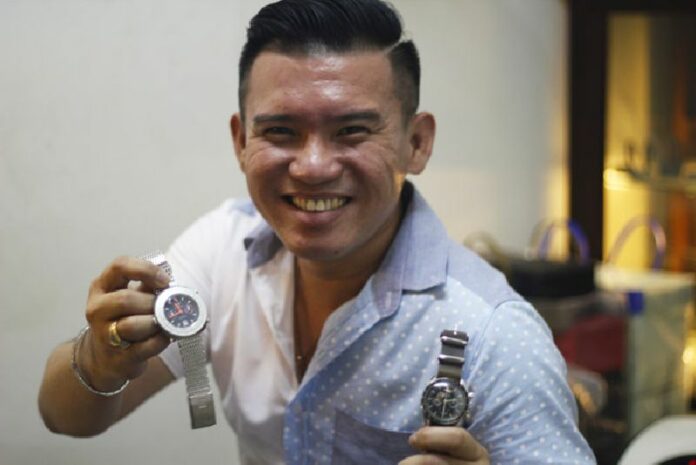
Watch seller Tongchai, aka Dr. Air Watch, at his shop in the Chatuchak Weekend Market in Bangkok. Photo: Cole Pennington

BANGKOK — As shoppers capitalize on the efficiency of the digital age, traditional transactions are dying.

Merchants and traders are giving way to iPhones and e-shops, even street food and taxis are just a few swipes away. But there’s a certain fascination with doing business the old fashioned way, and in a small alley at Chatuchak Weekend market, the vintage watch trading industry defies the odds to go against the trend of modernization.

“Watches are different than anything else. You need to be able to see every single detail and examine it. You need to love it. You come here to do that,” says Tongchai, who goes by the moniker Dr. Air Watch.

Tongchai has been dealing vintage watches for over 20 years. His business has persevered through the Asian Financial Crisis, the Global Financial Crisis, and the recent Thai economic slowdown. The vintage watch trading business seems as steadfast as some of the sterling brand names it champions.

\

\
 

“Watch values are tied to the economy, but the business is always good.” he says. While the values may rise and fall, demand remains steady. “When people have extra money they buy watches for fun, and even when the economy is slowing, they buy watches as investments, because Rolexes are as good as currency – sometimes better.” He’s referring to the recent weak performance of the Thai baht.

All of Tongchai’s business is done out of a small, unassuming stall near Chatuchak Gate 1 lined with vintage watch dealers. Most operate in cash only; he’s only had a credit card processing machine for less than a year. He’ll move numerous watches valued from 100,000 baht  to as much as 500,000 baht on a good weekend. The dim lighting and small trash deposits are a far cry from the glitzy luxury malls where people spend the same amount – or often far less  on high-end timepieces.

In the Western vintage watch markets, face-to-face transactions have been completely replaced by online marketplaces like analog/shift of New York City and Chrono24 out of Germany. Many don’t see this business model as realistic in the Thai market.

Taweesak, another veteran in the business specializing in vintage Seiko, believes sites like these only galvanize the market in Thailand.

“It’s hard to find a good watch now. In Asia, if you order a watch online you're probably not going to receive the same watch as in the picture,” he says. With an entire industry in the Philippines and China based on copying authentic parts, it’s very hard to separate the real deal from the fakes. The general consensus among Thai collectors is that online shopping in Southeast Asia can be dangerous. Dealers have the specialized knowledge to present authentic examples to customers.

And that’s a positive thing for Teewasak, who doesn’t welcome any sort of modernization in the industry.

“I’m bored of answering questions on Facebook. I can’t even see the screen!" he says. "My customers have been coming to me for 20 years, they can pick up the phone and call me."

\
 

While the domestic market may be resistant to change, other Thai vendors are using technology to reach foreign markets. Athisak Mujanamontin also operates out of a stall at the weekend market, but during the week, he fields inquiries from the largest market in the Asian watch collecting world: Japan.

“We need to embrace Line, Instagram and Facebook, because the younger generation is using technology. The collectors that I’ve been selling to for decades keep me in business, but if we don’t connect to younger foreign buyers, the market will slow down.” Athisak conjectures.

He uses tools like Instagram to show Thai and foreign buyers his newest watches for sale, but he specifically states that they need to come to his JJ stall to buy the watch. It works. Distance doesn’t stop overseas buyers from flocking to the market. “Japanese customers will already know what they want from seeing my Instagram feed. They’ll come with a list and buy in bulk. They’re often dealers in their country.”

One thing is for sure, and that’s the rising values of vintage watches.

“Margins are small, but you’ll always make 1-t0-5 percent on a Rolex,” Tongchai says. Teewasak reports that customers are buying watches as investments in bulk, and with recent currency fluctuations, there’s not a better time to buy.


Advertisement

Myanmar’s Monogamy Law Strikes Unintended Buddhist Targets

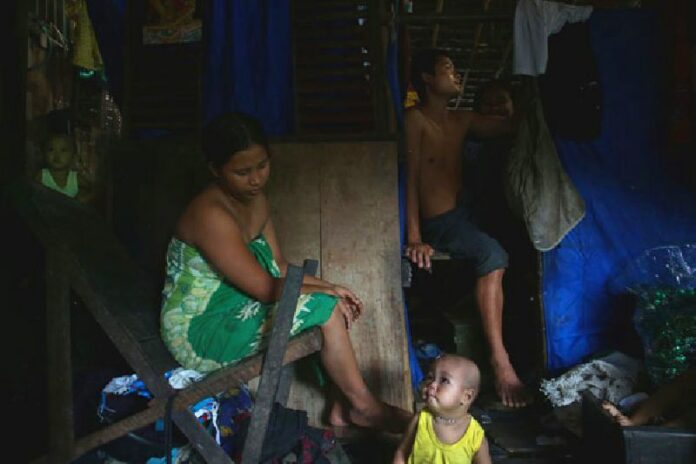
A family at their home in a slum area in Hlaing Tharyar, a sprawling township to the north of Yangon. Photo: Hkun Latt / Myanmar Now

YANGON — T’s husband ended their relationship with a simple text message. “He said, ‘I don’t want to be with you anymore. I’m going with her because she’s better than you.’ What can I say?” T said, looking down at the table.

The 26-year-old, who requested anonymity, was devastated. They’d been married for two years, and had been friends for 10. He left her for a woman he met via the Viber messaging app a few months earlier.

“I wanted to try my best to save the marriage. I didn’t want to be known as a divorcee in society,” she said, tears welling up in her eyes. 

The sole breadwinner, T had used her earnings from selling fresh goods at the market to buy him a motorcycle, a mobile phone, and a gold necklace. 

He took them all. 

She turned to ward authorities, all of them male, whose responsibilities include supervising social affairs and resolving local disputes.  

“They told me there was nothing they could do, that it’s very common. That last comment made me really angry,” recounted T, a slight woman with long black hair and traditional thanaka make-up on her cheeks. 

Her neighbors were not much help either. They sniggered at her for failing to keep her husband, she says. 

Faced with unsympathetic officials in a male-dominated and socially conservative culture, T, like dozens of women in Myanmar, found an unlikely ally in the controversial new Monogamy Law, which criminalises extramarital affairs and polygamy. Those found guilty could be imprisoned for up to seven years, and the defendant is denied bail. 

“It’s good there is such a law. In fact you can even say such a law is long overdue,” she said. T’s husband left her in March and lawyers say the law, enacted on Aug. 31, cannot be applied retrospectively, but she says she is determined to find a way. 

“I’m going to file a complaint. I’m not going to let him get away with it,” she said, her jaw set. 

The Monogamy Law was the last and the slimmest of four “race and religion protection laws” enacted after lobbying by nationalist Buddhist monks who claimed Myanmar and its women were under threat from Islam. The law has fired the imagination of ordinary citizens, although perhaps not in the way its backers had originally intended. 

Between Sept. 1 and Dec. 7, 29 complaints under the law were filed in Yangon alone, the country’s commercial capital, according to figures from the Yangon Police Force. The vast majority of them concerned Buddhist men. Three cases are against women. 


‘Rabbit Trap Catching Cats’

Women’s rights groups had often said existing laws governing marriage, divorce and personal relationships, which date back to British occupation in the 19th century, were outdated, unclear and poorly enforced. 

Under the Penal Code, the colonial-era primary legislation on violent crimes, legal sanctions already exist for polygamy but adultery is narrowly defined – only a man who has sexual intercourse with the wife of another man is deemed to have committed the offense. 

Yet rights activists say the four “race and religion protection bills” are not the solution and are in fact designed to discriminate against Muslims in the predominantly Buddhist country. 

The laws enjoyed swift passage in the parliament and were endorsed by President Thein Sein. Anyone criticising them received threats from the powerful Patriotic Association of Myanmar, better known by its Myanmar acronym Ma Ba Tha. 

The new government, which will take over next year, will inherit the laws, which are already proving to have unintended consequences. 

The Monogamy Law was intended to “preserve the sanctity of marriage, to safeguard from the danger of Jihadi Muslims who are marrying many women in an effort to establish a Muslim nation, and for women to avoid the problem of polygamy”, Wirathu, a leading Ma Ba Tha monk, recently wrote in the group’s journal. 

With the overwhelming majority of men charged under the Monogamy Law being Buddhist, however, Myanmar’s lively social media now describe the impact of the law with a traditional Burmese saying:  “The trap was set for rabbits but caught cats instead”.


Politically Motivated?
In the run-up to the Nov. 8 elections, Ma Ba Tha openly campaigned against the National League for Democracy after NLD lawmakers objected to the bills. Even after NLD’s landslide win, the group has warned the party not to abolish or amend these laws. 

Phyu Phyu Thin, an NLD lawmaker, was one of those who objected to the law. 

“People are now talking about how the law was aimed at one thing but affecting another thing. Laws have to be consistent and not violate people’s human rights,” said the Lower House MP. 

“It felt like (the laws) were enacted with a political purpose but using women as an excuse.”

The Monogamy Law states that it applies to everyone living in Myanmar, including foreign nationals married to Myanmar citizens. It prohibits a married person from entering a second marriage or “unofficially” living with another person while still married. 

Anyone can file a complaint, and punishment for violations include loss of property rights upon divorce for the guilty party, up to seven years in prison and a fine.

Criminalizing Private Affairs
Robert San Aung, a well-known lawyer, noted that cases under the law had been opened even before the relevant by-laws have been issued. 

“Normally, by-laws are required before a law can be enforced and there are no by-laws yet for the Monogamy Law,” he told Myanmar Now in a telephone interview. 

Rights groups say adultery is not an issue to be tackled by the criminal justice system and have questioned whether the government should interfere in private affairs. 

“I personally support the idea of monogamy but the issue of adultery exists not just in Myanmar and in our time, but in every country, culture, race and religion. It’s about individual choice and morality… It doesn’t make sense to ban this through laws,” said May Sabe Phyu, director of Gender Equality Network in Myanmar. 

Human Rights Watch pointed out that legal provisions that criminalise consensual sexual relations between adults, regardless of marital status, violate the right to privacy. 

A United Nations working group on discrimination against women also said in 2012 adultery should not be a criminal offense. 


Protection
Yet for women such as T, the law could offer much needed protection in a society which celebrates men’s virility, with popular sayings such as “A good man attracts a thousand women” and “If a tree is strong, ten thousand birds can take refuge there”.

Avoiding sexual misconduct is one of the five moral precepts Buddhists are supposed to live by, but it is a duty often ignored by Myanmar men.

K, a 48-year-old woman from western Myanmar, was married for seven years before her husband left her and married another woman, already pregnant with his child, in August.

“My husband learned from his cousins and uncles who behaved the same way. They showed him he could get away with it,” she said.

K only learned of the law’s existence from women rights activists after agreeing to a divorce, she said. She may not be able to use the law as her husband left her days before it came into force.

“If I could, I’d like to send all of them to jail to set an example.”

Story: Thin Lei Win

Advertisement

Table the Politics and Bite Into North Korean Cuisine at ‘Pyongyang Okryu’

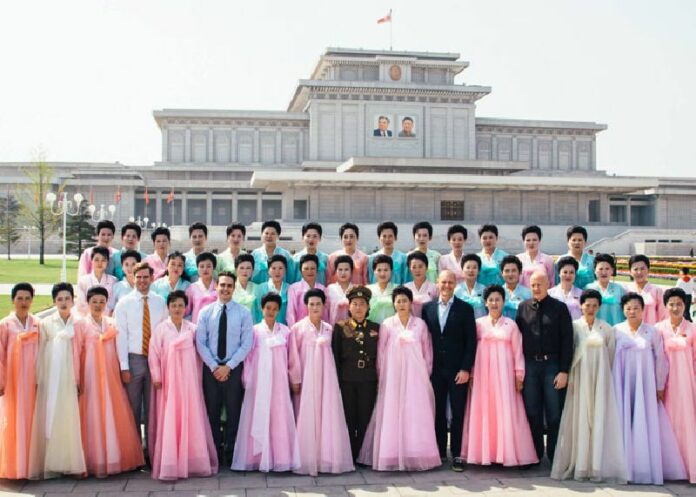
The author, front row fourth from left, is welcomed during a 2014 visit to Pyongyang, North Korea.

BANGKOK — I’m sitting on a stranger’s blanket spread across a small patch of grass with a severe buzz from rapid-fire soju shots with every person I meet. It’s May 1, 2014, in Pyongyang, North Korea, and it seems everyone in the capital city has come to Mt. Taesong to dance and sway to the shrill of operatic recitatives celebrating hard work and self-reliance for Labor Day. Families huddle around bottles of moonshine and from small grills sizzle assorted meat and vegetables.

A stranger invited me to indulge in a drink and snack on some grilled beef he was cooking. Depleted from dancing with too many elderly women, it was exactly what I needed. So there I was, eating slightly charred bulgogi cooked in convivial spirits by a man who Western media would have you believe probably wanted to see me as well-roasted as his beef. In that moment, politics were transcended with a snack.

It’s also the first thing I ordered at the newly opened Pyongyang Okryu Restaurant in Bangkok.

The small restaurant sits right off Ekkamai in an unassuming cul de sac. It’s owned by the government of the Democratic People’s Republic of Korea, but it’s operated by a family of three, the father being Mr. Kim. He’s lived in Bangkok for 10 years. His son tends to the dining room while his wife runs the show.

Kim introduced himself and explained the policy on taking pictures in his establishment. The policy is: You don’t. Not here, nor at any of the various North Korean-operated chain restaurants located around Asia and the Middle East.

“People say things on the internet,” he said. “They’ll take a picture and write. You know.”

 A North Korean man implores the author to try his home made Soju on Labor Day 2014 in Pyongyang. Photo: Richard Marks 
 A North Korean man implores the author to try his home made Soju on Labor Day 2014 in Pyongyang. Photo: Richard Marks

Being a journalist, I do know. The most common suggestion is that these restaurants launder North Korea’s dirty money. South Korean media claim they must remit hundreds of thousands of dollars annually to Pyongyang.

But it was difficult to see anything more going on with the Kim family than a focus on making Naengmyeon, or Cold Noodles, so I checked my politics at the door and sat down with an open palate and mind.

On my first visit, the dining room was filled with a table of two Americans, a Japanese man, and a pair of South Koreans. All were enjoying the fare and an absolutely bizarre show put on by a trio of oddly alluring North Korean women dancing and singing. The only thing that differed were the drinks coming to the U.S. table. We went for the beer instead of the the North Korean-made mushroom liquor and soju.

An extraordinary assembly of diners considering North Korea’s official contempt for their neighbors to the east after half a century of Japanese rule and ire for meddling American interventionists, most notably in what is viewed as a “domestic dispute” more widely known as the Korean War. A war technically still going on.

With diners from three nations the DPRK allegedly detests getting drunk and pigging out, I wasn’t the only one to check my politics. No one seemed to give a shit about troubled pasts at Pyongyang Okryu.

The first course lands on the table, a neatly organized display of head cheese. The presentation, perfectly aligned, looks like a  battalion of soldiers made from trimmings of head flesh that have been compressed and fused together with gelatin. While the taste wasn’t totally unpleasant, it didn’t live up to the expectations that Mr. Kim set forth during the ordering process, “This one is popular with foreigners. I think you’ll like it. The taste is smooth.”

It wasn’t my favorite Korean dish.

Mr. Kim’s son did warn us about the green peppers that we ordered, though. He wasn’t kidding when he said they were painfully spicy. “Eh, we eat Thai food every day, we can do spicy” we said to assuage his concern.

These peppers, slathered in the indispensable Korean condiment gochujang, must have been grown with roots stretching to the ninth circle of hell. After taking a hefty bite, all I could think about was an ice cold Ponghak, a deliciously malty brew I’d learned of in Pyongyang. Unfortunately Mr. Kim said a lack of demand in Bangkok didn’t warrant importing it. I convinced him to work on it. Unlike Thai chilis, the spicy from these dastard peppers can’t be combated by Singha. They need a sweet and strong hero like Ponghak to defend diners’ mouths.

A crowd of mostly Pyongyang residents enjoy Labor Day in 2014 at a picnic on Mt. Taesong. Photo Richard Marks

At 8:45 the service staff disappeared, only to re-emerge first as sequin-clad dreamgirls and later wearing traditional hanbok dresses. An accordion and synthesizer tunes filled the room as myself and the two other parties went quiet. The first of the performers waddled, with the most abnormal duck-like gait, onto the stage and proceeded to robotically unfold her arms in a way that seemed to take cues from popping and locking.

Another woman entered from stage right, only she wasn’t dancing. She was armed with a microphone set to maximum reverb. If you’ve never experienced taejung kayo before, then get ready for a mix of operatic, soaring vocals to the tune of well, you’ll just have to hear it for yourself. The themes of the song often reflect ideas popular in North Korea: economic independence, self-sustenance and hard work. Finally a third performer joined the stage and produced a fan as the trio lined up to perform a Buchaechum routine.

The audience awkwardly built up to a golf clap when the performance ended. The ladies exited the stage, leaving only the LED rope lights and LCD monitor displaying beautiful natural scenes around the DPRK to look at.

I glanced around the room to see if the service staff has gone back to work after the performance to order some more food. Nothing. And then a familiar tune, played on not so familiar instruments filled the air. A solo performer waltzed across the stage.

\
A rare glimpse inside a North Korean-operated restaurant in Saigon earlier this year. Photo: Simon Duncan


“Every night in my dreams….”

No. Was this…Titanic?

“I see you, I feel you. That is how I know you go on…”

Sure was. She was belting out “My Heart Will Go On”, and that song came alive in a way that I’d never heard it before. The massive reverb and perpetual smile plastered on the singer’s face made for an eerie rendition that’s hard to forget.

Then the beef landed.

It’s marinated in sesame oil, brown sugar, soy sauce, and a mixture of garlic, pear and ginger. The hefty portion is designed to be eaten communally, so, like in Thailand, order for the table, not for yourself. It’s generally cooked medium rare, so make sure to specify your preference when you order.

I was hoping for some sort of Proustian moment where the taste of the bulgogi transported me back to having a ball on Mt. Taesong for Labor Day a year before. But I got nothing. There was no mystery, no magic, no transcendental experience. It was just beef – tasty Korean beef.

Knocking back some Ponghak beer on a sunny afternoon in Hamhung, North Korea. Photo: Richard Marks

But I did reach a conclusion. Mr. Kim said something while he was explaining his photo policy that I didn’t want to hear. He said Pyongyang Okryu is “just a business.” And he’s right. It’s just a restaurant serving food from a country that’s shrouded in mystery. The food isn’t a mystery, we all know what beef tastes like. I wanted this restaurant to strike a frenzy of socialist feels directly into my heart, but it didn’t. It was just like eating at any other restaurant, except slightly more bizarre.

Though I’d likely expected too much, I was not disappointed. The atmosphere, glimpse of North Korean culture and interaction with Pyongyang-native service staff was neat. Where else can you have a chat with a young woman from one of most isolated cities on earth?

Mr. Kim has been here for a decade; his son was educated in Singapore, his speech peppered with Western slang. He uses Gmail and eats a big dinner with his staff every night. He’s a normal guy. And at Okryu, you get that sense.

The dinner reaffirmed the aphorism my North Korean guide returned to every time we gawked at fearsome propaganda on that 2014 tour of the Hermit Kingdom: “Governments are governments. People are people.”

People are people. And people have to eat. Even North Korean people. So why not eat with them at Pyongyang Okryu Restaurant?

Pyongyang Okryu Restaurant is located in Ekkamai on Soi Sukhumvit 63. There’s no Facebook page or website, but you can call them at 02-020-0220.

Advertisement

Police Weigh Defamation Suit Against Human Trafficking Investigator

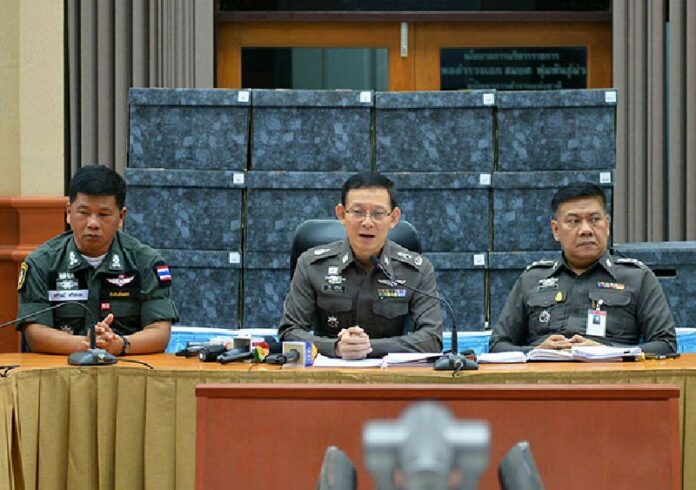
Police Maj. Gen. Paween Pongsiri, at center, at a Sept. 29 news conference in Songkhla province.
Photo: Khaosod English

By Aukkarapon Niyomyat and Amy Sawitta Lefevre
Reuters

BANGKOK — Police on Friday said they were considering suing a former officer investigating human trafficking for defamation over comments he made implicating senior officials in the trade.

Maj. Gen. Paween Pongsiri arrived in Melbourne a few days ago and told the Australian Broadcasting Corp. yesterday that he feared for his life because influential figures in the government, military and police implicated in the illicit trade want him dead.

"There are some bad police and bad military who do these kind of things," Paween told the broadcaster. "Unfortunately, those bad police and military are the ones that have power."


Head Human Trafficking Investigator Seeks Asylum in Australia


Royal Thai Police chief Chakthip Chaijinda told reporters that he did not know why Paween fled but said a legal team was checking whether his comments were defamatory.

"I don't know the reason why he had to go and speak about this issue but he should not talk about this because it could damage the country," Jakthip said.

Paween resigned from his post as deputy commissioner of Provincial Police Region 8 in November saying an order to transfer him to Thailand's south would expose him to revenge by members of trafficking syndicates still at large.

Suspects he was investigating for trafficking were influential in the region, he said, and could target him. His resignation raised serious questions over Thailand's commitment to end the human trafficking and protect its officers.

The crackdown on lucrative smuggling gangs followed the discovery in May of 36 bodies in shallow graves hidden deep in a mountain near the Thailand-Malaysia border, which sparked international outcry.

Thailand has brought a case against 88 suspected human traffickers but examination of some 500 witnesses in the case could take as long as two years.

Paween was listed as a key witness to testify against officials and other individuals facing criminal charges over their alleged involvement in trafficking.

Jakthip said there were no issues with the trafficking case and that Paween was the only police officer to raise allegations of intimidation.

video and transcript of the interview from ABC can be seen here


Advertisement

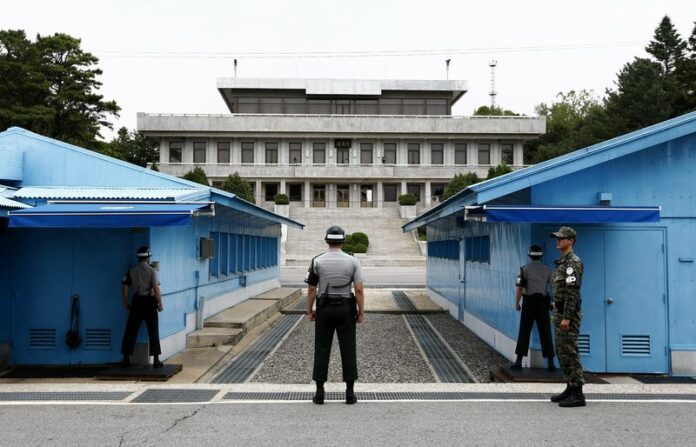
North, South Korea Hold High-Level Talks

The DMZ that separates the two Koreas.
Photo: Jeon Heon-Kyun / EPA

SEOUL — North and South Korea are to hold high-level talks Friday to discuss improving relations that were badly strained by military escalations this year, a news report said.

The Vice Unification Minister of South Korea, Hwang Boo Gi, was to meet with his counterpart at the jointly run industrial park just over the border in the North's Kaesong city, Yonhap News Agency reported.

"There are many issues to be discussed," Hwang told reporters before leaving Seoul. "We will do our best to resolve them one by one."

In November, a spokesman for South Korea's Unification Ministry indicated topics would include South Korean demands for regular family reunions as well as North Korea's desire to resume tourism to the Mount Kumgang resort in the north.

According to Yonhap, around 66,000 family members remain alive in South Korea from the families separated by the division of the peninsula after the Korean War of 1950-53. Their advancing age makes the issue a pressing one.

South Korean tours to Mount Kumgang were an important source of hard currency for Pyongyang, but were suspended after a female tourist was shot dead by soldiers in 2008, allegedly after walking into a military zone.

Ties were frayed this summer after a landmine explosion in August maimed two South Korean soldiers, prompting artillery fire from the South's military, and similar responses from the North.

North Korea has since expressed "regret" for the blast.

North and South Korea remain in a technical state of war following the conflict, which ended in a truce rather than a peace treaty.

 
Story: DPA


To reach us about this article or another matter, please contact us by e-mail at: [email protected].

Follow Khaosod English on Facebook and Twitter for news, politics and more from Thailand.

Follow @KhaosodEnglish

\

Advertisement

Australian Teen Terror Suspect Denied Bail

Australian Federal Police officers during a Thursday operation southwest Sydney, Australia. Photo: New South Wales Police / EPA

SYDNEY — A 15-year-old boy charged with plotting a terrorist attack in Sydney was denied bail Friday in the Children's Court.

Magistrate Elizabeth Ryan told the court she had concerns the boy would commit an extremely serious offense or endanger others if he was released on bail, the broadcaster ABC reported.

The boy, who cannot be named for legal reasons, was arrested during a series of police raids on homes Thursday in Sydney.

Also charged was Ibrahim Ghazzawy, 22, and three other men who were already in custody facing other terrorism and firearms counts.

They were charged with one count each of conspiracy to conduct an act in preparation for a terrorist act, which carries a sentence up to life in jail.

The Childrens Court was told police had discovered a text from the boy to a man saying: "I'm going to get to paradise through banana. God is great. No God but Allah."

Police said banana was the boy's code word for a gun. Police seized photos of the boy brandishing a firearm as well as copies of photos in his phone of a beheading by the Islamic State group and cheering Islamist radicals. He was already on bail for possessing an illegal gun.

Police allege the boy was an associate of a group of men charged with supplying a gun to a 15-year-old boy who shot a police worker and died in a gunfight with police in October outside Sydney police headquarters.

Police allege the group, including the boy, were planning to attack a police building in Sydney.

The boy is due to appear in court again Feb. 5.

Advertisement

Airport Rail Link to Halt, Bus Routes Change for ‘Bike for Dad’

The Airport Rail Link in an undated file photo. Photo: Prachachat

BANGKOK — The Airport Rail Link will be halted Friday between Phaya Thai and Ratchaprarop stations during the Bike for Dad cycling event.

Authorities said the train will not stop at those two stations from 3pm until the event finishes. Other stations along the line will operate as usual.

Passengers will be allowed to carry bicycles on board from 6am to midnight on Friday.


These 84 Bangkok Roads will Shut Down Friday for ‘Bike for Dad’


Bus service will be unreliable as more than 100 routes will be changed. BMTA buses will be free throughout the day and can be identified by signs indicating free service, according to the state news service. For information about buses call 1348 (Thai service only).


Advertisement

Hot News

LATEST NEWS

Bangkok
overcast clouds
31.1 ° C
31.1 °
31.1 °
57 %
2.7kmh
100 %
Wed
33 °
Thu
34 °
Fri
37 °
Sat
37 °
Sun
37 °