





























28.8 C
Bangkok
Saturday, July 25, 2026
Home Blog Page 2925

A Chinese Dinner for Two

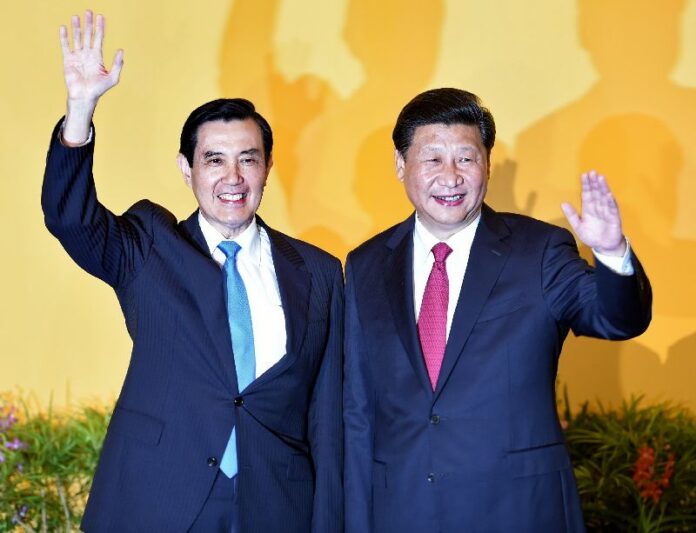
Chinese President Xi Jinping (R) and Taiwan President Ma Ying-jeou wave to journalists before their meeting at Shangrila hotel in Singapore on November 7, 2015. The leaders of China and Taiwan hold a historic summit that will put a once unthinkable presidential seal on warming ties between the former Cold War rivals. AFP PHOTO / Roslan RAHMAN

By Chris Patten
Project Syndicate

LONDON – A great deal of water has flowed through the Taiwan Strait in the 70 years since the leader of China’s Communists, Mao Zedong, met the leader of his nationalist opponents, Chiang Kai-shek. So the recent meeting in Singapore between their heirs, President Xi Jinping of the People’s Republic and his Taiwanese counterpart, Ma Ying-jeou, could legitimately be described as historic.

The diplomatic negotiation that preceded the meeting was exquisitely complex, even covering who should pay for dinner (they split the bill). But, after a brief exchange of views behind closed doors, no joint statement was issued and only a heavily sanitized account of the meeting was made available to China’s state media.

So why did the meeting happen, and what does it portend?

Ever since Mao’s Communists won the civil war (which the last meeting between the parties, in 1945, had been called to try to avert) and Chiang Kai-shek’s Kuomintang forces withdrew to Taiwan, relations between the two sides have smoldered without ever really catching fire. While there was no love lost between the United States and the Kuomintang leadership, the US gave Taiwan assurances of military protection, which deterred China from trying to unify the island with the mainland by force.

Mao’s adventures on the Korean peninsula, supporting the North against the South and its Western allies, helped to cement the Washington-Taipei axis, which, thanks to some nifty diplomatic footwork, survived President Richard Nixon’s rapprochement with China in the early 1970s. America recognized the communists in Beijing as China’s legitimate government, while helping to sustain Taiwan in a limbo between sovereignty and the practical exercise of statehood. The island ran its own affairs, becoming a rambunctious democracy in the 1980s, but never insisted on international recognition as a full-fledged sovereign state.

For China’s rulers, Taiwan was a “renegade province,” and it steadily picked off members of the international community who tried to treat it as anything more than this. But there has also been a recognition of reality – especially economic reality – along the way.

People remember 1989 for the Tiananmen Square killings. But that May and June, ministers like me flew to Beijing for what seemed to us all to be a positive and truly historic occasion. China allowed Taiwan to attend the Asian Development Bank’s annual board meeting for the first time, provided it was called “Taipei, China.”

Some years later, when I was a European Union commissioner, after we had negotiated World Trade Organization membership with both the People’s Republic and Taiwan, we wanted to set up an EU office in Taipei to monitor the island’s compliance with the WTO’s rules. Before doing so, I made a point of telling the Chinese government what we were doing – opening a commercial regulator, not an embassy.

Money of course talks for both China and Taiwan, and their economies are now closely linked, with large numbers of Taiwanese living and working in China (especially in the Shanghai area) and huge Taiwanese investments in Chinese manufacturing. Taiwan’s Foxconn, the world’s largest electronics manufacturer (including Blackberries, iPhones, and Kindles), has 12 factories in China, including one in Shenzhen that employs hundreds of thousands of workers.

But, though Taiwanese politics is naturally dominated by the island’s relationship with the mainland, the reality of deep commercial ties between China and Taiwan has had no diplomatic equivalent. The Kuomintang (also called the Chinese Nationalist Party) wants to improve relations without surrendering Taiwan’s independence. Its opponent, the Democratic Progressive Party, wants to strike a more autonomous posture, though whether it would ever really go for anything more substantial than tweaking China’s nose is doubtful.

A survey three years ago suggested that 80% of Taiwan’s 25 million people would support a formal declaration of independence, provided that it did not prompt a Chinese invasion. That is a rather large caveat. China regularly warns Taiwan against any such reckless action, and the US puts the squeeze on the island’s leaders whenever they seem to be getting too uppity with the mainland.

There appear to be two reasons why Xi and Ma met. First, they are clearly worried that the Kuomintang, which lost last year’s local elections in a landslide, will lose the general election in January as well. Both hope that showing that China and Taiwan can get along without too much trouble will bring electoral benefits for the Nationalists.

In addition, at a time when the Chinese economy is slowing and regional tensions are rising because of China’s muscle flexing in the South and East China Seas, Xi seems eager to radiate peace-loving ambitions. Having unsettled many of his neighbors, not just the Americans, his upcoming visit to Vietnam, and his prime minister Li Keqiang’s visit to South Korea, are of a piece with his dinner-hour diplomacy with Ma.

China’s real, long-term intentions are not entirely obvious, and maybe that’s part of its strategy: ambiguous signals play an important role in diplomacy. But two things are clear.

First, Xi’s initiative shows the extent to which he dominates Chinese politics. A weaker leader could not have taken such an ambitious step, which represents a real break with past Communist orthodoxy.

Second, peaceful reunification of the mainland and Taiwan remains unlikely, unless it takes place – as China continues to promise – on the basis of “one country, two systems.” But the Taiwanese cannot be very reassured by what they see happening today in Hong Kong, which was promised the same thing before its return to China in 1997.

Taiwan’s system is democratic; China’s is not. What the example of Hong Kong suggests is that China would have to force Taiwan to give up democracy and the rule of law – or embrace both itself – before it could welcome its “renegade province” back into the fold.

Chris Patten, the last British Governor of Hong Kong and a former EU commissioner for external affairs, is Chancellor of the University of Oxford. 

Copyright: Project Syndicate, 2015.
www.project-syndicate.org


To reach us about this article or another matter, please contact us by e-mail at: [email protected].
Advertisement

China Sees Record Online Sales on Singles Day

Photo: DPA / Ole Spate

BEIJING — Internet giant Alibaba broke its own sales record of 9.3 billion dollars during China's "Singles Day" 24-hour online shopping binge on Wednesday, defying fears of an economic slowdown in the world's second-largest economy.

Total gross merchandise volume on Alibaba's various online marketplaces matched last year's total at around midday and passed USD$10 billion shortly afterward. 

Alibaba, a collection of businesses that concentrate on online shopping, saw more than 70 percent of those sales come from its mobile sites, showing that both online shopping and smartphone use have become ingrained habits among Chinese consumers. 

The firm said it had sold over 2 million mobile phones online.

Alibaba rival and China's largest online direct sales company, JD.com, said on its Twitter feed that by midday Wednesday it had received over 14 million orders and surpassed the site's total number of orders on Singles Day last year. 

JD.com has about one-quarter of China's e-commerce market, according to analysts. 

Singles Day started in the 1990s as a sort of anti-Valentine's Day where people would celebrate being single. It is held on Nov. 11 each year because of the date's four single digits of 1.

In 2009, Alibaba started promoting the day as an opportunity for single people to buy discounted goods online to treat themselves. Since then, other e-commerce companies have also offered their own Singles Day promotions. 

Many consumers told DPA that they had been waiting for Singles Day to make their purchases. 

"I have been saving up to make some electronic purchases on Singles Day, including a new laptop and camera," said Michelle Yuan, a banker. 

"I bought a new TV set, groceries and some vintage clothes," said Jin Shu, who works as a retailer of women's clothes.   

Singles Day is also known as Bachelors Day because of the gender imbalance caused by China's one-child policy and traditional preferences to have sons. 

Although the government outlawed sex-selective abortion in the late 1980s experts say sex-selective abortion is the main reason why there are nearly 116 men for every 100 women in China. 

China made a surprise announcement last month that it would abolish its one-child policy and allow all married couples to have two children.

Story: DPA

Advertisement

Election Victory Nears for Myanmar Opposition

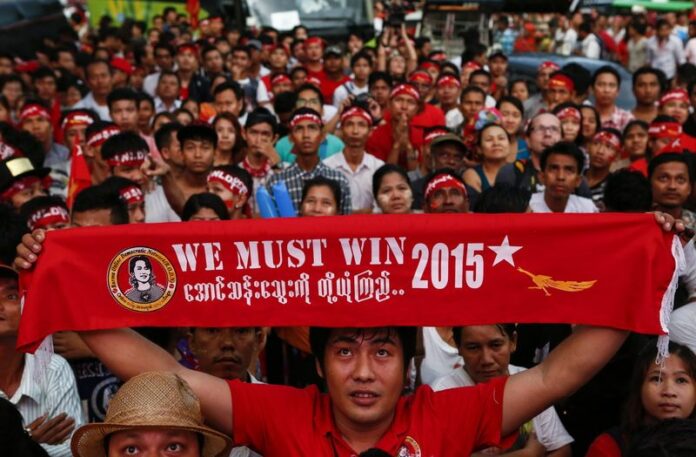
Supporters of the National League for Democracy celebrate in front of party headquarters Monday in Yangon. Photo: DPA / Lynn Bo Bo

YANGON — Myanmar's opposition National League for Democracy, or NLD, was on course for victory today, three days after the election.

"We lost," said Htay Oo, acting chairman of the military-backed Union Solidarity and Development Party, or USDP. "NLD won the election by a landslide. But we accept the defeat and respect the results."

The NLD, led by Nobel Peace laureate Aung San Suu Kyi, had won 163 out of 182 counted seats across the lower and upper houses as of earlier Wednesday, the Union Election Commission said, as well as a similar majority of votes counted for the 14 regional assemblies.

It needs a combined 329 to give it a majority in the two houses of the national Assembly of the Union, where the military retains an automatic 25 percent of the seats in each.

The USDP had just eight of the elected seats in the lower house and two in the upper one by early Wednesday, the commission said.

Observers welcomed the elections, but expressed caution. The U.S. observer mission said that the Muslim ethnic Rohingya group was not enfranchised, while the EU representative pointed to the military's reserved seats as an obstacle to full democracy.

Some reports Tuesday said elements of the NLD and an Asian monitoring group expressed suspicion that the election commission could be delaying the results deliberately, but both denied this later.

"You should know the situation here. It would take some time for results to reach the UEC," Damaso Magbual, mission head for the Asian Network for Free Elections, told DPA.

An NLD spokesman agreed. "I understand the transportation situation in some areas is very bad," party spokesman Nan Khin Htwe Myint said.

"It will take some time for the voting results from village level to reach to township level, division level and then to the UEC. But it should not take weeks. It should be done within a week."

Story: DPA

Advertisement

Four Redshirts Convicted of Burning Khon Kaen City Hall

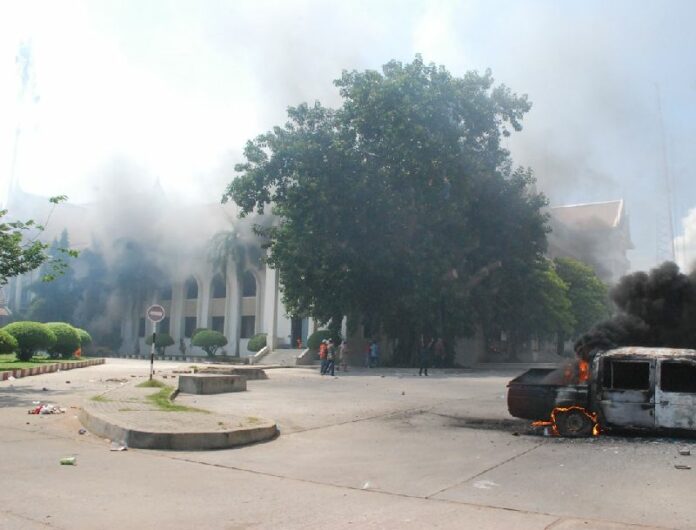
Khon Kaen city hall burns May 19, 2010.

By Teeranai Charuvastra
Staff Reporter

KHON KAEN — Four Redshirt activists were found guilty today for torching Khon Kaen’s city hall during 2010’s political unrest.

The four defendants received sentences ranging from three to 13 years in jail for their roles in the arson attack, which took place on May 19, 2010, the day a military crackdown in Bangkok brought an end to weeks of protest and unrest that claimed more than 90 lives.

Adisai Wibulsek, Jirattrakul Soomha, Suthat Singhabuakao and Udom Kammool were among the Redshirt demonstrators the prosecutor successfully argued broke into the city hall compound and set the building on fire on that day.

Prior to the arson, the demonstrators had been rallying in and around the building in solidarity with a larger Redshirt protest in Bangkok, where thousands of Redshirts had occupied parts of the capital city, from Lumpini Park to the luxury malls around Ratchaprasong intersection, for two months to demand a fresh election from then-Prime Minister Abhisit Vejjajiva.

\

Redshirt demonstrators at Khon Kaen city hall prior to the arson on May 19, 2010.

When the Khon Kaen demonstrators heard the military had mounted an assault on the Redshirt encampment in Bangkok, some of them threw petrol bombs and other objects into the city hall building, damaging but not destroying it. The four defendants were among them, the prosecutor said. 

The court ruled today the evidence implicating the four defendants was sufficient for a guilty verdict. 

“Photographs and videos taken by reporters from many agencies, and by security officers … clearly showed the four defendants committing the act,” read an excerpt from the verdict.

Adisai and Jirattrakul were subsequently sentenced to 13 years in prison, while Suthat and Udom received three years. The court declined to suspend their sentences, citing their “brazen disregard of the law.”

Boonyong Kaewfainok, the lawyer representing the four men, said his clients will appeal the verdict. 

The four defendants’ requests for bail release were denied by the court. 

More than 90 people, mostly civilians, were killed during the 2010 protests, which started in March and came to an end when the military stormed the protesters’ camps on May 19.

After Redshirt leaders called off the protests and surrendered to police, some Redshirts remained on the streets, and several dozen arson attacks were reported in the aftermath. Some municipal buildings in other regions were also burned down by local groups of Redshirts angered by the crackdown in Bangkok.

In response to the unrest, the Abhisit government, which had declared a State of Emergency in April, imposed a curfew over Bangkok and 23 other provinces. The situation was brought under control on May 20. 

Correction: The original version of this article stated that the Abhisit government declared a State of Emergency on May 19, 2010. In fact, the State of Emergency had been in place since April 7.

Related news:

There Was No Crackdown in 2010, Says Abhisit Witness 

2010 Crackdown Trial: Abhisit to Blame Violence on Blackshirts

Former PM to Face Impeachment for 2010 Crackdown


To reach us about this article or another matter, please contact us by e-mail at: [email protected].
Advertisement

Building a Bigger Stage for Indie Music, One Streamed Song at a Time

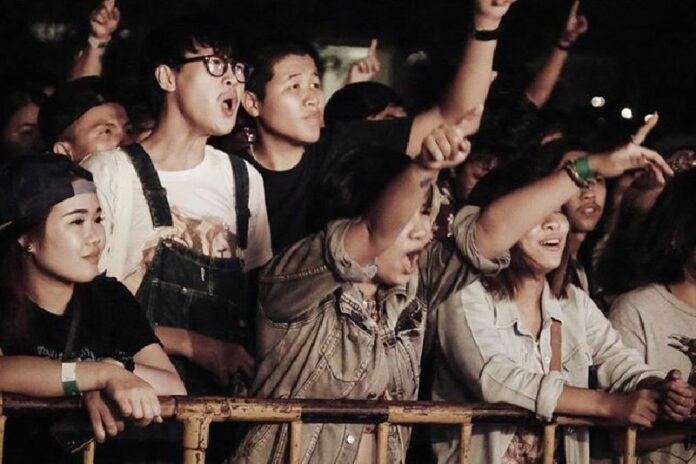
Audience at the Fungjai-sponsored 'Fresh Mushroom' music fest last month in Chiang Mai. Photo: Fungjai / Facebook

BANGKOK — When Itiporn “Van” Lakarnchua started playing in Bangkok, all the bands making original music had to race through sets at the single monthly show they could land.

More than a decade later, “independent music” has moved from the margins toward the mainstream, but play on radio or TV remains rare – as does the money.

So it came as some surprise when one of his bands got a call last year from a new streaming music service that wanted to know how to pay them – with money. They told the service, Fungjai, it wasn’t necessary.

“They said, ‘No matter how you feel about getting paid, we’re going to pay you,’” said Van, the 30-year-old drummer of Degaruda and bass player in Aire.

One year after launching, Fungjai says it wants to break the music box listeners have locked themselves within, but the key is getting them excited about new music and eventually comfortable with supporting what they love with their wallet.

“Music listeners discover music, then they listen to music,” Piyapong Muenprasertdee, one of the company’s founders, said in a recent interview. “The third stage is falling in love with the music, and the last is buying the music.”


Wannarit Pongprayoon Does it All Wrong to Make it Right for Bangkok’s Music Tribes


Since launching October 2014, Fungjai today claims to stream more than 3,700 tracks from 700 artists from its website – all for free. Earlier this month, it opened a beta version of its store to sell music.

Playing the middleman isn’t an easy thing. Musicians want to earn some money for what they create, while the YouTube generation struggles with the idea of paying for “content.”

So could Fungjai be the saving grace for original music? Piyapong said the company hopes to start selling music online and create more content such as podcasts.

They just launched a beta of their online store, offering pre-sales of albums by Slur and Somkiat. The full albums including digital art and inserts are 200 baht each, while individual tracks can be purchased for 25 baht.

They also plan to build a crowdfunding platform for artists to finance projects with support from their fans.

Fungjai is in part funded by Ookbee, the Bangkok-based e-book start up.

While they’re aggressively marketing the service to listeners, Fungjai is also trying to make it easy for musicians to be heard. Bands can join Fungjai, Piyapong said, without a complicated registration or license process like those required for iTunes.

While exporting Thai music internationally is one of Fungjai’s primary goals, Piyapong also hopes to introduce Thailand to more cool music from neighboring countries. He believes more musical exchange in the region will also help build a community outside the kingdom that will help the development of Thai music.

More than anything, Van the drummer said Fungjai’s approach has brought something not always in ready supply to small musicians: respect.

Instead of handling independent music as a niche novelty, he said the company has promoted it wholeheartedly.

“They’ve brought a real legitimacy to being an ‘independent musician.’” Van said. “They’ve made it clear that independent musicians are ‘real.’”

Listen to music free now on Fungjai.com or via their Android or iOS apps, or check them out on Facebook.

Corrections: An earlier version of this story indicated Van was the drummer for both Degaruda and Aire. In fact he plays bass guitar for Aire. It also said that Fungjai currently streams 2,000 tracks from 400 bands, numbers Fungjai said were based on outdated promotional materials. Fungjai said the site currently hosts 3,700 tracks from 700 artists. Fungjai also said the service launched in October 2014 rather than May 2014.

Related stories:

To Keep it Real, ‘Sofar Sounds’ Forgoes Mass Appeal

Advertisement

String of Jellyfish Stings Prompts Warning

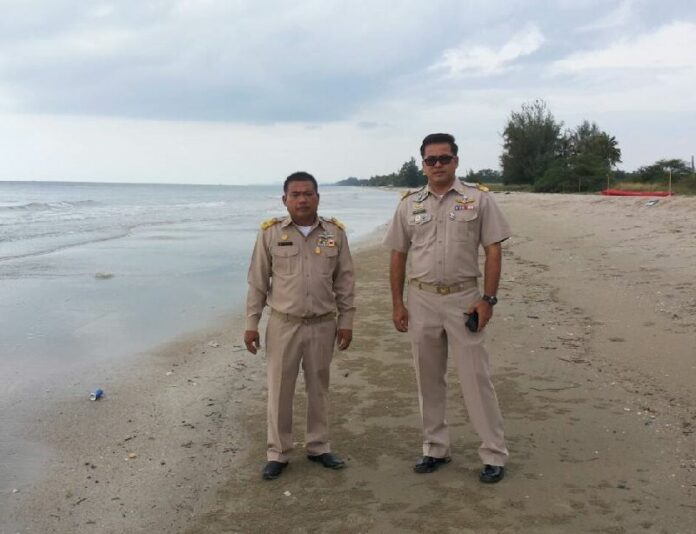
Local administrators on jellyfish patrol Monday in Prachuap Khiri Khan province.

PRACHUAP KHIRI KHAN — Swarms of jellyfish continue sending swimmers to hospital a month after their stings killed a tourist on Koh Samui, prompting louder warnings for visitors to be careful.

In the coastal province of Prachuap Khiri Khan, 10 tourists were stung by jellyfish in the sea off Huay Yang beach during the past weekend alone, including seven who required hospitalization, local official Thawatchai Daengcham said Monday.

“Fishermen in the area report seeing many types of jellyfish getting pushed into the shore by the current,” Thawatchai said after a tour of the beach. “Maybe it’s because of wastewater in the sea.”


Jellyfish Kill German Tourist on Koh Samui


He said many box jellyfish, whose especially potent venom was blamed for two deaths in the past 15 months, have been spotted. Rescue workers will be posted along the beach for tourists’ safety until the jellyfish migrate somewhere else, Thawatchai said.

Box jellyfish stings can be deadly. However, other types of non-lethal jellyfish were responsible for the recent string of stings, said Yanwuth Sudpimsri, another local administrator.

Restaurants located near the beach have been instructed to keep vinegar at the ready, as it can help slow the spread of jellyfish toxin, Yanwuth said.

“When you are stung by jellyfish, don’t press the area where the burn is,” Sitthisuk Aiyara, a local physician, said. “Use vinegar to clean the wound and quickly seek medical attention.”

A 20-year-old German woman died after being stung Oct. 6 on Koh Samui. In August 2014, a 5-year-old French boy died on Koh Phangan.


To reach us about this article or another matter, please contact us by e-mail at: [email protected].
Advertisement

BKK Taxi Charged With Beating Down Australian

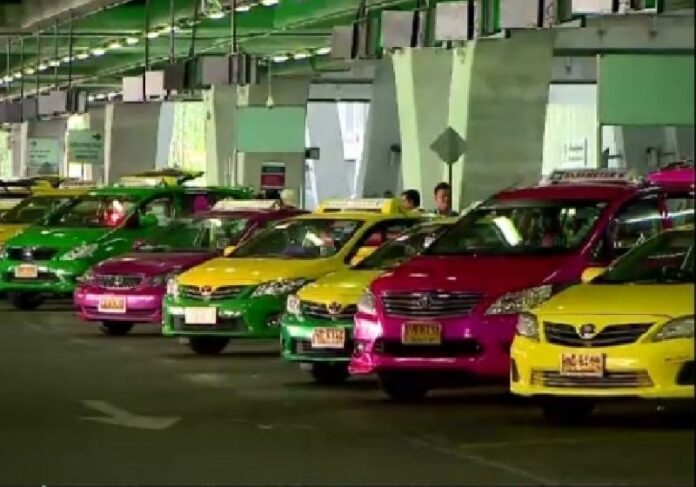
An undated file photo of taxis at Suvarnabhumi Airport. Image: Prachachat

BANGKOK — A taxi driver was arrested last night on suspicion of beating an Australian man at the entrance to Suvarnabhumi Airport.

Kamphan Siri, 32, has been charged with assault after he reportedly punched the foreigner in front of Gate Three at the airport’s arrival concourse at around 9.30pm on Tuesday night.

“The foreigner was drunk. He banged his fist on the car, so the taxi driver became angry, got out of his car, and punched him once,” Paisan Weerakitpanich of the airport police told Khaosod English. “Then the foreigner fell down, and his head hit the taxi door.”

Kamphan told police he was parking his car near the gate when the Australian man suddenly approached his taxi and banged the vehicle once with his fist, according to Lt. Cpt. Paisan.

At that point the Australian was bleeding from the head wound and was sent to a hospital for stitches. He missed his midnight flight. Doctors told the man to remain in their care for several days to monitor his condition, Paisan said.

Kamphan, the taxi driver, reportedly confessed to overreacting. 

“We inspected the vehicle,” Paisan said. “There was no sign of damage at all.”

Kamphan has been charged with physical assault, which carries a maximum penalty of two years in prison. He remains in police custody and will be brought to court tomorrow morning, Paisan said. 


To reach us about this article or another matter, please contact us by e-mail at: [email protected].

Advertisement

Nation Gripped by Comatose 'Lakorn' Superstar

Por Trissadee, at left, in a promotional image for the 2013 remake of comedy lakorn 'Dao Rueng.'

By Lisnaree Vichitsorasatra
Staff Reporter

BANGKOK — A nationally adored television heartthrob remains in a coma from dengue fever but is responding to treatment, his doctors said today.

Thrisadee "Por" Sahawong, 37, was transferred to Ramathibodi Hospital on Monday following treatment at an undisclosed hospital where complications left him in critical condition.

Thrisadee, a lakorn celebrity, has suffered a cascade of worsening conditions including kidney failure and internal bleeding. Doctors said he is breathing through a respirator. 

The actor rose to fame after he was named Cleo Thailand's 2004 Bachelor of the Year. In 2009 he was propelled into superstardom by his lead performance in classic lakorn remake Pu Yai Lee Kab Nang Ma, or Village Head Lee and Miss Ma. He has played more than 30 roles in other series.

It was unclear whether it was the first incidence of dengue fever for Thrisadee. There are several strains of the virus, and after the body fights it off the first time, it is vulnerable to infection by another variety.

Dengue fever, a mosquito-born illness once common to rural areas, has recently become an urban epidemic.

An outpouring of support came from his fans wishing for his speedy recovery, while some Twitter fans were upset over rumors last night he’d already died.

"My mom works for Toyota. There's one time Por had an event at Toyota. My mom said Por was really nice. He talked with every single staff. He's not like other celebs who visited. Please get well soon!" wrote Twitter user @Spknu12 in one of nearly 40,000 Tweets to use the hashtag #StrongerPor since Monday.

Advertisement

Terminal 21 Mall Back to Normal After Grilled Chicken Fire

Still image from a video of the mall interior filled with some from Tuesday's fire at Terminal 21 in Bangkok. Image: Pannawit Narakunphiphat / YouTube

BANGKOK — A small fire that forced the evacuation of a popular Bangkok shopping mall started in the kitchen of a grilled chicken restaurant.

The fire forced the evacuation and closing of the popular mall just after 11am on Tuesday, and the mall was declared safe and reopened later in the day at about 5pm. No injuries were reported.

Lt. Col. Apichart Thongchandee of the Lumpini Police Station, among officers responding to the alarm, said the blaze started at a restaurant on the fourth floor of the luxury shopping mall.

“Based on the accounts of witnesses who saw the incident, the fire started in a kitchen when the cooks were frying a dish,” Apichart said. “Luckily, no one was injured or killed in this incident.”


Fire Forces Evacuation of Terminal 21 Mall


Reports online said the fire broke out at a restaurant called Piri-Piri Flaming Chicken.

He added that forensic examiners were still investigating the exact cause of the fire.

Advertisement

Muay Thai's Global Reach Boosts Rural Economy

Dejdamrong Sor Amnuaysirichoke. Photo: Reuters

BANGKOK — Muay Thai is the national sport of Thailand, and for tourists no trip to the kingdom would be complete without a night spent at either Rajadamnern or Lumpinee, the iconic Bangkok stadiums where the best fighters go head to head.

Holidaymakers might struggle to understand the sport'™s somewhat unique etiquette and scoring system but over the course of a 10-fight card, they are bound to see moments of speed, power or sheer bravery that simply take their breath away.

The fighters put their body on the line for the benefit of the fans at ringside as well as the gamblers in the audience, who have an increasingly pervasive influence on the sport. However they do not always receive their just rewards as one former fighter explains.

Namsaknoi Yudthagarngamtorn was the recipient of the most coveted recognition available to a Muay Thai practitioner, the "˜Sports Writer'™s Fighter of the Year"™ award. He was a long term Lumpinee champion but despite his prowess in the ring the Surat Thani native was being shamelessly exploited by his manager.


Rags to Riches: The Story of Thailand's First MMA Champ


"œThe camp I was training at said they would look after all the money I earned from fighting and take care of it for me until it came time to retire," he said. "But when I finally decided to leave they gave me nothing, they would not even let me have the trophies and titles I had won for them during my career."

Despite having earned around 150,000 baht (about USD$4,200) per fight during the peak of his career Namsaknoi was broke and ended up back in his hometown of Chaiya mending fishing nets for a couple of dollars a day. It'™s a sad story but one which is played out year after year by Thai fighters too focused on being at their best in the ring to worry about financial affairs.

Historically the options for retired Muay Thai fighters have been extremely limited. Age catches up with all athletes and the process is much quicker when the sport in question requires almost superhuman levels of stamina and speed. For Namsaknoi the future looked bleak but after a surprise phone call he found himself earning the sort of money he could only have dreamed of as an active fighter,

"œI got a call from a friend who was a trainer at Evolve MMA in Singapore and he invited me to work there. At the time I was earning around 10,000 baht (USD$280) a month working as a trainer in Thailand but in Singapore I can earn as much as 400,000 baht (USD$11,200) a month through training classes and giving private lessons to students."

Namsaknoi grew up in poverty, with him and his six brothers and sisters all staying in a shed in their uncle'™s garden. With the income he receives in Singapore he has been able to save enough money to build a brand new house for his family and this is a common theme among the Thai trainers at Evolve MMA.

Working alongside Namsaknoi at Evolve MMA is another former Lumpinee champion called Dejdamrong Sor Amnuaysirichoke. He grew up in stifling poverty in a small village in the Southern province of Trang and enjoyed a glittering career as a fighter but despite this success his lifestyle was extremely modest,

"At the gym I trained in in Bangkok all the fighters would sleep together in one room and it was by the canal so the smell was sometimes very bad. The most money I ever got for a fight was 80,000 baht but in Singapore I earn a salary of 125,000 baht every month and get more money through giving private lessons."

The majority of Dejamdrong'™s money is sent back to Trang and he has singlehandedly dragged his entire family out of the poverty trap,

"œMy room in Singapore is paid for by Evolve MMA so I don'™t spend much money. I built my family a house in Thailand and bought a car. Unfortunately my Father passed away, but I am able to take care of my mother and my grandmother, and my brother who is disabled."

Traditionally Muay Thai practitioners come from poverty stricken corners of Thailand, with the northeast the most fertile breeding ground for elite fighters. The sport offers young men an escape from the monotony of rural life and an opportunity to earn the sort of money which their parents could only have dreamed of.

However Muay Thai fighters have never previously been able to achieve anything like financial parity with successful people from the worlds of business or commerce. At best they have become comparatively wealthy, better off than they started out, rather than rich by any usual definition.

That is all changing thanks to the globalization of Muay Thai and the popularity of camps like Evolve MMA, where people from all walks of life will pay to be trained in the "˜science of the eight limbs"™ by a former champion. It means that Namsaknoi and Dejdamrong have finally found the financial security which eluded them during their competitive careers.

In total there are 12 former Lumpinee champions currently employed by Evolve MMA. They hail from corners of Thailand as far flung as Maha Sarakham, Suphan Buri, Phattalung and Sakon Nakhon and between them they are sending tens of thousands of dollars home every month boosting the economy of some of the country'™s most impoverished regions.

Story: Reuters

Advertisement

Hot News

LATEST NEWS

Bangkok
light rain
28.8 ° C
28.8 °
28.8 °
84 %
4.6kmh
98 %
Sat
30 °
Sun
33 °
Mon
33 °
Tue
29 °
Wed
27 °