35.5 C
Bangkok
Saturday, July 25, 2026
Home Blog Page 2931

A Week Later, Authorities Clueless About Who Caused Hua Hin Oil Spill

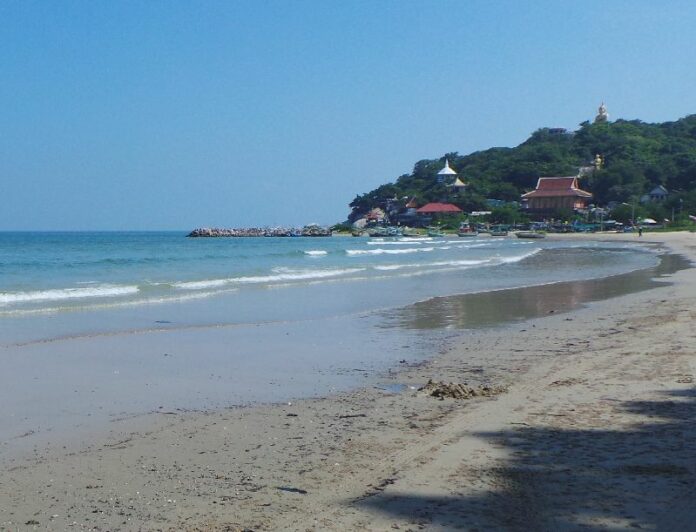
The post-cleanup beach this morning on the south side of Hua Hin.

HUA HIN — Seven days after an oil slick washed up on the beaches of Prachuap Kiri Khan province, authorities have yet to identify anyone behind the spill.

Gov. Thawee Narisirkul told reporters today officials are still working to find out who leaked the oil on Oct. 27, which blackened a number of beaches along 10 kilometers of coast, including the popular resort town of Hua Hin.

The governor said his office has already filed criminal charges against the unidentified ship, and officials are gathering evidence about the damage caused by the oil spill from local hotels, resorts and restaurants for further criminal and civil action. 

\

Workers clean up Hua Hin beach on Oct. 30, 2015

“This incident damaged the tourism sector,” Thawee said. “We have to take legal action to make an example in order to prevent this kind of incident from happening again in the future.”

Satellite images showed the 11sqm oil slick originated from a vessel or vessels near the mouths of the Mae Klong and Tha Chin rivers between Hua Hin and Bangkok. The images ruled out pipelines or platforms as the source but were too inconclusive to pin down which ship leaked the oil.

Local authorities responded by organizing a cleanup operation along the beach and declaring it open for business three days later. Thawee said today that while some tar remains on the shore, it poses no health hazard.

“It’s not dangerous,” Thawee said. “But it will stick to your body on contact, and it will be hard to wash it off.”

Pinsak Surasawadee, head of marine resources conservation, said his department is working with other agencies to determine the extent of ecological damage. Whether the effects will be long or short term depends on factors such as how fast the cleanup operation went, and where the oil slick hit, Pansak said.

“If the cleaning was fast, and if there’s no additional oil residue, within a few weeks it’ll be fine,” he said by telephone today. “The sea is also more dynamic than a mangrove forest. The latter is very vulnerable. If the oil covers it for too long, the plants will die.”

Asked whether it’s safe for humans to swim off Hua Hin,  Pinsak was circumspect.

“Speaking as a bureaucrat, of course I have to say it's safe, in order to raise confidence,” he said. “But speaking as a scientist, we need to measure it first, to be sure. … However, I believe that they have completely cleaned it in this case.”

A receptionist at Baan Kang Mung hotel on Hua Hin Beach told Khaosod English by telephone that none of the hotel guests expressed any concern about the recent oil leak.

Related news:

Lawsuit Threatened Over Hua Hin Oil Spill (Photos)


To reach us about this article or another matter, please contact us by e-mail at: [email protected].

Follow Khaosod English on and Twitter for news, politics and more from Thailand.

\

Advertisement

Ten Things that Suck About Bangkok Living

BANGKOK — While continuously voted to be the world’s top destination for tourists for 4 consecutive years, Bangkok ranked 102 out of 140 best cities to live in 2014.

As the only city in Thailand that people can elect their own Governor, Bangkok should be a role model of participatory local governance.

That was the non-profit research institute “Thailand Future Foundation” said when they revealed their new study about the City of God on Friday.

Here are 10 facts they believed can stimulate residents to push for changes against Bangkok Metropolitan Administration (BMA).

1. There are 37 units working toward the city’s traffic in the world’s ranked 8th traffic jam city.

While Ministry of Transport directed the routes of BTS Skytrains, operating concessions was given to private investors by BMA.

BMA Built and maintain all traffic lights, but it was practically controlled by traffic police.

2. We highly invested in the less used transports.

Safety, punctuation and convenience remain the familiar problems about public transportation.

City Hall’s solution – smart taxi stands and public bikes system, remain unused.


 3. Bangkok’s 3,200 unsworn municipal officers (tessakit) = 2 officers / 1 sq km

But what about the law enforcement?


4. The BMA spends 377 million baht annually on PR to publicize its campaigns.

That same amount of money could buy:

100 Bangkok Express Service spots

3,500 more street sweepers

half of the 778 million baht tax revenue the city collects for the 100,000 billboards officially permitted around the city


5. Expensive Bangkok lives push people to live in suburb. But the remoter they live, the more they have to pay for travel cost.

Land and condominium price in Bangkok increases 8 percent each year

Average wage in Bangkok increases 4 percent each year

Bangkok’s Skytrain fares is more expensive than

6. Bangkok’s has less than half the green space the BMA claims, because it counts traffic meridians, roadside trees and inaccessible private gardens.

7. BMA has 97,000 employees

2X more than Seoul

1.5X more than Jakarta

with the annual budget more than 80 billion baht

Isn’t it enough to work on the city’s problem?


8. 2 in 3 of students from schools under care of BMA failed international math test arranged by The Program for International Student Assessment (PISA).


9. Every BMA unit was evaluated “excellent performance” resulting in 2.3 billion baht bonus money.

66 out of 200 million baht training budget was used for study trip both in the country and abroad.  

\

A new complex of Bangkok city hall located in Din Daeng consists of a 37 floors building and a couple of 27 floors buildings. Photo : Arun Chaiseri Consulting Engineers


10. The construction per square metre of the new city hall office is higher than “MahaNakhon” skyscraper which is the tallest building in Thailand.

The 37 floors building located at Din Daeng is still not completed even it has been building for 20 years.
Advertisement

Cop Blames Rape of British Tourist on Bar’s Late Hours

Police Gen. Wutthi Phuawade spoke at news conference on Nov. 2, 2015

MAE HONG SON — A British tourist was raped in northern Thailand last week, and a deputy commander of the national police force said Monday it was because a bar stayed open too late.

The assault took place in the town of Pai in Mae Hong Son province in the early hours of Oct. 25, and a Chiang Mai man was arrested Friday in connection with the crime, according to deputy police chief Wutthi Phuawade, who said the suspect assaulted the victim after she left a bar.

“The main factor that led to the incident was because of an entertainment establishment that opened later than the time prescribed by law, which made the tourist become drunk and senseless,” Wutthi said at a news conference yesterday.

He said police would respond to the rape by more strictly enforcing operating hours in Pai, a popular tourist destination.

“Police in each jurisdiction will strictly inspect whether any entertainment establishment opens later than the legal closing time. They must strictly adhere to the closing time. If any jurisdiction allows any establishment to disobey the closing time, the officers in charge will be punished for negligence.”

Wutthi said the incident “has greatly damaged the image of Thailand.”

Police identified a 28-year-old man as the woman’s attacker and arrested him Friday. The man, Charnchai Inthiang, denied the rape allegation and insisted the sexual encounter was consensual, police said.

According to the police report, Charnchai approached the victim on motorcycle and offered her a ride to her hotel, but instead took her to a wooded area and sexually assaulted her. Charnchai has been charged with rape.

Officials in Thailand – which typically espouse conservative values – have often blamed sexual assaults on factors such as social vices and inappropriate dress.

In the wake of the September 2014 murder and rape of a British tourist in southern Thailand, junta chairman and Prime Minister Prayuth Chan-ocha suggested foreign women would be unsafe in Thailand if they wore bikinis – unless they were unattractive. 

The speech drew fury and mockery from foreign media, and Gen. Prayuth later apologized for the remark. 


To reach us about this article or another matter, please contact us by e-mail at: [email protected].

Follow Khaosod English on and Twitter for news, politics and more from Thailand.

\

Advertisement

Ball of Emerald Fire Ignites Night Sky (Video)

Still image from a dashcam video filmed last night of a meteoroid burning up in the atmosphere. Image: Saran Pol / YouTube

BANGKOK — It was difficult not to notice the night sky break from its usual form last night to flash in an eerie green glow.

Any questions of divine origin however were settled by the Thai Astronomical Society, who said the burst of light seen across Thailand at about 8:40pm was a meteor burning up in the atmosphere.

The fireball – the second to burn the sky in two months – soon set the internet ablaze with comments from witnesses in Bangkok, Ayutthaya, Nakhon Ratchasima, Chonburi and other parts of the country.


Dashcam footage of the meteoroid burning up in a green glow filmed in Bangkok. Video: Saran Pol / YouTube


\The internet was quick to offer its own explanations (right)

“The fall of the shooting star most likely has a negative effect,” Sorajja Nual-yu, who styles himself as the “Thai Nostradamus,” told Khaosod. “It may be connected to natural disaster or some persons. It may be about conflict.”

The astronomical society took a more sober view, writing online to assure the public it was just more stuff falling from space.

“The green light was presumably from chromium,” said astronomy professor Boonraksa Soonthorntham at a Monday night news conference. “But from the last update we received, there was no report of a meteor hitting the ground.”

It was the second such phenomenon to be widely witnessed since a flaming object streaked across the sky Sept. 7 during the daytime.

Related stories:

Flaming Meteor Falls Over Bangkok


Advertisement

'Snoopy' Honored on Hollywood Walk of Fame

The cartoon dog Snoopy, who joined the list of Hollywood legends with his own star on the city's Walk of Fame.  Photographer: Bernd Wüstneck/dpa

LOS ANGELES – Every dog has its day, and Monday was Snoopy's, as Charlie Brown's cartoon sidekick joined the list of Hollywood legends with his own star on the city's Walk of Fame.

In a tongue-in-cheek ceremony honoring the "world's best-known and most accomplished beagle," Hollywood Chamber of Commerce president Leron Gubler presented the Peanuts comic strip dog – represented by an actor in a human-sized Snoopy suit – with the 2,563rd named star embedded in the sidewalk along Hollywood Boulevard.

As the outsized alter ego and best friend to underdog hero Charlie Brown, Snoopy was "the original Joe Cool, a world-famous novelist, and a celebrated World War I Flying Ace," Gubler said.

"He's everything all of us should aspire to be," said film director Paul Feig at the mid-morning ceremony.

Snoopy's star is next to that of creator Charles M Schultz, whose Peanuts cartoon strip debuted in 1950 and went on to become one of the most beloved and influential comic strips of all time.

At the height of its success, Peanuts appeared daily in 75 countries, and commanded an audience of 355 million people.

Schultz died in 2000, but the franchise lives on. His son, Craig Schultz, directed the upcoming Peanuts feature film The Peanuts Movie, which is set to open in cinemas in the United States on Friday.

Snoopy may be the first beagle to get his own Walk of Fame star, but he's neither the first cartoon character nor the first dog.

The names of Mickey Mouse, Bugs Bunny and Donald Duck are forever inscribed in Hollywood's famous sidewalk, along with movie dogs Lassie and Rin Tin Tin.

Story: DPA


To reach us about this article or another matter, please contact us by e-mail at: [email protected].

Follow Khaosod English on and Twitter for news, politics and more from Thailand.
\

Advertisement

The Fate of Abe’s Japan

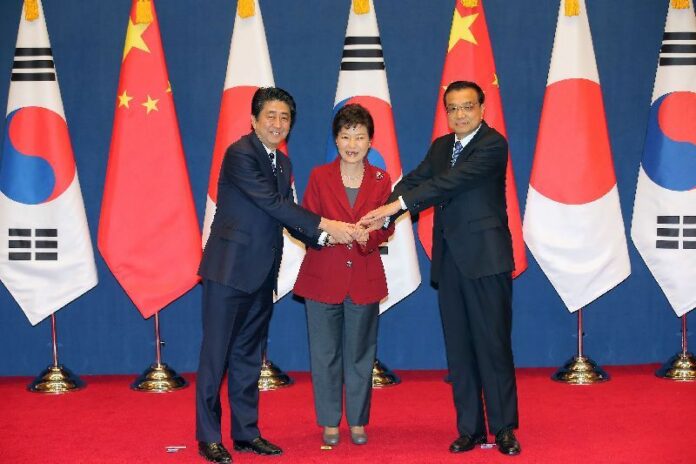
South Korean President Park Geun-Hye (C), Japanese Prime Minister Shinzo Abe (L) and Chinese Premier Li Keqiang (R) pose for a photo Nov. 1 ahead of a trilateral leadership summit at the presidential Blue House in Seoul. Photo: AFP

By Joseph S. Nye, Jr.
Project Syndicate

TOKYO – As Shinzo Abe sits down this week in Seoul with South Korean President Park Geun-hye and Chinese Premier Li Keqiang, he does so as the leader of a country that many people around the world now seriously underestimate. That dynamic certainly will be felt during the three Northeast Asian powers’ first summit since 2012.

Three decades ago, many erred in the opposite direction in their assessments of Japan. Many Americans feared being overtaken after Japanese per capita income surpassed that of the United States; Japanese manufacturing set the international standard; and some books even predicted an eventual war with a Japanese nuclear superpower. Such views extrapolated from Japan’s impressive postwar economic growth; today, after more than two decades of malaise, they simply remind us of the danger of linear projections.

That danger remains with us. In response to China’s rapid rise and the assertiveness of its Communist Party leadership, the current conventional wisdom portrays Japan as a country of secondary importance – which is equally mistaken.

Despite its economic slowdown, Japan retains impressive power resources. It is a democracy that has been at peace for 70 years, with a stable society and a high standard of living. Its per capita income is five times that of China, and Beijing residents can only envy Tokyo’s air quality and product safety standards. Its economy remains the world’s third largest overall, sustained by highly sophisticated industry.

While China has nuclear weapons and more soldiers, Japan’s military is better equipped in some areas (and obviously has the technological capacity to develop nuclear weapons very quickly). Moreover, Japan’s culture (both traditional and popular), overseas development assistance, and support of international institutions are impressive sources of soft power.

Yes, Japan faces severe demographic problems, with the population projected to shrink from 127 million to below 100 million by 2050. The current birth rate is 1.4 (well below the replacement rate of 2.1), and the Japanese are resistant to accepting large numbers of immigrants.

When Abe became Prime Minister almost three years ago, he vowed to restore Japan’s standing as a “first-tier country” by implementing an economic stimulus package, dubbed “Abenomics,” and reinterpreting Japan’s constitution to stiffen the country’s defense posture. But, whereas Abenomics was enacted quickly, the Diet enacted the defense legislation only recently – and after more than a year of effort.

Many in Abe’s Liberal Democratic Party would have preferred fundamental reform of Japan’s defense doctrine, by removing the constitution’s limits on the country’s armed forces. But public opinion and Abe’s coalition partner, Komeito, did not allow it.

Nonetheless, Japan’s interlocutors at the Seoul summit, China and South Korea, which suffered enormously from Japanese aggression in the last century, have protested loudly. Both are suspicious of Abe, who exacerbated tensions with nationalist rhetoric and a visit to the controversial Yasukuni Shrine early in his current administration. Indeed, Chinese President Xi Jinping has resisted meeting with Abe, as has Park, who will do so for the first time at the Seoul summit.

On the other hand, Abe has repaired the strained relations with the US that Japan had under his predecessors, and President Barack Obama reiterated the strength of the bilateral alliance during Abe’s state visit to the White House last April. Under the new defense guidelines, US and Japanese forces are able to plan and exercise more effectively, and the alliance is in its best condition in decades.

Abe has thus been relatively successful in terms of foreign and defense policy. But the situation on the economic front is more mixed. Inflation and unemployment are low, but growth is largely flat, and few experts I spoke with in Tokyo recently expect it to accelerate significantly.

The first two components (or “arrows”) of Abenomics – loose monetary and fiscal policies – helped to restore demand. But the third arrow of structural reform has remained in the quiver. Since his success in the Diet election last year, Abe has talked about liberalizing electricity markets, improving corporate governance, and undertaking tax reform. In addition, he hopes to use the recently concluded Trans-Pacific Partnership trade agreement to force reform of the inefficient agriculture sector.

One important constraint is labor supply. Abe has proposed relaxing visa conditions for expatriate workers; but immigration on a scale that would make a major economic difference is unlikely, given the homogeneity and insularity of Japan’s traditional culture. The difficulty of loosening limits on immigration will require Japan to mobilize its underused female human resources.

But that effort, too, must overcome formidable cultural obstacles. Abe has spoken frequently (including at the United Nations) about opportunities for women, and has called for women to make up 30% of Japan’s managers. But today they account for less than 10% of managers and about 1% of senior executives. The World Economic Forum’s index of gender inequality gives Japan a low rating. Government measures like family leave and more nurseries for working mothers can help, but traditional attitudes change slowly.

Unless it is addressed, the labor constraint implies that Japan will not reach its full potential economically – and thus in regional and global affairs as well. Japan is a successful, comfortable society, which has much to contribute to the world. The danger is that it is so comfortable that it will look inward and prove the conventional wisdom right.


Joseph S. Nye, Jr. is a professor at Harvard and author of Is the American Century Over?


Copyright: Project Syndicate, 2015.
www.project-syndicate.org


To reach us about this article or another matter, please contact us by e-mail at: [email protected].

Follow Khaosod English on and Twitter for news, politics and more from Thailand.

\

Advertisement

Radical Makeover of Chao Phraya River Delayed

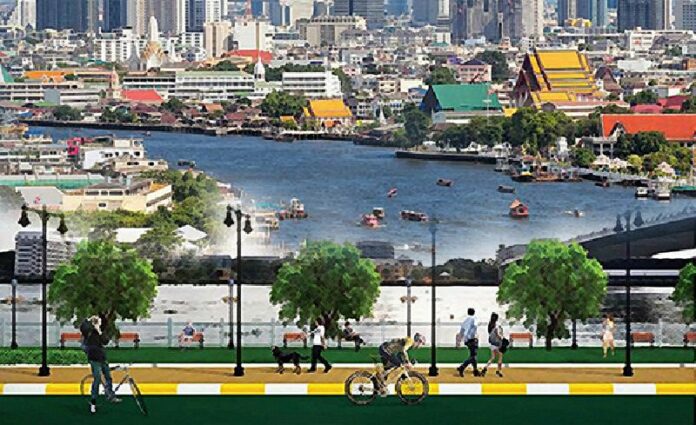
Fourteen kilometers of a concrete ‘promenade’ lining both sides of the mighty Chao Phraya river - to cost 14 billion baht - could prove a first phase of a larger 50-kilometer project proposed by the ruling junta. Photo: Matichon


BANGKOK — An ambitious and costly redevelopment project of the capital city’s greatest natural feature has been delayed after only one company was left in the running to get it started.

Two of the three consulting firms which had bid on the 14 billion-baht Chao Phraya river promenade dropped out since August, leaving only developer Panya Consultants Co. Ltd., said city official Pinit Lertudomthana, which means the project is on hold as the law requires a competitive bid, Daily News reported.

The contract, worth 120 million baht, was to consult for seven months on preparing a feasibility study of the 14-kilometer walkway spanning both sides of the river from the Pinklao to Rama VII bridges.

The winning firm would research how the project would impact the environment, city plan, waterflow and communities. It would also organize local hearings and conduct an environmental impact assessment before the project went for formal approval.

Should the Bangkok Metropolitan Administration reopen bidding, it will need to adjust the project to appeal to more firms, Pinit said.


On May 12, the military government approved the 14 billion-baht project to turn the banks of the Chao Phraya into a concrete promenade to be the “new landmark” of the country. The BMA claimed that apart from maximizing public land use, everyone would benefit when it became a recreation area, including a bike lane.

Panya Consultants has previously bid on flood control projects for Bangkok and were hired to prepare an environmental impact report for the controversial Dawei sea port in Myanmar.

The plan was soon harshly criticized both online and offline with more than 16,000 signatures on a petition opposing it. The cabinet was slammed for its fast passage of the deal without a well-rounded study or public consultation, raising questions about the deal’s transparency.

Friends of the River, the activist group which started the petition, said narrowing the river by adding the walkways and more development would affect water flow and the ecosystem. They believe the promenade will destroy both the river’s character and communities which have long settled there.

The BMA initially expected hire the consulting company in September to start construction, estimated to take 18 months, in June 2016.


Advertisement

‘Fake Cops’ Arrested for Extorting Pattaya Drug Users

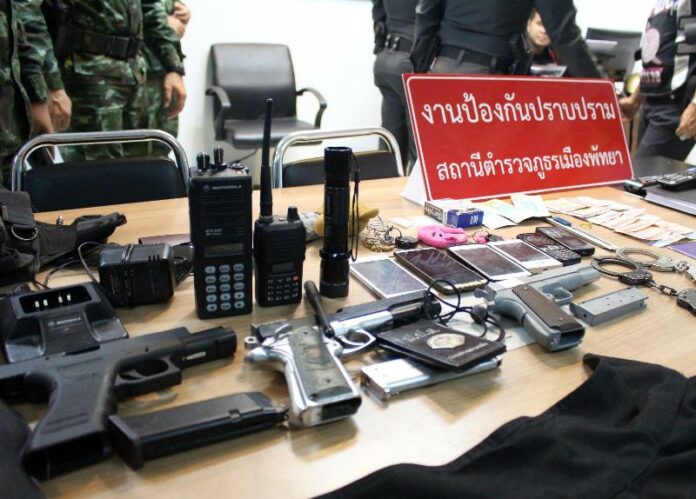
Fake guns and other evidence confiscated in the raid were displayed to reporters on Sunday night.

PATTAYA — Four people suspected of extorting ransom money from alleged drug users were arrested in the resort town of Pattaya, police said on Sunday night.

The four suspects are suspected of kidnapping and extorting an unknown number of victims for at least a month by posing as security forces, until a tip led officers to raid a hotel Sunday where they freed five hostages, said Lt. Col. Pawatchai Sudsakhon of the Pattaya City Police Station last night.

Pawatchai said the group – three men and one woman – would enter homes of people “involved in narcotics” and identify themselves as soldiers, police and anti-narcotics agents. 

“After that, they would take the victims to a safe house and test their urine,” Pawatchai said. “Then they would extort the victims of money in exchange for their freedom. If the victims didn’t have money, they would assault them and detain them.”

Police named the four as Somporn Klangnak, 29; Manop Thongchai, 33; Ratchata Abkornburi, 20; and Karuna Pramloi, 31. They have been charged with extortion. Pawatchai said police are still looking for the suspected ringleader, a man called Sarayuth Jehmad.

The five hostages freed Sunday also face charges.

Police were alerted to the gang when a woman complained to a local army unit that her daughter was being held in a hotel room by the suspects, Pawatchai said. Upon receiving word from the military, police reportedly raided the room and arrested the four suspects. Five hostages were also found at the room. 

Pawatchai said witnesses told police the suspects were seen bringing strangers to the hotel room for at least a month.

“If anyone has fallen victim, they can file charge against [the suspects],” Pawatchai said.

The five rescued hostages face drug charges because they tested positive for drugs, he added.


To reach us about this article or another matter, please contact us by e-mail at: [email protected].

Follow Khaosod English on and Twitter for news, politics and more from Thailand.

\

Advertisement

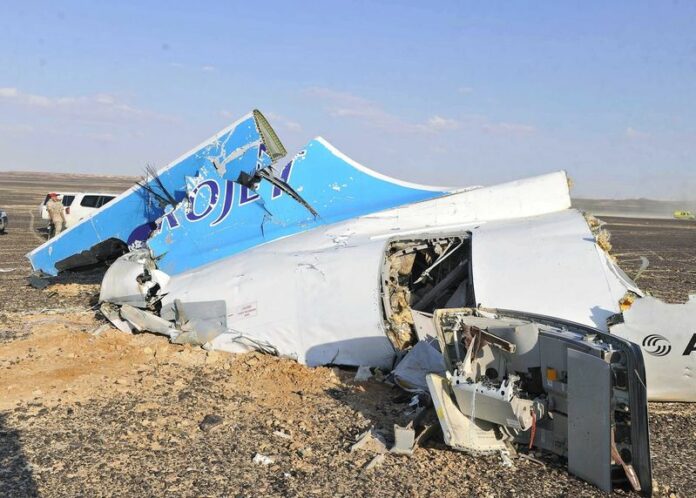
'Impact' Most Likely Caused Russian Plane Crash, Airline Says

Debris from the crashed Russian passenger jet lies strewn Saturday across the sand in Sinai, Egypt. Photo: EPA

MOSCOW — The Russian airline whose plane crashed in Egypt over the weekend said today the disaster was most likely caused by an external "impact."

"The only plausible reason can be a mechanical impact on the plane," the deputy general director of Kogalymavia, a small airline that operates flights under the name Metrojet, told a press conference.

"There is no combination of system failures that could cause the plane to be destroyed in the air," Alexander Smirnov said, according to the Interfax news agency.

Saturday's crash, in Egypt's Sinai Peninsula, was the deadliest in Russian history, with 224 people killed.

The crash happened about 20 minutes after flight 9268 took off on an early morning flight from the popular resort town of Sharm al-Sheikh to Russia's second largest city, St. Petersburg.

Almost all of the victims were Russian, authorities said. There were no survivors.

The plane was an 18-year-old, twin-engine Airbus A321-200, which seats up to 240 passengers, the French manufacturer said in a statement.

In 2011 a Kogalymavia airliner's fuel tank blew up after an engine fire started while the plane, a Russian-made Tu-154, was at an airport in the Siberian city of Surgut.

Story: DPA

Advertisement

Rags to Riches: The Story of Thailand’s First MMA Champ

Dejdamrong Sor Amnuaysirichoke. Photo: Reuters / Global MMA News

The first time Dejdamrong Sor Amnuaysirichoke fought, he was paid just 70 Baht (about USD$2). It doesn’™t sound like much, but to a 10-year-old boy growing up in rural Thailand, it felt like a fortune.

As a ONE Championship title holder his fight purses can now be measured by the tens of thousands of dollars, and it has been a remarkable journey for the 37-year-old.

In Muay Thai, a fighter is generally thought to be staring retirement in the face once they reach 30. Dejdamrong probably thought his fighting days were well behind him when he accepted an offer to come and coach at Evolve MMA in Singapore midway through 2013.

As a veteran of over 300 fights who had won titles in two divisions at the famous Lumpinee Stadium, his services as a trainer are highly sought after. Dejdamrong travelled to Singapore with the sole intention of sharing the knowledge he had acquired after decades of Muay Thai, but fate would conspire to give his fighting career a new lease of life.

\

\

After some time in Singapore, the Trang native was used to seeing Evolve MMA’™s Brazilian Jiu Jitsu, or BJJ, black belts instructing students in the art of grappling and submission fighting. It was completely different from the Muay Thai skills he had spent most of his life mastering but Dejdamrong was intrigued and asked if he could participate in a class.

He took to BJJ like the proverbial duck to water and within four months of taking his first BJJ class, he was stepping inside the cage to compete in mixed martial arts (MMA). At the age of 35, Dejdamrong was a late-starter, but he was determined to make up for lost time.

“It is very different from Muay Thai but there are some similarities. I think I am lucky because I was learning from BJJ black belts every day at Evolve MMA, they have so much experience and when your coaches are so skilled, it is easy to learn quickly,” Dejdamrong said.

Dejdamrong would go on to win his first four fights competing in ONE Championship’s 125lbs division and remarkably he won two of them by submission. In the space of a few months the Thai had gone from being a complete novice on the ground to establishing himself as a mixed martial artist with no obvious weaknesses.

In May 2015, Dejdamrong was rewarded for putting together a 4-0 record with a ONE Championship title shot. Seldom in history can a fighter make such a fast start to a professional MMA career and the Thai believes that the credit should go to his trainers and training partners.

“œEvolve MMA is the best place in the world to train because there are champions in wrestling, boxing, BJJ and MMA as well as Muay Thai. We all help each other, so I can share my knowledge of Muay Thai with the other fighters while they share their knowledge of BJJ or wrestling with me. It is like a university for martial artists, because everyone is always learning,” he said.

Dejdamrong never attended an actual university, as he was too busy training every day to pursue his Muay Thai dreams. But he is now one of the most respected martial arts trainers in Singapore as well as the first Thai fighter to ever win a ONE Championship title. He’s also been the subject of numerous magazine and newspaper articles in Thailand and is singlehandedly helping to raise awareness of the sport there.

Dejdamrong’s life story serves as an ongoing refute to the old adage that “˜you can’™t teach an old dog new tricks.” He is changing perceptions as to what is possible for a fighter in his late 30s to achieve and will need to continue doing so because a monumental challenge awaits him on Nov. 13.

That is the date Dejdamrong will face 23-year-old Brazilian Shooto champion Yago Bryan at ONE: Pride of Lions. The fight is set for the Singapore Indoor Stadium and is being talked about as the biggest 115lbs title bout in the history of Asian MMA. It will be the toughest test of his ONE Championship career to date but the Thai believes his experience will be key.

“œI have the best trainers and training partners at Evolve MMA so I am very well prepared and I have fought for big titles in Muay Thai many times before. He might be 15 years younger than me but that means I have much more experience than him and I am determined to defend my title.”

\

\

Story: Reuters

Advertisement

Hot News

LATEST NEWS

Bangkok
overcast clouds
35.5 ° C
35.5 °
35.5 °
50 %
4.6kmh
98 %
Sat
35 °
Sun
32 °
Mon
31 °
Tue
30 °
Wed
29 °