
























27.2 C
Bangkok
Saturday, July 25, 2026
Home Blog Page 2938

Billions of Baht Later, Doubts Persist About Bangkok CCTV

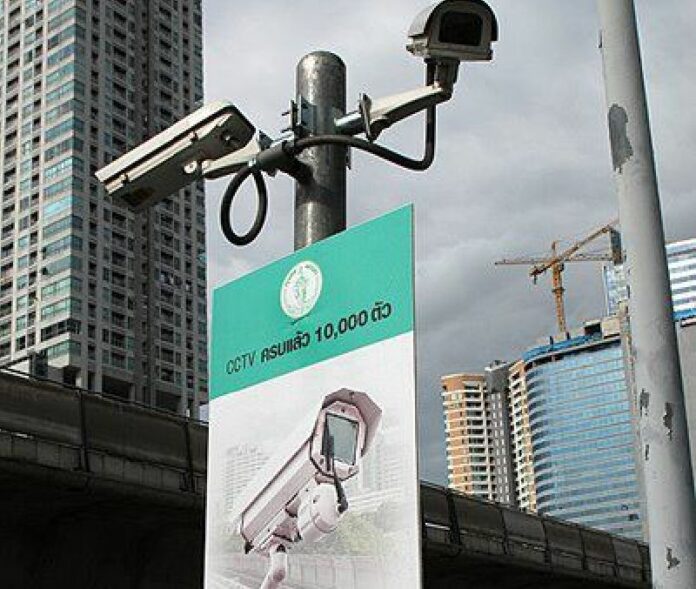
A sign below a Bangkok security camera in 2011 announces that 10,000 CCTV cameras had been installed. Photo: Pantip

BANGKOK — When Miruntee Katethip went to city hall and asked to see security camera footage of the day her house in western Bangkok was robbed this past March, she was told only five of 26 cameras in the area worked correctly.

When police turned to city-operated CCTVs for leads in August after the greatest apparent act of terrorism in modern Thai history, the police chief said 15 of 20 along the suspected bomber’s escape route were broken.

While law enforcement has become more reliant than ever on such systems – running the tapes being the starting point of many investigations – doubts about the capital city’s network of cameras persist, four years after the embarrassing discovery that hundreds were just empty shells.

“As we all have seen from the Ratchaprasong bombing case, the police themselves said that no useful footage was received from Bangkok’s CCTVs”, said police Cpt. Jomdet Trimek, a lecturer of Criminology and Criminal Justice Administration at Rangsit University.

Jomdet said Bangkok’s implementation of a closed-circuit television system has been a failure and made law enforcement, already notorious for its inefficiency, even worse.

A month before a powerful bomb killed 20 people, mostly tourists, at the Erawan Shrine on Aug. 17, Jomdet had concluded in his second study on the issue that the public felt no safer than they did in 2010, despite the number of CCTVs increasing to 50,000 from 20,000. The reason? Most people assume they are either fake or broken.

The effectiveness of security cameras in reducing crime remains an unsettled debate.

However, Jomdet’s study found people in the capital said they would feel safer if they knew the cameras worked.

Feuding and friction over the issue between the police and city officials has not boosted public confidence.


\

The 2011 discovery of this fake security camera, the details of which were posted online to the popular Pantip forum, resulted in the admission that upward of 500 such fake cameras had been installed in Bangkok


Following the Aug. 24 accusation from former police chief Somyot Pumpanmuang that three in four city cameras were broken along the route taken by the suspected shrine bomber, city officials shot back a testy response complaining, of all things, that police had never “thanked” the city for access to its system.

Although Somyot was referring to a street leading away from the scene of the blast, an adviser to Bangkok’s governor said city hall found only four broken cameras of the 107 located at the intersection where the shrine is located.

The Bangkok Metropolitan Administration conceded that for every one camera in the area, there were four privately owned cameras, such as those operated by businesses or hotels.

It also became clear during the bombing investigation that a number of BMA-operated cameras recorded very low quality images compared to the high-definition cameras used in the private sector. But it would be impractical for the city to operate so many streaming, high-definition cameras, Rangsit University professor Jomdet said.

The issue spilled into the news again earlier this month when a former MP of the Democrat Party raised the issue.

“The BMA has a policy to install 100,000 cameras overall by 2019, spending more than 40 billion baht,” Watchara Phetthong said. “Now after installing 50,000 cameras, they already have a problem.”

Watchara called for party leader Abhisit Vejjajiva to remove from his post Bangkok deputy governor Amorn Kitchawengkul, who is in charge of the BMA program.

Whether for the sake of public interest or internal politics, Watchara pushed the issue using the case of Miruntee – the woman whose home was burgled – to illustrate the failure of Bangkok’s expensive surveillance system. Miruntee herself demanded the BMA be held responsible to the tune of 3.4 million baht for her lost property.

Since 2011, the BMA has reportedly spent 3.6 billion baht on camera systems.

Responding Wednesday, Gov. Sukhumbhand Paribatra, also of the Democrat Party, said city hall welcomes inspection of its system and said another 10,000 cameras would be installed within a year.

Professor Jomdet said while politicians wrangle over the issue, he wants to continue his study every five years until enough cameras and control rooms using reliable equipment have been installed, as he believes it will make the city safer.

“About the same size as Bangkok, London has 400,000 cameras,” he said. “If you’ve committed to using the camera surveillance system then you need to invest in it. But it will be a waste of money if you can’t build the trust.”
 

Advertisement

Hardline Buddhist Nationalism Divides Myanmar Communities

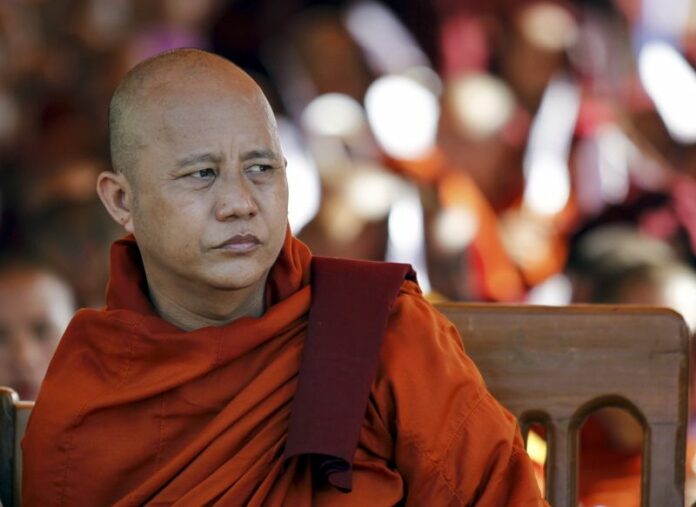
Hardliner Buddhist Monk Wirathu, 47, has been accused of leading calls to persecute Muslims in Myanmar, whom he refers to as 'the enemy.' Photo: EPA / Hein Htet

YANGON — At least once a week in the offices of a weekly newspaper in Yangon, editors engage in a spirited debate about the future of Buddhism in Myanmar.

They always intend to discuss it peacefully, but it often turns into a heated altercation between supporters and opponents of the Committee for the Protection of Nationality and Religion – a hardline Buddhist group led by radical monks.

"I can't understand why some people don't like Ma Ba Tha, which is working just to protect Buddhism here. They are not attacking Muslims or followers of other religions," said 30-year-old designer Zaw Win Maung, using the organization's Burmese acronym. He also works as a volunteer for the group.

"We must protect our religion and country from Islamization with new religious laws," he said.

The organization grew out of an earlier movement known as 969, led by intolerant monks to boycott Muslim-owned businesses and services.

With millions of supporters across Buddhist-majority Myanmar, Ma Ba Tha pressured the government to enact a package of controversial religious laws in July that forbid interfaith marriages, prohibit Buddhist women from changing their religion, restrict the number of children that designated groups can bear, and outlaw polygamy.

The organization now seems poised to became a mainstream political force ahead of the general elections scheduled for Nov. 8.

"We just want to see more and more parliamentarians who work hard to protect Buddhism," said Wirathu, a flamboyant monk who founded the movement, and who is leading door-to-door lobbying campaigns.

Ma Ba Tha's voter education program is different from others.

"We just want parliamentarians who are interested in protecting race and religion no matter what," Wirathu said. "We remind the public to choose candidates wisely."

Ma Ba Tha urges voters to favor avowedly Buddhist candidates who pledge to uphold and protect the new religious laws. They also must support the 1982 Citizenship Act, which openly discriminates against ethnic minority Rohingya Muslims.

Although the 2008 constitution drafted by the former military junta prohibits the use of religion in politics, hardline monks of Ma Ba Tha insist that it should depend on the situation.

"We don't want a party that doesn't care about race and religion to take power," Wirathu said.

"I fully support President Thein Sein for a second term, as he supports us to protect our race and religion," he said. 

Wirathu, 46, relishes his notoriety and actively courts controversy. He regularly uses uncharacteristically vulgar speech for a monk, and served eight years in prison for inciting religious violence before being released in 2011 under a general amnesty.

He has been called a "Buddhist bin Laden," but prefers to compare himself to James Bond.

In celebrations across the country for the enactment of the race and religious protection laws, leading Ma Ba Tha monks warned supporters to vote for the army-dominated Union Solidarity and Development Party (USDP) currently in power.

They also accused the main opposition of failing to protect the religious majority.

Leaflets were distributed, proclaiming: "If the NLD (National League for Democracy) wins the election and leads the cabinet, Buddhism will disappear shortly."

But not all Buddhist monks support the anti-NLD and anti-Muslim sentiment.

Last month, two monasteries in Mandalay, the nation's second-largest city, publicly denounced the Ma Ba Tha movement and said that monk Wirathu does not represent the monasteries, even though he is a senior figure in the Mandalay monkhood.

Other Buddhist associations including government-backed State Sangha Maha Nayaka Committee, the country's highest religious authority, have never voiced their support for the radical organization.

"Ma Ba Tha monks should carefully think about the impact of what they are doing in society, especially on the ethnic minorities that follow different religions. Our society has already split up because of civil war," said well-known Buddhist monk Pyinna Thiha.

"Nationalism makes society split deeper. It even divides monk associations, especially between Ma Ba Tha monks and pro-democracy monks," he said. 

Meanwhile, the USDP and its allies have campaigned on the importance of safeguarding race and religion. 

"Don't listen to someone who married a Kalar (South Asian), Hindu, Muslim, Negro or English and then says how much she loves her country," Agriculture Minister Myint Hlaing said on the campaign trail earlier this month. 

His remarks were widely regarded as a smear against popular opposition leader Aung San Suu Kyi, who married a British citizen.

The minister also warned that Myanmar would be turned into a Muslim country if the NLD wins the election.

"They don't care about you. They will not protect Buddhism as the party is full of Muslims," he said, according to the Myanmar Times.

Suu Kyi, in an interview with India Today TV channel, expressed concern over the increasing anti-Muslim sentiment and the use of religion for political ends, calling them "very worrying signs of religious intolerance which we did not have in this country before."

Even her own party excluded more than a dozen Muslim candidates from the NLD's list for November in order to placate Buddhist hardliners.

"Ma Ba Tha is creating a worse epidemic for the country," said Pyinna Thiha. "Unfortunately, no one seems to be able to stop them."

Story: DPA / Kyaw Lynn

Advertisement

Two Chinese Diplomats Shot to Death in Philippines

Two Chinese diplomats were shot and killed Wednesday in the Philippines. Photo: EPA / Jay Rommel Labra

MANILA — Two Chinese diplomats were killed and another wounded Wednesday in a shooting allegedly perpetrated by the husband of another embassy official in the Philippines, police said.

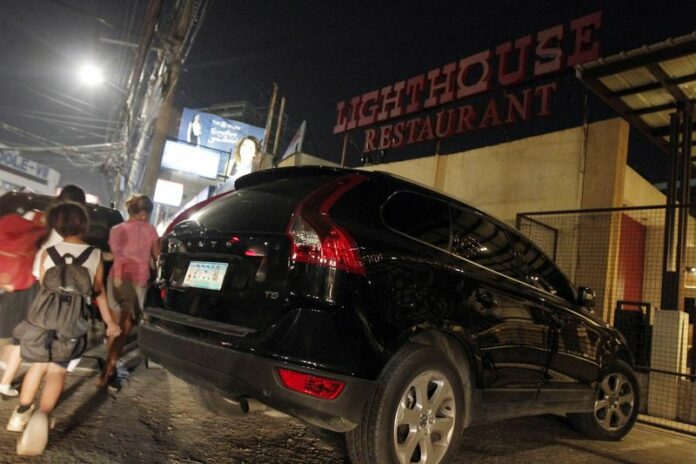
The victims and the suspect were inside a restaurant in Cebu City, 571 kilometers south of Manila, when the incident happened, according to Chief Superintendent Tom Banas a regional police director.

Initial investigation showed that Li Qing Liang, 60, husband of Chinese consul Gou Jing, 57, opened fire at Chinese Deputy Consul Sun Shan, finance officer Hui Li and Chinese Consul General Song Rong Hua inside the restaurant.

Sun and Hui were declared dead on arrival at a nearby hospital, while Song was wounded and in critical condition, Banas said.

Police were still determining the motive for the shooting, Banas said. He added that Li and Gou were taken into custody for investigation.

Advertisement

Indonesia to Use Chemical Castration to Punish Child Sex Offenders

Children. Photo: DPA / Julian Stratenschulte

JAKARTA — Child rights activists on Wednesday welcomed the Indonesian government's plans to use chemical castration as additional punishment for child sex offenders.

President Joko Widodo on Tuesday voiced approval for a law that provides for chemical castration for convicted paedophiles, the Cabinet Secretariat website said.

The chairman of the National Commission on Child Protection, Arist Merdeka Sirait, welcomed the proposal.

"Indonesia is facing a child abuse emergency," Sirait said.

"Child sexual abuse cases have been steadily increasing while our children have no proper protection," he said.

Government data show that child abuse cases had jumped from 2,178 cases in 2011 to 5,066 cases in 2014.

Social Affairs Minister Khofifah Indar Parawansa said the president supported castration as a form of punishment in addition to jail terms for child sex offenders, according to the Cabinet Secretariat.

She added that the president planned to issue a regulation containing such provisions.

Attorney General Muhammad Prasetyo said chemical castration could involve injecting a female hormone to reduce the sex drive of the offender.

Under the 2002 Child Protection Law, child sex offences are punishable by up to 15 years in prison and a maximum fine of 300 million rupiah (777,000 baht).

Story: DPA

Advertisement

Famous Astrologer Among Accused ‘Royal Imposters’

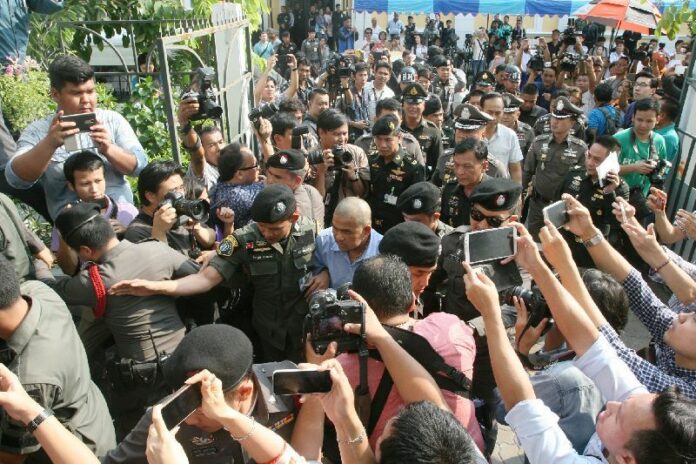
Police escort Suriyan Sujaritpalawong (in blue shirt) to the martial court in Bangkok today.

BANGKOK — A well-known astrologer and close aide to Thailand’s Crown Prince is among three suspects brought to a martial court today to be charged with insulting the monarchy.

Suriyan Sujaritpalawong and two other men, Jirawong Watanathewasilp and Police Maj. Prakrom Warunprapha, are accused by police of flaunting ties to the monarchy for personal gain. They have been charged under Section 112 of the Thai Penal Code, a law also known as lese majeste, which outlaws any action or remark that damages the reputation of the Royal Family. 

Police began the investigation on Friday, and the case came to light Sunday when it was announced by police officials. The identities of the three men were withheld until today, when police presented them in court to ask the military judges to remand them in prison while they face trial. The request is expected to be granted.

Related story: Police Announce Investigation of ‘Royal Imposters’

The three men arrived in police vehicles at the court this afternoon and were immediately taken into the building, wading through crowds of reporters and flanked by police officers. They did not speak to the press. Since the 2014 coup d’etat, military tribunals have overseen lese majeste cases and other offenses affecting ‘national security.”

Suriyan’s arrest came as some surprise, as he had been a close aide to Crown Prince Vajiralongkorn for at least eight years. Suriyan’s surname, Sujaritpalawong, was personally bestowed by Crown Prince Vajiralongkorn in 2008. 

He recently organized August’s “Bike for Mom” cycling event held to honor Her Majesty the Queen for her birthday. Suriyan, who doubles as a professional astrologer, also occasionally published candid photos showing a human dimension of the Crown Prince and his family on social media.

Late last month, Suriyan said he was involved in planning Bike for Mom’s sequel– Bike for Dad – to be held in December.

Jirawong was Suriyan’s secretary. Prakrom was a high-ranking police officer at the Technology Crime Suppression Division.

\

Police officers escort Police Maj. Prakrom Warunprapha (in black) to the martial court in Bangkok today

Police provided little information about the allegations against the three men. Although Police Lt. Gen. Sriwarah Rangsipramnakul, who was chosen to head the investigation, said Wednesday all three men had confessed to the charges, a police news released later stated only Suriyan had confessed while the other two denied the allegations.

Sriwarah said police will expedite legal proceedings against the men.

“As for evidence and behavior that implicate their wrongdoing, they are in the case file. I cannot disclose them right now,” Sriwarah told reporters.

Asked how long the suspects have been falsely abusing their ties to the monarchy, Sriwarah replied, “It’s been some time. More than one or two months.”

He did not rule out possibility of more arrests in the coming days.

“Whether there will be more than three or not depends on the evidence. I cannot answer anything about that right now,” he said. “If the evidence implicates anyone else, they will be prosecuted in accordance with the law.”

Open discussion about the Royal Family is considered taboo in Thailand; legal cases involving the monarchy and lese majeste offenses are often shrouded in secrecy.

Junta chairman and Prime Minister Prayuth Chan-ocha himself urged the media yesterday to refrain from giving “too much coverage” to the ongoing investigation.

“Don’t get involved in it too much, this issue about 112. I don’t want too much coverage about it,” Gen. Prayuth said. “They are contesting the charges. Are they guilty? Did they really flaunt the connection? Look at those things.”

He also lashed out at unidentified individuals he said continue to damage the royal family’s reputation.

“I don’t get what’s wrong with these people. What has the monarchy done to them? I don’t understand. They like to destroy what we have, destroy the beautiful history of the country, just so it will lead to democracy?” Prayuth said.

Clarification: Although police Lt. Gen. Sriwarah Rangsipramnakul said Wednesday that all three suspects had confessed to the charges, a police news release issued after Sriwarah's news conference indicated only Suriyan had confessed, while two other suspects denied the allegation. This story has been updated to reflect that.


To reach us about this article or another matter, please contact us by e-mail at: [email protected].

Follow Khaosod English on and Twitter for news, politics and more from Thailand.

\

Advertisement

Famous Astrologer Among Accused ‘Royal Imposters’

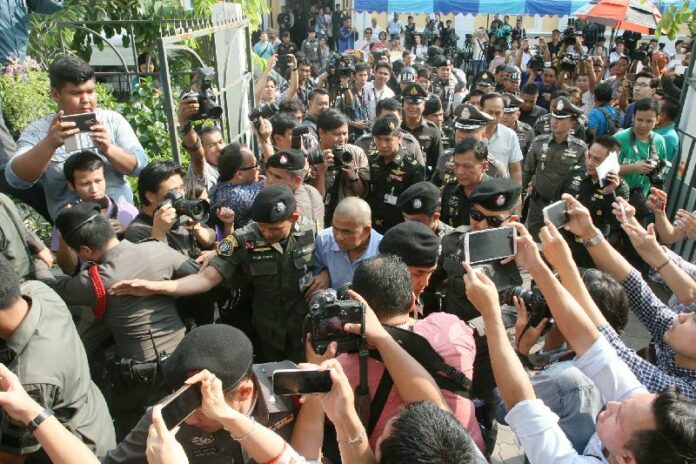
Police escort Suriyan Sujaritpalawong (in blue shirt) to the martial court in Bangkok today.

BANGKOK — A well-known astrologer and close aide to Thailand’s Crown Prince is among three suspects brought to a martial court today to be charged with insulting the monarchy.

Suriyan Sujaritpalawong and two other men, Jirawong Watanathewasilp and Police Maj. Prakrom Warunprapha, are accused by police of flaunting ties to the monarchy for personal gain. They have been charged under Section 112 of the Thai Penal Code, a law also known as lese majeste, which outlaws any action or remark that damages the reputation of the Royal Family.

Police began the investigation on Friday, and the case came to light Sunday when it was announced by police officials. The identities of the three men were withheld until today, when police presented them in court to ask the military judges to remand them in prison while they face trial. The request is expected to be granted.

Read: Police Announce Investigation of ‘Royal Imposters’

The three men arrived in police vehicles at the court this afternoon and were immediately taken into the building, wading through crowds of reporters and flanked by police officers. They did not speak to the press. Since the 2014 coup d’etat, military tribunals have overseen lese majeste cases and other offenses affecting ‘national security.”

Suriyan’s arrest came as some surprise, as he had been a close aide to Crown Prince Vajiralongkorn for at least eight years. Suriyan’s surname, Sujaritpalawong, was personally bestowed by Crown Prince Vajiralongkorn in 2008.

He recently organized August’s “Bike for Mom” cycling event held to honor Her Majesty the Queen for her birthday. Suriyan, who doubles as a professional astrologer, also occasionally published candid photos showing a human dimension of the Crown Prince and his family on social media.

Late last month, Suriyan said he was involved in planning Bike for Mom’s sequel – Bike for Dad – to be held in December.

Jirawong was Suriyan’s secretary. Prakrom was a high-ranking police officer at the Technology Crime Suppression Division.

\
Police officers escort Police Maj. Prakrom Warunprapha (in black) to the martial court in Bangkok today.

Police provided little information about the allegations against the three men. Although Police Lt. Gen. Sriwarah Rangsipramnakul, who was chosen to head the investigation, said Wednesday all three men had confessed to the charges, a police news released later stated only Suriyan had confessed while the other two denied the allegations.

Sriwarah said police will expedite legal proceedings against the men.

“As for evidence and behavior that implicate their wrongdoing, they are in the case file. I cannot disclose them right now,” Sriwarah told reporters.

Asked how long the suspects have been falsely abusing their ties to the monarchy, Sriwarah replied, “It’s been some time. More than one or two months.”

He did not rule out possibility of more arrests in the coming days.

“Whether there will be more than three or not depends on the evidence. I cannot answer anything about that right now,” he said. “If the evidence implicates anyone else, they will be prosecuted in accordance with the law.”

Open discussion about the Royal Family is considered taboo in Thailand; legal cases involving the monarchy and lese majeste offenses are often shrouded in secrecy.

Junta chairman and Prime Minister Prayuth Chan-ocha himself urged the media yesterday to refrain from giving “too much coverage” to the ongoing investigation.

“Don’t get involved in it too much, this issue about 112. I don’t want too much coverage about it,” Gen. Prayuth said. “They are contesting the charges. Are they guilty? Did they really flaunt the connection? Look at those things.”

He also lashed out at unidentified individuals he said continue to damage the royal family’s reputation.

“I don’t get what’s wrong with these people. What has the monarchy done to them? I don’t understand. They like to destroy what we have, destroy the beautiful history of the country, just so it will lead to democracy?” Prayuth said.

Clarification: Although police Lt. Gen. Sriwarah Rangsipramnakul said Wednesday that all three suspects had confessed to the charges, a police news release issued after Sriwarah’s news conference indicated only Suriyan had confessed, while two other suspects denied the allegation. This story has been updated to reflect that.


Advertisement

‘Finland Plot’ Columnist Convicted of Libeling Thaksin

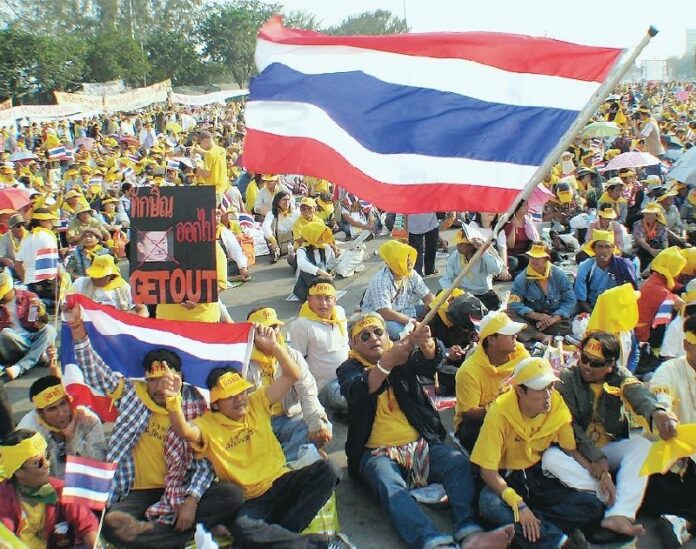
A Feb. 4, 2006, file photo of Yellowshirt protest in Bangkok.

BANGKOK — The Supreme Court today found a Yellowshirt columnist guilty of libel for alleging in 2006 that then-Prime Minister Thaksin Shinawatra supported an anti-monarchy movement.

Pramote Nakhonthap was handed a suspended two-year jail term for a 2006 article he wrote for Manager Daily in which he said Thaksin’s government collaborated with unnamed anti-monarchy activists in a bid to turn the Royal Family into “a mere symbolic institution.”

“There was never any plot,” Noppadol Patama, a Thaksin aide said today in a statement after the verdict. “This is a moral lesson that in politics, regardless of whether we like someone or not, we should only speak the truth to each other. From now on, defaming each other with false information should stop, because society doesn’t gain anything.”

Noppadol urged all sides to respect the court’s ruling. Responding to the verdict this afternoon, Pramote said he accepted the court’s verdict but would be undeterred in his writing.

The original case stemmed from a May 2006 article by Pramote titled “The Finland Strategy: A Plot to Change Thailand’s Ruling System,” referring to a conspiracy theory first circulated among Yellowshirt supporters in 2005 which alleged Thaksin and his Thai Rak Thai Party secretly pledged at a meeting in Finland to overthrow Thailand’s monarchy.

Read more: Who are the Yellowshirts

“Thaksin’s strategy and Thaksin’s regime have already started; they have already taken shape,” Pramote wrote. “If this continues unchallenged, it will be completed, and we will no longer have a monarch and democracy that we desire.”

In response to the article, Thaksin filed a libel suit naming Pramote and four other Manager Media Group staff members as defendants. The courts acquitted the four others. In 2009, Pramote was found guilty in the Criminal Court, a decision reaffirmed by the Court of Appeals in 2013. He subsequently appealed to the Supreme Court.

But today the Supreme Court dismissed Pramote’s appeal and reaffirmed the lower courts’ rulings, which sentenced him to one year in prison. Pramote has served no jail time in the matter and the sentence today was suspended for two years. 

Pramote’s article was published at the height of protests against Thaksin organized by the Yellowshirts, a coalition of middle-class urbanites, wealthy businesspeople and traditional elites dedicated to removing Thaksin and his influence from Thai politics. 

Thaksin, who won elections by wide margins in 2001 and 2005, is viewed by his supporters as a champion of the rural poor. The Yellowshirts see him as a corrupt autocrat who also sought to overthrow the monarchy. 

The Royal Family is widely revered, and any remark or action deemed libelous toward the monarchy is both a taboo and criminal offense, punishable by up to 15 years in prison.

When the military seized power from Thaksin in September 2006, it cited lese majeste (insult of the monarchy) as one of alleged crimes committed by his administration. 

Thaksin is currently living in self-imposed exile to avoid a 2008 corruption conviction handed down in absentia. However, despite his exile, he continues to wield his political influence via his proxies and political allies, such as sister Yingluck Shinawatra, who served as prime minister from 2011 to 2014. 

Yellowshirt Leader Acquitted

The same court today acquitted Yellowshirt leader and Manager Daily founder Sondhi Limthongkul in a separate libel case brought by Thaksin.

That suit stemmed from a 2006 speech given by Sondhi at a Yellowshirt rally accusing Thaksin of buying support from voters and dabbling in “superstition.” 

\

Sondhi Limthongkul (left) and his deputy, Sarocha Pornudomsak (right), at a Yellowshirt rally in Bangkok on Feb 4, 2006.

Two lower courts found Sondhi guilty of defaming Thaksin, but today the Supreme Court overturned those rulings and acquitted Sondhi on the grounds that Thaksin was a public figure open to criticism by members of the public. 

Sondhi was a co-founder of Yellowshirt umbrella organization the People’s Alliance for Democracy, and led protests against Thaksin in 2005. His former media corporation covered the protests extensively.  

Sondhi has kept a low profile in recent years. 

Related news:

Accusing Thaksin of Republicanism Not A Crime, Court Rules

Thaksin's Lawyer Denounces Lese Majeste Allegation


To reach us about this article or another matter, please contact us by e-mail at: [email protected].

Follow Khaosod English on and Twitter for news, politics and more from Thailand.

\

Advertisement

First Chapter of ‘Cyber War’ to Begin Thursday

Speaking at Government House yesterday, junta chairman Prayuth Chan-ocha said taking control of the internet by implementing a single gateway system was necessary to end defamation of his government online.

BANGKOK — Online activists have announced they will launch attacks against the government beginning Thursday after the prime minister said the project to route all internet traffic through a single point of control is still alive.

The coalition of anonymous internet users known as Citizens Against Single Gateway last night warned private sector operations with IT systems linked to government servers to transfer them to safe places before the assault on government systems begins at 10am on Thursday.

Those behind a crippling attack earlier this month, the Thailand F5 Cyber Army, issued the announcement yesterday after Prime Minister and junta chairman Prayuth Chan-ocha said agencies are still studying the project, and a widely circulated army intelligence report detailed efforts to monitor news sites, social media and “influential thinkers” threatening the nation.

“What important is your moral trait. …You always need freedom but ask for security and respect of human rights, but how can that be possible?” Gen. Prayuth said. “No, it isn’t. Because everyone is self-centered and always blames the law but never blame themselves.”


Internet Activists Declare ‘Cyber War’ on Junta


Although the government had earlier responded to the public uproar by playing down its goal of building a single gateway for all internet traffic – instead of the current 10 – Prayuth said there’s no other way to stop people from attacking his government.

“If you say we should not have the single gateway, can you prevent your group from writing things that defame the nation and government? If you can’t, then don’t tell me what method should be used.”

Just last week, the Minister of Information and Communication Technology said at an economic forum the plan had been scrapped, with the government focused on moving forward with developing its digital economy policies.

“If a single gateway means we only have one door or one window, then there is no such thing,” Minister Uttama Savanayana said Thursday.

The online activists claim to have 20,000 members ready to join their campaign, with thousands being trained online. The statement expressed disappointment in the government’s handling of the issue and accused officials of insincerity.

“This is 2015, not 1857. The world has moved forward a long way,” read the statement published online yesterday. “…To block information from the outside world is no longer possible.”

On Sept. 30 an unsophisticated attack – rapidly refreshing web pages to overwhelm their servers – was used to bring down a number of state agencies online, including those of the Ministry of Information and Communication Technology, CAT Telecom, Ministry of Defense, Government House, Internal Security Operation Command and Democrat Party.

Last night Facebook user “Somjate Pojananaan,” who helped to first bring the single gateway project to public attention, called attention to an intelligence report posted to the website of the Royal Thai Army. The report, from the first meeting of the Army Cyber Center, is a summary of the unit’s strategy, procedures and operations to counter what it identifies as online national security threats.

One slide in the report detailed the cyber unit’s monitoring of online influencers mapped together as a network threatening the nation. Another page identified news sites, social media platforms and chat applications targeted for "monitoring and inspection."

After it came to attention last night, the file was briefly taken offline and then replaced with a version excluding those pages.

\

News source and social media targeted for 'monitoring and inspection' in a page subsequently removed from an intelligence report from the army's website after it was publicized last night.

\

A network of "influential thinkers" identified as posing a national security threat was detailed in a page subsequently removed from an intelligence report from the army's website after it was publicized last night.


The individuals identified at the top of that network, former Thammasat University lecturer Somsak Jeamteerasakul, dismissed the chart as grossly inaccurate.

“It’s nonsense,” Somsak, who is living in exile in France, wrote on his Facebook last night.

He likened the report to the infamous “Anti-Monarchy Chart” compiled by the military in 2010, which listed dozens of activists and academics as members of an alleged republican movement. After a lecturer named in the chart sued the authorities for libel, army spokesman Sansern Kaewkamnerd admitted to the court in 2011 that he could not vouch for the document’s accuracy.

In his written comments, Somsak also expressed disbelief the army listed him as a key “influential thinker” in the slideshow. “They honor me too much (I’m embarrassed!).”

The Cyber Security Operation Center and other online operations sought 80 million baht in funding for the 2015 fiscal year, according to the document.

Additional reporting Teeranai Charuvastra 


Related stories:

Internet Activists Declare ‘Cyber War’ on Junta

Cyberactivists, Govt Don’t Blink on ‘Single Gateway’

Activists Issue Ultimatum to Junta over ‘Single Gateway’

Junta Readies ‘Great Firewall of Thailand’

Cyber Activists Bring Down Govt Sites to Protest ‘Single Gateway’


To reach us about this article or another matter, please contact us by e-mail at: [email protected].

Follow Khaosod English on and Twitter for news, politics and more from Thailand.

\

Advertisement

First Chapter of ‘Cyber War’ to Begin Thursday

Speaking at Government House yesterday, junta chairman Prayuth Chan-ocha said taking control of the internet by implementing a single gateway system was necessary to end defamation of his government online.

BANGKOK — Online activists have announced they will launch attacks against the government beginning Thursday after the prime minister said the project to route all internet traffic through a single point of control is still alive.

The coalition of anonymous internet users known as Citizens Against Single Gateway last night warned private sector operations with IT systems linked to government servers to transfer them to safe places before the assault on government systems begins at 10am on Thursday.

Those behind a crippling attack earlier this month, the Thailand F5 Cyber Army, issued the announcement yesterday after Prime Minister and junta chairman Prayuth Chan-ocha said agencies are still studying the project, and a widely circulated army intelligence report detailed efforts to monitor news sites, social media and “influential thinkers” threatening the nation.

“What important is your moral trait. …You always need freedom but ask for security and respect of human rights, but how can that be possible?” Gen. Prayuth said. “No, it isn’t. Because everyone is self-centered and always blames the law but never blame themselves.”


Internet Activists Declare ‘Cyber War’ on Junta


Although the government had earlier responded to the public uproar by playing down its goal of building a single gateway for all internet traffic – instead of the current 10 – Prayuth said there’s no other way to stop people from attacking his government.

“If you say we should not have the single gateway, can you prevent your group from writing things that defame the nation and government? If you can’t, then don’t tell me what method should be used.”

Just last week, the Minister of Information and Communication Technology said at an economic forum the plan had been scrapped, with the government focused on moving forward with developing its digital economy policies.

“If a single gateway means we only have one door or one window, then there is no such thing,” Minister Uttama Savanayana said Thursday.

The online activists claim to have 20,000 members ready to join their campaign, with thousands being trained online. The statement expressed disappointment in the government’s handling of the issue and accused officials of insincerity.

“This is 2015, not 1857. The world has moved forward a long way,” read the statement published online yesterday. “…To block information from the outside world is no longer possible.”

On Sept. 30 an unsophisticated attack – rapidly refreshing web pages to overwhelm their servers – was used to bring down a number of state agencies online, including those of the Ministry of Information and Communication Technology, CAT Telecom, Ministry of Defense, Government House, Internal Security Operation Command and Democrat Party.

Last night Facebook user “Somjate Pojananaan,” who helped to first bring the single gateway project to public attention, called attention to an intelligence report posted to the website of the Royal Thai Army. The report, from the first meeting of the Army Cyber Center, is a summary of the unit’s strategy, procedures and operations to counter what it identifies as online national security threats.

One slide in the report detailed the cyber unit’s monitoring of online influencers mapped together as a network threatening the nation. Another page identified news sites, social media platforms and chat applications targeted for "monitoring and inspection."

After it came to attention last night, the file was briefly taken offline and then replaced with a version excluding those pages.

\

News source and social media targeted for 'monitoring and inspection' in a page subsequently removed from an intelligence report from the army's website after it was publicized last night.

\

A network of "influential thinkers" identified as posing a national security threat was detailed in a page subsequently removed from an intelligence report from the army's website after it was publicized last night.


The individuals identified at the top of that network, former Thammasat University lecturer Somsak Jeamteerasakul, dismissed the chart as grossly inaccurate.

“It’s nonsense,” Somsak, who is living in exile in France, wrote on his Facebook last night.

He likened the report to the infamous “Anti-Monarchy Chart” compiled by the military in 2010, which listed dozens of activists and academics as members of an alleged republican movement. After a lecturer named in the chart sued the authorities for libel, army spokesman Sansern Kaewkamnerd admitted to the court in 2011 that he could not vouch for the document’s accuracy.

In his written comments, Somsak also expressed disbelief the army listed him as a key “influential thinker” in the slideshow. “They honor me too much (I’m embarrassed!).”

The Cyber Security Operation Center and other online operations sought 80 million baht in funding for the 2015 fiscal year, according to the document.

Additional reporting Teeranai Charuvastra 


Related stories:

Internet Activists Declare ‘Cyber War’ on Junta

Cyberactivists, Govt Don’t Blink on ‘Single Gateway’

Activists Issue Ultimatum to Junta over ‘Single Gateway’

Junta Readies ‘Great Firewall of Thailand’

Cyber Activists Bring Down Govt Sites to Protest ‘Single Gateway’


To reach us about this article or another matter, please contact us by e-mail at: [email protected].

Follow Khaosod English on and Twitter for news, politics and more from Thailand.

\

Advertisement

Around 4 Million Voters Shut Out of Historic Myanmar Election

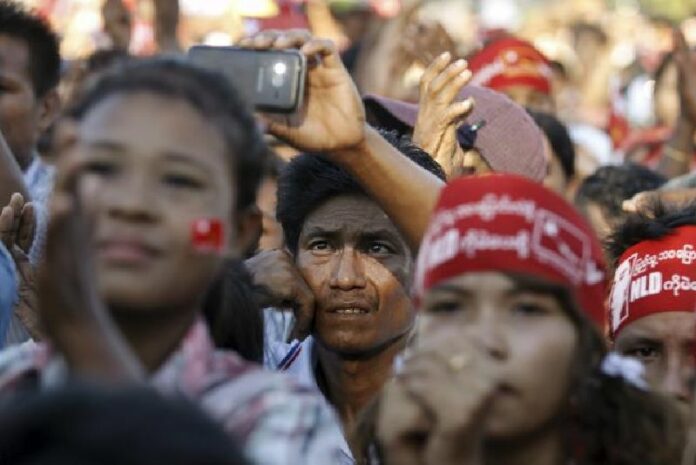
Supporters react as Myanmar pro-democracy leader Aung San Suu Kyi gives a speech at an Oct. 16 campaign rally for the upcoming general elections in Toungup, Rakhine state. Photo: Reuters / Soe Zeya Tun

By Amy Sawitta Lefevre and Antoni Slodkowski
Reuters

NAYPYIDAW, Myanmar — When Myanmar votes next month in what has been billed as its first free and fair election in 25 years, Tun Lin, and around 4 million of his fellow citizens, won't be taking part.

Most, like the 33-year-old fisherman, are working overseas and have been unable to register, but voter lists riddled with errors and the cancellation of polling in areas affected by ethnic violence could also dent the credibility of the election.

"I think that the government is not doing what it needs to do to make sure that all Burmese citizens are able to vote everywhere they are," said Phil Robertson, deputy director of Human Rights Watch's Asia division. "These people are largely going to be disenfranchised because the system doesn't encourage their participation."

The Nov. 8 general election is a major landmark in the reform of the former pariah state that began when a military junta ceded power to a quasi-civilian government in 2011.

Myanmar's ruling Union Solidarity and Development Party (USDP) is expected to be trounced by Aung San Suu Kyi's National League for Democracy (NLD) whose landslide victory in a 1990 election was ignored by the junta.

In the Thai fishing port of Mahachai, 45 kilometers southwest of Bangkok, many of the near 300,000-strong Myanmar migrant workforce complain of scant or confusing information that prevented them registering to vote.

Myanmar government representatives did not visit the town to tell people they could vote and many workers did not realize they could not use their temporary passports as identification when they traveled to Bangkok to vote last weekend, rights organizations said.

Many workers in Mahachai fled Myanmar after a crackdown on pro-democracy protesters in 1988, others migrated later to earn a better living in Thailand. Thousands welcomed Suu Kyi when she visited Mahachai in 2012 during her first trip abroad in 24 years.

"They don't care about us because they are afraid the NLD party will win so it's kind of like a prevention to stop us from voting," said Tun Lin, who lost his right hand in an accident on a Thai trawler off Indonesia.

Only around 34,000 out of more than 2 million officially registered Myanmar workers living overseas managed to register to vote in time, according to the government.


Postponement That Wasn't

After nearly half a century under military rule, the former Burma has little experience organizing elections. The army remains powerful, guaranteed a quarter of the seats in parliament and wielding a veto over constitutional change.

Last week, the chairman of the Union Election Commission, Tin Aye, a former general and ally of President Thein Sein, summoned major political parties and suggested the vote should be postponed due to recent flooding in some areas.

The move came without warning, even to senior election commission officials, shocking opposition parties who viewed the proposed delay as a tactic by the ruling camp to influence the outcome of the vote.

A media uproar ensued, accompanied by a blizzard of phone calls among worried diplomats gathered in the capital Naypyitaw before the commission made swift U-turn, announcing the vote would go ahead as scheduled.

The incident may simply have been the result of poor organization, but highlighted a lack of transparency that makes the system vulnerable to charges of government interference.


Missing Voters

Thousands of people in the areas worst affected by flooding will likely be unable to vote, but they will form only a small portion of the total number who cannot cast their ballot.

Election commission spokesman Thein Oo acknowledged there were problems and said the commission was working to fix them.

He said it was impossible to estimate how many people would not be able to vote. Observers agree a definitive number is not possible, but some estimate it at around 4 million people. This is more than 10 percent of 33.5 million people officially eligible to vote.

Some 800,000 former "temporary citizens", many of them Muslim Rohingya have been disenfranchised. Between 100-500,000 people in isolated ethnic areas or internal migrant workers, such as those in slums in Yangon are also not registered, Human Rights Watch estimates.

The numbers of internally displaced persons who cannot vote is in the tens of thousands. In addition, 110,000 refugees in nine camps along the Thai-Myanmar border won't vote. Many of the estimated 3 million migrant workers in Thailand have not registered, along with scores of people in Malaysia and Singapore, the organization said.

The election commission has also ditched plans for voting to take place in areas affected by ethnic violence even in places controlled by groups that agreed to a ceasefire.

"We won't have enough time to create voter lists and carry out necessary preparations," said Thein Oo, adding voting may take place in those areas once the situation stabilizes.

Nationwide, monitors and opposition parties say electoral rolls are ridden with errors and many names are missing.

"It's impossible for the election to be free and fair because there are so many mistakes on voter lists," said Sai Aik Paung, who heads the Shan Nationalities Democratic Party. "That's a great problem."

Additional reporting Juarawee Kittisilpa and Sai Tom Kham in Mahachai, Soe Zeya Tun in Naypyitaw, Sui-Lee Wee and Aung Hla Tun in Yangon

Advertisement

Hot News

LATEST NEWS

Bangkok
overcast clouds
27.2 ° C
27.2 °
24.4 °
81 %
2.7kmh
99 %
Sat
36 °
Sun
32 °
Mon
30 °
Tue
31 °
Wed
30 °