32.7 C
Bangkok
Friday, June 19, 2026
Home Blog Page 2938

Army Chief Says Elections Could Be Delayed

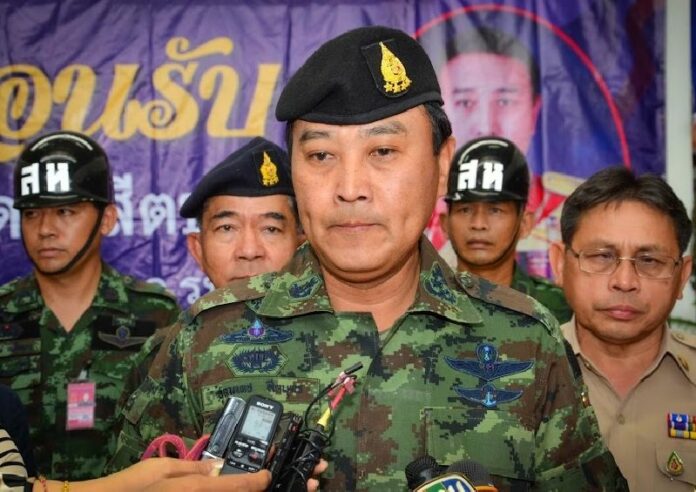
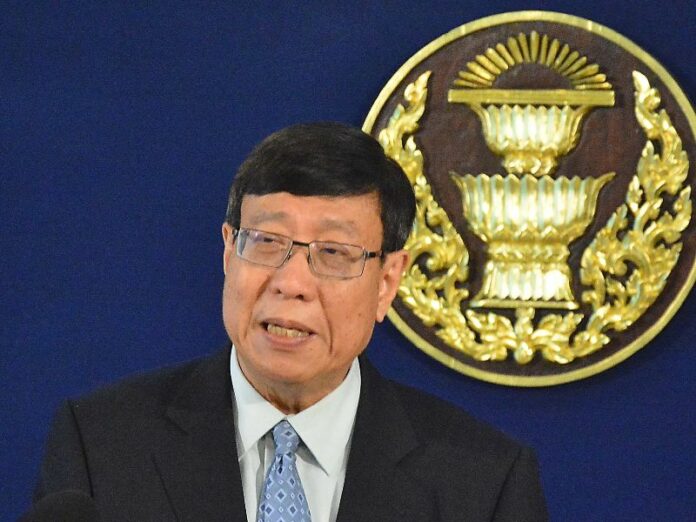
Royal Thai Army Chief Udomdet Sitabutr in a file photo from the military press office.

BANGKOK — Thailand’s army chief said today its plan for new elections may be postponed if unspecified events take place.

Repeating assertions the military would adhere to its “road map” for a return to civilian rule, Gen. Udomdet Sitabutr today indicated exceptions were possible under certain circumstances.

“But some parts of the road map may be extended in their time frame, because some events may take place,” Udomdet, who also serves as secretary-general to the ruling junta, said at an army academy in Bangkok today. “However, everyone is trying their best, and we will proceed [with the road map] in the best manner.”

Udomdet was responding to conservative activist Suthep Thaugsuban’s recent proposal the junta should indefinitely postpone new elections until the process of national reforms is completed first.

READ: Suthep Stresses 'Reforms Before Elections,' Unveils Plans for New Foundation

“That opinion is a personal one. We have our own procedures for accepting or rejecting those opinions,” he said of Suthep’s proposition. “The prime minister has always insisted that everything has to be in accordance with the road map.”

However, Udomdet added that if certain events were to transpire, the military might remain in power longer. He did not specify what those events might be.

Under the current road map announced by junta chairman and Prime Minister Prayuth Chan-ocha, who seized power from an elected government in May 2014, a referendum on the new constitution will take place in January 2016, and a new election will be held in September 2016, so long as the public approves the charter drafted by junta appointees.

But Suthep, who spearheaded the anti-government protests which paved way for the military coup, said Thursday he and his supporters “want see this government successfully reform the country before any election, no matter how long it takes."

\

Suthep Thaugsuban raises his fist during a street protest in Bangkok in this January 2014 file photo.

Asked whether the election would now be postponed to 2017, Gen. Udomdet replied, “I have to calculate the number in detail first. If I answer you now, it may be inaccurate.”

After staging the coup, the junta first promised an election would be held in late 2015. The time frame was later postponed to early 2016 and again to late 2016.

Speaking to reporters today, Gen. Prayuth said that Suthep and his foundation, which has the same leadership and uses the same language as the protest movement he led before entering the monkhood, are free to express their opinions, as long as they comply with the laws and refrain from causing conflicts.

“Everyone who comes out to do something has to be under the rules and laws, which clearly state what can and cannot be done these days,” Gen. Prayuth said at Government House. “He [Suthep] has said things and expressed support for me, and I thank him as a person, because I have known him for a long time.”

Prayuth nonetheless encouraged Suthep, a particularly polarizing character among the kingdom’s outsized political personalities, to refrain from stirring up dissent.

“But I would like to ask him not to cause any more conflicts,” he added. “Today, I am a referee. I have to be a fair referee.”

Gen. Prayuth has yet to directly address Suthep’s proposal for “reforms before election.”

“What does it have anything to do with me? It’s the business of the foundation,” he said Sunday. “They can do things, but [I can’t let them] break any laws, because my job is to enforce the laws, enforce the rules, with the same set of laws.”

Leaders of the Redshirt movement were incensed when the junta allowed Suthep to hold a press conference last week and accused it of practicing a double-standard by silencing only those on one side of the political divide.

Army chief Gen. Udomdet dismissed those allegations, saying the junta was not “giving weight” to Suthep’s proposal or taking sides. He said it came down to the quality of their opinions.

“If they are good, it’s fine. If they are not good, we will talk with them and reach some understanding,” he said. “The NCPO [the junta’s National Council for Peace and Order] has been doing this all along.”

Gen. Udomdet added, “I want all sides to be assured that the security force is treating every side equally.”


Related stories:

Redshirt Leaders Vow Response to Suthep Speech

Govt Officials React to Suthep's Return to the Spotlight

Interim Parliament Chairman Rejects Suthep’s Call for ‘Reform Before Election’


For comments, or corrections to this article please contact: [email protected]

You can also find Khaosod English on Twitter and Facebook
http://twitter.com/KhaosodEnglish
http://www.facebook.com/KhaosodEnglish


Advertisement

Phetchaburi Muslim Community Protests Bacon Factory

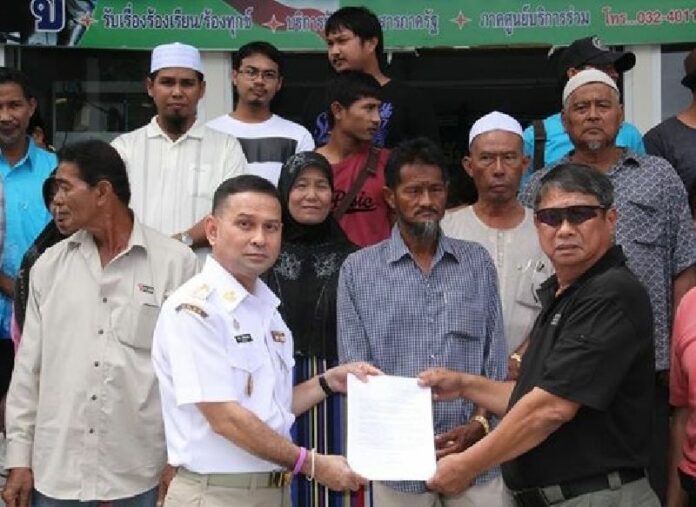
Saying they would suffer indignity and environmental damage, protesters from a Muslim community in Phetchaburi province present a petition yesterday against a bacon-making factory that would open close to three mosques.

PHETCHABURI — A group of Muslims rallied yesterday against a food company’s plan to construct a pork processing plant near their community southwest of Bangkok.

Around 50 members of a Muslim community in the Cha Am district of Phetchaburi province submitted a petition to officials over the construction of a facility they say is an indignity to their faith.

In the letter, the residents said they are opposed to a plan by Hua Hin Inter Foods Co. to build a factory for making bacon, sausages and ham near the Muslim-majority community. Pork is considered unclean in the Islamic faith and consuming it is forbidden.

“We have considered the plan, and we believe the factory should not be located in this area because 99 percent of the people are Muslims,” the letter said. “People in the community feel it will violate their livelihoods and practice of Islam.”

Three mosques are clustered near to the site of the planned factory. The letter also raised concerns that wastewater from the pork processing may contaminate sources of drinking water in the area.

Nearly 300 people have signed the petition so far. Nattawut Petchpromsorn of the provincial governor’s office accepted the letter on behalf of authorities.

There are approximately 4 million Muslims in Thailand, according to the 2010 census, amounting to around 6 percent of Thai population, which is predominantly Buddhist. More than half of Thailand’s Muslim population – 2,200,000 – live in southern provinces.

A municipal official said authorities have yet to grant a license for the company to construct the bacon factory.

“Currently, it is under the process of announcing the plan to the people, and to collect their opinion,” Nat Areekul, director of the municipal factory registration division, said yesterday.


For comments, or corrections to this article please contact: [email protected]

You can also find Khaosod English on Twitter and Facebook
http://twitter.com/KhaosodEnglish
http://www.facebook.com/KhaosodEnglish
Advertisement

Thai Police Break Up Alleged Counterfeit ID Card Ring for Foreigners

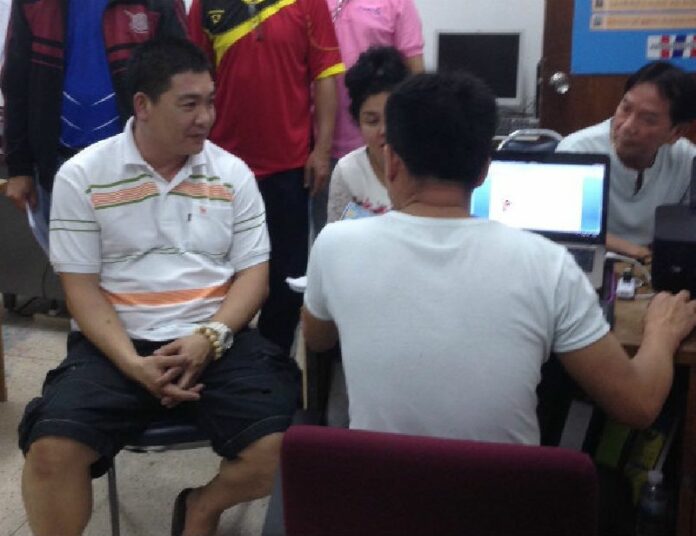
Police interview an unidentified Singaporean businessman accused of using a fake Thai ID in Chiang Rai province shortly after his arrest at the border with Myanmar on 28 July, 2015. Photo: Immigration Police

UTTARADIT — Five people are wanted by police for allegedly run a criminal scheme that produced fake Thai ID cards for foreigners living in Thailand.

Police Col. Pramuan Yimchan, a station superintendent in Uttaradit province, said at a press conference today that the five suspects sought for issuing the bogus cards are a state official, a monk and three civilians, though he did not identify any of them by name.

“All of the cards belonged to people who already died, but their names have not yet been removed from the citizens registration database.” Pramuan said. “The deceased were from different provinces … Their cards were used as new national ID cards for foreigners so that they can stay in Thailand indefinitely without ever having to acquire or extend visas.”

\

A fake Thai ID card allegedly found on a Singaporean businessman attempting to cross over the border in Chiang Rai province to Myanmar. Photo: Immigration Police


The scheme came to light after police in Chiang Rai arrested a 50-year-old Singaporean businessman trying to enter Myanmar with a fake Thai ID card, according to Pramuan. The Singaporean man’s ID card bore the name of a Thai man from Uttaradit province who died long ago, he added.

The Singaporean man was reportedly arrested after he presented the fake ID card to Thai immigration police at Thai – Myanmar border in Chiang Rai province on 28 July. The Singaporean works as a business manager in Bangkok, according to police reports.

Pramuan said further investigation reveals that a total of 11 counterfeit ID cards have been issued. Two, including the one carried by the Singaporean national, were allegedly issued at Baan Khok District Office in Uttaradit province.

According to Police Col. Pramuan, the forgers charged each foreigner 200,000 baht for their service.

He told reporters that the five suspects have not been arrested, and that police need permission from the National Anti-Corruption Commission to issue an arrest warrant for one of the suspects, who works as a permanent secretary in the Baan Khok District Office.

“Since this is an abuse of power within the bureaucracy, we have to file the request to the commission, and it will grant us permission,” Pramuan explained. “Then, we will proceed as told by the commission. We have already filed the request, but we have not yet received a reply.”

Pramuan added that police still have not identified the foreigners who have been using the counterfeit ID cards either.

“This case is a case that affects national security, and it is clearly committed by a criminal syndicate. We cannot know where these foreigners who are using Thai ID cards are, because the cards can be issued anywhere in the country,” Pramuan said.


For comments, or corrections to this article please contact: [email protected]

You can also find Khaosod English on Twitter and Facebook
http://twitter.com/KhaosodEnglish
http://www.facebook.com/KhaosodEnglish
 
Advertisement

US State Dept. Watered Down Human Trafficking Report

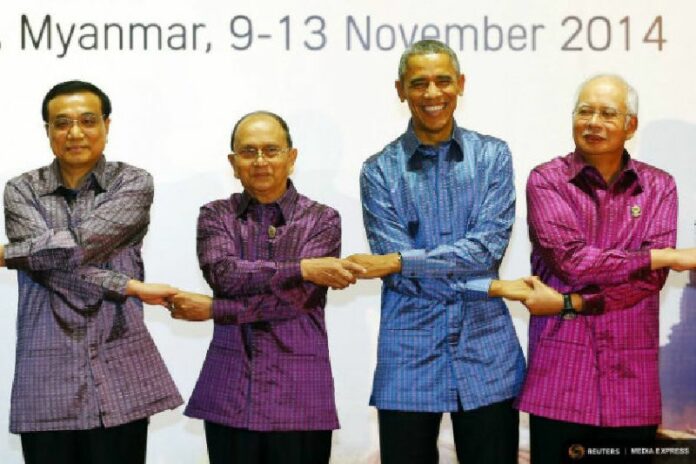
From the left, Chinese Premier Li Keqiang, Myanmar President Thien Sein, U.S. President Barack Obama and Malaysia's Prime Minister Najib Razak join hands at the 25th Association of Southeast Asian Nations summit in Nayppyitaw, Mayanmar, in this 12 November, 2014, file photo. Photo: Reuters/Damir Sagolj

WASHINGTON — In the weeks leading up to a critical annual U.S. report on human trafficking that publicly shames the world’s worst offenders, human rights experts at the State Department concluded that trafficking conditions hadn’t improved in Malaysia and Cuba. And in China, they found, things had grown worse.

The State Department’s senior political staff saw it differently — and they prevailed.

A Reuters examination, based on interviews with more than a dozen sources in Washington and foreign capitals, shows that the government office set up to independently grade global efforts to fight human trafficking was repeatedly overruled by senior American diplomats and pressured into inflating assessments of 14 strategically important countries in this year’s Trafficking in Persons report.

In all, analysts in the Office to Monitor and Combat Trafficking in Persons – or J/TIP, as it’s known within the U.S. government — disagreed with U.S. diplomatic bureaus on ratings for 17 countries, the sources said.

The analysts, who are specialists in assessing efforts to combat modern slavery – such as the illegal trade in humans for forced labor or prostitution – won only three of those disputes, the worst ratio in the 15-year history of the unit, according to the sources.

As a result, not only Malaysia, Cuba and China, but countries such as India, Uzbekistan and Mexico, wound up with better grades than the State Department’s human-rights experts wanted to give them, the sources said. 

\

Of the three disputes J/TIP won, the most prominent was Thailand, which has faced scrutiny over forced labor at sea and the trafficking of Rohingya Muslims through its southern jungles. Diplomats had sought to upgrade it to so-called “Tier 2 Watch List” status. It remains on “Tier 3” – the rating for countries with the worst human-trafficking records.

The number of rejected recommendations suggests a degree of intervention not previously known by diplomats in a report that can lead to sanctions and is the basis for many countries’ anti-trafficking policies. This year, local embassies and other constituencies within the department were able to block some of the toughest grades.

State Department officials say the ratings are not politicized. “As is always the case, final decisions are reached only after rigorous analysis and discussion between the TIP office, relevant regional bureaus and senior State Department leaders,” State Department spokesman John Kirby said in response to queries by Reuters.

Still, by the time the report was released on July 27, Malaysia and Cuba were both removed from the "Tier 3" blacklist, even though the State Department’s own trafficking experts believed neither had made notable improvements, according to the sources. 

The Malaysian upgrade, which was highly criticized by human rights groups, could smooth the way for an ambitious proposed U.S.-led free-trade deal with the Southeast Asian nation and 11 other countries.

Ending Communist-ruled Cuba’s 12 years on the report’s blacklist came as the two nations reopened embassies on each other’s soil following their historic détente over the past eight months.

And for China, the experts’ recommendation to downgrade it to the worst ranking, Tier 3, was overruled despite the report’s conclusion that Beijing did not undertake increased anti-trafficking efforts.

That would have put China alongside the likes of Syria and North Korea, regarded by the United Nations as among the world’s worst human right abusers. 

Typically, J/TIP wins more than half of what officials call “disputes” with diplomatic sections of the State Department, according to people familiar with the process. 

“Certainly we have never seen that kind of an outcome,” said one U.S. official with direct knowledge of the department.


Ability to Embarass

The Trafficking in Persons report, which evaluated 188 countries and territories this year, calls itself the world’s most comprehensive resource of governmental anti-human trafficking efforts. Rights groups mostly agree.

It organizes countries into tiers based on trafficking records: Tier 1 for nations that meet minimum U.S. standards; Tier 2 for those making significant efforts to meet those standards; Tier 2 "Watch List" for those that deserve special scrutiny; and Tier 3 for countries that fail to comply with the minimum U.S. standards and are not making significant efforts.

While a Tier 3 ranking can trigger sanctions limiting access to aid from the United States, the International Monetary Fund or the World Bank, such action is frequently waived.

The real power is its ability to embarrass countries into action. Many countries aggressively lobby U.S. embassies to try to avoid sliding into the Tier 3 category. Four straight years on the Tier 2 Watch List triggers an automatic downgrade to Tier 3 unless a country earns a waiver or an upgrade.

The leverage has brought some success, including pressuring Switzerland to close loopholes that allowed the prostitution of minors and prompting the Dominican Republic to convict more child trafficking offenders.

President Barack Obama has called the fight against human trafficking “one of the great human rights causes of our time” and has pledged the United States “will continue to lead it.”

But the office set up in 2001 by a congressional mandate to spearhead that effort is increasingly struggling to publish independent assessments of the most diplomatically important countries, the sources said.

The rejection of so many recommendations could strengthen calls by some lawmakers to investigate how the report is compiled.  After Reuters on July 8 reported on the plans to upgrade Malaysia, 160 members of the U.S. House and 18 U.S. senators wrote to Secretary of State John Kerry urging him to keep Malaysia in Tier 3, based on its trafficking record. They questioned whether the upgrade was politically motivated.

Senator Robert Menendez, a Democrat, has threatened to call for a Senate hearing and an inspector general to investigate if top State Department officials removed Malaysia from the lowest tier for political reasons.

The final decision on disputed rankings this year was made in meetings attended by some of the State Department’s most powerful diplomats, including Deputy Secretary of State Tony Blinken, Under Secretary of State for Political Affairs Wendy Sherman and Kerry’s Chief of Staff, Jonathan Finer, according to the sources. 

Sarah Sewall, who oversees J/TIP as Undersecretary of State for Civilian Security, Democracy and Human Rights, presented the experts’ recommendations, the sources said.  The State Department declined to make any of those officials available for comment.


'No, No, No'

The unprecedented degree of discord over this trafficking report began to become clear after Reuters early last month revealed plans to upgrade Malaysia from the lowest Tier 3 rank to Tier 2 Watch List.

The improved ranking came in a year in which Malaysian authorities discovered dozens of suspected mass migrant graves and human rights groups reported continued forced labor in the nation’s lucrative palm oil, construction and electronics industries. As recently as April, the U.S. ambassador to Malaysia, Joseph Yun, urged the country to take prosecution of human trafficking violations more seriously.

U.S. officials have denied that political considerations influenced Malaysia’s rankings. 

“No, no, no,” said Sewall, when asked by reporters last Monday whether Malaysia was upgraded to facilitate trade negotiations. She said the decision was based on how Malaysia was dealing with trafficking.

Representative Chris Smith, a New Jersey Republican who authored a 2000 law that led to the creation of J/TIP, said in an interview that the office’s authority is being undermined by the president’s agenda. “It’s so politicized,” he said.

If Malaysia had remained on Tier 3, it would have posed a potential barrier to Obama's proposed trade pact, the Trans-Pacific Partnership. That deal is a crucial part of his pivot to Asia policy. Congress approved legislation in June giving Obama expanded trade negotiating powers but prohibiting deals with Tier 3 countries such as, at that time, Malaysia.

Congressional sources and current and former State Department officials said experts in the J/TIP office had recommended keeping Malaysia on Tier 3, highlighting a drop in human-trafficking convictions in the country to three last year from nine in 2013. They said, according to the sources, that some of Malaysia’s efforts to end forced labor amounted to promises rather than action. 

The analysts also clashed over Cuba’s record with the State Department’s Western Hemisphere Affairs Bureau, whose view took precedence in the final report. 

Human rights groups and people with knowledge of the negotiations over the rankings said an unearned upgrade for Cuba, especially at a time of intense attention due to the historic diplomatic thaw between Washington and Havana, could undermine the integrity of the report.

Cuba had been on the “border line” for an upgrade in recent years, a former State Department official said. And although Cuba ended up with an upgrade, the final report remained highly critical, citing concerns about Cuba’s failure to deal with a degree of alleged forced labor in medical missions that Havana sends to developing countries. 

China was another source of friction. J/TIP’s analysts called for downgrading China, the world’s second-biggest economy, to Tier 3, criticizing Beijing for failing to follow through on a promise to abolish its “re-education through labor” system and to adequately protect trafficking victims from neighboring countries such as North Korea. The final report put China on Tier 2 Watch List.


Showing Deference

But the candor of J/TIP can run afoul of other important diplomatic priorities, particularly in countries beset by instability or corruption where U.S. diplomats are trying to build relationships. That leads every year to sometimes contentious back-and-forth over the rankings with far-flung embassies and regional bureaus – the diplomatic centers of gravity at the State Department.

“There is supposed to be some deference to the expertise of the office,” said Mark Lagon, J/TIP’s ambassador-at-large from 2007 to 2009 and now president of Freedom House, an advocacy group in Washington. If the office is now losing more disputes over rankings than it is winning, that would be “an unfortunate thing,” he said.

Most U.S. diplomats are reluctant to openly strike back at critics inside and outside of the administration who accuse them of letting politics trump human rights, the sources said.

But privately, some diplomats say that J/TIP staffers should avoid acting like “purists” and keep sight of broader U.S. interests, including maintaining open channels with authoritarian governments to push for reform and forging trade deals that could lift people out of poverty. 

From the start, J/TIP has tried to be impartial. It is based in a building a few blocks away from State Department, adding to the sense of two separate identities and cultures.

But establishing genuine independence has been difficult. At first, the heads of regional bureaus, representing the business and political interests of U.S. embassies, would join the J/TIP team around a table and have almost an equal say in deciding country rankings in the final report.

John Miller, a former Republican congressman from Washington state named by President George W. Bush to head the bureau from 2002 to 2006, overhauled that structure.

“I said ‘no way’,” Miller said in an interview. By 2004, decisions on how to rank countries were made by his office. Diplomats who objected could appeal to then deputy secretary of state Richard Armitage. “He rarely overruled me,” said Miller. Armitage, who is no longer in a government job, did not respond to a request for comment sent through his office.

Laura Lederer, who helped set the office up as senior human trafficking adviser from 2002 to 2007, said its job was “to assess and rate countries solely on their progress in addressing the prevention of trafficking, the prosecution of traffickers, and protection and assistance of victims.”

But officials who worked in the office over the past 15 years acknowledge that countries with sensitive diplomatic or trade relationships with the United States sometimes received special treatment following pressure from local embassies and other constituencies within the department.

One such country is Mexico – a key trading partner whose cooperation is also needed against drug trafficking and illegal immigration. It was kept at Tier 2 despite the anti-trafficking unit’s call for a worse grade, according to officials in Washington and Mexico City.

The controversy over this year’s report comes at a time when J/TIP lacks a congressionally confirmed leader. 

The prior chief, ambassador-at-Large Luis CdeBaca, left in November of last year. His deputy, Alison Friedman, then resigned to join a non-profit anti-slavery organization. And then it took until mid-July for Obama to nominate Georgia federal prosecutor Susan Coppedge as the next ambassador-at-large.

The lack of a director can increase the unit’s exposure to political influence, said Lederer.

Some say the perceived hit to the integrity of the 2015 report could do lasting damage.

“It only takes one year of this kind of really deleterious political effect to kill its credibility,”  said Mark Taylor, a former senior coordinator for reports and political affairs at J/TIP from 2003 to 2013.

Story: Reuters / Jason Szep and Matt Spetalnick


For comments, or corrections to this article please contact: [email protected]

You can also find Khaosod English on Twitter and Facebook
http://twitter.com/KhaosodEnglish
http://www.facebook.com/KhaosodEnglish
Advertisement

Cyclist Says Helmet Saved Him From Knife-Wielding Moto Maniac

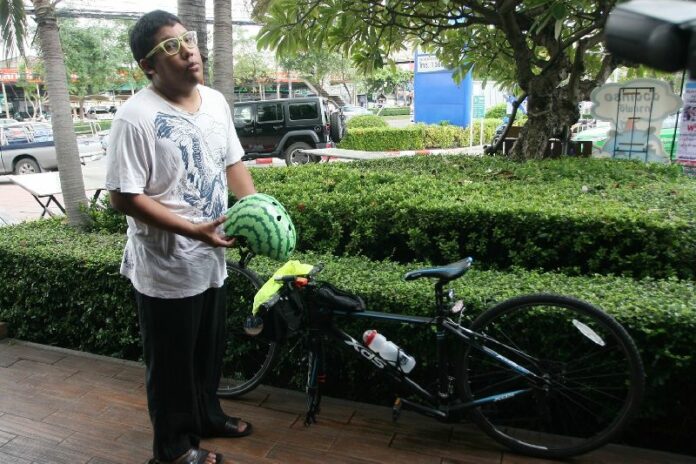
Thitiwat Rongthong, 25-year-old front man of The Darkest Romance, holds the helmet he says kept an attacker from slashing his head.

BANGKOK — A musician said a motorcyclist attacked him with a knife during a robbery attempt while he was cycling in Bangkok on Saturday night.

Thitiwat Rongthong, the 25-year-old singer and bassist for The Darkest Romance, told reporters today he was riding a bicycle to watch a show at a bar on Royal City Avenue at around 11.30 pm when a motorcyclist flanked him and forced him to stop on Rama IX Road.

According to Thitiwat, the masked motorcyclist accused him of almost crashing into his bike and then asked how much Thitiwat was willing to pay had he actually crashed into him.

Thitiwat said he attempted to walk away, at which point the motorcyclist drew out a knife and demanded his money.

“I told him I had no money. He tried to search my bag, but he didn’t find any money, so he slashed his knife at me, but I twisted away and used my helmet to shield myself,” Thitiwat said of the encounter. “The knife hit the helmet. Luckily I wasn’t hurt.”

\

Thitiwat claims this watermelon helmet saved his melon. Photo: Facebook

The suspect then reportedly fled the scene on his motorcycle. Thitiwat posted his story online several hours later as a “warning” to other bicyclists, and the post has been widely shared on the internet.

“Usually I don’t bike that often,” Thitiwat told reporters today. “I sometimes bike around my community or places that have many people around. Now that this of thing happened to me, I think I’ll quit biking at night, because I fear for my safety. I don’t want to risk myself anymore.”

The alleged attack came at a time when Thailand’s military government is urging the public to ride bicycles as an alternative to get around Bangkok’s notorious traffic.

The government will stage a mass cycling event on 16 August in Bangkok which is expected to draw at least 30,000 people. The event, called “Bike For Mom,” is being organized by the government on behalf of Crown Prince Vajiralongkorn to honor his mother, Queen Sirikit, who is set to turn 83 on 12 August.

Police Lt. Col. Sampan Luengsajjakul, deputy superintendent of Wang Thong Lang Police Station, said police are investigating the incident.

“After the victim filed the report, we have dispatched officers to search for information and inspect footage of CCTVs in the area,” he said.


For comments, or corrections to this article please contact: [email protected]

You can also find Khaosod English on Twitter and Facebook
http://twitter.com/KhaosodEnglish
http://www.facebook.com/KhaosodEnglish
Advertisement

Cyclist Says Helmet Saved Him From Knife-Wielding Moto Maniac

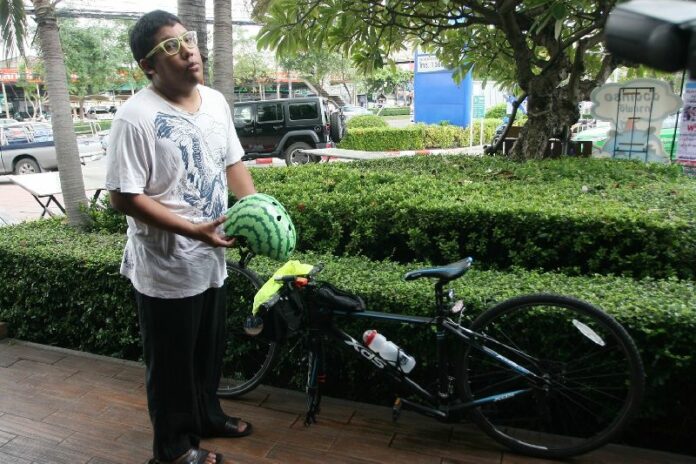
Thitiwat Rongthong, 25-year-old front man of The Darkest Romance, holds the helmet he says kept an attacker from slashing his head.

BANGKOK — A musician said a motorcyclist attacked him with a knife during a robbery attempt while he was cycling in Bangkok on Saturday night.

Thitiwat Rongthong, the 25-year-old singer and bassist for The Darkest Romance, told reporters today he was riding a bicycle to watch a show at a bar on Royal City Avenue at around 11.30 pm when a motorcyclist flanked him and forced him to stop on Rama IX Road.

According to Thitiwat, the masked motorcyclist accused him of almost crashing into his bike and then asked how much Thitiwat was willing to pay had he actually crashed into him.

Thitiwat said he attempted to walk away, at which point the motorcyclist drew out a knife and demanded his money.

“I told him I had no money. He tried to search my bag, but he didn’t find any money, so he slashed his knife at me, but I twisted away and used my helmet to shield myself,” Thitiwat said of the encounter. “The knife hit the helmet. Luckily I wasn’t hurt.”

\

Thitiwat claims this watermelon helmet saved his melon. Photo: Facebook

The suspect then reportedly fled the scene on his motorcycle. Thitiwat posted his story online several hours later as a “warning” to other bicyclists, and the post has been widely shared on the internet.

“Usually I don’t bike that often,” Thitiwat told reporters today. “I sometimes bike around my community or places that have many people around. Now that this of thing happened to me, I think I’ll quit biking at night, because I fear for my safety. I don’t want to risk myself anymore.”

The alleged attack came at a time when Thailand’s military government is urging the public to ride bicycles as an alternative to get around Bangkok’s notorious traffic.

The government will stage a mass cycling event on 16 August in Bangkok which is expected to draw at least 30,000 people. The event, called “Bike For Mom,” is being organized by the government on behalf of Crown Prince Vajiralongkorn to honor his mother, Queen Sirikit, who is set to turn 83 on 12 August.

Police Lt. Col. Sampan Luengsajjakul, deputy superintendent of Wang Thong Lang Police Station, said police are investigating the incident.

“After the victim filed the report, we have dispatched officers to search for information and inspect footage of CCTVs in the area,” he said.


For comments, or corrections to this article please contact: [email protected]

You can also find Khaosod English on Twitter and Facebook
http://twitter.com/KhaosodEnglish
http://www.facebook.com/KhaosodEnglish
Advertisement

Interim Parliament Chairman Rejects Suthep’s Call for ‘Reform Before Election’

Pornpetch Wichitcholchai, chairman of the National Legislative Assembly, speaks to the media at a news conference today.

BANGKOK — The top lawmaker in the junta’s National Legislative Assembly today said the military government cannot extend its stay in power as demanded by conservative activist Suthep Thaugsuban.

Assembly chairman Pornpetch Wichitcholchai said Suthep’s call for the military to stay in power and postpone elections until its national reform efforts are completed, “no matter how long it takes,” would contradict the road map it has promised for returning Thailand to civilian rule.

“Everything has to proceed in accordance with the road map,” Pornpetch said. “Whatever the [interim] constitution says, we have to comply with it, as the prime minister has already said.”

Under the current “road map” laid out by junta chairman and Prime Minister Prayuth Chan-ocha, a new election will take place by September 2016 so long as its draft constitution is supported in a public referendum to be held in early 2016. 

At his 30 July news conference, Suthep resurrected the rallying cry of his erstwhile protest movement to call for Prayuth’s regime to remain in power. 

"Reforms Before Elections" was the chief slogan of the conservative protest movement led by Suthep from November 2013 to May 2014. At the time, demonstrators demanded then-Prime Minister Yingluck Shinawatra's elected government be replaced with an appointed "People's Council" tasked with reforming the country before a new election. 

\

Anti-government protesters display a banner reading "Reform Before Election" on 23 January, 2014, in Prachuap Khiri Khan province.

When Yingluck dissolved the parliament and called snap election in February 2014, Suthep encouraged protesters to block voting and besiege polling stations in some parts of Thailand. The court eventually voided the election result on the ground that voting did not take place on the same day. 

Before a new election could be organized, Gen. Prayuth intervened and seized power from the government in May 2014. Suthep became a monk in southern Thailand two months later, spending a year in monkhood before returning to secular life last week. 

Gen. Prayuth has not commented on Suthep’s renewed call for “reform before election.” 

Meanwhile, Paiboon Nititawan, a member of the National Reform Council, another body appointed by the junta, said he would push for Suthep’s proposal by convincing the council to put the “reform before election” question to the public in the upcoming referendum.

“As far as I have talked to other NRC members, I realize that many agree with this idea,” Paiboon said today.

Paiboon said he and other council members will submit a joint request to their chairman to include the question in the referendum within this week. 

However, Pornpetch, the NLA chairman, said even if the referendum organizers agreed to include the “reform before election” question, it would not have any legal authority.

“That’s just an opinion,” Pornpetch said. “The government has no options. It has to only comply with what has been written in the 2014 interim constitution. It was clearly stated; therefore, it has to be so.” 


For comments, or corrections to this article please contact: [email protected]

You can also find Khaosod English on Twitter and Facebook
http://twitter.com/KhaosodEnglish
http://www.facebook.com/KhaosodEnglish

Advertisement

Krabi Ghostbusters Combat Spirits with Ancient T-shirt Magic

Residents of Baan Tai village in Krabi province field deployed red T-shirts and other creative displays to ward off soul-starved ghosts.

KRABI — One by one, they started fainting. Young and old. Men and women. Ever since July, members of the Baan Tai village in Krabi province suddenly started fainting. Some later died.

Unsure of the cause of their mysterious malady, it didn’t take long for locals to determine the most likely cause: ghosts. Now, armed with ancient knowledge to ward off the malevolent spirits, residents are pushing back to protect their very souls.

Homeowner Rayong Boonroong, 70, said Sunday that she herself fainted last month and became fearful for her life, especially after a relative dreamed the God of the Underground was out harvesting fresh souls from the living.

To discourage the wraiths from entering their homes, residents have started hanging red T-shirts and signs to scare off the gullible ghosts.

“This household has no faint-hearted people!” reads one of the signs. “Only strong persons live here!”

The ghosts are believed to be targeting residents born on Wednesdays – just like Rayong.

“This helps me feel more relieved,” she said of the spirit-repelling shirt.


Residents

This boy seems a little skeptical as he points to a scarecrow erected by Darunee Wangsop to scare the ghosts away on Sunday.

Darunee Wangsop, 26, went one better. She erected a scarecrow wearing a red T-shirt atop a motorcycle in front of her home.

“It looks like someone is guarding us all the time,” she explained.

It’s not the first time in recent memory that the T-shirt solution has been deployed to guard a community’s immortal souls.

Villagers in Buriram province last year used the same strategy to protect themselves from a tall, headless man who claimed several souls while the slept.


For comments, or corrections to this article please contact: [email protected]

You can also find Khaosod English on Twitter and Facebook
http://twitter.com/KhaosodEnglish
http://www.facebook.com/KhaosodEnglish
Advertisement

Police Hunt Soldier Wanted for Gang Rape of Teen

Officers with the Mae Sai Police Station are hunting for a soldier accused of sexually assaulting a 15-year-old girl in Chiang Rai province. Photo: Mae Sai Police

CHIANG RAI — Police in northern Thailand are hunting for a soldier accused of sexually assaulting a 15-year-old girl with three other men during the weekend.

The soldier, whose identity was withheld by police, is accused of assaulting the teen girl after she was lured to a private residence and plied with alcohol on Saturday night.

“I have instructed the police officers to proceed with this case in the most straightforward manner in accordance with the law,” Police Col. Songkrit Ontakrai, superintendent of Mae Sai Police Station told reporters today. “I believe that we will find all of the perpetrators soon.”

Three suspects have been arrested and are being questioned by police, Songkrit said, while the fourth, an army sergeant stationed at an army base in neighboring Phayao province, is still on the run.

Police have alerted the sergeant’s commanding officers about the charges and asked that he turn himself in, according to Police Maj. Chanawin Sindhuya, an investigative officer at Mae Sai Police Station.

All of the suspects have been charged with taking a minor from their parents with indecent purpose and sexually assaulting a minor.

One of the suspects had befriended the young victim on Facebook, police said, and picked her up from her home at around 6 pm that night and took her the house where three other men were drinking alcohol.

The four men then asked the victim to drink alcohol with them, according to police, and at around 8.30 pm began sexually assaulting her. The victim later managed to break free, grabbed a shirt and fled the crime scene.

While fleeing the girl was reportedly hit by a vehicle as she ran along the road in the dark, at which point the motorist alerted police.

Songkrit said a medical examination confirmed there were indications of sexual assault.


For comments, or corrections to this article please contact: [email protected]

You can also find Khaosod English on Twitter and Facebook
http://twitter.com/KhaosodEnglish
http://www.facebook.com/KhaosodEnglish


Advertisement

Redshirt Leaders Vow Response to Suthep Speech

Suthep Thaugsuban greets his supporters during a protest in Bangkok, 13 January, 2014

BANGKOK — Leaders of the Redshirt movement said they will test the ruling junta’s impartiality by calling their own news conference in response to one held last week by archrival Suthep Thaugsuban.

By allowing the man who led street protests culminating in the 2014 military coup d’etat to broadcast his return to public life, Redshirt leader Nattawut Saikua said on Saturday the military government applied a double-standard and vowed to respond in kind.

Angry that Suthep and his former protesters seemed to be resuming the same political activities – even wearing the same shirts worn during the protests – Nattawut, a leader of the United Front of Democracy Against Dictatorship, or UDD, said it would only be fair for the military government to give his group permission to discuss a topic of their choosing.

“So, next week I intend to invite all UDD leaders to wear red shirts and host a press conference about red-whiskered bulbuls in Thailand. I am sure I will get permission. I will let you know about the details later.”

A

A government spokesman said it would allow any activity that does not cause unrest or violate its rules. Officials have said they allowed Suthep to hold his news conference on July 30 because it was nonpolitical.

Held days after he ended a year in the monkhood following the coup, Suthep said at the conference he would not return to parliamentary politics and would devote himself to charitable works instead. Yet he also urged the military government to remain in power longer to complete its national reform efforts before new elections are held.  

"We want to see this government successfully reform the country before any election, no matter how long it takes,” Suthep said.

Jatuporn Prompan, chairman of the UDD, told reporters today that Nattawut’s call for press conference was an attempt to highlight the uneven standard applied by the junta to supporters of the former civilian government.

“He wants to communicate the issue about this double standard,” Jatuporn said. “He used the red-whiskered bulbuls as an example. Everyone knows it’s not a political issue. We want to ask, if we want to talk about an issue, can we do it?”

Meanwhile former Suthep ally and one-time head of the Democrat Party, Abhisit Vejjajiva rejected Suthep’s suggestion the junta remain in power for more time.

“The NCPO and the prime minister should stick to the existing roadmap and then return power to the people. I am sure our society will agree with me.” Abhisit said Saturday. “Under the current roadmap, an election will take place in September 2016, and a new elected government will be formed in early 2017.”

Since staging the coup against the Redshirt-backed government in May 2014, the junta has strictly enforced its ban on political activities. Soldiers and police have interfered with nearly 100 public discussions and forums in the past year, on the grounds that they may affect "peace and order" in the country, and some violators of the ban have been sent to stand trial in military court.

Supporters of the Redshirt movement routinely accuse the junta of selectively applying the ban on political activities only to them, while making exceptions for their rivals.

As for Suthep, Junta spokesman Col. Winthai Suvaree said he was “simply expressing his usual attitude” and urged the public to evaluate the message – not the man.

“I want people to look at the content, not the individuals,” he said. “If anyone believes Suthep’s action violated the NCPO’s policies, they can file complaints with us.”

As for Nattawut’s proposed ornithological discussion, Winthai said the regime would allow any activity that does not cause unrest or violate its rules.

“If he wants to do some activity, he can ask NCPO for permission,” he told reporters Saturday. “We will deliberate on the details."

Related news:

Suthep Stresses 'Reforms Before Elections,' Unveils Plans for New Foundation


Red-whiskered bulbul photo by Sandeep Gangadharan
 

For comments, or corrections to this article please contact: [email protected]

You can also find Khaosod English on Twitter and Facebook
http://twitter.com/KhaosodEnglish
http://www.facebook.com/KhaosodEnglish

Advertisement

Hot News

LATEST NEWS

Bangkok
overcast clouds
32.7 ° C
35 °
32.7 °
68 %
4kmh
99 %
Fri
30 °
Sat
31 °
Sun
35 °
Mon
36 °
Tue
37 °