27.2 C
Bangkok
Saturday, July 25, 2026
Home Blog Page 2942

Give up Meat and Sex for a Vegfest 'Ticket to Heaven'

A member of a Chinese opera troupe looks on as she applies make-up before performing at a shrine during the annual vegetarian festival in Bangkok on Wednesday. Photo: Reuters / Athit Perawongmetha

BANGKOK — Thailand's annual vegetarian festival kicked off this week, a time of year when the Southeast Asian country's meat-heavy dishes get a vegetarian makeover.

Known as Tesakan Gin Jay, or vegan festival, it takes place over 10 days and began over 150 years ago on the tourist island of Phuket, some 840 kilometers south of Bangkok.

Thailand is home to the largest overseas Chinese community in the world, and the festival is a time when Thai-Chinese, often third- or fourth-generation Chinese who grew up in Thailand, observe 10 days of abstinence.

Eating meat, drinking alcohol and having sex are thought to be vices and pollutants of the body and mind to be cut out entirely by the truly devoted.

"Eating vegetarian food during the festival purifies your mind and washes away your sins," said Lamyu Manolai, 59, a food vendor. "It's like going to a temple."

In Bangkok's Chinatown, yellow flags baring the words "purified" and "merit" flutter along Yaowarat Road, the area's main thoroughfare, a smorgasbord of vegan and vegetarian food stalls.

The food sold here is often made from meat substitutes including soy proteins made to look like the real thing, to varying degrees of success.

Fish maw soup, the neighborhood's signature dish, made with bamboo mushrooms, looks convincingly like its meat-based original.

Standing in front of her family-run food stall, Jutharatn Charoensawang, 47, chats away with customers who take pictures of her baked taro rice served in clay pots.

Part of a third-generation Thai-Chinese family which has been selling food in Chinatown for over a hundred years, she believes abstaining from meat is a direct ticket to heaven.

"If you go vegetarian for 10 days each year during the festival, you will go to heaven," she said. "I truly believe it."

Story: Reuters / Patpicha Tanakasempipat


\

Members of a Chinese opera troupe gather before performing Wednesday in Bangkok


\

Vendors prepare meat substitute for vegetarian food at a market Wednesday Bangkok's Chinatown


\

A vendor prepares meat substitute for vegetarian food Wednesday at a market in Bangkok's Chinatown


\

People shop for vegetarian food Wednesday at a market in Bangkok's Chinatown


\

People pray at a shrine Wednesday in Bangok


\

A member of a Chinese opera troupe applies make-up before performing at a shrine Wednesday during the annual vegetarian festival in Bangkok


Photo: Reuters / Athit Perawongmetha

Advertisement

Internet Activists Declare ‘Cyber War’ on Junta

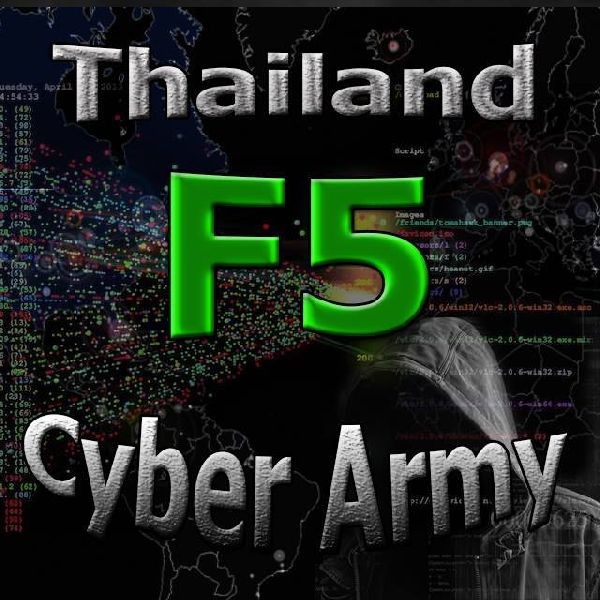
An image posted last night to Facebook along with a statement calling for renewed attacks on government web services starting Tuesday.

BANGKOK — Online activists announced last night they will launch a full-scale assault against the military government Tuesday after it ignored their demand it issue a cabinet resolution scrapping the single internet gateway policy.

After earlier giving an ultimatum of 12 days for the junta to formally cancel the project, the self-proclaimed “Thailand F5 Cyber Army” announced last night it will attack government websites and servers, and then escalate them weekly for the next month until such a resolution is issued.

“As the government ignored our previous warning and the deadline is due, we now declare a cyber war against the dictator government,” read the statement posted last night to the Citizens Against Single Gateway group on Facebook.

The group posted on Facebook four demands they said must be met.

Those behind the Facebook page are anonymous, but their cause has drawn support by tapping into anxiety online about government interference with the internet.


Gamers, Geeks on Epic Quest for Internet Freedom


Since the plan to build a system to funnel all internet traffic through a single channel erupted into controversy, government officials have insisted no action has been taken. Both junta chairman Prayuth Chan-ocha and the telecom minister have said it was only “under study” to protect national security and prosecute online criminals.

Speaking at an economic forum today, Deputy Prime Minister Somkid Jatusripitak said the plan had been halted.

"We will not talk about this any more. If we say we won't do it, we won't do it," Somkid was quoted saying at the meeting in a Reuters report.

Such assurances have done little to placate the furor online, where activists have pointed to a series of cabinet resolutions between June 30 and Aug. 25 which explicitly laid out a plan to “to control inappropriate websites and flow of news and information from overseas.”

Those resolutions, as has been pointed out, became legally binding when published.


Big Demands

In addition to calling for a new resolution to cancel those previously issued, the statement also demanded the government issue an order protecting online freedom and compel Prime Minister Prayuth to declare he will not use his special powers under Article 44 to shield those responsible or prosecute activists. It also said officials responsible for the plan must resign.

Those demands have little chance of being met or taken seriously.

Whether those involved in the online opposition can muster a crippling attack remains to be seen. Their first attack on Sept. 30 involved an unsophisticated method of bringing government web servers to their knees: Rapidly refreshing web pages until the servers were overwhelmed. The government has since taken measures to protect their web servers by routing requests through proxies outside of Thailand.

Regardless, messages online from the group claim it will paralyze the system of targeted government agencies for several days – not just a few hours as occurred in previous attacks. No specific targets have been publicly announced.

On Oct. 5, Suwaphan Tanyuwattana of the Prime Minister’s Office warned such actions would only serve to “cause trouble to the nation and the people.”

Master Poll, a poll of unknown provenance or methodology about public policy which appeared following the May 2014 coup from a group called the “Thai Researchers in Community Happiness Association,” released survey results today claiming most people aren't aware of the issue.

Conducted Oct. 5 through yesterday, the poll said 79.7 percent of people polled did not know about the single gateway issue, and 91.4 percent had not studied it. It also said 70.9 percent felt insecure about their online privacy.

Netizens first succeeded in bringing down at least six government websites on Sept. 30 by using a crude distributed denial of service attack, or DDoS, to show their opposition.

On Oct. 2, the “Thailand F5 Cyber Army” issued their ultimatum calling for the junta to officially drop the project by Oct. 14 and threatening to launch attacks if their request was not accepted.  

No government agency has issued a direct response today. Gen. Prayuth and Minister of Information and Communication Technology Uttama Savanayana both previously said the project was never initiated and thus was impossible to revoke by resolution.

On Oct. 8, Prayuth faulted the unnamed staff member responsible for typing his cabinet resolutions for misleading society. He said the cabinet meeting only aimed to discuss about how to protect internet from threats and told reporters to stop raising this issue.

An online petition opposing the policy has been signed by more than 150,000 people.


Translation of the demands made by the “Thailand F5 Cyber Army:

“1. Government must issue a Cabinet Resolution to resolve the other one that ordered establishment of the single gateway

"2. Political authorities responsible for this case must resign, and in case the budget was already paid, there must be legal prosecution.

"3. Cabinet Resolution must be issued to oblige (the government) not to infringe citizen rights and freedom in cyberspace (out of the justice system) unless there is a court order.

"4. The prime minister must declared to public that he will not use the Article 44 to excuse the officials from No. 2 and not prosecute people joining this activity in every case.”


Related stories:

Cyberactivists, Govt Don’t Blink on ‘Single Gateway’

Gamers, Geeks on Epic Quest for Internet Freedom

Activists Issue Ultimatum to Junta over ‘Single Gateway’

Govt 'Gateway’ Denials Contradict Cabinet Resolutions

Cyber Activists Bring Down Govt Sites to Protest ‘Single Gateway’

Single Gateway for Internet Still Under Study, Minister Says


Advertisement

Pope Francis Apologizes for Unspecified Scandals

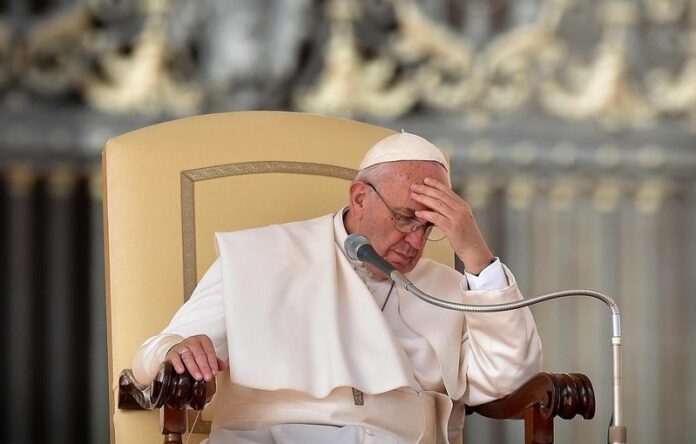
Pope Francis delivers his weekly address in 2015 in St. Peter's Square in the Vatican City. Photo: EPA / Ettore Ferrari

Vatican City — Pope Francis made amends Wednesday for the scandals that have rocked the Catholic Church in recent years, but did not explain what he was referring to.

"I would like, in the name of the Church, ask for your forgiveness for the scandals that in recent times have happened both in Rome and in the Vatican," Francis said in his weekly audience in St. Peter's Square.

Vatican spokesman Father Federico Lombardi refused to elaborate on the pontiff's remarks. "If he makes a general observation, it is not my duty to restrict or expand what he wanted to say," Lombardi told reporters.

The pope was elected in March 2013 with a mandate to reform the Vatican's bureaucracy, the Curia, in the wake of the VatiLeaks affair, which exposed alleged cronyism, graft and infighting within the Vatican hierarchy.

In his pontificate, he has also had to deal with the problem of paedophile priests and with the Vatican's in-house bank, the Institute of Religious Works, long suspected as serving as a haven for money launderers and mafia-linked criminals.

Francis spoke about scandals as the Synod of Bishops, an Oct. 4 to Oct. 25 Catholic summit on family issues, reached its halfway mark. Participants remain split on how the church should treat issues like divorce, homosexuality and cohabitation out of wedlock.

Discussions should be summed up in a final document, but top conservative cardinals wrote to the pope complaining that the drafting process was biased towards progressives, according to a leaked letter published Monday by Italian weekly l'Espresso.

British Cardinal Vincent Nichols – who is seen as a centrist – played down the significance of the letter, but said there were growing calls for the pope to settle the debate, once the synod is over, with the issuance of an official document.

"[The synod process] will need bringing to a conclusion and there is only one person who can do that," Nichols said.

During Wednesday's audience, Francis also greeted a delegation of more than 30 Chilean miners, who five years ago were trapped underground for 70 days.

"I think each one of you would be capable of coming here, and telling us what the meaning of hope is. Thank you for keeping faith in God," the pope told them.

Story: DPA / Alvise Armellini


To reach us about this article or another matter, please contact us by e-mail at: [email protected].

Follow Khaosod English on Facebook and Twitter for news, politics and more from Thailand.

Follow @KhaosodEnglish

\


Advertisement

Man Sought for Unprovoked Assault on Lat Phrao Street

A man violently assaults a random passer-by Tuesday in Bangkok's Lat Phrao district in a still image from security camera footage.

BANGKOK — Police are looking for a man seen attacking a pedestrian and threatening another on a street in the Lat Phrao district of Bangkok.

Police said they became alerted to the attack soon after it happened Tuesday morning near Soi Lat Prao 122 and believe the attacker to be a mentally ill man known for random acts of violence.

“I have instructed investigators and patrol units to track down and find this man, so that police can send him to a care facility,” said local police commander Col. Chettha Sawangsuk. “Because I am afraid he may hurt other people again.”

Footage of the incident posted online showed a man in long-sleeve shirt approaching a man in a yellow shirt and assaulting him without provocation. The yellow-shirted pedestrian was knocked to the ground and repeatedly punched and kicked before his assailant finally walked off.

Police officers were dispatched to the area after receiving report of a physical assault, where they found the 30-something victim but not the attacker, Chettha said.

“He suffered many bruises on his face and body. He was sent to a nearby hospital, but he did not file report with police,” Chettha told reporters.

After the assault, another security camera nearby captured the same attacker approach another pedestrian in a threatening manner, though he does not assault him.

According to Chettha, local residents said the perpetrator appeared to be a mentally-unstable homeless man who has committed similar crimes before.

Residents said that the man would threaten or punch male victims, and expose his genitals to women, Chettha said.

In September, a 38-year-old Laotian man was arrested for assaulting random strangers in Bangkok’s financial districts. Police moved to arrest him after his antics were posted and shared widely on the social media, where he was given the moniker “Siam Mafia.”


Related stories:

‘Siam Mafia’ Punching Rampage Ends in Arrest

Advertisement

Amnesty Calls on Thailand to Reopen Investigation into Activist’s Murder

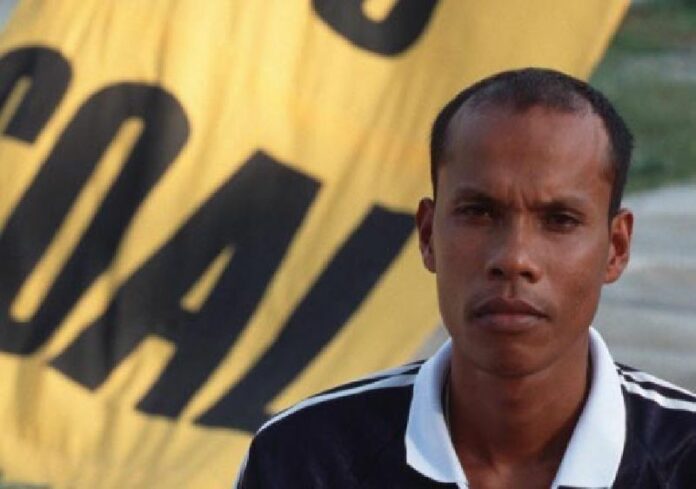
Slain environmental activist Charoen Wat-aksorn in an undated file photo. Photo: The Seub Nakhasathien Foundation

BANGKOK — Amnesty International called on Thai authorities Wednesday to reopen the investigation into three former officials after the Supreme Court upheld their acquittal in the 2004 murder of environmental activist Charoen Wat-aksorn.

The rights group urged Thailand to deliver justice in the case after the court ruled there was insufficient evidence to link the three men – a provincial administrator and his two sons – to the assassination of the 37-year-old pineapple farmer, who was shot to death in 2004 after successfully campaigning to stop the construction of two coal-fired power plants in the southern province of Prachuap Khiri Khan.

“The failure of the authorities to provide redress for Charoen and his family is a tragic development in a long battle for justice for him and other human rights defenders in Thailand,” the statement read. “Amnesty International renews its calls on authorities to take measures to protect all human rights defenders from attack and ensure that those responsible for crimes against them are brought to justice.”

The Supreme Court Tuesday upheld a 2013 Appeals Court judgment acquitting three local authorities who had been accused of plotting the murder: provincial administrator Monosh Hinkaew, former Bo Nok sub-district headman Juea Hinkaew, and local lawyer Thanu Hinkaew.

Two confessed hit men had said they were hired by the three defendants; however, they both died in custody in 2006 before they could testify against them.

Charoen became a local hero in 1995 after he mobilized Bo Nok villagers to fight against the coal plants until the government ordered the Gulf Electric Co. Ltd. to relocate the plants to Saraburi province in central Thailand.

The activist continued campaigning to protect local resources. On June 21, 2004, Charoen was returning from Bangkok where he’d gone to register a complaint alleging collusion involving a land grab, which jeopardized construction of a steel plant.

As he stepped off a bus at the Bo Nok bus station, two gunmen shot him eight times in the head.

The arrested gunmen, Sanek Lekluan and Prachuap Hinkaew, died separately in a Bangkok prison under unclear circumstances after they told the court the names of former officials who hired them to carry the killing.

In 2008, Thanu was sentenced to death by a criminal court. Manosh and Juea were acquitted.


\

Slain activist Charoen Wat-aksorn’s wife Kornuma Phongnoi, at center, stands outside The Supreme Court in Bangok on Tuesday along with about 100 villagers who insisted they would continue their mission to protect local resources despite the risks.


A confidential U.S. State Department cable prepared days after the conviction and released by WikiLeaks described it as “the first legal ruling of accountability” in the activist’s murder.

“The conviction of an alleged mastermind of the crime, instead of just the hired guns, offered at least temporary justice for a crime that sent a powerful message about the fate of those who dare to confront powerful interests,” read the cable sent Jan. 7, 2009, by the U.S. Embassy in Bangkok. “Furthermore, the mysterious death of the crime's suspected gunmen, while in state custody, does not bode well for the justice system's ability to shield itself from the operations of criminal networks.”

A lengthy series of appeals ensued, and in 2013, the Appeals Court acquitted all defendants and overturned Thanu’s conviction and sentence. The Supreme Court affirmed those rulings Tuesday.

Kornuma Phongnoi, Charoen’s wife, said though she could not agree with the verdict, she had to accept it. After 11 years fighting for justice in Charoen’s death, she said the justice system cannot be relied on for protection.

“After those behind the murder of Charoen Wat-aksorn were set free today, the influential politicians in Prachuap Khiri Khan will become bolder,” Kornuma wrote on a statement.

“That definitely makes it harder for us to protect and restore the local environment.”


Advertisement

Myanmar Signs Ceasefire with Rebel Groups

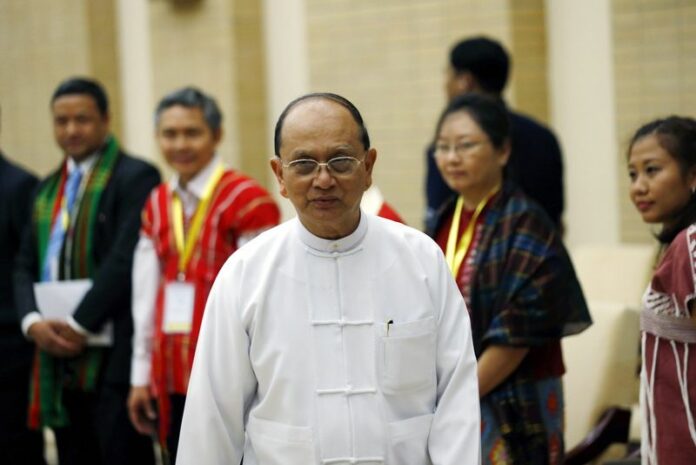
Myanmar President Thein Sein. Photo: EPA / Lynn Bo Bo

YANGON, Myanmar — Eight of Myanmar's armed rebel groups signed a ceasefire with the government on Thursday, after more than four years of negotiations that saw many other groups walk away or be excluded from the talks.

"We believe this is the first step to building a sustainable peace in the country," President Thein Sein said at the signing ceremony.

Myanmar's many ethnic rebel groups have had constant tensions and outbreaks of conflict with the Burmese-dominated nation state since it gained independence from Britain in 1948.

Critics say more of the country's at least 21 ethnic armed groups should be included in the ceasefire, and political prisoners released as part of the deal.

The groups that signed included the large militias from the Karen and Shan states. But seven others refused to put their names to the deal, and several more groups were excluded from the talks by the government.

"We are hoping all remaining ethnic armed groups will sign it sooner or later as we do know they also want peace," said Saw Kwe Htoo Win, secretary of the Karen National Union (KNU), the rebels' political wing.

"Without a ceasefire, we can't go to political dialogue. Only political means can solve the civil conflicts of our country," he told dpa by phone before the ceremony.

The government would allow groups that walked out to participate in the political dialogue stage due to start in the next 60 days "even if they didn't sign the truce yet," said Hla Maung Shwe, of the government-linked Myanmar Peace Center.

The ceasefire was witnessed by representatives of the European Union, United States, Norway, Japan and Thailand, as well as all major political parties in the country.

Opposition leaders Aung San Suu Kyi of the National League for Democracy and Khun Htun Oo of the Shan National League for Democracy were invited but did not attend the ceremony, sending representatives to sign as witnesses.

The eight groups that signed were removed from Myanmar's lists of unlawful and terrorist organizations, but critics say none of the country's political prisoners, including members of those groups, were released.

"We urge government to release our members as well as all remaining political prisoners as we believe political dialogue would not be meaningful if political prisoners remain," the KNU's Saw Kwe Htoo Win said, speaking for all eight signatory groups.

According to the Assistant Association for Political Prisoners of Burma, there are currently 95 political prisoners in the country.

Story: DPA


Related stories:

Myanmar Elections Back on for Nov. 8

Activists Race to Push Myanmar’s Apathetic Electorate to Vote

Despite Record Numbers, Myanmar’s Women Candidates Face Hurdles

Advertisement

Police Charge Employees in Zipline Tourist Death

Two employees from the Flying Squirrels zipline attraction in Chiang Mai reported to police today to face charges.

CHIANG MAI — Two staff members of a tourist attraction in Chiang Mai province have been charged with fatal negligence after a Chinese tourist died on a zipline ride operated by the company on Sunday.

Atiwat Orkam, 23, and Thaweesin Pongpanasawasdi, 31, both employees of the Flying Squirrels zipline company, surrendered to police today and acknowledged charges of negligence resulting in death.

Police identified them as the employees in charge when Chinese tourist Wang Qi broke her neck while riding the zipline line and later died.

Read our previous story: Another Chinese Tourist Dies on Chiang Mai Zipline

According to Police Lt.Gen. Thanitsak Theerasawat, the two ordered the tourist to ride on the zipline with another tourist at the same time, which caused the sling to accelerate too fast. The zipline eventually hit the end of the line with such force that her neck was broken, Thanitsak said.

Doctors at a local hospital determined the tourist died from a broken neck, the officer said. Police said the company originally reported she had suffered a heart attack.

Atiwat and Thaweesin have been released on bonds of 80,000 baht and 150,000 baht, respectively.

Santi Pitikam, a representative of Flying Squirrels, told reporters the company will pay 100,000 baht to compensate to the victim’s family, while the company’s insurance will also contribute 1 million baht.

The investigation is expected to be finished within 15 days, according to Police Lt. Col. Thaworn Nantisaen, the officer in charge of the case, citing an appeal from the Chinese Consulate in Chiang Mai.

“My commander and the public are paying a lot of attention to this case,” Thaworn said. “And the Chinese consulate also requested us to finish this investigation within 15 days, and I believe that it would be finished in time.”

Advertisement

Man Accused of BTS Up-Skirt Perving

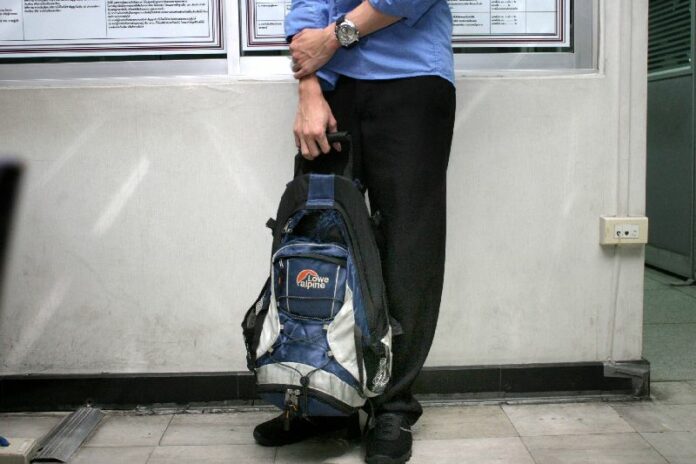
Angkul Pongsri, 28, poses for police today with the bag they say he confessed to filming videos up women's skirts on the BTS Skyrtrain system in Bangkok.

BANGKOK — A BTS security guard caught a man allegedly using a hidden camera to take photos up women’s skirts on the Skytrain last night.

Angkul Pongsri, 28, was caught while riding the train from BTS Phrom Phong to BTS Thong Lo after a guard became suspicious. Police said he later confessed to using a camera disguised as a battery power bank from Pantip Plaza to secretly photograph female passengers.

Police said Pongsri confessed to spending 1,600 baht at the popular IT mall to buy the spy camera, but said he only began applying it to his prurient purpose three days ago.

\

The secret camera Angkul reportedly told police he bought for 1,600 baht at Pantip Plaza. It has power inputs and outputs, and the words 'Power Bank' are convincingly printed on its side.


He insisted the naughty videos found on his memory card were not released to the public and were only used for his personal pleasure. No statements from his alleged victims were available to establish whether this made them feel any better.

The Skytrain security guard, 36-year-old Thongsun Mala, said Angkul was holding his backpack in his hands under a woman’s skirt instead of putting it on his back. Noticing he was standing very close behind the woman, he decided to confront Angkul and ask to inspect his bag at the BTS Thong Lo station.

Angkul said he was on his way home to Phra Khanong at 9pm last night, when he spotted the  woman wearing a short skirt. He then decided to put his backpack under her skirt so he could get some new footage.

Police Maj. Akkarach Thanomchart from the Thonglor Police Station said Angkul was charged with sexual harassment, which carries a maximum penalty of up to one year in prison and a 10,000-baht fine.

Advertisement

Uprising Anniversary: Victims’ Families Still Waiting for Compensation

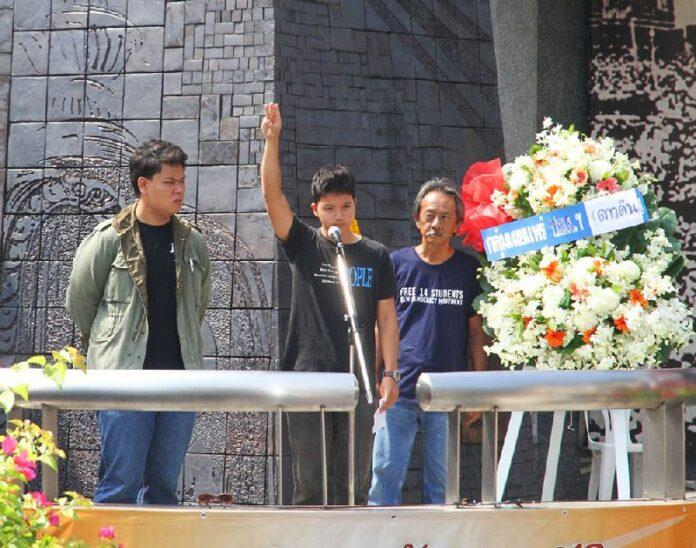
An activist from the Dao Din pro-democracy group flashes the 'three-finger salute' adopted by activists from the 'Hunger Games' films at a ceremony today marking the 42nd anniversary of the uprising on October 14, 1973.

BANGKOK — Families of those killed and injured this day 42 years ago in a popular uprising to topple a military junta mourned their losses at a ceremony today and renewed their calls for compensation from authorities.

The wife of the late activist Chira Boonmak, believed to be the first student killed that day, was among dozens present today for a religious service marking the anniversary, lamented Thailand’s current state of affairs and questioned the ambition for which her husband paid his life.

“Their ideal is the wish to be freedom from tyranny. We have had numerous coups because politicians wouldn’t reconcile with each other,” Lamiad Boonmak, who heads the Relatives of October 14, 1973, Martyrs Association said today. “Whoever heads the government, there’s a protest. It keeps going in this cycle. A full democracy can’t be achieved. So why are we still commemorating it? Why are we still holding this event?”

Lamiad said she has petitioned the current military government 10 times about a compensation fund approved prior the the 2014 coup but has yet to receive a meaningful reply.

\

Activists hold a banner today near the October 14 Memorial on Ratchadamnoen Avenue in Bangkok.

The former government led by Yingluck Shinawatra approved a plan in March 2012 to pay out 7,000 baht per month to immediate heirs of those injured or maimed, but the legislation was never enacted. The Yingluck administration was later ousted in the May 2014 coup d’etat, which brought the current junta to power.

“The coup happened, and it stripped our right to compensation,” 70-year-old Lamiad said at the ceremony held at the October 14 Memorial on Ratchadamnoen Avenue. “It was already approved in the Yingluck cabinet. We have been waiting.”

She addressed a complaint to Panadda Diskul, a minister in the prime minister’s office, who was present at the event.

“Last year, we told Mr. Panadda about it, and Mr. Panadda promised there would be action. But to this moment, we have not received any payment,” she said. “We are old, and some of us are disabled. We can’t do anything. We only want to exercise this right. We want only the 7,000 baht. But they won’t give it to us.”

Panadda tried to placate Lamiad by telling reporters that he would urge the government to speed up the compensation process.

“This issue is something that all the relevant agencies must discuss together and try to find a conclusion,” Panadda said. “The working committee has to do actual work. They have to talk about the real issues, what the obstacles are, and how the state can lend a hand.”

Lamiad’s husband, Chira, was a 29-year-old graduate student when more than 200,000 demonstrators occupied Ratchadamnoen Avenue in Bangkok on Oct. 13, 1973, to demand a new constitution and an end to the military’s decade-long rule.

On the next day, clashes broke out. The military attempted to disperse the protesters, using live rounds. After riots spread through parts of Bangkok, His Majesty the King intervened and removed junta chairman Thanom Kittikachorn from his premiership. Thanom and two of his deputies fled the country in the afternoon of Oct. 15, ending years of military dictatorship in Thailand.

Chira is believed to have been the first demonstrator to shot and killed on Oct. 14, the day now remembered by many Thais as a major milestone for democracy in the kingdom, and its anniversary is publicly commemorated every year.

But at today’s memorial service, Lamiad bitterly questioned whether there remains any point in marking the uprising when its ideal – “freedom from tyranny” – was far from being achieved.

“Everyone is only fending for their own interests,” she said. “That’s very different from Chira Boonmak, who dared to make the decision to leave his house on that day to call for rights and freedom for the people.”

Lamiad also quipped at government officials attending the ceremony, asking them, “You are here to commemorate the event, but are you not ashamed? Many of you are the October Generation now sitting in the government. You are sitting on the pool of blood, but you don’t care about us. I have had enough.”

Minister Pannada acknowledged the historical importance of the date.

“[14 Oct.] was the beginning of calls for democracy in Thailand. I think it’s impossible for the state to ignore it.”

Members of the Dao Din group, which has protested against the junta and the 2014 May military coup, were also present at the ceremony. Activists unfurled a banner denouncing former leaders of the 1973 uprising who have now shifted to supporting the military’s rule in Thailand.

A company of police officers was placed around the ceremony to maintain order at the Oct. 14 monument on Ratchadamnoen Avenue.

Although protests and political activities remain banned by the military junta, police did not interfere with the gathering today.


Related stories:

Enduring Myth of the ‘October 16’ Incident

Advertisement

Lynching of Muslim Suspected of Eating Beef 'Unfortunate' India's Premier Says

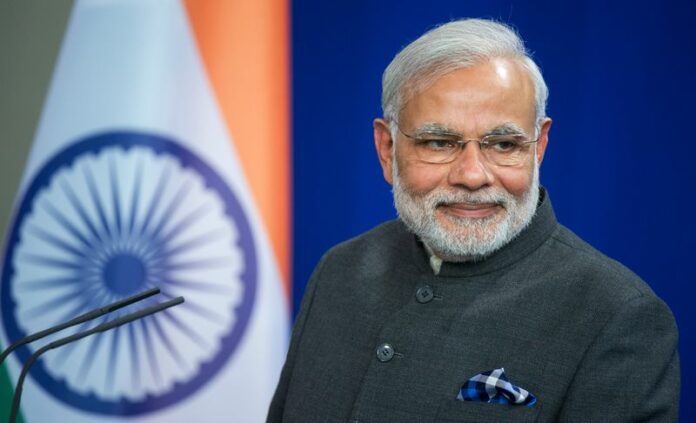
Indian Prime Minister Narendra Modi today described the murder of a Muslim man as 'unfortunate' as he faces criticisms over a less tolerant India. Photo: DPA / Bernd von Jutrczenka

NEW DELHI — The lynching of an Indian Muslim by a Hindu mob on suspicion he ate beef was "unfortunate," Prime Minister Narendra Modi said in an interview published Wednesday, in his first direct reference to the case.

The Hindus regard the cow as holy, and the mob killed the 55-year-old man in a village in the Dadri area of Uttar Pradesh state this month after rumors he had beef stored in his refrigerator. The slaughter of cows is banned in Uttar Pradesh.

Modi has been criticized for not commenting on this and other incidents such as the August killing of rationalist and author MM Kalburgi, who opposed idol worship, and the cancellation of a concert in Mumbai where Pakistani singer Ghulam Ali was to perform.

"Incidents like Dadri and Ghulam Ali are really sad, but what is the role of the central [government] in such incidents?" Modi said in the interview.

Leaders of the ruling Bharatiya Janata Party have maintained that these are law-and-order issues that are the responsibility of state governments – not the federal government that Modi heads.

"Opposition regularly accuses BJP of igniting communal flare, but isn't the opposition doing the polarization now?" Modi said in the interview.

In his only other comments so far, during an election rally in Bihar state last week, Modi urged citizens to follow President Pranab Mukherjee's message on the need to preserve core civil values of diversity, tolerance and plurality.

He did not mention any specific incident.

Modi's comments on the Dadri incident came as more than two dozen eminent writers gave up literary awards given by the state, saying the space for free expression in the country was shrinking in the face of growing intolerance toward different opinions and cultures.

"He [Modi] should have said 'I condemn' instead of 'unfortunate.' That is too weak a word in the circumstances," said writer Shashi Deshpande, who resigned from the board of the Literary Council. "A leader is morally responsible for what happens in your area and a few words can make a lot of difference."

Story: DPA

Advertisement

Hot News

LATEST NEWS

Bangkok
overcast clouds
27.2 ° C
27.2 °
25 °
83 %
3.2kmh
100 %
Sat
35 °
Sun
33 °
Mon
30 °
Tue
29 °
Wed
30 °