


























28.3 C
Bangkok
Tuesday, June 23, 2026
Home Blog Page 2955

Junta Chairman Lectures Youth on Thai-style Monarchy & Democracy [Transcript]

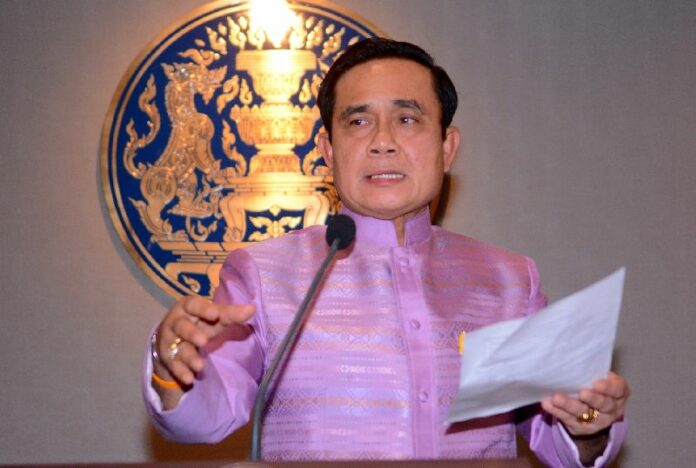
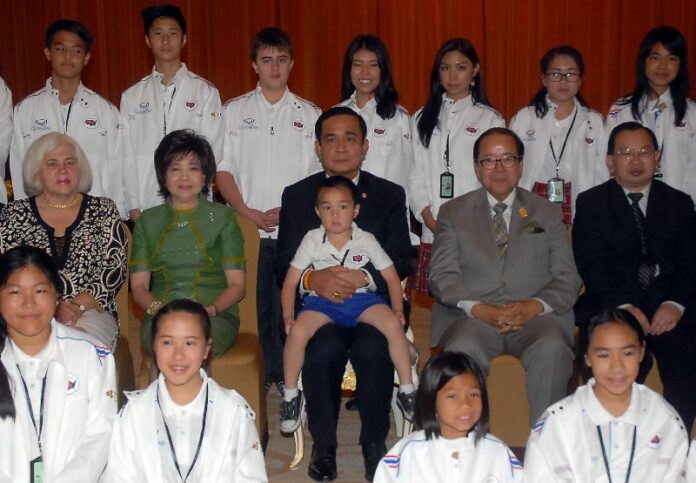
Thai junta leader Gen. Prayuth Chan-ocha poses for a photo with young Thais who live in America at the Government House in Bangkok, 8 July 2015.

BANGKOK — Speaking to a group of young Thais who were raised abroad, junta chairman Gen. Prayuth Chan-ocha stressed the importance of revering the Thai king, who he described as a “deity” that never interferes in politics.

Gen. Prayuth was speaking to 37 children and teenagers who were raised in America and invited by the government to visit Thailand and learn about its culture.

In the speech, the general explained that the Thai monarchy is “unique” and needs the special protection of the Kingdom’s lese majeste law, Section 112 of the Thai Criminal Codes, which punishes criticism of the royal family with up to 15 years in prison.

Gen. Prayuth, who came to power by staging a coup d’etat against an elected government on 22 May 2014, also told his young audience that he would return democracy to Thailand after a new constitution is approved in a referendum, which is set to take place in January of next year.

The following is an excerpt from his speech, which he delivered at the Government House this morning during an event titled “Young Thais in America Visiting the Motherland”:

“I want you, young people, to think about the monarchy of Thailand, which has provided spiritual guidance for the entire nation for a long time, unlike any other nation. In the past, everything was initiated by the monarchs, be it railways, waterworks, or other things. And then, a government was set up to continue the works. But an important thing that many groups try to do is to compare our monarchy with other nations.

This cannot be done, because our [monarchy] has a long, ancient history. They [Thai monarchs] are like deities. Our King is not involved with anyone. He is above all disputes.

When someone violates him, we need to use Section 112 of the Criminal Codes, which is like a libel law, because whenever someone insults us, we can sue them, but if it’s the monarchy, [the royal family] cannot sue them. This is because His Majesty is not involved with anyone, and he is under the constitution, and under every law that the government has created to protect him. Yet, people see it as human rights issue.

Let me ask you: if someone insults your father, would you give in? We wouldn’t. But if it happens to our parents, they can sue. But since His Majesty the King is not involved, he cannot sue, and who would take care of him? Thai people have to. Whoever doesn’t understand this is not a Thai. They are awful. This is a sensitive matter. I would like to ask the audience to explain that the monarchy of Thailand is not like the monarchy in any other country.

It’s like our democracy. It’s kind of hard to achieve, so it will be hard for people to forget about it, too. If it could be achieved too easily, it wouldn’t work because people wouldn’t know what the laws are. That cannot be done. I ask you, are we going to be American model [of democracy]? No.

Let’s take a look at America … Their [democracy] was born before ours. They reformed their country before we did. They abolished slavery many years ago. I am not saying anything bad about them, because I believe that our country is our country. We have to respect each other.

Today they don’t touch me much. They only want us to have an election, which I already explained would follow the road map. The [interim] constitution explains the timeline, and I will not amend it. Anything [the people] want me to fix or do for them, I do for them.

If they want a referendum, I let them have it. Elections will be held only if the [new] constitution passes the NRC [National Reform Council] and then the referendum. And the time will be extended for two months, and we will need to write organic laws for the constitution.

This is all in accordance with normal procedures. Yet they accuse me of wanting to stay in power. I ask you, can it be done? Whatever the law and the rules say, it has to be that way.”

The junta chairman also asked the children to be careful when they read news on social media, and urged them to be special ambassadors who spread goodwill and understanding about Thailand among foreigners.
Advertisement

Activists Vow to Continue Fighting For Democracy After Prison Release

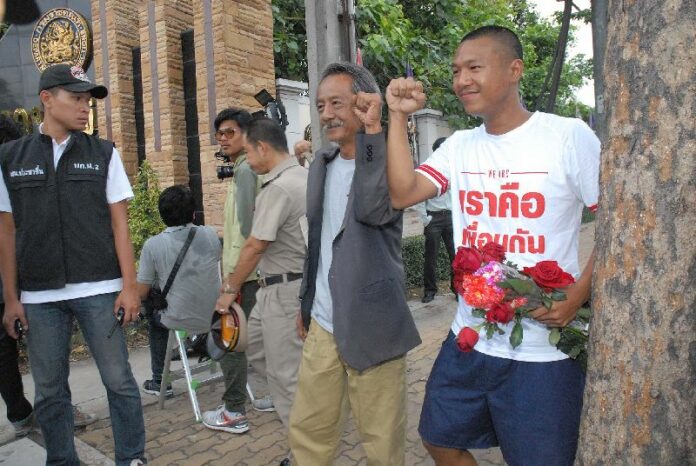
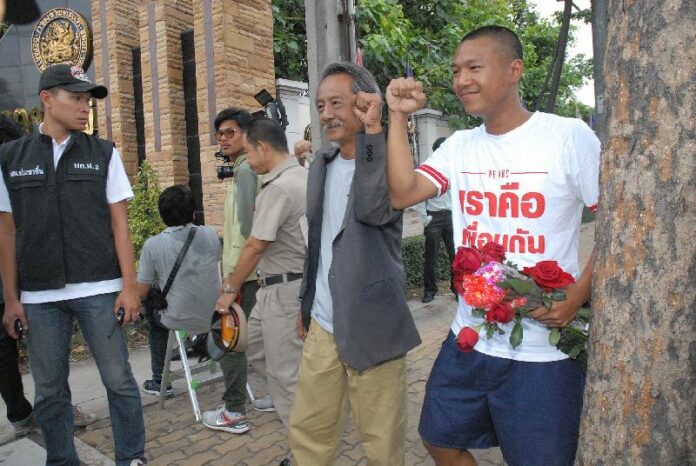
Jatupat Boonpatararaksa, aka Pai, and his father outside of Bangkok Remand Prison on 8 July 2015.

BANGKOK — The fourteen pro-democracy activists released from prison this morning say they will continue to campaign against the ruling military junta until democracy is restored in Thailand.

The activists, eleven of whom are university students, were freed from prison after 12 days this morning following the military court's decision not to extend their pre-trial detention. They were arrested on 26 June for leading a small pro-democracy rally in Bangkok, and charged with violating the junta's ban on protests and inciting unrest.

The group is facing up to 7.5 years in prison, and will be tried in a military court, which the junta granted jurisdiction over "national security" cases following the May 2014 coup. 

Rangsiman Rome, a law student at Thammasat University, said he and his friends were woken up by prison wardens at 4.30 am this morning and told to get ready for their release. The group was always treated well by officials during their time in prison, he added.  

"As for the rights, liberty, and democracy that we have been campaigning for, we will continue to do so, as long as Thai society is not yet democratic and is still ruled by dictatorship," Rangsiman declared outside of the prison this morning. "We will not run anywhere, because we have announced since the beginning that we believe in our non-violent approach, and we are willing to be arrested in order to show the world what Thai society is like in the present time." 

He continued, "As for people who try to discredit us, I would like to ask them to use their wisdom to see whether what we do is violent. Some people also try to discredit us by saying we were paid by foreign agencies to campaign. I can only laugh at the accusation, because what is really behind us is the five principles of democracy, justice, human rights, public participation, and non-violence."

Jatupat Boonpatararaksa, a Khon Kaen University student whose nickname is “Pai,” thanked those who visited him at prison and showed support for the group in their daily rallies.

"We will not run anywhere, because we have already made the decision to fight, so we will have to fight until we have our success,” he said. “We will not negotiate. We will not compromise. Twelve days in prison has made us stronger. If they want to send us back there, we are ready for it."

He added, "Since this society has no freedom anyway, it doesn't make much difference being in our outside prison."

\
Chonticha Chaengrew (center) and Rangsiman Rome (right) outside of Bangkok Remand prison after their release, 8 July 2015.

Chonticha Chaengrew, the lone female activist in the group of fourteen, said she was upset with officials from the women’s prison who insisted on driving her home this morning, even though she told them her entire family was waiting for her outside of Bangkok Remand Prison, where the male activists were released.

"They made my mother worry so much," Chonticha said. "I want the prison officials to apologize to her, because my mother had been waiting for me there. The officials should have released me in the public, instead of doing it in secrecy like that." 

Among the crowd of supporters welcoming the fourteen activists this morning was Payao Akhard, the mother of a volunteer medic who was shot dead by soldiers during the 2010 crackdown on Redshirt protesters. She said she sympathized with the students, who have recently been the target of spurious accusations. 

"Right now, the students are also being accused of having someone backing them," said Payao, referring to the junta's accusations that politicians and foreign agencies are funding the student group. "I want those in power to study some history so that they will see things in a clear way."

The fourteen activists embraced their supporters and families, talked with reporters, and sang an activist song in unison before dispersing from the scene peacefully. 

The jailing of the activists sparked the largest public show of dissent against Thailand’s military junta since the first week after the 22 May 2014 coup. Hundreds of people in BangkokChiang Mai, and cities around the world have staged demonstrations over the past 12 days to show their support for the group and demand their immediate release.

In addition to Rangsiman, Chonticha Chaeng-rew, and Pai, the activists include Ratthapol Supasopon, Songtham Kaewpanpruek, Pornchai Yuanyee, Pakorn Arrekul, Abhisit Sapnaphana, Apiwat Suntararak, Payu Bunsophon, Panupong Srithananuwat, Suwitcha Thipangkorn, Supachai Pukrongploy, and Wasan Sethsitthi.


For comments, or corrections to this article please contact: [email protected]

You can also find Khaosod English on Twitter and Facebook
http://twitter.com/KhaosodEnglish
http://www.facebook.com/KhaosodEnglish

Advertisement

Activists Vow to Continue Fighting For Democracy After Prison Release

Jatupat Boonpatararaksa, aka Pai, and his father outside of Bangkok Remand Prison on 8 July 2015.

BANGKOK — The fourteen pro-democracy activists released from prison this morning say they will continue to campaign against the ruling military junta until democracy is restored in Thailand.

The activists, eleven of whom are university students, were freed from prison after 12 days this morning following the military court's decision not to extend their pre-trial detention. They were arrested on 26 June for leading a small pro-democracy rally in Bangkok, and charged with violating the junta's ban on protests and inciting unrest.

The group is facing up to 7.5 years in prison, and will be tried in a military court, which the junta granted jurisdiction over "national security" cases following the May 2014 coup. 

Rangsiman Rome, a law student at Thammasat University, said he and his friends were woken up by prison wardens at 4.30 am this morning and told to get ready for their release. The group was always treated well by officials during their time in prison, he added.  

"As for the rights, liberty, and democracy that we have been campaigning for, we will continue to do so, as long as Thai society is not yet democratic and is still ruled by dictatorship," Rangsiman declared outside of the prison this morning. "We will not run anywhere, because we have announced since the beginning that we believe in our non-violent approach, and we are willing to be arrested in order to show the world what Thai society is like in the present time." 

He continued, "As for people who try to discredit us, I would like to ask them to use their wisdom to see whether what we do is violent. Some people also try to discredit us by saying we were paid by foreign agencies to campaign. I can only laugh at the accusation, because what is really behind us is the five principles of democracy, justice, human rights, public participation, and non-violence."

Jatupat Boonpatararaksa, a Khon Kaen University student whose nickname is “Pai,” thanked those who visited him at prison and showed support for the group in their daily rallies.

"We will not run anywhere, because we have already made the decision to fight, so we will have to fight until we have our success,” he said. “We will not negotiate. We will not compromise. Twelve days in prison has made us stronger. If they want to send us back there, we are ready for it."

He added, "Since this society has no freedom anyway, it doesn't make much difference being in our outside prison."

\
Chonticha Chaengrew (center) and Rangsiman Rome (right) outside of Bangkok Remand prison after their release, 8 July 2015.

Chonticha Chaengrew, the lone female activist in the group of fourteen, said she was upset with officials from the women’s prison who insisted on driving her home this morning, even though she told them her entire family was waiting for her outside of Bangkok Remand Prison, where the male activists were released.

"They made my mother worry so much," Chonticha said. "I want the prison officials to apologize to her, because my mother had been waiting for me there. The officials should have released me in the public, instead of doing it in secrecy like that." 

Among the crowd of supporters welcoming the fourteen activists this morning was Payao Akhard, the mother of a volunteer medic who was shot dead by soldiers during the 2010 crackdown on Redshirt protesters. She said she sympathized with the students, who have recently been the target of spurious accusations. 

"Right now, the students are also being accused of having someone backing them," said Payao, referring to the junta's accusations that politicians and foreign agencies are funding the student group. "I want those in power to study some history so that they will see things in a clear way."

The fourteen activists embraced their supporters and families, talked with reporters, and sang an activist song in unison before dispersing from the scene peacefully. 

The jailing of the activists sparked the largest public show of dissent against Thailand’s military junta since the first week after the 22 May 2014 coup. Hundreds of people in BangkokChiang Mai, and cities around the world have staged demonstrations over the past 12 days to show their support for the group and demand their immediate release.

In addition to Rangsiman, Chonticha Chaeng-rew, and Pai, the activists include Ratthapol Supasopon, Songtham Kaewpanpruek, Pornchai Yuanyee, Pakorn Arrekul, Abhisit Sapnaphana, Apiwat Suntararak, Payu Bunsophon, Panupong Srithananuwat, Suwitcha Thipangkorn, Supachai Pukrongploy, and Wasan Sethsitthi.


For comments, or corrections to this article please contact: [email protected]

You can also find Khaosod English on Twitter and Facebook
http://twitter.com/KhaosodEnglish
http://www.facebook.com/KhaosodEnglish

Advertisement

Thai Beach Murder Trial Begins

An undated composite photo made available by Britain's Foreign and Commonwealth Office on 17 September 2014 shows Britons Hannah Witheridge (L) and David Miller (R), who were found murdered on the island of Koh Tao in Thailand on 15 September 2014. EPA

BANGKOK (DPA) — The trial for last year's beach murder of two British holidaymakers began in Thailand on Wednesday.

Two migrant workers from Myanmar are accused of the rape and murder of Hannah Witheridge and the murder of David Miller on the island resort of Koh Tao in southern Thailand.

The Samui provincial court on Wednesday summoned police forensics investigators to defend DNA evidence that has been widely questioned.

Suspects Zaw Lin and Wai Phyo were arrested in October and confessed, but later withdrew their statements saying they were tortured.

The families of the victims, also attending the trial, have expressed sympathy for the Myanmar suspects and reservations over the conduct of the investigation.

Activist group the Migrant Workers Right Network, which raised funds for the defence, said it welcomed the two families' attendance as "the most important trial observers."

Defence lawyer Nakhon Chomphuchat called on media to report the case in a "correct manner," and said he was confident the trial would demonstrate that the Thai justice system functions to international standards.


For comments, or corrections to this article please contact: [email protected]

You can also find Khaosod English on Twitter and Facebook
http://twitter.com/KhaosodEnglish
http://www.facebook.com/KhaosodEnglish

Advertisement

14 Anti-Junta Activists Freed From Pre-Trial Detention

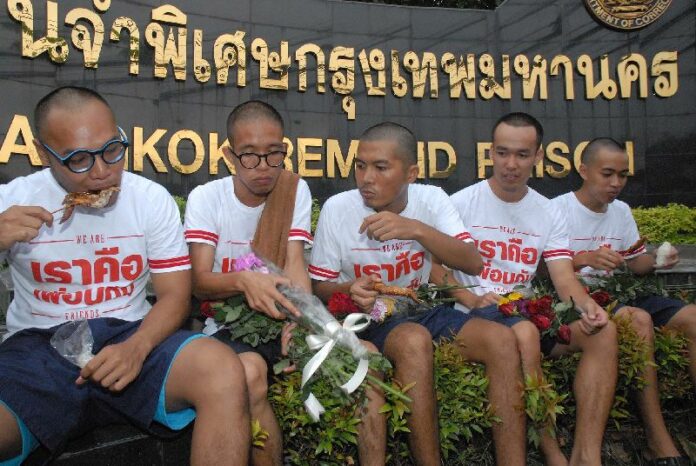
Activists eating grilled chicken after they are released from Bangkok Remand Prison on 8 July 2015.

BANGKOK — The fourteen activists charged with sedition for their peaceful anti-junta campaigns have been released from prison, though they are still facing a trial in martial court and up to seven years in jail.

The fourteen, eleven of whom are university students, were arrested on 26 June after they organized a small pro-democracy rally in Bangkok last month. A military court ordered the group to await trial in prison, but decided to release them yesterday after 12 days, accepting their lawyers' argument that the defendants had no intention to flee the country or interfere with the evidence. 

However, a prison official said yesterday that the activists would not be released until this morning because prison regulations prohibit releasing  inmates at night.

Supporters and families of the fourteen activists camped out over night in front of Bangkok Remand Prison and Bangkok Central Women Correctional Institution, where thirteen men and one woman were held respectively, to await their release. 

At around 6 am, a large van drove out of the prison building compound, prompting supporters to run after the vehicle. The van stopped just outside the prison's outer gate, and the thirteen male activists stepped out of the vehicle to loud cheers from the crowd. 

Rangsiman Rome, one of the activists, told Matichon that he and others were well treated by prison wardens throughout their 12 days detention. He said he had to consult with his friends about the group’s next move.

"I insist that we will continue to fight," Rangsiman told Matichon. "I will not only ask for democracy. These arrests were not the end, but a new beginning of our struggle." 

He also said he and other activists never considered posting bail to secure their release because they believe the martial court has no legitimacy to try civilians.

The fourteenth activist, 22-year-old Chonticha Chaengrew, arrived in front of Bangkok Remand Prison later because officials from the women’s prison reportedly insisted on driving her her home, even though no one was there at the time.

Her family also said they were not contacted by the prison about the unusual arrangement.

The fourteen activists, who call themselves the New Democracy Movement, are still facing up to 7.5 years in prison for charges of violating the junta’s ban on public gatherings and "inciting unrest." They are also facing additional outstanding arrest warrants for organizing anti-junta demonstrations on the one-year anniversary of the 22 May coup d'etat. 

In addition to Rangsiman and Chonticha, the group includes Ratthapol Supasopon, Songtham Kaewpanpruek, Pornchai Yuanyee, Pakorn Arrekul, Abhisit Sapnaphana, Jatupat Boonpatararaksa, Apiwat Suntararak, Payu Bunsophon, Panupong Srithananuwat, Suwitcha Thipangkorn, Supachai Pukrongploy, and Wasan Sethsitthi.


For comments, or corrections to this article please contact: [email protected]

You can also find Khaosod English on Twitter and Facebook
http://twitter.com/KhaosodEnglish
http://www.facebook.com/KhaosodEnglish

Advertisement

Thai Beach Murder Trial Begins

An undated composite photo made available by Britain's Foreign and Commonwealth Office on 17 September 2014 shows Britons Hannah Witheridge (L) and David Miller (R), who were found murdered on the island of Koh Tao in Thailand on 15 September 2014. EPA

BANGKOK (DPA) — The trial for last year's beach murder of two British holidaymakers began in Thailand on Wednesday.

Two migrant workers from Myanmar are accused of the rape and murder of Hannah Witheridge and the murder of David Miller on the island resort of Koh Tao in southern Thailand.

The Samui provincial court on Wednesday summoned police forensics investigators to defend DNA evidence that has been widely questioned.

Suspects Zaw Lin and Wai Phyo were arrested in October and confessed, but later withdrew their statements saying they were tortured.

The families of the victims, also attending the trial, have expressed sympathy for the Myanmar suspects and reservations over the conduct of the investigation.

Activist group the Migrant Workers Right Network, which raised funds for the defence, said it welcomed the two families' attendance as "the most important trial observers."

Defence lawyer Nakhon Chomphuchat called on media to report the case in a "correct manner," and said he was confident the trial would demonstrate that the Thai justice system functions to international standards.


For comments, or corrections to this article please contact: [email protected]

You can also find Khaosod English on Twitter and Facebook
http://twitter.com/KhaosodEnglish
http://www.facebook.com/KhaosodEnglish

Advertisement

14 Anti-Junta Activists Freed From Pre-Trial Detention

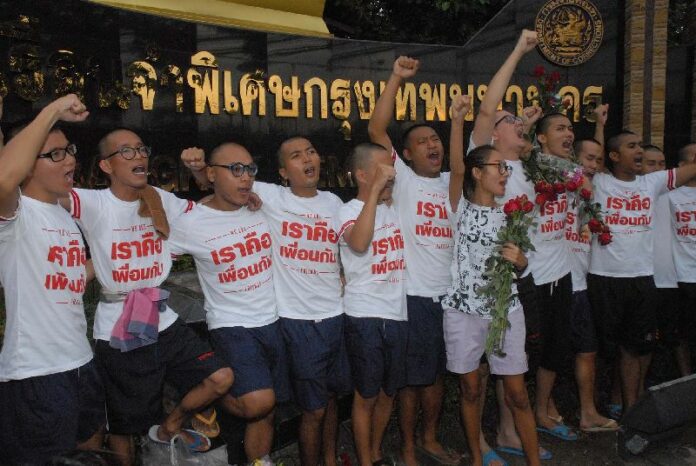
The 14 activists upon their release outside of Bangkok's Remand Prison, 8 July 2015.

BANGKOK — The fourteen activists charged with sedition for their peaceful anti-junta campaigns have been released from prison, though they are still facing a trial in martial court and up to seven years in jail.

The fourteen, eleven of whom are university students, were arrested on 26 June after they organized a small pro-democracy rally in Bangkok last month. A military court ordered the group to await trial in prison, but decided to release them yesterday after 12 days, accepting their lawyers' argument that the defendants had no intention to flee the country or interfere with the evidence. 

However, a prison official said yesterday that the activists would not be released until this morning because prison regulations prohibit releasing  inmates at night.

Supporters and families of the fourteen activists camped out over night in front of Bangkok Remand Prison and Bangkok Central Women Correctional Institution, where thirteen men and one woman were held respectively, to await their release. 

At around 6 am, a large van drove out of the prison building compound, prompting supporters to run after the vehicle. The van stopped just outside the prison's outer gate, and the thirteen male activists stepped out of the vehicle to loud cheers from the crowd. 

Rangsiman Rome, one of the activists, told Matichon that he and others were well treated by prison wardens throughout their 12 days detention. He said he had to consult with his friends about the group’s next move.

"I insist that we will continue to fight," Rangsiman told Matichon. "I will not only ask for democracy. These arrests were not the end, but a new beginning of our struggle." 

He also said he and other activists never considered posting bail to secure their release because they believe the martial court has no legitimacy to try civilians.

The fourteenth activist, 22-year-old Chonticha Chaengrew, arrived in front of Bangkok Remand Prison later because officials from the women’s prison reportedly insisted on driving her her home, even though no one was there at the time.

Her family also said they were not contacted by the prison about the unusual arrangement.

The fourteen activists, who call themselves the New Democracy Movement, are still facing up to 7.5 years in prison for charges of violating the junta’s ban on public gatherings and "inciting unrest." They are also facing additional outstanding arrest warrants for organizing anti-junta demonstrations on the one-year anniversary of the 22 May coup d'etat. 

In addition to Rangsiman and Chonticha, the group includes Ratthapol Supasopon, Songtham Kaewpanpruek, Pornchai Yuanyee, Pakorn Arrekul, Abhisit Sapnaphana, Jaturapak Boonpatararaksa, Apiwat Suntararak, Payu Bunsophon, Panupong Srithananuwat, Suwitcha Thipangkorn, Supachai Pukrongploy, and Wasan Sethsitthi.


For comments, or corrections to this article please contact: [email protected]

You can also find Khaosod English on Twitter and Facebook
http://twitter.com/KhaosodEnglish
http://www.facebook.com/KhaosodEnglish

Advertisement

Thailand's Top Brass Defends Plan to Spend 36 Billion Baht on Submarines

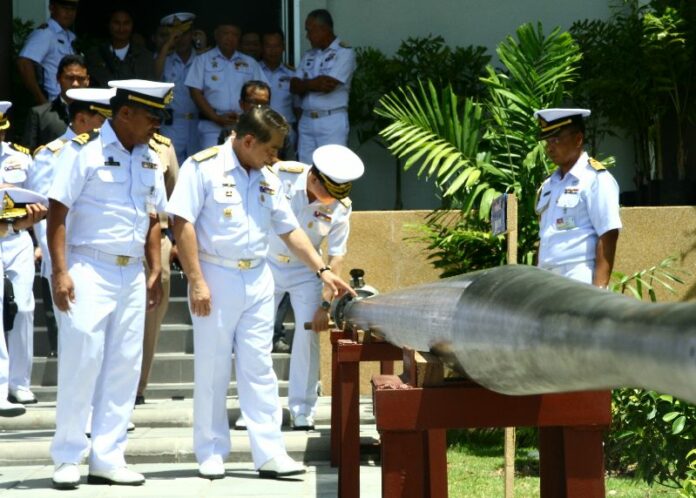
Then-Navy chief Admiral Narong Pipattanasai observes the remains of Thailand's last submarine during a visit to the headquarters of the Navy's submarine division on 7 July 2014 [Photo: Thai Navy website]

BANGKOK — Leading members of the ruling military junta and the Royal Thai Navy have insisted that a plan to buy three submarines from China is necessary to augment Thailand's national defense capabilities.

A Navy committee approved the plan to buy the three subs last week for 36 billion baht. The purchase is currently pending final approval from the Cabinet, which is headed by junta chairman and Prime Minister Prayuth Chan-ocha, who was chief of the army when he came to power through a coup in May 2014.

Although Thailand’s navy has maintained a submarine division, it has lacked a single vessel for the last 63 years. The army stripped the navy of its submarines in 1951 after naval officers attempted to stage a coup d'etat against the army-backed government at the time. 

Thailand’s social media has been awash with criticism of the new plan to purchase submarines, with commentators noting the enormous price tag, and questioning whether submarines are indeed vital to Thailand's strategic needs, as the country is not entangled in any major conflict with neighbors, and has not been invaded by sea since 1941.

"What the hell do you want from me?” Gen. Prayuth said today in response to the criticism.  "We have to look at the submarine issue step-by-step. If they can be bought, we have to see whether we need to buy them. Do we need them for combat, or not? Are we fighting anyone, or not? Do we have to take care of our resources, or not? Do we only have the Gulf of Thailand as our sea? We also have the Andaman Sea, do we not? Don't we have to protect our maritime resources? We won't keep them to fight or shoot at any one. We will keep them so that other people will be considerate of us. How we will maintain our navigation and fishing? You can see that other countries have problems in their seas. We have to think, are we going to have problems in the future? It's all about capability." 

When a reporter asked whether his government is attempting to strengthen ties with China by buying submarines manufactured there, he replied, "There is no need for that. We have a good relationship with China already. Every country is good to us, except those who are still stuck on the word 'democracy'. I'm not telling you this to show off." 

Meanwhile, Admiral Kraison Chansuwanit, the commander of the Thai Navy, said the public should refrain from commenting on what he described as the navy’s internal matters.

"I don't want the public to criticize us at this time. They have to think that each person has their own duty. The armed forces are the fence of the nation. I am a Navy officer, so I am responsible for the Navy. Each person should look to their own duty. Don't interfere with each other. Learn to listen. Don't only criticize, because the opportunity to have or buy submarines is hard to come by. It will take seven years just to acquire the submarines. And then we will train our force."

Adm. Kraison also said that the submarine fleet would come in handy in the event of war.

"If a war breaks out, nearly all of our surface ships will be wiped out. Submarines are what will survive,” he said. “I don't understand why we can't buy submarines, but we can buy other things. When I talk about submarines, people think about this and that. The Gulf of Thailand isn't so shallow that we can't use submarines. We have already studied it in details." 

The admiral then explained that China has offered Thailand the best deal: three submarines with free weapons and spare parts. 

"You should trust in the Navy," Adm. Kraison said. "If you only think ‘this cannot be done, that cannot be done,’ then you should just serve in the Navy so that you will know how things really are. It's not easy to be Navy officers. People who have to be on ships or dive in the submarines for 21 days and not see any sun or moon, how much they have sacrificed for the country. You say it will cost a lot of money to buy submarines. Well, it's my money, too. It's the money of all of us, because it's tax money." 

For comments, or corrections to this article please contact: [email protected]

You can also find Khaosod English on Twitter and Facebook
http://twitter.com/KhaosodEnglish
http://www.facebook.com/KhaosodEnglish

Advertisement

Thailand's Top Brass Defends Plan to Spend 36 Billion Baht on Submarines

Gen. Prayuth Chan-ocha at the Government House in Bangkok on 7 July 2015.

BANGKOK — Leading members of the ruling military junta and the Royal Thai Navy have insisted that a plan to buy three submarines from China is necessary to augment Thailand's national defense capabilities.

A Navy committee approved the plan to buy the three subs last week for 36 billion baht. The purchase is currently pending final approval from the Cabinet, which is headed by junta chairman and Prime Minister Prayuth Chan-ocha, who was chief of the army when he came to power through a coup in May 2014.

Although Thailand’s navy has maintained a submarine division, it has lacked a single vessel for the last 63 years. The army stripped the navy of its submarines in 1951 after naval officers attempted to stage a coup d'etat against the army-backed government at the time. 

Thailand’s social media has been awash with criticism of the new plan to purchase submarines, with commentators noting the enormous price tag, and questioning whether submarines are indeed vital to Thailand's strategic needs, as the country is not entangled in any major conflict with neighbors, and has not been invaded by sea since 1941.

"What the hell do you want from me?” Gen. Prayuth said today in response to the criticism.  "We have to look at the submarine issue step-by-step. If they can be bought, we have to see whether we need to buy them. Do we need them for combat, or not? Are we fighting anyone, or not? Do we have to take care of our resources, or not? Do we only have the Gulf of Thailand as our sea? We also have the Andaman Sea, do we not? Don't we have to protect our maritime resources? We won't keep them to fight or shoot at any one. We will keep them so that other people will be considerate of us. How we will maintain our navigation and fishing? You can see that other countries have problems in their seas. We have to think, are we going to have problems in the future? It's all about capability." 

When a reporter asked whether his government is attempting to strengthen ties with China by buying submarines manufactured there, he replied, "There is no need for that. We have a good relationship with China already. Every country is good to us, except those who are still stuck on the word 'democracy'. I'm not telling you this to show off." 

Meanwhile, Admiral Kraison Chansuwanit, the commander of the Thai Navy, said the public should refrain from commenting on what he described as the navy’s internal matters.

"I don't want the public to criticize us at this time. They have to think that each person has their own duty. The armed forces are the fence of the nation. I am a Navy officer, so I am responsible for the Navy. Each person should look to their own duty. Don't interfere with each other. Learn to listen. Don't only criticize, because the opportunity to have or buy submarines is hard to come by. It will take seven years just to acquire the submarines. And then we will train our force."

Adm. Kraison also said that the submarine fleet would come in handy in the event of war.

"If a war breaks out, nearly all of our surface ships will be wiped out. Submarines are what will survive,” he said. “I don't understand why we can't buy submarines, but we can buy other things. When I talk about submarines, people think about this and that. The Gulf of Thailand isn't so shallow that we can't use submarines. We have already studied it in details." 

The admiral then explained that China has offered Thailand the best deal: three submarines with free weapons and spare parts. 

"You should trust in the Navy," Adm. Kraison said. "If you only think ‘this cannot be done, that cannot be done,’ then you should just serve in the Navy so that you will know how things really are. It's not easy to be Navy officers. People who have to be on ships or dive in the submarines for 21 days and not see any sun or moon, how much they have sacrificed for the country. You say it will cost a lot of money to buy submarines. Well, it's my money, too. It's the money of all of us, because it's tax money." 

For comments, or corrections to this article please contact: [email protected]

You can also find Khaosod English on Twitter and Facebook
http://twitter.com/KhaosodEnglish
http://www.facebook.com/KhaosodEnglish

Advertisement

Junta Asks Overseas Thais to Explain Coup to Foreigners

Soldiers outside of the Army Club moments after Gen. Prayuth Chan-ocha announced a coup, 22 May 2014.

BANGKOK — The secretary-general of Thailand's ruling military junta has urged Thais living abroad to explain the reasons behind the May 2014 coup d'etat to foreigners.

"I want all of you who live abroad to explain the situation in our country to foreigners, so that they can understand what happened," said Gen. Chatchalerm Chalermsuk. "That the military does not want to hold on to power, and how we have been trying to restore peace in the country and move the nation forward, and enforce the laws." 

Gen. Chatchalerm made the remark in an address to representatives of a Boston-based Thai charity who met with him at Government House in Bangkok to donate one million baht to soldiers stationed in southern Thailand to combat a separatist insurgency. 

Gen. Chatchalerm said he has been explaining to foreign government officials during trips abroad that the military was forced to stage the coup on 22 May 2014 because the country’s political situation had reached a dead end.

"I have traveled to the United States and Australia to explain that this government will move along our road map, which will lead to an election," Gen. Chatchalerm said. "In the past, we had no exit, because the [former] government would not resign … And there were groups that came out to oppose the government. The military was afraid that it would lead to clashes. We could not let the situation to escalate beyond our control." 

The coup followed six months of street protests organized by a conservative, royalist movement called the People's Committee for Absolute Democracy With the King As Head of State (PCAD), which sought to replace then-Prime Minister Yingluck Shinawatra with a new leader directly appointed by the king. Nearly 30 people died in the protests, largely due to attacks on the protest camps committed by suspected pro-Yingluck militants, and clashes between protesters and security officers. 

On 7 May 2014, the Constitutional Court removed Yingluck from office for allegedly transferring an official without due cause, and the military staged a coup against the remnants of her government two weeks later. 

In today's speech, Gen. Chatchalerm also said he was concerned that some Thais are distorting information about the monarchy and the Kingdom’s lese majeste law, which forbids any criticism of the Royal Family. 

"Some people have fled their lese majeste charges to the United States. I don't know what the King has ever done wrong to these people," Gen. Chatchalerm said. "They have distorted the facts by saying that lese majeste has been used to score political gain. They break the laws, but they don't accept it when they are arrested. I have already explained to farang [Westerners] that His Majesty the King and the Royal Family would not file libel charges on their own, so officials must do it instead. We have never used this law for political gain."

Thailand’s lese majeste law, the harshest of its kind in the world, punishes any action or comment deemed negative of the monarchy with up to 15 years in prison. 

The number of lese majeste cases has spiked considerably since the May 2014 coup, which was led by staunch royalist Gen. Prayuth Chan-ocha. Nearly 50 people have been charged with lese majeste over the past year, and more than half of them have been denied bail while they await trial, according to iLaw, a watchdog group that tracks legal cases in Thailand.

The military government has also unsuccessfully sought to extradite lese majeste suspects who have fled abroad. Officials say 31 people charged with lese majeste are currently living in exile, with 14 of them residing in neighboring Laos.

For comments, or corrections to this article please contact: [email protected]

You can also find Khaosod English on Twitter and Facebook
http://twitter.com/KhaosodEnglish
http://www.facebook.com/KhaosodEnglish

Advertisement

Hot News

LATEST NEWS

Bangkok
scattered clouds
28.3 ° C
28.3 °
25 °
74 %
2.8kmh
46 %
Tue
38 °
Wed
37 °
Thu
36 °
Fri
37 °
Sat
37 °