
































32.3 C
Bangkok
Tuesday, June 23, 2026
Home Blog Page 2957

Chai Nat Farmers Fight Drought With Cat Doll

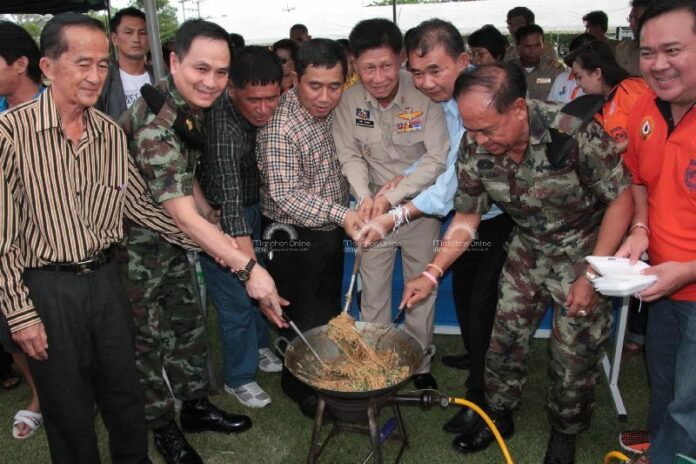
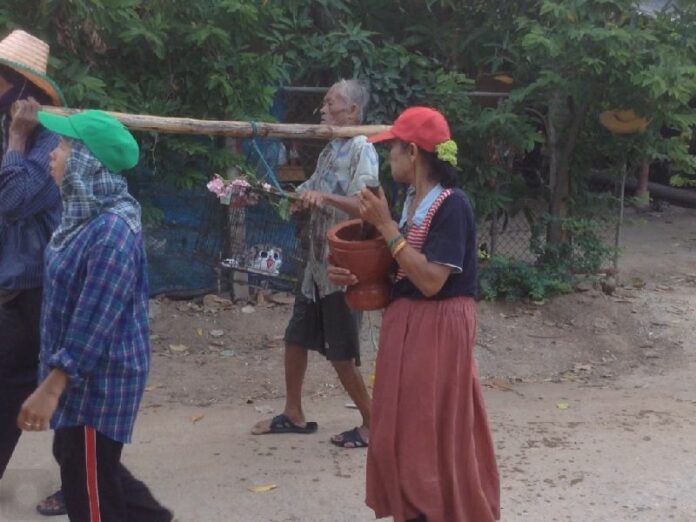
Farmers in Chainat use a Japanese doll in a traditional rain-summoning ceremony, 5 July 2015.

CHAI NAT — Farmers in central Thailand resorted to substituting a live cat with a Japanese doll in a traditional rain-summoning ceremony yesterday, amid a drought crisis that is choking many parts of the country.

Ratri Homhuan, a local leader in Suea Hok subdistrict, led the ceremony, which normally involves farmers carrying a live cat in a small wooden cage.

The tradition is rooted in a Thai folk belief that cats are magical creatures who can communicate with spirits and gods.

However, farmers in Suea Hok subdistrict chose to use a stuffed toy of a Japanese comic kitten called “Chi” instead of a real cat to avoid accusations of animal cruelty, Ratri said.

“The governor has told us that if we use a real cat, it may be considered animal cruelty and a violation of the Animal Welfare Act,” Ratri told Khaosod, referring to the animal protection law that was passed last year and is the first legislation of its kind in Thailand.

\
The Japanese doll named “Chi” used in the rain-summoning ceremony in Chai Nat province, 5 July 2015.

Another group of farmers in Wang Luang subdistrict of Phrae province also made headlines last week for using the famous Japanese robot-cat character “Doraemon” in their rain-summoning procession.

Forty out of Thailand’s 77 provinces, mostly rice-farming country north and northeast of Bangkok, have been stricken with drought for the past few weeks. Thai authorities have enacted a number of emergency measures to ease the crisis, including releasing artificial rain, distributing free water in villages, and opening reservoirs to farmlands in some areas.

Chatchai Promlert, director of Disaster Prevention and Relief Department, said heavy rain over the weekend brought some relief to 27 provinces, bringing the number of severely-afflicted provinces to 13 by Monday.

While Thailand’s Animal Welfare Act has been hailed as an important step forward for protecting wildlife and domestic animals in the Kingdom, the legislation has also been criticized for its lack of specificity.

Last week, five men in Buriram province were questioned by police after they posted photos of themselves preparing and eating cat, which they said they found dead on the side of the road. Police said they were investigating whether the men had violated the animal cruelty law, which stipulates in vague terms that only animals which are “raised to be eaten” can be slaughtered for that purpose.

Violating the law carries up to two years in prison.
Advertisement

'Drunk' Traffic Cop Surrenders to Police [+video]

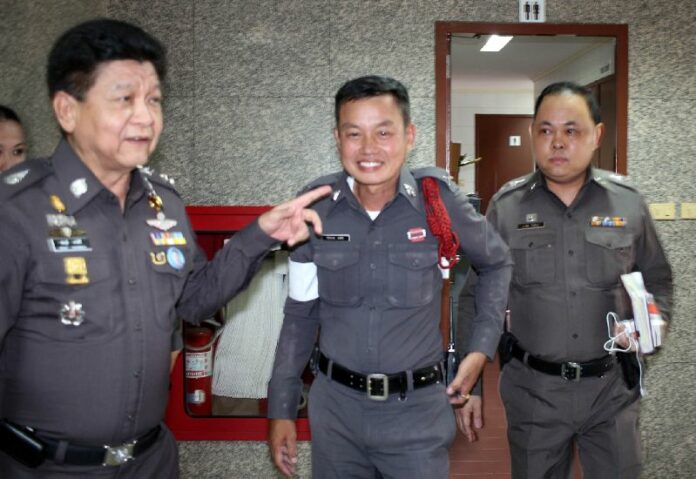
Pol.Sen.Sgt.Maj. Chakkrawan Wongchai (center) surrendered to police on 6 July 2015.

BANGKOK — Thai police are investigating a traffic cop who was filmed admitting that he was "a little bit drunk" while manning a road checkpoint in Bangkok last week.

The video, filmed on a phone and posted on social media over the weekend, shows the officer speaking incoherently to a motorist who he waved down at the checkpoint, prompting the driver to ask if he was drunk.

The following is an excerpt from their conversation:

Officer: I am drunk, but I don't drive!

Motorist: But you are a cop. You are on duty. 

Officer: I know. 

Motorist: So you're really drunk?

Officer: Well, a little bit drunk. 

The officer then scolds the driver for recording the encounter, and challenges him to "go ahead and share it" on social media.

The original version of the video was later deleted, but not before it was widely shared on social media.

Several hours after Thailand’s police chief announced that officers were investigating the incident this morning, Pol.Sen.Sgt.Maj. Chakkrawan Wongchai identified himself as the traffic cop in the video.

After speaking to Pol.Sen.Sgt.Maj. Chakkrawan in private, police spokesperson Pol.Lt.Gen. Prawuth Thawornsiri said an investigation committee is still looking into whether Chakkrawan was drunk while he was on duty.

Chakkrawan's colleagues reportedly told Pol.Lt.Gen. Prawuth that he often "sounds like a drunk person" when he speaks. Nevertheless, Pol.Lt.Gen. Prawuth said he has established that Chakkrawan "spoke inappropriately" to the motorist. 

"At the same time, we are trying to contact the person who recorded and published this video clip, so that he can provide us with information about what happened," Pol.Lt.Gen. Prawuth said. "We want to know about what was said during the inspection, whether there were harsh words spoken on both sides."

He added, "Recording videos is not illegal, as long as it doesn't damage other people or spread false information."

Speaking to reporters this morning, police chief Pol.Gen. Somyot Pumpanmuang noted that "this is not the first time" citizens have published videos of policemen behaving inappropriately.

"If this is indeed a wrongdoing, we will punish him without giving him any exception, because it is very inappropriate," Pol.Gen. Somyot said. 


For comments, or corrections to this article please contact: [email protected]

You can also find Khaosod English on Twitter and Facebook
http://twitter.com/KhaosodEnglish
http://www.facebook.com/KhaosodEnglish

Advertisement

Martial Court to Rule on Release of 14 Anti-Junta Dissidents Tomorrow

Chiang Mai residents hung post-it notes expressing support for the 14 pro-democracy activists jailed in Bangkok, 5 July 2015.

BANGKOK — Bangkok's military court will rule tomorrow on whether to extend the detention of fourteen anti-junta activists amid mounting support from the public to release the group.

One of the activists' lawyers, Kritsadang Nutcharus, said his legal team will ask the court to release the 14 activists, most of whom are students, on the grounds that they have no intention to flee the country.

The fourteen activists, who are facing charges of violating the junta's ban on protests and inciting unrest, were sent to jail by the court after they were arrested on 26 June for leading a peaceful pro-democracy rally in Bangkok. If found guilty, they face up to seven and a half years in prison. 

Under Thai laws, a court can order suspects to be remanded in prison for 12 days at a time. The session can be extended by the court up to seven times.

"If the court approves the second remand session, the students will have be to detained in prison, as they were," Kritsadang said. "But no matter how the court will rule, as a lawyer I will accept the decision, and I will contest the remand when the next session ends." 

Kritsadang said the activists remain in good spirits, although some of them have picked up minor illnesses in prison.

"The students insist to carry on their fight, because they are confident they are doing the right thing," he said. 

Over the past week, hundreds of Thais have defied the junta's ban on political gatherings to show their support for the activists, who have pledged not to apply for bail because they reject the military court's legitimacy to try civilians. The ruling junta granted military courts jurisdiction over "national security" cases after seizing power in a coup in May 2014.

\
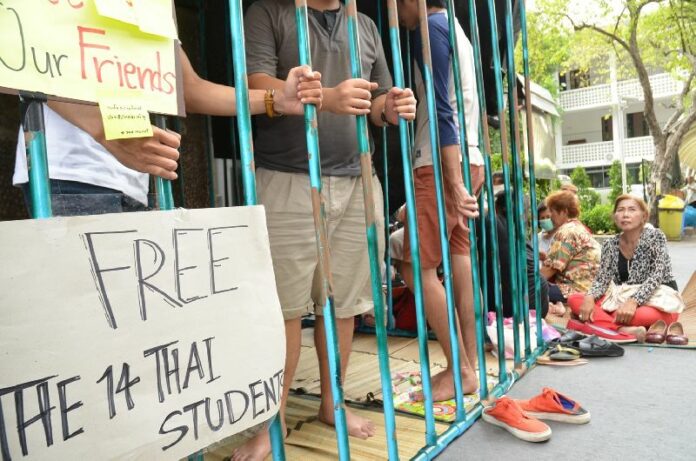
Students inside a mock prison cell made of pipes at Thammasat University to show solidarity with the 14 activists in jail, 5 July 2015.

The latest public show of solidarity for the group took place last night when over 200 people gathered in front of Chiang Mai University and hung post-it notes on the university's gate expressing support for the imprisoned activists. Some post-it notes also repeated the activists' core values of "democracy, human rights, public participation, justice, and non-violence." A similar event was held in Bangkok on Friday night. 

Approximately 200 security officers, mostly soldiers from 33rd Development Corps, observed the event in Chiang Mai but did not interfere. The activists dispersed peacefully from the scene shortly after sundown. 

In Bangkok, allies of the activists have held nightly candlelight vigils and gatherings, mostly in front of the prison where the group is being detained. 

Some students have also staged daily sit-ins inside a mock prison cell made of pipes at Thammasat University in Bangkok to show their solidarity with the fourteen, eleven of whom are university students as well.

So far, leading members of the junta have dismissed calls from the public – and bodies like the UN and EU – to release the activists.

Gen. Udomdet Sitabutr, commander of the Thai army and secretary of the ruling military junta, repeated this morning that authorities have no plans to interfere with the judicial process.

"They [the fourteen] have committed actions that are inappropriate. Their actions caused unrest and violated the laws, and violated the rules that the NCPO has set down for the sake of peace," he said, referring to the junta's National Council for Peace and Order. "We started by warning them, step by step. But they still did things that could lead to unrest and affect the country’s stability in the future. In the end, we are letting the laws handle them." 

"We cannot neglect this issue," he continued. "Otherwise, problems will develop gradually and lead to other troubles, and unrest. We see disaster looming ahead of us. I am confident that the people understand this … Allow me to insist that the government and the NCPO do not see any group of people as our enemies. We are not fighting anyone. We are merely taking care of and building peace in the society, in order to lead to a correct form of democracy in the future." 


For comments, or corrections to this article please contact: [email protected]

You can also find Khaosod English on Twitter and Facebook
http://twitter.com/KhaosodEnglish
http://www.facebook.com/KhaosodEnglish

Advertisement

Martial Court to Rule on Release of 14 Anti-Junta Dissidents Tomorrow

Students inside a mock prison cell made of pipes at Thammasat University to show solidarity with the 14 activists in jail, 5 July 2015.

BANGKOK — Bangkok's military court will rule tomorrow on whether to extend the detention of fourteen anti-junta activists amid mounting support from the public to release the group.

One of the activists' lawyers, Kritsadang Nutcharus, said his legal team will ask the court to release the 14 activists, most of whom are students, on the grounds that they have no intention to flee the country.

The fourteen activists, who are facing charges of violating the junta's ban on protests and inciting unrest, were sent to jail by the court after they were arrested on 26 June for leading a peaceful pro-democracy rally in Bangkok. If found guilty, they face up to seven and a half years in prison. 

Under Thai laws, a court can order suspects to be remanded in prison for 12 days at a time. The session can be extended by the court up to seven times.

"If the court approves the second remand session, the students will have be to detained in prison, as they were," Kritsadang said. "But no matter how the court will rule, as a lawyer I will accept the decision, and I will contest the remand when the next session ends." 

Kritsadang said the activists remain in good spirits, although some of them have picked up minor illnesses in prison.

"The students insist to carry on their fight, because they are confident they are doing the right thing," he said. 

Over the past week, hundreds of Thais have defied the junta's ban on political gatherings to show their support for the activists, who have pledged not to apply for bail because they reject the military court's legitimacy to try civilians. The ruling junta granted military courts jurisdiction over "national security" cases after seizing power in a coup in May 2014.

\
Chiang Mai residents hung post-it notes expressing support for the 14 pro-democracy activists jailed in Bangkok, 5 July 2015.

The latest public show of solidarity for the group took place last night when over 200 people gathered in front of Chiang Mai University and hung post-it notes on the university's gate expressing support for the imprisoned activists. Some post-it notes also repeated the activists' core values of "democracy, human rights, public participation, justice, and non-violence." A similar event was held in Bangkok on Friday night. 

Approximately 200 security officers, mostly soldiers from 33rd Development Corps, observed the event in Chiang Mai but did not interfere. The activists dispersed peacefully from the scene shortly after sundown. 

In Bangkok, allies of the activists have held nightly candlelight vigils and gatherings, mostly in front of the prison where the group is being detained. 

Some students have also staged daily sit-ins inside a mock prison cell made of pipes at Thammasat University in Bangkok to show their solidarity with the fourteen, eleven of whom are university students as well.

So far, leading members of the junta have dismissed calls from the public – and bodies like the UN and EU – to release the activists.

Gen. Udomdet Sitabutr, commander of the Thai army and secretary of the ruling military junta, repeated this morning that authorities have no plans to interfere with the judicial process.

"They [the fourteen] have committed actions that are inappropriate. Their actions caused unrest and violated the laws, and violated the rules that the NCPO has set down for the sake of peace," he said, referring to the junta's National Council for Peace and Order. "We started by warning them, step by step. But they still did things that could lead to unrest and affect the country’s stability in the future. In the end, we are letting the laws handle them." 

"We cannot neglect this issue," he continued. "Otherwise, problems will develop gradually and lead to other troubles, and unrest. We see disaster looming ahead of us. I am confident that the people understand this … Allow me to insist that the government and the NCPO do not see any group of people as our enemies. We are not fighting anyone. We are merely taking care of and building peace in the society, in order to lead to a correct form of democracy in the future." 


For comments, or corrections to this article please contact: [email protected]

You can also find Khaosod English on Twitter and Facebook
http://twitter.com/KhaosodEnglish
http://www.facebook.com/KhaosodEnglish

Advertisement

Japanese Investors Temper Interest With Caution in Myanmar

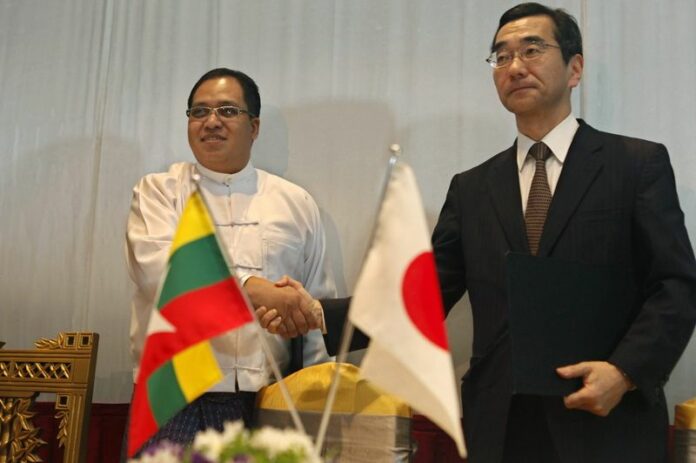
Nobuhiko Sasaski (R), Japan's Vice Minister of Economy, Industry and Trade Ministry, and Myanmar's Deputy Minister of National Planning and Economic Development Set Aung (L) in Yangon, Myanmar, 21 December 2012. EPA/LYNN BO BO

TOKYO (DPA) — Kyoko Okutani made her fourth trip to Myanmar in early June to explore more business opportunities in the South-East Asian country, this time inviting designers from Japan.

Okutani, the head of Women's World Banking Japan, said she is enchanted by Myanmar.

"Myanmar has untapped potential and a distinctive culture such as hand-woven textiles," said Okutani, an author of several books who has helped more than 1,000 women launch their own enterprises in Japan.

Okutani and the designers visited Myitkyina in northern Myanmar, and Nyaungshwe and Mandalay in the central part of the country. The highlight of their trip was to travel to Lake Inle to meet artisans and see lotus fabric, which is considered to be more precious than silk, she said.

Like Okutani's group, more Japanese businesses have been seeking a foothold in Myanmar since the country's liberalising reforms under President Thein Sein.

The Japanese government has wasted no time boosting its economic clout. On Saturday, Prime Minister Shinzo Abe pledged nearly 100 billion yen (813 million dollars) in low-interest loans to Myanmar to help develop infrastructure in a meeting with the president, which was held on the sidelines of the Mekong-Japan summit.

In 2012, Japan also decided to waive 3.7 billion dollars of old debt and resume full financial aid for the first time in 25 years.

The number of Japanese visitors who arrived at Yangon Airport tripled from 21,264 in 2011 to 66,187 in 2013, the second highest number after Thailand, according to the Japan External Trade Organization, which supports Japanese businesses abroad.

Most of them flew to the country on business, said Masaki Takahara, executive managing director of the organization's Yangon office.

The Japan Chamber of Commerce in Yangon saw its membership grow fourfold in the past three years to 205 companies as of December 2014.

Japanese investment, however, accounted for less than 1 per cent of a total amount of foreign investment in Myanmar from 1989 to October 2014, Jetro said, citing the country's government data. China was responsible for 29 per cent, Thailand for 20 per cent and Singapore for 14 per cent.

Myanmar has a range of problems that are barriers to investors.

"The biggest problem is shortage of electricity. They often suffer from power outages," Takahara said.

Another major problem is the vulnerability of the country's infrastructure such as roads, railways, communications, water supply and sewage systems.

So far, the number of existing Japanese manufacturers is only 10, most of which operate garment factories, Takahara said.

Daieikiseifuku Corp of Nagoya, central Japan, opened a clothing factory in Myanmar as early as in 2002 "to diversify risk and cut costs," said the company whose other overseas plant is in China.

In 2007, the company started to produce 21,000 business suits a month in Myanmar with 1,150 local employees, it said.

Many Japanese companies that have already launched businesses in the newly emerging economy are in the service sector, such as logistics and construction companies, law firms, accounting offices and consulting businesses, Takahara said.

In addition, in Yangon alone, there are 80 to 100 Japanese restaurants and seven free Japanese-language newspapers, the organization said.

That is because they expect an increasing number of Japanese companies to start doing business in the country, Takahara said.

In fact, when the Thilawa special industrial zone, 23 kilometres south-east of Yangon, is opened in the summer, 21 of the 40 companies that have taken units there will be Japanese, the trade group said.

Japanese firms can find several advantages in Myanmar such as rich natural resources and the cheapest labour in the region.

Myanmar also shares borders with China and India, two of the world's largest markets.

Myanmar is a "safe place," Takahara said. "There is also a friendly feeling toward Japan," despite Japan's brutal occupation of the country during World War II.

"You will also find more English-speaking people" in Myanmar, Okutani said.

In Japan, more seminars and conferences on business opportunities in Myanmar have been held not only in Tokyo but also outlying regions as a variety of companies are considering business opportunities there.

More Japanese companies "show growing interest" in Myanmar, said Keiji Kubo, an official at the government's Shikoku bureau of Economy, Trade and Industry in Takamatsu on the south-western island of Shikoku.

Kubo's office has held three seminars on Myanmar in the last two years and is planning the fourth soon.

Okutani said her group has already planned to launch a food-processing plant in Myitkyina.

"We're also considering the creation of products with local fabrics."

(Reporting by Takehiko Kambayashi)


For comments, or corrections to this article please contact: [email protected]

You can also find Khaosod English on Twitter and Facebook
http://twitter.com/KhaosodEnglish
http://www.facebook.com/KhaosodEnglish

Advertisement

Two Muslims Wounded in Deep South Shooting

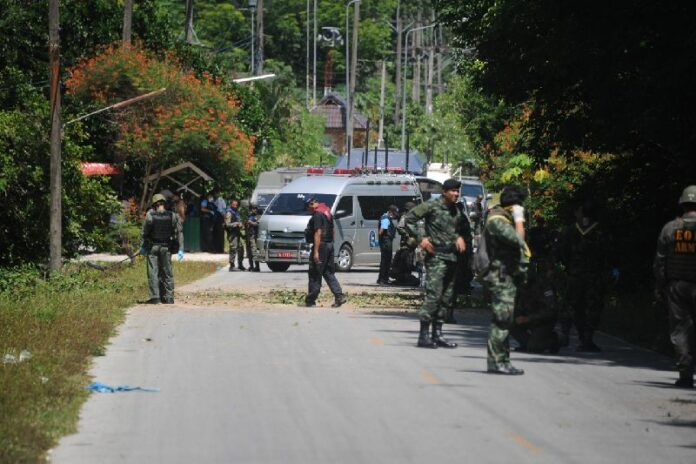
Security officers at the site of a roadside bombing in Narathiwat province on 4 July 2015.

NARATHIWAT — Two Muslim men who were returning home from a mosque in the southern border province of Narathiwat last night were shot and wounded by gunmen on a motorcycle, police told reporters today.

The two men were flanked by the assailants while they were riding a motorcycle home from Lubobatu mosque at around 11pm, said Pol.Maj. Naret Pumkaew, an investigative officer at Ra-Ngae Police Station.

The men, aged 36 and 48, are being treated at hospital and are still in “critical condition,” he said. Police have collected several bullet cases from the crime scene for investigation. 

Pol.Maj. Naret told reporters he believes the attack was "committed by groups who want to cause unrest" in the region, a state euphemism for the shadowy Islamic militants that stage regular attacks in the southern border provinces of Narathiwat, Yala, and Pattani. 

Most of the near-daily shootings and bombings are directed at soldiers and police in the region, which has been under martial law for more than nine years. Public schools and teachers are also frequently targeted.

More than 6,200 people have died in the decade-long insurgency, which aims to secede the Muslim-majority region, known colloquially as the Deep South, and create a breakaway Islamic nation.

Although the insurgency is waged by several Islamic militant networks, some pro-state, Buddhist vigilante groups are also known to operate in the area. 

Over the weekend, a roadside bomb exploded while a convoy of military officers were passing by in Narathiwat province. No one was injured in the blast, police said.

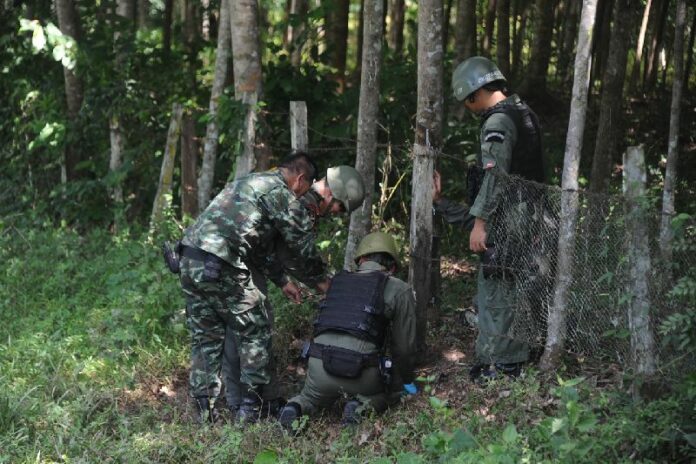
Pol.Col. Reungsak Baudang, commander of Rue So Police Station, said security officers later found two more bombs on the side of the road while sweeping the area for evidence. The two bombs were eventually defused, Pol.Col. Reungsak said. 

The officer said he believes the bombs were placed by insurgents who intended to wound or kill the soldiers.


For comments, or corrections to this article please contact: [email protected]

You can also find Khaosod English on Twitter and Facebook
http://twitter.com/KhaosodEnglish
http://www.facebook.com/KhaosodEnglish

Advertisement

Two Muslims Wounded in Deep South Shooting

Soldiers defuse a roadside bomb in Narathiwat province on 4 July 2015.

NARATHIWAT — Two Muslim men who were returning home from a mosque in the southern border province of Narathiwat last night were shot and wounded by gunmen on a motorcycle, police told reporters today.

The two men were flanked by the assailants while they were riding a motorcycle home from Lubobatu mosque at around 11pm, said Pol.Maj. Naret Pumkaew, an investigative officer at Ra-Ngae Police Station.

The men, aged 36 and 48, are being treated at hospital and are still in “critical condition,” he said. Police have collected several bullet cases from the crime scene for investigation. 

Pol.Maj. Naret told reporters he believes the attack was "committed by groups who want to cause unrest" in the region, a state euphemism for the shadowy Islamic militants that stage regular attacks in the southern border provinces of Narathiwat, Yala, and Pattani. 

Most of the near-daily shootings and bombings are directed at soldiers and police in the region, which has been under martial law for more than nine years. Public schools and teachers are also frequently targeted.

More than 6,200 people have died in the decade-long insurgency, which aims to secede the Muslim-majority region, known colloquially as the Deep South, and create a breakaway Islamic nation.

Although the insurgency is waged by several Islamic militant networks, some pro-state, Buddhist vigilante groups are also known to operate in the area. 

Over the weekend, a roadside bomb exploded while a convoy of military officers were passing by in Narathiwat province. No one was injured in the blast, police said.

Pol.Col. Reungsak Baudang, commander of Rue So Police Station, said security officers later found two more bombs on the side of the road while sweeping the area for evidence. The two bombs were eventually defused, Pol.Col. Reungsak said. 

The officer said he believes the bombs were placed by insurgents who intended to wound or kill the soldiers.


For comments, or corrections to this article please contact: [email protected]

You can also find Khaosod English on Twitter and Facebook
http://twitter.com/KhaosodEnglish
http://www.facebook.com/KhaosodEnglish

Advertisement

11-Year-Old Girl Injured by Bomb at School

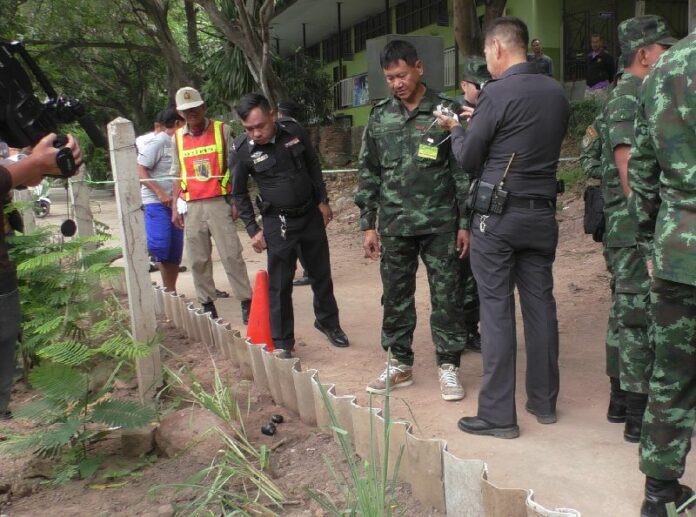
Soldiers and police investigate the site where a homemade bomb exploded in a schoolyard in Chainat province, 6 July 2015.

CHAI NAT – A homemade bomb exploded and injured an eleven-year-old girl while she was cleaning her school grounds in central Thailand this morning, police said.

According to police, the fifth-grader at Wat Thammamul School in Mueang district was assigned to clean the area around the school with a broom stick and came across a black-wrapped object on the ground. She then swept it with the broom and the object exploded near her leg.

The blast slightly injured both of her legs, and school staff provided her with first aid.

The girl’s teacher, Prapaisri Deeprasith, said a group of students ran to inform her about the explosion this morning, so she roped off the area and called police to investigate the incident.

Police found three more explosives nearby and brought the bombs to a forensic evidence unit for futher investigation.

Pol.Lt. Kritsada Thani, an officer at Chai Nat Police Station, said he believes the explosives were abandoned by teenage gangs who fought with rival gang members in the district last night.

Advertisement

Pro-Junta Activist Says Soldiers Accused Him of Backing Anti-Junta Students

Supot Piriyakiatsakul (L) with Yellowshirt and Redshirt leaders at an activity organized by the military to promote reconciliation in Nakhon Ratchasima, 6 June 2014. [Matichon]

NAKHON RATCHASIMA – A former leader of a local Yellowshirt organization in northeastern Thailand said soldiers have accused him of backing an anti-junta activist network, which he denied as he openly supports the current government.

Supot Piriyakiatsakul, 69, who has campaigned with the conservative Yellowshirt movement for years, told Khaosod that seven soldiers arrived at his home in Nakhon Ratchasima province on 2 July and sought to talk with him, though he was not home at the time. 

According to Supot, the soldiers identified themselves to his neighbors as officers from 21st Army District, and left a message for him before leaving the scene. 

They reportedly told Supot’s neighbors to tell him: "Don't get involved with Dao Din group. If you don't stop getting involved, and if you don't obey us, we will get involved with you.”

Dao Din is a social justice group formed by students at Khon Kaen University, and seven of its members are among the fourteen activists currently imprisoned in Bangkok for organizing a pro-democracy demonstration.

The fourteen are facing up to seven years in prison for charges of violating the junta's ban on public gatherings and inciting unrest. Bangkok’s martial court ordered them to be jailed while they await their trial. 

Members of the ruling military junta have alleged that the fourteen activists are backed by high-level politicians, but have not produced any evidence or publicly identified anyone by name.  

Supot said he phoned the commander of the 21st Army District and asked for an explanation, but was told that the visit was merely an "interaction," and that he had nothing to worry about. 

"This is an arrogant exercise of power," Supot said. "Throughout all this time, I and my fellow [activists] were united in showing our stance of supporting the government of General Prayuth Chan-ocha. We recently asked him to stay in power for a long time to solve the country's problems and deal with corrupt politicians. We have even traveled to Bangkok to show our support." 

Supot is a member of the Yellowshirt movement, which was formed a decade ago to protest former Prime Minister Thaksin Shinawatra and his successive political allies. In 2005-2006, Supot was a regional coordinator for the People's Alliance for Democracy, which sought to oust Thaksin and his government at the time.

In late 2013, Supot joined the People's Committee for Absolute Democracy With the King As Head of State – another reincarnation of the Yellowshirt movement – when it launched street protests to topple the government led by Thaksin’s sister, Yingluck Shinawatra. The campaign came to an end after then-army chief Gen. Prayuth seized power in a coup on 22 May 2014. 

In the wake of the May 2014 coup d'etat, Supot was one of the hundreds of activists, academics, and politicians summoned to army camps for up to seven days of "attitude adjustment" aimed at easing the country's political tensions.

"When the military summoned me for attitude adjustment, I joined it, and I showed my sincerity of wanting to build reconciliation and unity for people in the nation," Supot said. "Let me insist that I do not know Dao Din students at all. I have only been hearing about them in the news. There is no reason for me to be behind or give support to Dao Din."

He added, "This kind of net-casting is like pushing friends to join the opposition." 

Supot also said he would meet the army commander responsible for security operations in the province to show his "innocence" and inquire about the soldiers' visit on 2 July. 


For comments, or corrections to this article please contact: [email protected]

You can also find Khaosod English on Twitter and Facebook
http://twitter.com/KhaosodEnglish
http://www.facebook.com/KhaosodEnglish

 
Advertisement

Japan Pledges 6-Billion-Dollar Aid for Mekong Countries

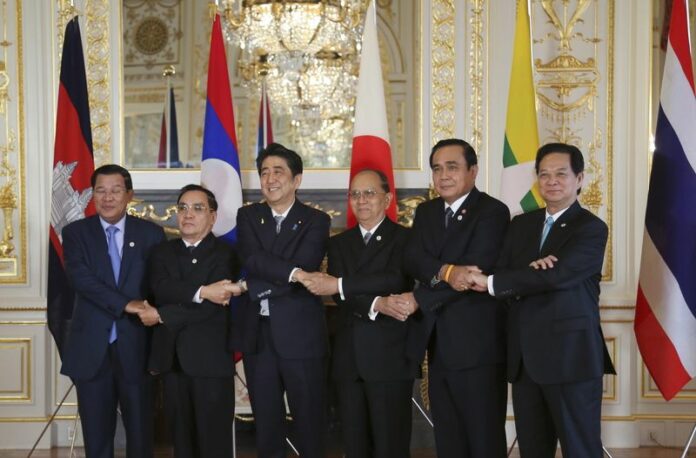
Leaders from rom Cambodia, Laos, Japan, Myanmar, Thailand, and Vietnam join hands for a group photo prior to the 7th Mekong-Japan Summit meeting at the Akasaka State Guest House in Tokyo, Japan, 04 July 2015. EPA/KOJI SASAHARA

TOKYO (DPA) — Japan pledged 750 billion yen (6.1 billion dollars) as a new development aid package for five countries along the Mekong River at a summit meeting in Tokyo Saturday.

Prime Minister Shinzo Abe met with the leaders of Cambodia, Laos, Myanmar, Thailand and Vietnam to adopt a new three-year development strategy to boost growth and connectivity in the South-East Asian region.

Japan hopes to distinguish its infrastructure development aid in the Mekong region from that of China, by promoting advanced Japanese technology, environment-friendly innovation and capacity-building schemes, Kyodo News agency reported, citing unnamed government officials.

Abe and the five countries' leaders agreed that the region has potential to be a "global growth centre" given its strategic location next to major Asian markets such as China and India.

"Peace and stability in the Mekong region, which is a strategic point for land and sea transportation, is extremely important for Japan," Abe said at the seventh Mekong-Japan summit.

Abe and the leaders "noted concerns expressed over the recent development in the South China Sea."

Recent satellite images released by a US research group showed China's construction of man-made islands in remote parts of the contested South China Sea is nearly finished.

The construction of a 3,000-metre airstrip on Fiery Cross Reef "is nearly complete," said the group, the Asia Maritime Transparency Initiative.

The leaders also said Saturday that recent developments in the South China Sea "will further complicate the situation and erode trust and confidence and may undermine regional peace, security and stability."

Japan's pledge comes less than a week after the new China-backed Asian Infrastructure Investment Bank was officially established in Beijing.


For comments, or corrections to this article please contact: [email protected]

You can also find Khaosod English on Twitter and Facebook
http://twitter.com/KhaosodEnglish
http://www.facebook.com/KhaosodEnglish

Advertisement

Hot News

LATEST NEWS

Bangkok
overcast clouds
32.3 ° C
34.4 °
30.5 °
62 %
4kmh
86 %
Tue
37 °
Wed
37 °
Thu
37 °
Fri
37 °
Sat
37 °