






























35 C
Bangkok
Wednesday, July 22, 2026
Home Blog Page 2970

Koh Tao Murders: Newspaper Apologizes for Implicating Official’s Son

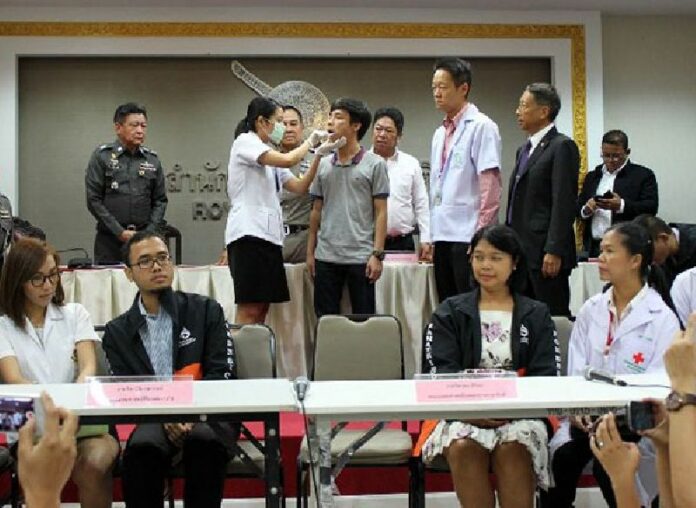
A police forensic technician takes a swab from the cheek of Warot  Toovichian at a 30 Oct. news conference in Bangkok.

BANGKOK — A Thai newspaper today published an apology for its coverage of the investigation into the murders of two British travelers in September on Koh Tao.

Khaosod newspaper apologized for two headlines suggesting the Warot Toovichian, the son of a village chief on Koh Tao, was responsible for the savage murders of British tourists David Miller and Hannah Witheridge on the island.

The newspaper also accused Warot, 22, of being the son of local “mafia” in two articles published on 24 and 25 Sept.

“We have verified facts and discovered that the aforementioned news items were inaccurate,” a statement published in today’s newspaper read.

In the statement published today, Khaosod said it was publicly apologizing as part of a settlement agreement with Warot, who filed a libel suit against the paper over its coverage.

It added the newspaper paid compensation of an undisclosed amount to Warot’s family.

Khaosod and Khaosod English are both owned by Matichon Group.

Miller and Witheridge were found dead on Haat Sai Ree beach on the island in the morning of 15 Sept., 2014. The two were bludgeoned to death and Witheridge was also raped, according to police.

EXPLORE: Timeline of the Koh Tao murders, investigation and trial

Two Burmese migrant workers were soon accused of the murders and are currently on trial. The two men, Zaw Lin and Wai Phyo, confessed to the crime upon their arrest in early October but later recanted, saying the confessions were beat out of them by police. Police have denied the allegation.

The pair has been held in prison since last October. If found guilty, they face the death penalty.

Observers and rights groups have accused authorities of using the migrant workers as scapegoats to sweep the matter under the rug.

Days before their arrest, police had identified Warot as a “primary suspect” on 24 Sept. and told media agencies they were seeking him for questioning. According to police reports at the time, Warot fled the island to Bangkok shortly after the murder.

However police later said they had established that Warot was in Bangkok at the time of the murders and was no longer considered a suspect. They later publicized the results of a DNA test they said cleared Warot of any connection to the murder.

Warot’s father, Woraphan Toovichien, also told reporters at a news conference his son was not involved in the killing and denied the characterization of his family as island “mafia.”

"We are not mafia or influential figures as reported in the news. My family has been helping authorities … and police in the investigation since the first day,” he said on 25 Sept. "The media coverage has saddened me. It's really serious, and it damages me, my family, and my relatives."

Related stories:

Koh Tao Murder: Top Forensic Scientist to Testify for Defense

Koh Tao Murder: More Forensic Evidence Available for Re-Test, Witness Reveals

Bangkok Suspect Cleared of Connection To Britons' Murder

Koh Tao Leader’s Son Cleared in First DNA Test: Police

Bangkok Suspect Cleared of Connection To Britons' Murder


To reach us about this article or another matter, please contact us by e-mail at: [email protected].

Follow Khaosod English on Facebook and Twitter for news, politics and more from Thailand.

Follow @KhaosodEnglish

\

Advertisement

Soldiers ‘Politely’ Stalk Pheu Thai Politician

Former Pheu Thai MP Wattana Muengsuk speaks to reporters in July about his petition to get a year-old travel ban lifted. Photo: Matichon TV

BANGKOK — A pair of soldiers shadowing a former politician who filed a lawsuit against the military government were only doing so to have a polite conversation with him, a government spokesman explained yesterday.

Responding to former Pheu Thai MP Wattana Muengsuk’s complaints that two soldiers came to his home Wednesday night to intimidate him, junta spokesman Winthai Suvaree told reporters yesterday the soldiers were merely making conversation with Wattana and ensuring he was safe.

“The officers were following guidelines to provide orderliness in a polite and respectful manner, as have been practised in the past,” Col. Winthai said at a news conference. “It was an effort to engage in conversation, exchange opinions and coordinate information.”

Earlier Thursday, Wattana accused authorities of trying to intimidate him over a lawsuit he filed Monday in the Upper Administrative Court seeking the repeal of a travel ban imposed by the regime on more than 100 people, mostly members of the former ruling Pheu Thai Party.

Wattana said the two soldiers came to his Bangkok home where they took photographs and grilled him about his daily activities. He said soldiers also visited his family home in Prachinburi province.

“What the soldiers were doing was intimidation and a violation of my right to privacy,” Wattana said, adding he had formally complained the junta, which is formally known as the National Council for Peace and Order.

But spokesman Winthai said the soldiers were dispatched to engage in conversation and provide security. He did not explain why the soldiers were sent or on whose orders, but instead opined on the usefulness of such interactions.

“In the past, we have received good cooperation. Some people even gave us constructive and useful suggestions,” Winthai said. “But sometimes, some individuals gave information based on their existing personal attitude, which have not considered circumstances and facts around them.”

Soon after it seized power, the junta forbade Wattana and others from leaving the country without its permission. After it rejected without explanation Wattana’s request to lift the ban in July, the 58-year-old Prachinburi native took his case to the court.

“I have to communicate this matter to the leader of the NCPO and to the people, who are my masters. I have always believed that the people are the owners of sovereign power,” Wattana said.

The former politician added, “I am never afraid of powers that do not come from the people. I have to say this because in the past year since you [the junta] have seized power, you have caused so much damage to this country. Otherwise, I wouldn’t waste my time talking about this. I would like to advise you to do something beneficial to the country, such as returning power to the people quickly.”

After staging the coup d’etat in May 2014, junta chairman and Prime Minister Prayuth Chan-ocha summoned hundreds of people, mostly politicians, activists, and academics for “attitude adjustment” sessions in army camps for up to two weeks. They were later released on the condition they would not engage in political activity.

Prayuth has also enacted a ban on protests, forums and other political activities, and sent violators of the ban to stand for trial in martial courts. The junta has insisted these clampdowns on civil rights are necessary to restore peace and order to the country, and that they are equally applied to all sides.

But Pheu Thai supporters and anti-coup activists have routinely complained they are on the losing side of a double standard and uneven enforcement.

Related stories:

Ex-Pheu Thai MP Appeals Junta’s Travel Ban

Junta Bars Pheu Thai Politician From Leaving Country


To reach us about this article or another matter, please contact us by e-mail at: [email protected].

Follow Khaosod English on Facebook and Twitter for news, politics and more from Thailand.

Follow @KhaosodEnglish

\

Advertisement

Deep South Ranger Assassinated at His Wedding

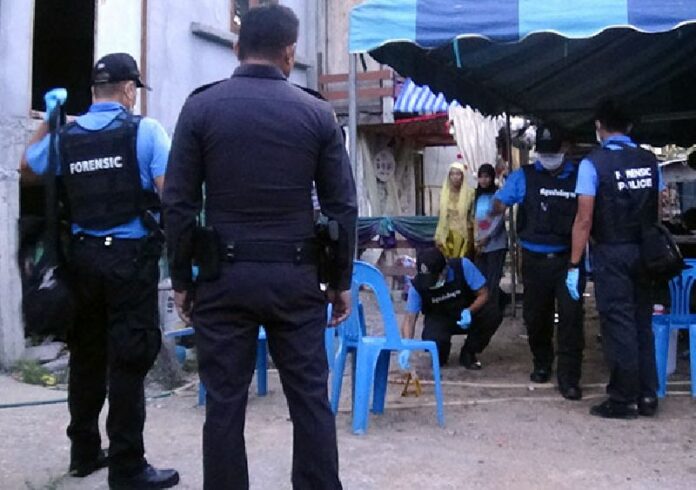
Investigators collect evidence at the scene where four gunmen shot an army ranger to death at his wedding reception yesterday in Pattani province.

PATTANI — Gunmen shot a Muslim army ranger to death at his wedding in the southern border province of Pattani yesterday – an attack authorities blame on local separatist militants.

The attack took place at a house in the Mueang district where the family of Ahmad Dao, a 28-year-old ranger, was hosting a wedding reception for him and his bride-to-be, police said.

“We believe this is an attempt to cause a bad situation by sympathizers of those who wish to cause unrest in the region,” Police Lt. Col. Anthee Ko-ari, an officer at a local police station, told reporters, using a state euphemism for secessionists who are battling to secede Pattani and its neighboring provinces from Thailand.

Ahmad and his bride, who was not identified, were welcoming guests to his wedding at around 5.20 pm when four men, who had arrived earlier and infiltrated the party, opened fire and shot Ahmad seven times before driving away, Anthee said.

Ahmad’s family rushed him to hospital but he later died of the injuries, Anthee said.

Police are investigating the attack.

According to data compiled by human rights groups, more than 6,000 people have died since the latest wave of separatist violence broke out in the Muslim-majority region, known as the Deep South, in January 2004.

The violence is believed to have been mostly perpetrated by a network of Islamic insurgents who aim to revive the independent nation of Patani, which was annexed by Thailand in 1902 and subsequently partitioned into the provinces of Pattani, Narathiwat and Yala.

At least 60,000 security officers have been stationed in the Deep South to combat the insurgency, including soldiers, marines, police officers and paramilitary army rangers.

Five people were killed and 14 injured in seven separates attacks between 6 Aug. and 12 Aug., according to Col. Pramote Prom-in, spokesperson of a counter-insurgency agency, the Internal Security Operation Command.

“The perpetrators of violence still create violent situations by planting bombs and shooting at security officers and civilians,” Pramote said at a news conference yesterday. “This is simultaneously done with efforts to spread the their ideology and distort facts, in order to discredit state power and spread paranoia in the region.”


Correction: An earlier version of this story indicated the attackers opened fire after pulling up on motorcycles. In fact they had earlier joined the wedding party before brandishing weapons and shooting the groom.


To reach us about this article or another matter, please contact us by e-mail at: [email protected].
Follow Khaosod English on Facebook and Twitter for news, politics and more from Thailand.

Follow @KhaosodEnglish

\

Advertisement

Deep South Ranger Assassinated at His Wedding

Family members console the bride of Army Ranger Ahmad Dao, 28, who was shot to death yesterday as he was welcoming guests to their wedding party in Pattani province.

PATTANI — Gunmen shot a Muslim army ranger to death at his wedding in the southern border province of Pattani yesterday – an attack authorities blame on local separatist militants.

The attack took place at a house in the Mueang district where the family of Ahmad Dao, a 28-year-old ranger, was hosting a wedding reception for him and his bride-to-be, police said.

“We believe this is an attempt to cause a bad situation by sympathizers of those who wish to cause unrest in the region,” Police Lt. Col. Anthee Ko-ari, an officer at a local police station, told reporters, using a state euphemism for secessionists who are battling to secede Pattani and its neighboring provinces from Thailand.

Ahmad and his bride, who was not identified, were welcoming guests to his wedding at around 5.20 pm when four men, who had arrived earlier and infiltrated the party, opened fire and shot Ahmad seven times before driving away, Anthee said.

\

Investigators collect evidence at the scene where four gunmen shot an army ranger to death at his wedding reception yesterday in Pattani province.

Ahmad’s family rushed him to hospital but he later died of the injuries, Anthee said.

Police are investigating the attack.

According to data compiled by human rights groups, more than 6,000 people have died since the latest wave of separatist violence broke out in the Muslim-majority region, known as the Deep South, in January 2004.

The violence is believed to have been mostly perpetrated by a network of Islamic insurgents who aim to revive the independent nation of Patani, which was annexed by Thailand in 1902 and subsequently partitioned into the provinces of Pattani, Narathiwat and Yala.

At least 60,000 security officers have been stationed in the Deep South to combat the insurgency, including soldiers, marines, police officers and paramilitary army rangers.

Five people were killed and 14 injured in seven separates attacks between 6 Aug. and 12 Aug., according to Col. Pramote Prom-in, spokesperson of a counter-insurgency agency, the Internal Security Operation Command.

“The perpetrators of violence still create violent situations by planting bombs and shooting at security officers and civilians,” Pramote said at a news conference yesterday. “This is simultaneously done with efforts to spread the their ideology and distort facts, in order to discredit state power and spread paranoia in the region.”


Correction: An earlier version of this story indicated the attackers opened fire after pulling up on motorcycles. In fact they had earlier joined the wedding party before brandishing weapons and shooting the groom.


To reach us about this article or another matter, please contact us by e-mail at: [email protected].

Follow Khaosod English on Facebook and Twitter for news, politics and more from Thailand.

Follow @KhaosodEnglish

\

Advertisement

Bus Crash Kills 16 Near Thai-Cambodian Border

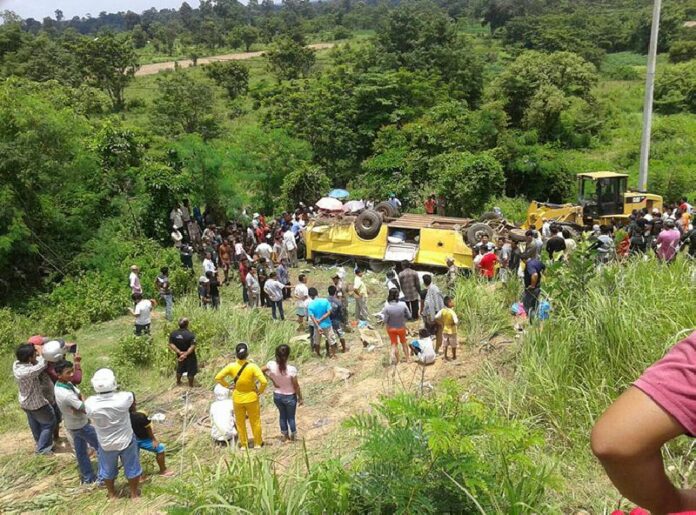
A tour bus returning to Cambodia from Thailand slid down a ravine and flipped, killing 16 passengers returning from a shopping trip.

SI SAKET — Sixteen people were killed when a tour bus traveling between Thailand and Cambodia fell into a ravine near the border yesterday.

The bus was carrying Cambodian tourists home after a sightseeing and shopping trip to a market in Si Saket province, according to an officer at the Si Saket border checkpoint, when it left the road near San Yai Mao Hill at about 11 am and plunged into a gulley about 3 kilometers inside Cambodia.

“This area is quite dangerous. Motorists who travel through the area of San Yai Mao Hill should exercise extreme caution,” Police Lt.Col. Setthapat said.

\

Police Lt. Col. Setthapat Na Songkhla told reporters the bus had left the market on the Thai side of the border and was making its way back to Phnom Penh when the accident happened, killing 16 people who died at the scene and seriously injuring 23 other passengers.

Some of the wounded were reportedly being treated in hospitals on the Thai side of the border.

Setthapat said another bus crash took place in the same area earlier this year, killing the deputy commander of the Cambodian Fourth Region Army and his assistant.


To reach us about this article or another matter, please contact us by e-mail at: [email protected].

Follow Khaosod English on Facebook and Twitter for news, politics and more from Thailand.

Follow @KhaosodEnglish

\

Advertisement

Court Cites ‘Reasonable Doubt’ in Acquittal of Lese Majeste Suspect

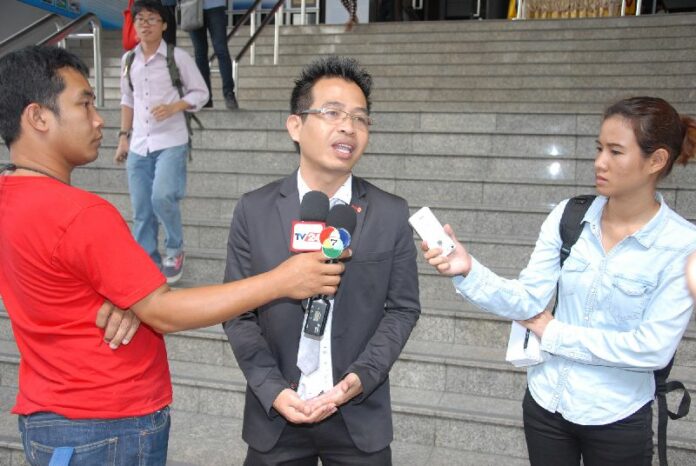
Surapak Phuchaisaeng speaks to reporters yesterday outside the Supreme Court. After four years and two prior acquittals by lower courts, the court issued a rare acquittal of a lese majeste case against the 44-year-old computer programmer.

BANGKOK — A long-running lese majeste case ended yesterday with a rare acquittal from the Supreme Court, which found a computer programmer not guilty of insulting the monarchy due to doubts about the evidence against him.

After four years of trial and appeals in the case against 44-year-old Surapak Phuchaisaeng, during one of which he was held in prison, the Supreme Court finally ruled in his favor yesterday, saying there were reasonable doubts about the integrity of the evidence presented against him.

Surapak was arrested in November 2011 and charged with violating Section 112 of the Thai Criminal Code, which outlaws any defamation of the monarchy. The law, which is also known as lese majeste, carries a maximum penalty of 15 years in prison.

Convictions under the offense have been growing increasingly more punitive. In the latest lese majeste cases, two courts 7 Aug. separately handed down a 30-year and 28-year sentences to a man from Kanchanaburi and a woman from Chiang Mai provinces, respectively.

Those record-breaking sentences drew condemnation for their severity.

“We are appalled by the shockingly disproportionate prison terms handed down over the past few months in lèse-majesté cases in Thailand,” the United Nations High Commissioner for Human Rights said in a statement Tuesday.

The statement also expressed alarm at the lack of free trial for lese majeste suspects, and called upon the Thai authorities to release those who are currently jailed for “exercising their freedom of expression.”

In Surapak’s case, the court ruled that the evidence, namely a laptop computer he used, could have been tampered with before it reached the court.

Surapak was accused of insulting the 87-year-old King Bhumibol on social media between 4 and 16 Nov. 2011. But according to the judges, the laptop confiscated from Surapak, who works as a programmer, was turned on twice prior to proper examination.

“Deliberation on the weight of evidence concerning computer data rests on the credibility of … storage of computer evidence, which must be preserved in its original form,” the verdict read. “Because each time a computer is turned on, a change [in data] will occur automatically, and the information may be amended or changed easily.”

The verdict continued, “Therefore, the court grants the defendant the benefit of the doubt. The court hereby affirm the verdicts previously reached by the Court of First Instance and the Court of Appeals.”

Both lower courts acquitted Surapak on the same grounds, but prosecutors appealed the verdicts.

Surapak was also placed in prison and denied bail throughout the trial in the first court, which lasted for a year and two months.

Speaking to reporters at the court yesterday, Surapak said he was confident that the information in his laptop computer was tampered with, especially the data that logged the websites he visited.

He also told reporters that he had much difficulty preparing his case in 2011 because he was put in prison at the time.

“It was very difficult for me to communicate with my lawyers. I had no tool to explain to the lawyers, because technical language about computers is very difficult to explain,” Surapak said.

Asked whether he would file charges against those who falsely accuse him of lese majeste, Surapak replied that he would have to discuss about it with his legal team first.

“I am pleased with the verdict because I have always insisted on my innocence. I am happy that the court allowed me the chances to explain my reasons. I thank the justice system. From now on, I will be able to invest and continue my business with a relieved heart,” Surapak added.

Surapak’s acquittal is a rare outcome in lese majeste trials. Suspects are usually forced to prove they are innocent of the charge, sometimes in a secret trial where reporters are not allowed to observe.

Related stories:

Record Sentences Today For Facebook Lese Majeste Offenses

30 Years In Prison For Facebooker Who ‘Insulted’ Monarchy


To reach us about this article or another matter, please contact us by e-mail at: [email protected].
Follow Khaosod English on Facebook and Twitter for news, politics and more from Thailand.

Follow @KhaosodEnglish

\

Advertisement

Court Cites ‘Reasonable Doubt’ in Acquittal of Lese Majeste Suspect

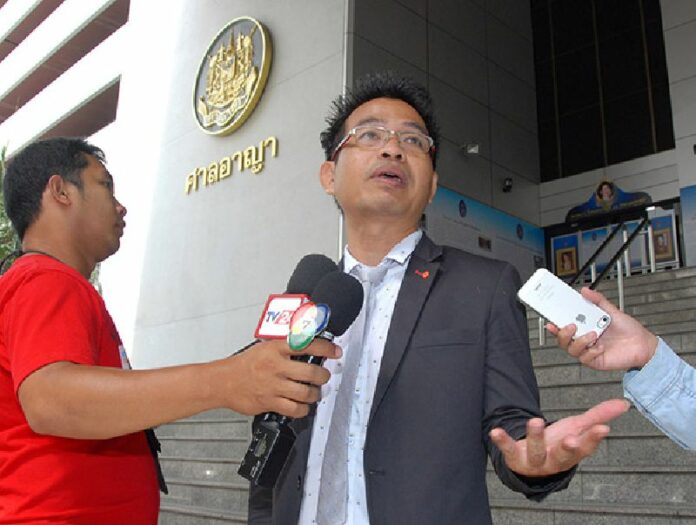
Surapak Phuchaisaeng speaks to reporters yesterday outside the Supreme Court. After four years and two prior acquittals by lower courts, the court issued a rare acquittal of a lese majeste case against the 44-year-old computer programmer.

BANGKOK — A long-running lese majeste case ended yesterday with a rare acquittal from the Supreme Court, which found a computer programmer not guilty of insulting the monarchy due to doubts about the evidence against him.

After four years of trial and appeals in the case against 44-year-old Surapak Phuchaisaeng, during one of which he was held in prison, the Supreme Court finally ruled in his favor yesterday, saying there were reasonable doubts about the integrity of the evidence presented against him.

Surapak was arrested in November 2011 and charged with violating Section 112 of the Thai Criminal Code, which outlaws any defamation of the monarchy. The law, which is also known as lese majeste, carries a maximum penalty of 15 years in prison.

Convictions under the offense have been growing increasingly more punitive. In the latest lese majeste cases, two courts 7 Aug. separately handed down a 30-year and 28-year sentences to a man from Kanchanaburi and a woman from Chiang Mai provinces, respectively.

Those record-breaking sentences drew condemnation for their severity.

“We are appalled by the shockingly disproportionate prison terms handed down over the past few months in lèse-majesté cases in Thailand,” the United Nations High Commissioner for Human Rights said in a statement Tuesday.

The statement also expressed alarm at the lack of free trial for lese majeste suspects, and called upon the Thai authorities to release those who are currently jailed for “exercising their freedom of expression.”

In Surapak’s case, the court ruled that the evidence, namely a laptop computer he used, could have been tampered with before it reached the court.

Surapak was accused of insulting the 87-year-old King Bhumibol on social media between 4 and 16 Nov. 2011. But according to the judges, the laptop confiscated from Surapak, who works as a programmer, was turned on twice prior to proper examination.

“Deliberation on the weight of evidence concerning computer data rests on the credibility of … storage of computer evidence, which must be preserved in its original form,” the verdict read. “Because each time a computer is turned on, a change [in data] will occur automatically, and the information may be amended or changed easily.”

The verdict continued, “Therefore, the court grants the defendant the benefit of the doubt. The court hereby affirm the verdicts previously reached by the Court of First Instance and the Court of Appeals.”

Both lower courts acquitted Surapak on the same grounds, but prosecutors appealed the verdicts.

Surapak was also placed in prison and denied bail throughout the trial in the first court, which lasted for a year and two months.

Speaking to reporters at the court yesterday, Surapak said he was confident that the information in his laptop computer was tampered with, especially the data that logged the websites he visited.

He also told reporters that he had much difficulty preparing his case in 2011 because he was put in prison at the time.

“It was very difficult for me to communicate with my lawyers. I had no tool to explain to the lawyers, because technical language about computers is very difficult to explain,” Surapak said.

Asked whether he would file charges against those who falsely accuse him of lese majeste, Surapak replied that he would have to discuss about it with his legal team first.

“I am pleased with the verdict because I have always insisted on my innocence. I am happy that the court allowed me the chances to explain my reasons. I thank the justice system. From now on, I will be able to invest and continue my business with a relieved heart,” Surapak added.

Surapak’s acquittal is a rare outcome in lese majeste trials. Suspects are usually forced to prove they are innocent of the charge, sometimes in a secret trial where reporters are not allowed to observe.

Related stories:

Record Sentences Today For Facebook Lese Majeste Offenses

30 Years In Prison For Facebooker Who ‘Insulted’ Monarchy


To reach us about this article or another matter, please contact us by e-mail at: [email protected].

Follow Khaosod English on Facebook and Twitter for news, politics and more from Thailand.

Follow @KhaosodEnglish

\

Advertisement

The Great Democracies’ New Harmony

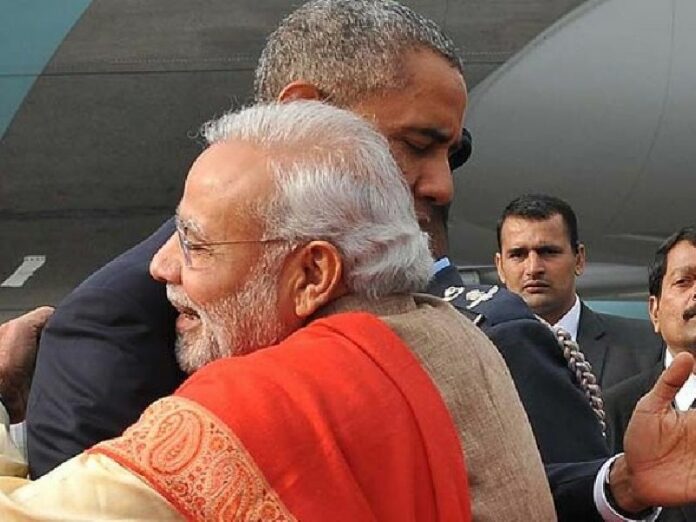
Barack Obama and Narendra Modi hug it out in New Delhi. PHOTO: AFP

By Joseph S. Nye, Jr.

CAMBRIDGE – When Indian Prime Minister Narendra Modi invited US President Barack Obama to attend his country’s Republic Day ceremonies earlier this year, it signaled an important change in relations between the world’s two biggest democracies. Ever since the 1990s, three American administrations have tried to improve bilateral relations, with mixed results. While annual trade between the countries has soared during this period, from $20 billion to more than $100 billion, annual US-China trade is worth six times more, and the political relationship has had ups and downs.


The two countries have a long history of confusing each other. By definition, any alliance with a superpower is unequal; so efforts to establish close ties with the United States have long run up against India’s tradition of strategic autonomy. But Americans do not view democratic India as a threat. On the contrary, India’s success is an important US interest, and several factors promise a brighter future for the bilateral relationship.


The most important factor is the acceleration in India’s economic growth, which the International Monetary Fund projects will exceed 7.5% through 2020. For decades, India suffered from what some called the “Hindu rate of economic growth”: a little more than 1% per year. It might more properly have been called a 1930s British socialist rate of growth. After independence in 1947, India adopted an inward-looking planning system that focused on heavy industry.


Market-oriented reforms in the early 1990s changed that pattern, and annual growth accelerated to 7% under the Congress party, before slumping to 5%. Since the 2014 general election brought Modi’s Bharatiya Janata Party to power, the government has reversed the slowdown.


And prospects for continued growth are strong. India has an emerging middle class of several hundred million, and English is an official language spoken by some 50 to 100 million. Building on that base, Indian information industries are able to play a major global role.


Moreover, with a population of 1.2 billion people, India is four times larger than the US, and likely to surpass China by 2025. Its sheer scale will be increasingly important not only to the global economy, but also to balancing China’s influence in Asia and managing global issues such as climate change, public health, and cyber security.


India also has significant military power, with an estimated 90-100 nuclear weapons, intermediate-range missiles, 1.3 million military personnel, and annual military expenditure of nearly $50 billion (3% of the world total). And, in terms of soft power, India has an established democracy, an influential diaspora, and a vibrant popular culture with transnational influence. Bollywood produces more films every year than any other country, out-competing Hollywood in parts of Asia and the Middle East.


But one should not underestimate India’s problems. Population alone is not a source of power unless those human resources are developed, and India has lagged well behind China in terms of literacy and economic growth. Despite its progress, around a third of India’s population lives in conditions of acute poverty, making the country home to a third of the world’s poor. India’s $2 trillion GDP is only a fifth of China’s $10 trillion, and a ninth of America’s $17.5 trillion (measured at market exchange rates).


Likewise, India’s annual per capita income of $1,760 is just one-fifth that of China. Even more striking, while 95% of the Chinese population is literate, the proportion for India is only 74% – and only 65% for women. A symptom of this problem is India’s poor performance in international comparisons of universities, with none ranked among the world’s top 100. India’s high-tech exports are only 5% of its total exports compared to 30% for China.


India is unlikely to develop the power to become a global challenger to the US in the first half of this century. Indeed, even in terms of soft power, a recent study by the Portland Consultancy in London placed India outside the top 30 countries. China ranked 30th, and the US came in third, behind the United Kingdom and Germany.


Nonetheless, India has considerable assets that already affect the balance of power in Asia. While India and China signed agreements in 1993 and 1996 that promised a peaceful settlement of the border dispute that led them to war in l962, the issue has heated up again, following Chinese actions in recent years.


India and China are fellow members of the BRICS (along with Brazil, Russia, and South Africa). But cooperation within that caucus is limited. While Indian officials are often discreet in public about relations with China, and wisely want bilateral trade and investment to grow, their security concerns remain acute. As part of the group of Asian countries that will tend to balance China, India has already begun to strengthen its diplomatic relations with Japan.


It would be a mistake to cast the prospects for an improved US-India relationship solely in terms of China’s rising power. Indian economic success is an American interest on its own. So is the open approach taken by India and Brazil on issues such as governance of the Internet, at a time when Russia and China are seeking more authoritarian control.


No one should expect an Indian-American alliance any time soon, given historical Indian public opinion. But one can predict a relationship in the coming years that will be both sui generis and stronger.


Joseph S. Nye, Jr. is a professor at Harvard and author of Is the American Century Over? Since 2002, he has co-chaired a US-India Strategic Dialogue under the auspices of the Aspen Institute.


Copyright: Project Syndicate, 2015.
www.project-syndicate.org


To reach us about this article or another matter, please contact us by e-mail at: [email protected].
Follow Khaosod English on and Twitter for news, politics and more from Thailand.
Advertisement

Thanasak: Nothing to Explain About Stripping Thaksin’s Rank to Foreign Governments

Former PM Thaksin Shinawatra speaks at the 2013 Asian Business Leadership Forum Awards in the United Arab Emirates in this photo posted to his Instagram.

BANGKOK — Thailand’s top diplomat said there is no need to explain a campaign to strip former Prime Minister Thaksin Shinawatra of his police rank to foreign governments.

Arguing the bid to deprive Thaksin, the de facto opposition leader, of his rank has nothing to do with politics and everything to do with the law, Foreign Minister Gen. Thanasak Patimapakorn told reporters yesterday when asked if foreign governments might see it as politically driven.

“We won’t have to explain anything to them, because it is being done in accordance with [normal] procedures,” Thanasak said.

Thaksin served in the police force from 1973 to 1987, rising to the rank of Police Lieutenant-Colonel, which he has retained since resigning from the force.

But the military government announced Tuesday it would take up the bid to remove that rank, citing police regulations stipulating they are forfeit to officers convicted and sentenced to jail by a court in serious criminal cases.

Junta deputy chairman Gen. Prawit Wongsuwan repeated yesterday that it was a procedural matter.

“This is not arbitrary. It’s all about the laws,” Prawit said. “The people who support Police Lt. Col. Thaksin have to understand that everything is being done under the law. We are not bullying anyone. This government doesn’t want to create any conflict.”

Thaksin was found guilty of corruption and sentenced to two years in prison by a Bangkok criminal court in 2008, two years after the military staged a coup d’etat against him, ending his five year tenure as an elected Prime Minister. However, Thaksin has never served the jail term because he fled Thailand several months before the verdict was handed down. He insists the conviction was politically-motivated.  

Since then, Thaksin has been living in self-imposed exile and has continued to influence Thai politics through his allies and proxies, such as his younger sister, Yingluck Shinawatra, who headed the government from 2011 to 2014.

The pro-Thaksin government came to an end when the military staged a putsch against it in May 2014. Following the takeover, the junta appointed several bodies to govern the countries, stacking the agencies with numerous politicians, activists, and academics known for publicly opposing Thaksin.

Gen. Prawit added that the government only made the decision to move forward with the plan Tuesday after studying the legal framework to make sure it could be done.

Nevertheless, Royal Thai Police spokesman Lt. Gen. Prawuth Thawornsiri it had never been done before.

He said the police have stripped 600 officers of their ranks due to legal convictions or other wrongdoing, but all cases involved active-duty officers. Never have police considered stripping the rank of someone who already left the force, Prawuth told reporters yesterday, saying there was no precedent.

“As far as I know, there is none,” he said. “We have to check again, but I believe this case is the first of its kind.”

Although Thaksin has been out of power since the 2006 coup, he continues to be a deeply polarizing figure in Thailand, where the two most prominent political factions – the Yellowshirts and the Redshirts – are divided along their anti- and pro-Thaksin stances.

While the Yellowshirts accuse Thaksin of being a corrupt populist who manipulated rural voters and harbored a hostile attitude toward the monarchy, the Redshirts view him as a champion of the poor whose policies helped raise many from abject poverty.


To reach us about this article or another matter, please contact us by e-mail at: [email protected].
Follow Khaosod English on Facebook and Twitter for news, politics and more from Thailand.

Follow @KhaosodEnglish

\

Advertisement

Devoted Burglar Arrested for 7th Time

Police said hyper-recidivist burglar Chaturong Komolpanik pried open this safe in Buriram province to make off with jewelry and cash worth more than 1 million baht.

BURIRAM — If at first you don’t succeed: Try, try, try again.

A serial burglar outdid that popular proverb several times over, according to the police who arrested him yesterday for the seventh time.

Chaturong Komolpanik, 45 of Lopburi, was taken into custody in Buriram province for allegedly making off with jewelry and cash worth more than 1 million baht from the home of a physician, Police Maj. Gen. Chartchai Taeng-iam said today.

The remarkable thing about Chaturong’s arrest? According to police, it was the seventh time they’ve busted him for the same thing.

\

Chaturong Komolpanki is given the perp sit-down by police in Buriram with the tools of what police said is the extremely recidivist burglar's committed trade. Convicted six times for burgarly before, Chaturong is suspected of stealing more than 1 million baht worth of jewelry and cash from a physician's home.

Chaturong was arrested and jailed six times in the past on related charges and was most recently re-released from prison in 2013, Chartchai said.

In the most recent case, police said Chaturong was recorded by security cameras on 23 July breaking into the second floor of the doctor’s home, where a gold necklace, gold bracelets, diamond rings and cash were later reported missing, Chartchai said.

Police did not say when they arrested him, but they suspect he might have been behind several other burglary cases in recent months in other provinces.

Police have charged him, again, with burglary.


To reach us about this article or another matter, please contact us by e-mail at: [email protected].
Follow Khaosod English on Facebook and Twitter for news, politics and more from Thailand.

Follow @KhaosodEnglish

\

Advertisement

Hot News

LATEST NEWS

Bangkok
overcast clouds
35 ° C
35 °
32.7 °
49 %
0.5kmh
98 %
Wed
34 °
Thu
32 °
Fri
30 °
Sat
34 °
Sun
34 °