




























33.5 C
Bangkok
Thursday, June 25, 2026
Home Blog Page 2972

Beijing Discontent After Hong Kong Rejects Electoral Reforms

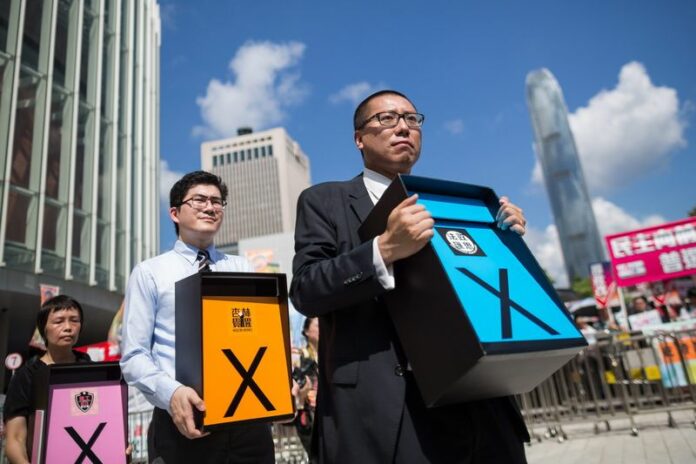
Pro-democracy supporters rally outside the Legislative Council in Hong Kong, China, 17 June 2015. EPA/JEROME FAVRE

HONG KONG (DPA) — Plans for election reform that triggered the worst unrest in years in Hong Kong were voted down Thursday, in a move criticized by Beijing.

Just 36 members of Hong Kong's 70-member Legislative Council voted, with eight in favour of the reform package and 28 against, according to reports.

"I think by now Beijing should understand how firm many Hong Kong people are in wanting to have a democratic system compatible with certain basic standards," Democratic Party lawmaker Albert Ho told dpa. 

The Beijing-backed reforms were also supported by the Hong Kong government, and needed at least a two-thirds majority to be approved by the council.

Hong Kong Chief Executive Leung Chun-ying, whose post is at the centre of the political wrangling, said that "he, the Hong Kong government and Hong Kong people are very disappointed about the result".

About 30 pro-establishment lawmakers walked out of the Legislative Council chamber less than a minute before the vote, South China Morning Post reported.

The lawmakers later told a press conference they were waiting for one more lawmaker to arrive before casting their votes, but there was a "miscommunication" and they missed the vote. 

Chinese Foreign Ministry spokesman Lu Kang told reporters in Beijing the result was something the government "does not wish to see," without answering further questions. 

The reform would have allowed the direct election of the city's next chief executive, but from a list of candidates pre-approved by Beijing. The pan-democrats want publicly nominated candidates.

Blocking it leaves in place the current system, where a 1,200-person committee of Hong Kong's economic and political elites selects the next chief executive, rather than the estimated 5 million eligible voters in the city.

The vote came after two days of debate.

Lawmakers opposing the changes said they hope to engage in talks with the Beijing government to restart the election reform process. 

Last year, tens of thousands of demonstrators occupied streets outside the legislative complex for nearly three months to protest the proposed reforms.

(Reporting by Joanna Chiu)


For comments, or corrections to this article please contact: [email protected]

You can also find Khaosod English on Twitter and Facebook
http://twitter.com/KhaosodEnglish
http://www.facebook.com/KhaosodEnglish
Advertisement

Junta Solicits Opinions on Referendum from Redshirt Politicians

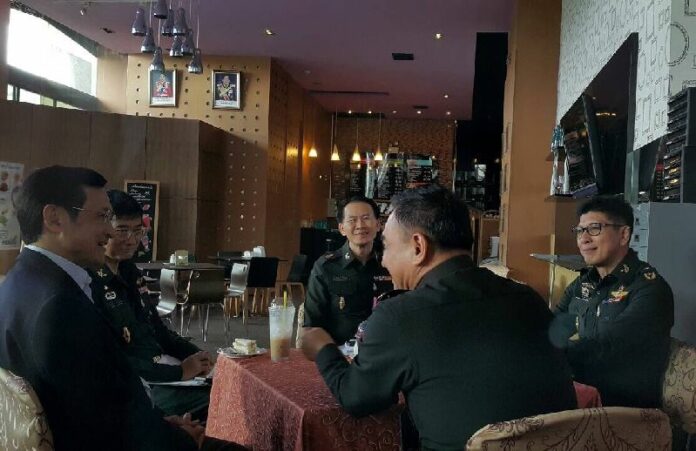
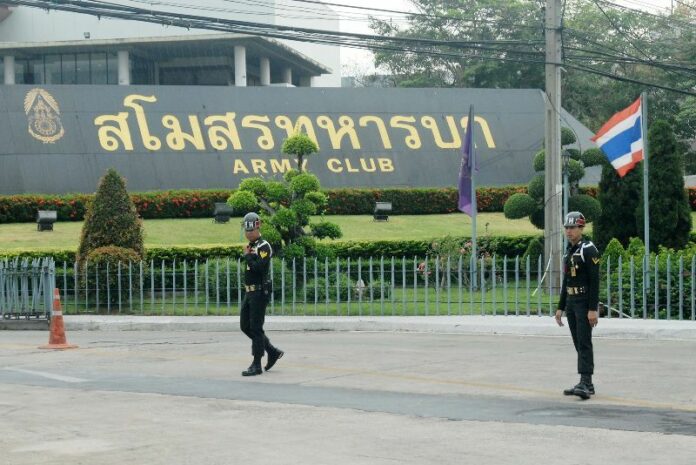
Former Pheu Thai Minister Chaturon Chaisaeng meeting with army officers at the Army Club, 18 June 2015.

BANGKOK — Three top leaders of the Redshirt movement met individually with army officers today after being invited to share their opinions on the junta’s national reform efforts.

The politicians were personally welcomed by Lt.Gen. Boontham Oris, the deputy director of the junta’s Center for Reconciliation and Reform, which has organized several state-sanctioned forums for prominent political leaders, academics, and activists.

Independently-organized discussions on politics remain banned by the junta, which seized power from the Redshirt-backed government in May 2014.

The political figures who met with army officers today included Chaturon Chaisaeng, a former Pheu Thai Party politician, and Jatuporn Prompan and Nattawut Saikua, two leaders of the Redshirts’ United Front of Democracy Against Dictatorship (UDD). Reporters were not allowed to observe the discussions.

Speaking to reporters after his meeting, Chaturon said he and the officers discussed the junta’s economic policies, new constitution, reconciliation efforts, and restrictions on freedom of expression.

Chaturon, a former MP and Cabinet Minister, said he told the officers that the upcoming referendum on the new charter, which is being drafted by junta-appointed councils, will be a "waste of money" if the military does not lift its ban on political debates. 

"If the referendum is not a free one, it will be a waste of money," Chaturon said. "Let me repeat: don't hold a referendum that binds people's hands and only allows people to express their agreement with the charter, because that will only result in undemocratic rules and unsustainable peace. In the end, conflict will return to the country."

Thailand’s previous constitution, which was dissolved by the military shortly after the coup, was put to a referendum in 2007 but only gave voters the option to accept or reject the document, without specifying an alternative. Critics believe many Thais reluctantly approved the charter – which was also written by a junta-appointed council – out of fear of prolonged military rule.

Chaturon also criticized the junta’s reconciliation efforts, citing the need for free debate in order to address the root causes of Thailand’s protracted political conflict. For much of the past decade, Thailand has been rocked by a power struggle between the mostly-rural and pro-democracy Redshirts, and a network of conservative middle and upper class Bangkokians, bureaucrats, and traditional elites.

Several leaders of the latter movement, commonly referred to as the Yellowshirts, are scheduled to meet with army officers to share their views on the junta's reform campaign tomorrow. 

"Throughout all this time, the [junta's] reforms have not addressed the root causes of conflict in this country: that laws were not respected, and the [former] government was unable to enforce the laws," Chaturon said. "So, [the junta leaders] need to ask themselves, do they want peace? If they want sustainable peace, there has to be a widespread exchange of opinions." 

Thailand's ruling junta has come under steady criticism from rights groups and foreign democratic governments for its clampdown on freedom of expression over the past year. Under the leadership of former army chief Gen. Prayuth Chan-ocha, the junta has maintained a ban on all political protests, pressured the media into self-censorship, and interfered with at least 73 forums on sensitive political topics.

The junta has also repeatedly postponed the date for national elections. At present, authorities say an election will take place in September 2016, given that the charter is approved and the political climate is deemed stable. 

After emerging from his meeting with officers today, UDD chairman Jatuporn said he stressed the need for a "transparent" referendum.

"They need to explain the referendum to foreigners, not only to Thai people," Jatuporn said. "If it is done in a transparent, efficient, and unblemished way, no matter what the result is, the country will be able to move forward. I am not personally afraid that [the junta’s use of] state power will interfere with the referendum, because the more power they use, the more resistance there will be." 

He added, "The people who assume the roles as referees must also perform their duties straightforwardly. Don't act like referees in [professional] wrestling, because all of them are unfair." 


For comments, or corrections to this article please contact: [email protected]

You can also find Khaosod English on Twitter and Facebook
http://twitter.com/KhaosodEnglish
http://www.facebook.com/KhaosodEnglish
Advertisement

Junta Solicits Opinions on Referendum from Redshirt Politicians

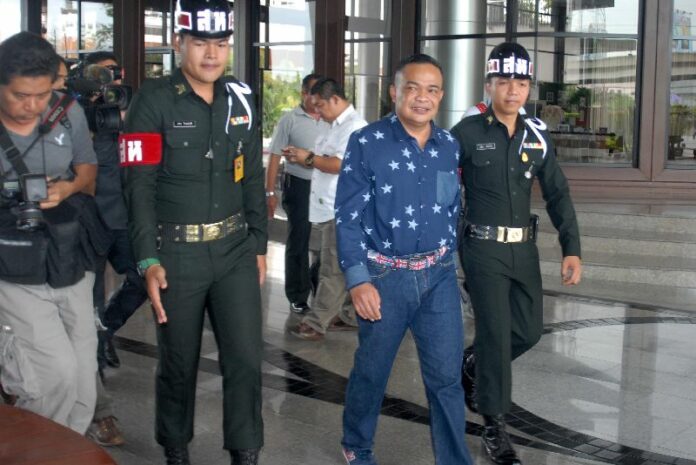
Redshirt leader Jatuporn Prompan arriving at the Army club for a discussion with military officers on 18 June 2015.

BANGKOK — Three top leaders of the Redshirt movement met individually with army officers today after being invited to share their opinions on the junta’s national reform efforts.

The politicians were personally welcomed by Lt.Gen. Boontham Oris, the deputy director of the junta’s Center for Reconciliation and Reform, which has organized several state-sanctioned forums for prominent political leaders, academics, and activists.

Independently-organized discussions on politics remain banned by the junta, which seized power from the Redshirt-backed government in May 2014.

The political figures who met with army officers today included Chaturon Chaisaeng, a former Pheu Thai Party politician, and Jatuporn Prompan and Nattawut Saikua, two leaders of the Redshirts’ United Front of Democracy Against Dictatorship (UDD). Reporters were not allowed to observe the discussions.

Speaking to reporters after his meeting, Chaturon said he and the officers discussed the junta’s economic policies, new constitution, reconciliation efforts, and restrictions on freedom of expression.

Chaturon, a former MP and Cabinet Minister, said he told the officers that the upcoming referendum on the new charter, which is being drafted by junta-appointed councils, will be a "waste of money" if the military does not lift its ban on political debates. 

"If the referendum is not a free one, it will be a waste of money," Chaturon said. "Let me repeat: don't hold a referendum that binds people's hands and only allows people to express their agreement with the charter, because that will only result in undemocratic rules and unsustainable peace. In the end, conflict will return to the country."

Thailand’s previous constitution, which was dissolved by the military shortly after the coup, was put to a referendum in 2007 but only gave voters the option to accept or reject the document, without specifying an alternative. Critics believe many Thais reluctantly approved the charter – which was also written by a junta-appointed council – out of fear of prolonged military rule.

\
Former Pheu Thai Minister Chaturon Chaisaeng meeting with army officers at the Army Club, 18 June 2015.

Chaturon also criticized the junta’s reconciliation efforts, citing the need for free debate in order to address the root causes of Thailand’s protracted political conflict. For much of the past decade, Thailand has been rocked by a power struggle between the mostly-rural and pro-democracy Redshirts, and a network of conservative middle and upper class Bangkokians, bureaucrats, and traditional elites.

Several leaders of the latter movement, commonly referred to as the Yellowshirts, are scheduled to meet with army officers to share their views on the junta's reform campaign tomorrow. 

"Throughout all this time, the [junta's] reforms have not addressed the root causes of conflict in this country: that laws were not respected, and the [former] government was unable to enforce the laws," Chaturon said. "So, [the junta leaders] need to ask themselves, do they want peace? If they want sustainable peace, there has to be a widespread exchange of opinions." 

Thailand's ruling junta has come under steady criticism from rights groups and foreign democratic governments for its clampdown on freedom of expression over the past year. Under the leadership of former army chief Gen. Prayuth Chan-ocha, the junta has maintained a ban on all political protests, pressured the media into self-censorship, and interfered with at least 73 forums on sensitive political topics.

The junta has also repeatedly postponed the date for national elections. At present, authorities say an election will take place in September 2016, given that the charter is approved and the political climate is deemed stable. 

After emerging from his meeting with officers today, UDD chairman Jatuporn said he stressed the need for a "transparent" referendum.

"They need to explain the referendum to foreigners, not only to Thai people," Jatuporn said. "If it is done in a transparent, efficient, and unblemished way, no matter what the result is, the country will be able to move forward. I am not personally afraid that [the junta’s use of] state power will interfere with the referendum, because the more power they use, the more resistance there will be." 

He added, "The people who assume the roles as referees must also perform their duties straightforwardly. Don't act like referees in [professional] wrestling, because all of them are unfair." 


For comments, or corrections to this article please contact: [email protected]

You can also find Khaosod English on Twitter and Facebook
http://twitter.com/KhaosodEnglish
http://www.facebook.com/KhaosodEnglish

Advertisement

Govt Repeals Arrest Warrants of 22 Suspected Insurgents in Deep South

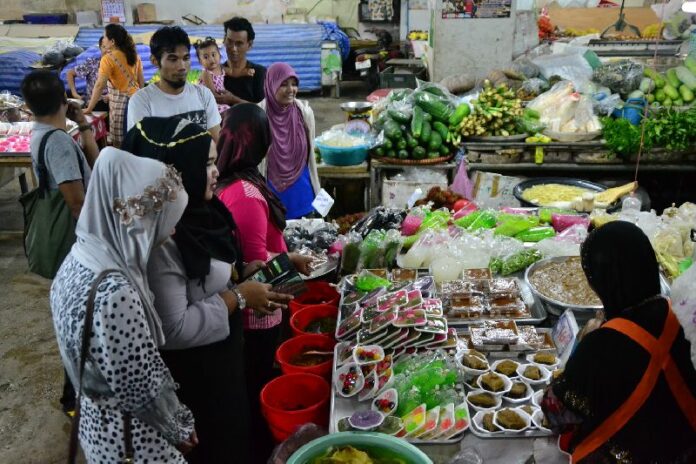
Muslim shopping in preparation for Ramadan in Yala province, 18 June 2015.

NARATHIWAT — Thai officials say they have repealed the arrest warrants of 22 former suspected members of the separatist movement in southern Thailand in an effort to promote reconciliation during the Islamic holy month of Ramadan.

Chamnan Muendam, the deputy governor of Narathiwat, said the 22 men were wanted by authorities for their suspected connections to local insurgent groups that have been waging a violent campaign to secede the provinces of Narathiwat, Yala, and Pattani and form a breakaway Islamic state.

The former fugitives surrendered to authorities and have abandoned their armed struggle in favor of a peaceful solution to the conflict, he said.

"[We] are proceeding with the government's policy of opening opportunities for those who think differently from the state or those who took up violent methods, and allowing them to return and solve the problems with peaceful methods," Chamnan said. 

Yesterday Thai army officials explained that suspected insurgents charged with crimes under the Emergency Decree, which has been in place in the region for a decade and grants security officers sweeping powers to detain and arrest suspects, will have their warrants revoked if they can prove their innocence.

Speaking today, Chamnan explained that members of the insurgent movement may also be granted legal amnesty if they prove their "innocent intention" by disavowing the violent campaign.

Thai authorities say the program is an effort to promote reconciliation during Ramadan, a holy month for Muslims that began today.

The deputy governor also handed over certificates to the 22 former suspects, confirming that their previous arrest warrants issued under the Emergency Decree have been formally revoked, and they are now free to return to their normal lives. 

The secessionist campaign in Narathiwat, Yala, and Pattani – a region known as the Deep South – has claimed the lives of more than 6,200 people since the most recent waves of violence broke out in January 2004, according to data compiled by rights groups.

Thai authorities have responded to the insurgency by deploying at least 60,000 security officers in the Deep South, and maintaining martial law and the Emergency Decree for more than nine years.


For comments, or corrections to this article please contact: [email protected]

You can also find Khaosod English on Twitter and Facebook
http://twitter.com/KhaosodEnglish
http://www.facebook.com/KhaosodEnglish
Advertisement

Govt Repeals Arrest Warrants of 22 Suspected Insurgents

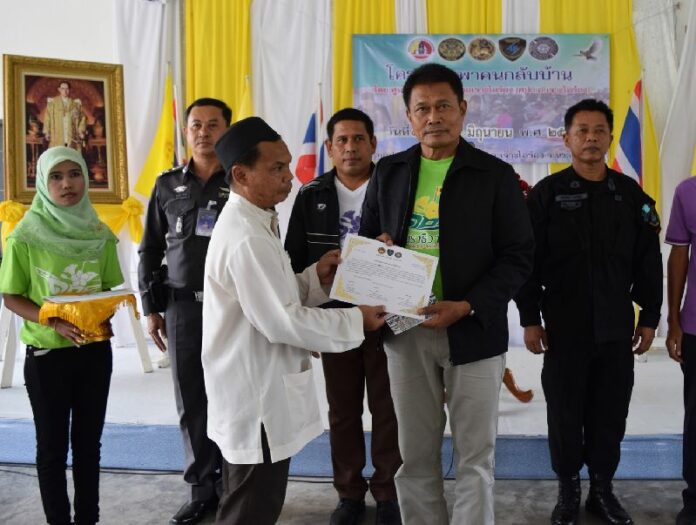
Officials present certificates revoking the arrest warrants of 22 former suspected members of the Islamic insurgency in southern Thailand, 18 June 2015.

NARATHIWAT — Thai officials say they have repealed the arrest warrants of 22 former suspected members of the separatist movement in southern Thailand in an effort to promote reconciliation during the Islamic holy month of Ramadan.

Chamnan Muendam, the deputy governor of Narathiwat, said the 22 men were wanted by authorities for their suspected connections to local insurgent groups that have been waging a violent campaign to secede the provinces of Narathiwat, Yala, and Pattani and form a breakaway Islamic state.

The former fugitives surrendered to authorities and have abandoned their armed struggle in favor of a peaceful solution to the conflict, he said.

"[We] are proceeding with the government's policy of opening opportunities for those who think differently from the state or those who took up violent methods, and allowing them to return and solve the problems with peaceful methods," Chamnan said. 

Yesterday Thai army officials explained that suspected insurgents charged with crimes under the Emergency Decree, which has been in place in the region for a decade and grants security officers sweeping powers to detain and arrest suspects, will have their warrants revoked if they can prove their innocence.

Speaking today, Chamnan explained that members of the insurgent movement may also be granted legal amnesty if they prove their "innocent intention" by disavowing the violent campaign.

Thai authorities say the program is an effort to promote reconciliation during Ramadan, a holy month for Muslims that began today.

The deputy governor also handed over certificates to the 22 former suspects, confirming that their previous arrest warrants issued under the Emergency Decree have been formally revoked, and they are now free to return to their normal lives. 

The secessionist campaign in Narathiwat, Yala, and Pattani – a region known as the Deep South – has claimed the lives of more than 6,200 people since the most recent waves of violence broke out in January 2004, according to data compiled by rights groups.

Thai authorities have responded to the insurgency by deploying at least 60,000 security officers in the Deep South, and maintaining martial law and the Emergency Decree for more than nine years.


For comments, or corrections to this article please contact: [email protected]

You can also find Khaosod English on Twitter and Facebook
http://twitter.com/KhaosodEnglish
http://www.facebook.com/KhaosodEnglish
Advertisement

Man Arrested for Destroying Sacred Chicken Figurines

Some of the chicken figurines allegedly broken by  Thanapong Buapeng in a shrine dedicated to King Naresuanon in Lampang, 17 June 2015.

LAMPANG — Police have arrested a 19-year-old man who allegedly smashed more than 50 figurines at a local shrine dedicated to an ancient Thai king in Lampang province while he was intoxicated.

According to police, Thanapong Buapeng entered a shrine dedicated to a King Naresuan, who lived 400 years ago, shortly after midnight on 17 June and proceeded to destroy dozens of small figurines of roosters placed by local residents as offerings. Thanapong fled the scene, but was arrested at his home yesterday, police say. 

King Naresuan (1555 – 1605) is frequently celebrated by Thai authorities for securing the independence of Ayutthaya Kingdom, a predecessor to present-day Thailand, by defeating the Burmese army in 1593. 

Although historical records of  King Naresuan's life remain obscure, according to lore he beat the son of a Burmese general in a cockfight while the young king-to-be was held as a hostage in the Burmese city of Pegu. The cockfight is often interpreted by Thais as a prophecy of his future victory against the Burmese. 

According to police, Thanapong said he was drinking with friends on 16 June and decided to destroy the figurines out of recklessness. Police charged him with damaging public property, and took him to the shrine today to apologize to the ancient king's spirit. 

Thanapong was previously arrested and jailed for three months for destroying public lights in Chiang Mai province, police said. 

In October 2014, a group of hardline royalists accused a Thai historian of insulting the monarchy by questioning the historical accuracy of a legendary elephant battle between King Naresuan and the leader of the Burmese army in 1593. A military officer filed a charge of lese majeste (defaming the monarchy) against the 82-year-old historian, Sulak Sivaraksa, though he was never indicted. The charge carries a maximum penalty of 15 years in prison. 


For comments, or corrections to this article please contact: [email protected]

You can also find Khaosod English on Twitter and Facebook
http://twitter.com/KhaosodEnglish
http://www.facebook.com/KhaosodEnglish

Advertisement

Red & Yellow Politicians 'Invited' to Discuss Junta's Reforms

Soldiers at the Army club during state-sanctioned forum on national reforms, 23 April 2015.

BANGKOK — Politicians from Thailand's two rival political camps have been asked by the military junta to attend a forum on its national reform efforts this Friday.

Officials say the politicians were invited by the junta’s reform-promoting agency, the Center for Reconciliation and Reform (CRR), which has organized several forums in the past for prominent political leaders, academics, and activists. 

Independently organized forums on politics remain banned by the junta, which seized power in May 2014.

According to officials, the upcoming forum will be held on 19 June at the Army Club in Bangkok. Among those invited are top leaders from the Redshirt movement – which supported the government toppled by the junta – and their rivals, the Yellowshirts, who campaigned against the former government for six months prior to the coup. 

The Redshirt-affiliated invitees include former Pheu Thai Party politician Chaturon Chaisaeng; Pheu Thai spokesperson Anusorn Iamsa-ard; Pheu Thai economic adviser Pichai Naripatapan; chairman of the United Front of Democracy Against Dictatorship (UDD) Jatuporn Prompan; and deputy UDD chairman Nattawut Saikua.

The allies to the conservative Yellowshirt movement named in the invitation are former leader of the People's Committee for Absolute Democracy With the King As Head of State (PCAD) Thaworn Senniam; and deputy chairman of the Democrat Party Nipit Intarasombat. 

Officials did not say which topics will be discussed at the forum on 19 June.

"I am not sure what kind of topic they invited us to speak about," former PCAD leader Thaworn told Khaosod today, though he said he is looking forward to sharing his suggestions about reforming Thailand’s bureaucracy, police force, and political institutions.

Nipit, the deputy chairman of the Democrat Party, said he received the invitation over the phone earlier today, and will share his opinions about the draft of the junta's new charter and the proposal by coup supporters for junta chairman Prayuth Chan-ocha to stay in power for two more years. 

Pheu Thai economic adviser Pichai, who has been criticizing the military government's economic policies on his Facebook account, also confirmed that he would attend the forum. Other politicians invited by the junta could not be reached for comment at the time of writing. 

After toppling an elected government last May, the junta appointed several councils to write a new constitution and propose a wide range of national reforms in the name of reconciling Thailand's bitterly divided political factions. The military government has also severely restricted freedom of expression by banning all political activities and censoring the media in an effort to silence critics. 


For comments, or corrections to this article please contact: [email protected]

You can also find Khaosod English on Twitter and Facebook
http://twitter.com/KhaosodEnglish
http://www.facebook.com/KhaosodEnglish
Advertisement

Thai Officials Urge Fugitive Insurgents to Surrender During Ramadan

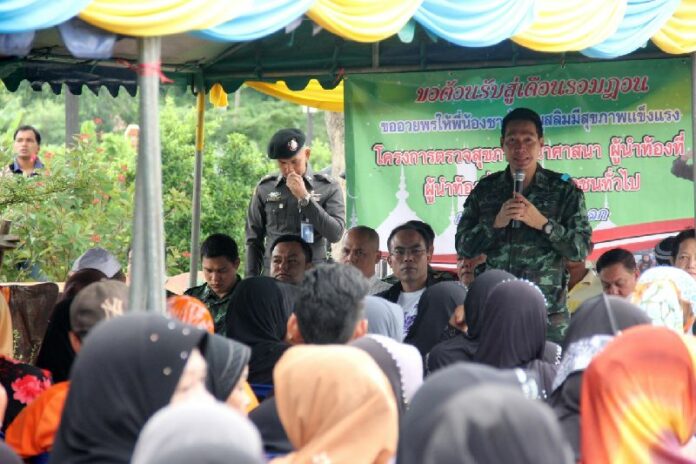
Thai army officers speaking to clerics and local Muslims in Narathiwat province, 17 June 2015.

NARATHIWAT — Thai officials are urging exiled members of the southern separatist movement to visit their families and surrender to authorities during the Islamic holy month of Ramadan.

Speaking at a gathering of around 600 local Muslims and clerics in Narathiwat province today, local official Worachate Prom-opas encouraged fugitive insurgents to return to Thailand for a fresh start.

"As for the people who were misguided and have traveled to live in neighboring countries and other areas, I'd like people to invite them to travel back and join the fasting with their family members, and urge them to start new lives," Worachate said. State officials commonly use the term “misguided” to refer to members of the separatist movement, which is seeking to form an independent Islamic state.

"It's not too late," Worachate said. "Authorities will give them fairness and assistance for the criminal cases in the best way we can." 

Ramadan is expected to begin on 18-19 June, depending on the sighting of the new moon by Islamic religious authorities. 

Worachate added, "This is the policy of the commander of the Fourth Region Army, who wants those who were once misguided to repent and join in the development of our country and build peace together."

Col. Pongpat Hongsinlak, a commander of an army unit in Narathiwat, told the crowd that suspected insurgents who have been charged with offenses under Thailand's Criminal Code will be treated with "protection and fairness" from authorities if they return.

Those who have been charged with crimes under the Emergency Decree, which grants security officers sweeping powers to arrest and detain suspects, will have their warrants revoked if they can prove their innocence, he said. 

"Fugitives who have been charged with Emergency Decree and Criminal Code warrants can go home and display their innocence," Col. Pongpat said. "They can contact their families. Officials will give them fairness, especially during the month of Ramadan. The Fourth Region Army would like to insist on its policy of bringing them home." 

Since January 2004, Islamic separatists have been battling Thai security forces in the southern border provinces of Pattani, Yala, and Narathiwat – a region known as the Deep South – in an effort to revive the independent state of Patani. The sultanate was annexed by Thailand at the beginning of the 20th century.

Some top members of the separatist network are believed to be assisting the shadowy movement from exile, mostly from neighboring Malaysia. 

The secessionist campaign has claimed the lives of more than 6,200 people since the most recent waves of violence broke out a decade ago, according to data compiled by rights groups.

Thai authorities have responded to the insurgency by deploying at least 60,000 security officers in the region, and maintaining martial law for more than nine years.

Human rights activists have frequently accused Thai authorities of mistreating suspects in the Deep South, especially by coercing confessions through intimidation and abuse. 

The National Human Rights Commission received at least 393 complaints of beating or torture under custody from southern border provinces between 2007 – 2013, according to Prachatai news.

 
For comments, or corrections to this article please contact: [email protected]

You can also find Khaosod English on Twitter and Facebook
http://twitter.com/KhaosodEnglish
http://www.facebook.com/KhaosodEnglish
Advertisement

Rohingya Crisis Tests ASEAN's Patience

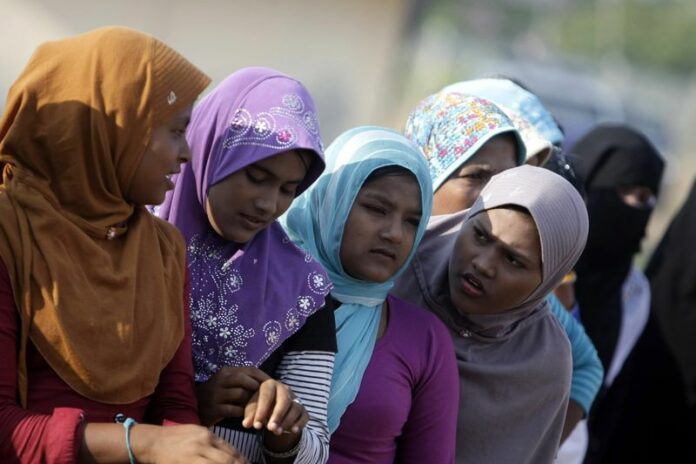
Rohingya refugee women queue for their breakfast at a temporary camp in Kuala Cangkoi, North Aceh, Indonesia, 02 June 2015. EPA/HOTLI SIMANJUNTAK

BANGKOK (DPA) — When Myanmar began a gradual reintegration into the international community in 2011, after decades of isolation under a military regime, some saw it as a reward for the patience of the regional grouping called ASEAN.

The Association of South-East Asian Nations has a long-established, unspoken agreement not to interfere in members' internal affairs, which observers said allowed it to keep Myanmar on board through years of criticism and pressure from other parts of the world.

The military regime was isolated by Western sanctions, "but as an ASEAN member, it was part of the economic cooperation process," said South-East Asia diplomatic expert Chayut Setboonsarng.

"This regional environment of non-interference and acceptance created an atmosphere of comfort" that encouraged Myanmar to move forward with its reforms, said Chayut, a consultant at government affairs advisory firm APCO Worldwide.

The bloc did take some measures, including barring Myanmar from the rotating chairmanship, but stopped short of threatening expulsion, or commenting openly on its internal politics.

Myanmar's leaders were therefore able to "make credible commitments about their intentions in relation to liberalization and democratization," Catherine Renshaw wrote in the Journal of Southeast Asian Affairs.

Four years on, as ASEAN contemplates ever-closer integration, that non-interference principle has been put to the test by a crisis which many see as having originated in Myanmar itself.

Thousands of Rohingya migrants from Myanmar made global headlines in June, stranded on fishing boats operated by human smugglers, trying to migrate to Malaysia and Indonesia through Thailand, and sometimes abandoned at sea.

Human rights groups say the Rohingya face "desperate" conditions in Myanmar, which does not recognize them as one of its ethnicities and considers them Bengali immigrants opening them up to institutional discrimination.

Indonesia and Malaysia agreed at a conference near Kuala Lumpur last month to temporarily shelter the migrants, but observers said that any durable solution requires the problem to be addressed at its Myanmar source.

Attempts to solve it "without seriously pressing Myanmar to deal with the Rohingya" would be "useless," a member of the Thai delegation to a subsequent regional conference in Bangkok said, on condition of anonymity.

Perhaps unsurprisingly, the first voices to speak out on the record have been from outside ASEAN, in particular Western NGOs and the United Nations, with the bloc's members themselves carefully avoiding the term "Rohingya" during their meeting.

"Citizenship must be the ultimate goal" for the Rohingya, said Volker Turk, assistant high commissioner of the UN refugee agency, adding that Myanmar must accept "full responsibility."

Richard Bennett, Amnesty International's Asia Pacific Director, slammed Myanmar for its "denial that the Rohingya even exist. This cannot be the basis on which to proceed."

Former ASEAN secretary-general Surin Pitsuwan said after the conference that there had to be some change in the status quo.

"The idea of non-interference should have its limitations, or the Rohingya problem will turn out worse for all of us," Surin said.

The problems of the Muslim Rohingya in Buddhist-majority Myanmar are "probably internal, but no country in this world has the right to treat people like Myanmar does," said Surin, a Muslim himself.

"ASEAN leaders need to recognize that it's time for the regional grouping to evolve by doing away with its archaic non-interference rules that are not compatible with today's challenges," said Phil Robertson, Human Rights Watch's Asia deputy director.

"Myanmar's systematic rights abuses against the Rohingya and their absurd denial of those abuses are the rock that ASEAN's so-called 'non-interference' principle may ultimately break on."

Within ASEAN, some have started calling for some revision of the principle.

Former Malaysian Prime Minister Mahathir Mohamad went as far as calling for the expulsion of Myanmar from ASEAN.

"Countries like these only give [ASEAN] a bad name," he said.

"If you want to commit genocide, leave ASEAN," he said at an international conference in Oslo in May.

"The fate of the people there needs to be defended from the outside."

(Reporting by Cod Satrusayang)


For comments, or corrections to this article please contact: [email protected]

You can also find Khaosod English on Twitter and Facebook
http://twitter.com/KhaosodEnglish
http://www.facebook.com/KhaosodEnglish
Advertisement

Rohingya Crisis Tests ASEAN's Patience

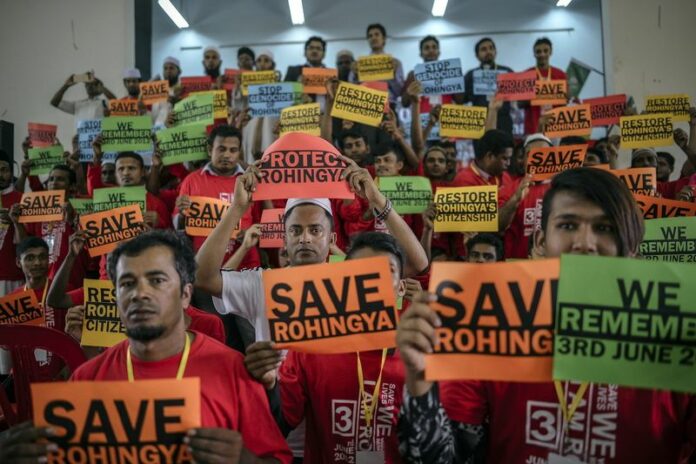
Rohingya migrants in Malaysia call for an end to discrimination against the Rohingya minority group in Ampang, near Kuala Lumpur, Malaysia, 03 June 2015. EPA/STR

BANGKOK (DPA) — When Myanmar began a gradual reintegration into the international community in 2011, after decades of isolation under a military regime, some saw it as a reward for the patience of the regional grouping called ASEAN.

The Association of South-East Asian Nations has a long-established, unspoken agreement not to interfere in members' internal affairs, which observers said allowed it to keep Myanmar on board through years of criticism and pressure from other parts of the world.

The military regime was isolated by Western sanctions, "but as an ASEAN member, it was part of the economic cooperation process," said South-East Asia diplomatic expert Chayut Setboonsarng.

"This regional environment of non-interference and acceptance created an atmosphere of comfort" that encouraged Myanmar to move forward with its reforms, said Chayut, a consultant at government affairs advisory firm APCO Worldwide.

The bloc did take some measures, including barring Myanmar from the rotating chairmanship, but stopped short of threatening expulsion, or commenting openly on its internal politics.

Myanmar's leaders were therefore able to "make credible commitments about their intentions in relation to liberalization and democratization," Catherine Renshaw wrote in the Journal of Southeast Asian Affairs.

Four years on, as ASEAN contemplates ever-closer integration, that non-interference principle has been put to the test by a crisis which many see as having originated in Myanmar itself.

Thousands of Rohingya migrants from Myanmar made global headlines in June, stranded on fishing boats operated by human smugglers, trying to migrate to Malaysia and Indonesia through Thailand, and sometimes abandoned at sea.

Human rights groups say the Rohingya face "desperate" conditions in Myanmar, which does not recognize them as one of its ethnicities and considers them Bengali immigrants opening them up to institutional discrimination.

Indonesia and Malaysia agreed at a conference near Kuala Lumpur last month to temporarily shelter the migrants, but observers said that any durable solution requires the problem to be addressed at its Myanmar source.

Attempts to solve it "without seriously pressing Myanmar to deal with the Rohingya" would be "useless," a member of the Thai delegation to a subsequent regional conference in Bangkok said, on condition of anonymity.

Perhaps unsurprisingly, the first voices to speak out on the record have been from outside ASEAN, in particular Western NGOs and the United Nations, with the bloc's members themselves carefully avoiding the term "Rohingya" during their meeting.

"Citizenship must be the ultimate goal" for the Rohingya, said Volker Turk, assistant high commissioner of the UN refugee agency, adding that Myanmar must accept "full responsibility."

Richard Bennett, Amnesty International's Asia Pacific Director, slammed Myanmar for its "denial that the Rohingya even exist. This cannot be the basis on which to proceed."

Former ASEAN secretary-general Surin Pitsuwan said after the conference that there had to be some change in the status quo.

"The idea of non-interference should have its limitations, or the Rohingya problem will turn out worse for all of us," Surin said.

The problems of the Muslim Rohingya in Buddhist-majority Myanmar are "probably internal, but no country in this world has the right to treat people like Myanmar does," said Surin, a Muslim himself.

"ASEAN leaders need to recognize that it's time for the regional grouping to evolve by doing away with its archaic non-interference rules that are not compatible with today's challenges," said Phil Robertson, Human Rights Watch's Asia deputy director.

"Myanmar's systematic rights abuses against the Rohingya and their absurd denial of those abuses are the rock that ASEAN's so-called 'non-interference' principle may ultimately break on."

Within ASEAN, some have started calling for some revision of the principle.

Former Malaysian Prime Minister Mahathir Mohamad went as far as calling for the expulsion of Myanmar from ASEAN.

"Countries like these only give [ASEAN] a bad name," he said.

"If you want to commit genocide, leave ASEAN," he said at an international conference in Oslo in May.

"The fate of the people there needs to be defended from the outside."

(Reporting by Cod Satrusayang)


For comments, or corrections to this article please contact: [email protected]

You can also find Khaosod English on Twitter and Facebook
http://twitter.com/KhaosodEnglish
http://www.facebook.com/KhaosodEnglish
Advertisement

Hot News

LATEST NEWS

Bangkok
overcast clouds
33.5 ° C
35 °
32.2 °
69 %
3.4kmh
95 %
Thu
37 °
Fri
37 °
Sat
36 °
Sun
36 °
Mon
36 °