29 C
Bangkok
Thursday, October 15, 2026
Home Blog Page 2981

Great Beers Inbound to Bangkok for Mikkeller Bash

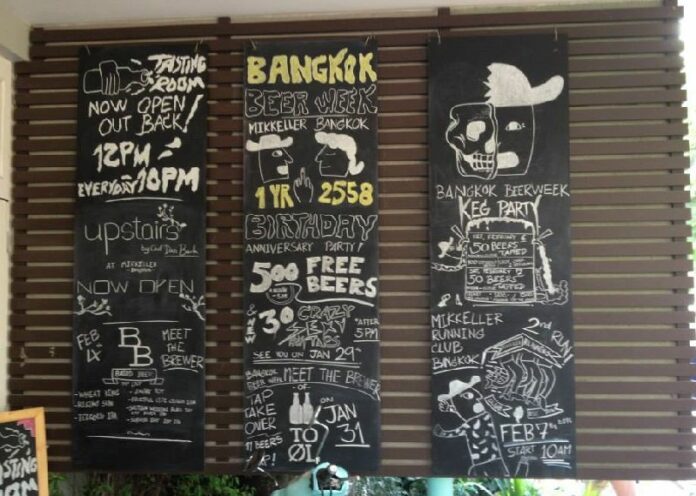
Mikkeler’s first birthday party on Feb. 7, 2015.

BANGKOK — Since the craft beer scene broke into the Bangkok drinking and dining mainstream last year, the bar has been rising with beer geeks thirsty for something bigger and bolder.

The early adopters over at Mikkeller are prepping for a sudsy shindig to get the craft beer scene buzzing – or at least seriously buzzed – again. To celebrate two years of getting people pie-eyed with rare beer from around the globe, Mikkeller will throw itself a weeklong birthday bash Feb. 1 to Feb. 7.

“We’re getting more beer into Thailand than we’ve ever had before,” said Mikkeller Bangkok’s Jakob Rasmussen. “Right now, there’s beer on boats from all over the world. Italy, New Zealand, Denmark, Australia, Belgium, America … and then something special that we can’t reveal just yet.”

Rasmussen said he hopes it isn’t a shameless repeat of their first anniversary party last year, which got a little out of hand.

“Last year turned into a shit show. People were taking their sample cup, loading it up, and getting totally drunk early in the afternoon,” he said. “They missed the point.”

The point, he said, is to enjoy the rare stuff, not just get loaded on American Dream or any of Mikkeller’s everyday beers.

This year the birthday party will take place over an entire week with the taps occupied by a different brewery every day.

On Feb. 5, Chef Dan Bark will host a special dinner where the best beer from each brewery over the week is put on draft along with a dish designed around it. That’s five different breweries plus one from Mikkeller with six dishes created especially for the beer.

Saturday sees the bar bring out the big guns. Rasmussen said he asked each of his suppliers for something “really special” and in response they sent beers that sometimes are never kegged, like Birra Del Borgo’s range of ales brewed with specialty champagne yeast, which lends a unique dry taste to the beer. Hunter Coffee from 18th St. Brewery, which earned a 99/100 score on RateBeer, will also be available. This is a beer that Americans line up for on release days in Indiana, and it will soon be here, 14,000 kilometers away.

Mead, an ancient beverage that’s enjoying a modern resurgence in popularity, will also debut. Superstition Meadery will be released for the very first time in Thailand on Saturday afternoon.

And of course, there will be lots of free beer. Check out the details online at Mikkeller Bangkok.

Advertisement

Say Another Last Goodbye to Iconic Soi 38 Street Food

Photo: Randolph Ruiz

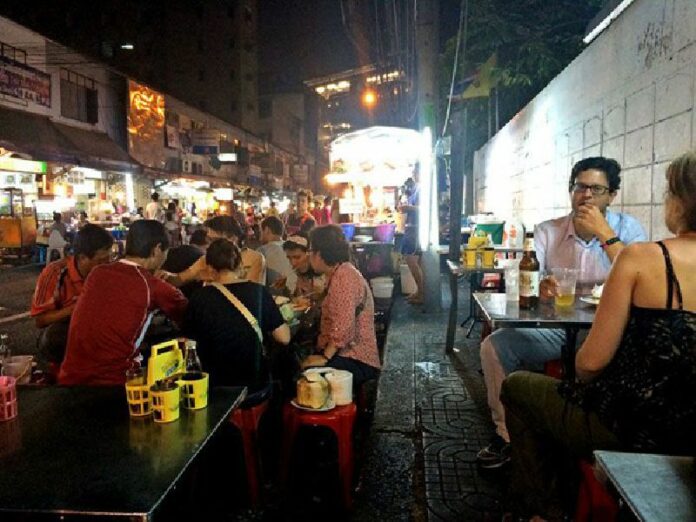
BANGKOK — Tonight is the last night for some of the remaining food joints on Soi Sukhumvit 38 before its famous street food scene, which for decades has fed tourists and locals, is finally swept away.

Several restaurants which for 40 years have operated in the building along the west side of the soi will serve their last suppers this evening after being granted several extensions, with the remaining food sellers clearing out by the end of next week for a condominium to be developed there.

“The last contract to rent the building for three years has come to an end,” said a dessert vendor answering the phone at the Nongamm Kanomwan shop who declined to give her name. “All the 10 tenants were then told to move out.”

She plans to remain open until as late as Wednesday before closing up to make way for another luxury condo. A few shops will remain open until later this month, she said.

In May 2015, City Hall officials accompanied by police and soldiers to notify vendors they had nine months to leave. Food stalls encroaching on the sidewalk were soon gone. The land was put up for sale by the family of the long-time landowner after he died in late 2014.

Another shop making congee said they’ll move to another building in the same soi, while noodle seller “Pa Lham” will depart to Phetchaburi province. Nongamm Kanomwan still has no idea where they’ll go.

“The buildings around here are expensive,” she said. “We cannot afford to rent it since we only sell our sweets for around 25 to 30 baht.”


Advertisement

PCAD Links ‘In the Past,’ Says New Govt. Spokesman

Photo: Courtesy Col. Atisith Chainuvati

By Pravit Rojanaphruk
Senior Staff Writer

BANGKOK — A newly appointed spokesman for the military government is playing down his ties to the movement which helped unseat the former civilian government.

Col. Atisith Chainuvati says he only participated in rallies, despite appearing in videos and photographs jovially celebrating the coup at a controversial, invitation-only party for the elite inner circle and leadership of the People’s Committee for Absolute Democracy with the King as Head of State, or PCAD.

However Atisith, who was appointed assistant government spokesman on Tuesday, said he only attended PCAD rallies and denied being a member, adding that it’s all the past now.

“I am not a member but had participated [in the rallies],” said the soft-spoken 44-year-old, who received his master’s degree in information systems management from the London School of Economics and a bachelor’s degree from the University of Connecticut.

PCAD, also known as the PDRC, was behind six months of street protests which paved the way for the military to seize power May 22, 2014. One week later Atisith was seen celebrating at a lavish party at an expensive French restaurant in the Thonglor area where he and other PCAD members dressed in military garb. PCAD leader Suthep Thaugsuban was the party emcee.

A still photo of Atisith obtained by Khaosod English showed him wearing a camouflage baseball cap with the power-button symbol used by the PCAD to market its Shutdown Bangkok campaign and smiling with PCAD co-leader Chitpas Krisdakorn. Five seconds into a coup celebration video posted to Instagram by Chitpas, Atisith claps happily along with others who all seem to be having a heck of a good time.


Video from the post-coup party where PCAD leadership, many in martial attire, celebrated the military's seizure of power. Originally posted to Instagram of Chitpas Krisdakorn
 

Atisith said his association with the movement, which at times issued calls from its stages for a coup to oust the former Pheu Thai-led government, would not compromise his work as assistant spokesman for the military regime.

“Well, personally I am not worried. It’s in the past. I can separate it. The situation now is different from then. … I too thought, when I was first appointed, that this issue would eventually be brought up.”

Atisith urged all sides in the political divide to seek reconciliation.

“We must look beyond our side, our personal interests. I think I have enough knowledge and know what is right, and what is a private matter.”

A well-placed source familiar with Atisith accused him of being a hardcore PCAD member, however.

“He is an elite Thai who had an overseas education and supported the [PCAD] cause in his own understanding of real democracy,” said the associate who requested anonymity due to their relationship. “During the PDRC shutdown, he was a real hardcore [member].”

However the source speculated that Atisith’s PCAD links were not a factor in his appointment, instead it was likely because he is a soldier, was educated abroad and fluent in English.

Prior to the appointment on Tuesday, Atisith was deputy director of the Army’s Foreign Liaison Division under the Directorate of Intelligence and is experienced in dealing with foreign contacts, including military attaches of various embassies.

Col. Thaksada Sangkachan was also appointed to the same job Tuesday.
 

Related stories:

Police Protest Giving Officer Position to Former PCAD Leader

Army Dismisses Socialite's Military-Themed Birthday Party


Advertisement

Chiang Mai Inventor’s Ingenuity Goes to the Dogs (VIDEO)

CHIANG MAI — Call it a bold technological advancement or a new, effective way to punish your dog.

A video clip posted Saturday shows a demonstration of a homemade dog-washing machine in Chiang Mai, with a white poodle-cum-guinea pig strapped inside the contraption to get a full body wash from more than a dozen automatic brushes.

The Rube Goldberg-esque apparatus appears to make extensive use of household pvc pipes and broom heads.

The innovation has received both positive and negative feedback.


“Holy crap, my cat will just love this. I assume this works on cats as well. I trust it will be simple to set up. Man, these guys are going to make millions from this,” a comment from Dittyd on LiveLeak reads.

Another user placed animal welfare before human advancement.

“Not surprising, coming from a country where dogs are seen as nothing more than objects. Therefore they need to be washed quickly and efficiently too, like other objects, without considering the dog's feelings,” LiveLeak user Phon Flux said.

To be fair at least, the two owners stayed with the dog through the whole cleaning process.

“[The dog] is shivering. Probably (s)he’s cold or something,” the male owner comments before a woman’s voice can be heard confirming, “[The dog is] cold.”

Although the inventor remains unidentified, Nong Deaw seems to be the name of the poor poodle. We can only hope the dog dryer never gets off the drawing board.


To reach us about this article or another matter, please contact us by e-mail at: [email protected].

Follow Khaosod English on Facebook and Twitter for news, politics and more from Thailand.

Follow @KhaosodEnglish

\

Advertisement

1.6 Billion Approved for Khlong Lat Phrao Renovation

A rendering of how Khlong Lat Phrao could look once extensive renovation of the waterway is completed. Image: Khon-Kool-Klong / Facebook

BANGKOK — City Hall signed a 1.6 billion-baht contract yesterday for the construction of 45-kilometer berms along Khlong Lat Phrao.

The Bangkok Metropolitan Administration on Thursday agreed to hire River Engineering Co., Ltd., to be construct concrete berms along the khlong, which will affect about 7,000 families living along the canals.

The berms, which will allow for roads to run alongside the khlongs, are part of a larger project to improve transportation and water flow along many of the capital city’s waterways. Ultimately 1.65 billion baht will be spent to do the same along 128 kilometers of Bangkok canals.


In the Way of Progress, Canal Dwellers Surrender Homes to Save Communities


Improving water flow, Deputy Bangkok Gov. Chumpol Sampaophol said, will help solve the city’s cyclical flooding crises.

The construction along Khlong Lat Phrao is expected to be finished in 3.5 years. The first 8-kilometer construction is scheduled to start in February.

Six of the 43 affected communities there must be relocated, and Chumpol said the Community Organizations Development agency has already devised a plan.


Advertisement

Military Searches House of Anti-Junta Student Activist

(Prachatai English)

Military officers reportedly searched a house of a well known anti-junta student activist currently facing an arrest warrant.

The Resistant Citizen, an anti-junta activist group, posted on its facebook page that at around 3 pm on Thursday, 14 January 2016, 5-6 military officers from an unidentified unit came to search the house of Sirawit Seritiwat, a 23-year-old student activist from Thammasat University.

The military officers went into the house without a search warrant and carried out a search while only the grandmother of Sirawit was present in the house.

Read the rest of story at Prachatai English 


Note: Khaosod English is not responsible for content on other websites.

Advertisement

Four Mexican Tourists Dead in Phichit Van Crash; Six Injured

Scene of the van crash that killed four Mexican tourists Thursday night in Phichit province.

PHICHIT — A van crash in Phichit province last night killed four Mexican tourists and injured six others Mexicans, police said today.

The victims were family members on a vacation in Thailand and were en route to the historical city of Sukhothai when the crash took place at around midnight, according to an officer at a local police station.

The van apparently slammed into a tree next to the highway. Rescue workers took nearly an hour to pull the injured tourists from the van wreckage. 

“They just arrived in Thailand last night, at Don Mueang Airport, and rented a van,” said Police Lt. Col. Surawat Surawatmontri, an officer at Pho Prathap Chang Police Station. 

Surawat speculated that the crash may have occurred because the tourist who was driving at the time was exhausted. 

The six injured survivors have been admitted to a local hospital. Surawat said some of the tourists told police they were headed to Sukhothai prior to the crash. 

Police are collecting information about the incident and will inform the Mexican Embassy soon, Surawat added. 


To reach us about this article or another matter, please contact us by e-mail at: [email protected].

Follow Khaosod English on and Twitter for news, politics and more from Thailand.

\

Advertisement

ISIS Claims Jakarta Attack Which Kills 7

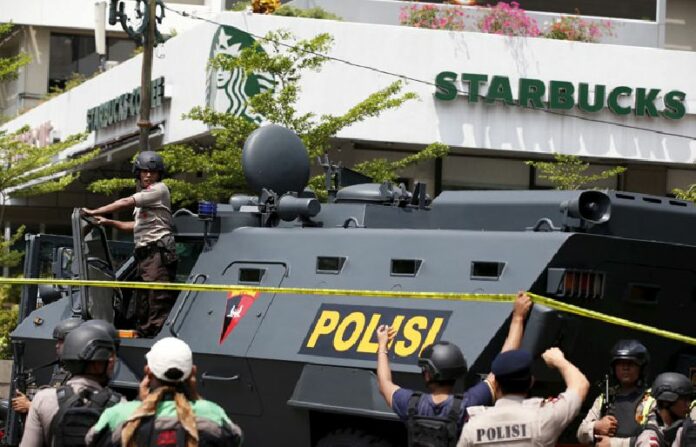
A police vehicle sits outside a Starbucks in Jakarta near the scene where suicide bombers and gunmen attacked in last year. Photo: Darren Whiteside / Reuters

By Kanupriya Kapoor and Darren Whiteside
Reuters

JAKARTA — Suicide bombers and gunmen attacked the heart of Indonesia's capital on Thursday and the assault was claimed by the Islamic State, the first time the radical group has targeted the world's most populous Muslim nation.

Just seven people were killed in Jakarta despite multiple blasts and a gunfight, and five of them were the attackers themselves, but the brazenness of the assault suggested a new brand of militancy in a country where low-level strikes on police are common.

It took security forces about three hours to end the attack near a Starbucks cafe and Sarinah, Jakarta's oldest department store, after a team of militants traded gunfire with police and blew themselves up.

An Indonesian and a Canadian were killed in the attack. Twenty people, including an Algerian, an Austrian, a German and a Dutch national, were wounded.

"A group of soldiers of the caliphate in Indonesia targeted a gathering from the crusader alliance that fights the Islamic State in Jakarta," the group said in a statement. It added that 15 people were killed.

Jakarta's police chief told reporters: "ISIS is behind this attack definitely," using a common acronym for Islamic State, and he identified an Indonesian militant, Bahrun Naim, as the man responsible for plotting it.

Police believe Naim is in the Syrian city of Raqqa.

The drama played out on the streets and on television screens, with at least six explosions and a gunfight in a movie theater. But the low death toll pointed to the involvement of local militants whose weapons were rudimentary, experts said.

In a sign of public unease, a bang caused by a tire bursting triggered a bomb scare that sent police cars rushing back to the scene hours after the attack.

"The president has said the nation and the people should not be scared and should not be defeated by acts of terror," said palace spokesman Ari Dwipayana.


Armored Cars, Helicopters

"The Starbucks cafe windows are blown out. I see three dead people on the road. There has been a lull in the shooting but someone is on the roof of the building and police are aiming their guns at him," Reuters photographer Darren Whiteside said as the attack unfolded.

Police responded in force within minutes. Black armored cars screeched to a halt in front of the Starbucks cafe and sniper teams were deployed around the neighborhood as helicopters buzzed overhead.

Jakarta police chief Tito Karnavian said one man entered the Starbucks cafe and blew himself up, wounding several inside.

As people poured out of the cafe, two waiting gunmen opened fire on them. At the same time, two militants attacked a police traffic post nearby, using what he described as hand grenade-like bombs.

After the militants had been overcome, a body still lay on the street, a shoe nearby among the debris. The city center's notoriously jammed roads were largely deserted.

Indonesia has seen attacks by Islamist militants before, but a coordinated assault by a team of suicide bombers and gunmen is unprecedented and had echoes of the sieges seen in Mumbai seven years ago and in Paris last November.

The last major militant attacks in Jakarta were in July 2009, with bombs at the JW Marriott and Ritz Carlton hotels.

But the country had been on edge for weeks over the threat posed by Islamist militants.

Counter-terrorism police had rounded up about 20 people with suspected links to Islamic State, whose battle lines in Syria and Iraq have included nationals from several Asian countries.


History of Attacks

Indonesia has the world's largest Muslim population, the vast majority of whom practice a moderate form of Islam.

The country saw a spate of militant attacks in the 2000s, the deadliest of which was a nightclub bombing on the holiday island of Bali that killed 202 people, most of them tourists.

Police have been largely successful in destroying domestic militant cells since then, but officials have more recently been worrying about a resurgence inspired by groups such as Islamic State and Indonesians who return after fighting with the group.

Alarm around the world over the danger stemming from Islamic State increased after the Paris attacks and the killing of 14 people in California in December.

On Tuesday, a Syrian suicide bomber killed 10 German tourists in Istanbul. Authorities there suspect the bomber had links to Islamic State.

The United States condemned the attack "in the strongest terms" and said it was committed to its strategic partnership with Indonesia and would stand by it, a U.S. National Security Council spokesman said.

Harits Abu Ulya, a expert on militancy who knows Bahrun Naim, the militant named by Indonesian authorities, said he expected more attacks.

"This is an indication that he has been learning from the Paris attacks and he has studied the strategy," he said. "I still have doubts about the capability of the local militants to carry out attacks on a bigger scale. But it is a possibility."

Aditional reporting Fergus Jensen, Gayatri Suroyo, Nilufar Rizki, Eveline Danubrata, Randy Fabi and Fransiska Nangoy, Ayesha Rascoe


Advertisement

The Koh Tao Verdict and Myanmar Migrant Worker Misery

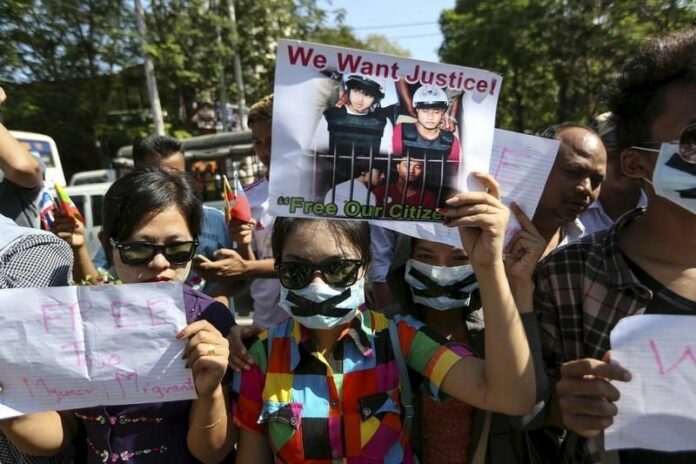
Protesters hold pictures of Zaw Lin and Win Zaw Htun, in front of the Thai embassy in Yangon Dec. 25. Photo: Soe Zeya Tun / Reuters
YANGON —The death sentences handed down to two Myanmar migrant workers by a Thai court on Christmas Eve ignited widespread condemnation in Myanmar.

Zaw Lin and Win Zaw Htun, both 22, were convicted of the murder of British tourists David Miller and Hannah Witheridge on the Thai resort island of Koh Tao in September 2014. The police investigation and proceedings were widely criticized for serious shortcomings, including allegations of police torture to extract initial confessions which the Thai authorities refused to investigate seriously.  Forensic experts from Thailand and Australia have raised serious questions about DNA evidence linked to the rape of Witheridge, on which the prosecution relied heavily. Defense lawyers have said they will appeal the decision.

The verdict sparked calls for a review of the case by senior officials in Myanmar, including by the military commander in chief Senior General Min Aung Hlaing and Myanmar’s ambassador in Bangkok. Protests in Myanmar quickly grew outside the Thai embassy in Yangon, where a petition of 25,000 signatures was presented last week, and at protests at major land border-crossings between the two countries. Anger at the verdict spread throughout social media, and the ultra-nationalist Buddhist group Ma Ba Tha staged anti-Thailand protests in Yangon.


Myanmar Migrants in Thailand


The case highlighted the poor treatment faced by over two million Myanmar migrant workers in Thailand.  Thai police, government officials and employers have been implicated in a system of pervasive abuse that includes killings, beatings, human trafficking and mistreatment of workers in the offshore fishing industry, food processing factories, plantations and farms, garment and other light industry factories, and even the lucrative tourism sector. These abuses have been documented by Human Rights Watch and others for decades.


Problems in western Myanmar

But why in the midst of Myanmar’s “economic boom” are workers still migrating from Myanmar to work in dangerous conditions in Thailand? Abuses of labor rights  and a lack of decent wages across many parts of Myanmar are partly responsible. Working conditions and opportunities are particularly dire in Myanmar’s western Rakhine State, where the two convicted men hail from.  The state has suffered more than most other areas under decades of military mismanagement and a dearth of basic social and community services.  

Residents in Rakhine State see few jobs and other economic benefits trickle down from major oil and gas projects granted in the state to Chinese firms. At the same time as the Koh Tao verdict was being handed down, Myanmar’s parliament approved a massive special economic zone and deep-sea port of 4,000 acres in Kyaukphyu in Rakhine State for Chinese and Thai firms to develop, which does not auger well for the protection of worker’s rights, assuming there are jobs for local people in the project.

The international community has looked in anguish at the desperate plight of ethnic Rohingya Muslims leaving Myanmar and Bangladesh on rickety boats to Malaysia.  But another dimension to the communal violence in Rakhine State is economically deprived Rakhine Buddhists are also prey for trafficking gangs and unscrupulous migrant worker brokers as they travel to Thailand for work and face abusive conditions. Many Rakhine nurse deep grievances towards the Bamar-dominated central state for the poverty produced by military rule.


Problems in northern and eastern Myanmar


Land grabs in eastern and northern Myanmar also continue to deprive rural families of their livelihoods, causing them to send their sons and daughters across the border to work. Increased landlessness and displacement due to natural resource extraction is generating rural unrest and protests against companies and the Myanmar military who are often implicated in these land grabs, as extensive research by Global Witness documented.

In visiting farming communities around Hpa-an in Kayin State in 2015, I frequently came across people in their twenties who had sought work in Thailand because of land grabs at home, often by state or military authorities who utilize unfair laws, bureaucratic opacity, and intimidation including arrests of critics, to avert compensation. Far from people returning from Thailand to take advantage of Myanmar’s opening, a new generation of people are heading east to earn a livelihood because their lives have either not improved or even worsened since the quasi-civilian government came to power in 2011.

Continued armed conflict in Shan State, which has displaced more than 10,000 civilians in recent months, is also causing many to flee and seek work in northern Thailand, joining tens of thousands of ethnic Shan who have fled these conflict zones since the 1980s. Despite the air of calm and talk of nationwide ceasefires, active armed conflict throughout Burma has increased since 2011, including intensive fighting in Kachin State that displaced over 130,000 civilians, providing another push factor for people inside Myanmar to migrate for work to its neighbors.


The Future


It is certainly understandable that many inside Myanmar are shocked at the Koh Tao murder case verdict and angry about the widespread mistreatment of migrant workers from Myanmar in Thailand.   But while correctly demanding that Thailand end its rights abuses against migrants, the incoming National League for Democracy government also needs to urgently address the structural inequalities and abuses that have driven people from Myanmar to work and live outside their country for many years.  Myanmar can hardly be considered as a future economic treasure trove when the benefits of its natural resources and its growing economy are not shared broadly with the rural poor, whose livelihoods continue to be insecure.


By David Scott Mathieson


This article was originally published at www.myanmarnow.org

"David Scott Mathieson is a Senior Researcher in the Asia Division of Human Rights Watch. Any views expressed in this article are those of the author and not of Myanmar Now."


Advertisement

200,000 Baht Bounty for Disappeared Karen Activist ‘Billy’

Porlachee Rakchongcharoen and his family in an undated photo. Photo: Courtesy Pinnapa Prueksapan

BANGKOK — Police have offered 200,000 baht for information about a community rights activist who has been missing for nearly two years.

The new effort to find what happened to activist Porlachee ‘Billy” Rakchongcharoen came as the former director of Kaengkrachan National Park is being investigated for alleged involvement in the persecution of the Karen community Porlachee campaigned for prior to his 2014 disappearance.

“We will give the reward to anyone who has the information and clues that lead to the discovery of Mr. Porlachee,” Police Lt. Col. Setthasit Suwannakut said today. “Whether he is alive or dead.”

Porlachee’s disappearance is being investigated by a joint task force of police and the Division of Special Investigation, or DSI. Setthasit Suwannakut, a DSI representative, announced his agency has contributed 100,000 baht for information leading to whereabouts of the missing activist.

Police also contributed 100,000 baht, Setthasit said.

Porlachee rose to prominence for campaigning on behalf of the Karen community in Kaeng Krachan National Park that then faced eviction from former director Chaiwat Limlikhit-aksorn. In May 2011, park officials torched Karen villages in the forest, allegedly under Chaiwat’s orders, prompting Porlachee to bring legal action.

\

Men wearing national park ranger fatigues set a structure ablaze in an image provided by a village resident.

The activist was last seen April 17, 2014, when he was stopped and detained by Chaiwat and several officials in the national park. His family alerted police two days later and accused Chaiwat of abducting Porlachee to silence him.

Chaiwat denied the allegation, insisting that he only held Porlachee for questioning for several hours and released him afterward.

Former Park Chief Under Fire

In a briefing to Porlachee’s family at the National Human Rights Commission today, police representative Traiwit Namthongthai said his team found evidence that could implicate Chaiwat in the alleged abduction.

“I believe Porlachee was not released as claimed by Chaiwat, because we found disparity in his testimony about where exactly he was released,” Col. Traiwit said. “Furthermore, Chaiwat claimed he went back to his residence after releasing Porlachee, but CCTV footage didn’t show Chaiwat’s car in the time that Chaiwat identified.”

Setthasit of the DSI said his agency is inspecting seven park vehicles for forensic evidence that could shed some light on what happened.

“DSI is searching the area and interrogating a total of 283 witnesses,” he said at today’s meeting headed by National Human Rights Commissioner Angkhana Neelapijit, whose husband Somchai Neelapijit was also abducted.

Apart from the investigation into Porlachee’s fate, Chaiwat is facing a separate inquiry by an anti-corruption commission for his role in the 2011 torching of Karen homes in his jurisdiction.

\

Men wearing national park ranger fatigues set a structure ablaze in an image provided by a village resident.

The Office of the Public Sector Anti-Corruption Commission is investigating Chaiwat for abuse of power, officials announced Wednesday. If found guilty, he could face up to 10 years in prison.

Insufficient Deterrence

Commissioner Angkhana told reporters the main obstacle to finding someone accountable for Porlachee’s abduction is an inadequate legal framework.

“The obstacle to making progress in forced disappearance cases in Thailand is the fact that we don’t have laws specifically dealing with this issue,” she said.

Critics of the establishment in Thailand have from time to time been abducted and presumably murdered. Although security officers are often implicated in these cases, they are rarely if ever prosecuted or found guilty. Human rights activists blame a requirement under the law that a body must be recovered to build a murder case.

Earlier this month, the United Nations called upon Thai authorities to end the legal impunity by ratifying international laws on enforced disappearance.

“I urge the Thai authorities to immediately ratify the International Convention for the Protection of All Persons from Enforced Disappearance,” Zeid Ra’ad Al Hussein, the UN High Commissioner for Human Rights, said Jan. 7 in a statement.

The call was echoed today by the New York-based Human Rights Watch.

“The Thai government should make a 180-degree turn in its policy by recognizing that secret detention and enforced disappearance fundamentally undermine the rule of law and destroy people’s trust in their government,” regional director Brad Adams said.

Advertisement

Hot News

LATEST NEWS

Bangkok
light rain
29 ° C
29 °
29 °
79 %
0.9kmh
100 %
Thu
29 °
Fri
37 °
Sat
35 °
Sun
33 °
Mon
34 °