32.2 C
Bangkok
Sunday, June 28, 2026
Home Blog Page 3045

New Zealand Rules Out Intervention in Myanmar Buddha "Insult" Verdict

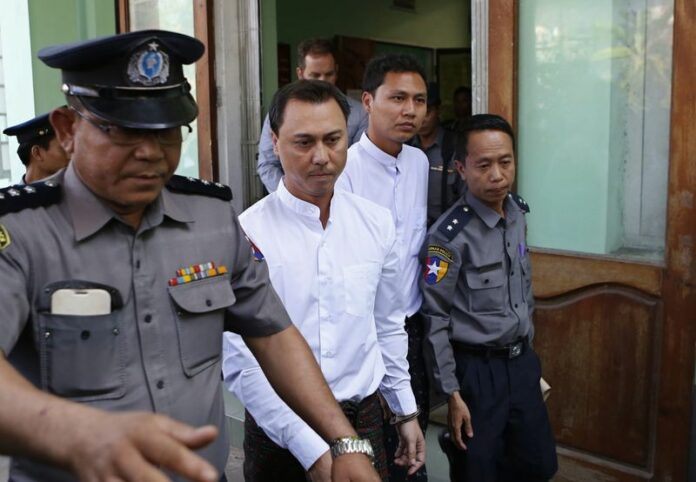
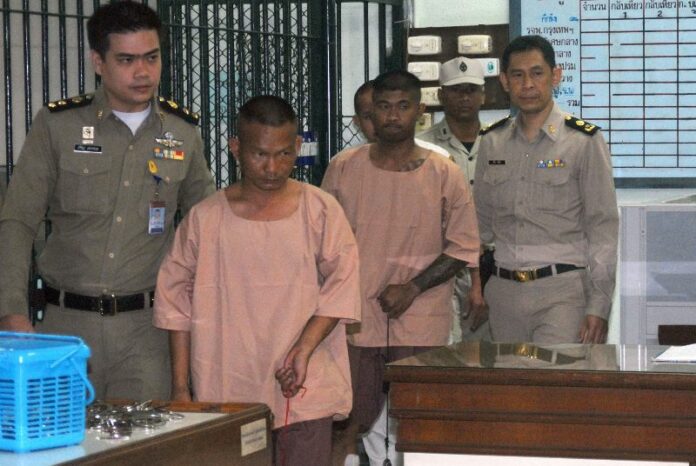
Myanmar citizens Tun Thurein (C-L) and Htut Ko Ko (C-R) are escorted by Myanmar policemen after their hearing at a court in Yangon, Myanmar, 02 January 2015. A court in Myanmar on Tuesday sentenced a New Zealand bar manager and the two Myanmar nationals to two and a half years in prison each, after they used an image of the Buddha wearing headphones in an online promotional poster. EPA/LYNN BO BO

By Kyaw Lynn

WELLINGTON (DPA) – New Zealand said Wednesday it would not intervene with Myanmar over the jailing of a bar manager for insulting Buddhism, while an appeal was being considered.

New Zealander Philip Blackwood, 32, was sentenced to more than two years in jail with hard labour after an image of the Buddha wearing headphones was published online to promote the V Gastro bar he managed in Yangon.

Foreign Minister Murray McCully said Blackwood was considering an appeal. "We need to respect this process and I won't be commenting while this is under way."

Co-accused Myanmar nationals Tun Thurein, 40, and Htut Ko Ko Lwin, 26, received the same sentence in a Yangon court on Tuesday.

"Clearly a lot of New Zealanders will find it difficult to understand in relation to the offending he has been found guilty of," McCully said.

A friend of Blackwood's, Catherine MacGillivray, is running an online appeal to raise funds for his defence.

"Phil was not aware he was breaking the law and has apologised for his mistake," she posted. "He is a great guy who would do anything to help anyone.

"He has a young family and I want him to come home and see his daughter grow up."


Advertisement

Prayuth: Terror Suspect Invited to Army Camp, Not Arrested

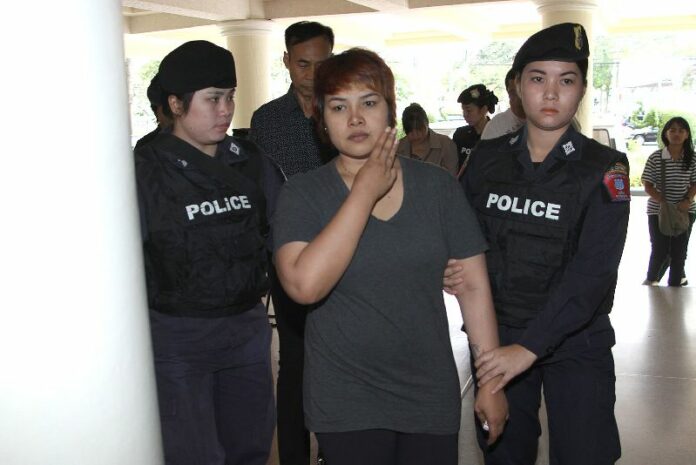
Nattathida Meewangpla in front of martial court in Bangkok on 17 March 2015.

BANGKOK — Junta chairman and Prime Minister Prayuth Chan-ocha has insisted that soldiers did not harm a 36-year-old woman who was held incommunicado in military custody for six days and later accused of participating in a terror plot.

The general's comment came in response to outcry from human rights groups concerning the disappearance of former volunteer medic Nattathida Meewangpla, who was taken from her residence without explanation by five soldiers on 11 March.

\
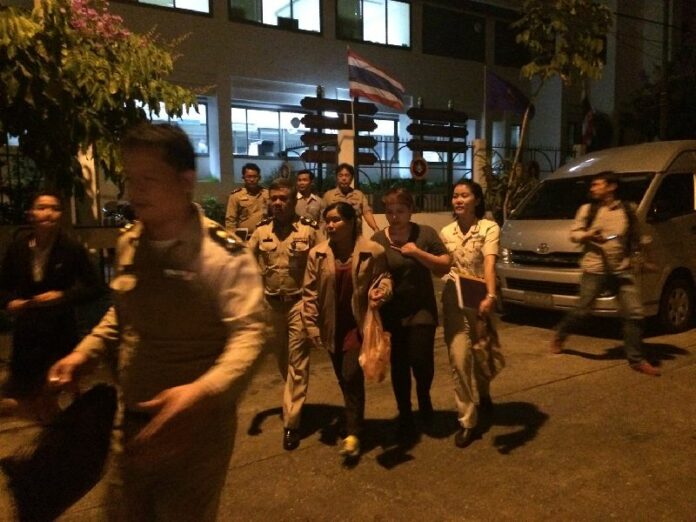
Nattathida Meewangpla flashing an anti-coup hand gesture while police escort her to their HQ in Bangkok on 17 March 2015.

After six days of detention, during which Nattathida was unable to contact the outside world, soldiers transferred her to police headquarters, where she was charged with conspiring in a terror network. 

According to Gen. Prayuth, the military merely "invited" Nattathida to "talk."

"We didn't arrest her at all. We simply invited her at her home for a talk, and she came," Gen. Prayuth said. "If we had announced it, there would have been a panic."

He continued, "We only invite people and release them. She understood and cooperated with us. It's only a discussion. We didn't arrest her. If we arrested her, she would have been in jail." 

Nattathida is currently being held in prison while she awaits trial for terrorism charges. 

"Let me stress that we never harmed her,” Gen. Prayuth said. "We are even less likely to harm her because she's a woman. Can soldiers be that cruel? If so, we wouldn't have lasted til this day."

A junta spokesperson initially denied that Nattathida was in military custody, but later retracted the statement, citing a lack of communication among security units.

According to Nattathida's cousin, the five soldiers who showed up at her house on 11 March did not explain why she was needed for interrogation. 

"They simply told her to bring some clothes. They didn't say on what charges they arrested her," her cousin told Khaosod. "They didn't say where they were taking her, and they wouldn't let us photograph them."

According to police, Nattathida has confessed to transferring money to members of an alleged terrorist group, but claimed to have no knowledge of their plan, which reportedly involved planting bombs in five locations across the capital city. Although the original plan was not carried out, the network successfully facilitated  the grenade attack at the Criminal Court on 7 March 2015, police say. 

Under martial law, which was imposed by the military junta after it seized power in May 2014, security officers can search properties without warrants and detain people without charges for up to seven days. 

The junta's prolonged use of martial law and suppression of civil liberties has drawn widespread condemnation from international human rights groups.

Today, the Thai Lawyers for Human Rights Center released a statement accusing the military of torturing four men who were recently arrested in connection with the alleged militant network. 

According to the lawyers, the four suspects, identified as Sansern Sri-unruen, Charnvit Jariyanukul, Norapat Luepol, and Wichai Yoosuk, were tortured into making false confessions by military officers during the period of 9 – 15 March. 

Sansern told Prachatai news that soldiers slapped him in the face, punched him in the chest and rib, and kicked him in the torso. He also told Prachatai he was electrocuted "30-40" times on his legs by military officers because he refused to confess. 

The four men are facing a litany of charges for allegedly belonging to the network behind the courthouse attack. 


Advertisement

'Abducted' Woman Assisted Terrorist Group, Police Say

Police question Nattathida Meewangpla at the police HQ in Bangkok, 17 March 2015.

BANGKOK — The 36-year-old woman who was taken by soldiers and held incommunicado for nearly a week confessed to unwittingly aiding a terror plot, police say.

Nattathida Meewangpla re-emerged yesterday when army officers transferred her to police custody in Bangkok, several days after her family reported she was missing. 

\
Nattathida Meewangpla flashing an anti-coup hand gesture while police escort her to their HQ in Bangkok on 17 March 2015.

A junta spokesperson initially denied that Nattathida was in military custody, but later retracted the statement, citing a lack of communication among security units.

According to police, Nattathida confessed to transferring money to members of an alleged terrorist group, but claimed to have no knowledge of their bomb plot.

Yet police say Nattathida's name was found in a LINE chat group that discussed the bomb attacks, which were supposed to take place in five locations around in Bangkok in early February. 

After the plan was scrapped, the leader of the network hired another group to carry out the grenade attack on a criminal court on 7 March, police say.

Nattathida and other alleged members of the first group are still liable for prosecution, because they procured funding for the attacks, said Pol.Maj.Gen. Chayapol Chatchaidech.

"Both groups were financed by a capitalist living in a foreign country," the officer said. "The network plotted to use violence to cause fear among the people."

Nattathida has been charged with conspiring in terrorism, conspiring in a secret society with an intention to break the laws, and hiring other persons to attempt murder.

At least 12 people have been arrested in connection with the alleged terror network, which police believe is led by Manoon Chaichana, aka Anek San Francisco, a Thai Redshirt activist who is currently living in the United States. 

Pol.Lt.Gen. Prawut Thawornsiri, spokesperson of the Thai police force, told reporters that Nattathida said she was introduced to Manoon by Supaporn Mit-arak, another alleged member of the network arrested on 12 March. When asked whether Nattathida identified as a Redshirt herself, the spokesperson replied that he did not know. 

Nattathida was later taken to the military court, where a judge denied her request for release on bail.

Her lawyer, Winyat Chartmontree, insisted that Nattithda knew nothing of the bomb plot and called the allegations against her "far-fetched." According to Winyat, she merely borrowed money from some members of the group to open her a laundromat. 

He also voiced concern that this case may disqualify Nattathida from serving as a witness in future court inquests related to the 2010 crackdown on Redshirt protesters.

Nattathida, who was a volunteer medic during the crackdown, provided testimony during a 2013 court inquest that found soldiers responsible for the deaths of six civilians inside a Buddhist temple on 19 May 2010. 

"The court may say she is a witness of no value, she has no credibility, she has hostility towards a certain party," Winyat said. 

The lawyer also said he was prevented from talking to Nattathida during her interrogation by police at the Metropolitan Police Headquarters, and that the military tried to appoint a new lawyer for her against her will. 

"I have been a lawyer for 17 years. I have done more than 1,000 cases," Winyat wrote on his official Facebook account. "I have met hundreds and thousands of police officers and bureaucrats. But nothing has matched what I’ve seen today.”

 
Advertisement

'Abducted' Woman Assisted Terrorist Group, Police Say

Nattathida Meewangpla flashing an anti-coup hand gesture while police escort her to their HQ in Bangkok on 17 March 2015.

BANGKOK — The 36-year-old woman who was taken by soldiers and held incommunicado for nearly a week confessed to unwittingly aiding a terror plot, police say.

Nattathida Meewangpla re-emerged yesterday when army officers transferred her to police custody in Bangkok, several days after her family reported she was missing. 

A junta spokesperson initially denied that Nattathida was in military custody, but later retracted the statement, citing a lack of communication among security units.

According to police, Nattathida confessed to transferring money to members of an alleged terrorist group, but claimed to have no knowledge of their bomb plot.

Yet police say Nattathida's name was found in a LINE chat group that discussed the bomb attacks, which were supposed to take place in five locations around in Bangkok in early February. 

After the plan was scrapped, the leader of the network hired another group to carry out the grenade attack on a criminal court on 7 March, police say.

Nattathida and other alleged members of the first group are still liable for prosecution, because they procured funding for the attacks, said Pol.Maj.Gen. Chayapol Chatchaidech.

"Both groups were financed by a capitalist living in a foreign country," the officer said. "The network plotted to use violence to cause fear among the people."

Nattathida has been charged with conspiring in terrorism, conspiring in a secret society with an intention to break the laws, and hiring other persons to attempt murder.

At least 12 people have been arrested in connection with the alleged terror network, which police believe is led by Manoon Chaichana, aka Anek San Francisco, a Thai Redshirt activist who is currently living in the United States. 

Pol.Lt.Gen. Prawut Thawornsiri, spokesperson of the Thai police force, told reporters that Nattathida said she was introduced to Manoon by Supaporn Mit-arak, another alleged member of the network arrested on 12 March. When asked whether Nattathida identified as a Redshirt herself, the spokesperson replied that he did not know. 

Nattathida was later taken to the military court, where a judge denied her request for release on bail.

Her lawyer, Winyat Chartmontree, insisted that Nattithda knew nothing of the bomb plot and called the allegations against her "far-fetched." According to Winyat, she merely borrowed money from some members of the group to open her a laundromat. 

He also voiced concern that this case may disqualify Nattathida from serving as a witness in future court inquests related to the 2010 crackdown on Redshirt protesters.

Nattathida, who was a volunteer medic during the crackdown, provided testimony during a 2013 court inquest that found soldiers responsible for the deaths of six civilians inside a Buddhist temple on 19 May 2010. 

"The court may say she is a witness of no value, she has no credibility, she has hostility towards a certain party," Winyat said. 

The lawyer also said he was prevented from talking to Nattathida during her interrogation by police at the Metropolitan Police Headquarters, and that the military tried to appoint a new lawyer for her against her will. 

"I have been a lawyer for 17 years. I have done more than 1,000 cases," Winyat wrote on his official Facebook account. "I have met hundreds and thousands of police officers and bureaucrats. But nothing has matched what I’ve seen today.”

 
Advertisement

Redshirt TV Channels Summoned For Airing 'Violent' Content

Redshirts stage a rally in front of 22nd Military District base in Ubon Ratchathani province to protest the military's order to shut down Redshirts-allied TV channels, 21 May 2014.

BANGKOK — Thailand’s media regulating agency has warned two private TV channels affiliated with the Redshirt movement to tone down their "divisive" and "violent" news coverage.

Executives and producers from the two channels, called Peace TV and 24 People's Station, met yesterday with officials from the National Broadcasting and Telecommunication Commission (NBTC). 

According to  NBTC sec-gen Thakorn Tantasith, the two channels have been broadcasting "violent" content that could "cause conflicts in society." He did not specify the offensive material prompted the summons.

"We discussed the issues and heard their explanation," Thakorn said. "There is no order to close down the stations, because a closure order needs a consent from the entire board, and I have to sign it first."

However, Thakorn warned that if the networks are uncooperative, they may be ordered to cancel some programs. 

Thida Thawornseth, a core Redshirt leader and producer at Peace TV, said the NBTC's summons came as a surprise because the channel has already been exercising self-censorship to adapt to the post-coup climate. 

"When we tape the shows, we filter them. We censor them, to some extent," Thida told Khaosod, referring to talk shows on the channel hosted by top Redshirt leaders like Jatupon Prompan, Nattawut Saikua, and Weng Tojirakarn. "We cannot please everyone, because everyone has different opinions."

According to Thida, NBTC officials also took issue with Peace TV's references to "third party individuals."

"But it's normal to do that in news shows, we are not in Parliament," said Thida, referring to a parliamentary regulation that discourages MPs from referring to individuals by name in speeches. 

Asked whether the channel will change its approach, Thida said she will wait for the next meeting with the NBTC on 24 March. 

Both of Thailand’s Redshirt and Yellowshirt movements operate their own TV and radio channels featuring news programs, talk shows, and live broadcasts of their political rallies. Media agencies affiliated with the two groups played significant roles in the pro- and anti-government rallies last year that culminated the in the May 2014 coup.

Gen. Prayuth Chan-ocha, who was serving as commander of the army at the time, ordered all partisan media agencies to shut down after he declared martial law on 20 May 2014.

When representatives from Thailand’s warring political factions were unable to broker a compromise during two days of army-moderated talks, Gen. Prayuth declared a coup d’etat.

The partisan media outlets were later allowed to resume operations under the conditions that they change the name of their stations and refrain from broadcasting any material that could "incite violence" in the country. 

 
Advertisement

Teachers' Bodyguards Bombed in Restive South

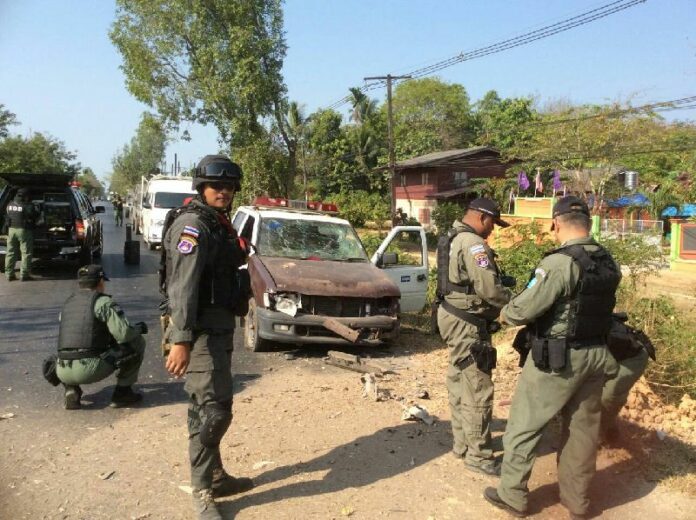
The scene of the bombing in front of Baan Pa Ko school in Thepha district in Songkhla province, 17 March 2014.

SONGKHLA — A roadside bomb injured a police officer who was guarding a school in southern Thailand, where Islamic insurgents regularly stage attacks on Thai authorities and public schools.

Police say the bomb exploded at 7:40 am in front of Baan Pa Ko school in Thepha district, apparently targeting a group of police officers who were stationed to protect teachers at the school.

The blast injured one police officer and damaged a police vehicle, according to police reports. 

Although security officers have not confirmed the motive of the attack, local Islamic separatists frequently attack public school teachers in the region, presumably because they are viewed as instruments of the Thai Buddhist  state. 

Approximately 180 school teachers have been killed since violence broke out in early 2004. Many teachers now travel with a large convoy of bodyguards and soldiers. 

The insurgency, which has claimed the lives of at least 6,000 people, has been waged by a shadowy network of groups seeking to revive the independent Pattani sultanate, which was incorporated into modern Thailand in the early 20th century. 

In contrast to the rest of country, where Buddhists make up a vast majority of the population, Thailand’s southern border provinces are predominantly Muslim.

The violence is concentrated in the border provinces of Pattani, Yala, and Narathiwat – a region known as the Deep South – but occasionally spills into the neighboring province of Songkhla. 

Thamrong Charoenkul, governor of Songkhla province, said he has instructed local administrators to "raise morale" of the people and teachers. He added that security measures will be increased in all districts of Songkhla. 

 
Advertisement

Police Investigating Chiang Mai Anti-Coup Sign

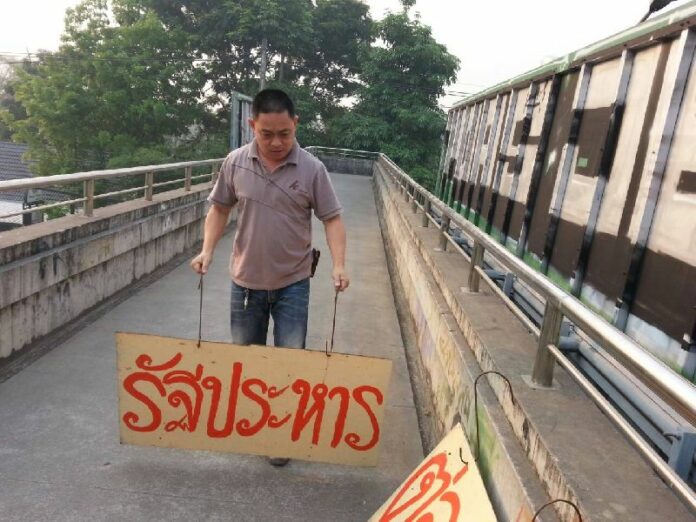
A plain-clothed police officer removing the anti-coup sign in Chiang Mai province, 18 March 2015.

CHIANG MAI — Police officers in the northern province of Chiang Mai are searching for those who hung an anti-coup sign over a highway this morning.

The sign, which read “Oppose the Coup,” was spotted on a highway sign on Mahidol Road. Police removed the sign as soon as they arrived at the scene. 

\
The "Oppose the Coup" sign spotted on Mahidol Road, Chiang Mai, 18 March 2015.

Pol.Maj.Gen. Pongsak Chueasomboon, deputy commander of 5th Regional Police, said he has instructed officers  to urgently investigate the incident. 

"They must inspect CCTVs in the crime scene and the area around it," Pol.Maj.Gen. Pongsak said, "They must inspect suspicious individuals or vehicles. I believe it won't be hard to find the perpetrators." 

He also called for all police units in the province to step up security measures to prevent any further incidents. 

Thailand’s military junta, which seized power in a coup last May, has banned all political activities and protests against its regime. Those who violate the order may face trials in martial court, where military officers serve as judges and appeals are not possible. 

Chiang Mai province is the hometown of Yingluck Shinawatra, the former Prime Minister whose government was ousted in the coup. Yingluck and her brother, former Prime Minister Thaksin Shinawatra, enjoy widespread support in the province. Small-scale anti-coup protests broke out in Chiang Mai shortly after the military takeover, but were quickly suppressed by security forces. 

 
Advertisement

Suspected Bombers Jailed for Contempt of Court

Mahahin Khunthong and Yutthana Yenpinyo at the criminal court in Bangkok today, 17 March 2015.

BANGKOK — Two suspects accused of throwing a grenade at the Criminal Court in Bangkok on 7 March were found guilty of disrespecting the judiciary today.

The criminal court sentenced Mahahin Khunthong and Yutthana Yenpinyo to five months in prison today for contempt of the court, an offense defined as "refusing to obey court regulations concerning the maintenance of peace and order, or unruly behavior on the court’s premises."

They are also facing a separate trial in military court on charges of attempted murder, detonating an explosive with the potential to harm others, and a possessing firearms and ammunition without a permit, among other offenses.

Today’s verdict said Mahahin and Yutthana caused "chaos" and "panic" by throwing a grenade at the court's parking lot on the night of 7 March.

"It was an action that affected the operations of officials and judges," the verdict read. "It also caused panic to the people." 

Military officers said they arrested the two suspects arrested shortly after the explosion, which did not injure anyone or cause major damages.

Mahahin and Yutthana were detained in an army camp for several days of interrogation before they were transferred to police custody. They are currently being held at Bangkok Remand Prison.

At least 15 arrest warrants have been issued for suspects in connection with the courthouse attack.

Police say the alleged "terrorist network" behind the bombing was plotting to stage bomb attacks on four other targets in Bangkok, including Chatuchak subway station, the 11th Infantry Regiment headquarters, Lumpini Park, and Siam Kempinski Hotel. 
 
Advertisement

Editorial: A Referendum is Not Enough

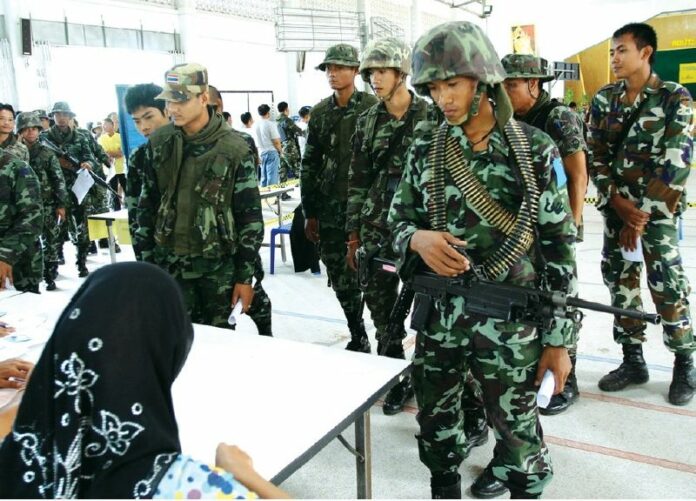
Soldiers in Yala province vote in the referendum on the 2007 charter.

The junta should organize a referendum that will allow the Thai people to choose between the upcoming 2015 constitution and the 1997 "People’s Constitution."

Junta leader and Prime Minister Prayuth Chan-ocha has suggested that it is still "too early" to discuss whether there will be a referendum on the 2015 charter, which is being drafted by a junta-appointed body.

However, the need for a referendum is so fundamental that it should not be up for discussion at all; without receiving approval from the people, Thailand’s 20th charter will lack all legitimacy and inevitably set the stage for a renewed political crisis. Even some members of the junta’s government have expressed support for the measure.

And yet, the promise of a referendum alone is not enough. The options made available to the people are equally important.

In the referendum for the 2007 charter, which was also drafted by a junta-appointed council, voters were only permitted to accept or decline the document.

This vagueness allowed the military junta at the time to spread fear that the alternative would be worse. Fearing prolonged military rule, many voters reluctantly approved the junta’s charter, not knowing what fate a rejection would bring.

In order to give the Thai people a true choice, the current junta should allow voters to choose between the 2015 charter draft – which is even more regressive than the 2007 constitution – and the 1997 constitution, which was drafted by an elected assembly. 

Hailed as the "People's Constitution," the 1997 charter was the first and only constitution to establish a fully-elected House of Representatives and Senate. In contrast, the draft of the 2015 charter calls for an unelected Senate, harking back to the 1980s, when MPs were elected but tightly controlled by an appointed Senate and unelected Prime Minister. 

The 1997 constitution is not a cure all for Thailand’s political ills. Reforms will still be needed, and reconciliation will be a slow and arduous process. However, the 1997 charter will allow this healing to take place under an elected government that can represent and respond to the demands of the people.

Democracy in Thailand has been repeatedly interrupted by military coups and dictatorships. Every time a charter is dissolved, the institution of democracy is weakened and the notion that electoral results can be overturned by extra-constitutional means is reinforced. The latter belief is the number one obstacle standing in the way of Thailand’s democratic future.

In order to end this cycle of crisis, the next charter must be built to last. Without the support from a majority of Thais, it will only be a matter of time before unrest resurfaces. 

If the junta is genuine in its goal to strengthen Thailand’s democracy, the Thai people must be involved in the process, starting with the constitution. 

 
Advertisement

Editorial: A Referendum is Not Enough

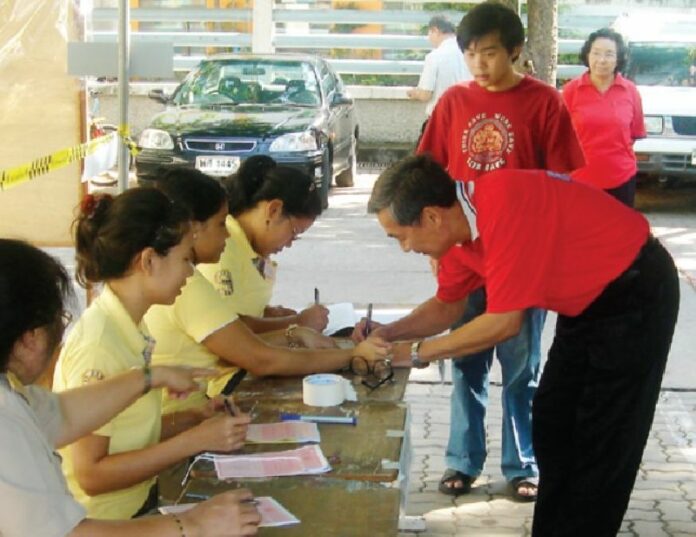
Anti-coup activist Weng Tojirakarn votes in the 2007 referendum, wearing red to signify his opposition to the constitution draft, 19 August 2007.

The junta should organize a referendum that will allow the Thai people to choose between the upcoming 2015 constitution and the 1997 "People’s Constitution."

Junta leader and Prime Minister Prayuth Chan-ocha has suggested that it is still "too early" to discuss whether there will be a referendum on the 2015 charter, which is being drafted by a junta-appointed body.

However, the need for a referendum is so fundamental that it should not be up for discussion at all; without receiving approval from the people, Thailand’s 20th charter will lack all legitimacy and inevitably set the stage for a renewed political crisis. Even some members of the junta’s government have expressed support for the measure.

And yet, the promise of a referendum alone is not enough. The options made available to the people are equally important.

In the referendum for the 2007 charter, which was also drafted by a junta-appointed council, voters were only permitted to accept or decline the document.

This vagueness allowed the military junta at the time to spread fear that the alternative would be worse. Fearing prolonged military rule, many voters reluctantly approved the junta’s charter, not knowing what fate a rejection would bring.

In order to give the Thai people a true choice, the current junta should allow voters to choose between the 2015 charter draft – which is even more regressive than the 2007 constitution – and the 1997 constitution, which was drafted by an elected assembly. 

Hailed as the "People's Constitution," the 1997 charter was the first and only constitution to establish a fully-elected House of Representatives and Senate. In contrast, the draft of the 2015 charter calls for an unelected Senate, harking back to the 1980s, when MPs were elected but tightly controlled by an appointed Senate and unelected Prime Minister. 

The 1997 constitution is not a cure all for Thailand’s political ills. Reforms will still be needed, and reconciliation will be a slow and arduous process. However, the 1997 charter will allow this healing to take place under an elected government that can represent and respond to the demands of the people.

Democracy in Thailand has been repeatedly interrupted by military coups and dictatorships. Every time a charter is dissolved, the institution of democracy is weakened and the notion that electoral results can be overturned by extra-constitutional means is reinforced. The latter belief is the number one obstacle standing in the way of Thailand’s democratic future.

In order to end this cycle of crisis, the next charter must be built to last. Without the support from a majority of Thais, it will only be a matter of time before unrest resurfaces. 

If the junta is genuine in its goal to strengthen Thailand’s democracy, the Thai people must be involved in the process, starting with the constitution. 

 
Advertisement

Hot News

LATEST NEWS

Bangkok
overcast clouds
32.2 ° C
32.2 °
32.2 °
97 %
4.3kmh
100 %
Sun
30 °
Mon
34 °
Tue
33 °
Wed
32 °
Thu
33 °