28.3 C
Bangkok
Saturday, July 25, 2026
Home Blog Page 3049

Provincial Court Accepts Appeal to Find Missing Karen Activist

(Prachatai English)

BANGKOK – Phetchaburi Provincial Court accepted an appeal to hold an emergency trial to find a missing a Karen human rights activist who disappeared in April 2014.

The Provincial Court on Tuesday accepted the appeal to hold an emergency trial under Article 90 of the Criminal Procedure Code to investigate the alleged unlawful detention of Porlajee Rakchongcharoen, aka Billy, a ethnic Karen and community rights activist.

The appeal request was submitted by Phinnapha Phrueksaphan, Billy’s wife.

Read more here.

Note: Khaosod English is not responsible for content on other websites.

Advertisement

Video Footage Exposes Source of Mysterious House Fires

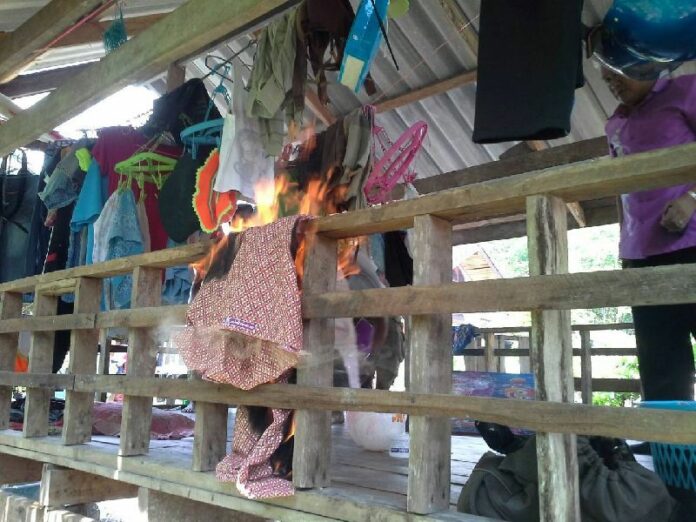
A photo of one of the more than 200 fires at a house in Phatthalung province, 23 April 2015 [Matichon].

PHATTHALUNG — Video surveillance has revealed that humans, not supernatural entities, are responsible for more than 200 fires lit inside a house in southern Thailand over the past few weeks.

Lom Sakwan, 63, told the media in mid-April that inexplicable fires kept erupting in his house in Phatthalung province. According to Lom, the flames would abruptly crop up in his kitchen, bedroom, and living room when no one was watching, causing significant distress to his family.

Lom said he counted more than 200 incidents over the course of several weeks.

His story attracted attention from local communities, national media, and followers of superstitious beliefs. Yesterday, a group of "hermits" arrived at Lom's house and informed him that a child ghost has been haunting his family and setting the fires. Lom organized a ceremony to dispel evil spirits on 26 April, in which at least five monks known for their necromancy skills were invited, yet five more blazes were reported later that day.

Meanwhile, scientists interviewed by the media have insisted that the fires are caused by humans. Yesterday, Weerachai Phutdhawong, a professor on forensic science at Kasetsart University, suggested cameras be set up to get to the bottom of the mystery. 

"Setting up cameras at the scene will help bring answers about the cause of the fire. Volunteers can also observe behavior of each family member in the house," Weerachai said. "I believe that setting up cameras there would not show any ghost coming to set the fire." 

Hours later, Channel 8 news station revealed that reporters placed a hidden video camera in Lom’s living room while they were talking to Lom and his family. 

In footage captured by the camera, a woman is seen quietly setting a fire to a piece of cloth while no one is watching her. She then walks away and alerts other people in the house about the flame. The video did not identify the woman but it is presumed she is one of Lom’s relatives.

Pol.Maj.Gen. Damrat Wiriyakul, commander of Phatthalung police, told Thai Rath news site that there is still debate about the source of the fires.

"Villagers in the area are still convinced that it is caused by supernatural [beings], which contradicts with opinion of experts," Pol.Maj.Gen. Damrat was quoted as saying. 


For comments, or corrections to this article please contact: [email protected]

You can also find Khaosod English on Twitter and Facebook
http://twitter.com/KhaosodEnglish
http://www.facebook.com/KhaosodEnglish

Advertisement

Death Toll Passes 4,700 in Nepal

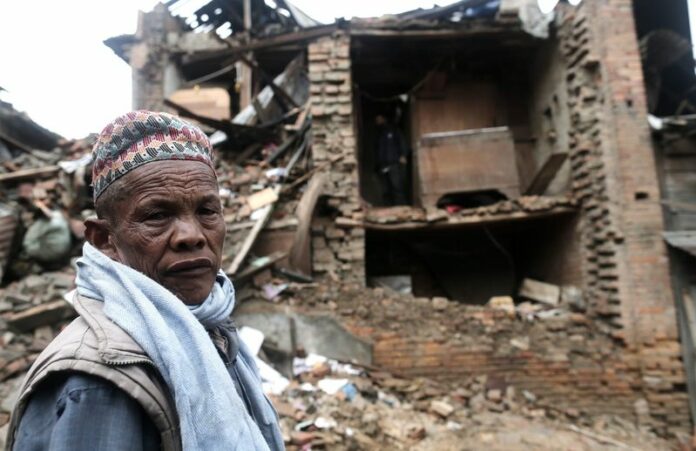
A man stands in front of a home in Bhaktabur destroyed in the Nepal earthquake over the weekend. EPA/SEDAT SUNA

KATHMANDU (DPA) — The official death toll from the earthquake in Nepal reached 4,731 Wednesday, with 1,448 of the fatalities recorded in the capital Kathmandu.

More movement was visible on the streets as people who had spent days in terror since Saturday's 7.8-magnitude earthquake struck ventured out, to buy essentials or to go to work despite the fear provoked by numerous aftershocks.

\
Women cover their faces as they watch rescue work at a collapsed building after the 25 April earthquake, in Shaku, Nepal, 28 April 2015. The official death toll in Nepal from the magnitude-7.8 earthquake at the weekend continues to rise. EPA/ABIR ABDULLAH

"We need to stock up food and buy other stuff now, just to be prepared," said Chejum Gurung, who was also taking care of six children in a Kathmandu neighbourhood, camping in her yard.

"I keep feeling like the ground is shaking still. Or maybe it's just my legs."

People waited hungry and cold for help to arrive, as they complained that assistance from the authorities had not reached them.

"We have limited resources and equipment, but we are learning from our weaknesses, and trying our best to speed up the rescue mission," Prime Minister Sushil Koirala said.

But people did not appear convinced by government's assurances and were leaving the capital, which has suffered massive casualties and destruction.

"We are leaving today for the Terai region, where we plan to remain until things get a bit better," said Chandra Shekhar Jaiswal, a resident of Maharajganj. "There is going to be a shortage of food and facilities here, so it's better to leave now."

But there were hundreds who will be forced to remain on the streets in Kathmandu, until they can find shelter.

"My son ran out just in time before our house went down. Two hundred and fifty houses in our neighbourhood are just piles of bricks or leaning against each other, ready to collapse any time," said Babu Raja, a resident of Dharmasthali district in Kathmandu.

"My family survived this. But it's a strange feeling knowing that you don't have a house to return to at the end of the day."

More than 15 countries were involved in the rescue and relief efforts.

"We have been coordinating with the government to distribute aid," said Ram Babu Shah, United Nations national information coordinator in Nepal.

"We are also trying to work in coordination with the other aid agencies that have arrived in Nepal to provide relief and rescue."

The government said it would enter the reconstruction phase soon after taking care of the quake victims, and that the heritage sites that had been destroyed would be rebuilt in phases.

Reporting by Pratibha Tuladhar

For comments, or corrections to this article please contact: [email protected]

You can also find Khaosod English on Twitter and Facebook
http://twitter.com/KhaosodEnglish
http://www.facebook.com/KhaosodEnglish


Advertisement

Death Toll Passes 4,700 in Nepal

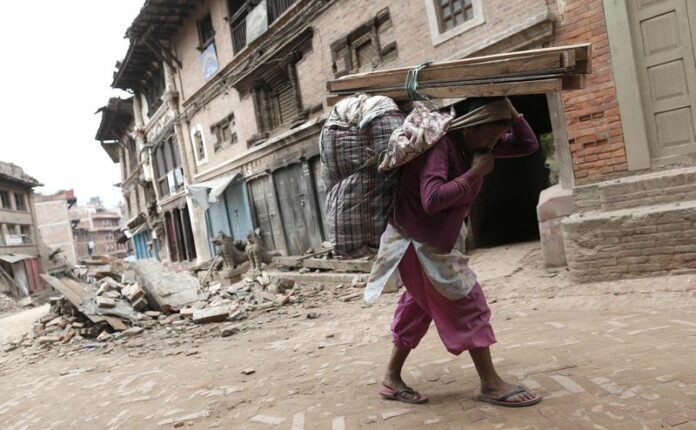
A woman carries her belongings as she walks along a road strewn with rubble near Bhaktapur in Kathmandu. EPA/SEDAT SUNA

KATHMANDU (DPA) — The official death toll from the earthquake in Nepal reached 4,731 Wednesday, with 1,448 of the fatalities recorded in the capital Kathmandu.

More movement was visible on the streets as people who had spent days in terror since Saturday's 7.8-magnitude earthquake struck ventured out, to buy essentials or to go to work despite the fear provoked by numerous aftershocks.

\
Women cover their faces as they watch rescue work at a collapsed building after the 25 April earthquake, in Shaku, Nepal, 28 April 2015. The official death toll in Nepal from the magnitude-7.8 earthquake at the weekend continues to rise. EPA/ABIR ABDULLAH

"We need to stock up food and buy other stuff now, just to be prepared," said Chejum Gurung, who was also taking care of six children in a Kathmandu neighbourhood, camping in her yard.

"I keep feeling like the ground is shaking still. Or maybe it's just my legs."

People waited hungry and cold for help to arrive, as they complained that assistance from the authorities had not reached them.

"We have limited resources and equipment, but we are learning from our weaknesses, and trying our best to speed up the rescue mission," Prime Minister Sushil Koirala said.

But people did not appear convinced by government's assurances and were leaving the capital, which has suffered massive casualties and destruction.

"We are leaving today for the Terai region, where we plan to remain until things get a bit better," said Chandra Shekhar Jaiswal, a resident of Maharajganj. "There is going to be a shortage of food and facilities here, so it's better to leave now."

But there were hundreds who will be forced to remain on the streets in Kathmandu, until they can find shelter.

"My son ran out just in time before our house went down. Two hundred and fifty houses in our neighbourhood are just piles of bricks or leaning against each other, ready to collapse any time," said Babu Raja, a resident of Dharmasthali district in Kathmandu.

"My family survived this. But it's a strange feeling knowing that you don't have a house to return to at the end of the day."

More than 15 countries were involved in the rescue and relief efforts.

"We have been coordinating with the government to distribute aid," said Ram Babu Shah, United Nations national information coordinator in Nepal.

"We are also trying to work in coordination with the other aid agencies that have arrived in Nepal to provide relief and rescue."

The government said it would enter the reconstruction phase soon after taking care of the quake victims, and that the heritage sites that had been destroyed would be rebuilt in phases.

Reporting by Pratibha Tuladhar

For comments, or corrections to this article please contact: [email protected]

You can also find Khaosod English on Twitter and Facebook
http://twitter.com/KhaosodEnglish
http://www.facebook.com/KhaosodEnglish

Advertisement

8 Uighurs Escape Sa Kaeo Detention Center

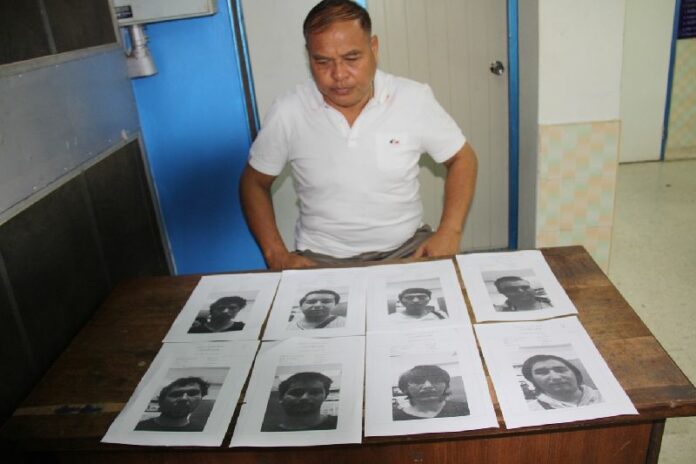
A detention facility staff in Sa Kaeo with the photos of eight Uighurs who allegedly entered Thailand and escaped from their holding cell on 28 April 2015.

SA KAEO — Police say they are looking for eight Uighurs who illegally entered Thailand and escaped from their holding cell last night.

According to police, 17 detainees broke out from the detention facility in Aranyaprathet district last night by hacking off a part of the ceiling and roof. Nine detainees were later arrested by police at around 4 am this morning, while the rest is still on the run. 

Police say all 17 detainees were arrested on Sunday near the Thai – Cambodian border in Sa Kaeo province for entering Thailand without proper visas. They are reportedly being held at the detention center to await their transfer to Immigration Police in Bangkok.

Police have not disclosed their nationality. 

The Uighurs are a Muslim people from China's Xiajiang province who speak a Turkic language. Many have crossed overland into Southeast Asian countries before heading elsewhere in an effort to flee China’s repressive policies. 


For comments, or corrections to this article please contact: [email protected]

You can also find Khaosod English on Twitter and Facebook
http://twitter.com/KhaosodEnglish
http://www.facebook.com/KhaosodEnglish

Advertisement

There Was No Crackdown in 2010, Says Abhisit Witness

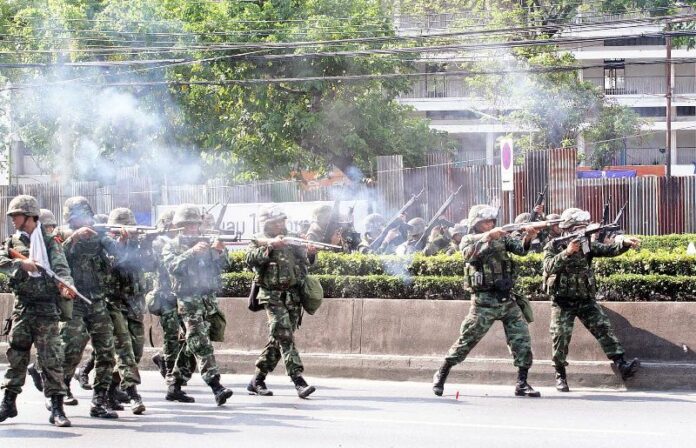
Soldiers advance in front of Lumpini boxing stadium in Bangkok on 15 May 2010.

BANGKOK — The military operation that dispersed Redshirt protesters in 2010 and left more than 90 people dead was not a "crackdown," says a former government official and key witness in an ongoing legal case over the incident.

Thawil Pliensri, who served as director of the National Security Council under Prime Minister Abhisit Vejjajiva, was called by Thailand’s national anti-graft agency to testify in Abhisit's defense today. The National Anti-Corruption Commission (NACC) is currently seeking to retroactively impeach Abhisit and his deputy, Suthep Thaugsuban, for authorizing the military operation on Redshirt protesters in April – May 2010. 

\
Soldiers advance in downtown Bangkok on 15 May 2010.

The NACC has charged Abhisit and Suthep with abuse of power for excessive use of force against civilians in the operation. If the NACC proceeds with the case, Thailand's junta-appointed legislature will vote on whether to impeach the former Democrat Party politicians and thereby ban them from politics for five years. If they are found guilty, Abhisit and Suthep will be the first state officials to be held responsible for the 2010 crackdown.

Thawil said he testified to the NACC today that security officers were forced to respond to the protests because armed militants had infiltrated the demonstrators and launched attacks on troops, police, and important buildings. He also contested the use of the word "crackdown," a widely accepted term used by Thai and foreign media to describe the events.  

"There was no use of force or crackdown on the protests," Thawil said. "I am not saying this to play with words, or because I am avoiding using the term crackdown, but that is what really happened. There was no crackdown."

Thawil continued, "There are two events that the protesters refer to as a crackdown, the event on 10 April 2010 around Khok Wua intersection, which was an effort to ask the protesters to return the area [to traffic], and the events between May 11 – 19 2010. That wasn't a crackdown, either. It was an effort to tighten the perimeter around the protest camps. The security officers did not crack down on the protests."

According to Thawil, even the final assault on Redshirt protest camps on 19 May 2010, which involved armored vehicles, was not a crackdown because "the leaders called off the protests on their own." 

"After that, a riot broke out," Thawil said. "There were arson attacks in Bangkok. Thirty-seven buildings were burned, and four provincial city halls were burned down too. Security officers stopped the situation at that point. We didn't crack down on the protests."

Although Thawil admitted that live ammunition was used in the military operation, he insisted that security officers resorted to using firearms only after they were attacked by Redshirt-allied militants on the night of 10 April 2010, and that security officers strictly followed rules of engagement. 

When a reporter asked Thawil to comment on court inquests that say security officers were responsible for the deaths of at least 18 victims in the crackdown, Thawil suggested that the rulings were not definitive, though he refused to elaborate. 

He also lashed out at Redshirt leaders for frequently referring to the clashes 2010 as "The Crackdown of 99 Deaths" because the government has counted only 91 deaths, 55 of which were Redshirt protesters.

"So there were only 55 [dead protesters]. These people died between the period of 10 April and 19 May. The incidents were not caused by security officers using force to pressure the protesters, and causing almost 100 deaths. It wasn't like that," Thawil said. 

The Abhisit government and military commanders have repeatedlyblamed Redshirt-allied militants known as the Blackshirts for the crackdown violence, despite evidence of soldiers firing their weapons indiscriminately into crowds of unarmed protesters. 

Although Redshirt leaders have repeatedly denied any connection to the Blackshirts, a number of activists have privately acknowledged that the militants were allied to their movement and provided a necessary self-defense against the military.

The identity of the Blackshirts has never been independently verified, though police arrested five men and one woman suspected of belonging to the militant cell last September. The group is awaiting trial in Bangkok prisons.  

 
For comments, or corrections to this article please contact: [email protected]

You can also find Khaosod English on Twitter and Facebook
http://twitter.com/KhaosodEnglish
http://www.facebook.com/KhaosodEnglish

Advertisement

There Was No Crackdown in 2010, Says Abhisit Witness

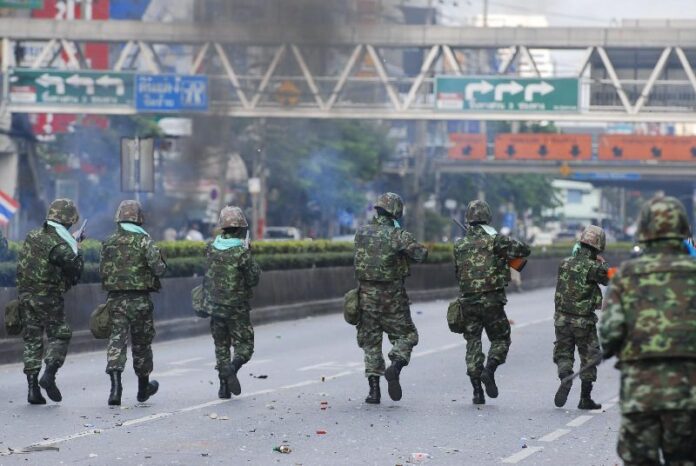
Soldiers in downtown Bangkok on 14 May 2010.

BANGKOK — The military operation that dispersed Redshirt protesters in 2010 and left more than 90 people dead was not a "crackdown," says a former government official and key witness in an ongoing legal case over the incident.

Thawil Pliensri, who served as director of the National Security Council under Prime Minister Abhisit Vejjajiva, was called by Thailand’s national anti-graft agency to testify in Abhisit's defense today. The National Anti-Corruption Commission (NACC) is currently seeking to retroactively impeach Abhisit and his deputy, Suthep Thaugsuban, for authorizing the military operation on Redshirt protesters in April – May 2010. 

\
Soldiers advance in front of Lumpini boxing stadium in Bangkok on 15 May 2010.

The NACC has charged Abhisit and Suthep with abuse of power for excessive use of force against civilians in the operation. If the NACC proceeds with the case, Thailand's junta-appointed legislature will vote on whether to impeach the former Democrat Party politicians and thereby ban them from politics for five years. If they are found guilty, Abhisit and Suthep will be the first state officials to be held responsible for the 2010 crackdown.

Thawil said he testified to the NACC today that security officers were forced to respond to the protests because armed militants had infiltrated the demonstrators and launched attacks on troops, police, and important buildings. He also contested the use of the word "crackdown," a widely accepted term used by Thai and foreign media to describe the events.  

"There was no use of force or crackdown on the protests," Thawil said. "I am not saying this to play with words, or because I am avoiding using the term crackdown, but that is what really happened. There was no crackdown."

Thawil continued, "There are two events that the protesters refer to as a crackdown, the event on 10 April 2010 around Khok Wua intersection, which was an effort to ask the protesters to return the area [to traffic], and the events between May 11 – 19 2010. That wasn't a crackdown, either. It was an effort to tighten the perimeter around the protest camps. The security officers did not crack down on the protests."

According to Thawil, even the final assault on Redshirt protest camps on 19 May 2010, which involved armored vehicles, was not a crackdown because "the leaders called off the protests on their own." 

"After that, a riot broke out," Thawil said. "There were arson attacks in Bangkok. Thirty-seven buildings were burned, and four provincial city halls were burned down too. Security officers stopped the situation at that point. We didn't crack down on the protests."

Although Thawil admitted that live ammunition was used in the military operation, he insisted that security officers resorted to using firearms only after they were attacked by Redshirt-allied militants on the night of 10 April 2010, and that security officers strictly followed rules of engagement. 

When a reporter asked Thawil to comment on court inquests that say security officers were responsible for the deaths of at least 18 victims in the crackdown, Thawil suggested that the rulings were not definitive, though he refused to elaborate. 

He also lashed out at Redshirt leaders for frequently referring to the clashes in 2010 as "The Crackdown of 99 Deaths" because the government has counted only 91 deaths, 55 of which were Redshirt protesters.

"So there were only 55 [dead protesters]. These people died between the period of 10 April and 19 May. The incidents were not caused by security officers using force to pressure the protesters, and causing almost 100 deaths. It wasn't like that," Thawil said. 

The Abhisit government and military commanders have repeatedly blamed Redshirt-allied militants known as the Blackshirts for the crackdown violence, despite evidence of soldiers firing their weapons indiscriminately into crowds of unarmed protesters. 

Although Redshirt leaders have repeatedly denied any connection to the Blackshirts, a number of activists have privately acknowledged that the militants were allied to their movement and provided a necessary self-defense against the military.

The identity of the Blackshirts has never been independently verified, though police arrested five men and one woman suspected of belonging to the militant cell last September. The group is awaiting trial in Bangkok prisons.  

 
For comments, or corrections to this article please contact: [email protected]

You can also find Khaosod English on Twitter and Facebook
http://twitter.com/KhaosodEnglish
http://www.facebook.com/KhaosodEnglish

Advertisement

Women's Groups Mark 11th Anniversary of Mosque Massacre

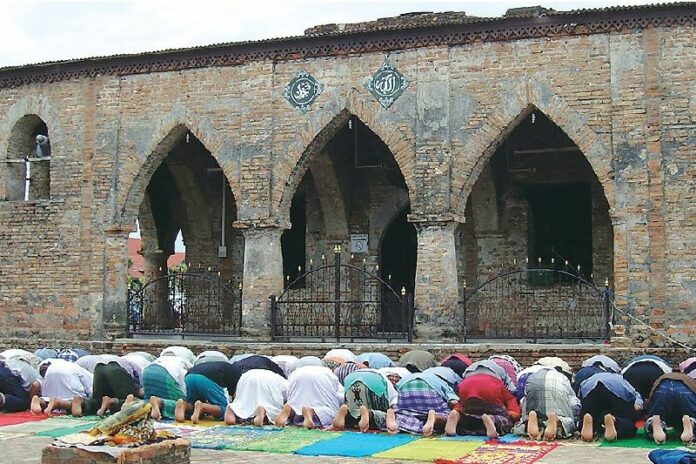
Muslims pray in front of the ruins of Krue Se mosque, 30 April 2004

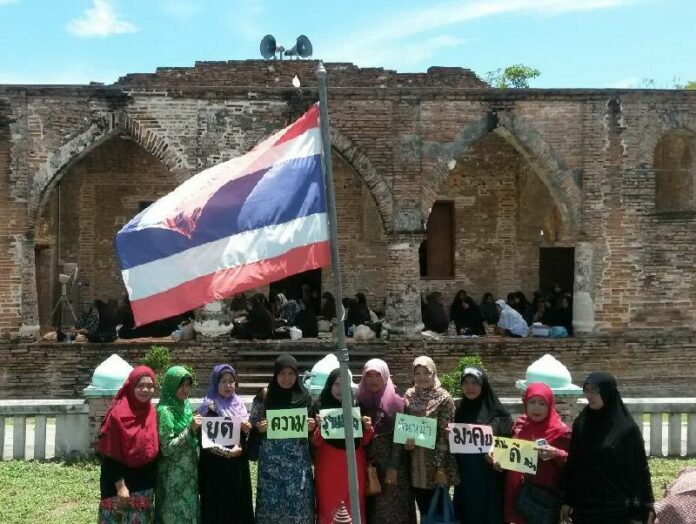
PATTANI — A network of women's rights advocates in Pattani province gathered today to mark the 11th anniversary of the deadly assault on a historic mosque, one of the bloodiest incidents in the separatist insurgency that has gripped the region since 2004.

Representatives of 21 organizations met at Park View Hotel in Pattani this morning to read a joint statement. The statement condemned the recent "cycle of violence" sparked by a military raid on a village in Thung Yang Daeng district that left four civilians dead last month. Following the raid, at least 30 retaliatory attacks have taken place in the region, killing 13 people, including nine women and children, the statement noted.

\
A network of women's rights advocates in Pattani mark the 11th anniversary of a massacre at Krue Se Mosque on 28 April 2015.

"When there is violence, no matter which side started it first, it always leads to retaliation and another cycle of violence," the statement read."It causes losses to lives and properties of civilians, especially vulnerable groups like women and children." 

The secessionist movement, which has claimed the lives of more than 6,200 people, has been waged by a shadowy network of militant groups seeking to revive the independent Islamic state of Patani that was annexed by Thailand in early 20th century. 

In their joint statement today, the women's groups listed four demands that they believe can help bring an end to the unrest in Thailand's three southern border provinces:

"1. Those who use weapons must cease their violence against civilians, especially women and children, and they must cease violent incidents in public areas, such as markets, schools, hospitals, and religious establishments, among others.

2. In order to prevent misunderstanding from escalating and feeding into cycle of violence, the state must be responsible in finding and presenting facts to the public in cases that terrorize public morale, including: the deaths of children and women, deaths of fighters for human rights, killings with cruel methods, massacre of families, and deaths that are believed to have been caused by state officials' excessive use of force. 

3. The state must be committed to eradicating the culture of impunity by equally protecting the rights of the victims and the accused. It must also compensate victims without discrimination based on race, religion, or social status. 

4. The people of all faiths must have restraint in the face of temptation from violent incidents, regardless of which side commits the acts, in order to prevent the cycle of violence from continuing. All forms of solution must uphold principles of peaceful methods, respect human dignity, and use dialogue to find solutions together."

The network includes groups like Thai Women Empowerment Funds, Buddhists for Peace Network, Network of Civic Women for Peace, and Narathiwat Muslimah Society. 

After the press conference, the activists gathered at Krue Se Mosque in Pattani to commemorate the siege and assault of the historic building eleven years ago, which left 32 insurgents dead. The massacre is considered one of the earliest and bloodiest incidents in the insurgency, which broke out in the southern provinces of Pattani, Yala, and Narathiwat in 2004. 

\
Gen. Pallop Pinmanee (far right) inspecting the mosque after the deadly assault, 28 April 2004

On the morning of 28 April 2004, dozens of young militants armed with machetes, knives, and wooden sticks attacked security checkpoints across the three border provinces in coordinated attack. The ambushes were quickly put down by superior-armed security officers. However, 32 militants stole weapons from a police checkpoint and barricaded themselves in the 300-year-old Krue Se mosque, prompting security officers to surround the building.

After a seven-hour siege, Gen. Pallop Pinmanee, commander of a local army unit, ordered troops to use maximum firepower – including rocket-propelled grenades – to retake the mosque. The operation killed all 32 insurgents, and devastated the historic building. 

It later emerged that Gen. Pallop's command contradicted his superior commander's order to negotiate with the mosque defenders and find a peaceful solution. He was transferred from the Deep South region on that day, although he retained a position in a counter-insurgency agency and no legal action was taken against him. 

For comments, or corrections to this article please contact: [email protected]

You can also find Khaosod English on Twitter and Facebook
http://twitter.com/KhaosodEnglish
http://www.facebook.com/KhaosodEnglish

Advertisement

Women's Groups Mark 11th Anniversary of Mosque Massacre

A network of women's rights advocates in Pattani mark the 11th anniversary of a massacre at Krue Se Mosque on 28 April 2015.

PATTANI — A network of women's rights advocates in Pattani province gathered today to mark the 11th anniversary of the deadly assault on a historic mosque, one of the bloodiest incidents in the separatist insurgency that has gripped the region since 2004.

Representatives of 21 organizations met at Park View Hotel in Pattani this morning to read a joint statement. The statement condemned the recent "cycle of violence" sparked by a military raid on a village in Thung Yang Daeng district that left four civilians dead last month. Following the raid, at least 30 retaliatory attacks have taken place in the region, killing 13 people, including nine women and children, the statement noted.

\
A network of women's rights advocates in Pattani mark the 11th anniversary of a massacre at Krue Se Mosque on 28 April 2015.

"When there is violence, no matter which side started it first, it always leads to retaliation and another cycle of violence," the statement read."It causes losses to lives and properties of civilians, especially vulnerable groups like women and children." 

The secessionist movement, which has claimed the lives of more than 6,200 people, has been waged by a shadowy network of militant groups seeking to revive the independent Islamic state of Patani that was annexed by Thailand in early 20th century. 

In their joint statement today, the women's groups listed four demands that they believe can help bring an end to the unrest in Thailand's three southern border provinces:

"1. Those who use weapons must cease their violence against civilians, especially women and children, and they must cease violent incidents in public areas, such as markets, schools, hospitals, and religious establishments, among others.

2. In order to prevent misunderstanding from escalating and feeding into cycle of violence, the state must be responsible in finding and presenting facts to the public in cases that terrorize public morale, including: the deaths of children and women, deaths of fighters for human rights, killings with cruel methods, massacre of families, and deaths that are believed to have been caused by state officials' excessive use of force. 

3. The state must be committed to eradicating the culture of impunity by equally protecting the rights of the victims and the accused. It must also compensate victims without discrimination based on race, religion, or social status. 

4. The people of all faiths must have restraint in the face of temptation from violent incidents, regardless of which side commits the acts, in order to prevent the cycle of violence from continuing. All forms of solution must uphold principles of peaceful methods, respect human dignity, and use dialogue to find solutions together."

The network includes groups like Thai Women Empowerment Funds, Buddhists for Peace Network, Network of Civic Women for Peace, and Narathiwat Muslimah Society. 

After the press conference, the activists gathered at Krue Se Mosque in Pattani to commemorate the siege and assault of the historic building eleven years ago, which left 32 insurgents dead. The massacre is considered one of the earliest and bloodiest incidents in the insurgency, which broke out in the southern provinces of Pattani, Yala, and Narathiwat in 2004. 

\
Gen. Pallop Pinmanee (far right) inspecting the mosque after the deadly assault, 28 April 2004

On the morning of 28 April 2004, dozens of young militants armed with machetes, knives, and wooden sticks attacked security checkpoints across the three border provinces in coordinated attack. The ambushes were quickly put down by superior-armed security officers. However, 32 militants stole weapons from a police checkpoint and barricaded themselves in the 300-year-old Krue Se mosque, prompting security officers to surround the building.

After a seven-hour siege, Gen. Pallop Pinmanee, commander of a local army unit, ordered troops to use maximum firepower – including rocket-propelled grenades – to retake the mosque. The operation killed all 32 insurgents, and devastated the historic building. 

It later emerged that Gen. Pallop's command contradicted his superior commander's order to negotiate with the mosque defenders and find a peaceful solution. He was transferred from the Deep South region on that day, although he retained a position in a counter-insurgency agency and no legal action was taken against him. 

 
For comments, or corrections to this article please contact: [email protected]

You can also find Khaosod English on Twitter and Facebook
http://twitter.com/KhaosodEnglish
http://www.facebook.com/KhaosodEnglish

Advertisement

Three Days of Mourning Declared as Nepal Death Toll Reaches 4,300

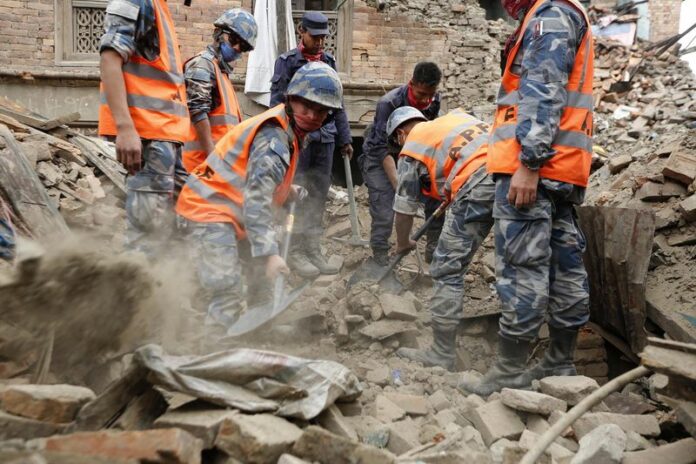
Rescue workers dig out several houses that collapsed in the Vhaktapur district following Saturday's earthquake in Nepal. EPA/ABIR ABDULLAH

KATHMANDU (DPA) — Nepal's government declared three days of mourning Tuesday for more than 4,000 people who died in a massive earthquake at the weekend.

The government raised the death toll to 4,353 as volunteers searched for dead and missing from Saturday's quake, with nearly 8,000 injured.

\
People sit in front of their destroyed home in Kathmandu, Nepal, 27 April 2015. EPA/Palani Mohan/International Federation Red Cross and Red Crescent 

"We were not prepared for a disaster of this scale," Interior Minister Bam Dev Gautam said. "We do not have enough resources and will need more time to reach out to everyone."

Many people in Kathmandu slept outdoors in public spaces, parks and roads. Electricity was restored in some areas, but remained intermittent.

People said rations and gas were running out, blaming the government for not doing enough to provide basic amenities.

"The food is running out in our area. Shops are hardly open and if they do people hoard and everything is gone in minutes," resident Rajendra BK said.

"We've been here on the streets, without food and water and we still haven't seen a government representative in three days," said a man camping on the roadside with his family.

The government also warned against black marketeering as people struggled to buy commodities.

Power outages have prevented people withdrawing money from banks.

\
Rescue team members from the Netherlands using a sniffer dog to search rubble for survivors in Kathmandu, Nepal, 27 April 2015. EPA/NARENDRA SHRESTHA

Interior spokesman Ministry Laxmi said remote villages in the hard-hit districts of Sindhupalchowk, Rasuwa, and Gorkha were still inaccessible to relief efforts.

One man staying in a makeshift tent with about 20 people said his home village Sindhukot in Sindhupalchowk district, 50 kilometres north-east of the capital, was completely devastated.

"My own uncle was killed after being buried under the house. All the cattle in the village were killed as well. Since it was accessible by road we brought the injured to Kathmandu, but the government has not send any relief efforts there."

On Mount Everest, the number killed by avalanches set off by the tremor was uncertain.

"We have brought down 14 bodies and three are to be airlifted today," police officer Bhanubhakta Nepal told dpa from the Everest region.

"We still can't say how many people died on the mountain," he said. "We rescued 205 people in total on Monday."

A spokesman for the tourism authorities said at least 20 were thought to have died on the slopes of the world's highest peak, while the Indian military put the toll at 22.

Almost all the 1,000 people who were at the base camp on Saturday had now been recovered, according to mountaineers' posts on social media.

\
Rescue workers dig out several houses that collapsed in the Vhaktapur district following Saturday's earthquake in Nepal. EPA/ABIR ABDULLAH

US mountaineer Alan Arnette wrote on his blog that a team would have to assess the possibility of restoring the route in time for the rest of the spring climbing season.

Across the border in China's Tibet Autonomous Region, authorities said 25 people were killed by the quake, and 117 injured, when nearly 80 per cent of houses collapsed in the three counties of Gyirong, Nyalam and Tingri.

Military and rescue personnel had been dispatched to the area to clear roads, reach any survivors and tend to those made homeless, state-run Xinhua news agency reported.

Around 20 aftershocks had been felt in Tibet since Saturday's quake, the report said. Tremors were also felt across Nepal and in neighbouring India Tuesday, Indian broadcaster NDTV said.

Reporting by Pratibha Tuladhar

 
For comments, or corrections to this article please contact: [email protected]
You can also find Khaosod English on Twitter and Facebook
http://twitter.com/KhaosodEnglish
http://www.facebook.com/KhaosodEnglish

Advertisement

Hot News

LATEST NEWS

Bangkok
light rain
28.3 ° C
28.3 °
28.3 °
82 %
3.6kmh
73 %
Sat
30 °
Sun
33 °
Mon
33 °
Tue
30 °
Wed
29 °