























27.2 C
Bangkok
Monday, June 29, 2026
Home Blog Page 3050

Bipartisan Alarm Over Junta's 'Anti-Politician' Charter

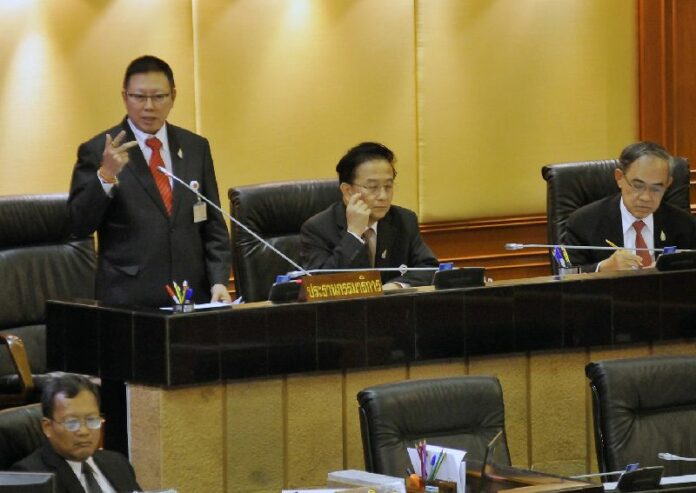
CDC chairperson Bowornsak Uwanno briefs the National Reform Council about the constitution drafting, 10 March 2015

BANGKOK — In a rare public forum on the future of Thai politics, prominent politicians from the country’s rival parties banded together to criticize the junta’s new charter and its restraints on the power of elected officials.

Top members of the Pheu Thai and Democrat Parties—who a year ago would have been aptly described as sworn enemies—agreed last night that if enacted, the new charter will be a major setback for democracy in Thailand and sow the seeds for renewed conflict. 

The panel discussion, held at the Foreign Correspondent's Club in Thailand (FCCT), was the first public debate between politicians since the coup last May, after which the junta banned political activities of any kind in the name of achieving "national reconciliation." Although authorities instructed last night's panelists not to criticize the junta, the politicians did not mince words when discussing the draft of the new charter, which was written by a junta-appointed council to replace the constitution shredded after the coup.

Disapproval of the draft was expected from the Pheu Thai politicians, whose party controlled the government toppled in the military takeover, but for many, Democrat Party leader Kasit Piromya's criticism came as a surprise.

"I thought that this reformation process under the military’s direction would be moving Thailand in the direction of more democracy and not less," said Kasit, who invited the coup when he joined protests against the Pheu Thai government last year. "But what I’m seeing at the moment…is that we are going backwards. This is a regression of the democratic aspirations of Thai society."

The current charter draft has been criticized by pro-democracy activists for curtailing the power of elected politicians and bolstering bureaucratic oversight. The draft’s most controversial departures from recent constitutions include the transformation of the Senate into a fully-appointed body, and a clause that will allow an unelected "outsider" Prime Minister to take control in the event of a political crisis.

Officials say a finalized version of the constitution will take effect in September 2014, after which a national election will be held. 

Alongkorn Polabutr, the sole representative from the military government on the panel last night, echoed the charter's anti-politician bent when he opened his statement by pointing the finger at the three politicians to his right.

"I am not very comfortable here because all three of my colleagues are out of jobs," said Alongkorn, a former Democrat Party leader who joined the junta’s National Reform Council (NRC) last year. "The reason they are out of jobs is because they could not undertake a peaceful way of solving their own problems."

The 22 May coup was the culmination of six months of Democrat-backed street protests against a Pheu Thai government, whose legislators sparked public outrage by trying to pass an amnesty bill that would have allowed for the return of former Prime Minister Thaksin Shinawatra. Thaskin, the de facto leader of the Pheu Thai party, was ousted in a coup in 2006 and is reviled by Democrat Party supporters.

On 20 May 2014, then-army chief Gen. Prayuth Chan-ocha summoned representatives from both parties for "peace talks," and declared a coup two days later after they were unable to broker a compromise.

The three politicians on the panel last night, who in addition to Kasit included veteran Pheu Thai leaders Chaturon Chaiseng and Phongthep Thepkanjana, admitted that their parties had played a role in the crisis that led to the coup. However, they agreed that punishing politicians by excluding them from the reform process and weakening their roles in government would only further exacerbate the country’s political rifts.

Chaturon, one of few voices to regularly criticize the reform process despite the junta’s clampdown on dissent, expressed concern that MPs will be restrained by a proposed council that will stay on to ensure the government continues the junta’s reform plans. 

Under the proposal, the 120-member council will be composed of members from the junta’s five interim bodies. 

"There will be a steering committee to monitor and make sure that the reform plans are continuously implemented," Chaturon explained. "People will have no way to demand what they need, because everything will be already decided."

In his defense of the new charter, NRC member Alongkorn listed the ways in which past politicians had failed the country, citing rampant corruption and damaging "populist polices." He said the new unelected Senate, which he called the 'House of Citizens,' would serve to keep politicians in check.

"We are going to have a House of Citizens to balance with the House of Politicians, because they don’t believe you are honest enough,” he said. "The usual means of checks and balances were not functioning."

However, Phongthep, a former judge, Pheu Thai MP and Cabinet Minister, argued that strengthening appointed bodies at the expense of elected politicians would only grease the wheels for more graft.

"When this House of Citizens takes office, they will become politicians," said Phongthep. "They will have the power, and people who have power can become corrupt."

Phongthep stressed that in order to reduce corruption, officials must be held more accountable to the voters, not less. He urged the junta to put the new charter up for a referendum and give voters the option to return to the 1997 constitution, in which both houses of parliament were fully and directly elected. 

Government officials said yesterday that the junta has not yet discussed whether there will be a referendum for the charter, which will be Thailand's 20th since the country became a democracy 82 years ago.

Speaking at the forum last night, NRC member Alongkorn said he understood the other panelists' criticism, but stressed the need to "look forward."

"I understand that we may not be under  normal circumstances after the coup d'etat and with martial law," he said. "If I was still thinking the old way, maybe I would speak the same way as these three gentlemen. But now, if you move a little bit to see the new future of Thailand and look back on where we made mistakes, maybe your way of thinking will change [too]." 
(Reporting by Sally Mairs)
 
 
Advertisement

Authorities Mull Limiting Visitors to Similan Islands

A meeting between the Similian National park and 16 tour operators on 11 March 2015.

PHANG NGA — Authorities in Phang Nga province are considering limiting the number of tourists on the Similan islands to 250 people per day in an effort to stem overcrowding on the national park land.

Nat Kongkasorn, head of the Similan National Park, said at a meeting with tour operators yesterday that there have been numerous complaints on social media about the impact tourists are having on the islands’ natural environment.

Renowned for their picturesque beaches and coral reefs, the Similan islands are popular destination for Thai and foreign tourists in southern Thailand. Trips to the islands are typically arranged by tour companies from mainland provinces like Phang Nga, Krabi, and Phuket. 

Representatives of 16 tour companies were present at yesterday’s meeting. In addition to setting a limit of 250 visitors per day, which Nat said would be divided among the tour operators, the park is also considering the following new policies:

  • Removing makeshift cafes installed by tour companies on the islands’ beaches
  • Rotating tourists' visits to different attractions around the islands throughout the day to avoid congestion in any particular area
  • Banning loud boat engines or motors that could churn up sands in the shallow water
  • Banning swimming and snorkeling in areas where coral reefs and marine lives might be affected
  • Banning littering in the oceans
  • Banning feeding marine life  

Anwarin Suchindasathien, manager of Sea Star company, said she agrees with many policies advised by the National Park officials, but warned that the limit of 250 tourists per day may be unrealistic. 

"Nowadays, each company brings about 150 tourists to visit the Similans," Anwarin said, "Therefore, it's impossible that the limit of two hundred per day will work, because there are at least 1,000 tourists visiting.”

Another tour company representative, Chalermsri Paeyai, said the number of tourists to southern Thailand has been rising sharply this month, which has contributed to the "unusually dense crowds" on the islands. However, Chalermsri, who heads Check In Andaman company, said that any restriction on the number of tourists to the Similans may cause a "chain reaction" that damages the tourism industry in the region.

"It could be be a chain reaction, affecting boat owners, boat crew, cars that pick up tourists, hotels, and the tourists," Chalermsri said, "But I am glad to see serious actions from the National Park about the problems." 

 
Advertisement

Citizenship Granted to Thailand's Colonial Diaspora

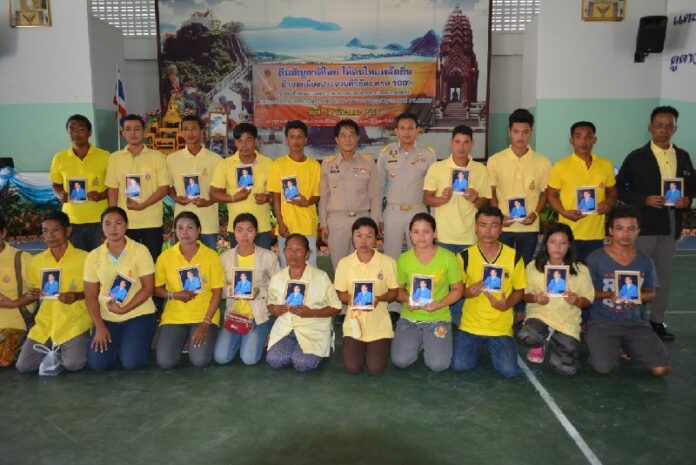
Twenty-four descendants of people who lived in Siam territory that later became Burma were granted Thai citizenship on 12 March 2015.

PRACHUAP KIRI KHAN — Following decades of bureaucratic delays, Thai authorities have finally granted citizenship to descendants of Thais who found themselves without a formal nationality after the British Empire declared their homes to be in Burmese territory nearly 150 years ago.

Pongpan Wichiansamut, permanent secretary to governor of Prachuap Kiri Khan province, presided over the ceremony granting Thai citizenship to 24 representatives of those descendants today. 

\
Twenty-four descendants of people who lived in Siam territory that later became Burma were granted Thai citizenship on 12 March 2015.

The new citizens’ ancestors lived west of Prachuap Kiri Khan and lost their official nationality when the British Empire declared the area part of colonial Burma in July 1868. The region, called Tenasserim, had previously been considered part Thailand, then known as Siam. 

Although the descendants of the group later migrated to Thailand, they were never formally recognized as Thais by authorities. The group first filed a request for citizenship in 1976, but their application was only accepted by the Cabinet in 2006, Pongpan said.

In total, 167 people have been granted the citizenship, including the 24 representatives who attended the ceremony today. Another 169 people are still waiting for their applications to be finalized by the Ministry of Interior Affairs. 

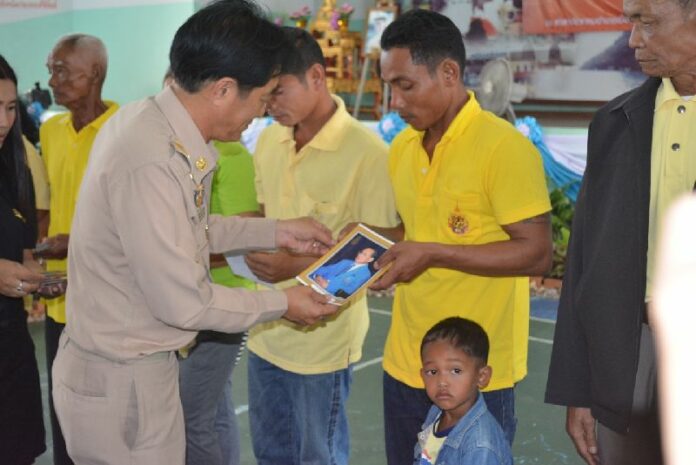
Pongpan and other officials handed out Thai ID cards, residential registration booklets, and portraits of His Majesty the King to the new citizens. The group then sang the Thai national anthem together. 

In the 19th century the Siamese government claimed parts of modern-day Myanmar, Laos, Cambodia, and Malaysia as its dominions. The Siamese claims were later contested by British and French colonialists in Southeast Asia in the middle of the century. By the early 20th century, the Siamese government's territories in Malaysia and Burma were annexed by the British Empire, while Cambodia and Laos fell under French control.

Known as "The Losses of Territory," the incidents are now routinely portrayed in public school textbooks as acts of Western aggression on Thai sovereignty. 

 
Advertisement

Prayuth Offers to Ban Himself From Post-Coup Senate

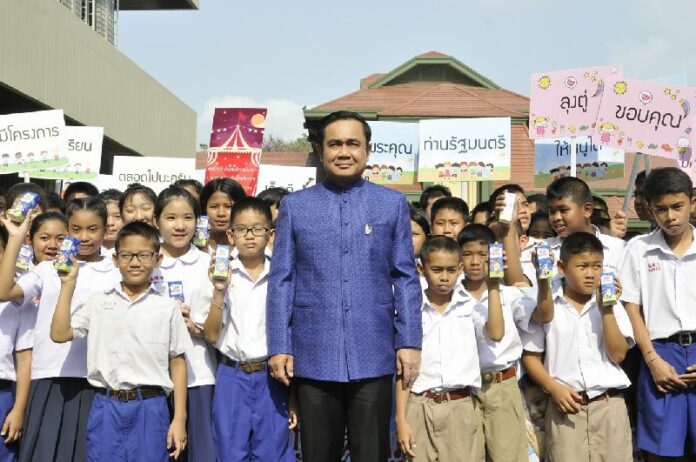
Junta chairman and Prime Minister Prayuth Chan-ocha posed for photo with a group of schoolchildren who visited the Government House in Bangkok, 10 March 2015

BANGKOK — In an effort to assure the public that he will not hold onto power after the next election, junta chairman and Prime Minister Prayuth Chan-ocha has instructed the drafters of the new charter to ban him from serving in the senate.

In a meeting between the junta and its appointed governing bodies yesterday, Gen. Prayuth said he was troubled by accusations that he wants to "perpetuate" his power into the new civilian government. 

"It's not true," Gen. Prayuth said, "I want everyone to complete their duties quickly, so that we can erase this allegation about perpetuating our power." 

The general then suggested that the new constitution specifically ban him from becoming a senator in the government that will take charge after the next election.

"In the provision about the senate, write my name in there and say I won't serve in the senate," Gen. Prayuth said.

According to the draft of the new charter, the senate will be a fully-appointed body, instead of the half-appointed, half-elected body it was under the 2007 constitution. Half of the senators will chosen by a council of "experts," while the others will be selected from a pool of former Prime Ministers, commanders of the armed forces, and other high-ranking bureaucrats.

Accusations that the junta is seeking to retain its grip after the next election mounted after a proposal to ban its members from political office for two years was swiftly shot down by top officials in the military government. Under the interim charter, only members of the Constitutional Drafting Committee will be subjected to the two year ban. 

Although Gen. Prayuth appears willing to forgo a career in the senate, he did not ask to be specifically barred from other offices, such as Prime Minister – a post he currently holds in addition to junta chairman.

Among the charter draft’s most controversial clauses is a provision that allows an unelected “outsider” Prime Minsiter to take the helm in the event of a political crisis. In previous constitutions, the Prime Minister has always been required to be an elected Member of Parliament. It remains unclear how the new charter will define a "political crisis" and how the unelected PM will be chosen.

The CDC was appointed to draft a constitution after the junta dissolved the 2007 charter followng the May 2014 coup. The charter, which will be Thailand's 20th, is expected to be finalized by September.

Politicians and pro-democracy activists in have criticized the charter draft, calling it a major setback for democracy in Thailand.

Speaking to the officials in yesterday's meeting, Gen. Prayuth also urged the CDC to "explain in details" about the draft of the constitution in order to prevent any further "misunderstanding" among the public. 

 
Advertisement

Citizenship Granted to Thailand's Colonial Diaspora

Officials grant Thai citizenship to 24 representatives of those descendants, 12 March 2015.

PRACHUAP KIRI KHAN — Following decades of bureaucratic delays, Thai authorities have finally granted citizenship to descendants of Thais who found themselves without a formal nationality after the British Empire declared their homes to be in Burmese territory nearly 150 years ago.

Pongpan Wichiansamut, permanent secretary to governor of Prachuap Kiri Khan province, presided over the ceremony granting Thai citizenship to 24 representatives of those descendants today. 

\
Twenty-four descendants of people who lived in Siam territory that later became Burma were granted Thai citizenship on 12 March 2015.

The new citizens’ ancestors lived west of Prachuap Kiri Khan and lost their official nationality when the British Empire declared the area part of colonial Burma in July 1868. The region, called Tenasserim, had previously been considered part Thailand, then known as Siam. 

Although the descendants of the group later migrated to Thailand, they were never formally recognized as Thais by authorities. The group first filed a request for citizenship in 1976, but their application was only accepted by the Cabinet in 2006, Pongpan said.

In total, 167 people have been granted the citizenship, including the 24 representatives who attended the ceremony today. Another 169 people are still waiting for their applications to be finalized by the Ministry of Interior Affairs. 

Pongpan and other officials handed out Thai ID cards, residential registration booklets, and portraits of His Majesty the King to the new citizens. The group then sang the Thai national anthem together. 

In the 19th century the Siamese government claimed parts of modern-day Myanmar, Laos, Cambodia, and Malaysia as its dominions. The Siamese claims were later contested by British and French colonialists in Southeast Asia in the middle of the century. By the early 20th century, the Siamese government's territories in Malaysia and Burma were annexed by the British Empire, while Cambodia and Laos fell under French control.

Known as "The Losses of Territory," the incidents are now routinely portrayed in public school textbooks as acts of Western aggression on Thai sovereignty. 

 
Advertisement

Prayuth Offers to Ban Himself From Post-Coup Senate

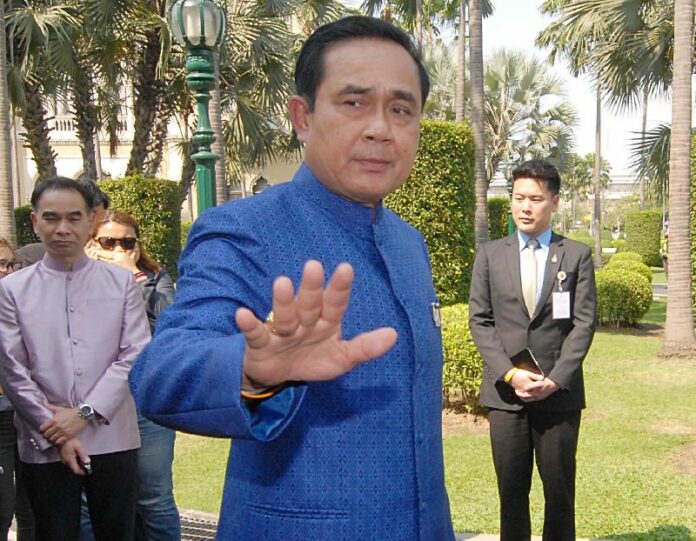
Junta chairman and Prime Minister Gen. Prayuth Chan-ocha on 10 March 2015.

BANGKOK — In an effort to assure the public that he will not hold onto power after the next election, junta chairman and Prime Minister Prayuth Chan-ocha has instructed the drafters of the new charter to ban him from serving in the senate.

In a meeting between the junta and its appointed governing bodies yesterday, Gen. Prayuth said he was troubled by accusations that he wants to "perpetuate" his power into the new civilian government. 

"It's not true," Gen. Prayuth said, "I want everyone to complete their duties quickly, so that we can erase this allegation about perpetuating our power." 

The general then suggested that the new constitution specifically ban him from becoming a senator in the government that will take charge after the next election.

"In the provision about the senate, write my name in there and say I won't serve in the senate," Gen. Prayuth said.

According to the draft of the new charter, the senate will be a fully-appointed body, instead of the half-appointed, half-elected body it was under the 2007 constitution. Half of the senators will chosen by a council of "experts," while the others will be selected from a pool of former Prime Ministers, commanders of the armed forces, and other high-ranking bureaucrats.

Accusations that the junta is seeking to retain its grip after the next election mounted after a proposal to ban its members from political office for two years was swiftly shot down by top officials in the military government. Under the interim charter, only members of the Constitutional Drafting Committee will be subjected to the two year ban. 

Although Gen. Prayuth appears willing to forgo a career in the senate, he did not ask to be specifically barred from other offices, such as Prime Minister – a post he currently holds in addition to junta chairman.

Among the charter draft’s most controversial clauses is a provision that allows an unelected “outsider” Prime Minsiter to take the helm in the event of a political crisis. In previous constitutions, the Prime Minister has always been required to be an elected Member of Parliament. It remains unclear how the new charter will define a "political crisis" and how the unelected PM will be chosen.

The CDC was appointed to draft a constitution after the junta dissolved the 2007 charter followng the May 2014 coup. The charter, which will be Thailand's 20th, is expected to be finalized by September.

Politicians and pro-democracy activists in have criticized the charter draft, calling it a major setback for democracy in Thailand.

Speaking to the officials in yesterday's meeting, Gen. Prayuth also urged the CDC to "explain in details" about the draft of the constitution in order to prevent any further "misunderstanding" among the public. 

 
Advertisement

New Constitution Enacted By 4 Sept: Govt

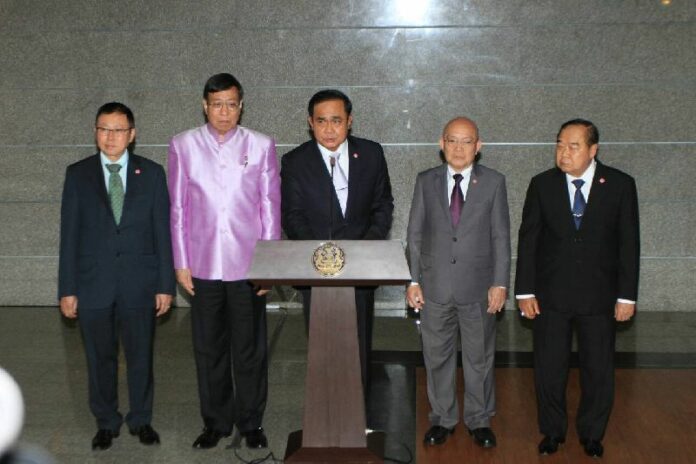
The leaders of the "Five Rivers" organizations in Bangkok, 11 March 2015.

BANGKOK — Thailand's 20th constitution will be inaugurated by His Majesty the King on 4 September 2015, government officials announced on Wednesday.

"The procedure will be completed by 25 May, upon which time the Constitution Drafting Committee will see whether there should be any amendments based on proposals from relevant agencies," said Visanu Kruengam, deputy Prime Minister. "It has been agreed that the final date that the Constitution will be submitted to the King on 4 September."

Per tradition, constitutions in Thailand are "signed" and enacted by His Majesty the King. 

Visanu made the announcement after a meeting between the five governing bodies installed by the military junta, known as the "Five Rivers," which include the Constitution Drafting Committee (CDC), the National Legislative Assembly (NLA), the National Reform Council (NRC), the Cabinet, and the junta itself. 

The junta seized power from an elected government on 22 May 2014, dissolved the 2007 "permanent" constitution, and appointed the CDC to draft a new one for Thailand. The junta has promised that a national election will be held after the constitution is enacted – given that the political climate in the country is deemed stable. 

According to Visanu, elections will take place approximately 150 days after the new charter is formally promulgated, which would fall in February 2016. 

Visanu also said the Five Rivers have not discussed whether there will be a referendum on the new charter, as was the case for the 2007 and 1997 constitutions.

He added that if a referendum was carried out, the date of the constitution's enactment, and the national elections, would be pushed back further. 

"If there is indeed going to be a referendum, the submitting of the constitution to the king on 4 September will not happen, and how long it will be pushed back, I cannot say," Visanu said. 

He also warned that a referendum would entail many complications, such as the question of what will happen if the charter draft is rejected by majority of voters. Visanu said one option is to adopt a recent constitutions, such as the 1997 or 2007 charters, but that the legality of that approach remains unclear.

"If the constitution fails the referendum and we adopt the 1997 or 2007 charter, can we do that?" Visanu said, "Who will let us do it? Which [constitutional] section will let us do it? Will the people let us do it?"

Visanu added that junta chairman and Prime Minister Prayuth Chan-ocha is "satisfied" with the overall direction of his road map for Thailand so far. 

"He would like to thank all agencies for working in accordance with the schedule of his road map," the deputy Prime Minister said. 


Advertisement

CDC's Poll Shows Lack of Support for Unelected PM

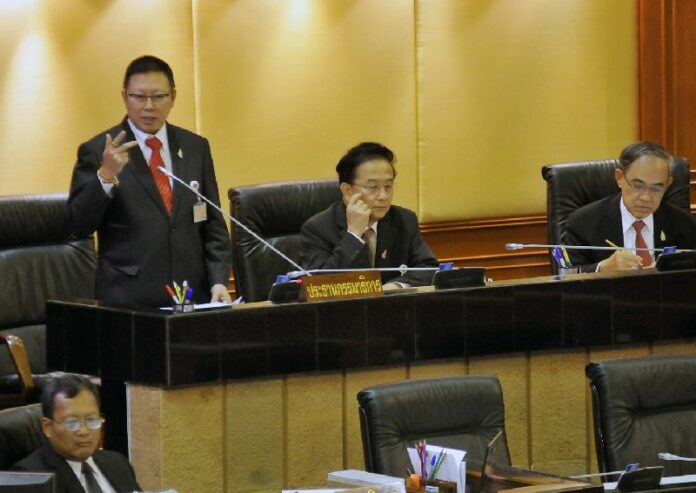
CDC chairperson Bowornsak Uwanno speaking to the CDC at Parliament House in Bangkok, 10 March 2015

BANGKOK — An opinion poll commissioned by the Constitution Drafting Committee (CDC) shows that a majority of respondents disagree with the CDC's proposal to allow an unelected Prime Minister in the new charter.

The poll questioned 5,800 people above the age of 18 across Thailand in January 2015, said CDC member Thawilwadee Bureekul. She said the survey is a part of the CDC's effort to consult public opinion on the the new constitution, which will be Thailand's 20th since democracy was established in 1932. 

According to the poll, 58.9 percent of respondents "agreed" that  the Prime Minister must be an elected Member of the Parliament, as required in recent constitutions. 

The survey result was publicized a few weeks after the CDC officially announced that the new charter will remove the requirement that the Prime Minister be an MP. CDC spokesperson Kamnoon Sitthisaman said the change is intended to allow for flexibility in the event of a "political crisis." 

The current interim charter, which was imposed by the military junta after it seized power from an elected government on 22 May 2014, similarly does not require the head of the government to be a House representative. Coup leader Gen. Prayuth Chan-ocha was later appointed by the interim parliament, whose members he had had handpicked, as the Prime Minister in August 2014. 

Asked whether the survey result will prompt the CDC to amend the PM clause, Thawilwadee replied that the CDC is willing to listen to all opinions. "If many sectors in the society think that this issue should be adjusted, improved, and amended, then it may be reconsidered," she said. 

However, CDC chairperson Bowornsak Uwanno showed no sign of amending the clause when he briefed the charter drafters yesterday. In the meeting at the parliament house, Bowornsak faulted Thawilwadee for prematurely presenting the survey results to the public. 

"I think it's too early, because she should have consulted or asked us about the opinion survey," Bowornsak said, "The questions should have been phrased clearly. For example, there was a question about whether the people think elections should be a duty, which can produce only one type of answer. If the question was phrased to ask whether an election should be a right or duty, the answers would be different.” 

Gen. Lertrat Rattanawanich, another spokesperson of the CDC, also suggested that the survey does not indicate significant opposition to the clause.

"Only 60 percent of the people agree that Prime Minister has to be an MP, which is in the moderate level. It doesn't mean that 90 percent of the people agree with it," Gen. Lertrat said. 

The poll also asked whether the new charter should enforce a quota of female representatives in local councils (55.7 percent agree), whether Thai authorities should treat all non-Thais who reside in Thailand as citizens (20.3 percent agree), and whether the death penalty should be abolished in Thailand (18.0 percent agree). 

Related coverage: 

New Charter to Allow Unelected Prime Minister
Thai Constitution Drafters Pave Way For Unelected PM


Advertisement

Drug Suspect Who Taunted Police Arrested At Thai-Burmese Border

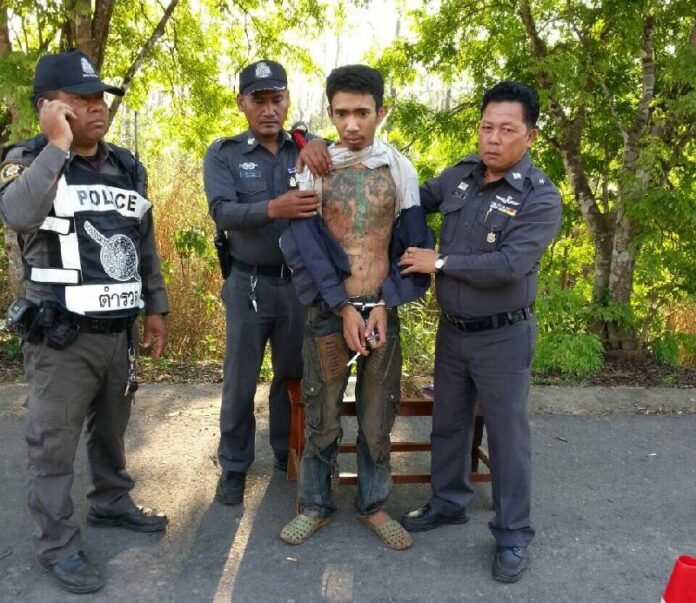
Police arrested drug suspect Adisak Srisa-ard, aka Benz Thasai, near the Thai-Burmese border on 11 March 2015.

BANGKOK — A suspected drug kingpin who had threatened to massacre police officers in Facebook posts was arrested near the Thai-Burmese border today, police say.

Adisak Srisa-ard, aka Benz Thasai, was arrested after police and military officers found him in van bound for Myanmar in Kanchanaburi province at around 8:20 am this morning, police told reporters. 

The suspect was then flown in a helicopter to police headquarters in Bangkok for further interrogation, escorted by armed soldiers and police officers.

\

Adisak, 26, went into hiding last year after a court approved his arrest warrant, but continued to regularly taunt police on his Facebook account.

He once posted a photo (above) of himself holding two automatic rifles with a caption that threatened to murder every officer at Si Prachan Police Station and their families for seeking his arrest. 

"I will hunt all of you down like dogs," he wrote in the photo's caption. "If I go to see you and cannot find you, it's ok. If I find your dad [instead], I will kill him. If I find your mother [instead], I will kill her. Your wife and children will die. I will kill all of your relatives."

He also posted a photo (below) of himself bathing in cash to show that he was still living well. 

\

Pol.Col. Kwanchai Teerasakul, superintendent of Sangkhla Buri Police Station, said police have received information for some time that Adisak was hiding close to Thai-Burmese border in Sangkhla Buri district, and regularly traveling between the two countries. Police then set up additional checkpoints near the border to catch him.

According to police, Adisak entered the narcotics trade as a local drug peddler in Suphan Buri before he became the leader of a major drug ring in the province, allegedly buying narcotics directly from the network run by Yi Se, a prominent drug lord in Myanmar. 


Advertisement

Authorities Briefly Detain, Intimidate Isan Activists Against Petroleum Explorations

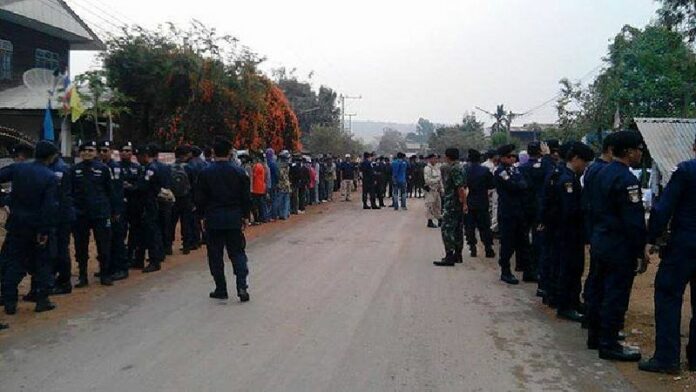
Volunteer defense officers line up along the main road to protect Apico Company convoy in Khon Kaen on 16 Feb 2015 [Prachatai English].  

(Prachatai English)

BANGKOK – Thai authorities continue to suppress local activists and villagers who are against the petroleum exploration in villagers in Thailand’s Northeast.

According to the Thai Lawyers for Human Rights (TLHR), the military on 25 February brought Thawatchai Surat, a northeastern energy activist, to Buriram Muang Police Station and forced him to sign an agreement not the campaign against an petroleum operator.

However, Thawatchai refused to sign any paper.   

Thawatchai is one of the activists who has been campaigning against the petroleum exploration of Shaanxi Yanchang Petroleum, a Chinese petroleum company,  in the northeastern provinces of Buriram, Maha Sarakham, Roi Et, and Surin.

Read more here.

Note: Khaosod English is not responsible for content on other websites.

Advertisement

Hot News

LATEST NEWS

Bangkok
overcast clouds
27.2 ° C
27.2 °
27.2 °
82 %
3.9kmh
100 %
Mon
34 °
Tue
34 °
Wed
33 °
Thu
35 °
Fri
27 °