




























28.3 C
Bangkok
Saturday, July 25, 2026
Home Blog Page 3050

6 Cops Busted, Expelled for Kidnapping Laotians

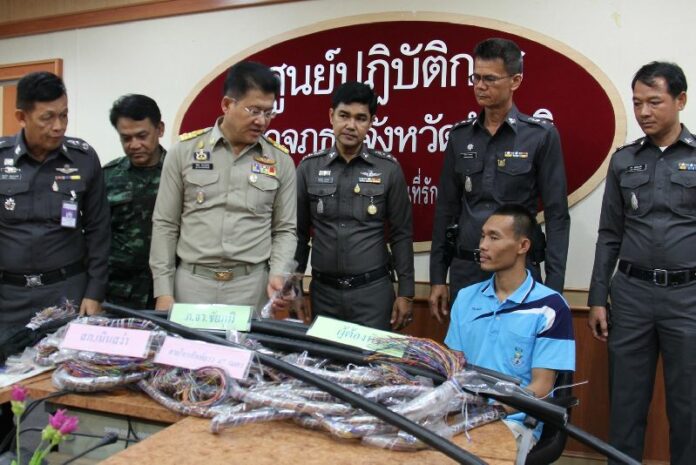
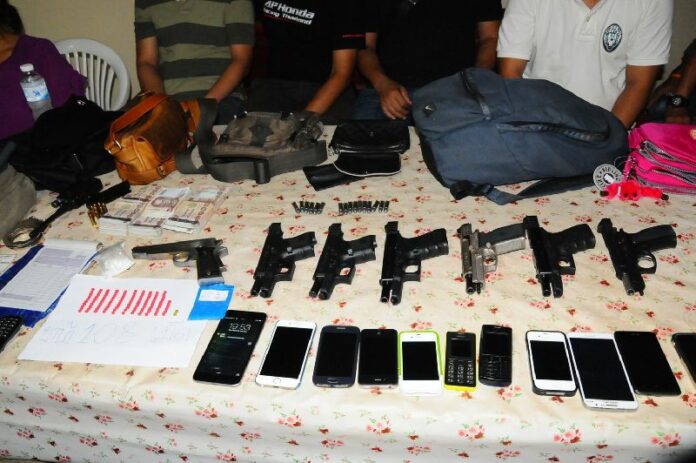
Objects confiscated from six police officers who have been accused of kidnapping a Laotian woman and her son in Nong Khai province, 27 April 2015.

NONG KHAI — Six police officers in northeastern Thailand have been arrested and expelled from the police force for allegedly kidnapping a Laotian businesswoman and her son.

With the help of two volunteer police officers, the six men kidnapped the victims and threatened their families to pay 2 million baht in ransom money, said Pol.Maj.Gen. Churat Pan-ngao, commander of Nong Khai Police.

According to Pol.Maj.Gen. Churat, the eight men approached the 55-year-old businesswoman, named Buachan Tantakaew, and her 14-year-old son while they were shopping at a mall in Nong Khai on 25 April. The officers then forced a bag into Buachan’s hand and said she and her son were under arrest for possessing narcotics, Pol.Maj.Gen. Churat said.

The group then reportedly brought Buachan and her son to a hotel and took photos of them with the bag of amphetamines. The officers told the victims their family had to pay 2 million baht in ransom money or else they would be prosecuted for the narcotics possession, Pol.Maj.Gen. Churat told reporters yesterday.

Instead, Buachan's husband alerted police in Nong Khai province. Pol.Maj.Gen. Churat said police tricked the men into arranging a venue for the ransom exchange, and arrested all of the suspects at the site.

The suspects are identified as Police Captain Surapat Pensri, Police Lieutenant Peerapong Tripong, Police Sub-Lieutenant Somdej Sukrom, Police Senior Sergeant Major Chainarong Orndee, Police Senior Sergeant Major Wirat Tanuchon, Police Senior Sergeant Major Pakorn Sukprasert, Thawat Thipsupha, and Tee Artsuwan. 

Police also confiscated seven handguns, one shotgun, 108 amphetamine tablets, and one packet of crystal methamphetamine from the officers.

The leader of the group, Pol.Capt. Surapat, has denied the allegations and told police his team was expanding an investigation into a drug arrest.

All of the arrested police officers are from Udon Thani police force, said Pol.Maj.Gen. Boonlert Chaipradit, commander of Fourth Region Police. He added that a special committee has been set up to handle the investigation and ensure impartiality. 

"I have already informed the commander of the Royal Thai Police about this. He has instructed me to proceed with the case strictly in accordance with the laws," Pol.Maj.Gen. Boonlert said, "Previously, there were reports that this group of Udon Thani police officers have been behaving badly. Now, this incident happened. They are police, yet they end up breaking the laws."

Pol.Maj.Gen. Boonlert said the six officers have been fired. 

All of the eight suspects have been charged with collecting bribes, illegal detention, kidnapping individuals under 14 for ransom, possessing firearm and ammunition without permit, carrying firearms into residential areas without due cause, possessing Category 1 narcotics with an intention to sell, and possessing Category 1 narcotics. 

 
For comments, or corrections to this article please contact: [email protected]

You can also find Khaosod English on Twitter and Facebook
http://twitter.com/KhaosodEnglish
http://www.facebook.com/KhaosodEnglish
Advertisement

Marking the End of the Vietnam War: Two Sides of the Story

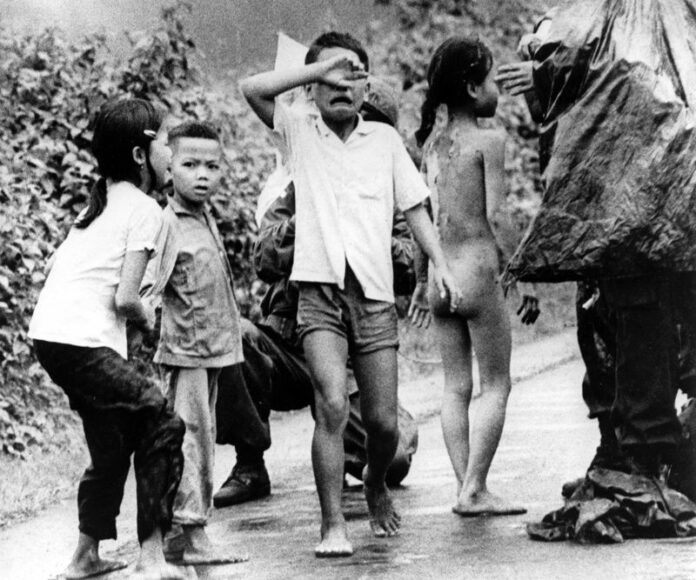
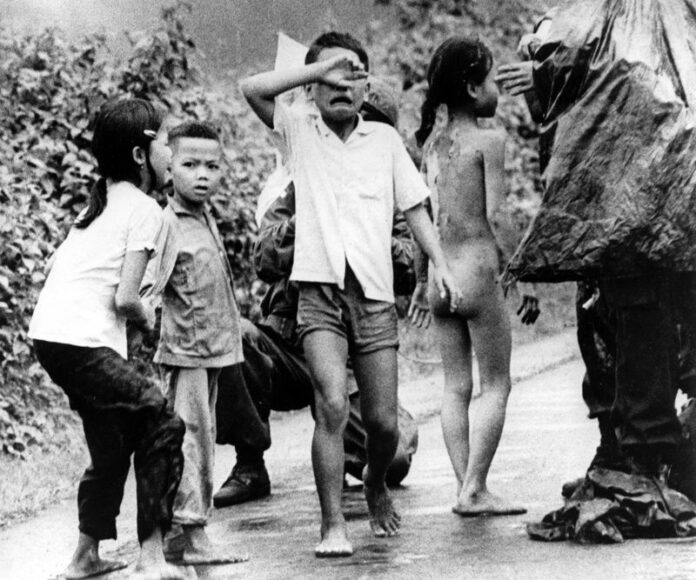
An archive photo shows children crying after a napalm attack on their village in 1972. Photo: UPI/dpa

HANOI (DPA) — The Vietnamese government calls it Liberation Day, but for Nguyen Van Hoang, a wiry man in his mid 60s, the events of April 30, 1975 had different connotations. He recalls the day his life changed forever with a wistful smile.

"I was stationed at a battlefield in the Central Highlands. I was sitting with some of the men when we heard that North Vietnamese troops had entered the presidential palace in Saigon. Later that day we surrendered."

Then 27, Hoang had risen to be an officer after joining the South Vietnamese army when he was 17.

"At the time I was only thinking about my men. The people say the bullet escapes you, not you escape the bullet. It's all about destiny."

\
Veterans of the North Vietnamese army during events commemorating the 30th anniversary of the end of the Vietnam War in Phu Tho province, 100 kilomteres northwest of Hanoi, 20 April 2005. EPA/JULIAN ABRAM WAINWRIGHT

It was a momentous day: the end of the Vietnam War, as it is known in other countries, and the first day of an independent, unified nation under the Communist government. Saigon was renamed Ho Chi Minh City after North Vietnam's revolutionary leader.

In Ho Chi Minh City, the anniversary was to be marked with incense ceremonies, a special arts programme and a bicycle race anmong others.

But despite the official festivities, the topic remains divisive.

Nguyen Duc Gan, 67, was a North Vietnamese soldier during the war. He was taken prisoner in 1969 and kept in the notorious Phu Quoc island jail until the Paris Peace Accords in 1973.

"On April 30, 1975, I received the news from our commanding officers that Saigon was liberated while I was convalescing in a camp [outside Hanoi]. I was very happy at that time."

Gan says he believes the date should be celebrated, but in a way that would help Vietnam and the US become closer.

"We should not forget the past, we should remind young Vietnamese people about the loss of the war, but in a way that encourages young people to look at future."

He says the way the country has marked the day has changed over the years.

"State media do not talk much about the cruelty of soldiers from South Vietnam or the Americans, but focus on the bravery of northern soldiers.

This view rankles with some.

A sturdy-looking man with a strong Californian accent, who gave his name only as Thanh, was one of the hundreds of thousands of "boat people" who fled the country after the war.

He returns to Ho Chi Minh City sporadically to help poor veterans who fought for the South. He did not want to give his real name because he was concerned it would affect his chances of returning for another visit.

"I don't want to be here to see the official celebrations" on Thursday, he said. "For me and many others it is a very sad day. I will be back in the US then and will spend the day with some friends."

"South Vietnamese soldiers in general have been forgotten. Not just in Vietnam but overseas as well," says Nathalie Nguyen, a scholar from Monash University in Australia who has written about the experience of South Vietnamese veterans.

"From the point of view of the South, the North Vietnamese wanted the whole of Vietnam to be communist and the South resisted. This side of it hardly ever features in accounts of the war. It has been very much dominated by the United States. That's beginning to change slowly," she said.

"There was a whole generation of historians who very much dominated this aspect of the historiography. That's beginning to shift now. It's just distressing that for many of the veterans it's too late."

\
A photo made available 27 April 2015 shows Vietnam War photojournalist Tim Page as he visits the War Remnants Museum in Ho Chi Minh, Vietnam 26 April 2015. EPA/LE QUANG NHAT

The government's partisan portrayal of history resonates with fewer people now, says political analyst and Vietnam expert Tuong Vu from the University of Oregon. This is partly because of the work of overseas Vietnamese who fled after the war.

"They are changing the minds of many Vietnamese about what the war was," he said. "At least part of it was civil war. They are persuading young Vietnamese, especially in south Vietnam, about that."

North Vietnamese veteran Gan says he believes it is not wrong to call it a civil war, but it was a civil war caused by foreign nations, not Vietnam.

"I think people still care about the anniversary of the end of the war now. It is one of the most important days of the nation. Without that day, there would be a no united Vietnam country now. Vietnam would be separated like North and South Korea."

Across the country veteran Hoang says life has been hard since the war ended. He spent nearly three years in a re-education camp and afterwards could not find a job at a state-run company.

"When you do paperwork at any official agency they won't do it for you. They say it's not enough, come back later. They won't say it's because you are a South Vietnamese soldier but I know that's the reason. The only paper I have is the re-education paper," he said.

"On April 30 I will feel sad because I am separate from normal people in society."

Reporting by Marianne Brown

For comments, or corrections to this article please contact: [email protected]

You can also find Khaosod English on Twitter and Facebook
http://twitter.com/KhaosodEnglish
http://www.facebook.com/KhaosodEnglish

Advertisement

Marking the End of the Vietnam War: Two Sides of the Story

An archive photo shows children crying after a napalm attack on their village in 1972. Photo: UPI/dpa

HANOI (DPA) — The Vietnamese government calls it Liberation Day, but for Nguyen Van Hoang, a wiry man in his mid 60s, the events of April 30, 1975 had different connotations. He recalls the day his life changed forever with a wistful smile.

"I was stationed at a battlefield in the Central Highlands. I was sitting with some of the men when we heard that North Vietnamese troops had entered the presidential palace in Saigon. Later that day we surrendered."

Then 27, Hoang had risen to be an officer after joining the South Vietnamese army when he was 17.

"At the time I was only thinking about my men. The people say the bullet escapes you, not you escape the bullet. It's all about destiny."

\
Veterans of the North Vietnamese army during events commemorating the 30th anniversary of the end of the Vietnam War in Phu Tho province, 100 kilomteres northwest of Hanoi, 20 April 2005. EPA/JULIAN ABRAM WAINWRIGHT

It was a momentous day: the end of the Vietnam War, as it is known in other countries, and the first day of an independent, unified nation under the Communist government. Saigon was renamed Ho Chi Minh City after North Vietnam's revolutionary leader.

In Ho Chi Minh City, the anniversary was to be marked with incense ceremonies, a special arts programme and a bicycle race anmong others.

But despite the official festivities, the topic remains divisive.

Nguyen Duc Gan, 67, was a North Vietnamese soldier during the war. He was taken prisoner in 1969 and kept in the notorious Phu Quoc island jail until the Paris Peace Accords in 1973.

"On April 30, 1975, I received the news from our commanding officers that Saigon was liberated while I was convalescing in a camp [outside Hanoi]. I was very happy at that time."

Gan says he believes the date should be celebrated, but in a way that would help Vietnam and the US become closer.

"We should not forget the past, we should remind young Vietnamese people about the loss of the war, but in a way that encourages young people to look at future."

He says the way the country has marked the day has changed over the years.

"State media do not talk much about the cruelty of soldiers from South Vietnam or the Americans, but focus on the bravery of northern soldiers.

This view rankles with some.

A sturdy-looking man with a strong Californian accent, who gave his name only as Thanh, was one of the hundreds of thousands of "boat people" who fled the country after the war.

He returns to Ho Chi Minh City sporadically to help poor veterans who fought for the South. He did not want to give his real name because he was concerned it would affect his chances of returning for another visit.

"I don't want to be here to see the official celebrations" on Thursday, he said. "For me and many others it is a very sad day. I will be back in the US then and will spend the day with some friends."

"South Vietnamese soldiers in general have been forgotten. Not just in Vietnam but overseas as well," says Nathalie Nguyen, a scholar from Monash University in Australia who has written about the experience of South Vietnamese veterans.

"From the point of view of the South, the North Vietnamese wanted the whole of Vietnam to be communist and the South resisted. This side of it hardly ever features in accounts of the war. It has been very much dominated by the United States. That's beginning to change slowly," she said.

"There was a whole generation of historians who very much dominated this aspect of the historiography. That's beginning to shift now. It's just distressing that for many of the veterans it's too late."

\
A photo made available 27 April 2015 shows Vietnam War photojournalist Tim Page as he visits the War Remnants Museum in Ho Chi Minh, Vietnam 26 April 2015. EPA/LE QUANG NHAT

The government's partisan portrayal of history resonates with fewer people now, says political analyst and Vietnam expert Tuong Vu from the University of Oregon. This is partly because of the work of overseas Vietnamese who fled after the war.

"They are changing the minds of many Vietnamese about what the war was," he said. "At least part of it was civil war. They are persuading young Vietnamese, especially in south Vietnam, about that."

North Vietnamese veteran Gan says he believes it is not wrong to call it a civil war, but it was a civil war caused by foreign nations, not Vietnam.

"I think people still care about the anniversary of the end of the war now. It is one of the most important days of the nation. Without that day, there would be a no united Vietnam country now. Vietnam would be separated like North and South Korea."

Across the country veteran Hoang says life has been hard since the war ended. He spent nearly three years in a re-education camp and afterwards could not find a job at a state-run company.

"When you do paperwork at any official agency they won't do it for you. They say it's not enough, come back later. They won't say it's because you are a South Vietnamese soldier but I know that's the reason. The only paper I have is the re-education paper," he said.

"On April 30 I will feel sad because I am separate from normal people in society."

Reporting by Marianne Brown

For comments, or corrections to this article please contact: [email protected]

You can also find Khaosod English on Twitter and Facebook
http://twitter.com/KhaosodEnglish
http://www.facebook.com/KhaosodEnglish

Advertisement

Myanmar Adds New Factory Per Week As Textile Sector Booms

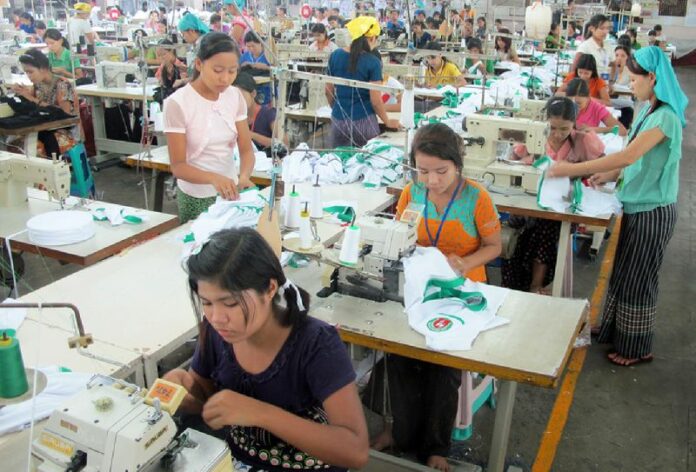
YANGON (DPA) – Green collars piled to one side, white polo shirts to the other – the young woman handles them with practised ease, creating a precise seam with her humming sewing machine.

The garment in making then goes to the next station, where her co-worker applies a strip of green tape to the short sleeves.

A fan rotates the warm air where 400 women labour eight hours each weekday day – four on Saturday – in the Shweyi Zabe textile plant on the outskirts of Yangon.

"One new factory opened every week in 2014," Khine Khine Nwe, the secretary of the Myanmar Garment Makers Association (MGMA), tells dpa.

There are currently 200,000 workers in more than 300 factories. Neighbouring Bangladesh has around 4,000 textile factories.

"In 10 years we want to have 3,000 factories," she says. The aim is to increase exports from the current 1 billion dollars a year 10 times over and to provide a million jobs.

And investors are answering the call. Chinese, Taiwanese and South Korean companies are flooding into the country. Shweyi Zabe's boss Aye Aye Han complains that the competition is luring her workers away by offering a couple of dollars more.

The country is benefiting from the waning star of neighbouring Bangladesh, where the collapse of the Rana Plaza textile factory with more than 1,000 fatalities two years ago drew attention to poor working conditions in garment factories.

The timing is also good in the politics of Myanmar, which is opening up after decades under a closed military dictatorship. There is a sense of opportunity since a nominally civilian government came to power in 2011.

Garment makers in Myanmar "are evidently in the starting blocks," says Thomas Ballweg of a German fashion association. "I see real potential."

He notes that factories have apparently been well built, with only one or two floors – unlike Rana Plaza with its eight floors. The workrooms are clean and the supervisors open to ideas.

Christian Maag, who heads the German underwear company ESGE, with plants in Romania, Bulgaria, Greece and India, is helping Shweyi Zabe to modernize production in Myanmar.

ESGE has provided software for production planning and assisted with computer programmes to help cutting to reduce fabric waste.

"We raised our productivity 20 per cent in 2013," Aye Aye Han says.

But there is a long way to go. Estimates put Myanmar productivity at half that of China, where production rates are high, but so are wages.

The Verisk Maplecroft consultancy says labour costs are lower in Myanmar than anywhere else in the world. Clothing companies like Gap, H&M and Adidas are already producing here.

"It's a kind of development aid, but with a business motivation," Maag says. "If things go well, we will place orders."

A trial run has proved reasonably successful, with scope for expansion, and Maag is convinced that "the textile sector has a future here."

Smart Myanmar, an EU project, is helping to build up a sustainable textile industry in Myanmar with the aim of secure jobs and good working conditions, along with conserving energy, recycling waste and cutting water consumption.

The head of the project is Simone Lehmann of Sequa, an organization of German industrial associations with the German GIZ development aid agency.

"Our focus is on small and medium-sized enterprises," she says. "We are supporting 16 of the 80 factories with local management."

Lars Droemer, sustainability manager at Swedish fashion company Lindex, is also optimistic on Myanmar.

He praises the code of conduct agreed by the textile sector, which bans employing children younger than 15, guarantees a minimum wage, restricts working hours to a maximum of 60 hours a week and allows trade unions.

"We are interested in Myanmar, because we were able to help set up the standards from the start," he says. Lindex operates according to the principle "People – Planet – Profit," in that order, he says.

Promoting local industry is part of the sustainability drive. "Foreign companies take down their factories [and relocate] when operations become cheaper somewhere else, but local employers do not," Droemer says.

The smaller Myanmar companies have yet to master the full production chain. At present they sew and package, but the big clients want a complete service, from supplying fabric and thread to dealing with customs and loading for shipment.

The MGMA is working in this direction. "We need textile weaving plants in Myanmar, and our companies need financing, duty-free imports of goods for re-export and we need more trained seamstresses," Aye Aye Han says.

Ballweg is confident. "Myanmar is today where Bangladesh was 10 years ago," he says. "But things develop three times more quickly today.


For comments, or corrections to this article please contact: [email protected]

You can also find Khaosod English on Twitter and Facebook
http://twitter.com/KhaosodEnglish
http://www.facebook.com/KhaosodEnglish
Advertisement

The AIIB and Global Governance

By Andrew Sheng and Xiao Geng

HONG KONG – Despite official American and Japanese opposition, 57 countries have opted to be among the founding members of the China-led Asian Infrastructure Investment Bank (AIIB). Regardless of what naysayers believe, this remarkable turn of events can only benefit global economic governance.

According to former US Treasury Secretary Larry Summers, the AIIB’s establishment “may be remembered as the moment the United States lost its role as the underwriter of the global economic system.” Asia Development Bank (ADB) President Takehiko Nakao, by contrast, does not believe that there will be a “major change to the world of development finance,” though he conceded that “there can be interpretations as to the symbolic meaning of this.”

Who is right will depend largely on the decisions that the AIIB’s top shareholders make regarding its operating structure. So far, the AIIB has not sought to amend the principle that the largest contributor to a multilateral organization gets the largest say in running it. Just as the US dominates the World Bank and Europe leads the International Monetary Fund, China will head the AIIB.

This implies a larger global leadership role for China – which the world, including its traditional powers, should welcome. After all, global leadership is not just a matter of might; it also reflects the provision of global public goods.

When World War II ended, the US, aside from being the world’s leading military and economic power, was the largest provider of such goods, through the Marshall Plan, support for the United Nations, and contributions to the Bretton Woods institutions (the International Monetary Fund and the World Bank). But massive debts have lately undermined the ability of the US – not to mention Europe and Japan – to continue making such large contributions. Fortunately, China is willing and able to fill the gap.

In fact, China might have done so within the Bretton Woods institutions, were the distribution of voting rights within them not skewed so heavily toward the incumbents, who still enjoy veto power. For example, China has a 3.8% voting share in the IMF and World Bank, even though it accounts for more than 12% of world GDP. The United Kingdom and France – which are one-third the size of China – each have a 4.3% share. With the incumbents unwilling to bring China’s voting share in line with its economic might, China had little choice but to launch its own institution.

But the AIIB has its own objectives, which do not align precisely with those of, say, the World Bank. Specifically, the bank is a critical element of China’s “one belt, one road” strategy, which encompasses two initiatives: the overland Silk Road Economic Belt, connecting China to Europe, and the 21st Century Maritime Silk Road, linking China to Southeast Asia, the Middle East, and Europe. While the US “pivots” to the east, China is pirouetting west, applying the lessons of its development to its trading partners across Eurasia and beyond.

Perhaps the most important of these lessons is that connectivity is vital to economic growth. Over the last three decades, the construction of roads, railways, ports, airports, and telecommunications systems in China has fostered trade, attracted investment, and, by linking the country’s land-locked western and southern provinces to its more prosperous coastal areas, helped to reduce regional disparities.

China’s Silk Road initiative, which aims to boost prosperity among China’s trading partners largely through infrastructure investment, is a logical next step – one on which China is spending significantly. In addition to its initial contribution of up to $50 billion to the AIIB, China has committed $40 billion to its Silk Road Fund, $32 billion to the China Development Bank, and $30 billion to the Export-Import Bank of China.

According to estimates by HSBC, the “one belt, one road” initiative could end up costing as much as $232 billion – just under two-thirds of the World Bank’s balance sheet in 2014. The $100 billion AIIB will play a central role in this effort.

Given massive global demand for infrastructure finance – which, according to ADB estimates, will amount to $8 trillion in Asia alone over the next decade – the AIIB should not be considered a threat to the World Bank, the ADB, or other multilateral lenders. Nonetheless, it will compete with them, owing to its distinctive – and probably more efficient – approach to lending.

In fact, the AIIB’s operations will most likely resemble those of the World Bank in the 1960s, when engineers with hands-on development experience dominated the staff and could design lending conditions that worked for borrowers. In the late 1980s, the World Bank began to implement the Washington Consensus, pushing for economic and political liberalization, without sufficient regard for local political or economic realities. The result was conditional lending, with terms – created mostly by policy wonks – that many developing-country borrowers could not meet (at least not without hiring consultants to adjust their official reporting).

The acid test of the AIIB’s effectiveness will be its governance model. One failing of the Bretton Wood institutions is their full-time shareholder boards of directors, which tend to undermine effectiveness by micro-managing and often requesting conflicting lending conditions. The World Bank has wasted far too much time re-organizing itself under various presidents, without recognizing the fundamental problem with its own governance structure. 

Even if the AIIB does not deliver as promised, its establishment is an important reminder that in a fast-changing world, economic governance cannot remain stagnant. If Western leaders really do believe in innovation, competition, and meritocracy, they should welcome the AIIB. 

Andrew Sheng is Distinguished Fellow of the Fung Global Institute and a member of the UNEP Advisory Council on Sustainable Finance. Xiao Geng is Director of Research at the Fung Global Institute.

Copyright: Project Syndicate, 2015.
www.project-syndicate.org


For comments, or corrections to this article please contact: [email protected]

You can also find Khaosod English on Twitter and Facebook
http://twitter.com/KhaosodEnglish
http://www.facebook.com/KhaosodEnglish
Advertisement

Navy Camp Tackles Student Gang Fights

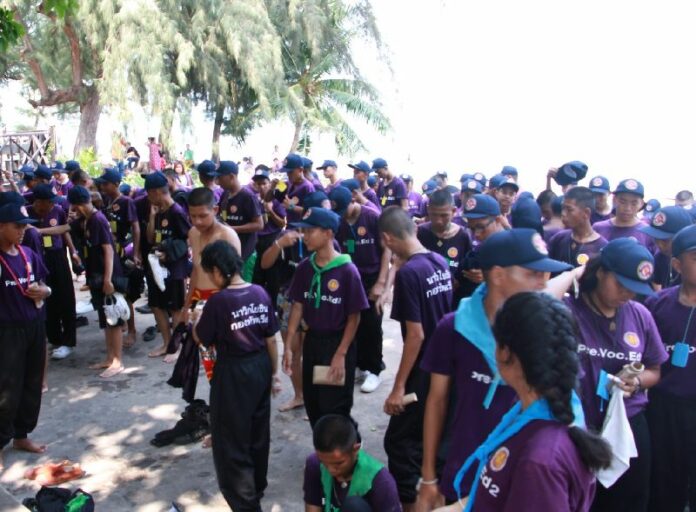
Vocational school students at an 0rientation camp on a Navy base in Chonburi, 27 April 2015.

CHONBURI — More than 400 incoming students at vocational schools in Chonburi province are attending a 3-week orientation camp organized by the Royal Thai Navy to reduce problems of gang rivalry.

The activities are being held on a Navy base in Sattahip district and are jointly overseen by the Vocational Education Commission (VEC), the Royal Thai Navy, and the Royal Thai Marine Corps, said Krittithorn Sukkamol, director of VEC's office in Chonburi. 

\
Vocational school students at an 0rientation camp on a Navy base in Chonburi [Photo: VEC].

According to Krittithorn, the 466 students, most of whom are entering the tenth grade, will be staying at the camp from 20 April to 9 May to receive training and lectures from Navy drill sergeants to instill discipline, morality, ethics, and a sense of unity.

Many vocational schools and polytechnic colleges in Thailand are known for long-running rivalries that can lead to gang violence, sometimes resulting in injuries and deaths.  

"I am confident that this program can [adjust] their behavior and solve problem of student fights," Krittithorn said today. "Even though we cannot prevent it 100 percent, but after everyone has gone through lessons in the program and training by the Navy drill instructors, they will be disciplined and have restraint."

She added, "Furthermore, since children from many schools are staying in the same camp, getting to know each other, and forming love and bonds with fellow vocational students of the same age, many problems that happened in the past will be gone." 

The course also offers classes on developing career skills, Krittithorn said.

Parents and families of camp attendees were allowed to visit the students and picnic with them for several hours today. 

In September 2014, junta chairman and Prime Minister Prayuth Chan-ocha said one of the priorities of his military government is to end student gang fights. Gen. Prayuth warned that any college that fails to curb gang violence could be shut down by the authorities. 

Related coverage:
Teen Gangs Trade Gunshots, Burn Vehicles in Ranong Town Center
BKK Students Killed In Suspected Gang Assassination


For comments, or corrections to this article please contact: [email protected]

You can also find Khaosod English on Twitter and Facebook
http://twitter.com/KhaosodEnglish
http://www.facebook.com/KhaosodEnglish

Advertisement

Redshirt TV Channel Ordered Off the Air

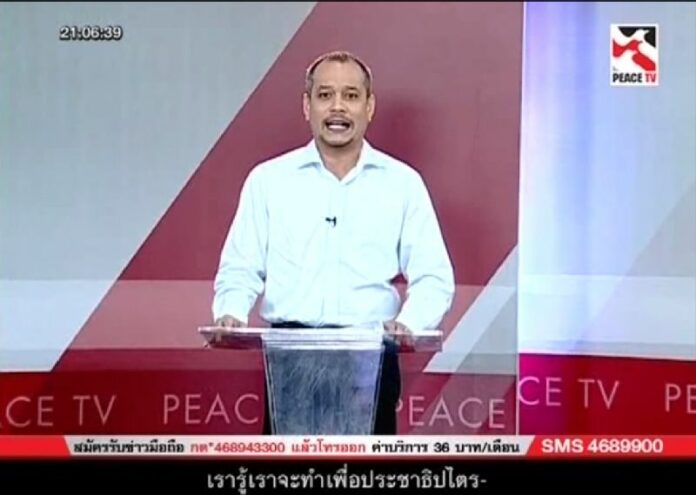
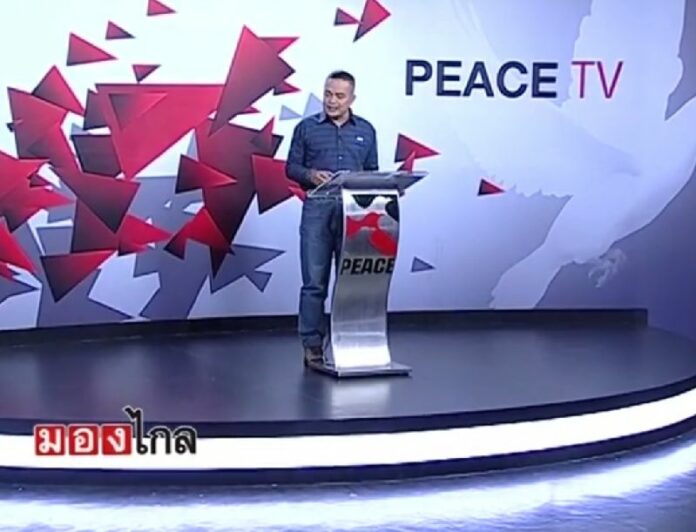
Redshirt leader Jatuporn Prompan on Peace TV, 27 April 2015.

BANGKOK — A Redshirt-run television station has been permanently canceled after Thai authorities decided its news coverage was politically divisive and could "incite unrest."

The decision was announced by Natee Sukonrat, deputy chairperson of the National Broadcasting and Telecommunication Commission (NBTC), on his official Twitter account today. 

\
Redshirt leader Nattawut Saikua on Peace TV in January 2015. 

The station, called Peace TV, was previously suspended for a week in April after the NBTC said its news coverage violated the ruling junta's Order No. 97, which forbids media from fomenting violence or causing "divisions in the Kingdom."

The station, which is operated by the largely anti-coup Redshirt movement, often featured core Redshirt leaders like Jatuporn Prompan and Nattawut Saikua. 

NBTC member Natee said today that the channel violated its agreement not to air politically divisive content.

"The NBTC has carefully deliberated on the action and concluded that it is a repeated offense," Natee wrote on Twitter. 

However, another member of the NBTC also took to Twitter to voice her opposition to the board's decision to revoke Peace TV's license. Supinya Klangnarong said she was the lone member to vote against the measure.

In series of Twitter posts, Supinya explained that the NBTC can choose from a variety of punishments, such as suspending the offending talk shows. Yet, the NBTC "skipped" all other possible measures and shut down Peace TV for good, an punishment she called "disproportionate."

"I agree that, by principle, the NBTC should increase its effort to regulate TV channels to prevent the problem of reproducing hatred and incitement, but it should be proportionate," Supinya wrote. "We should not just jump from not using power to using power in the highest way."

According to Supinya, Peace TV has recently focused on discussing the draft of the new constitution, which was written by a junta-appointed body, and a car bomb in the southern island of Koh Samui last month. 

"From what I have listened, Peace TV does not use rude language like another channel that belongs to the same political group. The content may be seen as criticizing the state power with a skeptical viewpoint," Supinya wrote. 

Core Redshirt leader a co-founder of Peace TV Nattawut Saikua said he will appeal the NBTC's order in Administrative Court and seek an injunction. 

"Peace TV is a private organization that does its business legally," Nattawut wrote in an official statement. "This motion does not only affect the rights and liberty, but also affects business of the station. Therefore, our legal team is using legal channel to defend our station." 

He also said he believes the NBTC, which has yet to formaly notify the channel, has been plotting to shut down Peace TV from the beginning.

"It's like they gave us yellow card first to build some legitimacy for giving us red card later," Nattawut said. "I don't understand those in power right now. The current situation requires diverse opinions to benefit the drafting of the constitution and create reconciliation, but they end up blocking a channel that voices different opinions. It means the opinions of certain people that do not match those in power will be rejected. With thing like this happening, how could this country move to democracy?"

Both of Thailand’s Redshirt and Yellowshirt movements operate their own TV and radio channels featuring news programs and live broadcasts of their political rallies. Media agencies affiliated with the two groups played significant roles in the pro- and anti-government rallies last year that culminated in the May 2014 coup.

On 20 May 2014, then-army chief Gen. Prayuth Chan-ocha unilaterally imposed martial law and ordered all partisan media agencies to shut down. Two days later, the general staged a coup d'etat and toppled the Redshirt-backed government. 

The partisan media outlets were later allowed to resume operations under the conditions that they change the names of their stations and adhere to the junta's guidelines. The junta has also enforced a ban on political gatherings and protests in an effort to promote "national reconciliation." 

Critics say the junta is particularly bent on curbing the influence of the Redshirt movement, which has commanded the polls and elected majorities in congress in every national election for the past decade. 


For comments, or corrections to this article please contact: [email protected]

You can also find Khaosod English on Twitter and Facebook
http://twitter.com/KhaosodEnglish
http://www.facebook.com/KhaosodEnglish
Advertisement

Redshirt TV Channel Ordered Off the Air

Core Redshirt Nattawut Saikua on Peace TV in 28 Jan 2015.

BANGKOK — A Redshirt-run television station has been permanently canceled after Thai authorities decided its news coverage was politically divisive and could "incite unrest."

The decision was announced by Natee Sukonrat, deputy chairperson of the National Broadcasting and Telecommunication Commission (NBTC), on his official Twitter account today. 

The station, called Peace TV, was previously suspended for a week in April after the NBTC said its news coverage violated the ruling junta's Order No. 97, which forbids media from fomenting violence or causing "divisions in the Kingdom."

The station, which is operated by the largely anti-coup Redshirt movement, often featured core Redshirt leaders like Jatuporn Prompan and Nattawut Saikua. 

NBTC member Natee said today that the channel violated its agreement not to air politically divisive content.

"The NBTC has carefully deliberated on the action and concluded that it is a repeated offense," Natee wrote on Twitter. 

However, another member of the NBTC also took to Twitter to voice her opposition to the board's decision to revoke Peace TV's license. Supinya Klangnarong said she was the lone member to vote against the measure.

In series of Twitter posts, Supinya explained that the NBTC can choose from a variety of punishments, such as suspending the offending talk shows. Yet, the NBTC "skipped" all other possible measures and shut down Peace TV for good, an punishment she called "disproportionate."

"I agree that, by principle, the NBTC should increase its effort to regulate TV channels to prevent the problem of reproducing hatred and incitement, but it should be proportionate," Supinya wrote. "We should not just jump from not using power to using power in the highest way."

According to Supinya, Peace TV has recently focused on discussing the draft of the new constitution, which was written by a junta-appointed body, and a car bomb in the southern island of Koh Samui last month. 

"From what I have listened, Peace TV does not use rude language like another channel that belongs to the same political group. The content may be seen as criticizing the state power with a skeptical viewpoint," Supinya wrote. 

Core Redshirt leader a co-founder of Peace TV Nattawut Saikua said he will appeal the NBTC's order in Administrative Court and seek an injunction. 

"Peace TV is a private organization that does its business legally," Nattawut wrote in an official statement. "This motion does not only affect the rights and liberty, but also affects business of the station. Therefore, our legal team is using legal channel to defend our station." 

He also said he believes the NBTC, which has yet to formaly notify the channel, has been plotting to shut down Peace TV from the beginning.

"It's like they gave us yellow card first to build some legitimacy for giving us red card later," Nattawut said. "I don't understand those in power right now. The current situation requires diverse opinions to benefit the drafting of the constitution and create reconciliation, but they end up blocking a channel that voices different opinions. It means the opinions of certain people that do not match those in power will be rejected. With thing like this happening, how could this country move to democracy?"

Both of Thailand’s Redshirt and Yellowshirt movements operate their own TV and radio channels featuring news programs and live broadcasts of their political rallies. Media agencies affiliated with the two groups played significant roles in the pro- and anti-government rallies last year that culminated in the May 2014 coup.

On 20 May 2014, then-army chief Gen. Prayuth Chan-ocha unilaterally imposed martial law and ordered all partisan media agencies to shut down. Two days later, the general staged a coup d'etat and toppled the Redshirt-backed government. 

The partisan media outlets were later allowed to resume operations under the conditions that they change the names of their stations and adhere to the junta's guidelines. The junta has also enforced a ban on political gatherings and protests in an effort to promote "national reconciliation." 

Critics say the junta is particularly bent on curbing the influence of the Redshirt movement, which has commanded the polls and elected majorities in congress in every national election for the past decade. 


For comments, or corrections to this article please contact: [email protected]

You can also find Khaosod English on Twitter and Facebook
http://twitter.com/KhaosodEnglish
http://www.facebook.com/KhaosodEnglish

Advertisement

24-Year-Old Steals Phone Cables to 'Support Girlfriends'

Chakri Tadee with the stolen cables at a police press conference, 27 April 2015.

CHAIYAPHUM – A 24-year-old man is under arrest for allegedly stealing copper from telephone cables in Chaiyaphum province and selling it for at least 60,000 baht – which he said was necessary to support his numerous girlfriends.

According to police, Chakri Tadee cut down cables belonging to TT&T on Baan Kai – Lahan Road in the early morning of 22 April. 

Police say Chakri stole 47 meters of cables and sold the copper for more than 60,000 baht.

Speaking at police press conference today, Chakri said he works for the state telecommunication enterprise TOT in Bangkok and used to smuggle copper from his workplace to sell in the black market. He said his income is not enough to finance the lifes of his several girlfriends, so he decided to cut the cables.

"I have many girlfriends. My latest girlfriend is about to start her new semester. She needs money," Chakri told reporters. 

Chakri has been charged with theft. 

 
For comments, or corrections to this article please contact: [email protected]

You can also find Khaosod English on Twitter and Facebook
http://twitter.com/KhaosodEnglish
http://www.facebook.com/KhaosodEnglish
Advertisement

Nepal Earthquake Death Toll Heads Towards 3,500

KATHMANDU (DPA) — The death toll from the 7.8-magnitude earthquake at the weekend in Nepal was 3,432, the Interior Ministry said Monday, after thousands more spent a second night in the open.

\
An injured earthquake victim receives medical treatment at Teaching Hospital in Kathmandu. EPA/NARENDRA SHRESTHA

The government said around 6,505 people were injured in the quake that hit on Saturday.

"Lightning and thunder. Haunting feel to the city, yet tens of thousands – or most of city – out on streets, under tarps," Kathmandu-based writer Kashish Das Shrestha tweeted.

Besides the fear caused by numerous aftershocks, people camping in open spaces were suffering a combination of rain, hunger and thirst.

"There is no space. So at least 50 people are crammed in an open area in our neighbourhood," said Pramod Karki, who was staying in a camp near his house in the capital's Kalanki district.

"The old people and children are defecating around the place and that could be a major health hazard."

People were living in small groups in camps, sharing resources as the foul smell and flies started infesting their makeshift homes.

\
People search for survivors stuck under the rubble of a destroyed building, after an earthquake caused serious damage in Kathmandu, Nepal, April 25, 2015.

Hospitals damaged by the quake were treating patients in improvised outdoor clinics.

Chief Secretary Lilamani Poudel asked all government employees and bodies to work to help the injured and the displaced.

The government said it was preparing to hold mass cremations to prevent diseases from spreading.

The Tourism Ministry said it was also focusing on rescuing the foreigners trapped around the country.

"We rescued around 82 people from the Everest Base Camp yesterday," ministry secretary Suresh Man Shrestha said.

"There are 18 dead bodies on Mount Everest but we brought down only the wounded. Hopefully there will be no more casualties."

"We are also using smaller helicopters and those from the Indian army too for rescue. We are focused on the Everest region and on Gorkha, Dhading, Nuwakot and Sindupalchowk districts."

\
People free a man from the rubble of a destroyed building after an earthquake hit Nepal, in Kathmandu, Nepal, April 25, 2015. EPA/NARENDRA SHRESTHA

Nepal's army has also deployed its forces.

"We have mobilized 90 per cent of our resources," said military official Jagdish Chandra Pokharel. "We're working on a war footing and we request people to do what they can to help people around them."

Prime Minister Sushil Koirala arrived back in Nepal on Sunday after cutting short a visit to Indonesia.

Authorities were struggling with limited capacity to respond to the crisis, he said.

"But we are expecting more foreign help now and now need to work on cremating people, on sanitation, on clean drinking water."

Efforts were also under way to fix phone lines and restore power on Monday, he said.

Aid from around the world was arriving or being promised.

Britain has pledged 5 million pounds (7.5 million dollars) and Canada has promised 5 million Canadian dollars (4.1 million US dollars).

The Asian Development Bank pledged up to 200 million dollars in credit for the first phase of rehabilitation. The bank said it is sending 3 million dollars as a grant for tents, medicines, food and drinking water. The rest of the money would be "additional resources," it said, probably a combination of grants and loans.

India was sending in a search-and-rescue team and Pakistan had set up temporary medical camps.

There was also high-tech help from Facebook and Google who have added functions to their online platforms to help people find friends and relatives caught in the quake.

Social networking site Facebook introduced its Safety Check feature, enabling users to mark their own status as "safe," or let their Facebook friends update their status for them.

Search giant Google's Person Finder allows users to post information about a third party, for example if the user had managed to reach someone in the area by telephone.


Reporting by Pratibha Tuladhar

 
For comments, or corrections to this article please contact: [email protected]

You can also find Khaosod English on Twitter and Facebook
http://twitter.com/KhaosodEnglish
http://www.facebook.com/KhaosodEnglish

Advertisement

Hot News

LATEST NEWS

Bangkok
light rain
28.3 ° C
28.3 °
28.3 °
82 %
3.6kmh
73 %
Sat
30 °
Sun
33 °
Mon
33 °
Tue
30 °
Wed
29 °