


























33.5 C
Bangkok
Monday, June 8, 2026
Home Blog Page 3161

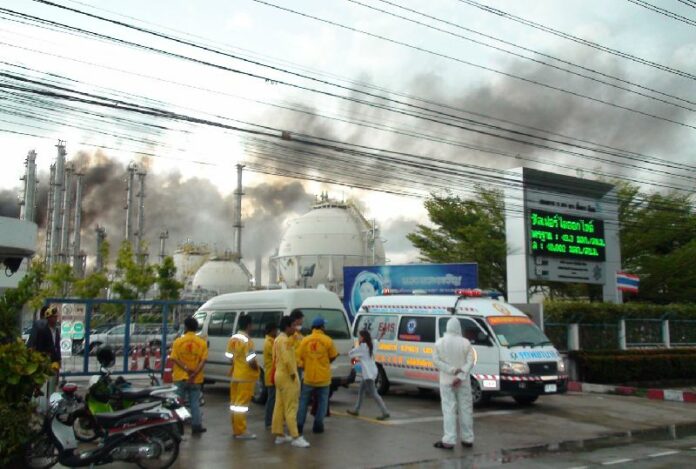
State Petroleum Agency 'Sorry' For Leaked Chemical

An explosion in Map Ta Phut Industrial Estate in Rayong province on 5 May 2012.

RAYONG — Thailand’s state petroleum enterprise apologised for leaking chemicals near a residential area in eastern Thailand – a year after an oil leak from the company's pipeline devastated an island in the same region.

“We would like to apologise for the incident,” said Anuthin Chuaipen, deputy manager of PTT Global Chemical, in reference to the chemical leak that occurred inside Map Ta Phut Industrial Estate in Rayong province over the weekend. PTT Global Chemical is a subsidiary of the state-owned PTT.

Residents close to the industrial park reported a "sulfur-like" smell in the area on 8 September, which many said irritated their nostrils and caused them to feel dizzy. The fume dissipated after a few hours, residents said.

Today, Mr. Anuthin admitted the smell was caused by an error during an operation to connect crude oil pipelines at a PTT station inside the industrial estate. The leak lasted for "15 minutes" before workers successfully resolved the issue, Mr. Anuthin said.

"PTT has dispatched safety and environment officials to the area to listen to those who were affected and provide assistance to them," Mr. Anuthin told reporters.

However, a number of residents said they would like to see stricter safety measures imposed over the industrial estate, which has been a source of environmental concern for years. 

At least 65 industrial projects have been based in Map Ta Phut Estate since the park was founded in 1990. Numerous cheimcal leaks and contaminations have reportedly caused illnesses, including cancer, among residents in the region. 

PTT Global Chemical is also currently embroiled in lawsuits over an oil leak from a PTT pipeline in the Gulf of Thailand in July 2013. The leak devastated some of Koh Samet’s pristine beaches and deterred many tourists from visiting the popular island.  

Critics have accused PTT of using its influence over Thai media to minimise news coverage of the oil leak and the company’s refusal to compensate business owners on the island. 


Read more: 
State Petroleum Enterprise Sued For Resort Island Oil Spill

 
For comments, or corrections to this article please contact: [email protected]

You can also find Khaosod English on Twitter and Facebook
http://twitter.com/KhaosodEnglish
http://www.facebook.com/KhaosodEnglish
Advertisement

State Petroleum Agency 'Sorry' For Leaked Chemical

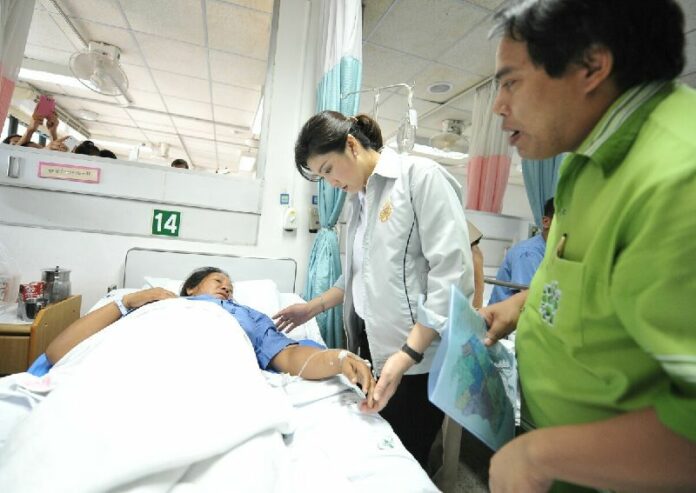
Then-Prime Minister Yingluck Shinawatra visiting a victim of the explosion in Map Ta Phut Industrial Estate in Rayong province on 5 May 2012.

RAYONG — Thailand’s state petroleum enterprise apologised for leaking chemicals near a residential area in eastern Thailand – a year after an oil leak from the company's pipeline devastated an island in the same region.

“We would like to apologise for the incident,” said Anuthin Chuaipen, deputy manager of PTT Global Chemical, in reference to the chemical leak that occurred inside Map Ta Phut Industrial Estate in Rayong province over the weekend. PTT Global Chemical is a subsidiary of the state-owned PTT.

Residents close to the industrial park reported a "sulfur-like" smell in the area on 8 September, which many said irritated their nostrils and caused them to feel dizzy. The fume dissipated after a few hours, residents said.

Today, Mr. Anuthin admitted the smell was caused by an error during an operation to connect crude oil pipelines at a PTT station inside the industrial estate. The leak lasted for "15 minutes" before workers successfully resolved the issue, Mr. Anuthin said.

"PTT has dispatched safety and environment officials to the area to listen to those who were affected and provide assistance to them," Mr. Anuthin told reporters.

However, a number of residents said they would like to see stricter safety measures imposed over the industrial estate, which has been a source of environmental concern for years. 

At least 65 industrial projects have been based in Map Ta Phut Estate since the park was founded in 1990. Numerous cheimcal leaks and contaminations have reportedly caused illnesses, including cancer, among residents in the region. 

PTT Global Chemical is also currently embroiled in lawsuits over an oil leak from a PTT pipeline in the Gulf of Thailand in July 2013. The leak devastated some of Koh Samet’s pristine beaches and deterred many tourists from visiting the popular island.  

Critics have accused PTT of using its influence over Thai media to minimise news coverage of the oil leak and the company’s refusal to compensate business owners on the island. 


Read more: 
State Petroleum Enterprise Sued For Resort Island Oil Spill

 
For comments, or corrections to this article please contact: [email protected]

You can also find Khaosod English on Twitter and Facebook
http://twitter.com/KhaosodEnglish
http://www.facebook.com/KhaosodEnglish

Advertisement

Video of Collapsed Beggar Elephant Spurs Investigation

Screenshot from a video of  baby elephant collapsing out of exhaustion in a market in Samut Sakhon, 10 Sept 2014.

SAMUT SAKHON — A video of a baby elephant collapsing out of exhaustion in a market has spurred police to search for the elephant handlers who reportedly brought the animal into the city to beg.

The video has been widely shared on social media and ignited a wave of criticism over the practice of bringing elephants into urban areas to beg for money from tourists. Animal rights activists have been decrying the practice for years, calling it inhumane and harmful to the elephants. 

The video appears to have been filmed at a market near Krathumban intersection in Samut Sakhon province, police say. 

"I have ordered officers to locate the elephant and owners in connection with the video," said Pol.Col. Palat Visetsingha. "But we have not found them yet. I believe the owners or the elephant handlers took the elephant away from the area after the clip was publicized."

Nevertheless, Pol.Col. Palat said police will increase patrols in the province to make sure that no elephant handlers, or mahouts, bring their elephants into town to beg. He urged the public report any incidents of elephant begging to police immediately. 

Mahouts who take their elephants into the city can face charges related to the obstruction of traffic, annoying bystanders, and animal cruelty. The latter carries a maximum of one month in prison and 1,000 baht fine, said Pol.Col. Palat. 

"Those who possess unregistered elephants will also face additional charges, but mahouts in the trade of elephant begging generally have their elephants registered," the officer added.

Thailand is a hub for animal tourism, with abundant opportunities for tourists to interact with animals like tigers, elephants, and gibbons. Yet according to animal welfare groups, many of these captive animals are physically mistreated and some of them have been poached from the wild.

Some tourism-related associations, such as the Association of British Travel Agents (ABTA), advise travelers to Thailand to exercise good judgment before participating in activities that might distress an animal. 

There are currently no comprehensive laws protecting animal welfare in Thailand, although a proposed bill is receiving “fast-track” consideration from the National Legislative Assembly (NLA), said Edwin Wiek, the founder of the Wildlife Friends Foundation Thailand (WFFT).  

Last month, a viral video of mahouts beating a beggar elephant in Hat Yai prompted police in the area to crack down on the trade.


Read more: 
For comments, or corrections to this article please contact: [email protected]

You can also find Khaosod English on Twitter and Facebook
http://twitter.com/KhaosodEnglish
http://www.facebook.com/KhaosodEnglish
 

Advertisement

Thai Authorities Reportedly To Launch Mass Internet Surveillance

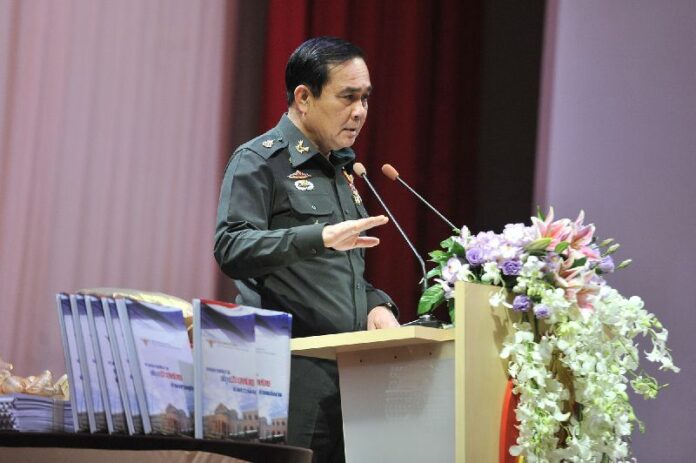
Thai military junta chairman and Prime Minister Prayuth Chan-ocha, 4 September 2014

(Prachatai English)

BANGKOK  Thai authorities reportedly plan to implement a surveillance system starting on 15 September to sniff out Thai internet users, specifically targeting those producing and reading lèse majesté content, a report says. Although the report is yet to be confirmed, it has created greater climate of fear among media. 

Prachatai has received unconfirmed reports from two different sources. One said the device targets keywords related to lèse majesté and that it is relatively powerful and could access all kinds of communication traffic on the internet. Another source said it could even monitor communications using secured protocols. Read more here

Note: Khaosod English is not responsible for content on other websites.

Advertisement

Academic Stages 'Ashamed' Protest Over Rector's New Cabinet Post

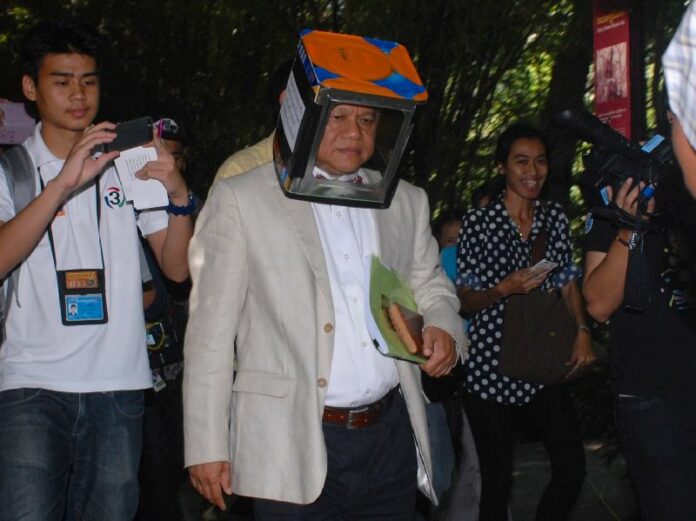
Sukree Charoensuk, dean of Mahidol University's College of Music, wore a metal box on his head in a symbolic protest over his university rector’s decision to become a Cabinet member in the country’s new military government, 10 Sept 2014.

BANGKOK — A prominent academic staged a rare public protest this morning over his university rector’s decision to become a Cabinet member in the country’s new military government.

Sukree Charoensuk, dean of Mahidol University's College of Music, wore a metal box on his head in a symbolic protest as he walked to attend a meeting with the university's rector, Rajata Rajatanavin, this morning. The metal box was a reference to the Thai idiom "putting a metal box over one's head," which describes feeling shame.

The university's rector, Dr. Rajata, was appointed Minister of Public Health in coup leader and Prime Minster Gen. Prayuth Chan-ocha’s newly-sworn in Cabinet, which is expected to administer the country until elections are held next October at the earliest.

Mr. Sukree said he felt "ashamed" because Dr. Rajata accepted the job even though rectors are prohibited from holding political office under university regulations. 

"He may have been appointed to the job as a Minister, but he should use his common sense and ethics. It is very important," Mr. Sukree said.

"I'm alone. I can only do this," he added. "Whether [Mr. Rajata] will quit or not is his business … But the fact that a person is holding two different positions at the same time makes me wonder, will he be able to do his job well?"

Mr. Sukree's protest was rare violation of the ban on public demonstrations put in place by the junta's National Council for Peace and Order, which seized power on 22 May under Gen. Prayuth's command. 

Kittikorn Chamorndusit, a lecturer from the Faculty of Environment and Resources Studies and a member of the University Council, later met with Mr. Sukree and presented him with a bouquet of flowers to show his support.

"We are an educational institution that should be example for young people," Mr. Kittikorn told reporters. "The University Act clearly says that rectors cannot hold political office."

Mr. Kittikorn said he and other lecturers will continue to pressure Dr. Rajata to respect the university's regulation by organising public forums and calling an emergency University Council meeting to discuss the matter on 17 September. 

Mahidol University's regulations also say that rectors must be able to work at the university full-time, which Dr. Rajata will not be able to do as long as he holds two jobs, Mr. Kittikorn added.

Reporters were not allowed to observe today's meeting, but university officials confirmed that Dr. Rajata was present. He did not give any comment to the press about Mr. Sukree's protest.

"Today's meeting proceeded according to usual schedule," a university official said. "There was no discussion about the controversy." 

Last month, students at Thammasat University launched a campaign denouncing the school's rector for joining the National Legislative Assembly (NLA), another body in the interim government whose members were handpicked by the NCPO. 


For comments, or corrections to this article please contact[email protected]

You can also find Khaosod English on Twitter and Facebook
http://twitter.com/KhaosodEnglish
http://www.facebook.com/KhaosodEnglish
Advertisement

Academic Stages 'Ashamed' Protest Over Rector's New Cabinet Post

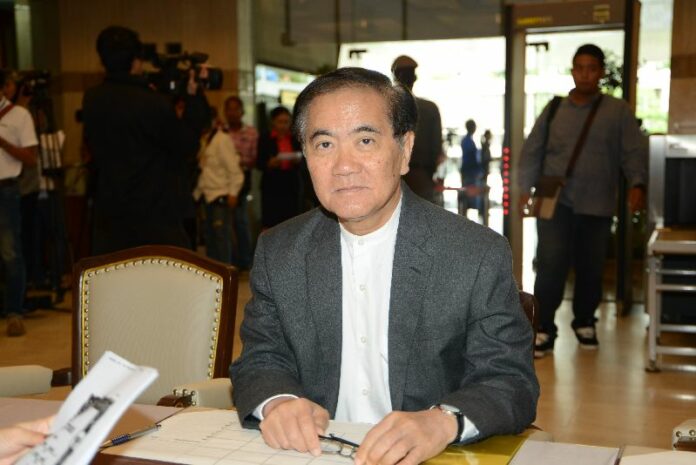
Rajata Rajatanavin, rector of Mahidol University, is now Minister of Public Health in Gen. Prayuth's Cabinet.

BANGKOK — A prominent academic staged a rare public protest this morning over his university rector’s decision to become a Cabinet member in the country’s new military government.

Sukree Charoensuk, dean of Mahidol University's College of Music, wore a metal box on his head in a symbolic protest as he walked to attend a meeting with the university's rector, Rajata Rajatanavin, this morning. The metal box was a reference to the Thai idiom "putting a metal box over one's head," which describes feeling shame.

The university's rector, Dr. Rajata, was appointed Minister of Public Health in coup leader and Prime Minster Gen. Prayuth Chan-ocha’s newly-sworn in Cabinet, which is expected to administer the country until elections are held next October at the earliest.

Mr. Sukree said he felt "ashamed" because Dr. Rajata accepted the job even though rectors are prohibited from holding political office under university regulations. 

"He may have been appointed to the job as a Minister, but he should use his common sense and ethics. It is very important," Mr. Sukree said.

"I'm alone. I can only do this," he added. "Whether [Mr. Rajata] will quit or not is his business … But the fact that a person is holding two different positions at the same time makes me wonder, will he be able to do his job well?"

Mr. Sukree's protest was rare violation of the ban on public demonstrations put in place by the junta's National Council for Peace and Order, which seized power on 22 May under Gen. Prayuth's command. 

Kittikorn Chamorndusit, a lecturer from the Faculty of Environment and Resources Studies and a member of the University Council, later met with Mr. Sukree and presented him with a bouquet of flowers to show his support.

"We are an educational institution that should be example for young people," Mr. Kittikorn told reporters. "The University Act clearly says that rectors cannot hold political office."

Mr. Kittikorn said he and other lecturers will continue to pressure Dr. Rajata to respect the university's regulation by organising public forums and calling an emergency University Council meeting to discuss the matter on 17 September. 

Mahidol University's regulations also say that rectors must be able to work at the university full-time, which Dr. Rajata will not be able to do as long as he holds two jobs, Mr. Kittikorn added.

Reporters were not allowed to observe today's meeting, but university officials confirmed that Dr. Rajata was present. He did not give any comment to the press about Mr. Sukree's protest.

"Today's meeting proceeded according to usual schedule," a university official said. "There was no discussion about the controversy." 

Last month, students at Thammasat University launched a campaign denouncing the school's rector for joining the National Legislative Assembly (NLA), another body in the interim government whose members were handpicked by the NCPO. 


For comments, or corrections to this article please contact[email protected]

You can also find Khaosod English on Twitter and Facebook
http://twitter.com/KhaosodEnglish
http://www.facebook.com/KhaosodEnglish
 

Advertisement

HRW: Redshirt Activist 'Disappeared' By Military

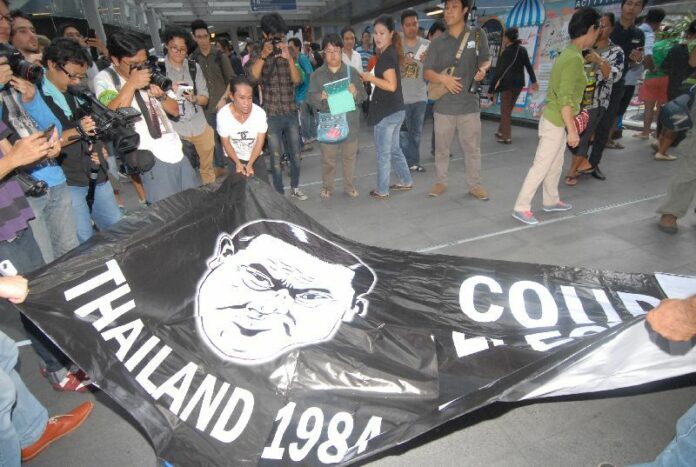
Anti-coup protesters on 1 June 2014 display a banner comparing Gen. Prayuth to the authoritarian dictatorship in George Orwell's famous novel, Nineteen-eighty Four.

BANGKOK— An international human rights organization is calling upon the Thai government to disclose the whereabouts of a Redshirt activist who was reportedly arrested by soldiers five days ago and hasn’t been seen or heard from since.

According to the New York-based Human Rights Watch, Kittisak Soomsri, 47, was arrested by plain-clothed soldiers in Bangkok on 5 September.

Shortly after the arrest, Mr. Kittisak’s family was reportedly informed through an anonymous phone call that Mr. Kittisak had been taken into military custody for questioning and would be released without charges after seven days—the legal limit for arbitrary detention under martial law.

However, Thailand’s military authorities have denied arresting Mr. Kittisak or keeping him in their custody, Human Rights Watch (HRW) reported in a press release yesterday.

“The Thai government and military should immediately disclose Kittisak’s location,” said Brad Adams, Human Rights Watch’s Asia Director. “Kittisak Soomsri’s enforced disappearance shows the Thai military’s wanton disregard for basic rights under martial law.”

Mr. Kittisak was an active member of the Redshirt’s umbrella organization, The United United Front for Democracy against Dictatorship (UDD), which supported the government toppled in the 22 May coup d’etat.

In 2010, Mr. Kittisak was accused of participating in a bomb attack and other violent incidents that occurred during confrontations between Redshirt protesters and security forces under then-Prime Minsiter Abhisit Vejjajiva’s government. According to Human Rights Watch, Mr. Kittisak was never arrested or prosecuted for these allegations.

Since seizing power on 22 May, Thailand’s military junta, known as the National Council for Peace and Order, has used its powers under martial law to summon and detain more than 300 activists, politicians, journalists, and academics for “attitude adjustment.” Many of these people have been held incommunicado in military camps and forced to sign forms promising not to participate in any political activities to secure their release.

The majority of detainees have been held for no more than seven days, but in late May a 26-year-old Redshirt activist was arrested and detained for nearly a month. After fleeing to Europe upon her release, Kritsuda Khunasen accused soldiers of beating and torturing her while she was in their custody.

NCPO chairman and Prime Minister Gen. Prayuth has dismissed her torture allegations as “untrue” and ignored the UN’s calls for an investigation.

“As both junta leader and prime minister, General Prayuth has vowed to respect human rights, but hasn’t followed through his words with actions,” Human Rights Watch’s Mr. Adams said. “Prayuth could start by ordering an end to arbitrary arrests and secret detentions, releasing all those wrongfully held.”

 
For comments, or corrections to this article please contact[email protected]

You can also find Khaosod English on Twitter and Facebook
http://twitter.com/KhaosodEnglish
http://www.facebook.com/KhaosodEnglish
Advertisement

Pricey Microphone Scandal Greets Junta Cabinet

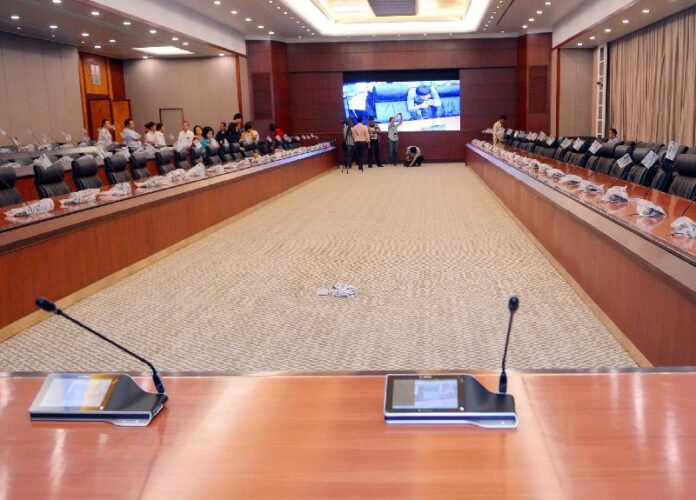
The Cabinet meeting room inside the Government House.

BANGKOK — As Thailand’s interim Cabinet ministers moved into their offices in the Government House today, questions about the recent 67 million baht renovation of the Cabinet room continue to loom large.

News outlets and social media users are demanding answers about the pricey sound equipment, which was installed during the recent renovation of the Government House in Bangkok.

Thailand’s new Cabinet, a third of who are military men, were appointed by coup leader and Prime Minister Gen. Prayuth Chan-ocha last week and moved in to their offices in the Government House today. 

Critics are focusing on the microphones, which were purchased by Thai officials for at least 145,000 baht each according to a number of media reports, though an analysis by Matichon placed the figure at 157,000 baht per piece. Officials said they bought a total of 192 microphones for the Cabinet meetings.

Suspicions were further raised after the Thai supplier of the microphones, Bosch, changed the price of the equipment from 99,000 baht to 199,000 baht several days after the criticism started to mount. 

Critics of the 22 May military coup are using the scandal to ridicule Prime Minister Gen. Prayuth, who has repeatedly said his military regime will banish government corruption.

Minister of the Prime Minister's Office Panadda Diskul initially defended the expensive audio system, arguing that the high-tech equipment is used by the White House and comes with anti-wiretapping devices.

Mr. Panadda later backtracked and distanced himself from the purchases; he now claims that neither he nor the military junta was responsible for buying the microphones, blaming the decision on Government House officials instead.

Meanwhile, Tuang Antachai, a member of the National Legislative Assembly (NLA), said today that he believes the microphone scandal was disseminated by "individuals with ill intention" who want to discredit the government.

Mr. Tuang denied reports of the microphones' price tags, but refused to give a specific price. 

"I don't want them to [spread] information that is not factual," Mr. Tuang said. "If an inquiry finds that the government has indeed done what the allegation says, I as an NLA member am willing to inspect the government's spending in order to promote transparency."

 
For comments, or corrections to this article please contact: [email protected]

You can also find Khaosod English on Twitter and Facebook
http://twitter.com/KhaosodEnglish
http://www.facebook.com/KhaosodEnglish
Advertisement

Pricey Microphone Scandal Greets Junta Cabinet

Minister of the Prime Minister's Office Panadda Diskul, 4 Sept 2014.

BANGKOK — As Thailand’s interim Cabinet ministers moved into their offices in the Government House today, questions about the recent 67 million baht renovation of the Cabinet room continue to loom large.

News outlets and social media users are demanding answers about the pricey sound equipment, which was installed during the recent renovation of the Government House in Bangkok.

Thailand’s new Cabinet, a third of who are military men, were appointed by coup leader and Prime Minister Gen. Prayuth Chan-ocha last week and moved in to their offices in the Government House today. 

Critics are focusing on the microphones, which were purchased by Thai officials for at least 145,000 baht each according to a number of media reports, though an analysis by Matichon placed the figure at 157,000 baht per piece. Officials said they bought a total of 192 microphones for the Cabinet meetings.

Suspicions were further raised after the Thai supplier of the microphones, Bosch, changed the price of the equipment from 99,000 baht to 199,000 baht several days after the criticism started to mount. 

Critics of the 22 May military coup are using the scandal to ridicule Prime Minister Gen. Prayuth, who has repeatedly said his military regime will banish government corruption.

Minister of the Prime Minister's Office Panadda Diskul initially defended the expensive audio system, arguing that the high-tech equipment is used by the White House and comes with anti-wiretapping devices.

Mr. Panadda later backtracked and distanced himself from the purchases; he now claims that neither he nor the military junta was responsible for buying the microphones, blaming the decision on Government House officials instead.

Meanwhile, Tuang Antachai, a member of the National Legislative Assembly (NLA), said today that he believes the microphone scandal was disseminated by "individuals with ill intention" who want to discredit the government.

Mr. Tuang denied reports of the microphones' price tags, but refused to give a specific price. 

"I don't want them to [spread] information that is not factual," Mr. Tuang said. "If an inquiry finds that the government has indeed done what the allegation says, I as an NLA member am willing to inspect the government's spending in order to promote transparency."

 
For comments, or corrections to this article please contact: [email protected]

You can also find Khaosod English on Twitter and Facebook
http://twitter.com/KhaosodEnglish
http://www.facebook.com/KhaosodEnglish
Advertisement

Air Force Orders Probe Into 'Naked Singer Party'

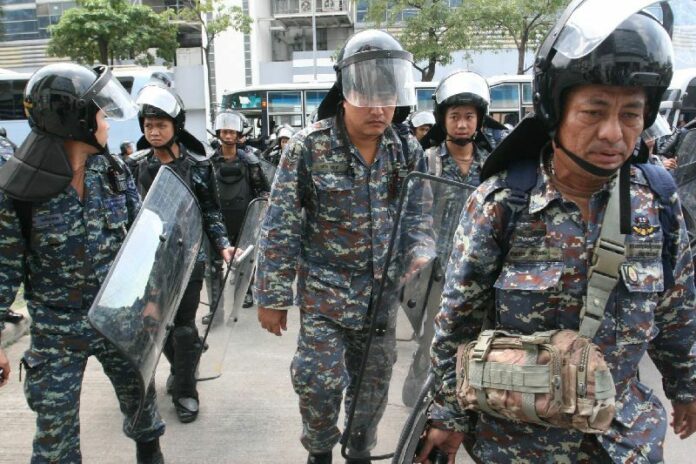
Troops from the Royal Thai Air Force arriving to protect the temporary office of Prime Minister Yingluck Shinawatra, 4 February 2014.

BANGKOK — The Royal Thai Air Force is investigating a video of a naked woman entertaining air force officers inside a military base, a spokesperson said today.

The video, which has been widely shared on social media, shows the nude woman singing and teasing men in Royal Thai Air Force uniforms at a party.

Air Marshal Monthon Satchakorn, a spokesperson for the air force, admitted today that the clip was likely filmed at a "recent" party that took place inside an air force base. 

The spokesperson did not say when the party took place or who attended, but said the officers seen in the video will be punished in accordance with air force rules, which prohibit hosting parties with inappropriate or nude acts on military property. 

"The Air Force has been inspecting and regulating the use of our facilities and the discipline of our force," AM Monthon said, "But I admit that there has been some failure in terms of discipline. The commanders of their respective units will urgently investigate the matter."

He added, "The officers' actions have damaged the reputation of the armed forces in general."

Thailand’s armed forces have been the source of several scandals in recent months. In August, an army captain allegedly brought troops under his command to beat nightclub security guards after they told him not to smoke inside the establishment. 

In addition, several armed servicemen were arrested earlier this year for allegedly serving as security guards for the anti-government movement that carried out six months of political protests prior to the 22 May military coup.


For comments, or corrections to this article please contact[email protected]

You can also find Khaosod English on Twitter and Facebook
http://twitter.com/KhaosodEnglish
http://www.facebook.com/KhaosodEnglish
Advertisement

Hot News

LATEST NEWS

Bangkok
overcast clouds
33.5 ° C
35 °
31.1 °
73 %
4kmh
100 %
Mon
34 °
Tue
34 °
Wed
35 °
Thu
31 °
Fri
30 °